Bronze and Glass

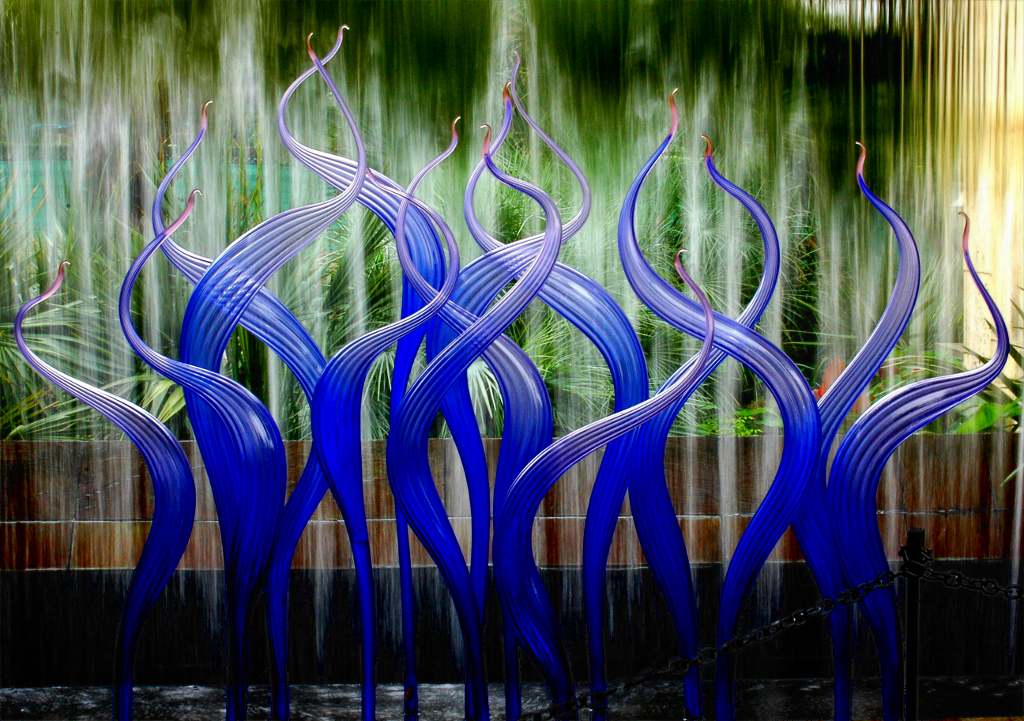
In addition to the interaction between the plants and the glass of Dale Chihuly’s installation at the Dallas Arboretum, there is the interaction between the glass and the other sculptures, mostly cast bronze, that already populate the gardens.

 For larger and more detailed versions of this photo – please visit the Flickr Page.

For larger and more detailed versions of this photo – please visit the Flickr Page.

Dale Chihuly at the Dallas Arboretum

I haven’t been to the Dallas Arboretum in decades. I used to go the the DeGolyer Estate for concerts back in the day, but once it became the Arboretum I’ve only been once. It was close to when it opened and I was disappointed because the plants hadn’t grown out yet. I took Nick there as a toddler because they were giving away free trees. I picked up a little live oak in a coffee can and planted it in back of our house in Mesquite. Everyone gave me a hard time because it was only an inch high (it looked bigger when it was still in its can). Over the decades, though, the thing grew – it’s now a huge beautiful tree.

The problem always was that the Arboretum admission is so expensive. I always felt it was more a private playground for the wealthy members of the Dallas Garden Club than an asset for the city. That was a silly opinion, I know, and I wanted to go visit, but never was able to get around to it.

I have always been a fan of Dale Chihuly, but I hadn’t seen very much of his work, other than some glass flowers at the Dallas Museum of Art. When I read about his exhibition at the Dallas Arboretum I was excited.

Our writing group has branched out into photography. We decided to go down there as a group and take pictures together. Everyone liked that, and one member had a set of tickets in a goody bag from a recent purchase. We picked a day and met down there at the opening, cameras in hand. I had a pack with extra lenses and a tripod and was self-conscious about lugging all that stuff. I shouldn’t have worried, most of the people going in were carrying tons of gear – either photographic or picnic stuff.

For a day I set aside my goal of taking pictures of people and gave myself permission to do “postcard shots.”

There were thick crowds of photographers wandering around. As is typical of Dallas, everyone seemed to be a gearhead. Near the entrance I stood next to a couple – he had a big, manly, camera with a long lens. We were looking at a giant yellow glass tree raised up into the sky.

“It would be cool to come out at night with a tripod and shoot that with a long exposure,” I said, just to make conversation.

“Well, I’ll tell you,” the guy with the big camera said, with a superior air, “I can hand shoot under any circumstances, I just shoot at 3200 ISO.” He waved his expensive hunk of optical glass and circuitry in my face.

“Oh, you are such a show off,” his wife said, the pride evident in her voice. The two of them walked off into a bit of woods. I had to chuckle – gearheads are so funny. I’m happy you can buy all that stuff… but you’ve still got the same old eyes and brain – and that’s what you really take pictures with.

But that little exchange really brought the challenge I faced into focus… so to speak. With hundreds of photographers in the Arboretum snapping hundreds of photographs each all the time from now until the exhibit closes in November…. How can anyone take a picture that is in any way unique? I don’t want to have the same picture as everybody else.

Four of us from our writing group spent about four hours walking around taking pictures. That’s a surprising amount of work, and a lot of walking. It will be interesting to see how we see the same thing in different ways. Peggy already has some of her fantastic photos up – go take a look – plus some more here.

Now I have about a hundred images and a lot of work getting these edited and in a form where they are usable. I’m not sure what I’ll do with all of them – I’ll use my Flickr account to store some. I should be able to get at least a half-dozen blog entries out of it… which is always a good thing.

Oh, the Chihuly Exhibition at the Arboretum is absolutely stunning, by the way. There are many varied groups of glass pieces in all kids of settings. He has done an amazing job of blending the glass with the living plants. His works range from small works interspersed in beds of plants to giant trees, maybe thirty feet high, made completely of glass. Walking through the gardens is an unforgettable experience – as you enter each new area you can’t help but gasp at the unexpected beauty that is waiting there.

I enjoyed taking all these photographs, especially since I wasn’t alone. I’d like to go back without a camera and simply look at the place. I’d like to go down with a sketch pad and some colored pencils. I would love to go back and try to take pictures of real people there among the sculptures, greenery, and beautiful settings.

Still, photographs do not to the thing justice. If you live in the Metroplex, you need to make plans to go down to the Arboretum and see this exhibit. If you don’t live here… I think it’s worth a trip by itself.

We’re really broke right now, but I want to find some way to scrape up the money to buy a membership to the Arboretum. I would love to be able to go down there and simply find a place to sit, look around, and maybe sketch a little bit. Beautiful things are so rare and fleeting in this world and to be able to go to a place like that and… well, simply wallow in the beauty is a wonderful thing.

(click to enlarge)

For a larger and more detailed version – Go to Flickr

Detail of a gigantic yellow glass tree.

For a larger and more detailed version – Go to Flickr

(Click to Enlarge)

For a larger and more detailed version – Go to Flickr

(Click to Enlarge) These boats full of Chihuly glass aren’t really floating on White Rock Lake like it looks. They are on the Arboretum infinity pool – beautiful.

For a larger and more detailed version – Go to Flickr

Mass Transit – On the Red Line

Dallas has never been seen as a city that is amenable to mass transit. Unlike an east coast megalopolis it was created in the age of the automobile – vast suburban tracts vomited out across the endless cotton fields along the pulsing arteries of constantly rebuilt freeways. But, for fifteen years now, we have had the DART rail. Always controversial, overly expensive, oft-reviled – the colored lines – Red, Blue, Green, Orange – crawled out inexorably across the map like vines on a brick wall.

Two tattooed guys – one skinny, one not – the skinny guy stands holding his skateboard, the other one sits hunched over a single speed bicycle – like a low slung bike for a kid a third his size. I am used to bicycles used as transport – this would be useless for that. It’s a bike used as a lifestyle statement. He rocks and stares at the chain like he’s afraid it will leap off the cogs if he lets it. Tired middle aged men slumped in seats, a guy playing a game on a smartphone, and a young couple standing in the door holding hands.

These are the people I live a lot of my life with. They are the same people you live a lot of your life with. Perfect strangers. Strangers on a train. I want to know these people and I want their stories.

The two guys, the skateboard and the inefficient but cool bicycle – they may be gutterpunks but they look like they are having fun. The guy on the bike moves back and forth at each stop to let folks get to the door or their seats. When their stop comes (one before mine) he shouts, “Off to another adventure” and shoots out the open door.

Looking at the young couple makes me ache. They may be poor and doomed… but together, today, right now, they are a thing of beauty. Beauty is so rare and so fleeting.

The others… all forgettable. But I know that the forgotten folks all have stories that will raise the hairs on the back of your necks. But we all sit and sway, look around, adjust our headphones, and get off at our stops.

What I learned this week, May 11, 2012


Ciao Publishers. Ciao Agents. Ciao slavery.


UNDER THE UNMINDING SKY


“It’s not catching, though.”

“Tell me you got that.”


What Kind of Literary Ecosystem Do We Want to Build?


Elotes – Corn in a Cup

Who wants to live forever.

One of the many delicious varieties of street food found in these here parts is Elotes… Mexican corn on the cob. You can find it roasted and on a stick, or you can find it cut off the cob and stuck in a cup.

A while back I went down to the Dallas Farmer’s Market to shoot some photographs:
here
here
here
here
here
and here

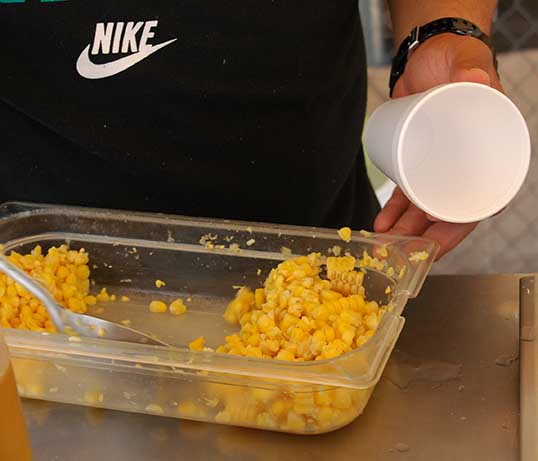
While I was waiting I tried a cup of corn from the Elotes vendor outside of the vegetable shed. He takes an ear of corn out of a warmer and cuts the kernels off fresh in front of you. Those go in a cup and are topped with everything unhealthy and delicious you can think of – margarine, mayonnaise, parmesan cheese, sour cream, hot sauce, lime (well that’s not unhealthy)… it is pretty darn good.

I tried it again the other day and took some photographs.

The elote stand at the Farmer’s Market

The corn is cut fresh in front of you.

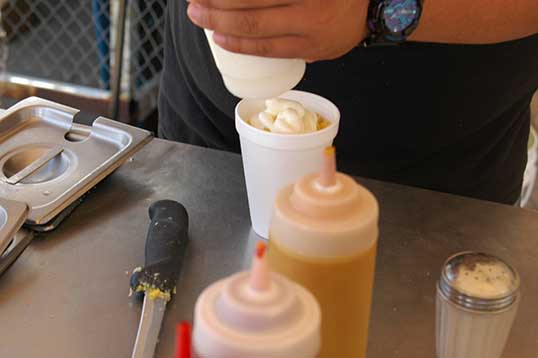
It goes in a foam cup.

Your favorite goodies go in.

Corn in a cup

Now I want to go around and try some other Elotes Stands in Dallas, see what’s the best.

City of Ate’s 100 Favorite Dishes: #93 Elotes at Fuel City

Best Elotes Cart – 2011 Fiesta Market

Elotes Cart Converts My Skepticism Into Full-Blown Corn Enthusiasm

Fastest Elotes This Side Of The Rio Grande

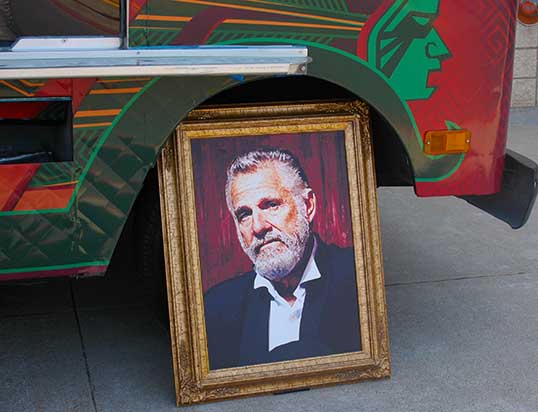
The Most Interesting Taco in the World

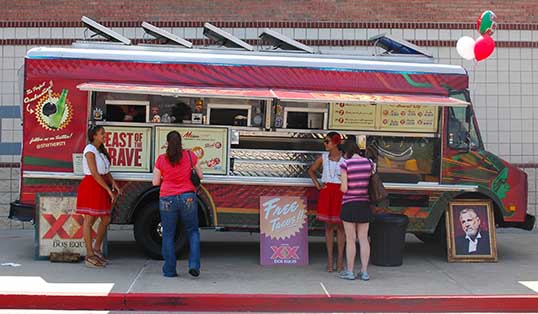
A couple of weeks ago I saw on facebook that Dos Equis was sponsoring a food promotion called Feast of the Brave. Through Cinco de Mayo, Dos Equis was teaming in Dallas with the Rock And Roll Tacos food truck in a competition to determine the American city with the bravest palate. Dallas would be competing with Miami, Houston, Austin, and Los Angeles for which city can earn the most “Bravery Points” by eating various unusual tacos. The delicacies promised were everything from wild hare, to shark, to wild hog, to goat, to frog legs, to snails (with corn fungus), to hog ear, to intestines, to alligator, to cricket….

An finally, each city would boast a “mystery taco” – worth 100 points each.

Do you think this might be something that would appeal to me?

Oh, Hell Yeah!

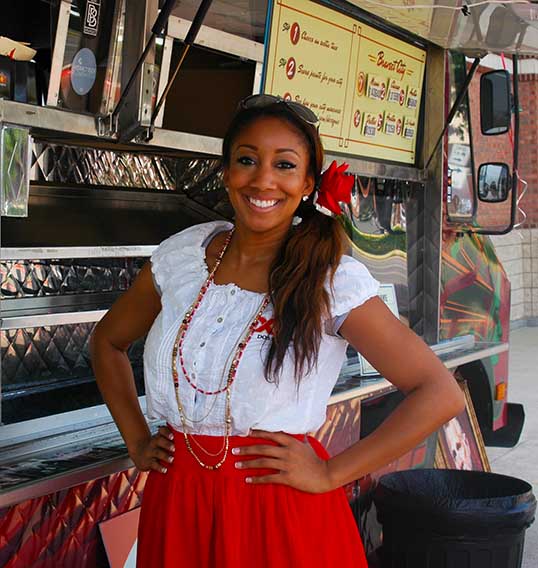
Unfortunately I was very, very busy and wasn’t able to hook up with the food truck until the very end. On Friday I took some flex time and left work early, hopping on the DART train and rushing to Main Street Park where the truck was set up. I ran up only to discover they were closing down… out of meat. The comely Dos Equis Taco Girls were very apologetic and showed me where they would be on Saturday, Cinco de Mayo – their last day.

We had another busy day planned, but I was not going to miss out so we drove down to the Albertson’s on McKinney and Lemmon at eleven, right when they opened. I did not realize that the tacos were free and you could get as many as you wanted.

There was no way I was going to mess around with Rabbit (only 10 points) or Wild Hog (Hey, that’s pork… what’s so brave about that? And only 20 points) – so I ordered two Shark (30 points each) and two Mystery Tacos (the Mystery Tacos were 100 points each). That totaled two hundred sixty bravery points – I feel I did my civic duty.

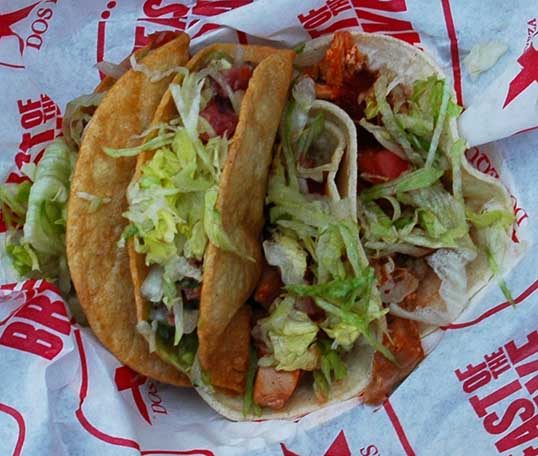
The Shark tacos were very good. The fish was rare and was served in a crispy shell with some tropical salsa. The mystery tacos were OK – nothing special – soft flour shells with lettuce and tomato.

My guess is that the mystery tacos were iguana. They wouldn’t tell us what they were – they said the identity would go out over twitter at ten that evening.

The Dallas “Feast of the Brave” Menu

One of the Dos Equis Taco Hotesses

Two Shark Tacos on the left, and two Mystery (Iguana) tacos on the right.

Feast of the Brave Taco Truck

He once went on vacation to The Virgin Islands ..Now they are just called The Islands.

I was right about Dallas’ mystery taco – it was iguana. Chicago’s was grasshopper, Miami was oxtail, Austin was straight jalepeno, and Los Angeles was 1,000 year old egg. I’m afraid that Dallas didn’t do too well, finishing fourth behind Miami, Chicago and Austin (we wanted to beat Austin). Bringing up the rear was Houston (at least we beat them) and last, Los Angeles.

I don’t always eat tacos, but when I do, I prefer iguana.

Stay thirsty, my friends.

The Great Dunes

A blogger, surroundedbyimbeciles that has stopped by here has a picture of himself at the Great Sand Dunes National Park as his avatar. He wrote a blog entry about it, check it out.

I knew I had two scanned photographs of Nick at the same spot, one taken in 1996 and one taken in 2001.

I dug around and found the photos and the blog entry I wrote in 2001 to go along with them.

Here’s the eleven year old entry from my archives…. July 3, 2001.


I’ve been to the Great Sand Dunes before, twice. Once, six years ago or so, a year before I started my journal the whole family stopped on the way from Santa Fe to Buena Vista. In 1997 I came here alone, on a solo trip around Colorado. I spent a couple days and camped here, and wrote about it.

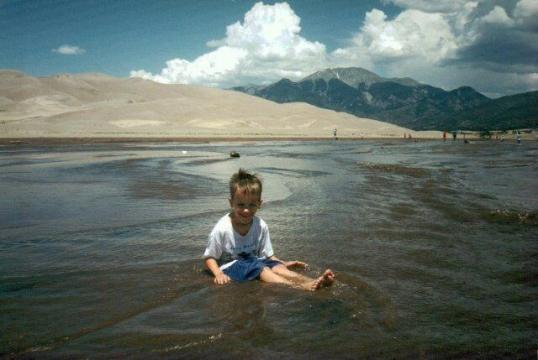
Medano creek, this late in the summer, is barely a trickle, and right after we arrived we crossed it and immediately started climbing the dunes. Even when we were walking the wide expanse of level sand before the dunes actually start I had my doubts about whether I could make the seven hundred foot climb up the piles of sand. It’s tough walking and at over eight thousand feet, the altitude doesn’t help much when you’re old and fat and out of shape like me. As soon as the steeper slopes started and Nick and Lee coursed ahead, shooting up the dunes like active ten-year-olds I knew there was no way I could make it all the way. My lungs were burning and my legs felt like Jello.

I decided that I could try to get as far as I could, though. I’ve done this before so I remembered how painful and discouraging uphill walking on sand can be – so I thought I’d be patient, walk a while, rest a while, and see what happened. The day was getting hot, too.

Nick and Lee pushed on ahead and pretty quickly they disappeared. Once you get into the dune field closer ones hide the highest dunes. One good thing about dune hiking is that you can’t really get lost and it’s a lot easier coming back down than going up – so it’s hard to get stranded in the sand.

Each dune I’d climb I divide into three sections in my mind. I’d climb the first third, then pause to try and catch my breath. The second third would be tougher, I’d have to stare at my feet and force them to take little baby steps until I reached my interim goal, exhausted, so I would sit down and rest until I felt my pulse return to normal. The third third would be easy after that long rest, and I’d settle in when I reached the top so I could enjoy the view.

By patiently munching through each set of dunes, higher and higher, I soon found myself walking the last slope to the highest dune, and not feeling too bad. I was worried that Nick and Lee would be impatient and head back down before I reached them, but they were there, digging around in the sand.

There was a gaggle of teenagers with sophisticated hiking gear – daypacks with integrated hydration systems and carbon fiber hiking poles- already there. They referred to Nick or Lee, who had been up there with them for a while before I arrived, as “the kids.” One of the teenagers was trying to impress his girl by talking about Lawrence of Arabia.

“No,” Nicholas said, “This isn’t like that, this is like Dune.”

We posed for a photo, then Nick headed back down to check on Candy.

I had a tough time getting Lee to go. There is another high dune, maybe five miles away, and Lee pitched a fit when I told him we couldn’t walk to it.

The teenagers left, then some guy from Switzerland walked up and we talked a bit while Lee dug holes in the sand.

Lee digging in the high dune

“A beeg sander-boxer,” the guy said, in his thick accent, “Een Switzerland, children haf only small boxen wit sander.” He was on a driving trip from Santa Barbara and I think the distances in the American West threw him a little. “Too far for little time,” he said. I said I was from Dallas and he asked if that was over a hundred miles from there. When I told him it was seven hundred miles he looked perplexed.

Meanwhile, Lee had walked over the next dune and was stomping out a giant, “LEE WAS HERE,” in the sand. The dunes are dry and hot on the surface, but surprisingly, are wet only an inch or two down. If you drag your feet it makes a dark line of wet sand, only to disappear a few seconds later.

A cloud blew down from the mountain and it began to rain. “Rain in zee desert!” the guy from Switzerland exclaimed. I convinced Lee to head down then, I was afraid of lightning up on the exposed dune.

“That’s more sand than I’ll ever have to play in,” said Lee.

“Don’t worry, you can play in more at the bottom.”

“Not as much as up here.”

The walk down was a lot easier than the one up. The hot day was suddenly cool from the rain, the dry yellow sand at first mottled, then dark from the falling water. By the time we reached Medano creek it was over and the sun came out again.

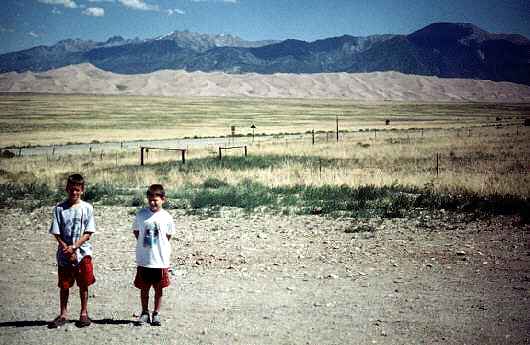
Nick and Lee in the parking lot at the edge of the Monument. 2001

Nick and Lee standing in the parking lot of a gas station right outside the Great Sand Dunes National Monument. The dunefield is a lot bigger than it looks, the tallest dune is seven hundred feet high or so. The mountains behind are the Sangre de Cristo range, several are over fourteen thousand feet high.

Lee busied himself in the creek, making a dam. While he worked I chatted with a Park Ranger – he had brought down a special sand wheelchair for a park guest. It had huge red balloon tires so it could be pushed across the soft sand. The Ranger said that the sand was twice as hard to walk in or to climb as firm ground.
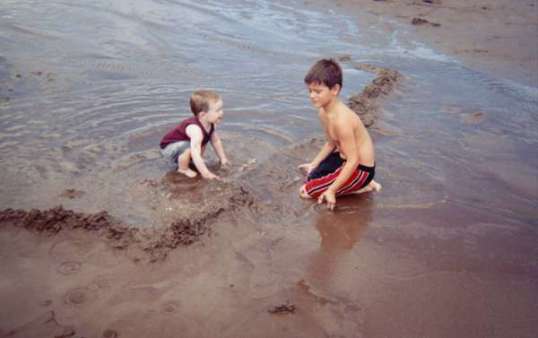
Lee getting help with his dam in the creek.

Meanwhile, Lee’s dam was stretching in a ragged arc across a portion of the creek. Medano creek is odd because of the load of sand it carries (the creek is what helps corral the dunes in place, it carries escaping windblown sand back around to the upwind side of the dunes) the stream is constantly moving around in little pulses and rushes as the sediment raises the bed of the creek itself. It was a good lesson in hydrology for Lee, with several lessons:

1: Don’t make a dam out of sand.

2: Little leaks soon become very big leaks.

3: The more you patch the little leaks the higher the dam gets and the faster the little ones get bigger.

4:Eventually, your dam is toast.
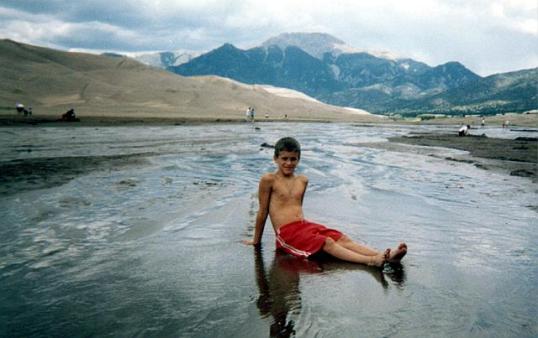
Nick in 2001

I posed Nick in this picture at that spot because I wanted to compare it to this picture.
Nick in 1996

This was taken in early June 1996. There is a lot more water in the creek due to spring melting snow. This picture was taken a couple weeks before I started this journal.

This is Nick, Lee, and I, taken at the top of the highest dune at The Great Sand Dunes National Monument. The thing is a lot taller than it looks in this picture – we had to climb seven hundred feet of sand to get there.

The three of us on the highest dune in 2001.


One good thing about keeping a blog (notice I still called it a “journal” – blogs were pretty new in 2001, though I’d been writing online every day in a journal for five years by then) is the preservation of memories. Until I reread this from my archives I had forgotten so many details – the Swiss Tourist that was flabbergasted at the sheer size of the American West, the teenagers with their high-end camping gear, the fact that at ten years old Nick knew what Dune was. In 2001 the Great Sand Dunes was still a National Monument – it became a full fledged National Park in 2004.

This is more than ten years old. Nick and Lee are both well into college now. I would love to go back there with them, pose Nick in the creek again as an adult. But there is so much to do now, so much to do and so little time to get it done in. Everything is so difficult.

Wooden Canoe

I am now to the point where everything brings back memories… not even a single memory but a chain of them… separated by great space and greater time – yet linked by a single thing, the inside of my head.

Something as simple as a wooden canoe lying on a grassy bank:

I found a small dugout wooden canoe upside down in a tropical lake, abandoned and rotting in a bank of watery weeds along the shore. I came up under it with a scuba tank on my back, the bubbles catching in its concave interior and I, looking at the long oblong shape against the sun, wondered what it was. There was nobody in miles so I took it for my own.

The wood was soft and I could scrape out the rotten part with a hunting knife. The bow was broken but I fixed it with a piece of plywood and some marine glue. I found some half empty used cans of bilious old paint in a garage closet so I painted it black and gray. I cut a plastic Clorox bottle into a bailer and I was good to go.

I learned to paddle there on that humid lake. Learned to fish from a canoe, learned to navigate in the darkness, saw creatures I never thought existed in fresh water – they had followed ships in through the Gatun locks and most were slowly dying from the lack of salt.

Then I learned to maneuver a rented dented aluminum canoe through the spring flash flowing Ozark rivers on college weekends – the rocky adrenaline thrill of white water and the relaxing lazy languid sluggishness of deep dark green. I learned that a foot of water can be dangerous when it is moving fast under a fallen tree. Also, be careful when you stop in the middle of a ten mile stretch of isolated river for a quick refreshing swim on a gravel bank… don’t leave your car keys behind.

I paddled into the netherworld of Spanish Moss and Bald Cyprus in East Texas Caddo lake. A place out of time where you can find an abandoned church in a place where God has forgotten. I learned to always check the flow of the water before setting out. You are never as strong as you think you are – sometimes it is hard to get back.

Paddling on a lake with two little kids in the boat I learned that you not only have to check the flow of the water, but the strength of the wind. A damned up prairie lake can throw air fast enough to grab the bow and turn it the way you don’t want to go.

There is the sound of small waves banging against aluminum. The feeling of an ill-fitting life jacket while you are trying to work the paddle. The smell of old fish bait. The heat of the sun on the back of your neck. The sight of the little vortexes that spin off your paddle, the little drops of water when you swing it to the other side. There is the ache in your shoulders at the end of a long day and the anticipation when rounding a curve in the river.

Most of all the rhythm of boat, paddle, and water when you get moving across a lake. When it’s all working together and you feel sorry for the folks roaring by spewing oil out of their big outboards (though you do look jealously at that nice little sailboat).

McKamy Spring

Somehow, surfing around the web, looking for information on the area near where I live and work, I stumbled across a tiny little article about a place called McKamy Springs, Richardson, Texas. The page told about a historic spring that was once used by the Native Americans as a reliable water source while hunting buffalo on the open prairie. There was a crude black and white photograph of a spring inclosed in a brick dome. Below the dome a small stream of bright water poured out.

McKamy Spring - historical photo

The spring had been bricked over sometime in the past and a commemorative stone placed beside it. The stone said, “The Yoiuane tribe of the Caddo group of Indians lived here as early as 1690 to 1840. They hunted buffalo and deer on the prairie. They used McKamy Spring as a watering place. It was from these friendly Tejas Indians that Texas got her name.”

Well, there isn’t much open prairie in these here parts nowadays – so I wondered if the spring was still there. I noticed that there was a small park called McKamy Springs Park in the middle of a new transit oriented development called Brick Row in Richardson along my way to work. I rode my bicycle there once while working out a bike route to work.

I remembered a nice, peaceful, little park in the place – I stopped there to rest and drink a water bottle. I didn’t notice a spring… but I wasn’t looking for one. Could the little McKamy Spring still be down there?

While I was out and about, it didn’t take much to stop by and take a look. Sure enough, the spring was there, exactly as it was in the photo (only now it was in color). Only a pitiful dribble of water trickled out, but I know how wonderful a trickle like that can be in a dry country. Green algae was growing over the stream and I had to climb down to fish out a discarded water bottle and a shopping bag.

Still, it seems cool to me that the little spring is still there, spitting out a bit of groundwater, even if it is surrounded by kids on a playground, locals walking their dogs, and folks sneaking out for a smoke. The open plains, the deer and the buffalo are long gone, but little McKamy Spring is still hanging in there.

McKamy Spring today.

The spring is in a nice little park in the center of a big mixed-use development.