Stuck Inside Of Mobile With The Memphis Blues Again

“‘Twas in another lifetime
One of toil and blood
When blackness was a virtue
The road was full of mud
I came in from the wilderness
A creature void of form
Come in she said I’ll give ya
Shelter from the storm.”
—- Bob Dylan, Shelter From The Storm

A week ago, we found that there was a party honoring the Lakewood Brewing Company‘s one year anniversary – held at the Goodfriend Beer Garden and Burger House in East Dallas. This was a must-go. Lakewood has great beers and there would be music. Every hour they would be tapping special kegs and casks.

We arrived at about one-thirty, only a half-hour after the festivities started, and found the place already more than packed. It was tough to get to the bar for a beer – it took almost an hour for our first fill. But it was worth the wait – they had a small keg of the French Quarter Temptress on tap. I had tried this before – it’s the great Lakewood Temptress, “cask conditioned with chicory root and bourbon soaked Noble Coyote Papau New Guinea coffee.” I love that beer.

Temptress – black as death, thick as sin, sweet as tomorrow morning’s regret…. the French Quarter Temptress is all that… plus coffee and bourbon.

Then, wonder of wonders, we were able to snag half of a table right in front of the band. The first group was packing it up and the second starting to bring in their instruments. I should have been prepared… copied down a list of the music for the afternoon, and, especially, a list of the hourly tappings. But I didn’t… and that was cool too. I didn’t really want anything other than that French Quarter Temptress and it was fine to not know what music was on the way.

As the band set up I recognized Chad Stockslager. He plays in several local bands and I had seen him with Chris Holt as Holt and Stockslager… a Simon and Garfunkel tribute band, three times – first at the Patio Sessions in the Arts District, then at the Foundry and the Dallas Zoo. They put on a great show – a really fun and mellow evening. I recognized a couple other local musicians, but couldn’t place the lead singer… though he looked familiar and his voice, especially, I knew I had heard before.

Then they started playing and we discovered that the band was The Buick 6, a Bob Dylan tribute band. The singer was Mike Rhyner, best known as a DJ on 1310 The Ticket. No wonder his voice was familiar.

Mike Rhyner singing with The Buick 6

Mike Rhyner singing with The Buick 6

We really enjoyed the show. Afterward, we talked to Billy Bones, one of the guitar players, and he said they would be at Lee Harvey’s in The Cedars that upcoming Friday. Lee Harvey’s is a great place – a combination beer garden and dive bar – a great place to hear music. It’s a dog-friendly place and Candy loves that so many people bring their mutts along.

Billy Bones with The Buick 6

Billy Bones with The Buick 6

Chad Stockslager playing keyboards with The Buick 6

Chad Stockslager playing keyboards with The Buick 6

“You used to laugh about
Everybody that was hangin’ out

Now you don’t talk so loud
Now you don’t seem so proud
About having to be scrounging
for your next meal.”
—-Bob Dylan, Like a Rolling Stone

I had an awfully tough week at work and when Friday came along it was really difficult for me to drag myself up and out and drive down for the show. I didn’t want to go – but I knew I would change my mind once I was actually there. I didn’t even have the energy to change clothes – so it was right in the car and out and down through the big evil city to the Southside.

It was a late show and we wanted to get there early so we could get something to eat. The fish tacos were great, and we settled in and waited for the festivities.

Storms were predicted – lightning shattered the horizon, someone held up a smartphone with an app that predicted heavy rainfall, but we didn’t need a weatherman to know which way the wind blows.

Lee Harvey's

Lee Harvey’s

Lee Harvey’s always has an amazing diverse crowd. A lot of different folks are there. Some are mathematicians, some are carpenter’s wives. A lot of pooches. The ages are all over – hipsters – college kids – some families with children…. all the way to people teetering on geezerdom.

Still a little stunned from the week I did manage to enjoy the music. A little food, a little beer, and I felt better. The Buick 6 do a great show. One nice touch is that they don’t try too hard to be absolutely accurate – staying in the spirit of Dylan more than the slavishly correct. A nice setlist selection too – there is so much to choose from. I guess it’s not surprising that the tune I liked the most had some sweet fiddle playing (Hurricane).

Everyone has their favorite Dylan tune – and there are so many of them. When faced with an oeuvre as vast as his it’s important to simply relax and let the band play what they want. Near the end of the second set, some young drunk blonde stumbled up to the stage and demanded the band play, “some of their own music.” I guess she doesn’t understand the idea of a tribute band… or much of anything else. Then her boyfriend loudly requested “Lay Lady Lay” – which is, I guess, a good enough song – but not… well, simply not a good idea. At least the two of them seemed well-matched.

Well, she don’t make me nervous, she don’t talk too much
She walks like Bo Diddley and she don’t need no crutch
She keeps this four-ten all loaded with lead
Well, if I go down dyin’ you know she bound to put a blanket on my bed.
—-Bob Dylan, From A Buick 6

So, despite my worn-out and beaten-down state that evening, we made it through the late set and, after petting the yellow Labrador Retriever sitting next to us one last time, headed for home. It was fun.

The festival was over and the boys were all planning for a fall
The cabaret was quiet except for the drilling in the wall
The curfew had been lifted and the gambling wheel shut down
Anyone with any sense had already left town
He was standing in the doorway looking like the Jack of Hearts.
—- Bob Dylan, “Lily, Rosemary And The Jack Of Hearts”

Mike Rhyner also has a Tom Petty tribute band, Petty Theft. They will be at Lee Harvey’s next Friday. I think I’ll be there. No matter how worn out I am.

“Yes, to dance beneath the diamond sky with one hand waving free,
Silhouetted by the sea, circled by the circus sands,
With all memory and fate driven deep beneath the waves,
Let me forget about today until tomorrow.”
—-Bob Dylan, ‘Mr. Tambourine Man’

Across the street from Lee Harvey's

Across the street from Lee Harvey’s

“And she takes just like a woman
And she aches just like a woman
And she wakes just like a woman
Yeah, but she breaks just like a little girl.”
—-Bob Dylan, Just Like A Woman

Oh, if you were wondering what my favorite Bob Dylan song is – it’s “Isis”, from Desire. The band didn’t play it – which is cool, because it isn’t really that kind of tune. I like it because it tells a story – and I’m all about story. It’s also about redemption and I’m a sucker for redemption. Most importantly, I bought that album (on Vinyl, of course) right after I graduated from college and started my first real job – and would listen to it in the evenings until is sank in… and it’s still in there. I was so much older then, I’m younger than that now.

She was there in the meadow where the creek used to rise
Blinded by sleep and in need of a bed
I came in from the East with the sun in my eyes
I cursed her one time then I rode on ahead.

She said “Where ya been ?” I said “No place special ?”
She said “You look different” I said “Well I guess”
She said “You been gone” I said “That’s only natural”
She said “You gonna stay ?” I said “If you want me to, Yeah “.

Isis oh Isis you mystical child
What drives me to you is what drives me insane
I still can remember the way that you smiled
On the fifth day of May in the drizzling rain.
—-Bob Dylan, Isis

Playing Around

Technium

Technium

The Four Noble Truths
1. Life means suffering.
2. The origin of suffering is attachment.
3. The cessation of suffering is attainable.
4. The path to the cessation of suffering.
There is a path to the end of suffering – a gradual path of self-improvement. It is the middle way between the two extremes of excessive self-indulgence (hedonism) and excessive self-mortification (asceticism). Craving, ignorance, delusions, and its effects will disappear gradually, as progress is made on the path.

Gecko in a Watering Can

Gecko in a Watering Can

Travelling Man – in paint and pixels

Grafitti in the Dallas Art Park, Deep Ellum, Dallas, Texas

Graffiti in the Dallas Art Park, Deep Ellum, Dallas, Texas

The Travelling Man Sculptures have become an instant icon in Deep Ellum.

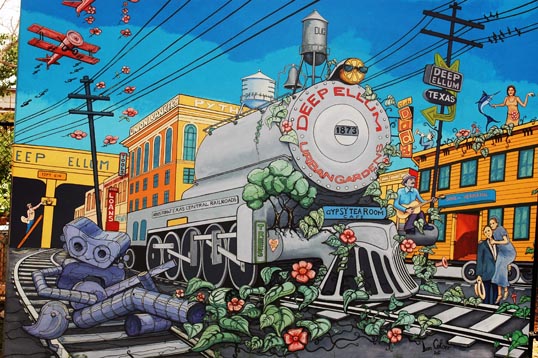
Painting at the entrance to the Urban Gardens, Deep Ellum, Dallas, Texas

Painting at the entrance to the Urban Gardens, Deep Ellum, Dallas, Texas

Up with the sun, gone with the wind
She always said I was lazy
Leavin’ my home, leavin’ my friends
Runnin’ when things get too crazy
Out to the road, out ‘neath the stars
Feelin’ the breeze, passin’ the cars

traveling_man_wallking_tall

Women have come, women have gone
Everyone tryin’ to cage me
Oh, some were so sweet, I barely got free
Others they only enrage me
Sometimes at night, I see their faces
I feel the traces they’ve left on my soul
Those are the memories that make me a wealthy soul

traveling_man_guitar

Sometimes at night, I see their faces
I feel the traces they’ve left on my soul
But those are the memories that make me a wealthy soul
I tell you those are the memories that make me a wealthy soul
Travelin’ man, yea
—-Bob Segar, Travelin’ Man

walking_tall

Click on any of the photographs for larger versions on Flickr.

I’ll always remember when I went down there and took these. In particular I remember walking backward looking through the viewfinder, tilted up at the tall sculpture looming overhead. Do you see that little green step by the sculpture’s feet?

I didn’t.

You don’t forget those kind of falls.

waiting_for_the_train

I’m Dancing As Fast As I Can

“Practicing an art, no matter how well or badly, is a way to make your soul grow, for heaven’s sakes. Now, I mean, I’m talking about singing in the shower, I’m talking about dancing to the radio, I’m talking about writing a poem to a friend–a lousy poem.”
― Kurt Vonnegut

“The sacred sense of beyond, of timelessness, of a world which had an eternal value and the substance of which was divine had been given back to me today by this friend of mine who taught me dancing.”
― Hermann Hesse

“The funny thing about writing is that whether you’re doing well or doing it poorly, it looks the exact same. That’s actually one of the main ways that writing is different from ballet dancing.”
― John Green

dance1a

“Life is the dancer and you are the floor.”
― Armando Vitalis, No Reason to Get Out of Bed – A Murderous Mystery

“We danced in the handkerchief-big space between the speak-easy tables, in which stood the plates of half-eaten spaghetti or chicken bones and the bottles of Dago red. For about five minutes the dancing had some value in itself, then it became very much like acting out some complicated and portentous business in a dream which seems to have a meaning but whose meaning you can’t figure out. Then the music was over, and stopping dancing was like waking up from the dream, being glad to wake up and escape and yet distressed because now you won’t ever know what it had been all about.”
― Robert Penn Warren, All the King’s Men

“there is no new experience in life. something may happen to you that you think has never happened before, that you think is brand new, but you are mistaken. you have only to see or smell or hear or feel a certain something and you will discover that this experience you thought was new has happened before.”
― Horace McCoy, They Shoot Horses, Don’t They?

Cadillac Ranch

Well there she sits buddy just a-gleaming in the sun
There to greet a working man when his day is done
I’m gonna pack my pa and I’m gonna pack my aunt
I’m gonna take them down to the Cadillac Ranch
Eldorado fins, whitewalls and skirts
Rides just like a little bit of heaven here on earth
Well buddy when I die throw my body in the back
And drive me to the junkyard in my Cadillac
—Bruce Springsteen, Cadillac Ranch

Cadillac Ranch, is west of Amarillo, Texas. I’ve stopped there a few times, mostly on the way back home from Santa Fe. It is an odd place – a modern American Icon of the New West.

Dallas Art Park, Deep Ellum, Dallas, Texas

Dallas Art Park, Deep Ellum, Dallas, Texas

Cadillac Ranch, West of Amarillo, Texas

Cadillac Ranch, West of Amarillo, Texas

Googlemap View

Cadillac Ranch

A crude little sketch I did in watercolor pencil on a postcard at the Cadillac Ranch west of Amarillo.

Cadillac Ranch - Old Guys Rule

Old Guys Rule

Cadillac Ranch

Cadillac Ranch

Invisible Cities

Cities & Desire 5

From there, after six days and seven nights, you arrive at Zobeide, the white city, well exposed to the moon, with streets wound about themselves as in a skein. They tell this tale of its foundation: men of various nations had an identical dream. They saw a woman running at night through an unknown city; she was seen from behind, with long hair, and she was naked. They dreamed of pursuing her. As they twisted and turned, each of them lost her. After the dream, they set out in search of that city; they never found it, but they found one another; they decided to build a city like the one in the dream. In laying out the streets, each followed the course of his pursuit; at the spot where they had lost the fugitive’s trail, they arranged spaces and walls differently from the dream, so she would be unable to escape again.

This was the city of Zobeide, where they settled, waiting for that scene to be repeated one night. None of them, asleep or awake, ever saw the woman again. The city’s streets were streets where they went to work every day, with no link any more to the dreamed chase. Which, for that matter, had long been forgotten.

New men arrived from other lands, having had a dream like theirs, and in the city of Zobeide, they recognized something from the streets of the dream, and they changed the positions of arcades and stairways to resemble more closely the path of the pursued woman and so, at the spot where she had vanished, there would remain no avenue of escape.

The first to arrive could not understand what drew these people to Zobeide, this ugly city, this trap.

—-Invisible Cities, Italo Calvino

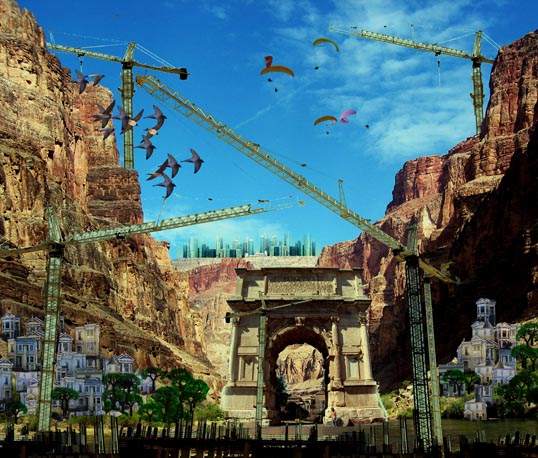
Invisible City - Gateway to Arcturus

Invisible City – Gateway to Arcturus

Thin Cities 5

If you choose to believe me, good. Now I will tell how Octavia, the spider-web city, is made. There is a precipice between two steep mountains: the city is over the void, bound to the two crests with ropes and chains and catwalks. You walk on the little wooden ties, careful not to set your foot in the open spaces, or you cling to the hempen strands. Below there is nothing for hundreds and hundreds of feet: a few clouds glide past; farther down you can glimpse the chasm’s bed.

This is the foundation of the city: a net which serves as passage and as support. All the rest, instead of rising up, is hung below: rope ladders, hammocks, houses made like sacks, clothes hangers, terraces like gondolas, skins of water, gas jets, spits, baskets on strings, dumb-waiters, showers, trapezes and rings for children’s games, cable cars, chandeliers, pots with trailing plants.

Suspended over the abyss, the life of Octavia’s inhabitants is less uncertain than in other cities. They know the net will last only so long.

—-Invisible Cities, Italo Calvino

For a month, starting on June 1, I read a short story every day and wrote a journal entry about them. For me at least, (I don’t know about how it was for you) it was a fun, interesting, and educational experience and exercise. One thing I learned is how wide the world of short fiction is – how varied and variable, diverse and divisive the styles, techniques, and artistry.

So I vowed to continue reading widely… and that brought me to a book by Italo Calvino – Invisible Cities (PDF). Technically, it’s a novel – a short novel. However, it is made up of a long series of very short sketches, each one describing a different, fantastic city – fifty-five in total. These are framed by an outer story, where Marco Polo is talking to Kublai Khan and telling the tales, thereby describing the cities he has visited.

Kublai Khan does not necessarily believe everything Marco Polo says when he describes the cities visited on his expeditions, but the emperor of the Tartars does continue listening to the young Venetian with greater attention and curiosity than he shows any other messenger or explorer of his. In the lives of emperors there is a moment which follows pride in the boundless extension of the territories we have conquered, and the melancholy and relief of knowing we shall soon give up any thought of knowing and understanding them.
—-Invisible Cities, Italo Calvino

The descriptions can be read individually, in relation to each other, and to the deep philosophical questions raised by the framing story.

It is short and easy to read, yet complex – with hidden aspects and dimensions that have to be teased out. It is so full of unique and interesting ideas that it slowed my reading down… I’d devour a half page and then have to rest to let the concepts and thoughts born by the text stop vibrating and resonating inside my head, let it all calm down, before I could read some more.

The book shows a lot of influence of Jorge Luis Borges… and is one book that is referred to as Borgesian. It is full of self-referential conundrums, mysterious contradictions, and postmodern enigmas.

I have to be careful about what I am reading when I write, because my reading is such an influence on what I write. I put up an entry containing something I wrote, Free Breakfast, while reading Invisible Cities a few days ago.

I would love to write like Italo Calvino… though nobody would read it. His fiction is a lot of fun, but it isn’t, for example, something that will ever be as popular as, say Harry Potter.

Now that I think about it… wouldn’t that be cool? A postmodern, Borgesian Harry Potter.

It could explore the duality of Harry Potter’s life. He lives in a cupboard, ignored, miserable, and hopeless for part of the year, then spends the rest in a world of Magic… where he is the chosen one. Which life is the real one… which is the real Harry Potter? Could the dire tragic life of poor Orphan Harry be so demoralizing that it drives him crazy? – Is the whole magical world of Hogwarts born from Harry’s desperation – an imaginary world where he gains unthinkable power and importance – where he becomes the chosen warrior in a war against the ultimate evil?

And what about Voldemort? He shatters his soul into a handful of pieces and stores each one in a Horcrux. He achieves immortality, at the price of a broken soul. Do these items then become Voldemort? How can a soul exist without consciousness? The potential for paradox and existential exploration are endless.

Even something as simple as the paintings…. Dead people make an appearance in the moving, talking paintings of Hogwarts. Is this a form of limited immortality? Do the paintings know they are dead? Are they sad? Are there moving and talking paintings with subjects that were never alive? Why not? If so… what are their memories? Do the dead paintings sleep? Do they dream of the living?

That would be a book worth reading… if someone had the skill to pull it off.

Hidden Cities 1

In Olinda, if you go out with a magnifying glass and hunt carefully, you may find somewhere a point no bigger than the head of a pin which, if you look at it slightly enlarged, reveals within itself the roofs, the antennas, the skylights, the gardens, the pools, the streamers across the streets, the kiosks in the squares, the horse-racing track. That point does not remain there: a year later you will find it the size of half a lemon, then as large as a mushroom, then a soup plate. And then it becomes a full-size city, enclosed within the earlier city: a new city that forces its way ahead in the earlier city and presses its way toward the outside.

Olinda is certainly not the only city that grows in concentric circles, like tree trunks which each year add one more ring. But in other cities there remains, in the center, the old narrow girlde of the walls from which the withered spires rise, the towers, the tiled roofs, the domes, while the new quarters sprawl around them like a loosened belt. Not Olinda: the old walls expand bearing the old quarters with them, enlarged but maintaining their proportions an a broader horizon at the edges of the city; they surround the slightly newer quarters, which also grew up on the margins and became thinner to make room for still more recent ones pressing from inside; and so, on and on, to the heart of the city, a totally new Olinda which, in its reduced dimensions retains the features and the flow of lymph of the first Olinda and of all the Olindas that have blossomed one from the other; and within this innermost circle there are always blossoming–though it is hard to discern them–the next Olinda and those that will grow after it.

—-Invisible Cities, Italo Calvino

Tar Roses

Make things that carry with them the residue of where they have been.
—-Dennis Oppenheim

Dennis Oppenheim 1938-2011
American (New York)
Tar Roses
1996

Frisco, Texas

Tar Roses, Dennis Oppenheim, Frisco, Texas

Tar Roses, Dennis Oppenheim, Frisco, Texas

Tar Roses, Dennis Oppenheim, Frisco, Texas

Tar Roses, Dennis Oppenheim, Frisco, Texas

Tar Roses, Dennis Oppenheim, Frisco, Texas

Tar Roses, Dennis Oppenheim, Frisco, Texas

Tar Roses, Dennis Oppenheim, Frisco, Texas

Tar Roses, Dennis Oppenheim, Frisco, Texas

Sunday Snippet – Free Breakfast

I have to be careful what I read while I’m writing. The style and feeling of what I’m reading tends to seep into, drown, and dominate what I put on paper.

Last week I plowed through Invisible Cities, by Italo Calvino. I’ll write about that book… maybe the day after tomorrow. But in the meantime… this is what happened.

Richardson2

Richardson2

Free Breakfast

Thelma bent and reached under the seat in front of her, pulled out her briefcase, and opened it on the meal-table which folded down from the seat back. Arranged in neat, alphabetical folders was information on a hundred cities that she had visited, either for work or for pleasure alone.

Anchorage, Birmingham, Cairo, Dallas… on and on. She was assiduous about collecting what would be useful on a return trip: lists of restaurants, business cards of important contacts, tourist magazines taken from hotel rooms – and would file these upon her return home. Thelma was especially fond of the compact maps that the rental car agencies would give out – she found these to be carefully designed for maximum help. They were the exact size and scale to get a renter around a city without any superfluous information or ornamentation.

She thumbed through the folders, one by one, allowing the memories of the previous visits to flood over her, hoping to jar loose a recollection of her present destination. She remembered getting a phone call in the middle of the night ordering her to go to the airport before dawn and getting on a flight, but she couldn’t remember where. All she remembered is thinking at the time that not only was that a city she had never been to, she had never even heard of it before that moment. It was odd that there was a city unknown to her (human geography had always been a passion)… but there it was. She couldn’t even remember getting on the plane, but assumed the ticket had been pre-purchased by her company… the way they always were.

Her memory was so bad because she was so tired. She had not had a good night’s sleep in weeks. Her nightmares had become so severe that her doctor said she was suffering the symptoms of Post Traumatic Stress Disorder – caused by the terrible subconscious memories of the nightmares – yet she could actually remember nothing from the dreams except vague impressions of deep, cold water, things moving in darkness, and breaking pipes. Awakened by the nightmares in her bed, she would lie in terror – confused about exactly where she was and even who she was. It was mid-summer but she would shiver with bone-deep cold, rising up from within.

The folders did not succeed in giving her a clue to her destination, so she closed the case and placed it back by her feet. She looked at the man sitting in the seat next to her – perhaps she could ask him their common destination. He was a large man, dressed formally, with an oddly-shaped beard, reading a book. Looking at the pages, all she could make out were squiggly lines in some unfamiliar alphabet. He probably didn’t even speak English – and how could she possibly ask a total stranger a question as stupid as, “Excuse me, do you know where this plane is going?”

Frustrated, she let out a sigh and tried to relax. Quicker that she imagined was possible, she slumped sideways against the reading man and fell asleep. For the first time in weeks she did not have a nightmare. She dreamed she was in a large green meadow, surrounded by steep, granite, rugged mountains capped with bits of snow. The meltwater coursed across the meadow in a hundred swift streams and as she walked up to a watercourse and began to step into it her foot began to rise up and she stepped again and again, higher and higher, as if on a rising stairway of air.

Soon, in her dream, Thelma was floating and then flying, rising and moving. She could see the patterns of the little streams in the meadow far below which, instead of joining into a larger river, meandered in a random pattern, sometimes joining together, sometimes splitting apart, so that the same configuration filled the entire area and it was impossible to determine where the water entered and where it left.

She rose higher and moved closer to the ragged vertical walls of rock until she could clearly see the small remaining nubs of snow and ice which were melting in the summer sun. Still higher, she began to look closer to see what was on the other side of the mountains… some sort of shape was emerging from the haze of distance.

But at this point she woke up. She felt refreshed from her first undisturbed sleep, but had to wipe a bit of spittle that had formed on her lips and she saw that it had stained the sleeve of the man sitting next to her. She turned to apologize but saw that he was still immersed in his reading and was paying no attention to her. She became aware of a noise and realized that the flight crew was making an announcement.

“We are now pulling up to the gate and will turn off the seatbelt sign as soon as the doors open. Will all passengers continuing on to Chicago, Paris, and Tokyo please remain seated while everyone debarking disembarks. We will only be on the ground for a short time. Thank you for your attention.”
Thelma frowned. She had missed the announcement of their location… but she was sure her stop was the first one on the flight, so at the ding of the bell, she collected her briefcase, rose, and retrieved her carryon bag from the overhead bin. She was the only person that left the plane.

The airport was crowded. Thelma could only see a few feet sideways through the surging sea of passengers. They did not seem to be the usual airport denizens – businessmen, families on holiday, students with backpacks – the mob wore tattered, wrinkled, out-of-style clothing – and had a thin, desperate, hungry look about them. Although there were men, women, and children of all ages and races, they did not seem to be in any family groupings – they all seemed to be struggling to get to their various destinations alone. The few that were carrying luggage had crude bags or parcels wrapped in dirty cloth.

Looking up above the crowd, Thelma realized that the airport looked exactly like every other airport – beams of steel or wood arched overhead, supporting a corrugated roof of light blue or cream metal. Large windows let in an orange light of either sunset or sunrise. Signs hung down with directions printed in several languages, none of which Thelma understood, and also included simple iconic drawings of mysterious objects. Finally, she spotted one sign that seemed to sport a sort of crude suitcase and an arrow beneath the puzzling lines of text – so she pushed her way in that location to get her checked luggage. She thought she remembered checking bags.

In complete contrast to the main concourse, the baggage claim area was deserted. A thin layer of dust covered the floor and Thelma could see her footprints as she walked across. A half-dozen huge metal belts emerged from openings in the wall that were covered with finger-shaped strips of rubberized cloth. These were all motionless and festooned with cobwebs. In some corners a hint of rust was beginning to appear on the machinery.

However, in the center of the room, there sat two bags, one large and one a bit smaller. They looked familiar to Thelma and she realized they were the same style and almost the same color as the carryon she held. She tried to check to make sure but the paper ID tags had been torn off.

Still, she collected the bags, attaching her carryon to the top of the smaller, and extending the handles, she lumbered out toward the twilit line of windows and glass doors. The automatic portal hissed open at her approach and she pulled her bags out to the curb. The thick humid air and oppressive heat struck her like a blow as she emerged from the cool air-conditioned terminal.

The orange light from earlier must have been sunset because it was now getting to be quite dark. She was happy to see, right in front of her, a large van parked along the curb. Large red symbols of some unknown language blazed across its side, but beneath, in smaller black block letters, were the welcome words “AIRPORT SHUTTLE”.

A man in a dark blue uniform and a jaunty cap stood beside the door and smiled at her. She stared at him – he looked familiar.

When Thelma was twelve, her parents had taken her on a driving trip across the continent, ending in New York. They had crossed the Mississippi on a huge bridge made up of silver steel beams and then had stopped in a tall Holiday Inn right on the Memphis riverbank. As they were checking in, she kept staring at the family in line in front of her. Outside she had seen the family which had already pulled up in a station wagon that was facing in the opposite direction. The father was untying a large valise from the rack on the roof. Thelma imagined that they were going on the same trip, coast to coast, but the other way, from East to West. There was a young boy about her age and something about him had drawn her to gawk. In her own way, she had fallen instantly in love with this boy.

Her family only stayed there for a day before they continued their journey, but everywhere Thelma went, to eat in the hotel restaurant, to swim in the pool, down the hall to fetch some ice from the machine, she would see the boy, sometimes close… sometimes at a distance, and her heart would ache. She never spoke to him and the boy never seemed to even notice her, but the day and the boy were etched deep into her head and heart forever.

Thelma realized that this man waiting at the Rental Car Van looked exactly like she imagined that boy would now. This could be him grown up. But what could she say? It would be silly to ask if he had been in a Holiday Inn with his parents decades earlier. And what if it was him? They had never spoken to each other.

“May I have your bags please,” he said with a sparkling smile.

She stood mute while he climbed into the van, carefully placing her bags on a tubular rack.

“And your purse, Ma’am?”

Thelma didn’t even think about how odd this request was as she handed him her handbag. Another flash of smile and he turned and climbed into the driver’s seat. She let out a soft sigh and began to follow but as she stepped forward the folding glass door of the van snapped shut an inch in front of her nose.

Shocked, Thelma staggered back a few steps as the van screeched its tires, sped away from the curb, and went careening down the street, disappearing around a concrete wall. Thelma felt panic welling up, she was now stranded in a strange city – she didn’t even know its name – without clothes, without ID, without money, without a credit card. She turned and retreated to the doors that she had emerged from, but found them locked.

At that moment, all the lights in the terminal went out. Thelma realized how late it was and how dark it had become. Still, who ever heard of an airport closing like that? What about the crowds trapped inside? She stood there for a long time, waiting for someone to come along or for something to happen, but no one did, and nothing occurred. The only thing she could do is start walking. In the distance, beyond the wall where the van had sped away, she could see the blue glow of streetlights.

She walked along the sidewalk as the road curved away from the airport. The way was well lighted by the ring-shaped streetlamps suspended high above on metal poles. She felt herself sweating through her clothes but made good time walking along the sidewalk. After a bit the sidewalk split away from the road and became a separate, paved trail. Thelma wasn’t sure about following it, but the road crossed a dark, swampy-looking patch on a bridge that had no walkway, so she had no choice.

The path entered a thick wooded area and curved first to the left, then to the right, and the streetlights were far enough distant so that the only thing visible was the bright concrete between the trees. The path became rougher and then the paving gave out until all that was left was a narrow, sandy lane. Thelma struggled along as best she could in the dark. The branches tore at her clothes and snipped at her face, thorny weeds underfoot sliced at her ankles.

Thelma decided she couldn’t go any farther and turned around to retreat. The path improved slightly but then began to go wild again and she realized she had made a wrong turn. Fighting back panic, she could think of nothing except to sit down in the soft sand along the widest patch of trail she could find.

She sat curled up, hugging her ankles and sobbed. The crying wore her out and she slowly gave up, stretched out in the warm sand, and fell asleep. She found herself in the same dream as she had on the plane, walking through the mountain meadow. As she approached a stream she began floating upward again, and looked ahead eagerly toward the rim of the surrounding mountains, hoping to get farther this time… and she was able to.

As she soared over the snowfields of the mountains she felt herself drifting lower on the other side, moving gently through waves of warm rising air. As she moved downward through the mist a shape began to form on the ground below. She saw long straight stretches of pale pavement, all emerging from a large building made of a complex series of giant halls. As the mist fell away she realized it was an airport and, though she had never seen it, it was the airport she had just left. As she drifted closer she saw the spot where the van had left her and the curving road away.

As Thelma’s dreamself passed high over the airport she saw a huge sign at the spot the largest road came up to the terminal. Though it was in an alphabet strange to her as she looked the symbols began to feel familiar and in her dream she realized the sign spelled out “Nepenthium International Airport.” That was the name of the city, Nepenthium.

The scene dissolved and she woke feeling the hot morning sun on her cheek. Aching, she gathered and pulled herself erect. Thelma was ravenous and thirsty, her clothes were torn and patches of sand stuck to her skin. Still, the peaceful sleep and pleasant dream had done her a world of good and she felt new hope welling up.

Looking around in the light of the rising sun she saw there was a barbed wire fence only a few feet into the woods on one side of the sandy path. There seemed to be light and space on the other side. She pushed her way through the tree branches and began to struggle over the wire. A barb jabbed her thigh. Fabric caught on the wire and she felt her clothing tear, but she pulled her way over. With a final rip as a hefty piece of cloth was left behind she fell clear and found herself on a strip of cool grass. She stood up and realized she had lost a shoe in the exertion to get over the wire. She kicked off the other and started moving barefoot. A trickle of blood ran down one leg.

The grass lined a road and on the other side was a large building. She waited for a gap in the passing cars and crossed the road. The building was undoubtedly a hotel and, although again the symbols on the sign were strange, she recognized a familiar logo of an international chain. Under the sign was a lettering board with black plastic letters lined up on a white glowing background.

The top line was a grouping of symbols, but underneath that was an English translation. It said, “Free Breakfast.”

Beyond the sign was a concrete apron in front of what must be the registration desk. Parked on the apron was the van from the airport. Thelma limped towards it, despite her torn clothing and desperate appearance.

Next to the van was the driver, standing there with the same bright smile. He had her luggage in a neat pile next to him. As she approached his grin expanded even wider and he reached his hand out and handed over her purse.

Digital Art – Bicycles

After having saved money for years I now have a graphics suite installed on a computer at home – Photoshop, The Gimp, Illustrator, and Corel Painter along with a Wacom Tablet.

What I want to do is to develop some skills… and more importantly, a vision. Right now, though, I’m playing around and learning my way around the pixels. Here’s a couple simple ones I did last night… both bicycle related.

Cruiser in the French Quarter

Cruiser in the French Quarter

If you are curious… for the original source of this – look here.

Folder

Folder

Decades of Art

With cities, it is as with dreams: everything imaginable can be dreamed, but even the most unexpected dream is a rebus that conceals a desire or, its reverse, a fear. Cities, like dreams, are made of desires and fears, even if the thread of their discourse is secret, their rules are absurd, their perspectives deceitful, and everything conceals something else.

“I have neither desires nor fears,” the Khan declared, “and my dreams are composed either by my mind or by chance.”

“Cities also believe they are the work of the mind or of chance, but neither the one nor the other suffices to hold up their walls. You take delight not in a city’s seven or seventy wonders, but in the answer it gives to a question of yours.”

― Italo Calvino, Invisible Cities

decades1

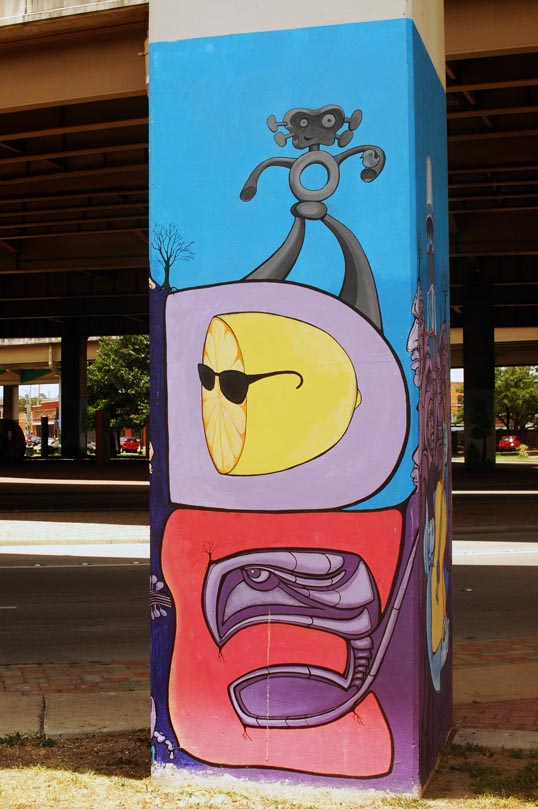
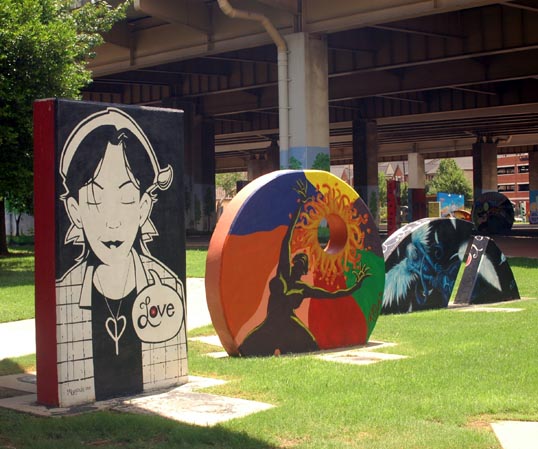
I have been putting up photographs I took a few weekends back at the Deep Ellum Art Park near Downtown Dallas. I have a lot more that I can use as I postprocess them to fill in journal entries on days that nothing much happens (or nothing that I want to write about here). The Deep Ellum Art Park is an area of concrete pillars of the overhead freeway connecting I30 and H75 (Central Expressway) plus a series of monoliths of various shapes that have been arranged in the gravelly areas between roadways for the purpose of serving as a canvas.

It’s a fun and interesting use of otherwise wasted space – a recovered area of urban blight.

It’s been growing over a period of decades and now has expanded to include decorative artworks in and around an urban garden and a dog park. It’s sort of officially authorized graffiti. I enjoy visiting the area, walking around looking at the graffiti/ paintings, and (obviously) taking photos of the scene.

decades2

One of the things I particularly enjoy is that I’ve been going down there for about twenty years now and it brings back memories. I remember sometime… maybe the early 90’s or so, that I did essentially what I’m doing now – I rode my bicycle (it would have been my Yokota Mountain bike – newly purchased – now converted into a commuter) down there and took some photographs.

That wasn’t really that long ago (in geologic time, for example), but times have changed so much. I would have been using my Pentax 35mm SLR so I would have been a lot more judicious about the number of shots – don’t want to waste film. Do you remember when you would say things like, “If the pictures come out” – “come out” was a common term back when you couldn’t look at the back of your camera and see what you had just shot?

….Or was it only ten years ago and I was using a primitive crude digital camera?
I don’t know which is true – I guess it doesn’t matter – thought it is pitiful and sad when your life stretches out into one featureless plain and one decade is indistinguishable from another.
Yet, a lot has changed.

But most of what has changed is me.

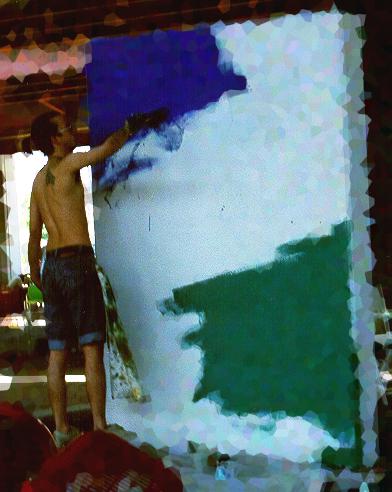
It was going down there and finding a few monoliths newly constructed and being painted for the first time. No more than a slim handful of them. Now there are over thirty, plus the hundred or so column sides. Each had an artist attached to it. Through lucky timing I had arrived during the inaugural event and the artists were at work.

I sat down on a bench to watch the painters paint (that’s another change – the benches are all gone – taken away because they attracted too many sleeping homeless people). There was an older man on a tall upright obelisk, a young man on a rectangular panel, and a young woman next to him on a semicircle jutting out of the earth.

I had so little confidence then – it was so very difficult to take pictures of people. Now, I would walk right up and ask them to pose with their work… they are painting a public monument after all – they would crave the publicity.

Watching the woman paint her bit of whitewashed concrete canvas I was filled with a hollow sense of longing and beauty. I don’t know why the scene of a woman and two men painting had this effect on me. The woman wasn’t especially attractive – and her painting, honestly, wasn’t particularly good. As a matter of fact, only the old man had a great amount of talent and skill – though I don’t remember what any of them actually painted. Their work is long gone now – painted over several times.

I dug around in my files and photographs and the only things I could find are these two small, blurry, edited shots I was using in some silly project.

11

2

The only thing that remains, the only thing left, is my memory of sadness that I felt at the time. That is still vivid and clear… even as all the other details have faded into obscurity.

decades3

He was thinking of all these things when he desired a city. Isidora, therefore, is the city of his dreams: with one difference. The dreamed-of city contained him as a young man; he arrives at Isidora in his old age. In the square there is the wall where the old men sit and watch the young go by; he is seated in a row with them. Desires are already memories.
― Italo Calvino, Invisible Cities