The Kiss

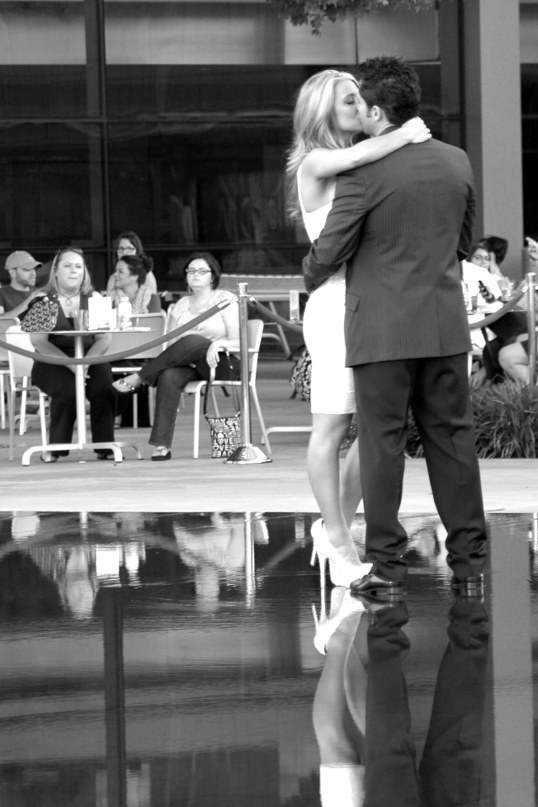
While I was sitting alongside the reflecting pool listening to the music I looked up and there was this blonde woman wearing a white skin-tight stretchy shiny Spandex dress running barefoot as fast as she could down the middle of Flora street with a pair of heels clutched in her hands. She was trying to smile but was obviously upset at being late for something. Her legs were moving as quickly as they could, but she was slowed by that dress. Nothing much could move above her knees.

A few steps behind her, walking leisurely, but more or less at the same speed, was another woman, casually dressed, carrying a bundle of flowers and walking a beagle on a leash. She had a big grin watching her friend try and hoof it.

I wondered what was up, and then looking down the street in the distance by the Meyerson Symphony Hall I could see the last of the sunlight glinting off a tripod and a woman with a big camera pacing around. The woman in the dress was late for a photo shoot. Looking closer – I spotted a man in a suit.

Maybe wedding photos; maybe engagement. I don’t know about the beagle – maybe the dog would be in a few shots. I saw them start to set up and shoot some down by the Symphony Hall and then they were lost in the distance.

I didn’t think about them for a while. I was enjoying the music – but for some reason I turned my head and there they were, right in front of me. They had moved down and were taking pictures in the middle of the reflecting pool. I guess the photographer was at an angle where the crowd listening to the music didn’t appear in the background.

They were almost finished. I raised my camera and only had time to squeeze off a couple shots.

It would have been cool if they had dragged that dog out there too.

Reflecting Pool

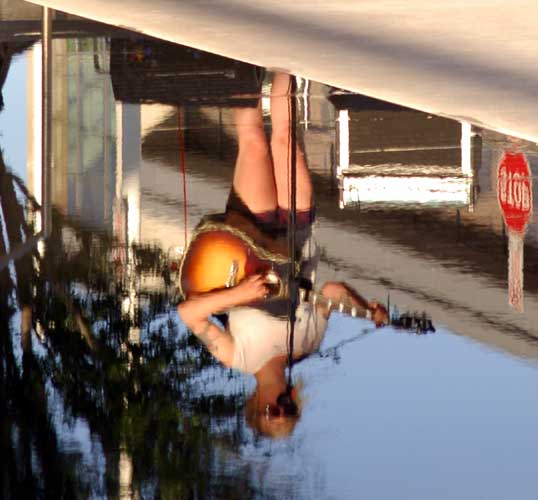
A photographic technique I like is to shoot an object’s reflection in a pool (specifically the one in front of the Winspear Opera house here in Dallas) then flip the image. For reference I like to leave a little strip of the original object, upside down, at the bottom of the photo.

I liked it when I used it a while back in a photo of a bicyclist crossing the pool. Last Thursday, at it again, I took a picture of a little girl running across the very shallow pool and I was very happy with it.

I’m sure I’ll do this again – so I hope y’all like it.

Kids love the reflecting pool. The water is less than a quarter inch deep.

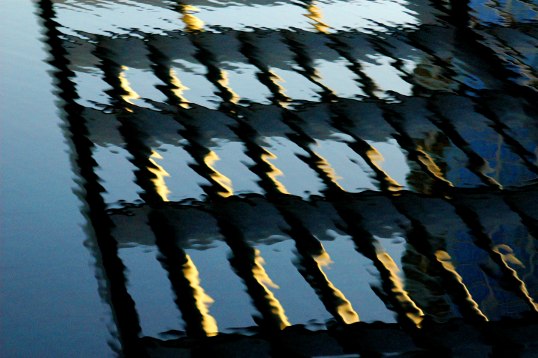
The aluminum grid of the Winspear Opera House sunshade - very high overhead, reflected in the pool.

Standing on the edge of the pool.

Sunday Snippet – Forklift Rodeo

Randall Zaphtig took his daughter Penelope by the hand and led her from the car. They were on a long roadtrip from his ex-wife’s (Penelope’s mother) funeral back to his home in Oklahoma. He had decided not to fly, thinking that the drive would give him time to get reacquainted with his daughter before introducing her to his new wife – her new mother – for the first time. The trip was turning out to be quiet and even more awkward than he had been afraid it would be. He was prepared for tears, but not for the withdrawn, silent, robot-like waif that his daughter had become.

On a whim, Randall left the Interstate at the New Calebtown exit. He turned off almost by habit – he had lived in New Calebtown for his first three years out of school and had worked in the Caleb Brother’s hat factory there as a production engineer.

For some reason, unknown even to him, he had a strong desire to show her the factory he had once worked in. He drove to the plant parking lot by reflex memory but when they both climbed out of the car he saw that the building was no more. All that was left was the cracked parking lot, with mean looking weeds starting to poke up through the fault lines in the asphalt.

Still he took Penelope’s hand and together they walked across to the broken lines of concrete footings that outlined where the factory used to be. Looking down at the parking lot next to that he saw peeling, faded, yet still visible orange lines stenciled in and over the almost invisible now yellow parking demarcations and a strong, long forgotten memory came flooding back, causing him to stumble a little.

The orange lines were from the forklift rodeo. The men in the shipping department took great pride in their ability to move undamaged product out of the door quickly and a great part of that was their ability to drive their forklifts. These were country boys and men, farmers, that had grown up driving trucks and farm equipment not long after they had shed their diapers. Industrial and agricultural machines were in their blood – hydraulic fluid, lubricating grease, and diesel fuel moved under their skin. Driving a forklift at the plant was nothing more than a further fulfilling of their destiny.

The highpoint of their year was the forklift rodeo. There were local, county, and finally State competitions and it was a sad year when somebody from Caleb Brother’s did not place high in the State Finals. A handful had won the competition over the decades and their trophies were displayed proudly in a glass case at the entrance to the office row.

A young hotshot out of college – Randall was expected to referee the factory rodeo. The orange lines were painted on the lot to the exact specifications of the annual contest. They were supplemented by piles of wooden pallets in strategically placed locations to form an obstacle course the contestants were expected to navigate with the heavy trucks, moving forward and backward, fast and slow, picking up, moving and dropping loads according to strict rules and regulations.

Randall had to stand on the dock over the aisle where a contestant would enter with a pallet on his forks, drop the pallet, back out, then turn around, re-inter and retrieve the pallet. He had a checksheet where he would note the proper use of the horn, back-up signal, and whether the driver would turn his head and look for oncoming traffic. He would note the angle of the forks when picking up or lowering, and the height of the forks when moving naked.

There were dozens of details that had to be adhered to and Randall used his checklist to grade the contestants. They would argue later over over whether their heads had turned or if they had looked closely enough or moved too fast backing out. In order to be victorious in the contests, there had to be practice and Randall was assigned to help out with this an hour a day for the month leading up to the Rodeo.

He hated standing out there for hours in the heat watching those men riding the smoke-belching machines, making little tick marks on his forms, and having to argue over every little detail. The men would rib him, especially teasing him endlessly over the fact that he couldn’t do what they did every day. It was humiliating.

Now, decades later, he wondered what happened to those men when the plant closed down. They all had families – sometimes three generations had worked there. Men like that had few options. There wasn’t anything else in New Calebtown for them. Randall had no idea how their families could survive.

He was pulled out of his sad reverie by his daughter. She had been walking along the cracks in the pavement and looking at the harsh spiny nettles that were fighting their way up. A few of them were blooming and she had carefully pulled the flowers off of the sharp stems.

“Here, Daddy, for you,” Penelope said, handing him the bunch of surprisingly colorful blossoms. He held them to his face and was surprised at how sweet they smelled.

“Come on, let’s go,” he said to his little girl, “We’ve still got a ways to go.”

The first Patio Session

In my neverending quest for free stuff to do I came upon an article touting this year’s Patio Sessions at Sammons Park in front of the Opera House in the Dallas Arts District. That sounded like a plan, so I rearranged some scheduling, dragged myself out of bed a little earlier so I could leave work on time, and took the DART Red Line from work downtown.

I got there in plenty of time – they weren’t even set up when I arrived. The two musical guests for this, the first Patio Session of the year were Madison King and Calhoun.

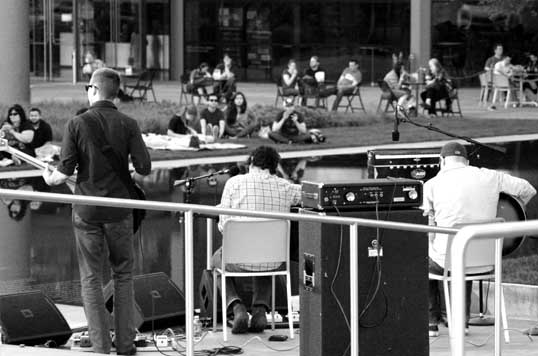
It was really nice. With the evening sun starting to set, the light in the Arts District was thick and gorgeous. The musicians played in front of the reflecting pool between the Winspear and the Wyly – which is a particularly attractive spot. The skyscrapers of downtown all glowed in the evening light like warm mountain spires and far overhead the aluminum sunscreen reached out with a welcoming last bit of shade. The crowd was light and super mellow – most people brought blankets and spread out on the patches of bright green grass around the pool. The weather, unusual for North Texas, was perfect – the killer summer heat hasn’t arrived yet.

Madison King was up first and did an excellent acoustic set. Everything was so relaxed and chilled – it was just what I wanted – a perfect escape at the end of a day.

Between the bands I wandered over to the food trucks and bought something to eat. There were plenty of tables – my only difficulty was balancing my food on the way over. Most people found their way into the roped-off area with little tables where they were selling alcohol. Even though this was outside, the sound was good and you didn’t have to scrunch up close – though you could if you wanted to. The only downside was the periodic roar of a Southwest Jet overhead and, for some reason, a couple of times the bells of the nearby Catholic Church erupted into a cacophony of clanging – which usually is cool, but clashed with the music.

I wandered back for Calhoun’s set. They were using an instrument I had never seen before – it was like an accordion in a ornate wooden box set on a stand. He would move one wall of the box back and forth and you could see the air going through little cloth valves. The box said “NAGI” on it and it didn’t take much work to find out what the instrument is. It’s a portable harmonium. These seem to be mostly used by Indian musicians, but it fit right in with what Calhoun was playing tonight. It enabled the three piece ensemble to have a deeper, more complex sound.

In their Youtube video for their SXSW showcase they look like a pop band, but again, for this setting, they went for a mellower, chilled out acoustic sound. They were very good at it and I really liked their set.

It didn’t last long – at 7:30 or so they were done. That’s nice for a work night, and I was able to catch the train before the sun set.

The Patio Sessions continue into the summer, every Thursday at 5:30. The lineup looks impressively diverse – and thankfully full of local talent – The Simon & Garfunkel tribute band looks cool, and I’m always up for a string quartet. I don’t know if it is always as relaxing and laid back – but I imagine it is. It might get more crowded as the season goes on, but there is plenty of room.

I’ll have to remember to bring a blanket next time.

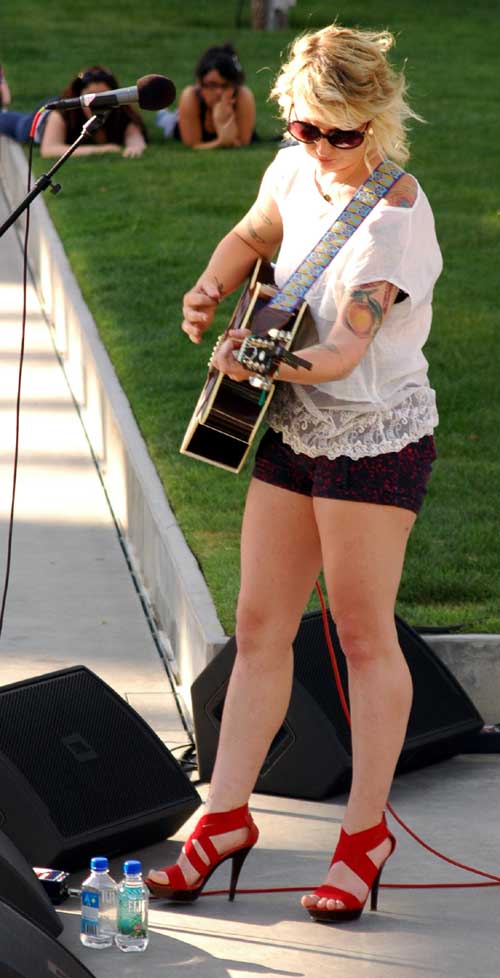
Madison King at the first Patio Session

Madison King

The musicians play next to the reflecting pool in front of the Opera House

.

The audience was very, very laid back.

.

Tha Nagi harmonium that Calhoun used... very cool.

.

.

.

.

.

What I learned this week, April 6, 2012

Next to my table at one of my favorite coffee places was this 3D photograph with a pair of glasses attached by a piece of brown twine. Pretty cool (though the twine was a little too short and it was hard to see the full effect). I liked it better than Avatar.


Work hard and sacrifice and you can send your children to an elite private university. That’s my son, Lee, in the following video. He’s the one in the Red Suit. I always wondered who did stuff like that.

Hey, whatever gets you into the final four.


Sometimes, I dream of a life led like this:

Unfortunately, this is only a dream, my real life is like this:

“Are you casting asparagus on my cooking?”


I’m not a huge fan of Titanic (even though I did like it more than I thought I would) and have no intention of seeing the 3D version. However, I am amused at the one change they made in the movie. Apparantly after (spoiler alert) the boat sinks, they had the wrong starfield – plus it was reversed for the second half of the sky. An astronomer was enough of a pest to get it changed in the 3D version.


From Maybe Mousse

The Google Art Project


I am hard at work on the cover for my book of short stories. I shouldn’t care, nobody looks at the cover of Kindle books anyway – but fear based procrastination is rampant. At any rate, here’s a nice TED talk on designing book covers.


What a great idea! From Library Scenester –

sips card

Sips Card brings independent fiction and local coffee shop/bar venues together. Customers can find Sips Cards at participating coffee shop-like venues. Each card contains a QR code, loaded with a short story from an independent writer meant to last as long as their drink. The cards are venue specific and include their business information as well as that issue’s author, story title, and website.


For my own reasons (which some of you may know) I have always wondered what a severed head in a shopping bag might look like. Thanks to Helen Taylor, now I know.

I bet it’s heavier than you would think.

A head in a shopping bag


Finally, a French Scopitone. It’s another odd France Gall offering and has three creepy male dancers with even creepier sideburns… like her classic Bebe Requin.

Where I Used to Work

Construction going up

When I first moved to Dallas, in 1981, my first job was downtown. I remember the quiet thrill of riding the bus into the forest of skyscrapers every morning – it was an exciting time. I felt that something was really happening – I wasn’t sure what it was, but it was something (I still don’t know what it was, and am pretty sure it wasn’t anything after all).

For a year or so my office was in the Kirby Building on Main Street. The interesting thing about that is a year earlier I had visited Dallas and had seen the Kirby Building from the Adolphus Hotel and wondered to myself, “What would it be like to work in a building like that?” It was a complete coincidence that I found myself toiling away in that very same space only a year later. The Kirby was a grand old place, much too ornate for a whippersnapper like myself and after awhile we moved to less expensive digs.

One thing I remember about the Kirby is that it had old fashioned carpets (they might have been wool) and on dry winter days you had to walk around with a key in your hand to touch the heavy brass doorknob and ground yourself or the static spark would leap out like Lilliputian lightning and shock the crap out of your fingertips whenever you would open a door. An odd thing to remember after all that time, but you don’t forget that much pain easily.

In the decades since, the Kirby Building has been converted into condominiums. I don’t know if they put in new carpet – I suppose they would have to. I hope it is conductive and non-static.

We moved across downtown to another venerable old edifice, this one not so ornate. It was the Cotton Exchange Building. It was like working in a time warp – they had a cotton trading floor and a restaurant on the ground floor that had not changed a bit since the fifties. We were afraid to eat the salad dressing.

I loved working there. These were the salad days in Dallas and I could watch the high rise buildings going up all around. They sprouted like giant glass asparagus from every available scrap of space. I loved to note the various construction techniques and architectural details – mostly how they made the shape such that they had the maximum number of corner offices. It was a cool place.

But all good things must pass and the Cotton Exchange building was too old and not profitable enough. To prepare for demolition they stripped a modern tacky exterior off and found a classic deco building underneath. There was some talk of preservation, but it was too little, too late.

They imploded the building. I thought about going down there to watch the old lady collapse under the thumb of the dynamite – but it was too early in the morning and I told myself I preferred to remember it as it was. For decades the lot sat vacant and I wondered why they had blown it up.

Now, finally, there is construction. Across the street the First Baptist Church is undergoing a massive renovation and the place of the old Cotton Exchange is being used… as a parking garage. I walked by a while back and took a couple of pictures.

I’m a little disappointed that the beloved old Cotton Exchange has been reduced to a spot for a garage… but I guess at least it is something. People have to park somewhere.

Even Baptists.

The new church across the street.

Baked Art From an Upscale Solar Cooker

The Museum Tower Condominiums tower over Tony Cragg's "Lost in Thought"

I have been a huge fan of the Nasher Sculpture Center since it was built. I go there all the time. It is truly one of the most comfortable, wonderful, and amazing public spaces I’ve ever seen. Family friendly , educational, beautiful, and a marvelous host to public gatherings – it was a thoughtful and generous gift from Raymond Nasher to the people of the city.

One of the goals of creating the Dallas Arts District, of which the Nasher is a linchpin, was to attract the high-end buzz of the wealthy clientele that enjoy throwing their millions around in order to wallow in the coolness of timeless art. These folks are hard to pry away from the coasts or the ancient alleyways of Europe but a roadfull of expensive venues and billions of dollars of paintings and sculptures was the lure. And so they come. The first habitat for these rare birds is the shiny new Museum Tower, reaching skyward from an odd oval of property where a Woodall Rogers Freeway ramp arced up and around.

Now I have no problem with that. I’m not a wealthy person and will never be. I have to beg and save just to buy a pen, for example. Most of the art scene I enjoy comes on Free Thursdays and Half-Price weekend and such as that, when the upper crust retreats and allows the hoi polloi to enter and tread their hallowed halls. I depend on the charity or at least the indifference of the wealthy patrons – I exist on their scraps – like a roach under the cabinets I scurry out when they aren’t looking for any crumbs that might be left behind.

So if someone wants to build a tower and charge millions of dollars for a two bedroom apartment – so be it. I applaud their industry, toast their imagination, and do not begrudge them their profits. If they want to call their property The Museum Tower – in order to capitalize on its location right next to the Nasher, fine. If they want to charge an extra million dollars per unit simply so the residents can use the museum garden as their side yard – complete with landscaping and a billion in modern sculpture – great. There is plenty of room and if you don’t mind standing next to me, I don’t mind standing next to you.

But don’t forget what side of the bread you’re putting the butter on. Without the museum there is no Museum Tower. Without the arts, there is no Arts District. Do not roast the goose that lays the golden eggs.

It started out with Tending (blue). The high rise stuck it’s ugly head right up into the viewport of James Turrell’s skyspace sculpture, my favorite spot at the Nasher and the best place to watch the sunset in the Metroplex. But, I’ve written about that before. (go read it)

An oversight, perhaps… pretty damn sloppy, though, if you ask me. You spend that much money on a building, make that much profit, can’t you figure out ahead of time that it’s going to ruin a great work of art? Or do you realize it and simply not say anything until it’s too late. Turrell can fix it, maybe, but when? He’s got other things to do.

And now, it’s happened again. And it’s a lot more serious this time.

They have put the mirrored cladding on the building and it is reflecting so much extra sunlight into the building at the Nasher that they are having to install shades simply to allow the newest sculptures in the room. Sunlight destroys art – but is necessary for art and the Nasher has always been very proud of it’s carefully engineered sunscreen roof. The architect spent a lot of time and effort designing a structure that allowed light for viewing in while blocking the damaging direct rays of the Texas sun. It was a brilliant triumph of design and construction and made for a world-famous light and airy museum that was a strong point of pride for the entire city.

It was a brilliant triumph until a few weeks ago when someone installed a giant mirror reaching five hundred  feet into the sky right next door that shot laser beams of killer sunlight into the Nasher from an entirely unexpected direction.

Read the articles:

Nasher to Museum Tower: Watch Your Glass, It’s Frying Us

Watch Your Glass, It’s Frying Us, Continued

Museum Tower Reflected Light Study

Nasher Sculpture Center says glare from Museum Tower is causing harm

Museum Tower Begins Visual Assault on James Turrell’s Tending, (Blue)

Mayor wades into uproar over Museum Tower’s glare

Museum Tower Glare Threatens Nasher Art

Nobody ever clicks on links, so here’s the skinny from the Dallas Morning News:

Officials at the Nasher Sculpture Center say that reflective glass recently installed on the exterior of Museum Tower, its new, 42-story neighbor in the Arts District, is compromising its indoor galleries, destroying its outdoor garden and threatening its future as a Dallas landmark.

Now under construction at the corner of Olive Street and Woodall Rodgers Freeway, Museum Tower heralds its proximity to the “tranquil garden” of the Nasher as a prime selling point for its residential units, which cost between $1 million and $5.4 million.

This makes me so angry I could spit. There is a city code that says, “A person shall not conduct a use that has a visible source of illumination that produces glare of direct illumination across a property line of an intensity that creates a nuisance or detracts from the use or enjoyment of the adjacent property.” For years I have had city inspectors quote much more obscure bits of code than this and made places I work do all sorts of crazy stuff.

But then again, the places I have worked have only employed thousands of ordinary people. They haven’t been home to a handful folks that can afford five million dollar apartments. They haven’t been owned by the Dallas Police and Fire Pension System (that’s who bought the tower).

When the Nasher was built, there was an agreement with Raymond Nasher, part of the covenant that helped him agree to build the museum and give his personal collection to the people of Dallas that stated the building next door would be a maximum of 21 stories and have a maximum reflectivity of 15. Now it is 42 stories with a reflectivity of 44.

So here we have a story of corporate greed and hidden scandal. Men like Raymond Nasher are no more.  I notice that mere months after he passed away – a new LA based architect was brought in to fuck things up and the tower doubled in size and reflectivity, causing all these problems -, about the time the City Pension System decided to make its purchase. I guess they knew then the city would not put up a fight. Mary Suhm, the Dallas City Manager says, “It’s not something we have jurisdiction over.” Well, she certainly knows which side of her bread is buttered.

Meanwhile, the art continues to bake and the goose that lays the golden egg is cooked. At least they are using green solar energy to do it.

A pole-sitting sculpture in front of a new Condo Tower going up.

The condominium tower going up next to the Nasher that is ruining Tending (blue).

Crawfish Pistolette!

After we finished up the Savor Dallas Arts District Stroll we walked outside into the setting sun and there were a dozen food trucks lined up by the Winspear Opera House. Have to get some food for the train ride home.  When selecting a food truck, I always like to try one I have never tried before.

This time was easy. There is a truck that I had read about, it seemed to have its debut at Mardi Gras this year, but I missed them at the Bishop Arts Carnival Parade. It was the Cajun Tailgator Truck – which offered New Orleans style fare, and I’m down with that.

Their menu looked great, and they recommended the Crawfish Pistolette (a PIstolette is a small, New Orleans sandwich made from a hard roll stuffed with goodies) and that was good enough for me. I ordered the Pistolette, a cup of gumbo, and a water – and still made it under my gourmet food truck theoretical limit of ten bucks.

Of course the sandwich was very good. I love crawfish, especially when I don’t have to work at it. A pistolette is a nice way to serve food from a truck – easy to carry, easy to eat, not too much.

The gumbo was especially good. I was impressed. It wasn’t seafood gumbo – but I don’t know if I’d want that from a truck. Instead it was a rich chicken and sausage blend and as good as any I’ve had outside of Louisiana.

So here’s another truck for me to follow around. I want to try the boudin balls, the red beans and rice (for me that’s the real heart of cajun cooking) and the Roast Beef Po-Boy (with debris!).

Laissez Les Bon Temps Rourler!

The Cajun Tailgators Food Truck in front of the Winspear Opera House.

Ordering from the Cajun Tailgators

Cajun Tailgators Menu

Crawfish Pistolette, Gumbo on a cool picnic table - the Arts District is working on place for Food Truck aficionados to sit while they eat.

Cajun Tailgators Website

Cajun Tailgators Facebook (seems the best way to find them)

Cajun Food Truck Brings ‘Big Easy’ To ‘Big D’

Food truck review: Cajun Tailgators

A Look at a New Food Truck: Cajun Tailgaters

Cajun Tailgaters Food Truck

Let the Good Times Roll with Cajun Tailgators!

Savor Dallas Wine Stroll

I was really struggling to come up with a birthday present for Candy. I was going to get her a Keurig single cup coffee machine, but right before I went out and bought it she developed some stomach problems related to coffee and told me she would have to quit drinking it. So I was back at square one.

Surfing around the web and checking facebook I came across an upcoming event here in Dallas that I, frankly, had never heard of. It was called Savor Dallas – and it is a multi-day, multi-location, celebration of food and wine and stuff like that. One event was called the Arts District Wine Stroll.

The Stroll was billed as:

The popular “Arts District Stroll” sets the stage for the two-day festival on Friday, March 30th, 5-7pm, where guests can enjoy wine and food tastings in the Dallas Museum of Art, the Nasher Sculpture Center, the Meyerson Symphony Center, and the Winspear Opera House. A group of the popular new Food Trucks will be selling their goodies along Flora Street during the Stroll.

So I guess it is something like a pre-paid pub crawl, except with a little more class.

Well, it looks like we might be on to something here. Walking around the Dallas Arts District, visiting four beautiful public buildings, all designed by Pritzker Prize winning architects, while sampling food and wine along the way. Meanwhile the usual flotilla of Food Trucks waits along the route in case you don’t get enough along the way.

That sounded like a plan to me – so I logged in and bought a pair of tickets online (good thing I didn’t wait – the event sold out a few days later).

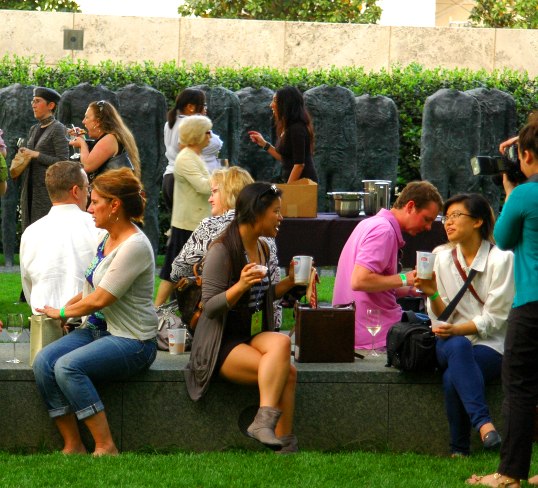
The event ran from five to seven – only two hours long. We didn’t want to waste any time, so I took a half-day of vacation from work and we decided to take the DART train down there to avoid any traffic or parking hassles. We arrived at the Winspear Opera house right at five o’clock, had our tickets scanned, received a green wristband and a wine glass, and we were off.

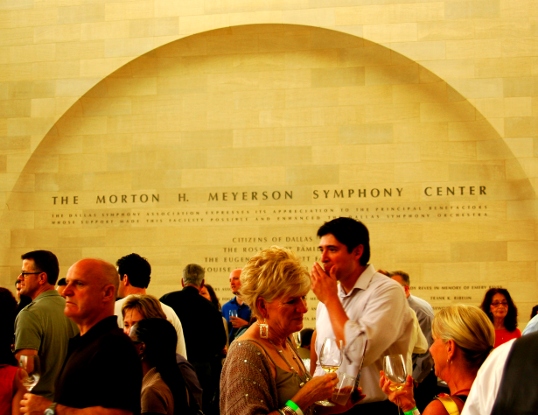
The thing was great. There were over fifty spots pouring out samples of wine spread among the four locations and a healthy handful of food spots. We hit the Winspear Opera house first (an excellent sake there, in addition to the wine), then moved next door to the Meyerson Symphony Hall. These were crowded, but the lines moved quickly and we were able to sample a good selection of wine and some excellent food.

I carried my camera and a small Moleskine Notebook with a matching fountain pen. I tried not to take too many pictures – it was really hard to hold a wine glass, little tray of food, and steady the camera enough to take decent photographs. I was going to take notes on particularly good wines – wines that Candy liked – I’m not a good judge, I like everything,… but it wasn’t really necessary, we simply picked up brochures and business cards from stuff we liked.

After the Meyerson we walked down to the Dallas Museum of Art. I liked it the best. Because it was down on the end and a longer stroll than the others, it was by far the least crowded and there weren’t any lines at all.

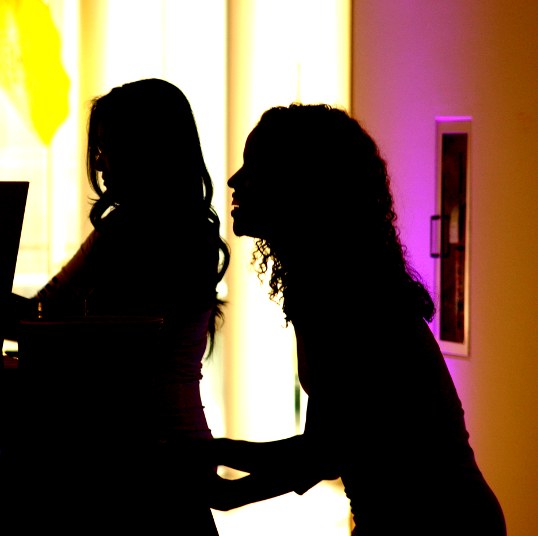
Best of all, though, they had a Tequila Sampling station. There were two attractive young girls in white skintight spandex minidresses mixing various tequilla concoctions and pouring out trayfulls of shot glasses for us to snatch up and sample. Some of the mixes (coconut and grapefruit juice) were a little off – I much preferred the straight, smooth tequila – but it was all pretty damn good. I could have parked myself in front of the tequilla sampling place, while waiters kept coming by with strange little hors d’ oeuvres – like lamb on plantain chips or oysters in tiny ice cream cones – all night long.

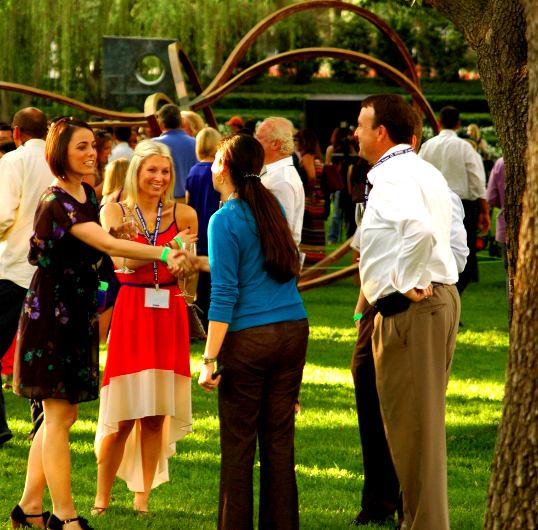
But it was time to move on and we walked next door to the Nasher for the final half-hour of the festivities. The Nasher garden is a perfect spot for something like this – a healthy crowd milling about the grass lawn of the garden, sheltered by the groves of perfectly groomed trees, sipping wine and eating food while about a billion dollars of modern sculpture looks on.

I slowed down on my alcohol consumption there – only trying a couple of wines – but there was some really good food. I had never had tuna tartare tacos before – and they were very good. I hate to say it, but with all the fancy top-shelf restaurants demonstrating their wares, I think the best thing I had was the tomato basil soup with mini croissant from La Madeleine. It was exactly what I wanted right then.

Everybody seemed to be having a blast. It hit just the right note – fancy enough to enjoy a special night out, but not too upper crust to be unpleasant or stressful. Candy made some new friends and I enjoyed the very diverse and interesting crowd. I even liked the fact that at two hours it was fairly short. It seemed to end right at the right time, we had all had our fill but didn’t get too worn out yet.

I’m definitely going to give this a shot next year. I’ll have to remember to get tickets early again – I’m sure it’ll sell out. It would be nasty if the weather was bad – you wouldn’t want to stroll around in the rain or a storm…. but if that happens I could simply find the tequila place and stay right there.

The crowd milling around in the Winspear Opera House, sipping their wine

In the Winspear Opera House - the wine folks would only pour a taste, but the beer people, like these Stella Artois reps, would give you a whole bottle poured into a big cup. Yeah!

In the Meyerson Symphony Hall.

At the Meyerson

Wine at the Meyerson

The light pouring into the Dallas Museum of Art

The Tequila girls at the Museum of Art

Tequila

One of the nice things at the Museum of Art is they had some semi-live music - a guitar player using some pre-recorded backing. It was very relaxing and everyone hung around and talked.

Pouring wine while the folks from Rush Hour, by George Segal, look on.

George Segal, Rush Hour

The happy crowd in the Garden at the Nasher Sculpture Center.

The Nasher Sculpture Garden

Hanging out at the Nasher on the stone wall in front of The Bronze Crowd, by Magdalena Abakanowicz.

Bronze Crowd, by Magdalena Abakanowicz

Folks at the Nasher

Making Tuna Tartare Tacos

I can’t say we tried everything they had on the Stroll – but I know we tried most of it.

Wines at the Savor Dallas Wine Stroll:
14 Hands Winery
Abbazia
Alexjandro Fernández
Apothic
Becker Vineyards
Black Oak
Bridlewood
Cambria
Carmel Road
Chateau Ste. Michelle
Columbia Crest
Comenge
Concannon Vineyard
Condado de Haza
Cupcake
Darcie Kent
Dow’s
Edmeades
Edna Valley
Emilio Moro
Fall Creek Vineyards
Farrier
Flip Flop Wines
Frei Brothers
García Figuero
Ghost Pines
J. Lohr Vineyards
J Vineyards
Lapostolle Winery
LeBaron Ranch
Les Cadrans de Lassegue
Louis M. Martini
MacMurray Ranch
Matarromera
Montecastro
Murphy Goode
Neige
Ortega Fournier
Prats + Symington
Protos
Red Diamond
Ritual
Santa Cristina
Selección de Torres
Sequoia Grove
Twin Springs
Veramonte
Viña Arnáiz
Vizcarra

Water Supplied by:
FIJI Water

The Tequila
1800 Tequila

Sake:
TY-KU Sake

Beer:
GreatBrewers.com
Hoegaarden Beer
Leffe Blonde
Shock Top
Stella Artois Beer

Food:

Meso Maya
La Madeleine
Texas Spice
Jorges Tex-Mex Cafe
Garlic Expressions
Pho Colonial

Sunday Snippet – Osage Orange

  • Osage-orange
  • Hedge-apple
  • Horse-apple
  • Bois D’Arc
  • Bodark
  • Bodock
  • Bow Wood
  • Wild Orange
  • Mock Orange
  • Southern Buckhorn
  • Syringa
  • Shittim Wood

When I was riding the DART train Friday night, I saw a poem up on the wall at the Lover’s Lane train station. I couldn’t see if clearly through the windows but it was a sort of list of synonyms for Osage Orange trees (in Texas, they are usually called Bois D’ Arc). There are ubiquitous trees across the middle of the country – they were planted by the millions in hedgerows after the horror of the dustbowl in the thirties to act as a barrier to the wind.

The land used to be divided into neat square mile parcels by these rows of trees. Now, a lot of the hedges are being torn out to get the last square inch of production out of the land.

These trees are fast-growing and scraggly, but thick and strong. They have these weird inedible green fruit that is covered in brain-like convolutions. I thought about the hedges and the trees and their relationship to the land and the people that live there and came up with this little snippet – maybe a story first draft, maybe not.

Osage Orange

Sam spent a lot of time over the summer with his friend Jim. Even though Jim’s father worked at the same advertising firm as Sam’s dad – he lived out in the country in a farmhouse he was leasing. Sam figured out that Jim’s father fancied himself a man of the earth and would wear denim overalls, dirty workboots, and an old weather faded straw hat on the weekends, though he would trade that for an Italian wool suit on workdays and Sam had never seen him do any actual farmwork.

Jim had a big family, with four sisters that were always out and around riding their horses and trying to drive Jim and Sam crazy. Sam was an only child and Jim’s mother would always ask him how his parents could stand being alone. Sam replied with a shrug, but he always thought his parents seemed glad to get rid of him for a week or two out at the farm. They acted like they were about to go on vacation.

Back then, people only had one television per family. Sam’s house had a plastic black and white in the kitchen with silver squares of foil folded around the rabbit ears. At Jim’s farm, they had to put up a big antenna on a pole to get reception out there, but they had a big new color set in a glossy wooden cabinet right in the middle of the living room.

Sam loved Saturday Night at the Movies at Jim’s house. The whole brood would pack into the living room and watch the movie of the week together. Somewhere in the middle of the show a Coca-Cola commercial would come on and Jim’s mother would heave herself up from the couch and waddle into the kitchen to fetch a cold bottle from the refrigerator. She would always do this when a Coca-Cola commercial would come on and had no idea why she was suddenly thirsty.

Jim and Sam would laugh and she would give them a perplexed stare but they never told her what was so funny.

Though Jim’s father only rented the farm house and the outbuildings, the kids pretty much had the run of the farmland in that whole corner of the county. Jim’s sisters would wander with their horses while Sam and Jim would hike. Over a steep ridge to the south of the farm was a big farm tank – a pond larger than most which dotted the country. The water was an opaque green and always contaminated by the cattle that strolled over to drink, but after a short time they spent getting used to the idea, Sam and Jim would swim in the pond, especially on the hot summer afternoons when the water was a welcome respite from the sun and various biting bugs. The bottom was soft mud and would bubble and stink when they walked through it but the water was surprisingly deep and kept cool even on the hottest stretches of summer.

Exploring further they crossed another, even higher and steeper ridge and discovered a construction crew digging out a hedge row of Osage Orange trees.

“They’re going to put in a subdevelopment here. My dad told me,” Jim said.

“That’s cool.”

“No it’s not, my dad says the whole city will grow out this far and swallow up all the farms and land and we’ll have to move farther out.”

Sam thought that would take a long time, but he kept his opinions to himself.

One day, walking up on the construction, the boys found a large pile of wood from the felled threes. The work crew had cut up the hedge and arranged the wood so that it could be hauled off easily. The big trunks were piled in a giant heap next to the big balls of roots, but off to the side the large branches were separated and cut into lengths.
“Hey, Sam, look at this!” Jim said, excited, “We can haul these back to the pond and built a raft.”

“Isn’t that stealing?”

“Nope, they’re going to have to haul this off or burn it anyway, we can take what we want.”

The boys ran back to the farm and returned with rope, their hatchets, and a bow saw. They made rope harnesses and dragged the wood over the ridge and down to their pond. They picked straight pieces but took some big ones. The wood was very heavy, orange in color, and tough. These were the hottest days of summer, the sun beating down. The boys worked together to move their burden, roped in tandem to the logs. Shirtless, they sweated until the salt burned their eyes and with each load completed they would dive into the pond to rinse and cool off.

All day Saturday and Sunday they hauled wood. They wanted this done before the work crew came back on Monday. Jim didn’t think they were stealing anything, but he didn’t want to have to answer any questions.

The rest of the week they worked cutting the logs. The logs they hauled were at least twice as long as they needed so every one had to be cut in half. The Osage Orange hedgeapple wood was strong as steel and hard as fint. Their little Boy Scout Hatchets would skip off the wood and only flake off little splinters with each blow – no matter how sharp they honed the edges. Their bow saw worked a little better and the boys took turn sawing until their hands were covered in blisters.

“This is too much work,” Sam said. “We need a different kind of wood.”

“No, this stuff is like iron, think of how strong the raft will be. It will last forever.”

Sam thought then of the two of them poling back and forth across the pond in their raft, and the image made him smile and gave him the motivation to ignore the pain in his palm and go back to sawing with his blister-covered hands.

After three days of sawing they began lashing the logs together, using the ropes left over from the harnesses they had fashioned the week before. In the movies it had always looked easy to lash together a raft, but they struggled with it. They had to revise their design several times, until they realized the importance of diagonal bracing in keeping their raft from collapsing sideways.

Finally, on Saturday, a full week after they had started, they finished their raft. It wasn’t as beautiful as the one they had filled their minds with, but they were very proud of the amount of work they had put into their creation. The sun was already touching the horizon when they decided to launch the raft.

“Well get it into the water tonight, then come out tomorrow and sail it around,” Jim said.

The two of them took up their places on either side of the raft. They had saved two of the smallest and straightest logs to use as a skid to slide the raft down into the water. Still, it was amazingly heavey and hard to move. The boys reached down deep and summoned up their last drops of adrenaline, closed their eyes, and shoved as hard as they could, working together.

Finally, somehow, the raft slid, gaining speed as it moved down into the green mucky water. With a healthy splash it freed itself from the skid and launched out over the pond. In his young mind, Sam saw a mighty ship leaving the quays and floating out onto the sea. With their feet sinking into the mud in the shallow water at the shore the boys gave a last loud spontaneous simultaneous shout and pushed the raft out towards the center of the pond, already thinking of swimming out there and climbing aboard and enjoying their work as the sun set orange in the west.

The raft moved out and sank like a rock.

“Of course it did,” Jim’s father told the two dejected boys after they had trudged home, “Osage Orange is the hardest, heaviest wood there is, that’s why they use those trees for hedgerows. Especially when it’s fresh and wet, it’s heavier than water.”

He let out a grownup laugh, but the boys didn’t think it was very funny.

Sam was going to go home in two days. He had thought of calling his parents and asking to stay another week. He had wanted to spend it floating around the pond on the raft. Now, though he didn’t want to stay. The boys didn’t hike to the pond the next day like they always did. They even let Jim’s sisters ride them around on the back of their horses, which seemed to make them happy, though Sam had trouble concealing the fact that he was actually scared of the horses.

The next summer, Sam came out to the farm for a few days. Sitting in the back seat while his parents drove him out there, he saw the yellow pine two by fours they were using to build the new homes where the hedgerow used to be. They were in perfect rows and squares, all exactly the same. Jim and Sam talked about walking out there to explore the half built houses, they knew they would have to go by the pond on the way and they couldn’t do that.

Sam kept thinking about the raft slowly rotting into that foul mud at the bottom of the pond and called his parents to come get him two days early. Jim understood this was for the best, and his mother assumed wrongly that Sam for some reason finally missed his own family.