The Grand Opening of the Cedars Food Truck Park at Dallas Heritage Village


Looking for something to do over the Weekend, I was drawn to the Grand Opening of a new food truck park, Dallas’ first, The Cedars Food Truck Park, down in the Dallas Heritage Village on the south side of downtown.
I rode the DART train to the Cedars Station and walked across the no man’s land south of downtown to the park.
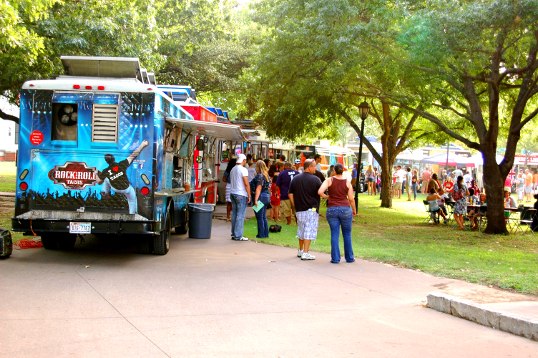
Most of the food trucks were in a big arc around the open grounds.

A lot of trucks and a wide variety of food.
There were eighteen food trucks at the park for the grand opening. It’s a little scary how many of them I have already eaten at and written about:
Since I was there early and it was still scorching hot – the lines were non-existent and I chose some sushi from Crazy Fish.
Music was provided by a three piece mountain-folk group, The Sicklies – that I know nothing about but will see again if I have the chance.

The Sicklies
Liquid refreshments were provided by the folks from the nearby bar/club Lee Harvey’s – serving up some beer from the Deep Ellum Brewing Company. Their stout was as excellent a dark beer as I have had in a long time – really good stuff.
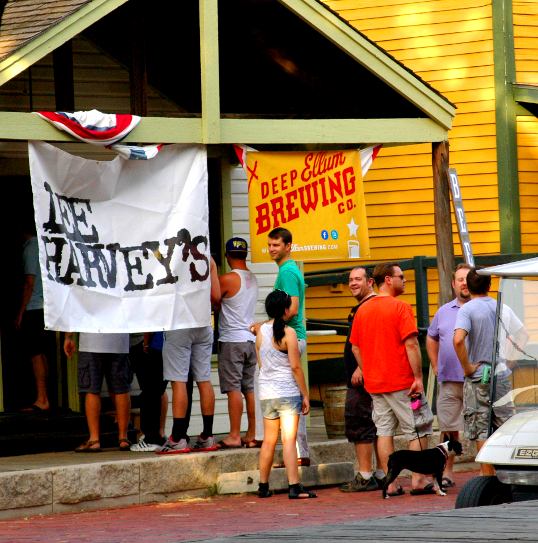
Beer from The Deep Ellum Brewing Company, served up by the folks from Lee Harvey’s. The beer lines were plenty long – a lot of thirsty folk.
The whole evening was a blast. As the evening grew long and the air grew cooler the crowd grew until there were long lines at the food trucks and even longer ones for the beer. I didn’t stay too late – I didn’t want to make the walk back to the DART station in the pitch of night.
Sometimes the big city shows you its good side – it did tonight. I’m not sure if it was the presence of all the old historic buildings, the comradeship of the past, or if it was simply a well-planned event, but everyone was smiling and talking to each other. A happy time… with food, and very good beer.

A photographer – You don’t see these cameras very often any more. Shame, really.

For a larger and more detailed version Please Visit the Flickr Page
This is a cool bronze sculpture at one end of the McCasland Sunken Garden at the Dallas Arboretum. You can see the sculpture in the foreground of the photo I used once for a Sunday Snippet I did to practice my character sketches.
These might not be as good as Peggy’s… we seem to be taking pictures of the same things – sort of Dueling Chihulys, so to speak – but it’s all good.

For a larger and more detailed copy, Please go to Flickr

For a larger and more detailed copy, Please go to Flickr
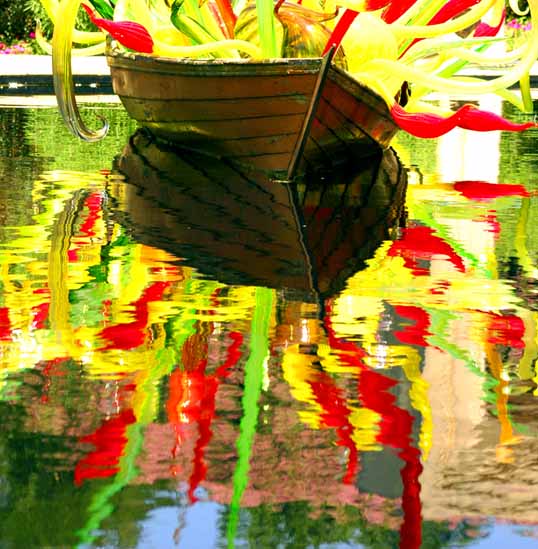
For a larger and more detailed copy, Please go to Flickr
Last Thursday I took a PTO day off of work, a mental health day. I decided to go to the Dallas Arboretum in the morning and hang out for a while. We have a membership there, so I don’t have to pay for parking or admission, which is nice. Especially nice because I can go at my leisure and simply relax and walk around, not feel any pressure to get my money’s worth. For that, I can always come back another time.
The Chihuly Exhibit is still up, and will be until November. It is a beautiful as always – and now, since I have a familiarity with it, I am able to see some details and subtle facets that I missed the first time or two through. More than the Chihuly stuff, gorgeous as it is, I am appreciating the beauty of the Arboretum itself – its design and vegetation.
This trip, as always, I took a lot of photographs, which I will continue to force upon my helpless readers whenever I feel like it – or I can’t think of anything else to whine on about. So far, from this trip, here, here, and here, for example… with many more to come.
But other than snapping photographs I wanted to find some spot to sit down with my Kindle and read for a bit, simply soak up the peaceful beauty.
When I first arrived at opening, there weren’t too many folks there, but the crowd quickly grew. Now, there weren’t as many folks as there are on the weekends, not by a long shot, but they tended to cluster along the main paths, surround the more spectacular Chihuly stuff, and blabber on about this and that – generally messing with my chill.
No problema, I expected this. It is a public spot – a tourist attraction – with a very popular special exhibit going on until November… I did not expect to have the whole place to myself. I had already decided to seek out a couple of hidden places, somewhere that I could sit, undisturbed, read a little, and generally chill out.
A couple of parameters had to be established:
The first hidden spot is one I already knew about – I had spotted it the first time I came to the Arboretum. The first stage of A Woman’s Garden is a fiendishly designed series of formal gardens and water features that have a lot of Chihuly’s most spectacular glass works. It draws a big crown, oohing and ahhing and holding their iPhones up to send images back home to Aunt Emma who didn’t want to visit Dallas in the summer.
What they miss are some clever, smaller bits of garden that jut off to the side, little isolated areas that really make the place special. One of these, sandwiched between the first fountain by the entrance to A Woman’s Garden and the Degolyer Mansion is called The Sunset Garden. It is a tiny path that goes up a bit of hill to a stone bench beneath a huge tree. As the name implies, the bench faces west and would be a great place to watch the solar orb sink beneath White Rock Lake. There is a little sign that directs you to the side garden – a sign that everybody, entranced with the colorful glass beyond, seems to miss.
When you clamber up to the stone bench you look down through a gap to a fountain and then past into another small garden – The Pecan Parterre Garden, with a beautiful little sculpture – Harriet Frishmuth’s “Playdays” (more on that bronze piece in a few days, I promise). It is a truly idyllic spot.
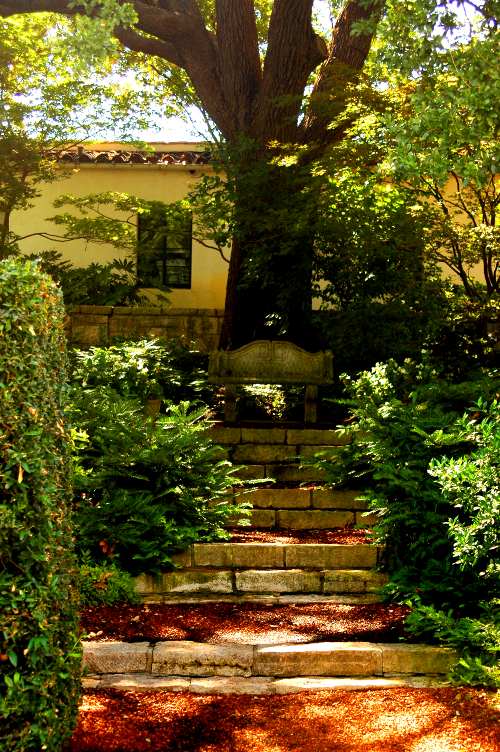
The path up to the stone bench in the Sunset Garden from the main entrance to A Woman’s Garden.

A view of the Sunset Garden from the veranda of the DeGolyer mansion. You can see the sun-drenched entrance to A Woman’s Garden and its fountain, and the Pecan Parterre Garden, with the little statue, beyond. White Rock lake is through the trees in the background – this would be a wonderful spot to watch the sun set.
The only problem – as I discovered once I climbed up there and settled in – is that the stone bench is tilted out, ever so slightly, so it is not very comfortable. It’s like sitting in a church pew. I’m afraid that little detail makes the sunset garden a bit more useful to look at than to sit in for more than a few minutes.
Later on, though, I found another little hidden spot that didn’t have any disadvantages at all. I was strolling through the Jonsson Color Garden (the big open ovals where some large Chihuly glass rears up) and looking into the strip of woods that separates that area from the Texas Town (a children’s area with small historical displays) and noticed a wooden bench set deep within the trees. I walked around a bit and found the path back there.
It was perfect. It sits in deep shade from tall overhead trees and is screened from the main walking path by a clump of Crape Myrtles. Cool and quiet – most importantly, the wooden bench is very comfortable. A perfect spot to sit and read (I cranked through an entire novel) and contemplate the universe.
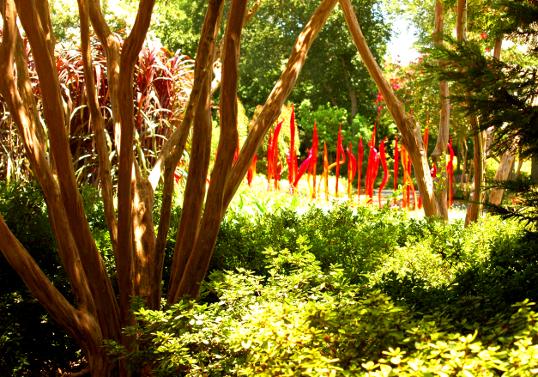
The view ahead and to the left from the little bench. These are some Chihuly red glass sculptures sitting along the edge of the Jonsson Color Garden.
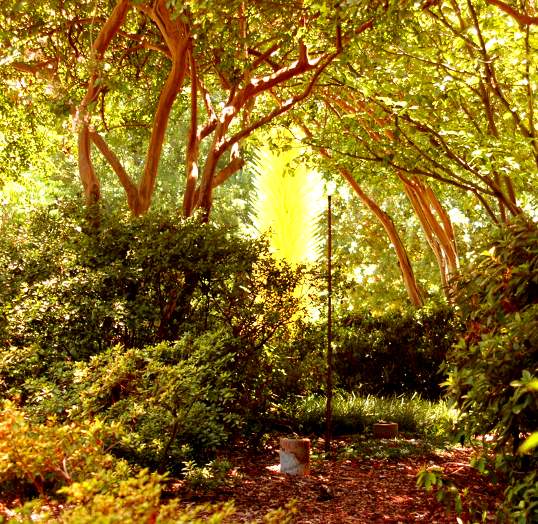
To the right from the bench is a bit of a view of Chihuly’s gigantic Yellow Icicle Tower.

Here’s the bench, with my Kindle, camera case, and woefully inadequate water bottle.
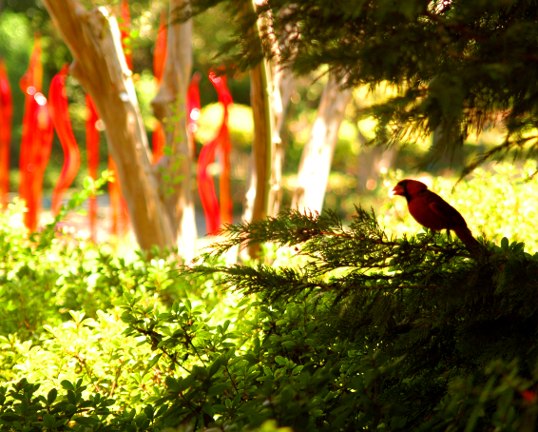
I had a little visitor while I was sitting there – somebody else trying to get out of the killer afternoon heat.
It was too comfortable – I stayed too long into the stifling heat of the afternoon. The rest of the day I was dizzy and confused… even more so than normal. Still, I think I’ll go back. It’s a nice place… and there has to be some more hidden spots that I haven’t found yet. Maybe one with some burbling water nearby.
One of the most impressive sights in the Dallas Arboretum is the Magnolia Allee (along with the different, but equally gorgeous, Crape Myrtle Allee). A long, straight, and narrow path runs between two walls of ancient giant Magnolia trees. This year, the fountain at the end is replaced by one of the larger Dale Chihuly works.
It’s something to see, and even more amazing to walk down.
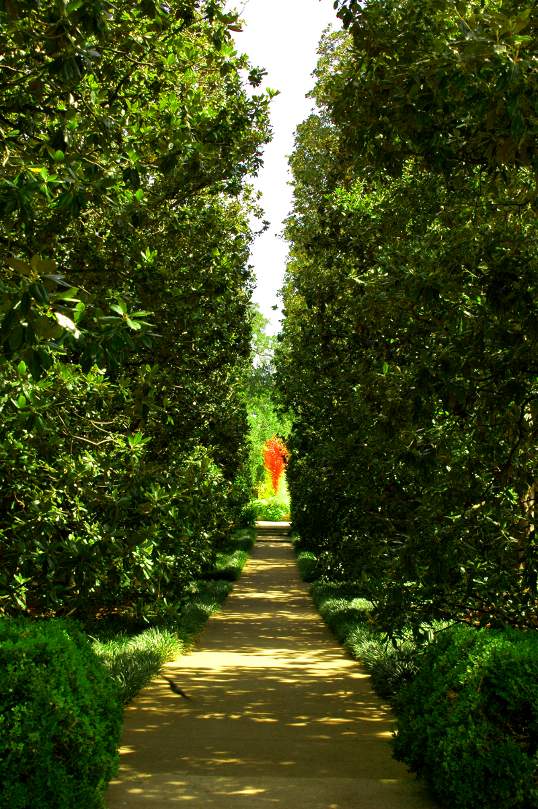
Magnolia Alee
For a larger and higher quality version Visit the Flickr Page
While Dallas rates, again, its well-deserved award as the worst city in the nation for bicycling, my suburb of Richardson was awarded the most bike friendly neighborhood. The best of the worst… so to speak.
One piece of cycling infrastructure that Richardson has embraced is the idea of separate, striped, bicycle lanes on their broad residential avenues. The square mile neighborhood I live in, Duck Creek, is bisected north and south, plus east and west, at the half mile marks by two of these avenues – Apollo, going east and west, and Yale, north and south.
In the last year or so, both have had a bike lane striped off going each way. These are marked off on the right hand side and are shared with bikes and parked cars. The square mile is also sliced on the diagonal with the Duck Creek Linear Park and its trail, plus the Owens Trail branching off to the north under the power lines, Glenville Trail heading west through the trails snaking around Huffines Park – my neighborhood is not lacking for bicycle infrastructure (love the Googlemap green lines for bicycle routes – though they don’t have the one’s on my streets).
The city is expanding this program, and another road near me, Grove, has had the same treatment for at least two miles of its transit through the city.
These improvements have been very popular. Not so much for the bicycle infrastructure they provide – but for their “calming” effect on traffic. These roads were wide enough to allow passing before – which only encouraged excessive speed, and a lot of folks were confused over which lane to drive in. Now the roads are narrowed to a reasonable width and seem to be the better for it.
Recently the city improved the bike lanes in my neighborhood by adding a narrow “buffer zone” that restricts traffic a tad more and gives a bit of confidence to the bike riders.

Bike lane on Yale, near my house.
I’ve been experimenting with these lanes a bit over the last few weeks and have come up with a few opinions and observations.
The lanes themselves are great. Sometimes, sharing the lane with parked cars can be a problem – wide vehicles like lawn-mowing company trailers can force you too far to the left, and there’s always the fear of someone opening a car door in front of you. The drivers do respect the lanes, though. The lanes would be tough for a high speed rider on a hot road bike – but a slow tourist or commuter has no problem in the middle of the blocks.
One problem is the intersections. Left hand turns are harrowing on a bicycle – there isn’t enough sidewalk or shoulder to do the stop, turn, and cross. The cars use the bike lanes for right turns. Look at this picture.

Bike lane merging with right turn lane at Beltline road.
This is a very busy crossing and the cars are going by fast in all directions. There is simply not enough space to navigate a bike through there. If you ride a bike very much in traffic you will learn that bicycles are often invisible to turning cars – I am more afraid of cars making turns than I am of speeding motorists.
Another observation is a more generic one. Planners tend to look at long stretches of road. If they can open up a long stretch, they view that as a victory.
When you are planning a route for your own personal use you tend to think about choke points. These are locations or short stretches of road that cannot be easily or safety crossed on a bicycle. Your route will be developed not to take advantage of long stretches of good road as much as it is chosen to avoid these choke points.
Some of the most notorious sets of these are the railroad crossings. Look at this one on Arapaho – a very busy major thoroughfare.
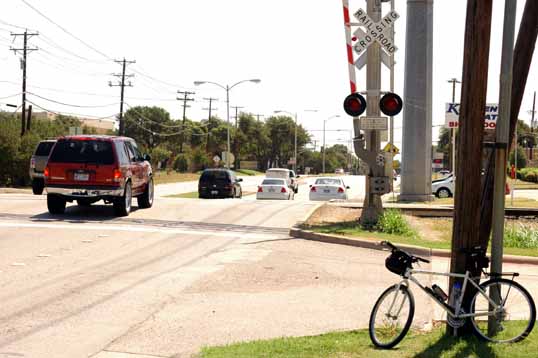
Rail crossing on Arapaho road.
There are three lanes of traffic both ways going through that little space – going fast, up to fifty miles per hour or more (don’t lecture me on speed limits… this is Texas). There is no sidewalk, no shoulder, no other way to cross. That hump has a set of rough wheel-swallowing steel rails sitting there on top of it. You hit that wrong on a bike and you are going down. There is no other crossing to the south for a mile. It’s two miles south to a safe crossing.
The Grove road bike lane is right behind me… as is the Arapaho DART station. If I want to ride my bike to the library; I have to go through there. If there is any traffic at all I have no alternative than to stop, get off my bike, and carry it over the tracks.
Which isn’t the worst thing in the world… but I wish someone would work on these choke points.
There are few things as beautiful as dappled sunlight meandering down through a grove of trees.
–Me, 1998
Even on the hottest, brightest, summer days an overhead canopy of old trees makes for shade and comfort.
The air is still and hot and innervated with the sounds of cicadas desperately trying to find their mate before they die, too soon. Their song is desperate – they have waited for over a decade in the dark, hard ground and now have only days in the sun. Their abandoned skins, dry and hard on the barks of trees, their gray blue dead bodies, spent, line the concrete paths.
Everyone has a grove of trees that brings back some sort of memory – you should revisit it and walk around. It looks different… the trees grow slowly, but they grow, the weeds are trimmed in a changing shape – like a slow wave. But it also looks the same, as all shaded groves of trees look the same.
I love taking a rest, lying down and looking up through the trees at the sun peeking through from above.


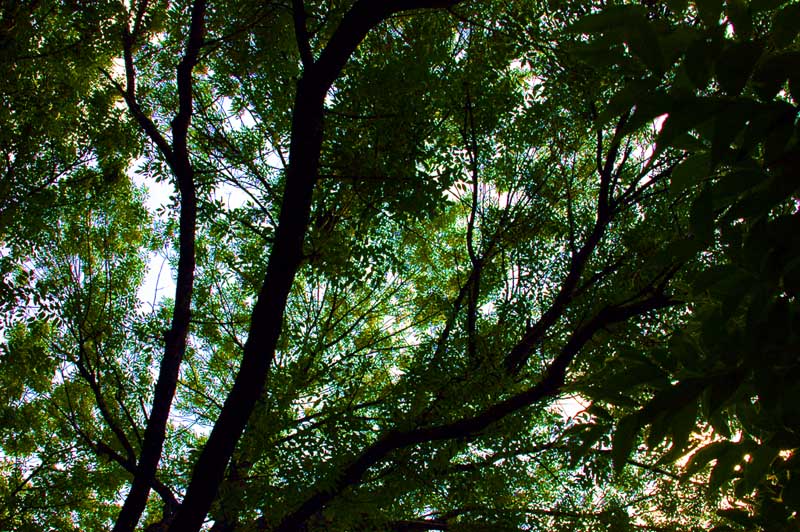
(click to enlarge)

I braved the heat today and went on a bike ride up at the Oak Point Park and Nature Preserve in Plano – riding down to Bob Woodruff park and out west along Plano’s Santa Fe trail (every city here has one of these). It’s a fun little route I rode last year and it’s a vaired one – some wooded creek bottoms, some open prairie, and a couple of nice hills.
About halfway out the Santa Fe trail branch of my route, along Oak Grove road, I had noticed a sign that said, “Santa Fe Park and Bowman Cemetery.” Looking up the hill I saw an open stretch of grass with some old monuments peeking over the crest. On the way back, I pumped up an alley and found the old cemetery – took a break to look at the stones and snap a few pictures.

The cemetery is in the middle of a neat, modest suburban neighborhood. Somehow, it fits there.

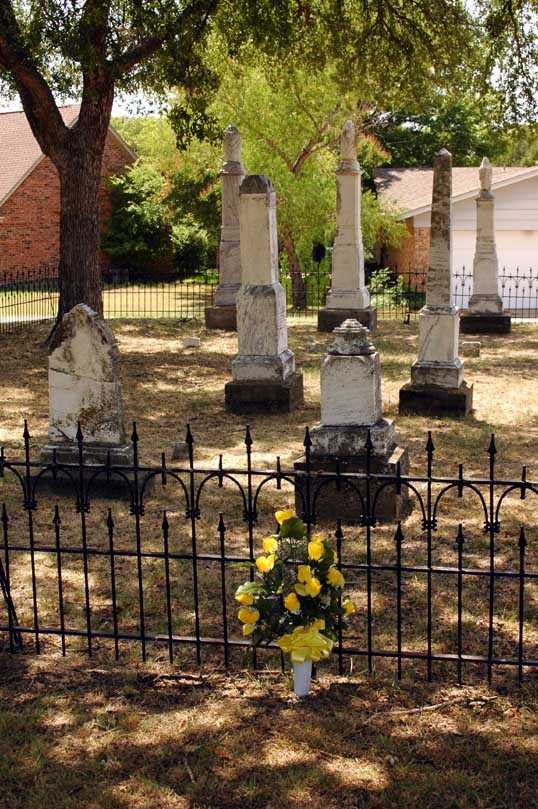
Someone is still putting flowers out on some of the graves – a century later.
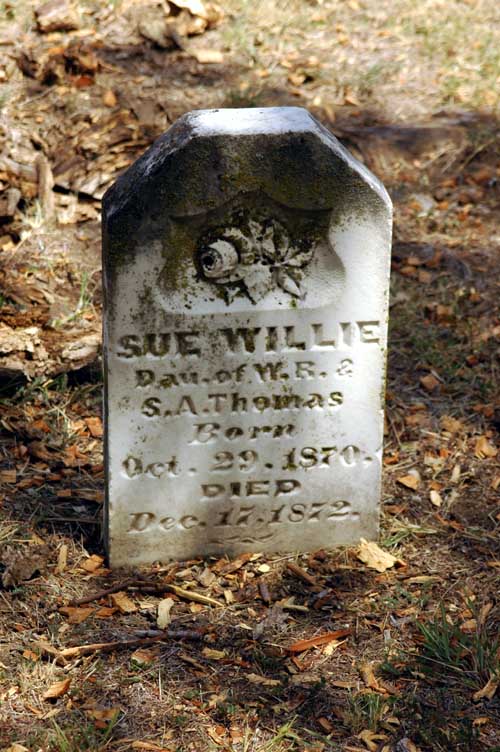
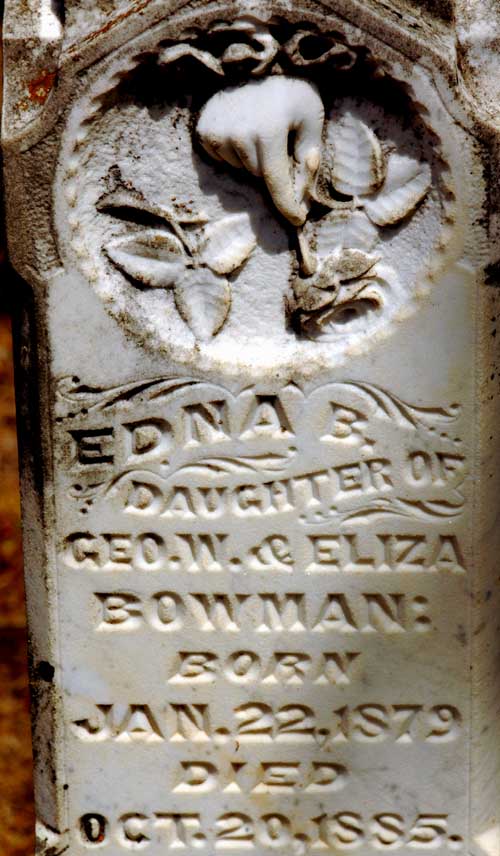


Not all the markers are grand monuments. Some, like these were no bigger than a small paperback book.
The cemetery sits right in the middle of a middle class suburb, but you can picture it on a knob of a hill with wilderness all around without much trouble. There is a historical marker – but the plastic is faded and crazed and I couldn’t read it.
From a historical website (they seemed to have trouble reading it too – thus the ellipses):
John D. Bowman established Bowman Cemetery with the burial of his daughter, Julia Ann Bowman Russell, who died on September 5 1858. The cemetery contains two fenced family lots. The large, more elaborate lot with wrought iron fencing, contains the burial of several members of John D. Bowman family, and their immediate in-laws. Among these are Joseph Russell, a Peters Colony (Republic of Texas land grant given to investors led by William S. Peters) settler, and Dr. Henry Dye, an early…..physician. The smaller, wire-fenced lot contains members of the Brown family, who were related to the Bowman and Russell families through marriage. Several marked and unmarked burials of both early African Americans and European American residents of Plano surround these fenced lots. A variety of gravestone types are represented in Bowman Cemetery. These range from the prominent marble tablet stones and a few….modern granite markers. Many of these stones are adorned with symbols and fancy….such as fraternal organizations….and religious or philosophical beliefs typical of the time period. The most recent marked burial in the cemetery is for John D. Bowman’s son, George W. Bowman, who died in June of 1921.
Whenever I see an old cemetery like this I can’t help but be reminded of how many folks died young. Half the graves are of children, half of the rest are less than thirty years old. When you find yourself down and worrying about the latest “crises” or feel the world is going to hell in a handbasket, think of these pioneers and how tough their life used to be.
There’s so little in the world we can be sure of, and maybe it’s that lack, that flaw or deficiency, if you will, that drives our strongest compulsions.
—- Ben Fountain, Brief Encounters with Che Guevara
After finishing the massive collection of J. G. Ballard’s fiction, I’m cruising my Kindle, finishing off some fiction that I have started and slacked off on.
From the first time I stumbled across a description of it – I was irresistibly drawn to Ben Fountain’s collection Brief Encounters With Che Guevara. First, he is an author that shares a city with me. Originally, from North Carolina (I was born there – in the first of many burgs I lived in with the word “Fort” as its prefix) he has a law degree from Duke (where my son goes to school) and then moved to Dallas to practice real estate law.
He struggled for years before he finally was able to publish this book. Malcolm Gladwell even wrote about his delayed genius. Finally he is recognized as a great writer and has gained additional fame for articles published in the aftermath of the Haitian Earthquake (I know a little about Latin American Third World Earthquakes).
There are eight stories in the book:
I absolutely loved the first story – Near-Extinct Birds of the Central Cordillera – set in Columbia, a country Fountain has no experience with.
“It’s better to go. It would have been better if I had gone to Colombia, it would have been better if I had gone to Sierra Leone. You never know what you’re missing. You never know what you don’t know until you go. But you can’t always go. You don’t have unlimited time and unlimited money. And so you do the next best thing—you try to imagine yourself into these places. The way I did it was to read everything I could get my hands on and to talk to other people who might have information. If there were helpful movies or documentaries, I sought those out. I was just trying to soak it all up and imagine my way into it using that basic research and my own experience in similar places or similar situations.
I actually think his distance from Colombia helped the story. It’s the story of an ornithologist kidnapped by Colombian rebels. While in captivity he discovers a natural prize of infinite value – though nobody else really understands. In the end, it is he who does not understand. It is the confusion of the ornithologist when confronted with the fatal mysteries of the third world that forms the backbone of the story.
It is this discord between the first and third worlds… this frission when confronted with something that is older, more passionate, and raw than anything you have ever thought possible – and then the dawning of the realization that this jewel of wonder is wrapped in impenetrable layers of horror and death, doom and madness… and there isn’t anything you can do about it – that’s what it likes to be exposed to the third world.
Believe me, I know.
Fountain seems to feel this in his stories and skirts it without completely diving in – but he comes closer than most anything I’ve read since the simple Ray Bradbury story, The Highway.
I would love to read his work as it continues to mature… to see him dig closer to the heart of darkness. Unfortunately he seems to be seduced by politics and moving more away from what I want to read. We’ll see, I won’t give up on him. I won’t give up looking for what I want.
On the other hand, I guess if you want something done, if you want to read something different, maybe you have to do just dig in and do it yourself.

Addicted to Haiti by Ben Fountain
After the Earthquake, but Before the Flood by Ben Fountain
What to Read? Ben Fountain Recommends
Brief Encounters with Che Guevara, Ben Fountain
Better Late Than Never: A Review of Ben Fountain’s Brief Encounters With Che Guevara
 Bill Chance