’twas in another lifetime, one of toil and blood
When blackness was a virtue and the road was full of mud
I came in from the wilderness, a creature void of form.
Come in, she said,
I’ll give you shelter from the storm.
—–Bob Dylan, Shelter From the Storm
Time Exposure, Night, Downtown Dallas, Ross and Olive (click to enlarge)
Crankcase oil drippings leave grease spots on the tarmac. The Texas summer profligate heat splits the pavement like an overripe tomato. But it’s night now and the humidity hums and settles over the earth. The browning grass still has a little green to give up.
Time smears the taillights into blood read streaks – claret smears – ephemeral neon tubes projected onto the light detector. Effects you can’t see with your eyes appear in the little screen.
And in the other lane, headlights leave a blazing aurora. Brilliant luminous lines.
These are always there – but you don’t ever notice them – hidden by time, too busy keeping things from running into each other.
“Space and time are the framework within which the mind is constrained to construct its experience of reality.”
― Immanuel Kant
Our government, I am more and more convinced, has degenerated into a mechanism whose most palpable effect (not its purpose, of course) is to irritate citizens by wasting their time and requiring their collusion in an endless bureaucratic paper chase.
My Tech Top 10
An interesting list – Actually, I only agree with one of his choices. Bet you can guess which one.
The only way to drop into Rio. I’m glad I was able to watch this on youtube – now I don’t have to do it myself.
The entire process seems to have started in 1923, when a biologist named Walter Finkler reported that he had managed to successfully transplant the heads of insects. He’d been working with water boatmen, meal worms, and common butterflies – both in adult and grub form. The transplantation process was not complex. He’d grab two insects, cut off their heads with sharp scissors, and switch them. The fluid that the insects themselves leaked cemented the new heads in place. After a little time — a 1923 article says a few weeks — the insects were healed up and doing whatever their new heads told them to do. Finkler claimed that the heads of female insects on male bodies continued female behavior, and the head of one species of butterfly kept the habits of its own species, even when its body belonged to a different species.
Bicycling in Dallas is too difficult and too dangerous. Bicycling magazine called Dallas the worst city for cyclists—twice (in 2008 and 2012). As a result, only heroes do it. And the solution is simple. We need only change the way we think.
When the story you are reading is published online, there will appear, without question, comments from people who will assail Mike McNair and hurl insults at cyclists of every stripe for getting in the way of their cars. A number of years ago, golf commentator David Feherty wrote a story for D Magazine about getting run over on his bike by a car in Dallas. He did a turn with Krys Boyd on 90.1 KERA to talk about the experience and his long rehabilitation. Online and on air, a sizable number of people said: “Screw the cyclists! They are a hazard and should get off the road!” Words to that effect.
That attitude is the first thing that must change if Dallas is ever to achieve its world-class ambitions. Bicyclists are like children. They are slow. They are sometimes unpredictable. They weave and wander and clearly think the world revolves around them. They infuriate. But they are our future. So we should not only tolerate them, we should encourage and coddle them.
Great News. The Dallas Museum of Art had free admission when it was first opened, and I was working downtown. While it is worth the paid admission, making it free enables a person to enjoy the place on a more informal basis. I used to go there and look at one piece of art only – really think about it. Hard to do that when you pay ten bucks to get in.
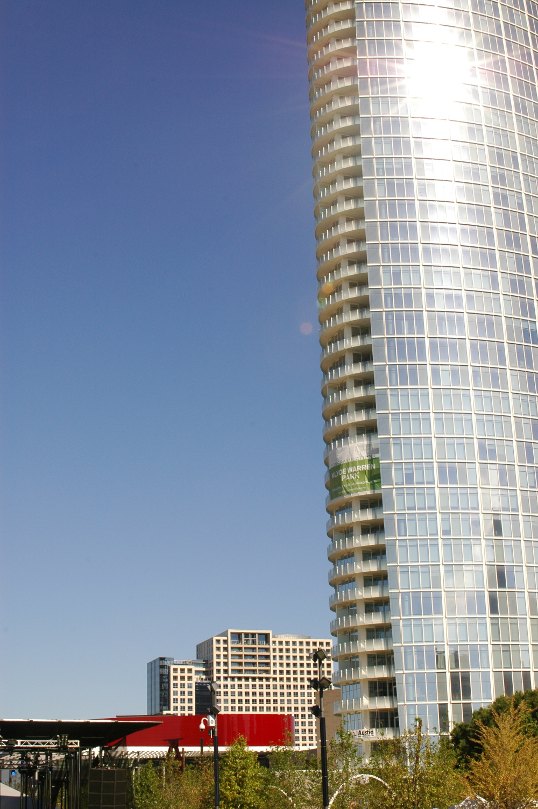
As Nasher Sculpture Center landscape architect Peter Walker sees it, the intense light reflecting off Museum Tower, the 42-story, $200 million condominium complex across from the center, is an “attack on the garden and on the building and on the art.” According to Walker, “What the reflection does is very much like putting light through a magnifying glass, it essentially burns everything that it sees.”
Writing in my Moleskine Journal outside the Mojo Lounge, Decatur Street, French Quarter, New Orleans
Anyone with free time in North Texas tomorrow, Saturday, December 1st, think about coming down to Deep Ellum for the first
Craft and Growler, down on Exposition near fair park, is open and it’s a cool place. A long way for me to drive for a growler full of beer…. but it’s worth it (my car gets great mileage).
An Idea Pomodoro – timer, pen, composition book.
A freelance writer shares his thoughts and experiences using the Pomodoro Technique to cut down on distractions and squeeze more productivity out of his day.
Blood Meridian is my “favorite” – if that’s the right word.
The fates of The Kid and Judge Holden are irrevocably intertwined. Although Holden slaughters The Kid (by now The Man) in an outhouse, we’re spared the repugnant details. We’re not spared the reactions of those that spy the hideous scene. The Man’s death was not a quick, nor was it a pretty affair.
This man is my hero.
When I watch that video, it’s amazing how many of the things that make Dallas livable are a direct product of this guy’s work.
One thing I thought interesting is that, as an example of what Dallas has that is bad – he showed a photo of the High Five interchange. What he didn’t know/mention is that underneath that giant monstrosity is a really nice bicycle trail. When they built the High Five, they thought seriously about providing alternative transport and added a way to cross both 635 and 75 – two of the frustrating barriers to alternative transport in our area.
It’s also a pretty darn impressive route to ride – along a little urban creek with almost a billion dollars worth of five layers of roadway stretching upwards hundreds of feet overhead.
The problem was that the cities on either side didn’t provide the support to build access to the High Five trail for years after it was built. Now it’s connected, but not as well as it should be.
Over the past 14 months, as this issue became known and stories about the damage Museum Tower is doing to its neighbors have appeared locally and nationally, many of you have asked us what you can do to encourage a positive resolution. If you live in the city of Dallas, I would ask you to make your Dallas city council representative aware of your opinion, whether by letter, email, or telephone. If you live outside of the city and care about Dallas’ cultural institutions voicing your support and opinion to our elected officials is also welcome. The leadership of Museum Tower needs to recognize their responsibility to our community, and your council representatives can play an important role in resolving this matter.
I’d like to reaffirm that we at the Nasher are advocates for the development of the Arts District and support the goal of Museum Tower to add residencies to this neighborhood. Ray Nasher has given our community an incredible gift by building an unparalleled museum in the heart of the Dallas Arts District and making his extraordinary collection accessible to all. The Nasher is an invaluable educational, cultural and economic resource for the people of Dallas and visitors from around the world and we need your support and your voices to ensure its future contributions to the region.
With thanks, as ever, for your interest and support,|
Sincerely,
Jeremy Strick
Director
Nasher Sculpture Center
If you would like to share your thoughts please contact support@nashersculpturecenter.org
The deadly solar rays burning down from the Museum Tower onto the Klyde Warren Park. The tower builders say this is not a problem, but take my word for it, it was nasty.
This bright shadow on the wall of the Nasher sculpture garden is not cast by the sun, but by the reflection off the Museum Tower.
You might expect that email and the ballpoint pen had killed the fountain pen. But sales are rising, so is the fountain pen a curious example of an old-fashioned object surviving the winds of change?
For many people, fountain pens bring back memories of school days full of inky fingers, smudged exercise books and piles of pink blotting paper.
But for others, a fat Montblanc or a silver-plated Parker is a treasured item. Prominently displayed, they are associated with long, sinuous lines of cursive script.
…..
Sharon Hughes, a buyer for John Lewis, says people relish returning to solid, traditional objects to make sense of a difficult and complex world.
“They are an old-fashioned thing but people like the personal touch. It is nice for things to be handwritten and not having everything via email,” she says.
According to Eva Pauli, from German manufacturer Lamy, the digitisation of everyday life has led to a change in writing by hand.
“Writing is becoming more and more exclusive and personal. This will probably be the reason that some people speak of a comeback of the fountain pen,” she says.
A sculpture garden is a wonderful place… a well-done sculpture garden on a nice day is the best of all possible places – one where the blue sky, crystal humming air, and moving spectators become part of the exhibit and integral to the pure joy of hanging out in such a spot.
A woman sits barefoot, shoes and drink nearby with her backpack not far away, and quietly studies her notebooks in the sun. How is she not as exquisite a work of art as the famous bronzes? The curve of her back, the spherical bun of hair on top of her head, and the sun gleaming from her ankles and toes – these are the simple pleasures the great artists strive for lifetimes to come close to duplicating and have to settle for a second-rate imitation, the best they can do.
The granite chair behind her is Settee, by Scott Burton. His works blur the distinction between furniture and sculpture. I’ve always enjoyed his piece at the Nasher, here in Dallas, Schist Furniture Group (Settee with Two Chairs). I’m never really comfortable sitting on his work – it seems wrong to wear the art like that, even though that’s exactly what he intended.
What sculpture is to a block of marble, education is to the soul.
—-Joseph Addison
When a finished work of 20th century sculpture is placed in an 18th century garden, it is absorbed by the ideal representation of the past, thus reinforcing political and social values that are no longer with us.
—-Robert Smithson
Sculpture is the art of the hole and the lump.
—-Auguste Rodin
Sculpture occupies real space like we do… you walk around it and relate to it almost as another person or another object.
—-Chuck Close
There is no substitute for feeling the stone, the metal, the plaster, or the wood in the hand; to feel its weight; to feel its texture; to struggle with it in the world rather than in the mind alone.
—-William M. Dupree
When I walked around the Chihuly glass exhibit at the Arboretum… here, here, here, here, here, here, and here – I heard one questions several times. People asked, “What happens when it hails.”
This is Texas, and they don’t say “if” it hails, they say, “when.” Even the Arboretum literature addresses that. It said that the glass is tougher than you think, and that Chihuly has capacity standing by to replace anything that breaks. When it hails.
Well, it hailed. It looks like the only damange is to the white blossoms in the Persian garden pool, the ones I saw the second time I visited the exhibition. They said the works will be replaced and the rest of the glass is unscathed.
The Chihuly glass in the Persian Garden Pool that was damaged by hail at the Dallas Arboretum. This photo was taken before the storm.
For those of you from places where the weather isn’t quite so… Texas-like, here’s some homespun video of what we live with here. All from Thursday afternoon.
Piano says that because the Nasher is a privately held collection, it is free to leave its Flora Street museum and go elsewhere — although he noted that this is not something the Nasher family wants to do, that it was the dream of founder Raymond Nasher to put his collection in the Dallas Arts District at that location. Were Nasher alive today, Piano says, he would “mad, mad, mad, mad, mad.”
I agree, I think the Nasher is playing way too nice with this. If it were my collection I would be in talks with, say New York City and see if the colection could be relocated to… maybe a nice site in Central Park. They would leap at the chance. I know the city of Dallas would be hurt by the move, but to make it up they could use the Nasher site for low income housing and maybe a homeless shelter. I’m sure the Museum Tower next door would enjoy that.
The Museum Tower Condominiums tower over Tony Cragg’s “Lost in Thought”
For generations, government policies have been geared toward creating endless landscapes of strip malls like the one Bentivolio looks at with such fondness. In the process we have gutted our traditional downtowns. We have eaten up farmland and forest. We have, …, endangered the lives of our senior citizens. We have engineered a world where children cannot walk or bike to school without risking their lives. We have created countless places devoid of any real social value.
An interesting article, but one that, for me at least, is ultimately useless. You might as well send a heroin addict an piece of paper listing the inconvieniences of shooting up.
Well, on Friday, there’s the Arts District Summer Block Party. These are always a lot of fun. I might do Late Night at the DMA. The Nasher has been showing kid’s movies on an inflatable screen in the garden, but this week it’s 500 Days of Summer. I’m getting a little tired of Zooey Deshanel’s Goofy Quirky Zany Adorkable Hipster Doofus persona… but still…
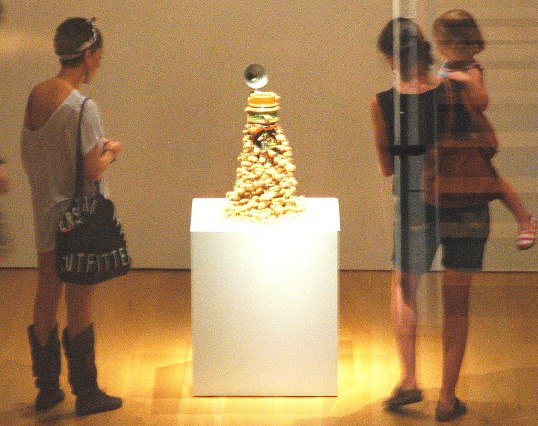
On the way to the restrooms, down in the cool, dim Basement (where the deadly burning rays of the Museum Tower cannot reach) of the Nasher Sculpture Center is a room with three oddly disturbing sculptures. This is the first installation at the Nasher by a local artist. His name is Erick Swenson, and he makes strange meticulous tableaux out of resin, most involving animals in some stage of death or decomposition. They are arrestingly realistic and strangely surreal at the same time.
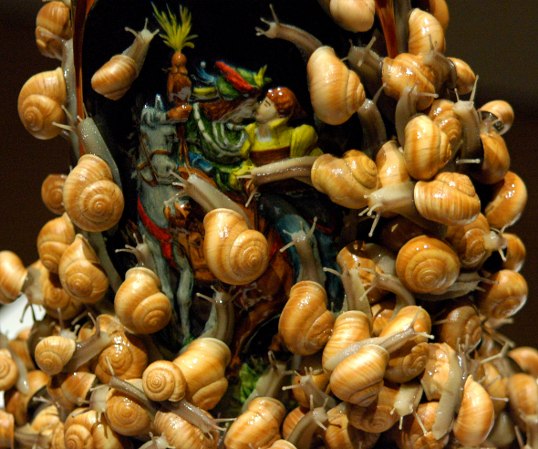
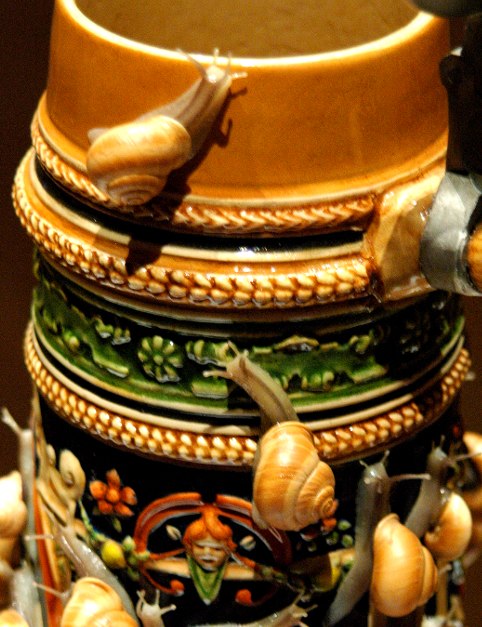
You can trap and kill snails and slugs in your garden with beer. This sculpture is called Schwärmerei – a German import to English that means something like fanatical enthusiasm, or the deadly insanity of the crowd (a word that could be fine-tuned and well-understood in Germany).
He says, “This is a static object. I’m asking you to look at this for more than three seconds. That’s hard to do sometimes. People just blow through stuff, you know. So it’s leaving things sort of enigmatic and open-ended.”
I granted his wish, staying and staring, then photographing the Stein ‘N Snails. Other than the obvious metaphorical underpinning, it was a gorgeous and highly skilled work of craftsmanship. I can see it as an advertising piece for a new chain of eateries called the Brewpub Escargot.
Unfortunately, I don’t posses a macro lens or decent flash lighting so the photos do not do due justice. For a good picture of a snail go here. So I suppose y’all will have to go down to the Nasher and see for yourself. By the way, the third sculpture, the one hidden from the squeamish public behind the little wall, is a doozy… you are forewarned.
Most folks were spending more than three seconds at the sculpture.
It’s hard to know what the mediation will accomplish, since the developers of the condo tower and their Los Angeles architect, Scott Johnson, have so far done little to accept responsibility. In an exhaustive report on the issue in D, Dallas’s city magazine, Tim Rogers quoted the developers as asking the Nasher what it was prepared to do to help, as if this were a negotiation in which both sides were expected to give an equal amount to reach an amicable compromise. Johnson, for his part, told The New York Times, “I can’t say sitting here now that the Nasher may not need to do something on their end.”
Why, in heaven’s name, should they have to? The Nasher was there first, it didn’t create the problem, and it is suffering from it.
There’s a photo of the glare inside the Nasher’s beautiful, Renzo Piano designed pavillion.
I don’t want to sound like the old fart that I am, but look at this list of the best 70 albums from the 1970’s (not considered the best decade for music by any shot). There is nothing that comes close to any of these being done today.
The ’70s sometimes get a bad rap: Often these years are remembered as the musical era that brought us disco at its absolute gaudiest. But there was far more going on in the decade than polyester, sequins and cocaine; the 1970s saw the rise of the singer/songwriter, the birth of punk rock, reggae’s infiltration of the mainstream and the long, strange trip led by some of psychedelia’s finest.
In fact, it’s a decade so musically diverse, we had quite a time whittling it down to our top albums. When we polled our staff, interns and writers, over 250 albums received votes, but ultimately these 70 emerged as clear favorites.
I have been writing about the ultra-expensive condominium Museum Tower cooking the Nasher sculpture center the same way a bully with a magnifying glass burns the ants on the sidewalk: here here
and here
The New York Times now has an article on the issue,
There are a couple of interesting quotes. First, from the Los Angeles based architect that designed this monstrocity:
Scott Johnson, the Los Angeles architect who designed Museum Tower, said he was willing to consider remedies but that the Nasher also had to be open-minded. “My responsibility is to fully vet solutions vis-à-vis Museum Tower — that’s my building,” he said. “But I can’t say sitting here now that the Nasher may not need to do something on their end.”
So, you see his concern for the neighbor (The Museum) that actually made his project (The Museum Tower) possible. I would imagine it would have been a good idea to “fully vet” his design before the thing was built, don’t you?
And also, a fact I did not know, that helps to emphasize the whole political disgustedness of the whole thing:
Complicating matters is that the $200 million Museum Tower is owned by the Dallas Police & Fire Pension System, on whose board sit four members of the City Council.
Ok, that makes it even more clear how the developers knew they could get away with this without the city doing a thing to stop them. Remember, none of this went into action until Raymond Nasher died – then the powers that be moved in to devour the carcass of his philanthropic vision.
The final word is from the livid Renzo Piano… who just might know a little about this sort of thing.
“By doing this, they kill what they use to sell it,” Mr. Piano said.
I think that, right now, the tower should be requred to change its name (Maybe to “Death Star Condominium Tower”) and to remove all reference to the Nasher Museum from its sales pitch (where it, of course, figures very prominantly). Actually, they should be required to warn their potential residents of the skin cancer danger poised by the neighbor next door due to the reflected sunlight.
The Museum Tower Condominiums tower over Tony Cragg’s “Lost in Thought”
The news is spreading. Also, as the city prepares to open their much-ballyhooed park that has been built over the Woodall Rogers freeway – it has been “discovered” that the glare from the tower raises the temperature in the park significantly. Now, everyone is getting pissed off – though not as much as me.
There are some updates:
– D Magazine has done an extensive and interesting article about the tower and the politics behind it. Read this… it is fascinating stuff – even if you don’t give a damn about Dallas: D Magazine – The Towering Inferno How Museum Tower threatens the Nasher Sculpture Center and the Woodall Rodgers roofdeck park, two of the most prized assets of the city’s vaunted Arts District.
Finally, the chairman of the Dallas Police and Fire Pension Trustees has a video saying that they have everything under control. He says they have been unfairly blamed for the problem. – He makes a good speech, but the building is still there – cooking everything within reach of its reflected laser beams. He says he’ll fix it – I’ll believe it when I see it.
It bugs me that he talks about all these architects, consultants, and experts they have hired. How about Renzo Piano, the architect of the Nasher. He has made his opinion very clear and he isn’t happy. It sounds to me like the Dallas Police and Fire Pension fund has hired a bunch of hacks and are trying to convince us they know more that the Pritzker Prize winner.
During the week I sometimes see something cool surfing around and make a note to put a link to it up on my friday blog entry. But a day later the thing has gone viral, everybody knows about it, and I have to take it off.
Here’s one of those – you’ve probably seen it, but if you haven’t, you should.
ALL ABOUT COFFEE:
What is Coffee?
The History of Coffee
Ten Steps to Coffee
How to Store Coffee
How to Brew Coffee
The Value of Coffee
Coffee Recipes
Roasting Types
Coffee From the World
From the Seed to the Cup










 Bill Chance