Short Story (flash fiction) Of the Day, The Barracuda in the Pool by Cecilia Kennedy

I’m suddenly aware that I’m smiling. I’ve finally made it here, to summer—after such a long winter—and I’ve treated myself to a dip in the pool.

—-Cecilia Kennedy, The Barracuda in the Pool

Mural, Deep Ellum, Dallas, Texas

Good writing will bring back memories. Flash fiction can artificially extend its length and value that way – by tacking strong memories onto the end of the text itself.

Today’s flash fiction brings back a couple to me (maybe spoilers… maybe read the story first).

One was (maybe 1972) swimming inside the shark netting in the ocean at Fort Sherman (now long gone) on the Atlantic side of the Canal Zone. I remember the taste of salt, the sweltering heat, and the primordial green of the neighboring rain forest. There was a large active crowd in the water and I put on my mask and dipped my face below the surface to take a look. There was a barracuda, a big one, gliding smoothly between the writhing bodies. Minding his own business. He looked so streamlined, so powerful, so prehistoric… like something from another world. I felt embarrassed because I dared contaminate his ocean with my pitiful presence.

The second was… maybe two years later and 500 miles northwest of there, diving into a pool in a country club in Managua. I mistook the shallow end and plunged my face into the rough gunite bottom. It hurt but the worst was when I stood up. A young woman standing in the pool looked at my face and the gore pouring down and let out the most blood curdling movie scream I have heard in my life. I was ultimately fine, the worst wound was the sound of her voice and the terror on her face. That remains after a half century has passed.

Read it here:

The Barracuda in the Pool by Cecilia Kennedy

from Flash Fiction Magazine

by Cecilia Kennedy

Cecilia Kennedy Twitter

Short Story (flash fiction) Of the Day, Partition by Susan Carol

Here, in the Pink Zone, we are safe, but we are sad. Once a week carts arrive with provisions: rice, beans, tea. Sometimes there are fruits. Mangoes, apples, persimmons. The youngest of us rush at them as if to quench a longing for our fathers’ arrival.

—-Susan Carol, Partition

Ravens Drug Store, Oak Cliff

I keep reading about dystopia, refugees, or the end of the world. Should read about something happy – but it doesn’t read realistic right now.

Partition by Susan Carol

from Reflex Fiction

Short Story (Very Short Flash Fiction) Of the Day, “Give It Up!” by Franz Kafka

“I think we ought to read only the kind of books that wound or stab us. If the book we’re reading doesn’t wake us up with a blow to the head, what are we reading for? So that it will make us happy, as you write? Good Lord, we would be happy precisely if we had no books, and the kind of books that make us happy are the kind we could write ourselves if we had to. But we need books that affect us like a disaster, that grieve us deeply, like the death of someone we loved more than ourselves, like being banished into forests far from everyone, like a suicide. A book must be the axe for the frozen sea within us. That is my belief.”
― Franz Kafka

St. Vincent’s Guest House, New Orleans

Tough days – tired days – days where you are not sure what day it is or where you are or where you’re going or why you’re going you don’t know where. Franz Kafka days.

There are several translations of Give It Up! scattered in many places across the web. It’s so short, though, instead of a link I’ll past the whole thing in here – one abbreviated paragraph of despair.

“Give It Up!” by Franz Kafka

It was very early in the morning, the streets clean and deserted, I was walking to the station. As I compared the tower clock with my watch I realized that it was already much later than I had thought, I had to hurry, the shock of this discovery made me unsure of the way, I did not yet know my way very well in this town; luckily, a policeman was nearby, I ran up to him and breathlessly asked him the way. He smiled and said: “From me you want to know the way?” “Yes,” I said, “since I cannot find it myself.” “Give it up! Give it up,” he said, and turned away with a sudden jerk, like people who want to be alone with their laughter.

The Strange Bird

For he had no typewriter ribbon left and only fifty sheets of paper and he counted on the stabbing imprint of the keys to make an impression like a branding, and when he had used the fifty sheets, front and back, he would start again, typing over what he had already impressed upon the page.

—- Jeff VanderMeer, The Strange Bird


Bird, Scavenging along an Interstate Highway in Texas

Back in the olden days, the days when we did things, I would go to a book club in a bookstore on the other side of town and join a group that would read the same book and discuss it. It seems so long ago.

One book we read was Jeff VanderMeer’s Dead Astronauts. I really can’t say I enjoyed the book – it was too, too difficult to read. I looked forward to the discussion. I was curious about what everybody thought – but the thoughts were jumbled. I asked, at the end of the evening, “Would anyone here have finished this book on their own – without the pressure of having book club?” The answer was a resounding NO.

Though I won’t say the book was enjoyable, it was interesting… and it was… haunting is the best I can come up with.

And when I came across an online short story written by VanderMeer – The Situation – I read it and wrote about it. It was another fabulous story but told in a more conventional way – not too difficult to get through.

And then… well, there’s this thing I do. I always like to have some short books laying around – something to read when I don’t have very much time, energy, or patience. What I do is I walk down the aisles of the library in the fiction section simply looking at the physical books. Then I pull the small and slim volumes out and see if they are something I might be interested in. This, again, was back in the olden days when there were libraries.

The last book like that I checked out – I looked at it and, surprise, it was another by Jeff VanderMeer – a short novel, novela really, called The Strange Bird.

And it, again was in a different style. It was a straightforward (though bizarre) tale told as a hero’s journey – like The Odyssey, or The Alchemist,  or The Hobbit, or something like that.  The protagonist is the eponymous “Strange Bird” – a creature that may have started out as a bird but had been manipulated in a horrific futuristic bio-tech lab – bits added from many different animals… and humans… fantastic properties and abilities… until what was left was an intelligent, damaged, powerful, fearful, beautiful, hurt and most of all – unique thing – the Strange Bird:

In the lab, so many of the scientists had said, “forgive me” or “I am so sorry” before doing something irrevocable to the animals in their cages. Because they felt they had the right. Because the situation was extreme and the world was dying. So they had gone on doing the same things that had destroyed the world, to save it. Even a Strange Bird perched on a palm tree on an artificial island with a moat full of hungry crocodiles below could understand the problem with that logic.

—- Jeff VanderMeer, The Strange Bird

Even though the styles are varied – the Strange Bird is a “Borne” novel and The Situation is a “Borne” novela and The Dead Astronauts is another “Borne” novel. They are set in a fantastic world established in the linchpin novel Borne by Jeff VanderMeer. This is a dystopian earth destroyed by the experiments conducted by The Company – a giant biotech conglomerate. The blasted world is left with the few remaining humans battling for survival with the genetic monsters created by The Company – now escaped and running amok.

There are characters and locations shared (though often at different times – different stages of their lives) – Charlie X, Rachel and her lover Wick (who sells drugs in the form of customized beetles that produce memories when shoved in one’s ear), the Balcony Cliffs, and especially the giant flying killer bear, Mord. Borne himself(herself? itself?) is mentioned briefly in The Strange Bird.

So, now, what choice do I have? I picked up a copy of Borne – will read it next.


Short Story Of the Day (Flash Fiction) A Trace of Music by Robert Garner McBrearty

During all my drinking days, I listened for that music and thought it might be worth continuing to drink just to hear it once more. But, of course, it wasn’t.

—-Robert Garner McBrearty, A Trace of Music

Music at Ciclovia Dallas

Working my knee back with ice, rest and ibuprofen. Yesterday, I rode my spin bike on very light resistance for an hour and today, one week after I slipped coming out of the shower and twisted my knee, I rode my road bike for the first time – five miles around the ‘hood. It was fine – not entirely pain-free, but bearable. Maybe ten miles tomorrow after work (I have to work, I am essential). The nice thing about the road bike is that with my feet clipped in they are held rigid with no lateral flex in my leg or knee. That helps. It’s a bitch getting my shoes on, however.

A day at a time – small improvements – each day a little better than the day before.

Like in today’s story….

Read it here:

A Trace of Music by Robert Garner McBrearty

from Heart of Flesh Literary Journal

Robert Garner McBrearty Homepage


Gervaise

“With almost superhuman strength she seized Virginie by the waist, bent her forward with her face to the brick floor and, notwithstanding her struggles, lifted her skirts and showed the white and naked skin. Then she brought her beater down as she had formerly done at Plassans under the trees on the riverside, where her employer had washed the linen of the garrison.

Each blow of the beater fell on the soft flesh with a dull thud, leaving a scarlet mark.”

Emile Zola, L’Assommoir


Yesterday I finished Zola’s L’Assommoir and enjoyed it a lot. In doing some online research about the book I discovered it had been made into a 1956 French film called Gervaise that wasn’t supposed to be too bad. It was directed by René Clément and starred Maria Schell (sister of Maximilian). I was able to find a copy of the film and waited until I finished the book – then sat down to watch it.

L’Assommoir is a big, complicated, 500 page book and I knew they would have to slim it down to get the story into a movie. They did, but remained faithful to the spirit of the Zola novel. The movie concentrates on Gervaise – not surprisingly – and leaves out a lot of the tumult around her. I really liked the film – despite being over sixty years old (a year older than me) it holds up well. Gervaise’s decent into abject poverty, despair, and destruction is rushed as compared to the book – she is still alive at the end of the film and the book conveys the horrors of her descent better. There is a political subplot added to the movie that wasn’t in the book – and I didn’t think it added much. But otherwise, I thought the movie did a good job and illustrated the look of a lot of the story that I had trouble imagining (having never been to Paris of the Second Empire myself).

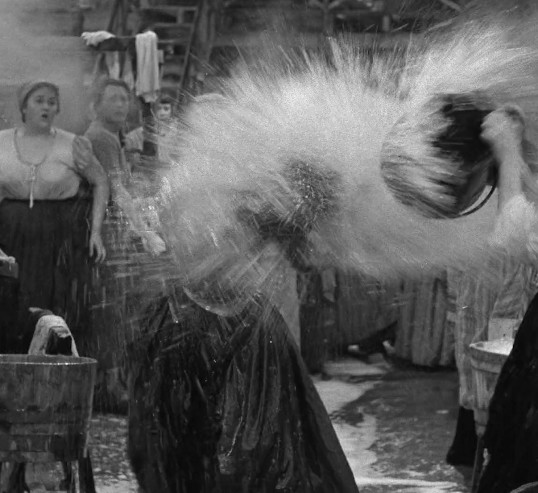
Like the book, the movie suffered from prudish editing – luckily the version I found seems mostly uncut (it was 116 minutes long). The biggest difference seems to be in the fight in the wash house between Gervaise and her arch-rival Virginie at the beginning of the story – the version I saw had a bloody scene of Gervaise tearing off Virginie’s earring and then beating her bare bottom with a wooden paddle. Tame by modern standards – those scenes were too much for the 1950’s.

The movie is one of the most expensive (in modern currency) foreign films ever made. The sets are extensive, detailed, and realistic.

And the best thing is that many of the memorable set pieces of the book are preserved. The wedding party and its visit to the Louvre, the horrifying fall her husband takes off a roof on the day she is to buy her shop, Gervaise’s Name-Day feast, Coupou’s alcoholic madness (though transferred from an asylum to Gervaise’s shop – probably more dramatic that way), and most of all the famous fight between Gervaise and Virginie in the wash house – all were giving loving care and exciting treatment.

Gervaise and Virginie going at it in the wash house. Gervaise’s man, Lantier, has just run off with Virginie’s prostitute sister, Adèle.

Virginie about to hit Gervaise with the wooden paddle.

Gervaise has reversed the fight and is about to give Virginie a vicious paddling.

This scene was apparently too much for the censors. Virginie is about to get hers.

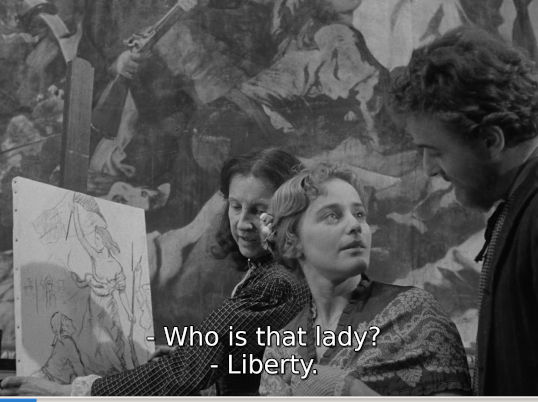
The wedding party goes to the Louvre, here Gervaise and Goujet are standing in front of Delacroix’s Liberty Leading the People.

Delacroix’s Liberty Leading the People

Gervaise singing at her Name Day party – the high point of her life.

A ruined and despairing Gervaise at the end of the film.

Compare this scene to:

L’Absinthe (detail) by Edgar Degas

At least Degas’ woman still has her hat (Gervaise has pawned hers).


Reviews of Gervaise:

Adapting Emile Zola’s L’Assommoir, René Clément’s Gervaise (1956)

Gervaise: True Grit

GERVAISE – ESSENTIAL ART HOUSE


L’Assommoir

“While the storm was erupting, she stayed, staring at it, watching the shafts of lightning, like someone who could see serious things, far away in the future in these sudden flashes of light.”
Emile Zola, L’Assommoir

 I am now a good chunk (have been reading for a year and a half) into Emile Zola’s twenty volume Rougon Macquat series of novels. Attacking this pile of books in the recommended reading order:

  • La Fortune des Rougon (1871) (The Fortune of the Rougons)
  • Son Excellence Eugène Rougon (1876) (His Excellency Eugene Rougon/ His Excellency)
  • La Curée (1871-2) (The Kill)
  • L’Argent (1891) (Money)
  • Le Rêve (1888) (The Dream)
  • La Conquête de Plassans (1874) (The Conquest of Plassans/A Priest in the House)
  • Pot-Bouille (1882) (Pot Luck/Restless House/Piping Hot)
  • Au Bonheur des Dames (1883) (The Ladies’ Paradise/Shop Girls of Paris/Ladies’ Delight)
  • La Faute de l’Abbé Mouret (1875) (The Sin of Father Mouret/Abbe Mouret’s Transgression)
  • Une Page d’amour (1878) (A Lesson in Love/A Love Episode/A Page of Love/A Love Affair)
  • Le Ventre de Paris (1873) (The Belly of Paris/The Fat and the Thin/Savage Paris/The Markets of Paris)
  • La Joie de Vivre (1884) (The Joys of Living/Joy of Life/How Jolly Life Is/Zest for Life)
  • L’Assommoir (1877) (The Dram Shop/The Gin Palace/Drink/Drunkard)
  • L’Œuvre (1886) (The Masterpiece/A Masterpiece/His Masterpiece)
  • La Bête Humaine (1890) (The Beast in the Man/The Human Beast/The Monomaniac)
  • Germinal (1885)
  • Nana (1880)
  • La Terre (1887) (The Earth/The Soil)
  • La Débâcle (1892) (The Downfall/The Smash-up/The Debacle)
  • Le Docteur Pascal (1893) (Doctor Pascal)

The next one up (the thirteenth) was L’Assommoir – I picked up an excellent Penguin Classics translation by Robin Buss entitled The Drinking Den (there is no good English translation for the French word L’Assommoir).

L’Absinthe (detail) by Edgar Degas

From the article 10 Intoxicating Facts About Edgar Degas’s L’Absinthe

9. IT INSPIRED A LITERARY MASTERPIECE.

L’Assommoir by celebrated French novelist Émile Zola was an exploration of alcoholism among the poor of Paris. Zola must have seen the painting during its disastrous 1876 debut, as his book was published the following year. The author credited Degas for some of L’Assommoir ‘s imagery, telling him, “I quite plainly described some of your pictures in more than one place in my pages.”

It took me five months to finish  L’Assommoir – well, actually I read it in a week – I spent five months reading other stuff. I guess that’s all right.

After reading La Joie de Vivre  I had to decide –  I had already read L’Assommoir – along with four of the next five. Years ago, before the internet, I was able to get my hands on L’Assommoir, Germinal, La Bête Humaine, and Nana – but none of the others in the Rougon-Macquart Cycle. So, do I re-read L’Assommoir? Or skip ahead to L’Œuvre (which looks really interesting).

I decided to re-read the ones I had poured through already. At least with L’Assommoir I’m glad I did.

First of all it’s arguably (along with Germinal) the best book in the series. It’s a terribly sad story but an arresting one, full of fascinating full-blooded characters filling a complete world. We can’t live (thank God) in the world of the underbelly of Paris in the Second French Empire – but the book takes us there and we can feel the moments of passionate fun along with the grinding poverty and ultimate doom of a group of people we come to know well and care deeply about.

The story follows Gervaise Macquart, who we met briefly in the first novel in the series,La Fortune des Rougon, where she ran away from her country town of Plassans to Paris with her lover, Lantier. She works as a washerwoman and has two children with Lantier until he leaves her for another woman. Then she marries a non-drinking roofer, Coupeau and her life takes a turn for the better. She is able to put together the funds to open her own laundry, hire employees, and her daughter is born (Nana – who will have her own book later on, as will Gervaise’s other two children) – everything is going great. This is Zola, however, and he accounts for the madness in the Rougon-Macquart family and after Coupeau is severely injured in an accident they go on a long, heartbreaking, alcohol-fueled fall into abject poverty, disaster, and madness.

The second reason I was glad I re-read the book is that I was able to get a good great translation. As I’ve written before all Zola’s books are available for free in ebook form from Project Gutenberg. However, these translations done by  the Vizetelly family are not the best. Henry Vizetelly was imprisoned over the publication of his translation of La Terre, which was considered offensive. Subsequent editions of all of Zola’s novels were heavily edited by his son Ernest in order to avoid further prosecutions.

I have learned to bite the bullet and buy a modern translation if one is available. This is especially true of L’Assommoir. It is filled with street slang and risque scenes which are omitted from the Vizetelly versions. The Penguin edition I had was translated by Robin Buss and was very well done. I’m going to look for his translations of any French novels in the future.

The arc of the story of L’Assommoir is heartbreaking but I loved the structure of the novel. It is built around a series (pretty much one per chapter) of set pieces. In keeping with Zola’s style of literary naturalism these scenes are finely detailed, rollicking, and the reader feels in the heart of the action. The wedding  (with a tumultuous visit to the Louvre), Gervaise’s triumphant feast (the zenith of her life which also contains the seeds of her downfall), and the final battle with alcoholic madness of her husband Coupeau, are some of the most famous – but there are more.

So, if you want an introduction to the seedier side of Paris, an introduction to Zola and naturalist literature, with a great (although heartbreaking) story – you can’t do better than L’Assommoir.


Short Story (flash fiction) Of the Day, The Repurposing of Harold Foster by Debbi Voisey

‘Photons are bouncing around all the time,’ he’d said. ‘They’re landing on you. They’re disturbed by your smile and they gather in your eyes.’

—-Debbi Voisey, The Repurposing of Harold Foster 

George Herold, Dallas Contemporary

There is physics and there is life and death. They must be related in ways too subtle and complex for us to comprehend – but they must be the same. Even though your soul must be in there somewhere – your consciousness strung out along fields of electrical energy – every atom in your body obeys the same rules as the atoms in a high school demonstration laboratory experiment. The little spring cannon shoots a steel sphere across a big sheet of paper – you measure the distance, write it down in a spiral notebook… your thoughts flutter between writing up the assignment and the girl in the next group (why couldn’t she be in yours… she never is). But I digress.

I have been thinking a lot about the brain of a dilapidated decrepit old man and how it compares to the brain of a vibrant vigorous young one. There is no difference.

A nice, wistful little piece of short fiction today. Read it here:

The Repurposing of Harold Foster by Debbi Voisey

From Reflex Fiction

Debbi Voisey

Debbi Voisey Twitter


Short Story (flash fiction) Of the Day, Weight by Dawn Lowe

He was old, thin and wasted. The space suit lay in the dust at his feet, white and shiny, a US flag on its chest.

“How much?” I asked.

“$1,500,” he said. “Cash.”

—-Dawn Lowe, Weight

(click to enlarge)
Mural, Deep Ellum
Dallas, Texas

We all see them, people by the side of the road, selling stuff. Some folks never look and always drive by. Some folks have an irresistible hoarder urge and look for bargains.

Are there things you can buy that will really change your life? For the better? For sure?

Maybe they will change someone else.

A very short story about someone that decides to stop. Not looking for a bargain, they willingly overpay.

Read it here:

Weight, by Dawn Lowe

from issue 1 of Brilliant Flash Fiction

Dawn Lowe (Aurore Lebas) Twitter

Jellyfish In the Sun

“But how can I put a name to what it is that I want? How am I to know that I really don’t want what I want, or that I really don’t want what I don’t want? These are intangibles that the moment you name them their meaning evaporates like jellyfish in the sun.”
Andrei Tarkovsky, Stalker: un film de Andreï Tarkovski

Broken Concrete and Rebar, Dallas, Texas


I took a day of PTO today (I am still working, I am essential) to try and heal my knee which I hurt in a fall outside my shower on Sunday. Someone reminded me of RICE – Rest, Ice, Compression, and Elevation (Would like to try RICED – with the addition of Drugs… but no luck there) and that sounded good for me. I made a spot where I could stretch out with a flexible ice pack on my knee. To kill the time I watched a movie on my laptop which I had seen over three decades ago – Stalker by Andre Tarkovsky.

Tarkovsky is, as I’m sure you know, an unmitigated genius – a master of idiosyncratic film making.  I’m glad I saw the film again – I noticed a lot that I missed the first time.

One aspect is the Russian technique of adding very deep philosophical soliloquies spouted by characters in the story – the plot becomes a scaffold to present these musings on faith, desire, and humanity. It is like Dostoevsky or Tolstoy where dramatic action illustrates deeper issues.

Here’s an example – the long monologue by the character known only as Writer after he narrowly escaped death in the room of dunes (you’ll have to click through and watch it on YouTube).

Look at this closely… who is he talking to?

And, like all of Tarkovsky’s films… what images! I hadn’t noticed (or remembered) the Wizard of Oz trick of having the day to day life in black and white (or at least de-saturated sepia tones)   and only have the full luscious color spring out in the Zone itself (when you see the film note carefully what other subject is shown in color). The burning rocks on the shore. The room of dunes. The dust devils on the dried up undulating swamp (apparently this scene and others involved carcinogenic chemical wastelands that may have eventually led to the death of the director and others involved in the film). The catalog of items in the long shot through the shallow water. The stalactite festooned tunnel of horror, the meat grinder. The way he films faces….

It is a feast for the eyes as well as the brain.

Let everything that’s been planned come true. Let them believe. And let them have a laugh at their passions. Because what they call passion actually is not some emotional energy, but just the friction between their souls and the outside world. And most important, let them believe in themselves. Let them be helpless like children, because weakness is a great thing, and strength is nothing. When a man is just born, he is weak and flexible. When he dies, he is hard and insensitive. When a tree is growing, it’s tender and pliant. But when it’s dry and hard, it dies. Hardness and strength are death’s companions. Pliancy and weakness are expressions of the freshness of being. Because what has hardened will never win.

Andrei Tarkovsky, Stalker