Everybody had so much fun at the Seersucker Bicycle Ride and Picnic the other day. There was a lot of photography going on – such great shots. One discussion was about the relative advantages of taking the regular posed shot versus the technique of staying still and waiting for the photograph to come to you.
Amanda Popken of Dallas Cycle Style had brought a couple of kites on her bicycle. I stayed in one place while she ran past, trailing a kite behind her.
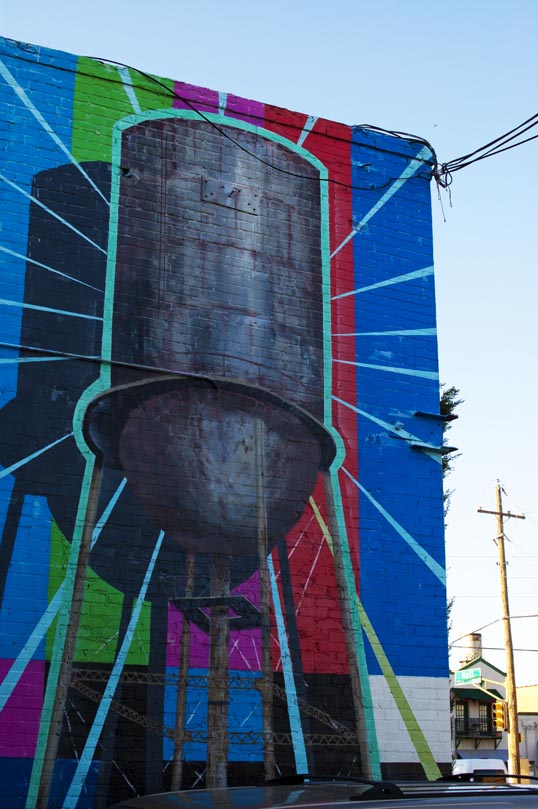
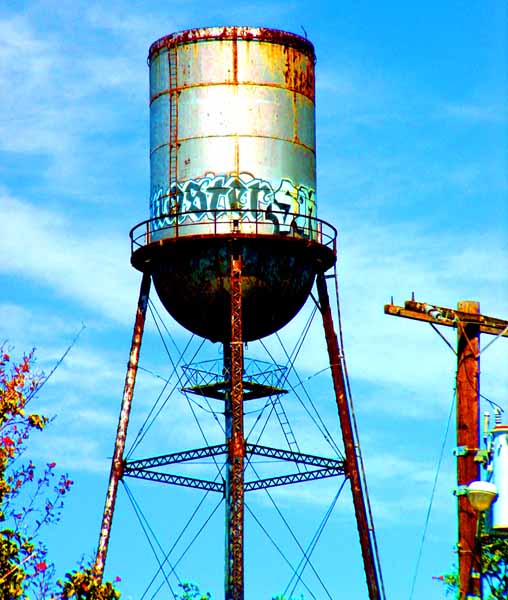
You could see the real water tower from the mural. It’s the little thing in the bottom right of the photo. Unfortunately, I couldn’t get the light – or the space to use a telephoto – so you can’t see both very well.
This looks like a back alley somewhere, but it is actually a street – with a name and signs and everything. It is Clover Street, in Deep Ellum, Dallas, Texas.
Although it is little known outside Dallas, Deep Ellum has a long and illustrious, often infamous, history. The rise and development of today’s music owes as much to Deep Ellum as it does to New Orleans, Chicago, California, or Nashville.
Riding my bicycle down Clover Street I see these old steel rails rise up for a couple blocks before disappearing back below the tarmac and concrete. What story do they tell? Was there a streetcar line running down a narrow lane? Or were the buildings factories and the rail line built to bring in raw materials and to haul out product?
That was probably it. Looking at Googlemaps, Clover starts at Trunk Avenue (a railroad name, of course), runs down and ends behind the Adams Hats Lofts. These are urban living spaces converted from an old hat company. But the building’s original use, built in 1914, was one of Henry Ford’s original assembly plants for the Model T.
So you can imagine trainloads of parts going down that line a hundred years ago, and completed automobiles rolling back out to all over everywhere. These would be any color you wanted… as long as it was black.
It was a nice day today, the first really warm day (over 90) of the year. I wanted to get in a bike ride, so I sat down with Google Maps to figure one out.
Recently, the city of Plano has built a nice connector trail that runs from Oak Point Park in the east, across and under Highway 75 to connect with the Bluebonnet Trail and the rest of the trail system. I had stopped to explore this the other day on my way back from a visit to Frisco. That’s the nice thing about keeping my folding Xootr Swift in the back of my car – I can stop whenever I feel like it and explore.
I drive a tiny car – a Toyota Matrix. I always liked it because I could fold the rear seats down and get a bike (barely) into the back of the car (never liked exterior bike racks). I was surprised at how small the Xootr Swift folded down. I was able to fit it easily in the small space behind the rear seat. Now I have a four-passenger car again.
So I put together a fifteen mile ride (that linked map is backward – I decided at the last minute to ride the route in the opposite direction). I’d start in the north parking lot at Collin Creek Mall and take fifteenth street east and then P street north until I caught the trail that runs down to Oak Point. Then north through the park, and west on the new trail to the Bluebonnet Trail. I could it to the intersection with the Southeast heading Chisholm Trail which would take me back to my car.
Going through the park was interesting. First, in a wooded section, a bobcat ran across the trail right in front of me with a mouse in his jaws. I know they are there, but you don’t see too many bobcats, especially in the bright of the day.
As I worked north, I started coming across crowds of people walking along the trail. There was a huge music festival – the first Suburbia Music Festival – set up – giant stages, tents, rides – in the big open field that covers the hill at the park. It looked cool – but I don’t have the cash for admission so I rode on.
Finally, a little north of the festival (but close enough that I could still hear amplified music booming in the distance, I took a break at a picnic table along the trail. I had almost a gallon of iced water in a soft cooler attached to the CrossRack on the back of my Xootr Swift. I’ve found that carrying cold water like that makes riding in the Texas heat bearable and I wanted to get a jump on the season.
The spot was really nice. Even though it is in the middle of a giant tony Texas suburb, with miles of massive brick homes cheek-to jowl sprinkled with gas stations and chain restaurants… all this was hidden behind the riparian forest that followed Rowlett Creek and its tributaries. All I could see was my little strip of smooth concrete, a large expanse of tallgrass pasture (hopefully, they are trying to recreate a habitat that once covered the entire center of the country) and bordered by the thick bottomland woods.
Next to the table was a tilted sign – a historical marker. Protected by plexiglass was a big poster outlining a terrible event – the Muncey Massacre – that had occurred near the spot a long time ago. I read it, took a photo of it, and typed it out here for you to read – save you a trip out onto the trail.
It wasn’t hard to imagine the wildness and hardships of that time. Even with the music reverberating in the background.
The Muncey Incident
The promise of free land offered by the Republic of Texas for the purpose of colonizing the unappropriated lands of the Republic resulted in conflicts with American Indians due to encroachement on their way of life.
The first Anglo-American settler in the Plano area is believed to have been Mr. McBain Jameson, who received his conditional certificate (land grant) from the Republic of Texas on January 2, 1840. The next family to settle in the area was that of Jeremiah Muncey, his wife and four children. Muncey received his grant on January 3, 1842. In 1844 Jameson, an older man, settled with the Muncey family rear Rowlett Creek. The chosen site was situated near the intersection of Legacy Road and Highway 5/Avenue K today. The homestead was at the edge of the densely wooded creek bottom near a spring. The Muncey family and Jameson reportedly were living in a temporary shelter while constructing a log cabin.
According to traditional accounts, in the fall of 1844, Leonard Searcy, his son, William Rice and his son went on a hunting trip down Rowlett Creek. They set up camp about ten miles from their home, near the Muncey homestead. The next morning, when Leonard Searcy went in search of the Muncey family, “…he discovered a heartrending sight.”
Mr. and Mrs. Muncey, their young child, and Jameson had been murdered. The three Muncey boys were gone. It was later discovered that the 15-year-old had gone to another settlement for provisions, but the 17- and 12-year old boys appeared to have been taken captive.
There was evidence the attack had occurred that morning, only a few hours before Searcy’s arrival. Believing the perpetrators might still be near, Searcy quickly returned to camp to warn the others. When he arrived, only the elder Rice was at the camp, as their two sons had ridden off to hunt. The two fathers immediately went searching for them and soon found the body of Mr. Rice’s son. They loaded his body onto a horse and with no sign of young Searcy, rode the ten miles home. They arrived to find Searcy’s son already home. The young Searcy had been with Rice’s son when they were attacked and told them the story of his narrow escape.
A party of men was gathered to pursue the suspects who “traveled fast and were not overtaken.” The two missing Muncey boys were never heard from again, but remains believed to be that of the boys were later found on the “flats” along the retreating trail. The true identity of the assailants was never known. Oral history attributes the attack to American Indians on the basis of young Searcy’s account of the death of the Rice boy. Such a confrontation would not have been unexpected, for the incoming Anglo settlers were taking away the homeland of the American Indians and threatening their very existence. Nevertheless, we will never know the true story of who was actually involved, for the telling of the story from generation to generation has likely introduced assumptions and biases that do not reflect the original event.
The Muncey incident, however, had no impact on the continuing influx of settlers, for Texas became a state in 1845 and Collin County was established the following year. Reputedly the Muncey confrontation was the last violent episode between settlers and American Indians in this area. Nevertheless, as one account noted “it…struck cold fear into the hearts of the early settlers and they lived with this fear for years to come.”
Produced by The Plano Conservancy for Historic Preservation, Inc.
Funded by a grant for the City of Plano Heritage Commission.
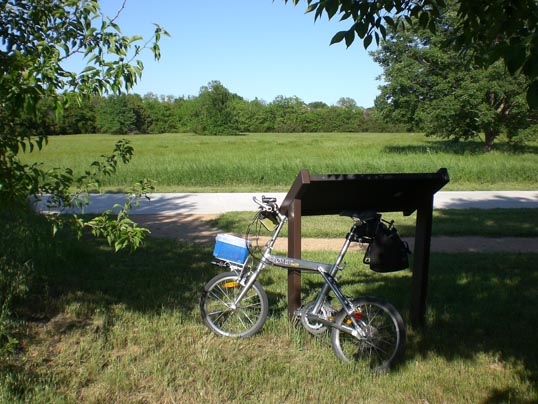
My Xootr Swift along the trail near the site of the Muncey Massacre, Plano, Texas.
The view of trail, meadow, and trees. You would never know you were in the middle of a gigantic city. The historical information was in the sign my bike is leaning against. Plano, Texas.
As I have said before, there is a local beer, a milk stout, made by Lakewood Brewing company called The Temptress. I think this is one of the best things in the world – not the best beer, best things.
The other week, at the Cobra Brewing Company event, I ran into a guy out in the yard wearing a Lakewood shirt. He worked at Lakewood Brewing. He was one of those people (at least on this day) that acted like he knew everything. The thing is, though, nobody knows everything… but he did know an awful lot.
So I stood there for a long time and pumped him for all the knowledge I could. Types of beer, good and bad local brews, the future of the local breweries, small business philosophies and how to grow, sour beers (the hottest, coolest, newest thing – awful, terrible, spoiled swill in my opinion) and on and on.
We talked about how difficult The Temptress is to make. Then he said that for this holiday season, Cinco de Mayo, they were making a seasonal special edition Temptress – the Mole Tempress.
I have mixed feelings about these special variations. Some are really good – the Bourbon Barrel Temptress is fantastic. Some are not so great – the Raspberry Temptress was too Raspberry-y. The thing is, how do you improve on perfection?
But Mole Tempress? That sounded interesting.
For those of you not from these here parts (or parts south of here) Mole is a complex, Mexican sauce made with hot chili peppers and a myriad of other spices. It is ground, reconstituted, and cooked into a thick paste that screams with flavor. It is good stuff.
This isn’t something that you would immediately associate with as a beer ingredient. But local craft beer can afford to experiment. That’s the whole idea.
Meanwhile, fast forward to now – this is the rare slice of pleasant weather time here in North Texas – the wonderful few days between the cold, wet winter and the killer summer heat. Bike riding time.
There was a terrible accident on Highway 75 – a semi tractor trailer burst into flames beneath a crossing turnpike. The entire highway was shut down. My cow-orkers were caught in the ensuing backup – some sitting stuck on frontage roads for hours. I saw the news on the early morning Television – but it didn’t affect my bike ride to work in the least.
As the workday wound down I somehow remembered a Tweet I had received from Lakewood Brewery that the Mole Temptress had been released. At about the same time I received another from the Alamo Drafthouse Cinema that they had a keg of said brew on tap.
I had never ridden my bike from my work to the Alamo Drafthouse. I sat down with Google Maps and figured out a route, winding across a busy freeway and through a few varied neighborhoods. It wasn’t very far. A single beer on the way home would be a good way to mark a Friday after work (we are broker than broke right now – it’s all the entertainment I can afford).
So off I rode in the beautiful weather of the early afternoon. I had to wind around a bit – one problem with Google Maps route-finding is that it is hard to tell in a mixed residential/apartment/commercial/retail area if you can ride from one parking lot to the next or if there is a big wall there, invisible to the overhead view. Still, it took less time than I thought.
The theater was abuzz – The Amazing Spiderman 2 was premiering and there were costumed heroes, throngs of loud kids, and a big velcro jumping-thing. But they did have my Mole Temptress on tap.
It was good, very good. A complex, spicy mix – the hot pepper and chocolate flavors came through just right. I don’t think it was as good as the regular Temptress – but few things are. Maybe nothing is.
Still, a change of pace, a hot spicy cold drink, on a nice late afternoon, on an outside patio next to a gaggle of bikes… there are worse things.
A terrible Blackberry photo of my folding Xootr Swift parked next to a Yuba cargo bike (set up to carry a whole family) outside the Alamo Drafthouse Cinema. Two different philosophies on urban bicycling.
Don’t let the spandex-clad iron men scare you off! Here are seven reasons why all types of people are biking to work—and why cities are encouraging them.
French Quarter, New Orleans
Waiting for a flat to get fixed.
Dallas’ downtown has improved so much over the last few years – it’s become a cool place. It still has a long way to go, and it still has a bad reputation as a giant desert of concrete, steel, and glass. However, the “best” downtown isn’t very far away.
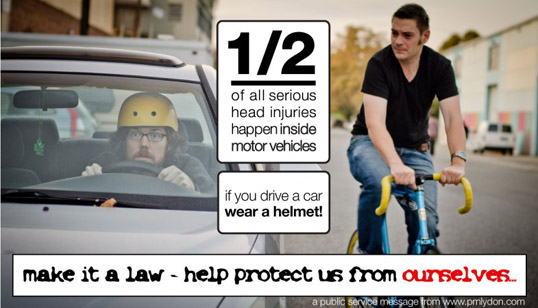
A very interesting article, although I disagree with his conclusion. I am opposed to mandatory helmet laws but I personally (almost) always wear a helmet.
His argument that ten times more head injuries occur in cars is not a valid one – because there are probably a thousand times more miles driven in cars than on bikes. Also, the argument that helmets reduce the cycling rate is valid from a public policy perspective, but not a personal one. Once you are used to wearing one, it is not a detriment. The argument that a helmet increases risky riding – I think it’s the other way around. Cyclists that engage in risky riding (fast, extreme off-road, heavy traffic) tend to wear helmets, not the other way around.
Now, the idea that cars will come closer to a cyclist with a helmet is interesting – but not strong enough for me to offset the 85% reduction in head injuries. Personally, I made the decision to always wear a helmet thirty years ago. At that time, I had a cyclometer on my bike and I was going down a long, steep hill on a light narrow-tired road bike and the reading hit forty-five miles per hour. I realized that a pebble in the road would be a fatal accident. Now that I think about it, I wear a helmet not so much as protection from cars (those will be bad no matter what) but as a protection from simply falling and hitting my head on a curb or something.
Now, the idea of wearing a helmet while driving or riding in a car is an interesting one. That’s something I could support.
Any suggestions or feedback would be greatly appreciated. Si o No.
On Day 7 of last year I read and wrote about the story Sea Oak, by George Saunders. It made me want to read more. I have just finished a long, interesting, but somewhat repetitive tome and wanted something shorter and lighter. So I picked up a book of George Saunders short stories in a digital loan from my library. It was the collection Tenth of December – and has been almost universally praised, often listed as one of the best books of last year.
And it did not disappoint.
First of all, though, the negative. George Saunders has a great skill – an innovative way – with words. Sometimes it feels as if he is showing off. Unusual forms, unexpected voices, mannered style – it’s all here and may be layered a little thick. I can see why the jaded literati have are so enamored – he can be challenging. In a few places I wanted to tell him to simply get on with it.
But, still, the stories had heart. The true judge of a work is whether or not you care about the characters and in these stories you do. They will break you in unexpected places and in an unanticipated fashion.
Back to the style. One technique that he uses to devastating effect is to tell a story from several points of view – from characters that are about to intersect in surprising ways. He uses this technique to illustrate how completely different the world is seen by different people. He exposes the little lies everyone tells themselves… simply to get through the day.
The first story in the collection uses this technique in triplicate. A popular girl, an unpopular boy, and a meter reader with bad intentions all tell their own stories in their own voices, observing each other under harrowing circumstances. A delicate structure, but one of great strength.
Another story – this one available online from the New Yorker, Puppy – uses the same technique for two women. They observe and are observed by each other and both found lacking – though they both are doing the best they can.
The title story – also available online, Tenth of December – has a young boy living in a fantasy world inside his head and an older man with a big problem intersecting on a freezing mountainside. Each has no idea of the others plight but are able to arrive at an understanding in the end.
Arguably the oddest, and possible the most powerful story, the The Semplica-Girl Diaries – Read it here, too, courtesy of the New Yorker – is written as a diary from a father to future generations. The jarring language and constant use of abbreviations makes it a hard read (I was halfway through before I figured out what “SG” meant) but by the end you realize it is worth the effort. A devastating comment on consumer culture, international capitalism, and exploitation of third world workers – all disguised as a diary of a father trying to have a nice birthday party for his little girl.
So, there are three stories you can read online. If you like them, get the book – it’s worth it.
And those are three more stories I can’t use for my month of short stories in June, if I decide to do that.
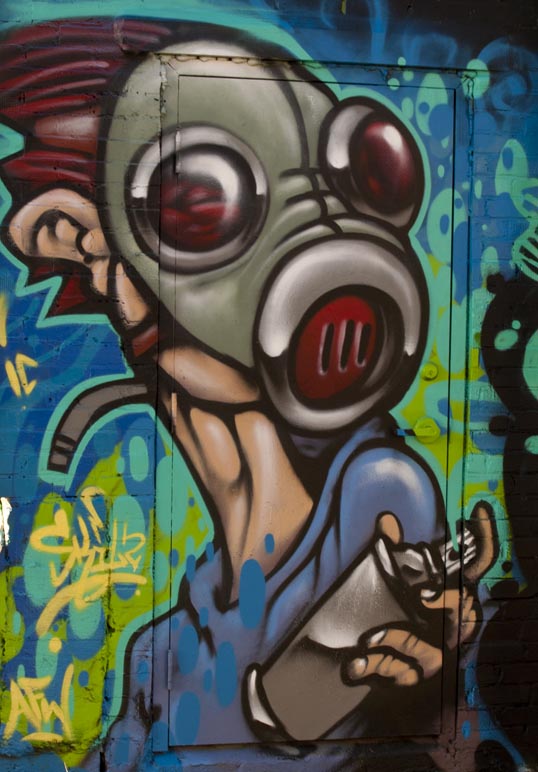
“Graffiti is one of the few tools you have if you have almost nothing. And even if you don’t come up with a picture to cure world poverty you can make someone smile while they’re having a piss.”
― Banksy, Banging Your Head Against a Brick Wall
Deep Ellum, Dallas, Texas
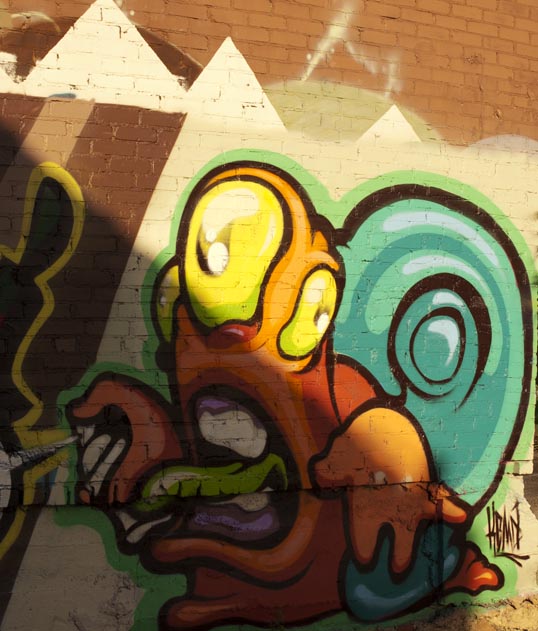
“If you hear a voice within you say you cannot paint, then by all means paint and that voice will be silenced.”
― Vincent van Gogh
Deep Ellum, Dallas, Texas
When I was a twelve year old schoolboy I would sit at my little desk and press my fists into my eyes until the most wild and strange patterns would appear against the back of the closed lids. Then I would snap open my eyes. The drab world of the classroom was suddenly bright and life was worth living and the ghosts of the abstract shapes and designs would still be superimposed, for a brief second, over this shimmering simulacrum of reality. It is that moment that I have struggled to paint – every day for the rest of my life. At least.
—-Nestor Fudant, The Ninth Mad Impostor That Understands the Rogue
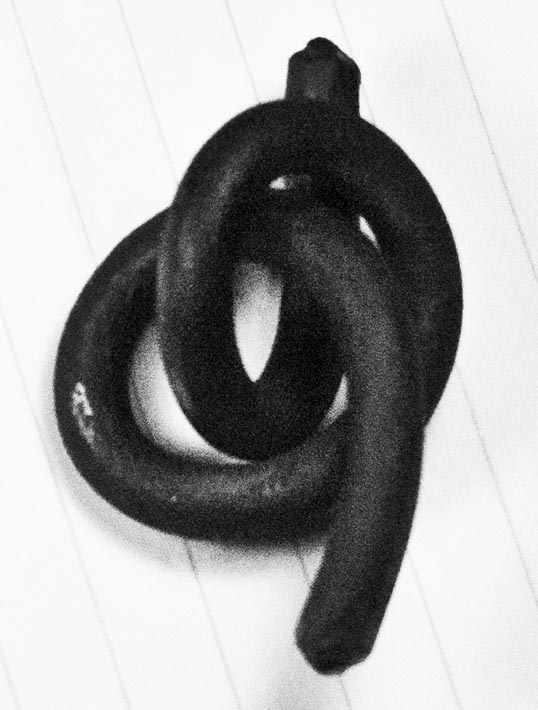
Decorative Knot, made by a blacksmith at Frisco Heritage Museum, Frisco, Texas
Last Sunday I made the long drive up north to Frisco. A friend of mine had told me about an open house at the Frisco Heritage Museum and Village. All the historical buildings would be open to the public. It sounded like a bit of fun, so I was there.
As I walked out of the Railroad Station I heard a series of loud metallic clangs. I turned toward the sound and there was a shower of orange sparks from a healthy flame sprouting up in the darkness of a metal shed. I recognized these as the telltale signs of a Blacksmith at work.
I walked down there and settled in, talking to the smithy at work. He was forging square nails by heating and pounding iron rods. He took special pride in his work, talking about how he had placed in some recent blacksmithing contests. Someone asked him about taking lessons and he said that Brookhaven college has a number of blacksmithing courses. After a couple of nails, he said he was done, and went over to sit down. A younger man came into the shop and began to set up his work.
“That’s one guy that learned at Brookhaven,” the original smithy said.
I walked out to see the rest of the buildings on display – the church was especially cool. Then I returned to see what the new guy was doing.
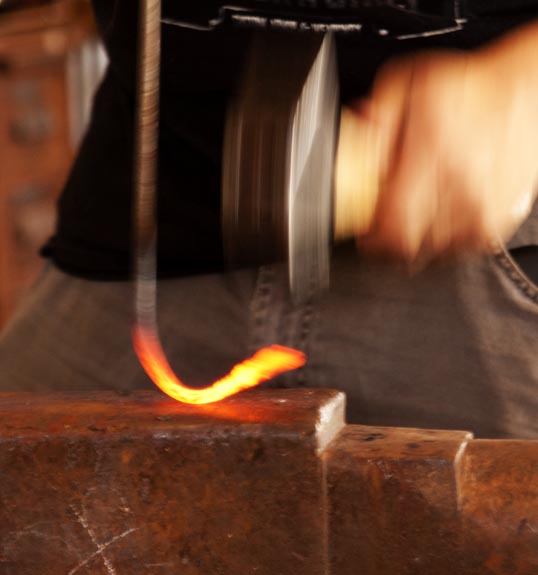
“I’m making decorative knots,” he said. He was heating rods, then bending them into a series of small loops. Finally he’d cut the knot off… and start on another. It was mostly practice in heating, forging, and bending metal – but it was pretty interesting.
He cooled one knot off in a wooden bucket of water and handed it to me. “Here’s a souvenir,” he said.
For some reason, I really like the thing.
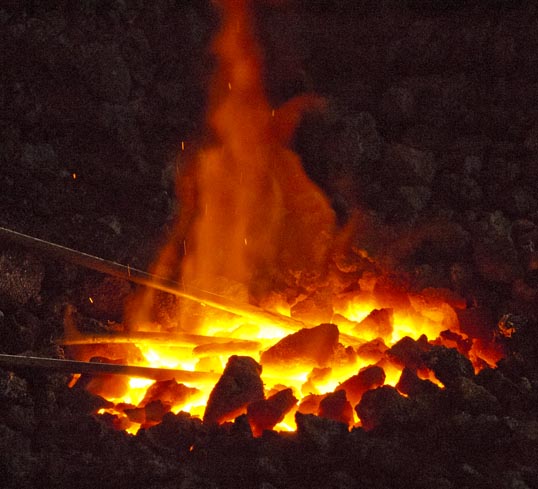
Blacksmith fire from coal and coke. You can see a knot heating in the lower left.
Hammering a heated knot.
Hammering a heated knot.
The blacksmiths sitting around, talking shop.
Coal and coke fire, Frisco, Texas. They explained how if you put too many of those irons in there, you would lose the one you needed to work on – thus – “too many irons in the fire.”
Decorative Knot, made by a blacksmith at Frisco Heritage Museum, Frisco, Texas
People from the Seersucker Ride at Klyde Warren Park, Dallas, Texas
A tradition in Dallas in the bicycling community is the fall/winter Tweed Ride. Last December’s ride was a lot of fun, though bitterly cold. As a bookend to that ride, the great folks at Dallas Cycle Style organized a springtime/warm weather ride, and called it the Seersucker Ride. It looked like a blast.
But I needed something seersucker to wear. I am the most fashion-challenged person in the world – but I knew what seersucker is. The only reason I knew was because once, a few years back, I had actually looked it up after seeing this scene in Sophie’s Choice.
Right now we are as broke as broke can be, so I couldn’t spend any money on clothes. Also, I futzed and dutzed, as always, around and waited too long – so ebay was out of the question. I did a circuit of the various thrift stores and actually found some seersucker (mostly pants) here and there – but none of it came even close to fitting me. It appears that only undernourished men wear seersucker.
So I was left with a journey into the heart of the beast. I actually went to a mall. Other than a trip to NorthPark for the Nasher Exchange Sculpture (and I wasn’t going to buy anything) I haven’t been inside a mall in decades. Collin Creek Mall is only a tiny jump up the freeway from where I live. I remember driving there from Oak Cliff in 1981 when it first opened – it seemed like driving forever – and how shiny, lavish, and sumptuous the enormous multi-lobed two story shopping extravaganza seemed – like a brave new world. Now, not that long later, the mall is on its last legs, barely hanging on for dear life, coasting on past glories. To walk the corridors is borderline depressing.
I found a shirt that was seersucker-like on a clearance rack for four dollars. The only open checkout was in the shoe department where I had to wait behind a woman trying to get a discount because the pair she was looking at had a tiny blemish.
“Look on my works, ye Mighty, and despair! Nothing beside remains. Round the decay Of that colossal wreck, boundless and bare The lone and level sands stretch far away.”
—-Shelley
So I had my seersucker. On Saturday morning I packed my Xootr Swift bicycle with food, drink, and a blanket, put a fresh battery in my camera, and rode the DART train downtown to meet everyone at Klyde Warren Park.
My Xootr Swift bike with picnic supplies loaded in the pannier.
The park was a hive of activity – S.E. Hinton was on her way to grace the presence of the Dallas Reads One Book celebration of The Outsiders. They gave us all paperback copies and took photos of everyone in period outfits reading the tome. We would like to have seen the author (and seen the movie they would show later) but we had a picnic to do so we all rode off across Uptown to Lee Park.
Posing with an S. E. Hinton paperback.
It was a beautiful spot – along Turtle Creek with a fountain in the center and a wave of purple/pink Azaleas blooming across the water. We parked the bikes, spread out the blankets, and unloaded the vittles – a veritable moveable feast. A volunteer had driven in to deliver items too bulky to bike – coolers of ice, extra water, a croquet set. Not content with pitiful portable picnic players, he brought in a generator, amp, and speakers and we had vintage music all proper – angel trumpets and devil trombones.
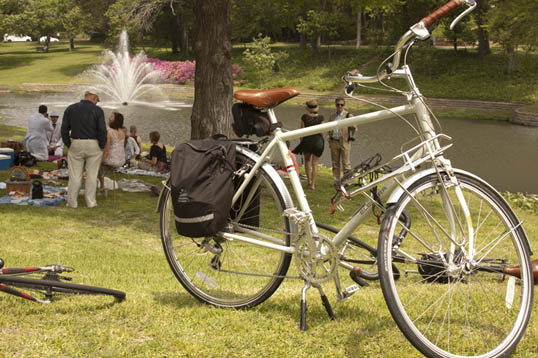
Seersucker Ride and Picnic, Lee Park, Dallas, Texas
Seersucker Ride and Picnic, Lee Park, Dallas, Texas
Seersucker Ride and Picnic, Lee Park, Dallas, Texas
Seersucker Ride and Picnic, Lee Park, Dallas, Texas
Such a great day. The weather was warm with a bit of a breeze. A beautiful park with a lot of cool people. There is something about wearing silly clothing and riding together through a big city on ridiculous bicycles that is relaxing and disarming. Such fun.
There were a lot of photos taken – I tried not to spend too much time shooting, but everything and everybody around was too freakishly photogenic to resist. I have a nice collection I’ll post here for journal entries over the next few days.
Shooting photographs at the Seersucker Ride and Picnic, Lee Park, Dallas, Texas
All good things must come to an end and we packed up and headed out. Three of us rode back downtown, cutting west on the Katy Trail which ends at the American Airlines Center. As we passed next to the building the Dallas Mavericks basketball playoff game ended, spilling an enormous throng of blue-T shirted fans out all around us – flowing like a rabid river as we worked our way through on our bicycles. It was surreal.
Luckily, the home team had won on a last second three point shot right before we arrived, so everyone was in a great mood. Everyone was yelling, “Vince Carter!, Vince Carter!”
It wouldn’t have been any fun to ride through that crowd if the home team had lost.
I rode back to Klyde Warren Park and rested for a bit. I knew the trains would be full of Maverick fans on their way home, plus I needed to decompress for a few minutes. Next to me a young couple sat playing chess – she was much better, but he liked to win, so he kept buying her wine until he prevailed. The inflatable movie screen for the showing of The Outsiders went up – but I didn’t want to stay downtown that long after dark, so I caught my train and went home.















 Bill Chance