Sunday Snippets

A very busy day today, out and about… I did manage to sit in the Espumoso Caffe in the Bishop Arts District in Oak Cliff and sketch out a short story in my notebook. I meant to type it up when I was home in the evening and let you see it here, but I’ve been hammering away and it’s nowhere near done. I have to drive to Oklahoma City tomorrow to pick up Nick, so I better get some sleep.

All I have for this week, therefore, are three little snips of text, signifying very little. I try to keep on file, well, several hundred little scenes or sketches… mostly culled from the wreckage of failed stories – in the hope that I might be able to use them someday. I pull them out in times of low ambition and massage them, water and fertilize them… see if something roots and grows from the barren cuttings of words.

For example….


The little boy came up out of the water like a sprite from a fountain. He shook the droplets off and watched the tiny rainbows as they flew from his body. He looked down at the dark footprints his wet soles left on the hot concrete – at the space between the toes and curved pads and as he gained speed there was only the toes and the ball, then finally nothing as his skin dried.

A sudden scream of air – a whistle – blown – designed to startle – stopped the boy in his tracks right at the foot of the ladder.

“No Running!” came the simple loud command from high.

The boy shook as he looked up at the voice from the chair – but the speaker was obscured by the bright haloing sun.

He walked carefully the rest of the day, little steps, glancing up at the chair.

That night he ate his dinner and cleaned his plate. Then he copied his lessons from the book onto his blue-lined three-holed paper using his number two lead pencil. He took his evening bath, and – remembering the instructions from his health textbook – combed his hair one hundred times. Finally, he crawled into bed, pulled his blanket up to his neck and quietly, almost silently, sobbed himself to sleep.

He sat on a thin high chair at a narrow bar of blond wood facing the broad windows sipping his drink and watching people drive up outside. Two scruffy guys wearing leather jackets sat smoking and talking – making wide, violent gestures and laughing – at a little table on the sidewalk. He was looking out over their heads. One guy had long stringy dirty hair, balding a little in front. The other had given up and shaved this pate.

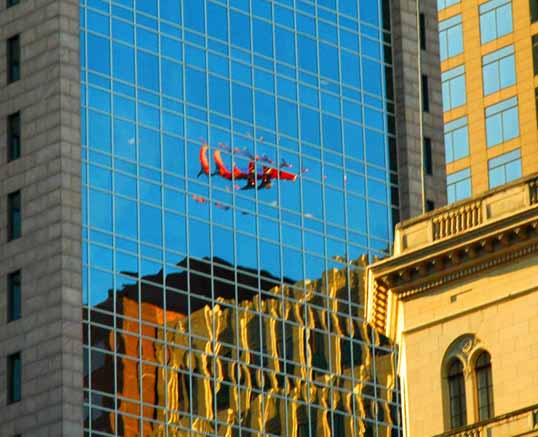
Across the busy intersection was a bank building of white marble alternating in vertical strips with blue reflective glass. It extended up past the top of the windows – he wasn’t sure how tall it eventually was. He glanced up and caught the reflection of an aircraft, an orange and red Southwest passenger jet, crossing the face of the building. It must have been on landing approach over his head; lined up with the bank building’s mirrored windows. The image would jump from one strip to the next, sometimes curved and distorted, sometimes magnified, sometimes shrunk to a pinpoint, depending on the flaw in that particular glass panel. The plane would dance, bend, and jump, flitting distorted and plastic.

He noticed the two guys staring at the dancing plane too. As the reflection disappeared off the left side of the bank they laughed and waved their arms bent in the air in imitation of the flexible jet. They turned and shared a silent smile with him through the window – for a split second.

Until he thought better of it and turned back down to his book.


(click to enlarge)

Paul woke up naked and crusted with what must have been vomit. His brain felt like it had swelled to twice its usual size but was still stuck in the same little head. He thought the pressure might separate his skull along some jagged line, exploding his brain in sweet relief. Every nerve in his body was firing quickly and randomly and the light pouring in from the end of the bridge felt toxic. Paul tried to protect himself by digging deeper under the pile of filthy blankets that was left to him. They weren’t thick enough and Paul was forced to try and figure out what to do. His elbows and knees were scraped bloody and his tongue felt torn on the underside, like it had been half pulled out.

He scrabbled around for his clothes, keys, and wallet and found nothing except a filthy pair of green shorts and a denim jacket that said Big Bambu on the back and a fresh bloodstain coursing across the front. He put those on, wrapped himself in the least-filthy rag he could find for warmth, slid down the concrete slope, and padded barefoot along the trail under the high Interstate overpass back to his car.

He wasn’t really surprised when he found the Chrysler missing. He dug around the camp trying to find anything of value but it had been stripped. The dirty shreds of rags, old shopping carts, and trash were still there as was a dark spot where the night’s campfire had burned itself out cold. But no food, drink, shoes, or anything else of any value remained.

Paul sat and cried for over an hour, until the sun rose and heated the mass of concrete overhead and it felt like a rumbling broiler. He could not figure out how to get home. He considered hitchhiking but couldn’t imagine anyone stopping for a horrible apparition like himself. He couldn’t find any change – not enough for a pay phone, and the thought of trying to panhandle… he couldn’t bear the thought of someone seeing him like that.

Then Paul realized that the creek at the bottom of the interchange was the same drainage system that coursed through his apartment complex. He thought he could follow the way, make the correct turns. He limped down into the stale slow-flowing water, the mud feeling good on his feet, but the filthy liquid stinging his wounded knees and elbows. He noted the direction the water was flowing, turned into it and began trudging upstream.

The Great Dunes

A blogger, surroundedbyimbeciles that has stopped by here has a picture of himself at the Great Sand Dunes National Park as his avatar. He wrote a blog entry about it, check it out.

I knew I had two scanned photographs of Nick at the same spot, one taken in 1996 and one taken in 2001.

I dug around and found the photos and the blog entry I wrote in 2001 to go along with them.

Here’s the eleven year old entry from my archives…. July 3, 2001.


I’ve been to the Great Sand Dunes before, twice. Once, six years ago or so, a year before I started my journal the whole family stopped on the way from Santa Fe to Buena Vista. In 1997 I came here alone, on a solo trip around Colorado. I spent a couple days and camped here, and wrote about it.

Medano creek, this late in the summer, is barely a trickle, and right after we arrived we crossed it and immediately started climbing the dunes. Even when we were walking the wide expanse of level sand before the dunes actually start I had my doubts about whether I could make the seven hundred foot climb up the piles of sand. It’s tough walking and at over eight thousand feet, the altitude doesn’t help much when you’re old and fat and out of shape like me. As soon as the steeper slopes started and Nick and Lee coursed ahead, shooting up the dunes like active ten-year-olds I knew there was no way I could make it all the way. My lungs were burning and my legs felt like Jello.

I decided that I could try to get as far as I could, though. I’ve done this before so I remembered how painful and discouraging uphill walking on sand can be – so I thought I’d be patient, walk a while, rest a while, and see what happened. The day was getting hot, too.

Nick and Lee pushed on ahead and pretty quickly they disappeared. Once you get into the dune field closer ones hide the highest dunes. One good thing about dune hiking is that you can’t really get lost and it’s a lot easier coming back down than going up – so it’s hard to get stranded in the sand.

Each dune I’d climb I divide into three sections in my mind. I’d climb the first third, then pause to try and catch my breath. The second third would be tougher, I’d have to stare at my feet and force them to take little baby steps until I reached my interim goal, exhausted, so I would sit down and rest until I felt my pulse return to normal. The third third would be easy after that long rest, and I’d settle in when I reached the top so I could enjoy the view.

By patiently munching through each set of dunes, higher and higher, I soon found myself walking the last slope to the highest dune, and not feeling too bad. I was worried that Nick and Lee would be impatient and head back down before I reached them, but they were there, digging around in the sand.

There was a gaggle of teenagers with sophisticated hiking gear – daypacks with integrated hydration systems and carbon fiber hiking poles- already there. They referred to Nick or Lee, who had been up there with them for a while before I arrived, as “the kids.” One of the teenagers was trying to impress his girl by talking about Lawrence of Arabia.

“No,” Nicholas said, “This isn’t like that, this is like Dune.”

We posed for a photo, then Nick headed back down to check on Candy.

I had a tough time getting Lee to go. There is another high dune, maybe five miles away, and Lee pitched a fit when I told him we couldn’t walk to it.

The teenagers left, then some guy from Switzerland walked up and we talked a bit while Lee dug holes in the sand.

Lee digging in the high dune

“A beeg sander-boxer,” the guy said, in his thick accent, “Een Switzerland, children haf only small boxen wit sander.” He was on a driving trip from Santa Barbara and I think the distances in the American West threw him a little. “Too far for little time,” he said. I said I was from Dallas and he asked if that was over a hundred miles from there. When I told him it was seven hundred miles he looked perplexed.

Meanwhile, Lee had walked over the next dune and was stomping out a giant, “LEE WAS HERE,” in the sand. The dunes are dry and hot on the surface, but surprisingly, are wet only an inch or two down. If you drag your feet it makes a dark line of wet sand, only to disappear a few seconds later.

A cloud blew down from the mountain and it began to rain. “Rain in zee desert!” the guy from Switzerland exclaimed. I convinced Lee to head down then, I was afraid of lightning up on the exposed dune.

“That’s more sand than I’ll ever have to play in,” said Lee.

“Don’t worry, you can play in more at the bottom.”

“Not as much as up here.”

The walk down was a lot easier than the one up. The hot day was suddenly cool from the rain, the dry yellow sand at first mottled, then dark from the falling water. By the time we reached Medano creek it was over and the sun came out again.

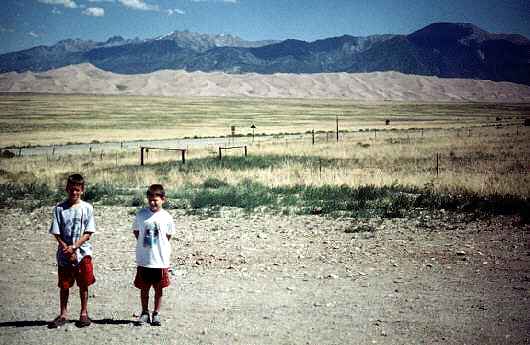
Nick and Lee in the parking lot at the edge of the Monument. 2001

Nick and Lee standing in the parking lot of a gas station right outside the Great Sand Dunes National Monument. The dunefield is a lot bigger than it looks, the tallest dune is seven hundred feet high or so. The mountains behind are the Sangre de Cristo range, several are over fourteen thousand feet high.

Lee busied himself in the creek, making a dam. While he worked I chatted with a Park Ranger – he had brought down a special sand wheelchair for a park guest. It had huge red balloon tires so it could be pushed across the soft sand. The Ranger said that the sand was twice as hard to walk in or to climb as firm ground.

Lee getting help with his dam in the creek.

Meanwhile, Lee’s dam was stretching in a ragged arc across a portion of the creek. Medano creek is odd because of the load of sand it carries (the creek is what helps corral the dunes in place, it carries escaping windblown sand back around to the upwind side of the dunes) the stream is constantly moving around in little pulses and rushes as the sediment raises the bed of the creek itself. It was a good lesson in hydrology for Lee, with several lessons:

1: Don’t make a dam out of sand.

2: Little leaks soon become very big leaks.

3: The more you patch the little leaks the higher the dam gets and the faster the little ones get bigger.

4:Eventually, your dam is toast.

Nick in 2001

I posed Nick in this picture at that spot because I wanted to compare it to this picture.

Nick in 1996

This was taken in early June 1996. There is a lot more water in the creek due to spring melting snow. This picture was taken a couple weeks before I started this journal.

This is Nick, Lee, and I, taken at the top of the highest dune at The Great Sand Dunes National Monument. The thing is a lot taller than it looks in this picture – we had to climb seven hundred feet of sand to get there.

The three of us on the highest dune in 2001.


One good thing about keeping a blog (notice I still called it a “journal” – blogs were pretty new in 2001, though I’d been writing online every day in a journal for five years by then) is the preservation of memories. Until I reread this from my archives I had forgotten so many details – the Swiss Tourist that was flabbergasted at the sheer size of the American West, the teenagers with their high-end camping gear, the fact that at ten years old Nick knew what Dune was. In 2001 the Great Sand Dunes was still a National Monument – it became a full fledged National Park in 2004.

This is more than ten years old. Nick and Lee are both well into college now. I would love to go back there with them, pose Nick in the creek again as an adult. But there is so much to do now, so much to do and so little time to get it done in. Everything is so difficult.

What I learned this week, May 4, 2012

I have been writing about the ultra-expensive condominium Museum Tower cooking the Nasher sculpture center the same way a bully with a magnifying glass burns the ants on the sidewalk:
here
here
and here

The New York Times now has an article on the issue,

Dallas Museum Simmers in a Neighbor’s Glare

There are a couple of interesting quotes. First, from the Los Angeles based architect that designed this monstrocity:

Scott Johnson, the Los Angeles architect who designed Museum Tower, said he was willing to consider remedies but that the Nasher also had to be open-minded. “My responsibility is to fully vet solutions vis-à-vis Museum Tower — that’s my building,” he said. “But I can’t say sitting here now that the Nasher may not need to do something on their end.”

So, you see his concern for the neighbor (The Museum) that actually made his project (The Museum Tower) possible. I would imagine it would have been a good idea to “fully vet” his design before the thing was built, don’t you?

And also, a fact I did not know, that helps to emphasize the whole political disgustedness of the whole thing:

Complicating matters is that the $200 million Museum Tower is owned by the Dallas Police & Fire Pension System, on whose board sit four members of the City Council.

Ok, that makes it even more clear how the developers knew they could get away with this without the city doing a thing to stop them. Remember, none of this went into action until Raymond Nasher died – then the powers that be moved in to devour the carcass of his philanthropic vision.

The final word is from the livid Renzo Piano… who just might know a little about this sort of thing.

“By doing this, they kill what they use to sell it,” Mr. Piano said.

I think that, right now, the tower should be requred to change its name (Maybe to “Death Star Condominium Tower”) and to remove all reference to the Nasher Museum from its sales pitch (where it, of course, figures very prominantly). Actually, they should be required to warn their potential residents of the skin cancer danger poised by the neighbor next door due to the reflected sunlight.

The Museum Tower Condominiums tower over Tony Cragg’s “Lost in Thought”

From Bloomberg: Dallas Museum Seeks to Shade Pension-Backed Tower’s Sunny Glare


Nine Dangerous Things You Were Taught In School


Optical Design


15(ish) Things Worth Knowing About Coffee

Wooden Canoe

I am now to the point where everything brings back memories… not even a single memory but a chain of them… separated by great space and greater time – yet linked by a single thing, the inside of my head.

Something as simple as a wooden canoe lying on a grassy bank:

I found a small dugout wooden canoe upside down in a tropical lake, abandoned and rotting in a bank of watery weeds along the shore. I came up under it with a scuba tank on my back, the bubbles catching in its concave interior and I, looking at the long oblong shape against the sun, wondered what it was. There was nobody in miles so I took it for my own.

The wood was soft and I could scrape out the rotten part with a hunting knife. The bow was broken but I fixed it with a piece of plywood and some marine glue. I found some half empty used cans of bilious old paint in a garage closet so I painted it black and gray. I cut a plastic Clorox bottle into a bailer and I was good to go.

I learned to paddle there on that humid lake. Learned to fish from a canoe, learned to navigate in the darkness, saw creatures I never thought existed in fresh water – they had followed ships in through the Gatun locks and most were slowly dying from the lack of salt.

Then I learned to maneuver a rented dented aluminum canoe through the spring flash flowing Ozark rivers on college weekends – the rocky adrenaline thrill of white water and the relaxing lazy languid sluggishness of deep dark green. I learned that a foot of water can be dangerous when it is moving fast under a fallen tree. Also, be careful when you stop in the middle of a ten mile stretch of isolated river for a quick refreshing swim on a gravel bank… don’t leave your car keys behind.

I paddled into the netherworld of Spanish Moss and Bald Cyprus in East Texas Caddo lake. A place out of time where you can find an abandoned church in a place where God has forgotten. I learned to always check the flow of the water before setting out. You are never as strong as you think you are – sometimes it is hard to get back.

Paddling on a lake with two little kids in the boat I learned that you not only have to check the flow of the water, but the strength of the wind. A damned up prairie lake can throw air fast enough to grab the bow and turn it the way you don’t want to go.

There is the sound of small waves banging against aluminum. The feeling of an ill-fitting life jacket while you are trying to work the paddle. The smell of old fish bait. The heat of the sun on the back of your neck. The sight of the little vortexes that spin off your paddle, the little drops of water when you swing it to the other side. There is the ache in your shoulders at the end of a long day and the anticipation when rounding a curve in the river.

Most of all the rhythm of boat, paddle, and water when you get moving across a lake. When it’s all working together and you feel sorry for the folks roaring by spewing oil out of their big outboards (though you do look jealously at that nice little sailboat).

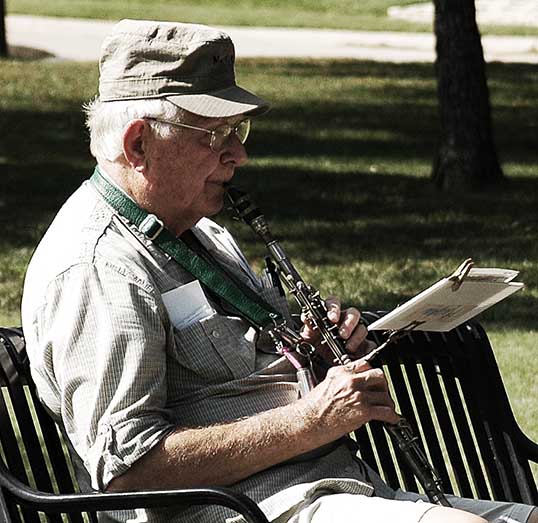
Clarinet in the Park

I went for a bit of a walk in the very picturesque Prairie Creek Park here in Richardson. The place was crawling with photographers – most of them pros, lugging huge lenses, and carefully posing children, couples, or recent graduates along the rocks of the waterfall or in the fading patches of bluebonnets and other wildflowers.

Off to the side, a man was sitting on a metal park bench playing an ancient metal clarinet. He had a bag of sheet music at his feet and he’d select a piece, clip it into his music holder, and then play. Nobody was paying any attention to him.

Except for me.

McKamy Spring

Somehow, surfing around the web, looking for information on the area near where I live and work, I stumbled across a tiny little article about a place called McKamy Springs, Richardson, Texas. The page told about a historic spring that was once used by the Native Americans as a reliable water source while hunting buffalo on the open prairie. There was a crude black and white photograph of a spring inclosed in a brick dome. Below the dome a small stream of bright water poured out.

McKamy Spring - historical photo

The spring had been bricked over sometime in the past and a commemorative stone placed beside it. The stone said, “The Yoiuane tribe of the Caddo group of Indians lived here as early as 1690 to 1840. They hunted buffalo and deer on the prairie. They used McKamy Spring as a watering place. It was from these friendly Tejas Indians that Texas got her name.”

Well, there isn’t much open prairie in these here parts nowadays – so I wondered if the spring was still there. I noticed that there was a small park called McKamy Springs Park in the middle of a new transit oriented development called Brick Row in Richardson along my way to work. I rode my bicycle there once while working out a bike route to work.

I remembered a nice, peaceful, little park in the place – I stopped there to rest and drink a water bottle. I didn’t notice a spring… but I wasn’t looking for one. Could the little McKamy Spring still be down there?

While I was out and about, it didn’t take much to stop by and take a look. Sure enough, the spring was there, exactly as it was in the photo (only now it was in color). Only a pitiful dribble of water trickled out, but I know how wonderful a trickle like that can be in a dry country. Green algae was growing over the stream and I had to climb down to fish out a discarded water bottle and a shopping bag.

Still, it seems cool to me that the little spring is still there, spitting out a bit of groundwater, even if it is surrounded by kids on a playground, locals walking their dogs, and folks sneaking out for a smoke. The open plains, the deer and the buffalo are long gone, but little McKamy Spring is still hanging in there.

McKamy Spring today.

The spring is in a nice little park in the center of a big mixed-use development.

Sunday Snippet – The Red Tail

A quick first draft I hammered out on a break from work. There may be something here, but I’m not sure what.

Walter ran through the corn. It was higher than his head and he knew he was invisible. The stalks stood thick, but there was room to run between the rows. He realized he still had the gun in his hand and that it was slowing him down, affecting his gait. He raised the gun to his face and realized that it was giving off a burned smell and that the barrel was hot.

He threw the gun away into the corn.

He wanted to start running again, but Walter had lost his way. The high corn hid him but made it impossible to see where he was going. The noon sun was directly overhead and he realized he didn’t even know what direction he had come from.

So he just ran.


When he was a child, Walter Skopsky’s father gave him a gift. He didn’t know it at the time but that moment was to shape the rest of his life. His father was a struggling alcoholic insurance underwriter and was hunched over his desk balancing the family’s meager bank accounts late one evening – trying to finish so he could reach for his second bottle. Walter was out of paper for his school work and was pestering his father for a sheet or two when the old man reached into a drawer and fell upon a pad of graph paper. He threw it and told his son to leave him alone for the rest of the night.

Walter still remembers the cool, green color of the pad, the thick blue and fine red lines crisscrossing in a grid of such heavenly precision – the repeating pattern of the axis implying an infinite steadiness and surety reaching out past the edges of the sheets into infinity to the left and right, back from the past and forward into the future.

It was the most beautiful thing Walter had ever seen.

A shy, nervous, and delicate boy, Walter took refuge in his graph paper. Once he committed something to the Cartesian Predictability on the single plane he felt he had the world under his control.

He was terrified of the long drives his family would take every holiday to West Virgina – to spend time with his mother’s large, diffuse and complex, intertwined family. The visit was a blur of loud and unpleasant confusion to Walter, but the drive up there and back was horrifying. Walter did not have access to accurate statistics on driving fatalities, but he watched the evening news and read the paper. He knew that a lot of people were meeting a gruesome end on the roads. Walter made guesses as to the percentages of deaths per thousand miles of driving and would graph the family voyage along with his estimate of his odds of dying in a fiery crash.

During the trip he would look from the back seat of the car over his father’s shoulder at the odometer and would then retreat and mark their progress on his graph and reduce his estimate of fatality until, pulling into the weed-infested gravel driveway of his aunt’s doublewide, the two lines would move to zero and he could breath easier until it was time for the trip back.

As the years went by Walter became increasingly unsatisfied with his simple linear graphs. The world was getting too complicated. That was when, on a whim, he fished the teacher’s guide to a set of standardized progress tests given out to his entire grade level out of a classroom trash can. He slipped the guide into his notebook and surreptitiously sneaked it home like it was a set of state secrets. That night he removed the clear cellophane from the unread thin pamphlet and devoured it cover to cover. There, he discovered, for the first time, the concept of the bell curve.

The simple curve resonated with Walter and he felt, finally, that he had learned a concept that explained the world to him. At first the librarian dismissed him, but he kept bugging the woman until she led him to an introductory statistics textbook that had a long chapter on the normal distribution. The mathematics were above him, but Walter began to understand the curve itself in its graphical form, with the large number of “normal” points arranged around the center and the two, rare, special, “tails” extended out to either side.

Walter copied the curve onto an entire pad of graph paper and then began to fill in the areas with highlight markers, so he could still see the lines underneath. He used the most common yellow markers on the vast territory of the center hump of the curve. The top one percent of the tail, he colored green and the bottom one, he colored red.

He stared at that upper green tail and swore he would always be in there, no matter what it took. If he couldn’t make it there – he would move on. He entered into a long period of studying. He would graph his test scores and his mid-semester and final grades – making sure he was in that top one percent. Anything less would be represented by a big blotch in that vast yellow mediocrity of the curve and Walter would be up late at night, sweating in his bed, and staring at that mark of self shame.

In English class one day, they read Robert Frost’s “The Road Not Taken” and Walter wrote a long heart-felt essay about how the two roads led to the left and right areas of his beloved bell curve, and the “Road Less Traveled” led to the right-handed, green tail. He even stapled one of his beloved graphs to the back of the paper, carefully labeled with sections of the poem. He let slip a rare grin of self-satisfaction as he handed in his paper, sure that the teacher would be impressed by his understanding of the relationship between statistics and literature.

Walter was mortified when the paper was returned with a “C-” and the notations, “Well written, but does not make sense,” and, “Does not follow instructions.” Tears welled up in his eyes as he made a mark slightly to the left of center in the vast hated yellow land of the bell curve.

He kept staring at that graph… as time and again he kept ending up in that yellow center. It was horribly frustrating and he became more and more discouraged. Walter needed to be there in that green tail – the top one percent. But, try as hard as he could, he kept falling short. Slowly, inevitably, he began to think about the other end of the graph, the red end. The bottom one percent. What would life be like down there?

It was about that time that Walter’s father fell asleep in his car in the garage with the engine running. There was a lot of talk about whether he had done himself in or had simply made another drunken mistake… his last one. Walter didn’t think it made much difference either way.

In the confusion after his father’s death Walter was able to sneak into his parent’s bedroom and find the black plastic case hidden under the shoe stand. Walter’s father had proudly taught his son how to use the snub nose revolver and the two of them had spent some time out in the country, target shooting at whiskey bottles stuck between strands of barbed wire.

The gun was the only possession of his father’s that Walter cared about. He was able to keep it hidden away under his mattress. Nobody ever payed much attention to his room and after his mother disappeared and he was sent to live with his aunt in West Virginia nobody payed any attention to him at all.

Walter had grown into a tall, lanky, quiet youth. He wasn’t too quick, but he was fast, and he had some stamina. At first, he did well in math, which made his teachers like him and the other kids stay even further away.

He was still making his graphs, and his bell curves, but he had stopped coloring in the green tail on the right hand side. His mind began thinking more and more about the red end to the left and began to rejoice as his marks were drifting lower and lower, moving in that direction.

Finally, one summer he decided to take the plunge. He began thinking more and more about a little gas station out on the highway. A dirt road ran to the east from his aunt’s trailer and was separated from the gas station by a wide, flat, corn field. He was tall, fast, and though it was wide he knew he could run across that field in less than five minutes.

A girl from his high school worked out there on the weekends. Her parents owned the place. She was a senior and a cheerleader and everybody knew who she was though Walter was sure she had no idea who he was.

All Walter had to do was wait until the corn had grown higher than his head.


He didn’t know where he was going, but Walter still ran through the corn. His pockets were stuffed with cash which seemed heavier than it should have been.

Walter realized that this must be what it felt like to be down in the red tail of the bell curve. Lost, running, desperate. This wasn’t what he expected but he wasn’t sure if it was what he wanted. He did know that now he was there, down in the red tail, that he was there for good.

Pet Parade

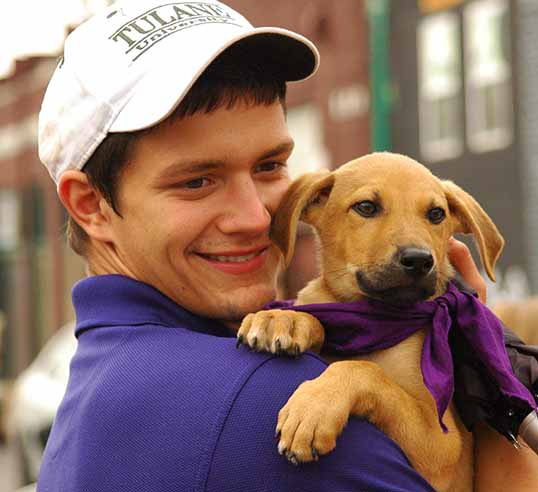
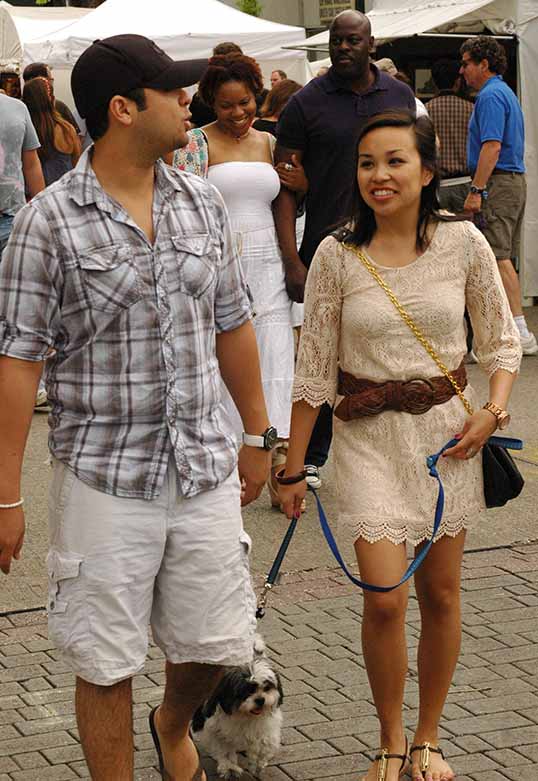
A while back I wrote about our little daytrip down to the Deep Ellum Arts Festival. We always try to go around noon on Sunday because that is when the Pet Parade is, and the guaranteed cornucopia of dogs makes Candy happy. She likes the canines, I get a kick out of the hipster doofuses. The parade was led by a parrot riding a remote controlled toy jeep.

I dug through my files and copied some of the photographs onto a thumb drive to transfer over to Candy’s computer for her enjoyment and thought I’d share them with y’all.

My son Lee (visiting from New Orleans for the weekend) and a new friend.

After a while, do people start to look like their pets?....

What I learned this week, April 27, 2012

A few weeks back, I wrote a couple of  blog entries about the new Museum Tower killing the Nasher Sculpture Center.

The news is spreading. Also, as the city prepares to open their much-ballyhooed park that has been built over the Woodall Rogers freeway – it has been “discovered” that the glare from the tower raises the temperature in the park significantly. Now, everyone is getting pissed off – though not as much as me.

There are some updates:

– D Magazine has done an extensive and interesting article about the tower and the politics behind it. Read this… it is fascinating stuff – even if you don’t give a damn about Dallas:
D MagazineThe Towering Inferno
How Museum Tower threatens the Nasher Sculpture Center and the Woodall Rodgers roofdeck park, two of the most prized assets of the city’s vaunted Arts District.

In the newest news, Dallas Lawyer Tom Luce has been appointed to mediate the dispute.
Dallas Lawyer Will Mediate Nasher vrs. Museum Tower  Dispute

Finally, the chairman of the Dallas Police and Fire Pension Trustees has a video saying that they have everything under control. He says they have been unfairly blamed for the problem. – He makes a good speech, but the building is still there – cooking everything within reach of its reflected laser beams. He says he’ll fix it – I’ll believe it when I see it.

It bugs me that he talks about all these architects, consultants, and experts they have hired. How about Renzo Piano, the architect of the Nasher. He has made his opinion very clear and he isn’t happy. It sounds to me like the Dallas Police and Fire Pension fund has hired a bunch of hacks and are trying to convince us they know more that the Pritzker Prize winner.

Nowhere in all of this do I hear anything about the fact the tower ruined James Turrell‘s Tending (Blue).

This whole thing makes me so angry… I better stop and move on now.


H.P. Lovecraft Answers Your Relationship Questions


During the week I sometimes see something cool surfing around and make a note to put a link to it up on my friday blog entry. But a day later the thing has gone viral, everybody knows about it, and I have to take it off.

Here’s one of those – you’ve probably seen it, but if you haven’t, you should.

Never Seen Before Photos of New York City

Grand Central Station

You can see the online gallery here: NYC Department of Records
( the link if flooded right now… hope it comes back soon, these photos are stunning).


Ten Steps To Coffee

ALL ABOUT COFFEE:
What is Coffee?
The History of Coffee
Ten Steps to Coffee
How to Store Coffee
How to Brew Coffee
The Value of Coffee
Coffee Recipes
Roasting Types
Coffee From the World
From the Seed to the Cup


Jackie Collins – on my decision to self-publish