Sunday Snippet – New Orleans Writing Marathon

On the morning after Halloween Candy went down to the restaurant in the St. Vincent’s Guest House for breakfast and when I joined her she introduced me to someone she had met at the counter. It was Brant Osborn, an English Teacher from Slidell.

He was at St. Vincent’s for a Writing Marathon organized and sponsored by the Southeastern Louisiana Writing Project. The idea was that a group of about twenty writers would break into groups, either stay at the guest house or walk around the Lower Garden District for the day, stopping and writing as the mood struck them. Periodically, folks would read what they had written – hopefully providing ideas, inspiration and motivation for each other.

He asked me if I wanted to go.

I ran up to my room and grabbed my Moleskine and Varsity Disposable Fountain Pen.

The entire group (mostly English teachers and a few intruders like myself) started in the common room at the guest house, wrote a little and then we took off. There were five of us in my group, myself, Richard Louth (the organizer of the writing marathons), George, and Roman.

We walked down Magazine street, hitting a coffee shop, then po-boys for lunch, a side trip to a park, and then a beer at a table outside a neighborhood bar. We’d write and read at each stop. At the end we met back at St. Vincent’s for a celebration and reading, until darkness fell completely.

Most folks wrote little essays or short works inspired by St. Vincent’s, the history of New Orleans, or the other folks in the writing group. I, as is my wont, struggled to squeeze out some fiction. I didn’t have any of my writing prompt or idea collections with me. The only things I had was the inspiration of the St. Vincent’s hostel, some bits of story the other guys would tell, and a quote from a singer on Frenchman Street the night before, “Folks from small towns get arrested in the big city, folks from the big city get arrested in small towns.”

So I spent a whole day walking around Magazine Street in New Orleans with a group of like-minded folks, writing and reading. It was, for me, a perfect day. I want to publicly thank Richard Louth for putting together this program and for Brant Osborn for inviting me.

It was so much fun that now I want to do a writing marathon in Dallas. I’ve been thinking about it and am putting together a page on my blog to organize my thoughts. Go over to that page and take a look, feel free to leave comments or suggestions. The more the merrier.

So what did I write? Here it is, copied pretty much verbatim from my Moleskine. It’s about a third of a short story… and I’m working on where to take it from here.

Parasol

Chapter 1 Svetlana (I)

Svetlana dragged her backpack up the rickety wooden stairs through a heavy wrought iron gate. A fat man with an eyepatch sat behind a tall desk with paint peeling off the front.

She worried about her English – she had studied for over a decade and always dreamed of this – but now was the first time she actually spoke a complete sentence. She could feel her accent rolling in her mouth like a hot walnut.

The man with the eyepatch didn’t even look up. He flipped a set of keys in front of Svetlana and handed her a half-sheet of paper – cut unevenly with a set of numbered rules. It was handtyped and xeroxed, with a tattoo of hand-written corrections. The top line said, “Rules are non-negotiable – you will be thrown out of the hostel.

The one-eyed man finally spoke, still without looking up. “Down that hall – men on the left, you are on the right.”

Svetlana dragged her pack down the hall. The thin, worn carpet and painted walls were stained with water leaking from somewhere above. Strangely, the passage was lined with fine bronze sculptures of nude men and women – out of place in the worn and tattered building.

She reached the women’s dormitory and pushed the door open.

A quick feeling of panic rose in her throat as she looked down the center of a double row of bunk beds constructed of two by four beams nailed in a grid. In the Ukraine, she had her own wing with a personal servant. She had never slept in a room shared with strangers.

Chapter 2, Russell (I)

Russell never thought, never in a million years, that he could be thrown in jail for pissing on the side of a building. At home, you can pee wherever you want – it is a God-given right. He was no more than a block down the street from the bar when he realized he had forgotten to use the bathroom before he left. There was an unlit alley and he ducked in. He was admiring the patterns of oblique shadow the streetlights made on the rough brick when he noticed the blue and red flashing lights mixed in with the yellowish streetlight.

Just when he broke out into a grin at the interplay of colors and shapes he felt a rough hand on his shoulder.

Russell jumped a bit at the voice yelling in his ear, “Well, now, look who’s going to jail tonight.”

His arms were pulled back and he felt the cold steel click around his wrists.

“Shit, son, you ain’t even zipped up,” the unseen voice said. “Now, don’t you piss on me or I’ll crack your damn head.”

He felt his hands released and as soon as he brought them forward and fixed his pants he was shoved forward. His hand came up to catch himself from falling, his palms against the uneven wall. Boots pushed his feet apart.

Strong hands moved down his sides and between his legs, and finally slid his wallet out of his back pocket.

Chapter 3 Svetlana (II)

She looked down the room and saw a woman with spiked hair and a piercing through the side of her nose rummaging through a pile of plastic grocery sacks. She looked up. Svetlana thought she saw a tiny colorful flickering on the woman’s face.

“Which bed should I take?” Svetlana asked. The woman looked at her for what seemed like a long time then gestured at a lower bunk three beds down from where she was crouched.

“This one honey, it’s right under mine. Throw your pack on the bunk, but don’t leave it there when you’re gone. They got too many thieves ’round here.”

The woman glanced down at the bags at her feet and Svetlana saw a guilty look flash over her face. It didn’t stay there long. Svetlana threw her pack onto the lower bunk the woman had gestured at and then stood at the foot of the bed, stiffly, waiting to see what would happen next.

For most of her life Svetlana had dreamed of this moment – she had escaped. She was halfway around the world, but this was no dream. She realized, for the first time, that she had not actually thought past this very second, and was at a complete loss of what to do now. The panic rose and settled like a hard knot in her chest. She felt paralyzed – her mind blank. She stared at the woman, afraid the two of them would be standing like that forever.

The woman broke the impasse by moving quickly toward her – almost at a run – turning at the last instant in front of the flinching Svetlana and jumping up onto the top bunk. The woman was so close to Svetlana that she could see that her nose piercing was a tiny skull. Inside, a small LED was blinking – making the skull’s eyes flash bright red.

“You’re not from around here, are ya,” the woman said.

“No, the Ukraine. Is my accent that bad?”

“Nah, everybody’s got an accent here.”

“Your nose piercing?”

“Oh yeah, cool, huh. I make these and sell ’em on the corner. People love ’em. Changing the battery’s a bitch though. You want one? I’ll give you a discount.”

“I’m afraid I don’t have a piercing there.”

“Oh, no problema,” the woman said, fingering a large safety pin laced into a leather bracelet on her wrist. “Don’t have to go through your nose anyway. I’ve got a double skull – red and blue – can put that one through a nipple.”

Svetlana started to shake a little, and the knot under her breastbone grew and hardened.

“Not now, I’m sorry. Just off the plane and I’m still,… what do you say? Still on Ukraine time?”

‘Jetlagged.”

“Jet – Lagged,” Svetlana repeated slowly.

“Shit Ukraine,” the woman said, “I’m Joanna.”

“Svetlana.”

“OK Ukraine, whatever. You look like you need a beer. Grab your bag, let’s go.”

Chapter 4 Russell (II)

The concrete pallet had no mattress and the jailhouse orange coveralls were thin so Russell wasn’t really asleep when the noise outside the cell snapped his eyes open. Two huge deputies were dragging a man down the corridor towards the cell. He was wearing a once-whitish suite, covered in thin blue lines – now stained with blood and at least one other substance. The man looked exhausted and one eye was swollen almost shut but he still heaved and wiggled against the thick arms that restrained him.

The two deputies tossed him against a wall where he gathered himself erect and began the useless task of trying to smooth the countless deep wrinkles out of his suit. One deputy turned and began to work the lock on the cell door while the other kept facing the man in the suit.

“Gentlemen, “ the man in the suit began to talk in a surprisingly clear, steady, and controlled voice. “I do not stand to be treated like this. You should know that, not only am I an attorney, I am a member of the New York bar.”

The guard facing the man did not say a thing but gave a sharp shrug of his shoulder and a heavy telescoping rod shot down from his hand about the length of his forearm. At the end of the rod was a small but mean looking black sphere.

The man in the suit said, “Ahhhh,” but before a complete word could form the guard raised the extended truncheon and began wailing away at the man in the suit. His arm moved like a piston while the rod whistled through the air landing on the man with a sickening wet thud. Russell noticed the man had the presence of mind to cover his good eye with both hands and to turn and curl to present the smallest target. Russell had the feeling that this wasn’t the first time he had been beaten.

Russell guessed than swinging a heavy club like that was hard work and within a minute the guard stopped, bent over with his hands on his knees and breathing hard. He caught his breath and asked his partner, “Do you want a go at him, Hubert?”

“Naw, I got my licks in when we picked him up. I got a bottle in my locker, lets drop him here and grab a quick snort.”

They grabbed the man and attempted to throw him into the cell but somehow, he resisted enough to stand and walk through the cell door on his own volition. It shut with a metal clang and the two guards left without a backwards glance.

“They didn’t put you in a jail jumpsuit,” Russell said.

“No they did not,” the man said with a bit of pride in his voice, “That, my friend, is the source of the disagreement I had with those two apes back there. As you see, I’m still wearing my seersucker, and that I won that argument.”

Russell thought that was a definition of the word, “won,” that he had not ever heard before.

“How did you get here from New York?”

“Oh, I’m not really from New York. I was born and raised less than three miles from this very hoosegow. I only said I was from New York to impress those dimwitted thugs back there.”

“Now,” Russell said, “I’m just a country kid, but if I sat up all night thinking of saying something that would guarantee I got a bad beating in here, I don’t think I could do any better than telling them I was a New York lawyer.”

The man went on as if Russell hadn’t said a thing. “Now friend, I am an attorney… or at least I was. The state bar did not take too kindly… and over-reacted to – a trivial incident involving a real estate loan and the District Attorney’s niece. My present plans, however, do include, when they come to fruition, the reinstatement of my lawyerly license.”

“I don’t see how getting beat up in jail is going to help you get your license back,” Russell said. “Oh, and I’m Russell and I guess I’m pleased to meet you.”

The man seemed to think for a minute before giving up his name. “Jameson P. Samuel, at your service, but you can call me Jim.”

Chapter 5 Svetlana (III)

Joana ordered, “Two beers, whatever IPA you’ve got on tap please, and a coffee.”

“”What coffee you want?” the Bartender/Barista asked.

“I like my coffee like I like my women, dark, bitter, and Nicaraguan.” Joana turned to Svetlana, “No offense intended, Ukraine.”

Svetlana had no idea how to react to this but luckily one of her English lessons had covered what to say when someone said, “No offense.”

“None taken,” she replied.

The two women grabbed their drinks and settled into a booth at the end of the bar. Svetlana noticed everyone staring at someone in the booth across from them. She followed their gaze and saw a man in a stained white suit that looked like it had been slept in for a week. Half his face was swollen terribly. He was sipping a Bloody Mary with the paper umbrella stills ticking out of it and was talking loudly to a young man with ruffled hair – nursing a coffee in a foam cup.
Mojo Nola

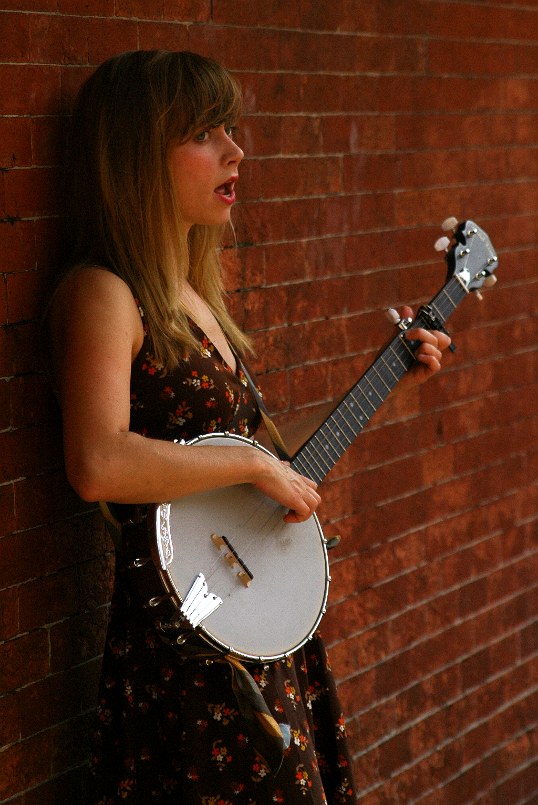
Banjo Player on Royal Street in the French Quarter, New Orleans

(Click for a larger and more detailed image on Flickr)

I only had a dollar left
and I gave it to the
Beautiful Girl
Playing the Banjo
on Royal and singing a simple sweet country tune.

My little dollar joined the sparse cluster of crumpled green in her banjo case on the sidewalk
– I saw there was a kazoo in there too
What else is there to spend your last dollar on?
Except for bus fare home. So it looks like a long walk on some sore and tired feet.
I wanted to take her picture and I didn’t want to do that without leaving at least a dollar.

I would have left more, but, like I said, that was my last. I wonder if it would mean anything to her – the banjo playing girl – if she knew it was my last dollar?

In the St. Louis Cemetery #1 there is a vault that was donated and is dedicated to the musicians of New Orleans that can’t afford to pay for their own burial.

Banjo Player on Royal Street, French Quarter, New Orleans

(Click for a larger and more detailed version on Flickr)

Writing in my Moleskine Journal outside the Mojo Lounge, Decatur Street, French Quarter, New Orleans

(Click for a larger and more detailed version on Flickr)

Plaque on the Musician’s Tomb, Saint Louis Cemetery #1, New Orleans.

The Rum Diary

Hunter S. Thompson

I don’t like to write negative reviews… in that I don’t like to write bad things about bad things. Why waste your time and mine being snarky about crap that doesn’t cut it? Life is too short – my keys are wearing out – there’s plenty of whining snarky criticism shooting around this interweb thing already.

Sometimes I make an exception. There is stuff that is good, there is stuff that is bad… and there is stuff that is… let’s say, a glorious failure. Now that I think about it, glorious failure is a special thing – you can’t make it on purpose, it takes guts and effort, and when it happens you can wallow in it and enjoy yourself a bit… or a lot.

I am always looking out for interesting new stuff coming out on film or video and trying to hit the literature version first. The book is always better. You never want to read the book after seeing the film.

So it was that about a year ago, I saw that a film version of Hunter S. Thompson’s first book, The Rum Diary, was being made – starring Johnny Depp as Thompson – the second time he has tackled such a roll, after the Fear and Loathing in Las Vegas movie proved that that book was unfilmable.

The Rum Diary was Hunter S. Thompson’s second novel, though his first (Prince Jellyfish) has never been published. It was written in the early 1960’s but wasn’t published for almost forty years. I was immediately attracted by the novel and its setting. A tropical location, the late nineteen fifties, a picaresque tale of drunken lost souls careening around an exotic backwater – all themes I find irresistible.

So I read it. It was short, it didn’t take long. I can’t say the book was good overall, or even well-written, but I enjoyed it. The characters were interesting, the setting attractive, the story engaging – but it was a mess. It had no arc. It was a glorious failure.

So I looked forward to the film. The tropical setting looks nice on screen. Depp is talented, of course, and has the Thompson shtick down pat. The rest of the cast is impressive and, in turns, each co-star (Aaron Eckhart can do the slimy businessman in his sleep, Michael Rispoli as the fallen photographer was a revelation, Giovanni Ribisi was almost unrecognizable as a walking corpse of a man, Amber Heard was more beautiful more sexy that the world should allow) did a star turn.

But, on the whole, they took the mess of a story and, trying to fix it, fucked it up completely. I understand that they had to add an overlying structure, add heroes and villains, try to give the thing a point… but it all fell flat. The most enjoyable aspect of the book was the fact that nobody fit a stereotype and in shoehorning everybody into their closest Hollywood stock character the film killed the joy of the book.

For example, really the central character of the book isn’t the narrator, but the woman, Chenault (what a great name – makes me think of the Flying Tigers). In the book she was the fiancée of Yeoman – a slight newspaperman who is adrift in Puerto Rico. Her character is mysterious and confused – a real person. In the book she is the drop-dead gorgeous trophy engaged to the evil businessman – reduced to the object of competition between the greedy developer and the moral-yet-flawed Depp. Nice to look at, but easy to forget.

The climactic dance scene at the Carnival in St. Thomas… so unexpected and horrifying in the book – becomes a mere plot device in the film.

Check out the differences here:

I have never been a fan of text cards during the end credits of a film explaining what happens to the characters in the future (except, of course, for Animal House) – but in The Rum Diary the execrable explanation completely spoils any good will generated up to that point. It ruins everything; if you see the movie, look away.

The biggest problem is that the film wanted to make itself about Hunter S. Thompson. In the book, the young Thompson is more an observer that anything else. It is a proto-Thompson – you can see the future echoes of Gonzo stirring, but he is not there yet.

They shovel a lot of later Thompson into The Rum Diary – culminating in a totally ridiculous scene, straight out of Fear and Loathing, where Depp and the photographer put LSD drops into their eyes and then watch a giant tongue unroll. It doesn’t fit.

So, after this bad review, I do have to contradict myself and say I enjoyed watching The Rum Diary – though I am glad I saw it on Netflix instead of in a twelve-dollar movie house munching ten dollar stale popcorn with “golden topping” on it. It still had the tropical setting, and Depp, and picaresque characters, and a beautiful woman… and what more can we ask for?

We can ask for a lot more… but we don’t usually get it.

The Rum Diary backstory, Episode 1

Oh, this is, as far as I’m concerned, the Real Rum Diary:

Opening Bell

From an article That Jerk? C’est Moi in the Wall Street Journal:

The problem with writing in coffee shops is that everyone hates the kind of people who write in coffee shops—especially the kind of people who write in coffee shops. You see the guy in the corner hunched over his laptop and you think (forgetting, for the moment, that you are also hunched over a laptop): “For chrissake, get an office.” As someone who writes in coffee shops for a living, I have wrestled with this paradox for much of my adult life.

One book of essays on writing (I don’t remember exactly which one –  if you know please comment) said that a sure sign of a failure at writing is someone that writes in coffee shops. He took that as a sign of being non-seriousness, of being a hipster doofus, of being twee. I totally understand where he was coming from, but I think he missed an important distinction. I write in coffee shops not because it is cool but because I go to coffee shops sometimes and I write wherever I go. In other words, I go to coffee shops for coffee… well, not really… the coffee I make at home is better than any coffee shop coffee (Fresh ground beans, French Press in the way to go)… I go to coffee shops to get out of the house and I write there because I am there.

The New York Times, of course, has an non-serious, twee, hipster doofus take on the thing… Destination: LAPTOPISTAN

JUST after 4 o’clock on a Wednesday afternoon, as a dozen people clicked away on their laptops at the Atlas Café in Williamsburg, Brooklyn, half of a tree broke off without warning less than a block away. It crashed into the middle of Havemeyer Street, crushing a parked car, setting off alarms and blocking the street. A deafening chorus of horns rose outside Atlas’s window as traffic halted. An 18-wheeler executed a sketchy 10-point turn in the middle of a crowded intersection before a pair of fire trucks made their way through the traffic jam in a blaze of red. Chain saws roared, sawdust flew and the horns built to a peak. It was New York urban pandemonium at its finest.

Inside the warm confines of Atlas, separated from the chaos by only a thin wall of glass, not a soul stirred.

There are dangers, of course. From Coffee shops are ruining creative writers

Fiction writers are using coffee shops as settings within their works because they’re writing in coffee shops. And that’s why coffee shops ruin creative writers.

I am guilty of this – at the Pearl Cup one afternoon, I wrote a short story about a guy (not me, a mob hitman) sitting in the Pearl Cup. I thought I had put it up here as a Sunday Snippet… but I can’t find it. There was a robbery and people died. Only once though; I can live with that.

I live in Dallas – purportedly the un-hippest city in the world (no longer true) – but there are a few nice independent coffee places here tucked in between the barbeque, strip joints, and Baptist Churches. There was even a list – Get your morning buzz: The top 10 indie coffeehouses in Dallas.

The list, with my notes, starting with the ones I’ve been to:

The Pearl Cup  Been there many times – attended some author readings there too. It’s a great place, but often too crowded to get a table. I’m excited because they are about to open a branch in my neck of the woods.

White Rock Coffee Been there many times. Cool place not too far from where I live.

A cool piece of wall art at White Rock Coffee

Espumoso Caffe – Been there a few times, really great place.

Through the door of the Espumoso Caffe, Bishop Arts District, Dallas

Oddfellows – Never had the coffee there, but love the place and the food. Wrote about it here.

The bar dining spot at Oddfellows – a wooden bench, metal pipe for a backrest, and a log for a footrest. Our waitress has my wheat beer and Candy’s wine.

These are the places I haven’t been:

Oak Lawn Coffee

Opening Bell

Drip Coffee Company

Cultivar Coffee & Tea Co.

Crooked Tree Coffeehouse

Murray Street Coffee House

Antonio Ramblés listed a few too – Anywhere but Starbucks – but only one The Corner Market wasn’t on the other list. It’s on Greenville and McCommas, where I used to live (a long, long, long time ago), so I’ll add them.

The Corner Market

So now I have a list, and I need to work my way through it. Today, Opening Bell. It’s in the Southside building in the Cedars, an area I have been getting familiar with for no particular useful reason. It’s right across the street from the fabulous NYLO hotel with its SODA bar – one of my favorite spots in the Metroplex. It’s been on my list for a while.

So I took the DART train down to the Cedars Station and tried out Opening Bell.

It’s in the basement of Southside on Lamar – an urban living complex built inside an enormous old brick building that used to house the Sears offices and warehouse. It’s not surprising then that it has a local feel to it – catering especially to the thousands of folks living overhead. A lot of folks wander in sleepily, getting a fill of their personal cup or thermos. It’s full-service, selling food (I had a huge and excellent chicken salad sandwich), beer, and wine in addition to coffee, chai and tea. There is a little stage for their evenings of live music (have to check that out some time). The refurbished warehouse space is adequately funky and cavernous, the voyage to the restrooms an industrial adventure (and I mean that in a good way). The coffee is good, both espresso and brewed (refills on the latter – yay!). The proper urban doofus artwork adorns the old industrial brick (local art, posters for Hendrix and Townes Van Zandt, an old accordion perched above the barista).

I did drink too much coffee. I knew it was bad when the barista asked me what kind of coffee I wanted and I replied, “I don’t care.”

The music they play is excellent (among the Dallas coffee spots second only to Espumoso… so far, and so, so much better than the crap they spew out over the speakers at Starbucks). Wifi is fast and reliable, service is friendly, and customers are interesting.

So no complaints – another great spot to move from the “going to visit” list to he “got to go back to” list.

What I learned this week, October 12, 2012

Then and Now:


In Dallas, October means the State Fair. And the State Fair means fried stuff.

Comprehensive 2012 Texas State Fair Fried Food Guide


Martyn Ashton takes the £10k carbon road bike used by Team Sky’s Bradley Wiggins & Mark Cavendish for a ride with a difference. With a plan to push the limits of road biking as far as his lycra legs would dare, Martyn looked to get his ultimate ride out of the awesome Pinarello Dogma 2. This bike won the 2012 Tour de France – surely it deserves a Road Bike Party!

Shot in various locations around the UK and featuring music from ‘Sound of Guns’. Road Bike Party captures some of the toughest stunts ever pulled on a carbon road bike.


How iPhones destroyed going to the movies — in more ways than one


13 Brains I’d Like To Eat


Cormac McCarthy Cuts to the Bone

Blood Meridian used to be a much different novel. McCarthy’s early drafts reveal how an American masterpiece was born.

At least this is what I pictured after I came across a recipe for homemade gunpowder in McCarthy’s notes. The laminated recipe, scrawled in small cursive letters on a bail bondsman’s notepad, is part of the Cormac McCarthy Papers—98 boxes of notes, letters, drafts, and correspondences on all of the reclusive author’s works—archived at Texas State University-San Marco’s Wittliff Collections. Bought for $2 million in 2008 as a joint venture between the university and Bill Wittliff (screenwriter of Lonesome Dove), the collection includes unpublished material such as a screenplay, Whales and Men, and drafts of an upcoming novel, The Passenger (not available for reading until after publication). But of primary interest to McCarthy’s most devoted fans are the multiple drafts of the Tennessean’s magnum opus, Blood Meridian or the Evening Redness in the West. The archives give us a unique look inside the working method of an artist who speaks little about his own work—and gives us clues as to how his reticence, when brought into Blood Meridian itself, transformed a good book into a cold-blooded masterpiece.


I’m not generally a big fan of bridal photograph shoots – but this one will do:

Bad-Ass Roller Derby Bridal Shoot

Source: frayededgeconcepts.files.wordpress.com / via: frayededgeconcepts.wordpress.com

From Frayed Edge Photography


40 Things To Say Before You Die


I live in a… well, in a completely different world than Camile Paglia. However, I’ve been reading some of her work online, am very interested in the book she is about to publish, and surprised how much we think alike, though our points of view are so very different.

Some meaty thought in some of these articles:

How Capitalism Can Save Art
Camille Paglia on why a new generation has chosen iPhones and other glittering gadgets as its canvas.

WHITHER THE ARTS? At Ricochet, Dave Carter links to Camille Paglia’s essay in the Wall Street Journal on the decline of the art world with a reminder of the wonders of the 700-year old Cologne Cathedral.

In the comments, Michael Malone of Forbes, ABC and PJM reminded readers of how the church managed to survive World War II:

I hate to burst anybody’s bubble about the ‘miraculous’ survival of Cologne Cathedral in WWII, but it was anything but that.  When my parents were touring the cathedral years ago and the tour guide began describing this miracle, my father, who actually had bombed Cologne, whispered to my mother, “We left it standing because it was perfect for targetting the rest of the city.”  On the same trip, sitting at a cafe enjoying his morning weiss beer and veal sausage, a local struck up a conversation with him, eventually asking, “Have you been to Cologne before, Herr Malone?”  My father casually replied, “No, but I’ve flown over it a couple times. . .”

And finally, a very interesting interview with some surprising points:

In “Glittering” return, Paglia lets loose

I don’t like the situation where the Democratic Party is the party of art and entertainment, the party of culture, while the Republicans have become the party of economics and traditional religion. What that does is weaken both sides. One of the themes in my book is the current impoverishment of the art world because of its knee-jerk hostility to religion, which is everywhere. That kind of sneering at religion that Christopher Hitchens specialized in, despite his total ignorance of religion and his unadmirable lifestyle, was no model for atheism. I think Hitchens was a burden to atheism in terms of his decadent circuit of constant parties and showy blather. He was a sybaritic socialite and roué – not a deep thinker — whose topical, meandering writing will not last. And I’m no fan of Richard Dawkins’ sniping, sniggering style of atheism, either.

A responsible atheist needs to be informed about religion in order to reject it. But the shallow, smirky atheism that’s au courant is simply strengthening the power of the Right. Secular humanism is spiritually hollow right now because art is so weak. If you don’t have art as a replacement for the Bible, then you’ve got nothing that is culturally sustaining. If all you have is “Mad Men” and the Jon Stewart “Daily Show,” then religion is going to win, because people need something as a framework to understand life. Every great religion contains enormous truths about the universe. That’s why my ’60s generation followed the Beat movement toward Zen Buddhism and then opened up that avenue to Hinduism – which is why the Beatles went to India with the Maharishi Mahesh Yogi. Then it all disappeared, when people became disillusioned with gurus. But spiritual quest was one of the great themes of the ’60s that has been lost and forgotten – that reverent embrace of all the world religions. This is why our art has become so narrow and empty. People in the humanities have sunk into this shallow, snobby, liberal style of stereotyping religious believers as ignorant and medieval, which is total nonsense. And meanwhile, the entire professional class in Manhattan and Los Angeles is doping themselves on meds and trying to survive in their manic, anxiety-filled world. And what are they producing that is of the slightest interest? Nothing. Nothing is being produced in movies or the fine arts today (except in architecture) that is not derivative of something else.


50 People You Wish You Knew In Real Life

Hidden Places

Last Thursday I took a PTO day off of work, a mental health day. I decided to go to the Dallas Arboretum in the morning and hang out for a while. We have a membership there, so I don’t have to pay for parking or admission, which is nice. Especially nice because I can go at my leisure and simply relax and walk around, not feel any pressure to get my money’s worth. For that, I can always come back another time.

The Chihuly Exhibit is still up, and will be until November. It is a beautiful as always – and now, since I have a familiarity with it, I am able to see some details and subtle facets that I missed the first time or two through. More than the Chihuly stuff, gorgeous as it is, I am appreciating the beauty of the Arboretum itself – its design and vegetation.

This trip, as always, I took a lot of photographs, which I will continue to force upon my helpless readers whenever I feel like it – or I can’t think of anything else to whine on about. So far, from this trip, here, here, and here, for example… with many more to come.

But other than snapping photographs I wanted to find some spot to sit down with my Kindle and read for a bit, simply soak up the peaceful beauty.

When I first arrived at opening, there weren’t too many folks there, but the crowd quickly grew. Now, there weren’t as many folks as there are on the weekends, not by a long shot, but they tended to cluster along the main paths, surround the more spectacular Chihuly stuff, and blabber on about this and that – generally messing with my chill.

No problema, I expected this. It is a public spot – a tourist attraction – with a very popular special exhibit going on until November… I did not expect to have the whole place to myself. I had already decided to seek out a couple of hidden places, somewhere that I could sit, undisturbed, read a little, and generally chill out.

A couple of parameters had to be established:

  • Obviously, out of the main traffic areas.
  • A nice bench to sit on.
  • Shade (I am using the phrase “Chill Out” in the metaphoric sense – the heat is amazing and deadly)
  • A nice view

The first hidden spot is one I already knew about – I had spotted it the first time I came to the Arboretum. The first stage of A Woman’s Garden is a fiendishly designed series of formal gardens and water features that have a lot of Chihuly’s most spectacular glass works. It draws a big crown, oohing and ahhing and holding their iPhones up to send images back home to Aunt Emma who didn’t want to visit Dallas in the summer.

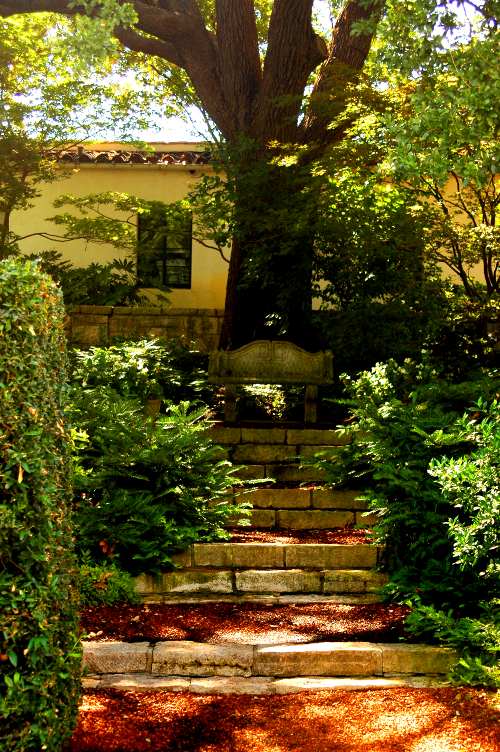
What they miss are some clever, smaller bits of garden that jut off to the side, little isolated areas that really make the place special. One of these, sandwiched between the first fountain by the entrance to A Woman’s Garden and the Degolyer Mansion is called The Sunset Garden. It is a tiny path that goes up a bit of hill to a stone bench beneath a huge tree. As the name implies, the bench faces west and would be a great place to watch the solar orb sink beneath White Rock Lake. There is a little sign that directs you to the side garden – a sign that everybody, entranced with the colorful glass beyond, seems to miss.

When you clamber up to the stone bench you look down through a gap to a fountain and then past into another small garden – The Pecan Parterre Garden, with a beautiful little sculpture – Harriet Frishmuth’s “Playdays” (more on that bronze piece in a few days, I promise). It is a truly idyllic spot.

The path up to the stone bench in the Sunset Garden from the main entrance to A Woman’s Garden.

A view of the Sunset Garden from the veranda of the DeGolyer mansion. You can see the sun-drenched entrance to A Woman’s Garden and its fountain, and the Pecan Parterre Garden, with the little statue, beyond. White Rock lake is through the trees in the background – this would be a wonderful spot to watch the sun set.

The only problem – as I discovered once I climbed up there and settled in – is that the stone bench is tilted out, ever so slightly, so it is not very comfortable. It’s like sitting in a church pew. I’m afraid that little detail makes the sunset garden a bit more useful to look at than to sit in for more than a few minutes.

Later on, though, I found another little hidden spot that didn’t have any disadvantages at all. I was strolling through the Jonsson Color Garden (the big open ovals where some large Chihuly glass rears up) and looking into the strip of woods that separates that area from the Texas Town (a children’s area with small historical displays) and noticed a wooden bench set deep within the trees. I walked around a bit and found the path back there.

It was perfect. It sits in deep shade from tall overhead trees and is screened from the main walking path by a clump of Crape Myrtles. Cool and quiet – most importantly, the wooden bench is very comfortable. A perfect spot to sit and read (I cranked through an entire novel) and contemplate the universe.

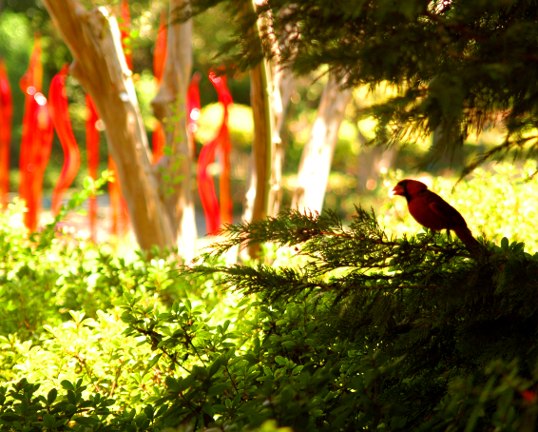
The view ahead and to the left from the little bench. These are some Chihuly red glass sculptures sitting along the edge of the Jonsson Color Garden.

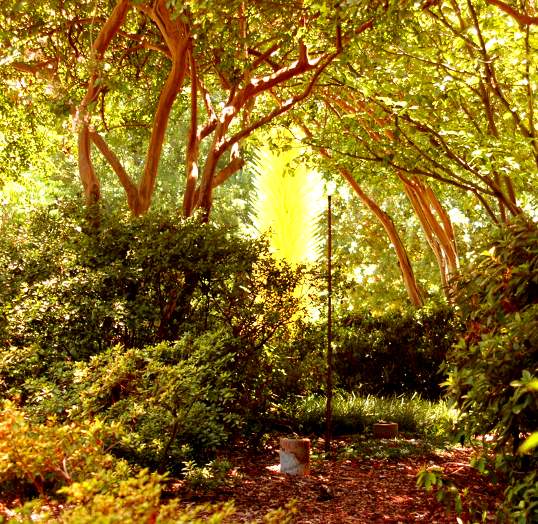
To the right from the bench is a bit of a view of Chihuly’s gigantic Yellow Icicle Tower.

Here’s the bench, with my Kindle, camera case, and woefully inadequate water bottle.

I had a little visitor while I was sitting there – somebody else trying to get out of the killer afternoon heat.

It was too comfortable – I stayed too long into the stifling heat of the afternoon. The rest of the day I was dizzy and confused… even more so than normal. Still, I think I’ll go back. It’s a nice place… and there has to be some more hidden spots that I haven’t found yet. Maybe one with some burbling water nearby.

Brief Encounters with Che Guevara

There’s so little in the world we can be sure of, and maybe it’s that lack, that flaw or deficiency, if you will, that drives our strongest compulsions.

—- Ben Fountain, Brief Encounters with Che Guevara

After finishing the massive collection of J. G. Ballard’s fiction, I’m cruising my Kindle, finishing off some fiction that I have started and slacked off on.

From the first time I stumbled across a description of it – I was irresistibly drawn to Ben Fountain’s collection Brief Encounters With Che Guevara. First, he is an author that shares a city with me. Originally, from North Carolina (I was born there – in the first of many burgs I lived in with the word “Fort” as its prefix) he has a law degree from Duke (where my son goes to school) and then moved to Dallas to practice real estate law.

He struggled for years before he finally was able to publish this book. Malcolm Gladwell even wrote about his delayed genius. Finally he is recognized as a great writer and has gained additional fame for articles published in the aftermath of the Haitian Earthquake (I know a little about Latin American Third World Earthquakes).

There are eight stories in the book:

  • Near-Extinct Birds of the Central Cordillera (my favorite)
  • Rêve Haitien
  • The Good Ones are Already Taken
  • Asian Tiger
  • Bouki and the Cocaine
  • The Lion’s Mouth (really excellent story of Sierra Leone and the compulsions of aid workers)
  • Brief Encounters with Che Guevara
  • Fantasy for Eleven Fingers (odd story… reminds me of Campion’s “The Piano” – even before the end)

I absolutely loved the first story – Near-Extinct Birds of the Central Cordillera – set in Columbia, a country Fountain has no experience with.

He says in an interview:

“It’s better to go. It would have been better if I had gone to Colombia, it would have been better if I had gone to Sierra Leone. You never know what you’re missing. You never know what you don’t know until you go. But you can’t always go. You don’t have unlimited time and unlimited money. And so you do the next best thing—you try to imagine yourself into these places. The way I did it was to read everything I could get my hands on and to talk to other people who might have information. If there were helpful movies or documentaries, I sought those out. I was just trying to soak it all up and imagine my way into it using that basic research and my own experience in similar places or similar situations.

I actually think his distance from Colombia helped the story. It’s the story of an ornithologist kidnapped by Colombian rebels. While in captivity he discovers a natural prize of infinite value – though nobody else really understands. In the end, it is he who does not understand. It is the confusion of the ornithologist when confronted with the fatal mysteries of the third world that forms the backbone of the story.

It is this discord between the first and third worlds… this frission when confronted with something that is older, more passionate, and raw than anything you have ever thought possible – and then the dawning of the realization that this jewel of wonder is wrapped in impenetrable layers of horror and death, doom and madness… and there isn’t anything you can do about it – that’s what it likes to be exposed to the third world.

Believe me, I know.

Fountain seems to feel this in his stories and skirts it without completely diving in – but he comes closer than most anything I’ve read since the simple Ray Bradbury story, The Highway.

I would love to read his work as it continues to mature… to see him dig closer to the heart of darkness. Unfortunately he seems to be seduced by politics and moving more away from what I want to read. We’ll see, I won’t give up on him. I won’t give up looking for what I want.

On the other hand, I guess if you want something done, if you want to read something different, maybe you have to do just dig in and do it yourself.

Addicted to Haiti by Ben Fountain

After the Earthquake, but Before the Flood  by Ben Fountain

 What to Read? Ben Fountain Recommends

Brief Encounters with Che Guevara, Ben Fountain

Hot Zones

Better Late Than Never: A Review of Ben Fountain’s Brief Encounters With Che Guevara

Finally Finished

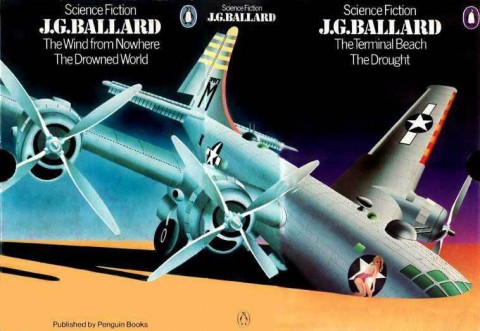
Well, one thing about writing this thing is that I can get dates. Let’s see here it is, September 17, 2011 is when I started reading the Complete Stories of J. G. Ballard. I finished it this week… so it took me about ten months to get through the whole thing.

By no means is that the only thing I’ve read in the last year. I’d read a few stories and then jump to something else… only to return when that was done. The last week or so, though, I made a concentrated push to get through to the end.

It is a massive tome. Ninety Eight short stories, novellas, and novelettes, ending up one short of one thousand two hundred pages. The paper version weighs about four pounds and would be a real pain to carry around. Inside my Kindle, though, the weight of all those bytes is barely noticeable.

I had read a lot of these stories before. In high school, in the 1970’s I discovered his short fiction and gobbled up what I could get my paws on. What was cool about reading this now is that the stories were arranged in chronological order – so I revisited what I remembered and then continued to cruise right on past, on into the future (which now is the relatively recent past). I would look at the dates on the later stories and think of myself sitting there in 1973, and realizing what I was reading wouldn’t be written for another decade.

Since this is his complete body of work, in order, you can’t help but notice the continuing themes. The lonely, wealthy woman living alone in a crumbling estate, exerting an inexorable influence on the protagonist and the people living around him. The abandoned decadent tourist destination. The desiccated sea with dry sand waves and coral canyons. Empty swimming pools. Nature, time, and technology intersecting and reacting in unexpected, beautiful, and horrific ways…. And many more.

Near the end there are three longer works: News from the Sun, Memories of the Space Age, and Myths of the Near Future. These three, read consecutively, are fascinating companions to each other. They are essentially the same story, told with tiny shifts in attitude and points of view. They deal with the theory that man’s ventures into outer space have set loose a change in the very nature of time itself and the entire human race, in a series of events centered on the now long-abandoned Florida NASA launch sites is becoming unstuck in time. It is never clear whether this is a disaster – a punishment for shaking off our bonds, or a further leap in evolution where the human race is able to exist within and without time itself. The strong impression is that it is both.

Fascinating. Especially powerful in that, within these vast movements of irresistible forces the central theme of the stories remains the human relationships of the protagonists and how they struggle to maintain their place, their loves, their very lives.

Ballard writes:

I just tend to write whatever comes mentally to hand, and what I find interesting at a particular time. These decisions as to what one’s going to write tend to be made somewhere at the back of one’s mind, so one can’t consciously say: ‘that’s what I’m going to write’. It doesn’t work out like that! (interview in ‘J. G. Ballard: The First Twenty Years’, 1976).

I’m barely aware of what is going on. Recurrent ideas assemble themselves, obsessions solidify themselves … (interview in ‘The Paris Review’, 1984).

I feel that the writer of fantasy has a marked tendency to select images and ideas which directly reflect the internal landscapes of his mind, and the reader of fantasy must interpret them on this level, distinguishing between the manifest content, which may seen obscure, meaningless or nightmarish, and the latent content, the private vocabulary of symbols drawn by the narrative from the writer’s mind (‘Time, Memory and Inner Space’, 1963).

Some of the stories, especially some of the later ones are more experimental pieces… a skilled author showing off what he can do – pushing the boundaries of fiction. Some of these work better than others.

Vermilion Sands

Vermilion Sands

Still, I think my favorite are the Vermilion Sands stores – especially The Cloud-Sculptors of Coral D. Something about that decadent vacation spot really gets to me.

Now, the tough question. What to read next?

  • 1 • Prima Belladonna • [Vermilion Sands] • (1956) • shortstory
  • 12 • Escapement • (1956) • shortstory
  • 23 • The Concentration City • (1957) • shortstory (aka Build-Up)
  • 39 • Venus Smiles • [Vermilion Sands] • (1957) • shortstory
  • 50 • Manhole 69 • (1957) • shortstory
  • 68 • Track 12 • (1958) • shortstory
  • 72 • The Waiting Grounds • (1959) • novelette
  • 96 • Now: Zero • (1959) • shortstory
  • 106 • The Sound-Sweep • (1959) • novelette
  • 137 • Zone of Terror • (1960) • shortstory
  • 150 • Chronopolis • (1960) • novelette
  • 169 • The Voices of Time • (1960) • novelette
  • 196 • The Last World of Mr. Goddard • (1960) • shortstory
  • 208 • Studio 5, The Stars • [Vermilion Sands] • (1961) • novelette
  • 235 • Deep End • (1961) • shortstory
  • 244 • The Overloaded Man • (1961) • shortstory
  • 255 • Mr F. is Mr F. • (1961) • shortstory
  • 267 • Billennium • (1961) • shortstory
  • 279 • The Gentle Assassin • (1961) • shortstory
  • 289 • The Insane Ones • (1962) • shortstory
  • 298 • The Garden of Time • (1962) • shortstory
  • 305 • The Thousand Dreams of Stellavista • [Vermilion Sands] • (1962) • shortstory
  • 321 • Thirteen to Centaurus • (1962) • novelette
  • 339 • Passport to Eternity • (1962) • shortstory
  • 355 • The Cage of Sand • (1962) • novelette
  • 373 • The Watch-Towers • (1962) • novelette
  • 395 • The Singing Statues • [Vermilion Sands] • (1962) • shortstory
  • 405 • The Man on the 99th Floor • (1962) • shortstory
  • 412 • The Subliminal Man • (1963) • shortstory
  • 426 • The Reptile Enclosure • (1963) • shortstory
  • 435 • A Question of Re-Entry • (1963) • novelette
  • 459 • The Time-Tombs • (1963) • novelette
  • 472 • Now Wakes the Sea • (1963) • shortstory
  • 480 • The Venus Hunters • (1963) • novelette
  • 504 • End-Game • (1963) • novelette
  • 521 • Minus One • (1963) • shortstory
  • 530 • The Sudden Afternoon • (1963) • shortstory
  • 541 • The Screen Game • [Vermilion Sands] • (1963) • novelette
  • 559 • Time of Passage • (1964) • shortstory
  • 569 • Prisoner of the Coral Deep • (1964) • shortstory
  • 574 • The Lost Leonardo • (1964) • shortstory
  • 589 • The Terminal Beach • (1964) • novelette
  • 605 • The Illuminated Man • (1964) • novelette
  • 628 • The Delta at Sunset • (1964) • shortstory
  • 641 • The Drowned Giant • (1964) • shortstory
  • 650 • The Gioconda of the Twilight Noon • (1964) • shortstory
  • 658 • The Volcano Dances • (1964) • shortstory
  • 663 • The Beach Murders • (1969) • shortstory
  • 669 • The Day of Forever • (1966) • shortstory
  • 683 • The Impossible Man • (1966) • shortstory
  • 697 • Storm-Bird, Storm-Dreamer • (1966) • shortstory
  • 711 • Tomorrow is a Million Years • (1966) • shortstory
  • 720 • The Assassination of John Fitzgerald Kennedy Considered as a Downhill Motor Race • (1966) • shortstory
  • 722 • Cry Hope, Cry Fury! • [Vermilion Sands] • (1967) • shortstory
  • 735 • The Recognition • (1967) • shortstory
  • 755 • The Cloud-Sculptors of Coral D • [Vermilion Sands] • (1967) • shortstory
  • 757 • Why I Want to Fuck Ronald Reagan • (1968) • shortstory
  • 760 • The Dead Astronaut • (1968) • shortstory
  • 769 • The Comsat Angels • (1968) • shortstory
  • 781 • The Killing Ground • (1969) • shortstory
  • 788 • A Place and a Time to Die • (1969) • shortstory
  • 795 • Say Goodbye to the Wind • [Vermilion Sands] • (1970) • shortstory
  • 806 • The Greatest Television Show on Earth • (1972) • shortstory
  • 811 • My Dream of Flying to Wake Island • (1974) • shortstory
  • 820 • The Air Disaster • (1975) • shortstory
  • 828 • Low-Flying Aircraft • (1975) • shortstory
  • 841 • The Life and Death of God • (1976) • shortstory
  • 849 • Notes Towards a Mental Breakdown (1976 version) • (1976) • shortstory
  • 856 • The 60 Minute Zoom • (1976) • shortstory
  • 864 • The Smile • (1976) • shortstory
  • 873 • The Ultimate City • (1976) • novella
  • 925 • The Dead Time • (1977) • novelette
  • 940 • The Index • (1977) • shortstory
  • 946 • The Intensive Care Unit • (1977) • shortstory
  • 953 • Theatre of War • (1977) • novelette
  • 968 • Having a Wonderful Time • (1978) • shortstory
  • 972 • One Afternoon at Utah Beach • (1978) • shortstory
  • 982 • Zodiac 2000 • (1978) • shortstory
  • 989 • Motel Architecture • (1978) • shortstory
  • 1000 • A Host of Furious Fancies • (1980) • shortstory
  • 1010 • News from the Sun • (1981) • novelette
  • 1037 • Memories of the Space Age • (1982) • novelette
  • 1061 • Myths of the Near Future • (1982) • novelette
  • 1085 • Report on an Unidentified Space Station • (1982) • shortstory
  • 1090 • The Object of the Attack • (1984) • shortstory
  • 1101 • Answers to a Questionnaire • (1985) • shortstory
  • 1105 • The Man Who Walked on the Moon • (1985) • shortstory
  • 1116 • The Secret History of World War 3 • (1988) • shortstory
  • 1124 • Love in a Colder Climate • (1989) • shortstory
  • 1130 • The Enormous Space • (1989) • shortstory
  • 1139 • The Largest Theme Park in the World • (1989) • shortstory
  • 1145 • War Fever • (1989) • novelette
  • 1161 • Dream Cargoes • (1990) • shortstory
  • 1173 • A Guide to Virtual Death • (1992) • shortfiction
  • 1175 • The Message from Mars • (1992) • shortstory
  • 1184 • Report from an Obscure Planet • (1992) • shortstory
  • 1189 • The Secret Autobiography of J.G.B. • (1981) • shortstory (aka The Secret Autobiography of J. G. B******)
  • 1192 • The Dying Fall • (1996) • shortstory

The Action of Grace in Territory Held Largely by the Devil

I have been working my way through the stories in Knockemstiff, a collection by Donald Ray Pollock. The characters in the tales are unrelenting losers – it’s harrowing. You would never want to meet these people and shouldn’t care when they meet their inevitable doom. The stories are not for the faint of heart (I’ll write about the book itself in a few days).

Yet, you do care. The stories do work.

In researching the literature I came across a quote from Flannery O’Connor. This make sense, she was a master of the grotesque and the sacrificial outsider. Knockemstiff is in Ohio, not the South of O’Connor’s milieu – but there is a kinship.

The piece I read had a quote:

From my own experience in trying to make stories “work,” I have discovered that what is needed is an action that is totally unexpected, yet totally believable, and I have found that, for me, this is always an action that indicates that grace has been offered. And frequently it is an action in which the devil has been the unwilling instrument of grace. This is not a piece of knowledge that I consciously put into my stories; it is a discovery that I get out of them. 

And this is it in a nutshell. That’s some of the best advice on fiction I’ve read in a long time.

The quote came from a book, Mystery and Manners – Occasional Prose, Selected and Edited by Sallay and Robert Fitzgerald.

An expanded selection reads:

To insure our sense of mystery, we need a sense of evil which sees the devil as a real spirit who must be made to name himself, and not simply to name himself as vague evil, but to name himself with his specific personality for every occasion. Literature, like virtue, does not thrive in an atmosphere where the devil is not recognized as existing both in himself and as a dramatic necessity for the writer. 

We are now living in an age which doubts both fact and value. It is the life of this age that we wish to see and judge. The novelist can no longer reflect a balance from the world he sees around him; instead, he has to try to create one. It is the way of drama that with one stroke the writer has both to mirror and to judge. When such a writer has a freak for his hero, he is not simply showing us what we are, but what we have been and what we could become. His prophet-freak is an image of himself. 

In such a picture, grace, in the theological sense, is not lacking. There is a moment in every great story in which the presence of grace can be felt as it waits to be accepted or rejected, even though the reader may not recognize this moment. 

Story-writers are always talking about what makes a story “work.” From my own experience in trying to make stories “work,” I have discovered that what is needed is an action that is totally unexpected, yet totally believable, and I have found that, for me, this is always an action that indicates that grace has been offered. And frequently it is an action in which the devil has been the unwilling instrument of grace. This is not a piece of knowledge that I consciously put into my stories; it is a discovery that I get out of them. 

I have found, in short, from reading my own writing, that my subject in fiction is the action of grace in territory held largely by the devil. 

I have also found that what I write is read by an audience which puts little stock either in grace or the devil. You discover your audience at the same time and in the same way that you discover your subject; but it is an added blow.

There is another sentence in there that I had to think about, think about hard….

There is a moment in every great story in which the presence of grace can be felt as it waits to be accepted or rejected, even though the reader may not recognize this moment. 

And there is the lesson for a writer. Even in the most terrible of circumstances and even with the most degenerate of characters there is a moment where grace is offered, and the story happens in the next split second… when the offer is accepted or rejected.

I have been digging through stories that I have read, looking for that moment… and usually finding it.

I have added, right at the top, of the notes I use to develop a story idea, “Where is the grace offered, how is it felt, and why is it accepted or rejected.”

There is always more to be learned. That’s why we get out of bed in the morning.

Volt

I had a little money left over on an Amazon.com gift card and began to choose some Kindle books. I picked up a couple of short story selections, Knockemstiff, by Donald Ray Pollock and Volt, by Alan Heathcock. Pretty much by a flip of the coin, I read Volt first.

Volt has eight semi-connected longish short stories. Right off the bat, the description of a farmer accidentally killing his son while tilling a field resonated with me. I’m a father and have spent a little time on a tractor seat bouncing in the heat and dust, watching a mile-distant fence line slowly, inexorably approach.  That awful scene was enough to justify the price of the book and the time to read it. I thought that first story could have ended after those two pages.

It didn’t though, as the father, destroyed by the accident and jolted by a near miss with a freight train – runs away. And runs and runs and runs – putting Forest Gump to shame. He ends up wiping his life away and building a new one, of sorts. It’s a journey worthy of Odysseus, and likewise, he finds that home is not what it used to be. Too much water under the bridge.

The stories are all small-town Gothic. They are set in the hopeless wide-spot-in-the-road of Krafton… an imaginary town. Trust me as one who knows – there are a lot of Kraftons out there. One hell of a lot. These are forgotten hamlets where everyone with any ambition or brains left town long ago – leaving the impression that the remaining conscripts – imprisoned by tradition, lack of imagination, and ennui – exist simply to work their way back down the evolutionary chain. There is even a Biblical Flood – though plenty of unworthy survive.

There is one hopeful character, Sheriff Helen Farraley, a plump middle-aged former grocery store manager pressed into service to combat evil no mortal should have to face. Her decisions seem insane, until you try to see her world through those eyes.

At the end of the finely crafted book, I felt I knew the doomed citizens of Krafton, and hoped somehow, someday they find the redemption that they deserve, even if they don’t see it or don’t chose it for themselves.

Now, on to Knockemstiff.

New York Times Review – Stories of Small-Town Strife

‘Volt’ writer Alan Heathcock’s internal duality fuels his gripping prose and creates his epic stories

‘Volt’: Stories for Mourning, After A Nameless Loss

BOOK REVIEW: Alan Heathcock

Bookslut – VOLT BY ALAN HEATHCOCK