This Is Why We Can’t Have Nice Things

“How dare you laugh,” Mr. Thomas said. “It was my house. My house.”

“I’m sorry,” the driver said, making heroic efforts, but when he remembered
the sudden check to his lorry, the crash of bricks falling, he became
convulsed again. One moment the house had stood there with such dignity
between the bomb sites like a man in a top hat, and then, bang, crash, there
wasn’t anything left—not anything. He said, “I’m sorry. I can’t help it, Mr.
Thomas. There’s nothing personal, but you got to admit it’s funny.”
—-Graham Greene, The Destructors

Destroyed V-Bike, Arts District, Dallas, Texas

I found this destroyed V-Bike when I was taking a photo of the mural called “The Storm” on the Ace Parking Garage at 717 Leonard Street for yesterday’s blog entry. If you look in the lower right portion of the photo of the mural you can see the bike, sort of – gives a sense of scale.
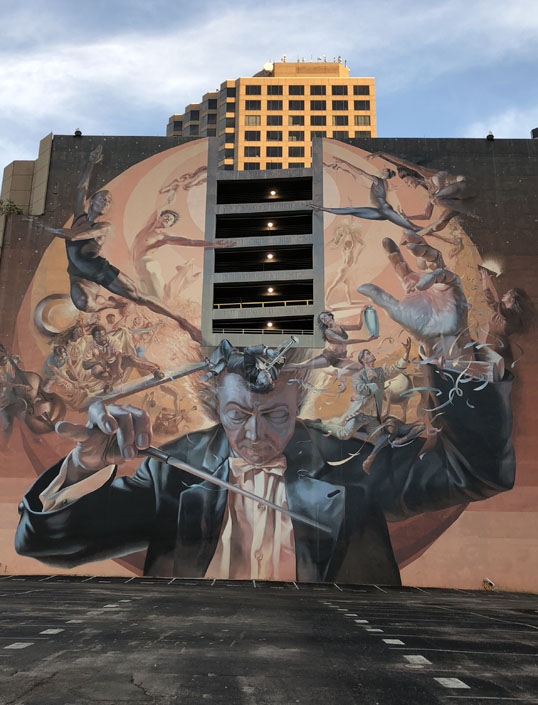
The full mural (previous photo center bottom) – Ace Parking, Dallas, “The Storm” Art Mural on Ace Parking Garage at 717 Leonard Street

If you live in Dallas, you are used to seeing bike share bikes broken all over the place. This one was in particularly bad shape – it looks like it was torn apart by a T-Rex. I assume it was run over – hopefully nobody was riding it at the time.

I have wanted to write about the saga – the rise and fall – of the bike sharing movement in Dallas, but it is/was too complex/bizarre/exciting/sad and kept changing – writing about it was like nailing jelly to a tree.

This Texas Monthly Article is as good a summary as you will read. In short, four or five companies jumped on the Dallas dockless bike share bandwagon and tried to stake out territory by putting thousands upon thousands of bikes out on the streets and sidewalks. They were everywhere. Then, there was a predictable crash and now you rarely see a rideable bike – except a lot of homeless have hacksawed the locks off and are riding them for free. Where the bikes failed they were replaced by electric scooters – which seem to be more practical for a few reasons.

I have mixed feelings – of course I loved the idea of the dockless bikes, freedom and anarchy and all that, even though I couldn’t imagine actually riding one (I have one of my personal bikes with me almost all the time in Dallas). The highly regulated bike share in New Orleans seems to work very well (though that is a tourist city – something completely different). And I do find the scooters useful.

So I’ll just be sad at the torn up bikes. Especially the V-Bikes – they were assembled locally and have some interesting innovations – single front fork blade and chainstay, enclosed shaft drive, and no-flat tires for example. They did have one fatal flaw though – the seats weren’t adjustable and I am too tall and couldn’t ever ride one.

Two V-Bike share bikes flanking my vintage Cannondale at Mockingbird DART station, Dallas, Texas

Shaft drive on a V-Bike bike share bike.


The Maestro’s Button

“My soul is a hidden orchestra; I know not what instruments, what fiddlestrings and harps, drums and tamboura I sound and clash inside myself. All I hear is the symphony.”
― Fernando Pessoa, The Book of Disquiet

The button on the Maestro’s shirt – detail from “The Storm” a mural on Ace Parking Garage at 717 Leonard Street, Dallas, Texas

The full mural (previous photo center bottom) – Ace Parking, Dallas, “The Storm” Art Mural on Ace Parking Garage at 717 Leonard Street

What We Build Could Be Anything

“It’s creepy, but here we are, the Pilgrims, the crackpots of our time, trying to establish our own alternate reality. To build a world out of rocks and chaos.
What it’s going to be, I don’t know.
Even after all that rushing around, where we’ve ended up is the middle of nowhere in the middle of the night.
And maybe knowing isn’t the point.
Where we’re standing right now, in the ruins in the dark, what we build could be anything.”
― Chuck Palahniuk, Choke

Arts District, Downtown Dallas, Texas

The Fortune of the Rougons

“They again kissed each other and fell asleep. The patch of light on the ceiling now seemed to be assuming the shape of a terrified eye, that stared wildly and fixedly upon the pale, slumbering couple who reeked with crime beneath their very sheets, and dreamt they could see a rain of blood falling in big drops, which turned into golden coins as they plashed upon the floor.”
― Émile Zola, The Fortune of the Rougons

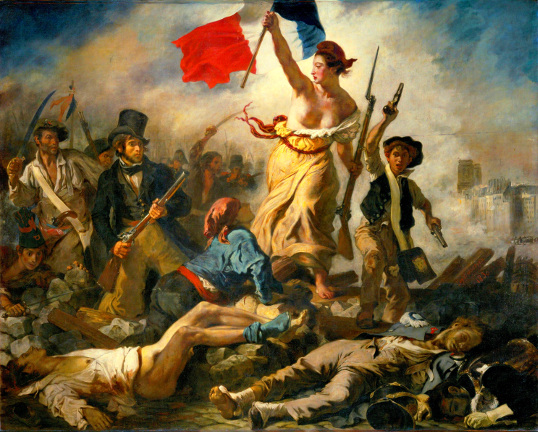
Delacroix’s Liberty Leading the People

Let’s see – I started reading La Fortune des Rougon – the first book of Zola’s Rougon-Macquart cycle on September 19. I finished it today – so that’s thirteen days. I had hoped to finish in ten… but that’s close.

So, one down, nineteen to go.

What did I think about it?

Well, it’s the introductory work of a twenty-book cycle. Considering that, it crams in a lot of introductory material. Zola’s 20 Rougon-Macquart novels are a sweeping account of one family during the Second French Empire. There are over 300 characters in the complete series, many of whom are introduced in first book. Also, the social and political aspects of this age are covered in all their complexity.

So there is a lot of information here. A lot of the story is an encyclopedic recitation of facts and relationships as the spotlight moves around different branches of the family tree. This gets a little confusing – I did benefit from some advice I read recently, “Don’t read lying down; always have a pen and some index cards handy, take notes.”

That isn’t really meant as a criticism, merely a statement of fact. This is a huge, rambling story and it takes a bit of effort to get the snowball rolling down the hill. The books are a statement of Zola’s belief in heredity and madness – but there is more than that.

In the final analysis, the judgement of a novel like this is whether or not you give a damn. There aren’t a lot of heroes in this kaleidoscope of selfishness and dysfunction… but there are two. The two young lovers, Silvere and Miette, are quiet innocent saints. They, alone in all the characters deserve something better, and your heart goes out to them. When they are on the page – you give a damn.

Unfortunately, they are doomed.

When I put down the book I had to sit and think for a few minutes – I felt like I had just returned from a long journey and had to digest all that I had seen and learned. And that – I think – is the sign a book had been worth reading.

Now on to the next – Son Excellence Eugène Rougon (1876) (His Excellency Eugene Rougon/ His Excellency)

AUTHOR’S PREFACE

I wish to explain how a family, a small group of human beings, conducts
itself in a given social system after blossoming forth and giving birth
to ten or twenty members, who, though they may appear, at the first
glance, profoundly dissimilar one from the other, are, as analysis
demonstrates, most closely linked together from the point of view of
affinity. Heredity, like gravity, has its laws.

By resolving the duplex question of temperament and environment, I shall
endeavour to discover and follow the thread of connection which leads
mathematically from one man to another. And when I have possession of
every thread, and hold a complete social group in my hands, I shall
show this group at work, participating in an historical period; I shall
depict it in action, with all its varied energies, and I shall analyse
both the will power of each member, and the general tendency of the
whole.

The great characteristic of the Rougon-Macquarts, the group or family
which I propose to study, is their ravenous appetite, the great
outburst of our age which rushes upon enjoyment. Physiologically the
Rougon-Macquarts represent the slow succession of accidents pertaining
to the nerves or the blood, which befall a race after the first organic
lesion, and, according to environment, determine in each individual
member of the race those feelings, desires and passions–briefly, all
the natural and instinctive manifestations peculiar to humanity–whose
outcome assumes the conventional name of virtue or vice. Historically
the Rougon-Macquarts proceed from the masses, radiate throughout the
whole of contemporary society, and ascend to all sorts of positions by
the force of that impulsion of essentially modern origin, which sets the
lower classes marching through the social system. And thus the dramas of
their individual lives recount the story of the Second Empire, from the
ambuscade of the Coup d’Etat to the treachery of Sedan.

For three years I had been collecting the necessary documents for this
long work, and the present volume was even written, when the fall of the
Bonapartes, which I needed artistically, and with, as if by fate, I
ever found at the end of the drama, without daring to hope that it
would prove so near at hand, suddenly occurred and furnished me with
the terrible but necessary denouement for my work. My scheme is, at
this date, completed; the circle in which my characters will revolve
is perfected; and my work becomes a picture of a departed reign, of a
strange period of human madness and shame.

This work, which will comprise several episodes, is therefore, in
my mind, the natural and social history of a family under the Second
Empire. And the first episode, here called “The Fortune of the Rougons,”
should scientifically be entitled “The Origin.”

EMILE ZOLA PARIS, July 1, 1871.

The Interior of the Soul

“There is one spectacle grander than the sea, that is the sky; there is one spectacle grander than the sky, that is the interior of the soul.”
― Victor Hugo, Les Misérables

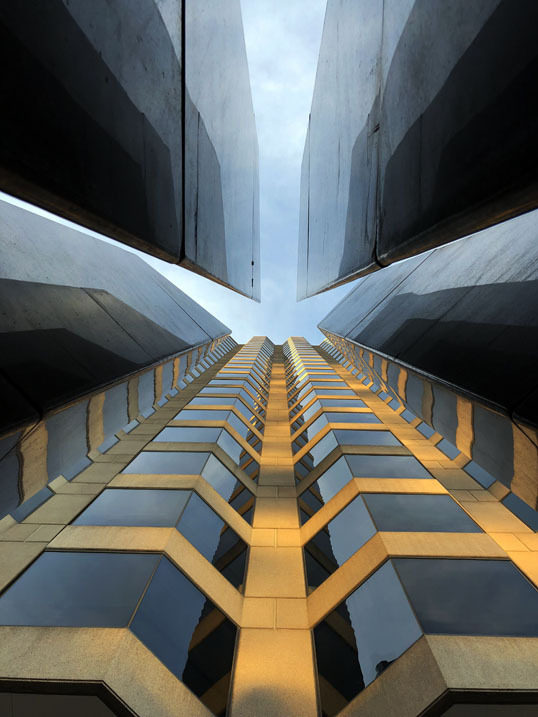
View Skyward, near the Pearl/Arts District DART station, Dallas, Texas

And what the same spot looks like from the side:

The Pearl/Arts District DART station, Dallas, Texas

Open Your Veins, and Bleed

“You simply sit down at the typewriter, open your veins, and bleed.”
—-Walter Wellesley “Red” Smith (and many others)

Our kitchen cabinets are filled with pint beer glasses emblazoned with local breweries – souvenirs of the visits to many brewery tours and keep-the-glass sampling events.

Deep Ellum Brewing Company – Dallas Blonde

One of these was a little too close to the edge of the kitchen counter when my son’s Lab was looking up there scouring for leftovers and knocked one off – breaking it on the floor – shattering the vessel into a thousand slivery shards. The first nine hundred and ninety are easy to sweep up. The last ten are invisible, sharp and hard, hard to find.

Last night as I walked barefoot through the kitchen to my room, intending to sit down and write for my hour… I found one.

There is an interesting pain profile as a sliver of glass pushes through the thick callus on the bottom of a foot into the tender, live flesh, muscle, and sinew beneath. I doesn’t hurt much… until it does. I hopped on one foot to a countertop and leaned while I searched for the glass. It’s transparent, crystalline and invisible, of course, so I had to feel for it, then pull it out. I glanced at the splinter before throwing it in the trash. It was longer than usual and was red-tipped – but I didn’t think much about it.

I suffer from a form of graphomania and, while most people complain of writer’s block, if I don’t get a solid hour of writing in each day it’s hard for me to go to sleep (writing something good… now, that’s another question – one for another day).

I sat down at my desk and lost myself, writing for an hour or so. I saved my work, and decided it was time to walk back and go to bed. But as I tried to stand up, I realized that my foot was stuck firmly to the floor. That was confusing and unsettling, why couldn’t I lift my foot up from the painted concrete – I was floored. Looking down into the murk under my desk I saw that my foot was centered in a dark-colored disk of some glue-like material that was intent on keeping it there. I had already forgotten what had happened only an hour before – so I guessed I had spilled some fruit drink or something and it had dried into a sticky trap.

So I redoubled my efforts and with a viscous pop my foot came up. It wasn’t until a few minutes later I remembered the glass sliver and realized my foot had been stuck to the floor by a pool of drying blood. I hadn’t moved my foot for over an hour, plenty of time to bleed, coagulate, and adhere.

Not much I could do, so I went to sleep. Today, I found dark crimson crescents of blood scattered throughout the house – I didn’t realize how much I walked around last night.

Time to get out the mop.

Glass from Wine Walk
Deep Ellum
Dallas, Texas

Lakewood Brewing Company, French Quarter Temptress, Special Glass, Brewed, Fort Worth, Texas

Can Never Be Undreamed

“That which is dreamed can never be lost, can never be undreamed.”
― Neil Gaiman, The Wake

Buddhist Center of Dallas

Today, after a lot of hard work doing nothing at all useful, I felt the need for a nap.

I dreamed of a house, one that is very familiar to me. It is a classic old wooden Victorian – getting long in the tooth. Like thousands and thousands throughout the center of the continent, the place I am so familiar.

It is larger than most, four stories including a dormered top floor with ceiling slanted to match the steep snow-shedding roof. There is an apartment addition over the double garage, reachable from the second floor. The main floor is completely encircled by a porch, with an old metal glider facing the road. There is an old-fashioned sleeping porch extending off the back portion of the second floor – a refuge from the hot summers, a peaceful relic from before air conditioning.

Walking the halls, I realized that I knew every square inch of this large-rambling house and remember all the repairs and improvements done over the decades. I even remembered how it used to be – I remember standing over an opening that led down to the floor furnace, the crisp white winter smell, the warm air convectioning up, the blue gas flame hissing away far below, how my feet felt on the hot metal grating.

Of course, once I ended my nap, stood up and entered the wasted day fully I realized that the house that I knew in such detail and remembered for so long does not exist. Has never existed. Could not even possibly exist.

Yet it feels more real than my actual home – or any dwelling I have lived in before.

How Can I Be Substantial

“How can I be substantial if I do not cast a shadow? I must have a dark side also If I am to be whole.”
― C.G. Jung, Modern Man in Search of a Soul

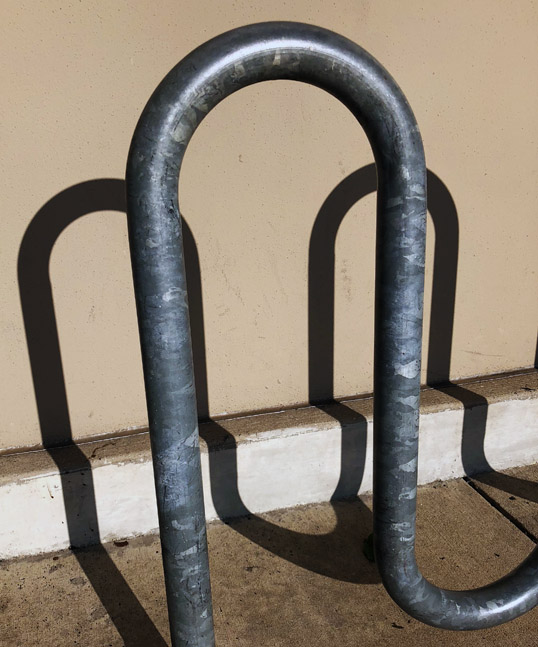
Target Rack

People Get Brain Fade

“This is what comes from the wrong kind of attentiveness. People get brain fade. This is because they’ve forgotten how to listen and look as children. They’ve forgotten how to collect data. In the psychic sense a forest fire on TV is on a lower plane than a ten-second spot for Automatic Dishwasher All. The commercial has deeper waves, deeper emanations. But we have reversed the relative significance of these things. This is why people’s eyes, ears, brains and nervous systems have grown weary. It’s a simple case of misuse.”
― Don DeLillo, White Noise

Fading, Peeling Mural, somewhere in Dallas, Texas

What the Hell, Robert

“Don’t you ever get the feeling that all your life is going by and you’re not taking advantage of it? Do you realize you’ve lived nearly half the time you have to live already?”
“Yes, every once in a while.”
“Do you know that in about thirty- five more years we’ll be dead?”
“What the hell, Robert,” I said. “What the hell.”
“I’m serious.”
“It’s one thing I don’t worry about,” I said.
“You ought to.”
“I’ve had plenty to worry about one time or other. I’m through worrying.”
“Well, I want to go to South America.”
“Listen, Robert, going to another country doesn’t make any difference. I’ve tried all that. You can’t get away from yourself by moving from one place to another. There’s nothing to that.”
“But you’ve never been to South America.”
“South America hell! If you went there the way you feel now it would be exactly the same. This is a good town. Why don’t you start living your life in Paris?”
― Ernest Hemingway, The Sun Also Rises

Running of the Bulls, New Orleans