A Thing of Beauty

I know I should not give things – physical objects – attributes beyond what they are – simply shapes of metal, rubber, and leather. Things are not as important as people.

Bicycles…. umm, that’s another matter.

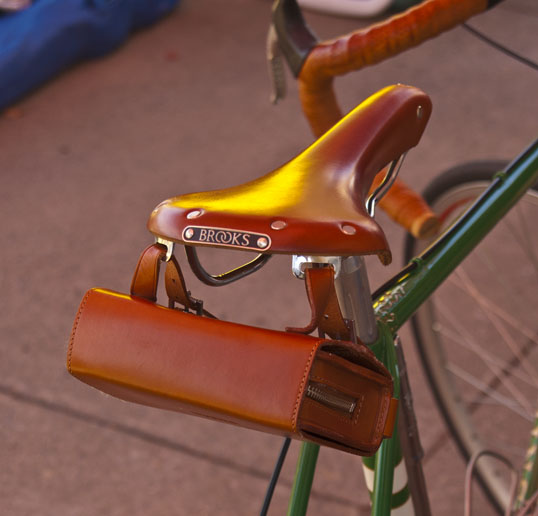
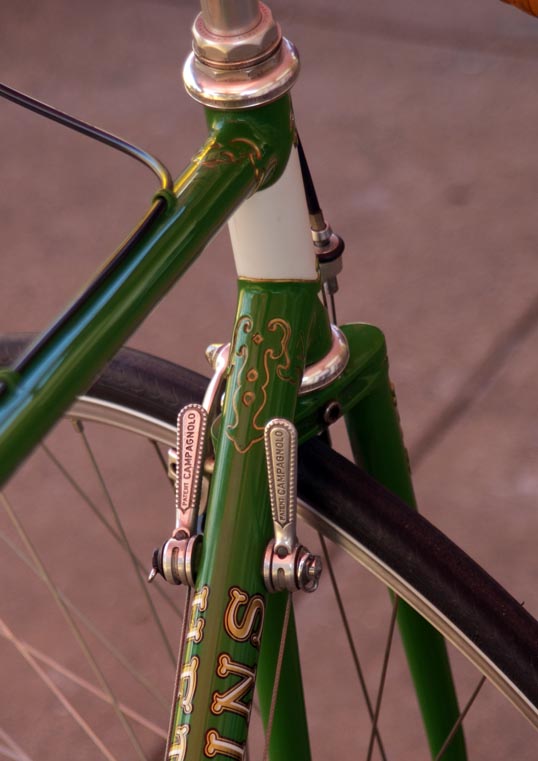
At a vintage bicycle ride/show/swap meet I attended a while back there was a Hetchins bicycle that was of such sublime beauty that I can’t really think of it as a physical object only. The Hetchins bikes are known for intricate lugwork and for being, well, transcendent works of art.

This one was painted green with the lugs set off with gold paint – and a full complement of Brooks leather saddle, bar tape, and tool bag. Vintage Campagnolo… of course.

A simple bicycle, yet such a thing of beauty.

vintage3

vintage2

vintage1

Mystery Sculpture

While I was riding my commuter bike around downtown Dallas, I stumbled across this piece of welded iron sculpture in back of the office building at 2001 Bryan Street.

I looked around and couldn’t find any type of plaque or label or anything. I have no idea what the sculpture is or who did it or who put it out there in back of that skyscraper.

Still, whatever, I like the thing and am glad I found it. It sort of feels like my own personal secret sculpture, in the middle of the big city.

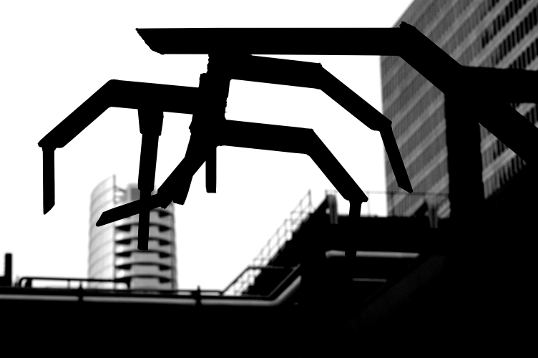
The Mystery Sculpture, welded iron.

The Mystery Sculpture, welded iron.

The sculpture, with the Eye of Sauron in the background.

The sculpture, with the Eye of Sauron in the background.

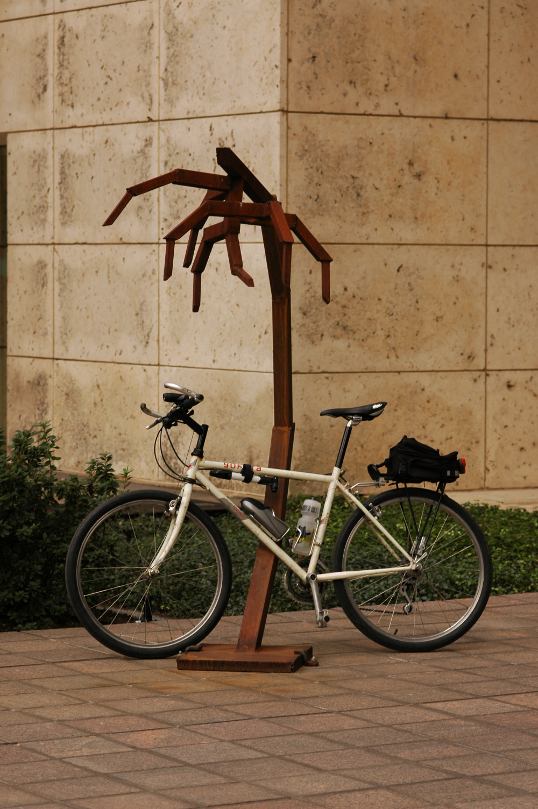
My commuter bicycle, leaning up against the mystery sculpture.

My commuter bicycle, leaning up against the mystery sculpture.

Cycling in Style

Stylish bike rider, French Quarter, New Orleans

Stylish bike rider, French Quarter, New Orleans

Despite the fact that (in additional to the least-cool) I am the least fashionable person on the planet I am interested in the idea of bicycling style, or chic, or whatever you want to call it. Not the old spandex, carbon, and logo style, but the more relaxed, European, style of riding a bike in the urban environs.

I went on a fun ride the other day with a nice group visiting some boutiques and such in a couple of stylish and hip neighborhoods of Dallas.

Yes, they exist.

Looking through the library I discovered a book by David Byrne, where he relates some of his experiences riding a folding bike through some of the more interesting cities of the world.

He starts out insulting my city… which is pretty world-renowned for cycling unfriendliness.

Bicycle Diaries

by David Byrne

Chapter One – American Cities

Most US cities are not very bike-friendly. They’re not very pedestrian-friendly either. They’re car-friendly – or at least they try very hard to be. In most of the cities one could say that the machines have won. Lives, city planning, budgets, and time are all focused around the automobile. It’s long-term unsustainable and short-term lousy living. How did it get this way? Maybe we can blame Le Corbusier for his “visionary” Radiant City proposals in the early part of the last century:

His utopian proposals — cities (or just towers really) enmeshed in a net of multilane roads — were perfectly in sync with what the car and oil companies wanted. Given that four of the five biggest corporations in the world still are oil and gas companies, it’s not surprising how these weird and car-friendly visions have lingered. In the postwar period general Motors was the largest company in the whole world. Its president, Charlie Wilson said, “What’s good for GM is good for the country.” Does anyone still believe that GM ever had the country’s best interests at heart?

Maybe we can also blame Robert Moses, who was so successful at slicing up New York City with elevated expressways and concrete canyons. His force of will and proselytizing had wide ranging effects. Other cities copied his example. Or maybe we can blame Hitler, who built the autobahns in order to allow German troops and supplies fast, efficient, and reliable access to all points along the fronts during World War II.

I try to explore some of these towns — Dallas, Detroit, Phoenix, Atlanta — by bike, and it’s frustrating. The various parts of town are often “connected” — if one can call it that — mainly by freeways, massive awe-inspiring concrete ribbons that usually kill the neighborhoods they pass through, and often the ones they are supposed to connect as well. The areas bordering expressways inevitably become dead zones. There may be, near the edges of town, an exit ramp leading to a KFC or a Red Lobster, but that’s not a neighborhood. What remains of the severed communities is eventually replaced by shopping malls and big-box stores isolated in vast deserts of parking. These are strung along the highways that have killed the towns that the highways were meant to connect. The roads, housing developments with no focus, and shopping centers eventually sprawl as far as the eye can see as the highways inched farther and farther out. Monotonous, tedious, exhausting… and soon to be gone, I suspect.

He’s right of course… but not completely right. There is hope. Dallas (and every big modern city) does have its notorious web of high speed freeways, concrete ribbons of death.

But they don’t cover the whole city. In between these barriers are real neighborhoods with real people living in them. The challenge is to get off the freeway and find what’s there – and a bicycle is the best way to do it.

The freeways become a barrier to pierce. The city is working on creating routes and I’m working on finding them.


Someone is Having a Bad Day

I was on my way home from a fun bike ride on Exposition Avenue and in Deep Ellum when I saw traffic coming to a sudden stop and a column of nasty black smoke rising in the distance. A car was on fire, right before the Highway 75 Exit to Woodall Rogers.

Car fire just north of downtown, Dallas.

Car fire just north of downtown, Dallas.

I had this happen to me once… it isn’t fun.

Years ago, I was sitting down in a cheap Chinese restaurant, about to dig into a lunch-portion of cashew chicken when somebody stuck their head in the door.

“Excuse me, does anyone in here drive a blue Ford?” he asked.

“I do,” I piped up. I assumed I had left my lights on or some such drivel.

“Oh, it’s on fire.”

Not good news. I had been having trouble with the carburetor (this was in the ancient days of yore when every car had at least one carburetor) backfiring and such and it seems to have decided to spit out flames while it was sitting there in the tiny parking lot of the Chinese restaurant. This was in the dark days, the absolute nadir of American engineering and the cars were all a terrible, complex mess with all sorts of odd-looking, unfathomable, and flammable parts bolted to their engines and equipped with carburetors that, apparently, were prone to self-immolation.

It had a mile of rubber hoses and tubing supposedly fulfilling mysterious functions running all over under the hood like a giant bowl of evil black spaghetti. All of this was burning, sending a giant column of toxic smoke high into the gray sky.

I stared, dumbstruck into inactivity, at the conflagration until the proprietor came out with an extinguisher… so I extinguished it. The white powder mingled with the black soot and molten rubber in such a mess that I knew the car had had it.

Now I was faced with a difficult choice. The whole restaurant was staring at me, standing there, holding the spent extinguisher next to my ex-vehicle… but I still had a fresh plate of Chinese food sitting inside.

So, I sucked up my pride and what little dignity I had left… walked back inside, sat down, and resumed my luncheon. This was only about a half-mile from my work, so after I finished I strolled out and walked back along the road to my work for the afternoon. This was before cellphones, so I couldn’t really even call anybody to come get me… and I don’t think I would have anyway.

While I walked I would look back over my shoulder at the column of evil black smoke as it continued to rise and then spread out in a cloud that seemed to hover high in the sky, exactly between me and the bright spot in the cloud cover that represented the sun.

I wanted to put this whole thing behind me, so I signed the title, stuck it behind the license plate of the burned out wreck, and had a salvage company come take it away for its scrap metal value without my presence. I asked them to pay the owner for his extinguisher in cash, and they sent me a check for whatever was left.

I was able to buy two Compact Disks with the balance… I think they were Tears for Fears and Fine Young Cannibals (their second CD).

bad_day2

bad_day3

Lucky Dogs

From the wonderful book, A Confederacy of Dunces, by John Kennedy Toole. In the story, Ignatius J. Reilly discovers and ends up working for a famous New Orleans Hot Dog Vendor. In the book, it’s Seven Paradise Vendors… in real life, Lucky Dogs.

Seven Paradise Vendors, Incorporated, was housed in what had formerly been an automobile repair shop, the dark ground floor of an otherwise unoccupied commercial building on Poydras Street. The garage doors were usually open, giving the passerby an acrid nos-trilful of boiling hot dogs and mustard and also of cement soaked over many years by automobile lubricants and motor oils that had dripped and drained from Harmons and Hupmobiles. The powerful stench of Paradise Vendors, Incorporated, sometimes led the overwhelmed and perplexed stroller to glance through the open door into the darkness of the garage. There his eye fell upon a fleet of large tin hot dogs mounted on bicycle tires. It was hardly an imposing vehicular collection. Several of the mobile hot dogs were badly dented. One crumpled frankfurter lay on its side, its one wheel horizontally above it, a traffic fatality. Among the afternoon pedestrians who hurried past Paradise Vendors, Incorporated, one formidable figure waddled slowly along. It was Ignatius. Stopping before the narrow garage, he sniffed the fumes from Paradise with great sensory pleasure, the protruding hairs in his nostrils analyzing, cataloging, categorizing, and classifying the distinct odors of hot dog, mustard, and lubricant. Breathing deeply, he wondered whether he also detected the more delicate odor, the fragile scent of hot dog buns. He looked at the white-gloved hands of his Mickey Mouse wristwatch and noticed that he had eaten lunch only an hour before. Still the intriguing aromas were making him salivate actively. He stepped into the garage and looked around. In a corner an old man was boiling hot dogs in a large institutional pot whose size dwarfed the gas range upon which it rested. “Pardon me, sir,” Ignatius called. “Do you retail here?” The man’s watering eyes turned toward the large visitor. “What do you want?”

“I would like to buy one of your hot dogs. They smell rather tasty. I was wondering if I could buy just one.”

Lucky Dogs cart - Bourbon Street, French Quarter, New Orleans

Lucky Dogs cart – Bourbon Street, French Quarter, New Orleans

“May I select my own?” Ignatius asked, peering down over the top of the pot. In the boiling water the frankfurters swished and lashed like artificially colored and magnified paramecia. Ignatius filled his lungs with the pungent, sour aroma. “I shall pretend that I am in a smart restaurant and that this is the lobster pond.”

“Here, take this fork,” the man said, handing Ignatius a bent and corroded semblance of a spear. “Try to keep your hands out of the water. It’s like acid. Look what it’s done to the fork.”

“My,” Ignatius said to the old man after having taken his first bite. “These are rather strong. What are the ingredients in these.”

“Rubber, cereal, tripe. Who knows? I wouldn’t touch one of them myself.”

“They’re curiously appealing,” Ignatius said, clearing his throat. “I thought that the vibrissae about my nostrils detected something unique while I was outside.”

Ignatius J. Reilly

Ignatius J. Reilly, sculpture on Canal Street.

Ignatius is such a fan of the Paradise Hot Dog, he is able to get a job as a vendor, setting out on the streets of his beloved New Orleans, pushing a heavy cart.

This does not turn out well.

George, who was wandering up Carondelet with an armload of packages wrapped in plain brown paper, heard.the cry and went up to the gargantuan vendor. “Hey, stop. Gimme one of these.”

Ignatius looked sternly at the young boy who had placed himself in the wagon’s path. His valve protested against the pimples, the surly face that seemed to hang from the long well-lubricated hair, the cigarette behind the ear, the aquamarine jacket, the delicate boots, the tight trousers that bulged offensively in the crotch in violation of all rules of theology and geometry.

“I am sorry,” Ignatius snorted. “I have only a few frankfurters left, and I must save them. Please get out of my way.”

“Save them? Who for?”

“That is none of your business, you waif. Why aren’t you in school? Kindly stop molesting me. Anyway, I have no change.”

“I got a quarter,” the thin white lips sneered. “I cannot sell you a frank, sir. Is that clear?” “Whatsa matter with you, friend?”

“What’s the matter with me? What’s the matter with you? Are you unnatural enough to want a hot dog this early in the afternoon? My conscience will not let me sell you one. Just look at your loathsome complexion. You are a growing boy whose system needs to be surfeited with vegetables and orange juice and whole wheat bread and spinach and such. I, for one, will not contribute to the debauchery of a minor.”

“Whadda you talking about? Sell me one of them hot dogs. I’m hungry. I ain’t had no lunch.”

“No!” Ignatius screamed so furiously that the pas-sersby stared. “Now get away from me before I run over you with this cart.”

George pulled open the lid of the bun compartment and said, “Hey, you got plenty stuff in here. Fix me a weenie.”

“Help!” Ignatius screamed, suddenly remembering the old man’s warnings about robberies. “Someone is stealing my buns! Police!”

My son, Lee in front of a cart.

My son, Lee in front of a cart.

Another Set List on the Green

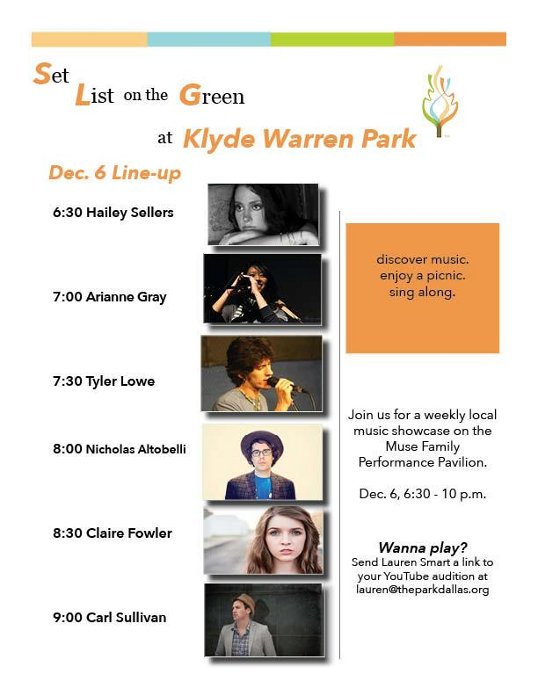
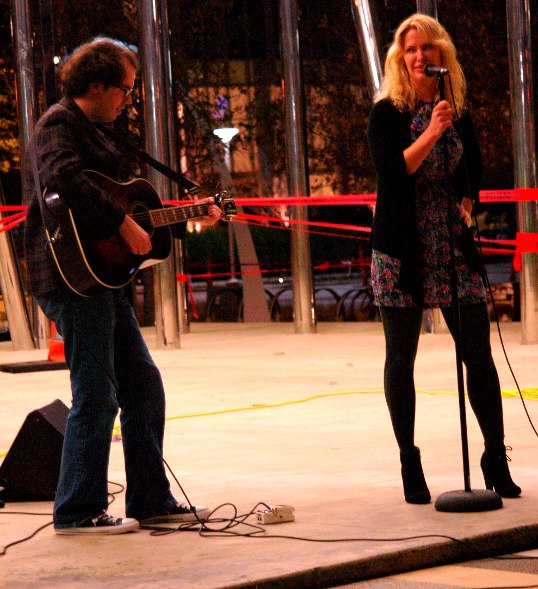
I had a lot of fun last week at the Set List on the Green – downtown Dallas in Klyde Warren Park. So much fun that, braving a bit of chill, I hopped a train and headed down as the sun set.

What Set List is about is, on Thursdays at 6:30 PM they have six local musicians take the stage for a half-hour set each. What is cool is the wide variety of talent (and, frankly, wide range of talent) on display. Though, not surprisingly, the musical stylings tend toward the folk/acoustic/country/songwriter sort of thing… your really don’t know what to expect.

It makes for a nice evening. A chair or blanket on the grass, a bit of sustenance from a local gourmet food truck, a beer or glass of wine from a nearby stand, and some good local music. I am compiling quite a list of music that I like and am able to follow them around the city… find stuff I like. It’s pretty damn cool, if you ask me.

This is only the second SOG (Setlist On the Green) and it’s the last of the season. Due to the impending cold weather (yes, it does get semi-cold here in Dallas in the dead of winter) they will be on hiatus until March. I’m looking forward to it starting up again… though if they go on Thursdays, they will compete with the Patio Sessions nearby…. so little time, so many choices.

At any rate, the lineup this week:

next_week_set_list

This time, I did drag my camera along.

Arianne Gray

Arianne Gray

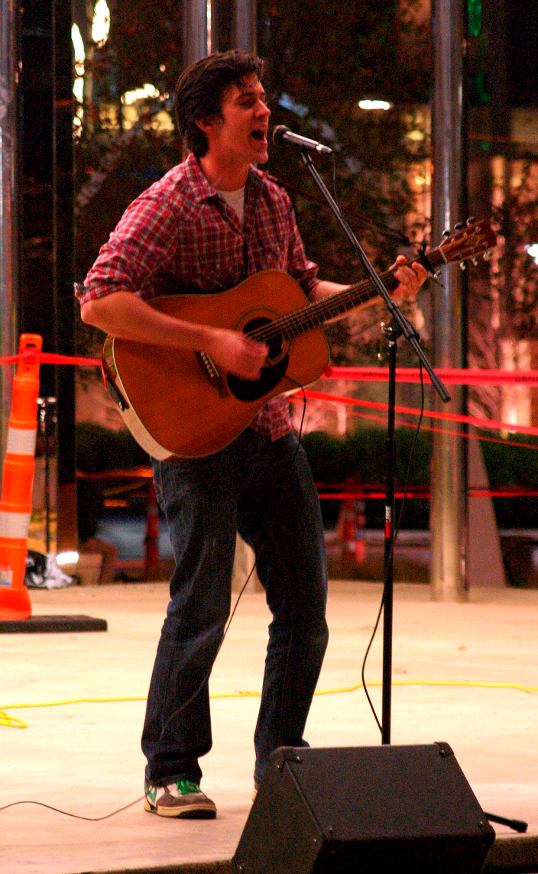
Tyler Lowe

Tyler Lowe

Nicholas Altobelli

Nicholas Altobelli

Claire Fowler

Claire Fowler

Carl Sullivan and the Rising Suns

Carl Sullivan and the Rising Suns

http://vimeo.com/22583608

Cities of the Dead

tour1

New Orleans Cemetery – Saint Louis #1

On our last trip to the Big Easy, we signed up for a New Orleans Cemetery tour from Tulane University.

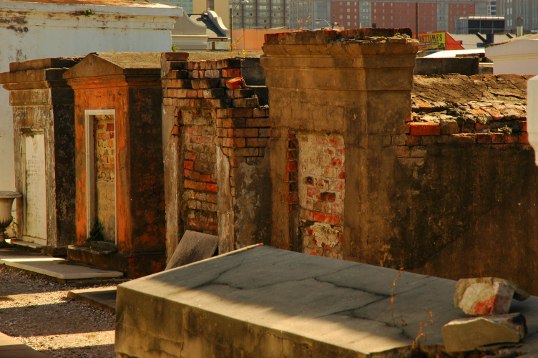
The Cemeteries of New Orleans are famous – when you visit you notice them right away on your drive away from the airport. Because of the high water table, burial in the city is above ground in crypts. If you tried to stick a coffin underground it would come bobbing up in the first hurricane and go hurtling down the street.

The dense clusters of stone crypts packed into rows give the cemeteries of New Orleans the nickname, “cities of the dead.”

All the parents piled in to the bus on the Tulane campus for the trip to St. Louis Cemetery #1. The woman sitting next to us spent her time making desperate phone calls. She was from Rockaway in New York and her house had been destroyed by Hurricane Sandy. She had decided to go ahead and make the planned trip to visit her daughter at school so she could use the Internet to register for assistance while her husband remained behind trying to salvage what he could. There was a lot of irony in a parent from New York coming to see her daughter in New Orleans as a refugee from a devastating hurricane.

The tour was very interesting – mostly because of our tour guide. A spry elderly New Orleans native of French extraction – thick with that amazing melodious Cajun accent – she spoke a lot of the unique way of looking at life (and death) necessary for survival in a place as inhospitable to polite civilization as New Orleans. She spoke of the constant friction between the attitude of the New Orleans natives and the Americans… spoken as if they were aliens from another planet.

She said she didn’t understand the Americans, even though she was glad she was married to one, because, “Darling, somebody has to do the work.” She said, not long after she was married, her husband had to go in to the office on a Saturday,

“Honey, where’re you goin’,” she asked.

“I’m going to work.”

“What do you mean? It’s Saturday. Nobody works on a Saturday!”

The concept was completely incomprehensible to her.

Then she went on to describe the details of a New Orleans internment. She said, “Ah never though this was unusual. I thought everybody did it like this. When I went to another city I was stunned. Ah said ‘You did a hole? And drop a body down there? And cover it up?’ Ah couldn’t believe it.”

You see, I always knew about the above ground crypts in New Orleans, but I never understood the process. You see, these are family crypts – or in some cases, organizational crypts. They are built in two parts, an upper chamber and a lower one. A small opening at the back of the crypt connects the two.

When you die, there is no embalming… and no fancy metal or lined casket – just a pine box. They open the crypt and you go in the top chamber. There you wait, for at least a year and a day, until the next person expires. Then they open up the tomb, secure in the knowledge that the tropical heat and humidity have done their work, and there isn’t much left of you. Any surviving pieces of casket are removed and everything else is pushed back through the opening where it falls into the lower chamber, leaving room for the next occupant.

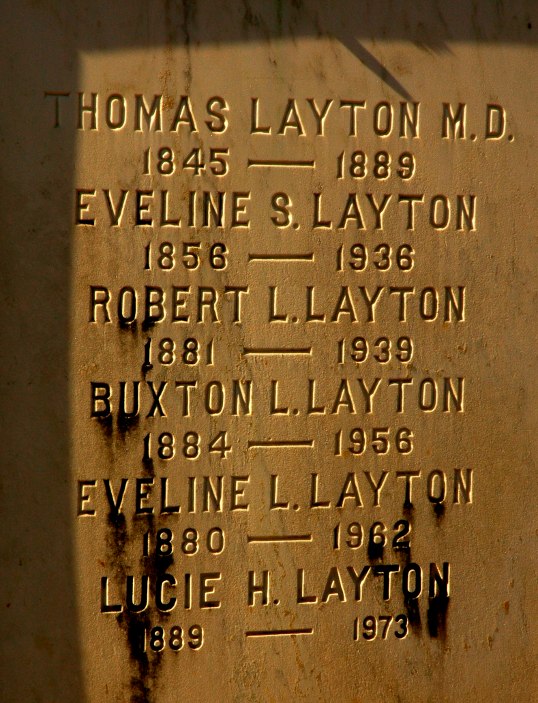
This is repeated as long as necessary. Some of the tombs had dozens of names on them, spanning well over a century.

Some of the details are fascinating. The walls of the cemetery are lined with small “wall tombs.” These are for when, as our guide said, “Somebody dies too soon, before the year and a day. They get stuck in the wall tomb until they can get moved back into the family crypt.”

Our tour guide in front of a typical New Orleans burial crypt.

Our tour guide in front of a typical New Orleans burial crypt.

A street in the City of the Dead. Family crypts on the left, wall crypts on the right.

A street in the City of the Dead. Family crypts on the left, wall crypts on the right.

Older crypts, getting run down.

Older crypts, getting run down.

Wall crypts. Space is at a premium. Look at the tiny spaces at ground level.

Wall crypts. Space is at a premium. Look at the tiny spaces at ground level.

Layton family crypt.

Layton family crypt. Over a century of family members.

Our guide said she was waiting for tomb space to open up and had saved money to buy in. “Space is limited, and in death like in life, it’s location, location location. I don’t want to go to my rest outside the city, I want a tomb in New Orleans.”
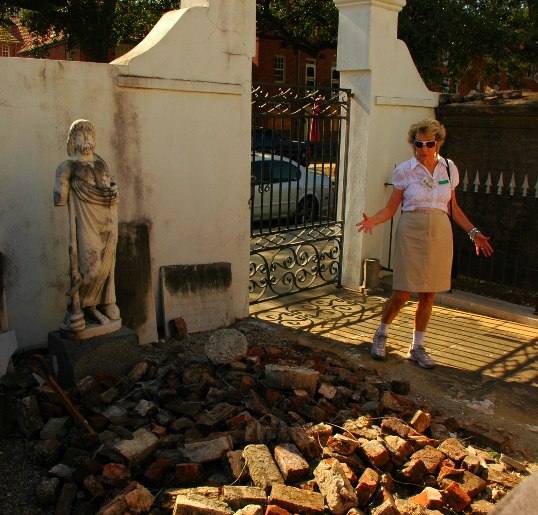
When a family dies out, nobody is left to take care of their crypt and it can collapse. Our guide said she had her eye on this spot in case it came up for sale.
When a family dies out, nobody is left to take care of their crypt and it can collapse. Our guide said she had her eye on this spot in case it came up for sale.

Rainy Day in New Orleans

New Orleans is over a hundred miles from the ocean, but it is barely dry. Rain comes quickly and unexpectedly… except it is always expected.

Luckily, there is a source of refuge in the Big Easy – whenever the skies open up, there is always a bar handy to seek shelter and good cheer.

Waiting for the St. Charles Streetcar, the rain came down, hard, so we ducked into The Avenue Pub (which happened to be right there).

The Avenue Pub is beer heaven. Open 24hrs. 7Days (never know when it’s going to rain). Their list of beers on tap is three pages long.

The Beer Buddha says:

“Honestly this category really isn’t fair; but why punish one bar because all the others can’t hold it’s jockstrap? We all know The Avenue Pub is THE beer bar in not only New Orleans but in Louisiana. Nothing against all the other bars in the state but you ALL know you have a long way to go to be mentioned in the same sentence with AP.”

Draft Magazine lists it as one of the 100 best beer bars in the country. They say:

“Only in New Orleans will you find a beer bar open 24/7. The staff is militant about clean beer lines and proper glassware, so even when you stumble in at 4 a.m. you get the best pint in the city. Choose from more than 47 rotating taps and about as many bottles, all focusing on American beer. Go for an exhaustive introduction to local NOLA Brewing or to people-watch from the balcony.”

The Complex City Guide has it at 12 in the 25 best Beer Bars in the country. They say,

“Louisiana may not be the first state you think of when you think of beer (sure, they’ve got Abita), but when you change state to city and beer to drunk, it’s no wonder that New Orleans has one of the best beer spots in the country. Avenue Pub features a rotating 47 taps on two floors (so you can get your exercise in between rounds) and once you mix that with some amazing Louisiana cuisine, you won’t be thinking about Bourbon Street no more. And the most important part, here in the land of to-go cups, the Avenue is open 24 hours a day. Yup.”

And all this is right there, right on the Streetcar Line, right when it starts to rain.

My only complaint – they don’t have Deep Ellum Brewing Company’s Pollinator on tap. Maybe I can send them an email.

The Avenue Pub, on St. Charles in New Orleans

  • Moleskine with Varsity Disposable Fountain Pen
  • Streetcar Fare
  • Beer list and food menu
  • NOLA Blonde Ale Beer
  • Fox Barrel Pear Cider (sorry, it wasn’t even noon yet and I was a little beer’d out – so I had a cider. It was good. So sue me)

A lot of taps.

No Orange Slices! No Muddling!

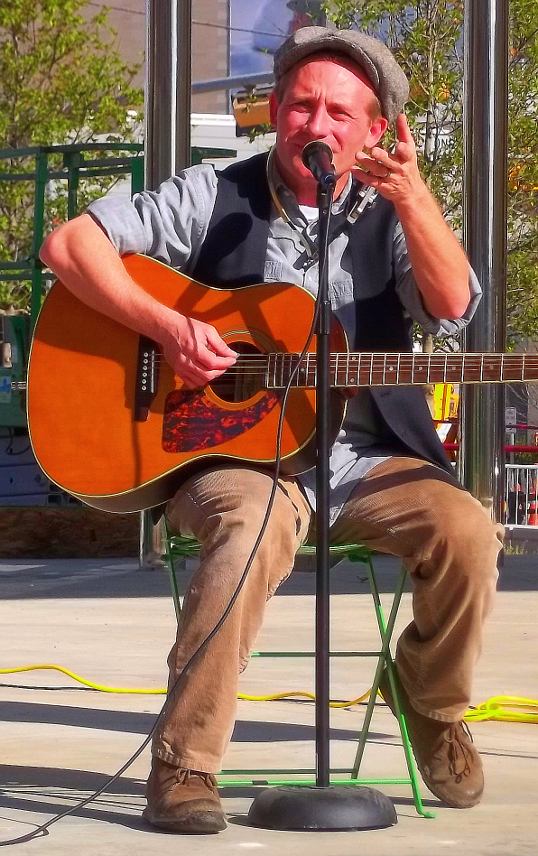
Michael Prysock

Michael Prysock, (facebook), with Mark Deffebach  Sunday afternoon concert in Klyde Warren Park, Dallas, Texas

I mean, the genuine roots of culture is folk music.

—-Johnny Rotton

Michael Prysock and Mark Deffebach the Mandolin Player

There are no bridges in folk songs because the peasants died building them.

—-Eugene Chadbourne


Michael Prysock

The late sixties and early seventies were kind of a breeding ground for exciting new sounds because easy listening and folk were kind of taking over the airwaves. I think it was a natural next step to take that blissful, easy-going sound and strangle the life out of it.

—-Alice Cooper

You have to open your mind. I like the ability to express myself in a deep way. It’s the closest music to our humanity – it’s like a folk music that rises up out of a culture.

—-Sonny Terry


Bad Veins

We left the Deep Ellum Brewing Company’s First Annual Party and walked over to Main street where the Deep Ellum Market was in full bloom. I’ve heard some good music at the Markets – the bands set up on the sidewalk outside a recording studio on Main. I’ve seen Ducado Vega and June Marieezy – they were all really good.

Today was a duo called Bad Veins – a guitar/singer/keyboardist and a drummer. They said they usually play with a backing tape deck (named Irene) but decided to be a little more laid back and simply play. They were pretty darn good. They had a little cadre of fans sitting in plastic chairs in the street. How cool.

Benjamin Davis – Bad Veins guitar player and singer.

The Bad Veins and their dedicated fans.

A fan.

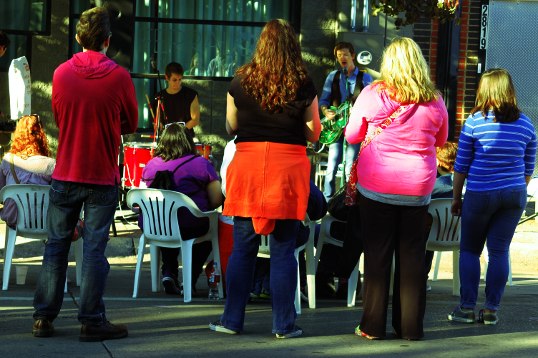
Bad Veins playing on the sidewalk in Deep Ellum.