All the Way Around

I have been working hard, riding my bicycle every day. I’m out of shape and too big and too old, but still I try.

One helpful thing is that I have done this before. I was a lot younger then, which makes it a lot harder now, but I know it can be done because it has been.

When I first moved to Dallas I was young and full of pee and vinegar, but I began to give in to my slothful and dissipative nature and started eating out too much and lounging around watching too much television. So I fixed my bike up and started to go our riding on a regular basis… at least four times a week. Now there are bicycle trails everywhere, but back then, in the early eighties, there was only one in Dallas, the White Rock Lake Trail. When I started, I lived on Lower Greenville… then I moved a little north to Lover’s Lane and Northwest Highway – and both gave access to White Rock Lake.

I remember the first few times I rode – I couldn’t make it all the way around. This can be problematic, because once you are on the other side of the lake, you have no choice but to ride back. Again, I was young then and the mileage started to increase quickly and before long, around I would go (it’s about nine miles around the lake).

Two memories stand out from those early circuits. Once, I was plugging up an uphill spot when a young woman passed me, standing on her pedals, and shot up the same hill like it wasn’t there. I thought this was the most beautiful thing I had seen – her power, her technique. It wasn’t long though, before I could do the same thing – without even thinking about it. That was a moment of pride.

One problem with riding back then was that it was a nice little downhill jaunt to get to the lake. That meant the last part of my ride, from the lake to my apartment was uphill. I had to be careful and make sure I had enough energy left to get up the hill. One day I miscalculated and had to use up every last bit of willpower I had to get back home. The problem was, I lived in a second story apartment, and there was no way I could make it up the stairs, especially carrying my bike. I had to lie down in the yard, next to my bicycle, for almost an hour, until I was rested enough to trudge up the stairs. I was surprised that nobody came out to see what was wrong with me (not that the people there were helpful – they were very nosy).

So now I’m at it again. The other day I made a list of the rides I wanted to do over my few days off around the fourth, and one was a circumnavigation of White Rock Lake – something I hadn’t done in decades. It brought back a lot of memories, mostly of when I was starting out. I’m riding an inefficient mountain bike, so it is good exercise. I carry plenty of water and my Kindle, and stop whenever I feel like it to read a few pages.

That’s a good time for me. Riding my bike in a nice spot, with memories flooding back, and stopping in bits of shade now and then… reading a bit, riding a bit. It doesn’t get much better than that.

My old Raleigh is hanging out in the garage. Maybe I’ll work on it, see if I can bring it back to life. It’s old, but it’s light and might still go faster and easier than my mountain bike. We’ll see.

I may be old, but I’ve done it before.

Where I started. I think this is the “runners’ lot” – the “cyclists’ lot” is a bit farther down the road. So sue me.

Near the north end of the lake there is a long pedestrian/bike bridge they built to get across an arm of the lake. Back in the day we had to ride on a narrow sidewalk along Mockingbird Lane – a very busy road. If someone was coming the other way… you could pass, but with no more than an inch to spare. It was frightening.

I stopped and visited with the folks at White Rock Paddle Company. I think I’ll go back there soon and rent a canoe. There’s some swampy backwaters I want to explore. It looks like fun.
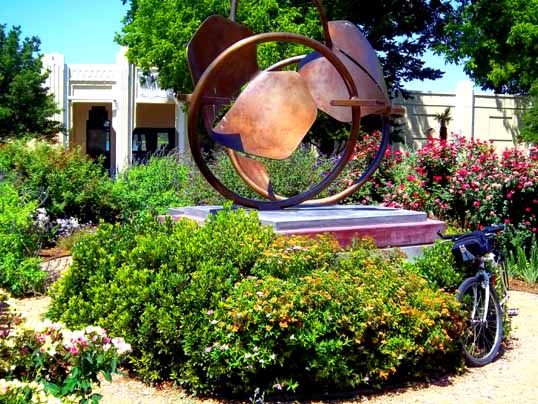
The old art-deco bath house is now the Bath House Cultural Center and it has a nice sculpture and butterfly garden out front. It’s one of my favorite spots around the lake so I stopped there and read a couple short stories on my Kindle.

A view of the dam across the lake with the towers of Downtown Dallas poking up in the background.

The trail runs between the lake and the Dallas Arboretum. Here’s a bit of Chihuly visible through the trees. That sculpture is about thirty feet tall and is called “Yellow Icicle Tower.” I took a picture of it at night here.
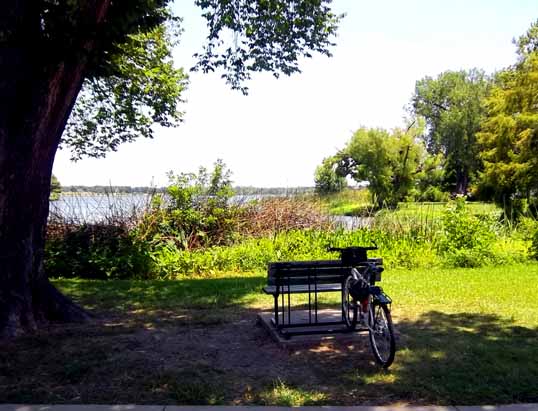
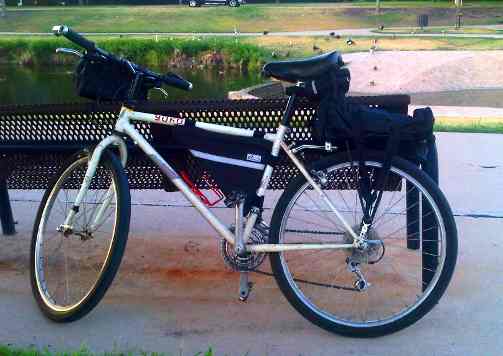
This bench is one of my favorite spots on the West side of the lake. It’s a quiet shady spot. I remember sitting here years ago, taking it easy, though the area looked different back then. The plaque on the bench said that it was dedicated in 1998, so I must have sat there when it was new. These benches have bicycle racks built in to them, a very useful design.

What I learned this week, July 6, 2012


girl from ipanema turns fifty

wsj

original

Frank Sinatra

Ella Fitzgerald


20 Songs for Sticking It to The Man


The Power and the Peril of Our Crowdfunded Future

This year Kickstarter has provided more money to the arts than the National Endowment for the Arts (NEA).


I like the song… may not be anything special – but any music video with Kelsey Gunn in it is worth an Embed. It’s odd seeing her in something serious after all those 5 Second films.

The Action of Grace in Territory Held Largely by the Devil

I have been working my way through the stories in Knockemstiff, a collection by Donald Ray Pollock. The characters in the tales are unrelenting losers – it’s harrowing. You would never want to meet these people and shouldn’t care when they meet their inevitable doom. The stories are not for the faint of heart (I’ll write about the book itself in a few days).

Yet, you do care. The stories do work.

In researching the literature I came across a quote from Flannery O’Connor. This make sense, she was a master of the grotesque and the sacrificial outsider. Knockemstiff is in Ohio, not the South of O’Connor’s milieu – but there is a kinship.

The piece I read had a quote:

From my own experience in trying to make stories “work,” I have discovered that what is needed is an action that is totally unexpected, yet totally believable, and I have found that, for me, this is always an action that indicates that grace has been offered. And frequently it is an action in which the devil has been the unwilling instrument of grace. This is not a piece of knowledge that I consciously put into my stories; it is a discovery that I get out of them. 

And this is it in a nutshell. That’s some of the best advice on fiction I’ve read in a long time.

The quote came from a book, Mystery and Manners – Occasional Prose, Selected and Edited by Sallay and Robert Fitzgerald.

An expanded selection reads:

To insure our sense of mystery, we need a sense of evil which sees the devil as a real spirit who must be made to name himself, and not simply to name himself as vague evil, but to name himself with his specific personality for every occasion. Literature, like virtue, does not thrive in an atmosphere where the devil is not recognized as existing both in himself and as a dramatic necessity for the writer. 

We are now living in an age which doubts both fact and value. It is the life of this age that we wish to see and judge. The novelist can no longer reflect a balance from the world he sees around him; instead, he has to try to create one. It is the way of drama that with one stroke the writer has both to mirror and to judge. When such a writer has a freak for his hero, he is not simply showing us what we are, but what we have been and what we could become. His prophet-freak is an image of himself. 

In such a picture, grace, in the theological sense, is not lacking. There is a moment in every great story in which the presence of grace can be felt as it waits to be accepted or rejected, even though the reader may not recognize this moment. 

Story-writers are always talking about what makes a story “work.” From my own experience in trying to make stories “work,” I have discovered that what is needed is an action that is totally unexpected, yet totally believable, and I have found that, for me, this is always an action that indicates that grace has been offered. And frequently it is an action in which the devil has been the unwilling instrument of grace. This is not a piece of knowledge that I consciously put into my stories; it is a discovery that I get out of them. 

I have found, in short, from reading my own writing, that my subject in fiction is the action of grace in territory held largely by the devil. 

I have also found that what I write is read by an audience which puts little stock either in grace or the devil. You discover your audience at the same time and in the same way that you discover your subject; but it is an added blow.

There is another sentence in there that I had to think about, think about hard….

There is a moment in every great story in which the presence of grace can be felt as it waits to be accepted or rejected, even though the reader may not recognize this moment. 

And there is the lesson for a writer. Even in the most terrible of circumstances and even with the most degenerate of characters there is a moment where grace is offered, and the story happens in the next split second… when the offer is accepted or rejected.

I have been digging through stories that I have read, looking for that moment… and usually finding it.

I have added, right at the top, of the notes I use to develop a story idea, “Where is the grace offered, how is it felt, and why is it accepted or rejected.”

There is always more to be learned. That’s why we get out of bed in the morning.

Old Engine

I’ve been working hard, riding my bicycle from five to ten miles every day. It’s getting really hot, but luckily, you make your own breeze on the bike and it’s possible to get some riding done in the heat. Staying hydrated is the key. I carry two water bottles and a big liter container full of iced water in a bag and that helps. As the summer gets worse, I’ll start wearing a hydration pack – though the thing is a pain to fill and to keep clean.

What I do when it gets hot is to ride a bit, then stop, rest, drink some water and maybe read some on my Kindle. Ten miles and three short stories seems to be a nice bit of morning’s work.

I still feel stupid riding around, but I’m getting used to that. Feel stupid, look stupid – after a while it’s all the same – you have to do what you have to do. It’s more a matter of survival than of vanity.

Sometimes I carry a small point-and-shoot along with me, though I don’t see much worth pointing at or shooting. I did run across this car. I’m not a car expert or a connoisseur of automobiles but this one looks pretty darn cool.

If it has the original engine inside – it’s the same age as the one on my bicycle.

1957 Thunderbird

Volt

I had a little money left over on an Amazon.com gift card and began to choose some Kindle books. I picked up a couple of short story selections, Knockemstiff, by Donald Ray Pollock and Volt, by Alan Heathcock. Pretty much by a flip of the coin, I read Volt first.

Volt has eight semi-connected longish short stories. Right off the bat, the description of a farmer accidentally killing his son while tilling a field resonated with me. I’m a father and have spent a little time on a tractor seat bouncing in the heat and dust, watching a mile-distant fence line slowly, inexorably approach.  That awful scene was enough to justify the price of the book and the time to read it. I thought that first story could have ended after those two pages.

It didn’t though, as the father, destroyed by the accident and jolted by a near miss with a freight train – runs away. And runs and runs and runs – putting Forest Gump to shame. He ends up wiping his life away and building a new one, of sorts. It’s a journey worthy of Odysseus, and likewise, he finds that home is not what it used to be. Too much water under the bridge.

The stories are all small-town Gothic. They are set in the hopeless wide-spot-in-the-road of Krafton… an imaginary town. Trust me as one who knows – there are a lot of Kraftons out there. One hell of a lot. These are forgotten hamlets where everyone with any ambition or brains left town long ago – leaving the impression that the remaining conscripts – imprisoned by tradition, lack of imagination, and ennui – exist simply to work their way back down the evolutionary chain. There is even a Biblical Flood – though plenty of unworthy survive.

There is one hopeful character, Sheriff Helen Farraley, a plump middle-aged former grocery store manager pressed into service to combat evil no mortal should have to face. Her decisions seem insane, until you try to see her world through those eyes.

At the end of the finely crafted book, I felt I knew the doomed citizens of Krafton, and hoped somehow, someday they find the redemption that they deserve, even if they don’t see it or don’t chose it for themselves.

Now, on to Knockemstiff.

New York Times Review – Stories of Small-Town Strife

‘Volt’ writer Alan Heathcock’s internal duality fuels his gripping prose and creates his epic stories

‘Volt’: Stories for Mourning, After A Nameless Loss

BOOK REVIEW: Alan Heathcock

Bookslut – VOLT BY ALAN HEATHCOCK

Armored Pole

I have always been fascinated by the armored utility pole. That’s a wooden cylinder – lights, power, telephone –  that has been used as a guerrilla bulletin board for so long, had so many handbills stapled to it, that it has become covered in steel. You see these in the cool, hip neighborhoods – places with a lot of bars and live music. Places where folks run along with staple guns and stacks of freshly printed band flyers and click… click, there’s another one.

It’s generally illegal and the streets department takes them down… but look at the poles.

What is the ultimate end of this? Can a pole have so many staples in it that there can be no more shot in? The accretion of metal – the slow sculpting – the combination of nature and man-made steel violence… it’s life in a nutshell, posted up there for everyone to see.

Here’s one I saw the other day. A pole densely festooned with staples – then a big chunk is taken out by a careening car – a collision hard enough to split of a healthy sliver but not enough to take down the pole. The fresh wood is exposed and, soon enough, the staples start reproducing. In a year or so the wound will be completely healed.

Old Band Flyers

Flickr: The Band Flyers Pool

50 Amazing Gig Posters Sure to Inspire

The Best Art Band Flyers in Chicago

Peanuts and Cracker Jack

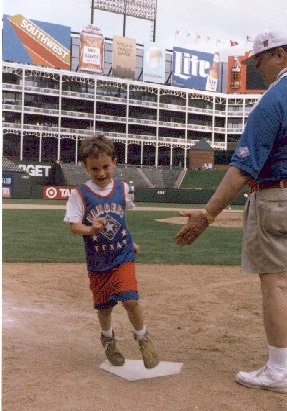
Nick crossing home plate at Rangers Ballpark in Arlington. They let the kids run the bases after an afternoon game – we had to wait for hours for his turn. This would have been right after the Ballpark opened, probably 1995. It’s hard to believe he’s a junior in college now.

A few weeks ago I won a pair of Ranger tickets in a raffle. They weren’t particularly expensive seats – only ten dollars each – but something won is always something good. Still, the games were on a Friday night – that’s a long drive after work, and the horrible Texas heat is upon us… so I considered giving the tickets away.

But it turned out that Nick was flying into town the afternoon before the game, so I was glad to hang on to them. There is nothing better than going to a baseball game with your son.

Baseball is a time machine. Baseball exists outside of the rest of reality and to enter a baseball stadium is to connect with every other time you have been to a baseball game.

When we walked in I thought of the first major league games I had attended – in Kansas City while I was in college. I thought of the old Ranger Ballpark – the crappy old one that was a little bit to the north of Rangers Ballpark. Since I was with Nick, I remembered taking him as a toddler to the old ballpark – he immediately began to throw ketchup coated french fries over the railing onto the crowd below. We had to leave before the second inning.

I remembered the times we would take the kids to games. We would buy really inexpensive bench seats out in the outfield, right next to the opposing team’s bullpen. Nick and Lee would talk to the pitchers through the wire mesh. Some would give them pitching hints. Some gave them souvenir balls.

Nick talked about driving back from school in North Carolina to see a World’s Series game at the Ballpark. As a twenty-odd year Ranger fan I never thought I’d see a World’s Series played here (now I want to see them win one).

All the ballgames I had been to or played in swirled in my mind, decades and decades worth. The ballpark is fancier than it used to be, the scoreboards are colorful, stunning, electronic (I remember seeing a single-A game in Charleston, West Virginia where the “Dot Race” was three kids racing behind the outfield fence with brightly-colored wooden cutout horses atop long poles), and now the food choices are much more varied and tasty (and expensive) – but the game is the same. The bat, the ball, the three bases exactly the same distance apart.

It is a connection between people and between times and between space. It is baseball. I had not been to a game in a couple years… I almost forgot.

One thing I always say is that baseball is the only sporting event that you can enjoy when your team loses. For most of the night, that looked like what was what was going to happen. I was resigned to the loss and simply soaking up the atmosphere and enjoying hanging out. Oakland was up two to nothing until the eighth inning and the Rangers loaded the bases. There were two outs though, so not much hope.

But, wonder of wonders, a run walked in, and then Craig Gentry hit a bases-loaded, three run triple to give the good guys the win. A bases-loaded triple! Arguably the most exciting play in the game. The sell-out crowd went nuts. The radio announcers on the way home said the Baseball Gods were smiling on the Rangers tonight.

Then, after the game, they had a fireworks show. It was very nice – I’m not sure, but I think this was the first time I’ve seen those really cool smiley-face star shells – impressive.

Oh, somewhere in this favored land the sun is shining bright; the band is playing somewhere, and somewhere hearts are light, and somewhere men are laughing, and somewhere children shout.

And sometimes – not often, but sometimes, there is joy in Mudville.

The view from the cheap seats. This is actually a really good place to sit. It’s high up, but you get a view of the game you don’t see on television – the placement of the fielders, the way a double play moves. I had no complaints.

One of the things I like best about Rangers Ballpark is the ample terrace around the upper level. Even on a hot summer evening there is a nice breeze at this altitude and it’s a great place to walk out and hang for a few minutes while the other team is batting.

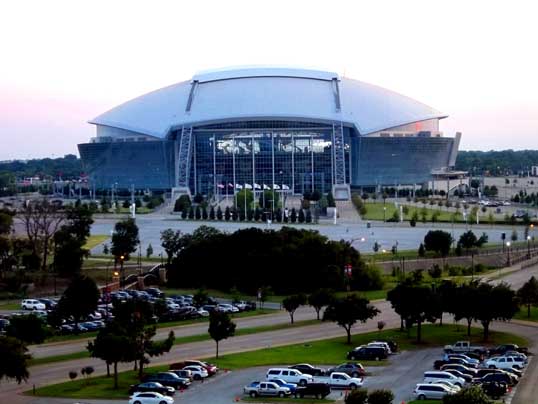
If you look over the edge of the terrace on the first-base side you have an imposing view across the parking lots of the Death Star – where the Dallas Cowboys play. A photograph does not convey the horrible gigantic-ness of this monstrosity.

Off the third-base side are the roller coasters of Six Flags Over Texas.

The sun sets over the parking lots from the terrace of the Ballpark.

I couldn’t believe it… during a slow part of the game the crowd actually started doing the wave. About three decades too late in my opinion. Even the big main scoreboard didn’t approve.

Blue Threadlocker

Last weekend, it was hot, very hot. As it does every year, summer is slamming its toxic wall of incalescence into the population like Castle Bravo into Bikini. I had a ten mile bicycle ride planned out – from the DART station at Araphaho north along the Central Trail and looping through the Spring Creek Natural Area – including the new little extension that runs up under the towering vertiginous George Bush Turnpike interchange… then back. Ten miles isn’t very far, but my bike is heavy and inefficient and its motor is old and worn out – so it was enough, especially in this heat.

(click to enlarge)

My good intentions were to get up at dawn and go in the relative cool of the dewy morning – good intentions… but we know where the road that is paved with those leads to. I did not actually get on the road until the sun was directly overhead. It wasn’t too bad, though – I carried plenty of iced water and the Spring Creek part of the trail is shaded by the thick forest. I took my Kindle and stopped a few times to read a short story at any particularly tempting shaded bench I came across.

The looping trails through the Spring Creek Natural Area converge on a little footbridge over the creek. There is a nice bench there – a good place to rest and get away from the city for a few minutes.

The only problem I had was that the bolts on my bicycle rack worked themselves loose while I was riding. I noticed one side coming off and stopped to fix what I could – and then later the other came loose. I was able to keep going after some repairs, but the rack was useless.

Rack

Bike Nashbar rack mounted on the back of my bicycle.

When I arrived at home I was able to scrounge up replacements for the bolts that I lost and reassembled everything. But I knew this would happen again. No matter how hard I torque down those little aluminum bolts the constant shaking and jarring of my halting progress across uneven concrete would make them back their way out of their proper, tight position. So I sat down facing the search engines and decided to learn what I could do to stop this from reoccurring.

I entered the world of the threadlocker. There are many brands and many types… but it didn’t take long to limit everything down to one key identifier and two types – Red and Blue.

Both colors will keep your bolts under your thumb, but the red, the high strength, has to be heated to five hundred degrees to give up its grip. The blue, however, is removable with “ordinary hand tools.” So blue it was.

A trip to an automotive parts store and a tiny tube of blue threadlocker was at hand. I took the rack off, and carefully reinstalled it, squirting a little blue stuff onto each bolt as I threaded it back home.

So now, is it possible that that rack will go flying off into oblivion when I am tooling along in the middle of nowhere sometime casting my absolutely necessary survival gear into some bottomless pit? Maybe.

But I’ve done what I can.

Pack Straps

This works, but it looks stupid. Though not as stupid as when I’m actually riding the thing.

What I learned this week, June 29, 2012

The Terms


Great News! One of my favorite independant Coffee Houses – The Pearl Cup – is opening a new branch in Richardson – the city where I live. It is planned on opening in late September or August. It won’t be particularly close to my house (It’s in a very nice neighborhood – not the kind of place where people like me live) but it will be a lot easier to get to than the one down on Henderson in the City. Nobody goes there anyway, it’s way too crowded.

Pearl Cup to Open a Location in Richardson!

Dallas Observer Best Coffee Shop – The Pearl Cup


The Bartender’s Tale: How the Watergate Burglars Got Caught

Think you know everything about Watergate? Leave it to a barman to add a surprising twist to Washington’s most enduring story


Turing the tables on scammers

Why would a Nigerian scammer admit that he’s from Nigeria? After all, Nigeria is notorious for fraudulent emails. Shouldn’t the fraudsters claim instead to be from Turkey or South Africa or, really, anywhere but Nigeria? That’s a question asked by Microsoft researcher, Cormac Herley, and seconded by security guru Bruce Schneier. Herley’s insightful answer looks at the economics of scam emails:

Attacking the maximum number of people does not maximize profit. … Since the scam is entirely one of manipulation he would like to attack (i.e., enter into correspondence with) only those who are most gullible. … Since gullibility is unobservable, the best strategy is to get those who possess this quality to self-identify. An email with tales of fabulous amounts of money and West African corruption will strike all but the most gullible as bizarre.

Nigerian scams are labor intensive for the scammer, but only after the first bite. Actually landing even the most gullible correspondents takes time, effort, and skill that the scammers don’t want to waste.