Across the Mississippi

I will not be just a tourist in the world of images, just watching images passing by which I cannot live in, make love to, possess as permanent sources of joy and ecstasy.

—-Anais Nin

The camera makes everyone a tourist in other people’s reality, and eventually in one’s own.

—-Susan Sontag

The traveler sees what he sees, the tourist sees what he has come to see.

—-Gilbert K. Chesterton

Every tourist in New Orleans has their picture taken in front of the St. Louis Cathedral in Jackson Square. Usually, they climb the levee with a lump of sugar-slathered fried dough washed down with bitter coffee sitting in their stomach like the grease of doom to grin at the camera while facing the river.

I prefer this view of the Cathedral, from across the Mississippi at Algiers Point. The water flows by… always different, always the same.

No man ever steps in the same river twice, for it’s not the same river and he’s not the same man.

—-Heraclitus

Time is the substance from which I am made. Time is a river which carries me along, but I am the river; it is a tiger that devours me, but I am the tiger; it is a fire that consumes me, but I am the fire.

—-Jorge Luis Borges

“I thought how lovely and how strange a river is. A river is a river, always there, and yet the water flowing through it is never the same water and is never still. It’s always changing and is always on the move. And over time the river itself changes too. It widens and deepens as it rubs and scours, gnaws and kneads, eats and bores its way through the land. Even the greatest rivers- the Nile and the Ganges, the Yangtze and he Mississippi, the Amazon and the great grey-green greasy Limpopo all set about with fever trees-must have been no more than trickles and flickering streams before they grew into mighty rivers.

Are people like that? I wondered. Am I like that? Always me, like the river itself, always flowing but always different, like the water flowing in the river, sometimes walking steadily along andante, sometimes surging over rapids furioso, sometimes meandering with hardly any visible movement tranquilo, lento, ppp pianissimo, sometimes gurgling giacoso with pleasure, sometimes sparkling brillante in the sun, sometimes lacrimoso, sometimes appassionato, sometimes misterioso, sometimes pesante, sometimes legato, sometimes staccato, sometimes sospirando, sometimes vivace, and always, I hope, amoroso.

Do I change like a river, widening and deepening, eddying back on myself sometimes, bursting my banks sometimes when there’s too much water, too much life in me, and sometimes dried up from lack of rain? Will the I that is me grow and widen and deepen? Or will I stagnate and become an arid riverbed? Will I allow people to dam me up and confine me to wall so that I flow only where they want? Will I allow them to turn me into a canal to use for they own purposes? Or will I make sure I flow freely, coursing my way through the land and ploughing a valley of my own?”

—-Aidan Chambers, This is All: The Pillow Book of Cordelia Kenn

How could drops of water know themselves to be a river? Yet the river flows on.

—- Antoine de Saint-Exupery

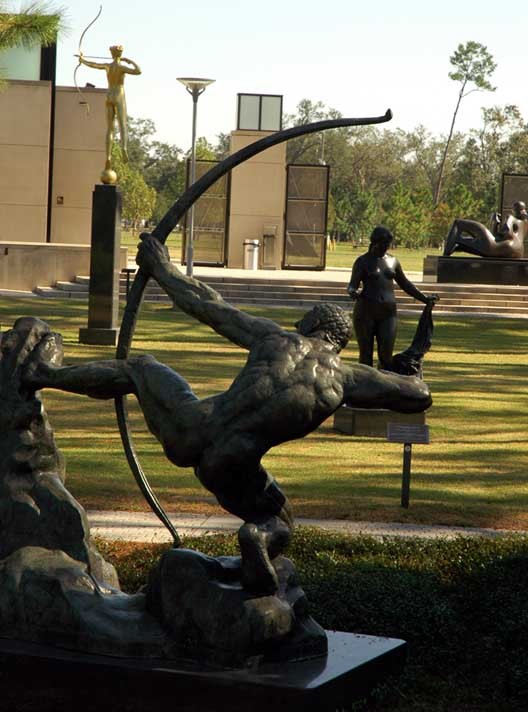
Two Archers

Besthoff Sculpture Garden, New Orleans, Louisiana

A good archer is not known by his arrows but his aim.

—-Thomas Fuller

(Click for a larger version on Flickr)

What we want is not freedom but its appearances. It is for these simulacra that man has always striven. And since freedom, as has been said, is no more than a sensation, what difference is there between being free and believing ourselves free?

—-Emil Cioran

(Click for a larger version on Flickr)

Sculptures in the photos:
Henry Moore, Reclining Mother and Child

Pierre Aususte Renoir, Venus Victorius

Augustus Saint-Gaudens, Diana, The Huntress

Antoine Bourdelle, Hercules the Archer

G Force

Einstein’s Principle of Equivalence:

The starting point for general relativity is a statement called the principle of equivalence, which states that a uniform gravitational field in some direction is indistinguishable from a uniform acceleration in the opposite direction.

However, Einstein also said:

You can’t blame gravity for falling in love.
—-Albert Einstein

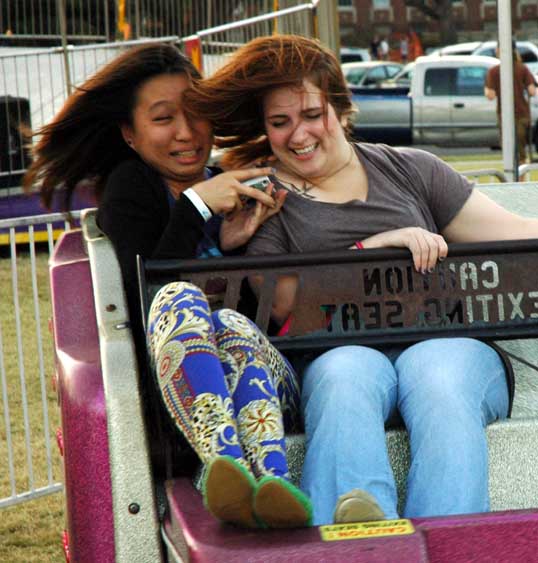
Tulane Homecoming, New Orleans, Louisiana

Sunday Snippet – New Orleans Writing Marathon

On the morning after Halloween Candy went down to the restaurant in the St. Vincent’s Guest House for breakfast and when I joined her she introduced me to someone she had met at the counter. It was Brant Osborn, an English Teacher from Slidell.

He was at St. Vincent’s for a Writing Marathon organized and sponsored by the Southeastern Louisiana Writing Project. The idea was that a group of about twenty writers would break into groups, either stay at the guest house or walk around the Lower Garden District for the day, stopping and writing as the mood struck them. Periodically, folks would read what they had written – hopefully providing ideas, inspiration and motivation for each other.

He asked me if I wanted to go.

I ran up to my room and grabbed my Moleskine and Varsity Disposable Fountain Pen.

The entire group (mostly English teachers and a few intruders like myself) started in the common room at the guest house, wrote a little and then we took off. There were five of us in my group, myself, Richard Louth (the organizer of the writing marathons), George, and Roman.

We walked down Magazine street, hitting a coffee shop, then po-boys for lunch, a side trip to a park, and then a beer at a table outside a neighborhood bar. We’d write and read at each stop. At the end we met back at St. Vincent’s for a celebration and reading, until darkness fell completely.

Most folks wrote little essays or short works inspired by St. Vincent’s, the history of New Orleans, or the other folks in the writing group. I, as is my wont, struggled to squeeze out some fiction. I didn’t have any of my writing prompt or idea collections with me. The only things I had was the inspiration of the St. Vincent’s hostel, some bits of story the other guys would tell, and a quote from a singer on Frenchman Street the night before, “Folks from small towns get arrested in the big city, folks from the big city get arrested in small towns.”

So I spent a whole day walking around Magazine Street in New Orleans with a group of like-minded folks, writing and reading. It was, for me, a perfect day. I want to publicly thank Richard Louth for putting together this program and for Brant Osborn for inviting me.

It was so much fun that now I want to do a writing marathon in Dallas. I’ve been thinking about it and am putting together a page on my blog to organize my thoughts. Go over to that page and take a look, feel free to leave comments or suggestions. The more the merrier.

So what did I write? Here it is, copied pretty much verbatim from my Moleskine. It’s about a third of a short story… and I’m working on where to take it from here.

Parasol

Chapter 1 Svetlana (I)

Svetlana dragged her backpack up the rickety wooden stairs through a heavy wrought iron gate. A fat man with an eyepatch sat behind a tall desk with paint peeling off the front.

She worried about her English – she had studied for over a decade and always dreamed of this – but now was the first time she actually spoke a complete sentence. She could feel her accent rolling in her mouth like a hot walnut.

The man with the eyepatch didn’t even look up. He flipped a set of keys in front of Svetlana and handed her a half-sheet of paper – cut unevenly with a set of numbered rules. It was handtyped and xeroxed, with a tattoo of hand-written corrections. The top line said, “Rules are non-negotiable – you will be thrown out of the hostel.

The one-eyed man finally spoke, still without looking up. “Down that hall – men on the left, you are on the right.”

Svetlana dragged her pack down the hall. The thin, worn carpet and painted walls were stained with water leaking from somewhere above. Strangely, the passage was lined with fine bronze sculptures of nude men and women – out of place in the worn and tattered building.

She reached the women’s dormitory and pushed the door open.

A quick feeling of panic rose in her throat as she looked down the center of a double row of bunk beds constructed of two by four beams nailed in a grid. In the Ukraine, she had her own wing with a personal servant. She had never slept in a room shared with strangers.

Chapter 2, Russell (I)

Russell never thought, never in a million years, that he could be thrown in jail for pissing on the side of a building. At home, you can pee wherever you want – it is a God-given right. He was no more than a block down the street from the bar when he realized he had forgotten to use the bathroom before he left. There was an unlit alley and he ducked in. He was admiring the patterns of oblique shadow the streetlights made on the rough brick when he noticed the blue and red flashing lights mixed in with the yellowish streetlight.

Just when he broke out into a grin at the interplay of colors and shapes he felt a rough hand on his shoulder.

Russell jumped a bit at the voice yelling in his ear, “Well, now, look who’s going to jail tonight.”

His arms were pulled back and he felt the cold steel click around his wrists.

“Shit, son, you ain’t even zipped up,” the unseen voice said. “Now, don’t you piss on me or I’ll crack your damn head.”

He felt his hands released and as soon as he brought them forward and fixed his pants he was shoved forward. His hand came up to catch himself from falling, his palms against the uneven wall. Boots pushed his feet apart.

Strong hands moved down his sides and between his legs, and finally slid his wallet out of his back pocket.

Chapter 3 Svetlana (II)

She looked down the room and saw a woman with spiked hair and a piercing through the side of her nose rummaging through a pile of plastic grocery sacks. She looked up. Svetlana thought she saw a tiny colorful flickering on the woman’s face.

“Which bed should I take?” Svetlana asked. The woman looked at her for what seemed like a long time then gestured at a lower bunk three beds down from where she was crouched.

“This one honey, it’s right under mine. Throw your pack on the bunk, but don’t leave it there when you’re gone. They got too many thieves ’round here.”

The woman glanced down at the bags at her feet and Svetlana saw a guilty look flash over her face. It didn’t stay there long. Svetlana threw her pack onto the lower bunk the woman had gestured at and then stood at the foot of the bed, stiffly, waiting to see what would happen next.

For most of her life Svetlana had dreamed of this moment – she had escaped. She was halfway around the world, but this was no dream. She realized, for the first time, that she had not actually thought past this very second, and was at a complete loss of what to do now. The panic rose and settled like a hard knot in her chest. She felt paralyzed – her mind blank. She stared at the woman, afraid the two of them would be standing like that forever.

The woman broke the impasse by moving quickly toward her – almost at a run – turning at the last instant in front of the flinching Svetlana and jumping up onto the top bunk. The woman was so close to Svetlana that she could see that her nose piercing was a tiny skull. Inside, a small LED was blinking – making the skull’s eyes flash bright red.

“You’re not from around here, are ya,” the woman said.

“No, the Ukraine. Is my accent that bad?”

“Nah, everybody’s got an accent here.”

“Your nose piercing?”

“Oh yeah, cool, huh. I make these and sell ’em on the corner. People love ’em. Changing the battery’s a bitch though. You want one? I’ll give you a discount.”

“I’m afraid I don’t have a piercing there.”

“Oh, no problema,” the woman said, fingering a large safety pin laced into a leather bracelet on her wrist. “Don’t have to go through your nose anyway. I’ve got a double skull – red and blue – can put that one through a nipple.”

Svetlana started to shake a little, and the knot under her breastbone grew and hardened.

“Not now, I’m sorry. Just off the plane and I’m still,… what do you say? Still on Ukraine time?”

‘Jetlagged.”

“Jet – Lagged,” Svetlana repeated slowly.

“Shit Ukraine,” the woman said, “I’m Joanna.”

“Svetlana.”

“OK Ukraine, whatever. You look like you need a beer. Grab your bag, let’s go.”

Chapter 4 Russell (II)

The concrete pallet had no mattress and the jailhouse orange coveralls were thin so Russell wasn’t really asleep when the noise outside the cell snapped his eyes open. Two huge deputies were dragging a man down the corridor towards the cell. He was wearing a once-whitish suite, covered in thin blue lines – now stained with blood and at least one other substance. The man looked exhausted and one eye was swollen almost shut but he still heaved and wiggled against the thick arms that restrained him.

The two deputies tossed him against a wall where he gathered himself erect and began the useless task of trying to smooth the countless deep wrinkles out of his suit. One deputy turned and began to work the lock on the cell door while the other kept facing the man in the suit.

“Gentlemen, “ the man in the suit began to talk in a surprisingly clear, steady, and controlled voice. “I do not stand to be treated like this. You should know that, not only am I an attorney, I am a member of the New York bar.”

The guard facing the man did not say a thing but gave a sharp shrug of his shoulder and a heavy telescoping rod shot down from his hand about the length of his forearm. At the end of the rod was a small but mean looking black sphere.

The man in the suit said, “Ahhhh,” but before a complete word could form the guard raised the extended truncheon and began wailing away at the man in the suit. His arm moved like a piston while the rod whistled through the air landing on the man with a sickening wet thud. Russell noticed the man had the presence of mind to cover his good eye with both hands and to turn and curl to present the smallest target. Russell had the feeling that this wasn’t the first time he had been beaten.

Russell guessed than swinging a heavy club like that was hard work and within a minute the guard stopped, bent over with his hands on his knees and breathing hard. He caught his breath and asked his partner, “Do you want a go at him, Hubert?”

“Naw, I got my licks in when we picked him up. I got a bottle in my locker, lets drop him here and grab a quick snort.”

They grabbed the man and attempted to throw him into the cell but somehow, he resisted enough to stand and walk through the cell door on his own volition. It shut with a metal clang and the two guards left without a backwards glance.

“They didn’t put you in a jail jumpsuit,” Russell said.

“No they did not,” the man said with a bit of pride in his voice, “That, my friend, is the source of the disagreement I had with those two apes back there. As you see, I’m still wearing my seersucker, and that I won that argument.”

Russell thought that was a definition of the word, “won,” that he had not ever heard before.

“How did you get here from New York?”

“Oh, I’m not really from New York. I was born and raised less than three miles from this very hoosegow. I only said I was from New York to impress those dimwitted thugs back there.”

“Now,” Russell said, “I’m just a country kid, but if I sat up all night thinking of saying something that would guarantee I got a bad beating in here, I don’t think I could do any better than telling them I was a New York lawyer.”

The man went on as if Russell hadn’t said a thing. “Now friend, I am an attorney… or at least I was. The state bar did not take too kindly… and over-reacted to – a trivial incident involving a real estate loan and the District Attorney’s niece. My present plans, however, do include, when they come to fruition, the reinstatement of my lawyerly license.”

“I don’t see how getting beat up in jail is going to help you get your license back,” Russell said. “Oh, and I’m Russell and I guess I’m pleased to meet you.”

The man seemed to think for a minute before giving up his name. “Jameson P. Samuel, at your service, but you can call me Jim.”

Chapter 5 Svetlana (III)

Joana ordered, “Two beers, whatever IPA you’ve got on tap please, and a coffee.”

“”What coffee you want?” the Bartender/Barista asked.

“I like my coffee like I like my women, dark, bitter, and Nicaraguan.” Joana turned to Svetlana, “No offense intended, Ukraine.”

Svetlana had no idea how to react to this but luckily one of her English lessons had covered what to say when someone said, “No offense.”

“None taken,” she replied.

The two women grabbed their drinks and settled into a booth at the end of the bar. Svetlana noticed everyone staring at someone in the booth across from them. She followed their gaze and saw a man in a stained white suit that looked like it had been slept in for a week. Half his face was swollen terribly. He was sipping a Bloody Mary with the paper umbrella stills ticking out of it and was talking loudly to a young man with ruffled hair – nursing a coffee in a foam cup.

St. Vincent’s Guest House

Finding a hotel in another city on the Internet is a funny thing… it’s not so much like looking for something blind as it is trying to make a decision, a choice, based on secondhand information where everyone is lying to you.

When Candy was researching a place to stay in New Orleans for our trip last week she kept coming across a place called St. Vincent’s Guest House. We’ve stayed a handful of places in the past, most notably the Prytania Park, and the Mandevilla B&B (both highly recommended BTW) but the St. Vincent was a lot (a lot!) cheaper.

I didn’t get too involved in the planning, and while we were flying to New Orleans I was really curious about what this place would be like. It was in a great location – right on Magazine Street in the Lower Garden District – close to downtown (and the quarter) and the St. Charles Streetcar.

But it was only going to cost us fifty dollars a night. What kind of Big-City hotel charges fifty dollars a night? In my mind I pictured an old run-down Motel 6, kicked out of the chain for excessive filthiness, occupied mostly by prostitutes, and a constant drug trade going on in the parking lot. Still, it’s only fifty bucks a night, we need to spend as little as possible, and all I need is a place to sleep – so I could deal with anything.

When we drove up and checked in, I quickly realized the truth could not be farther from this image. St. Vincent’s is a massive ancient brick edifice of classic New Orleans design with impossibly high ceilings, balconies with intricate cast iron railings, and one hell of a history to boot.

The imposing facade of the St. Vincent’s Guest House, facing Magazine Street in New Orleans. I had to move around a bunch of film crews and trucks to get this – they were shooting scenes for Treme. The St. Vincent must be a popular location – they did scenes for Red (the Bruce Willis film) there – now I’ll have to watch the damn thing.

The side of the St. Vincent Complex, from Race Street. We stayed on the second floor of the wing in the background, that’s the carriage house in the foreground.

From a faded clipping in the lobby:

History

St. Vincent’s was built in 1861 as an orphanage. It was founded by the Daughters of Charity order of nuns, however much of the funding was provided by Margaret Haughery. Margaret was an illiterate, Irish immigrant to New Orleans – she was a orphan herself and lost her husband and baby to yellow fever here in New Orleans. This was not unusual. Every summer up to 30.000 people here would die of mosquito born diseases such as yellow fever and malaria. Margaret’s tragic losses led her to dedicate her life to alleviating the suffering of children. She made a great fortune from her baking business and dedicated her wealth and compassion to philanthropic works. St. Vincent’s was among the greatest of these works. When Margaret died in 1882, the entire city closed down to mourn her loss and thousands followed her funeral parade, a fitting tribute to a truly great person. You will notice the clock on the roof of the carriage house at St. Vincent’s (across the courtyard) – this was willed to St. Vincent’s by Margaret as a final gift.

There is a lovely statue of Margaret between Prytania and Camp Streets, just near the 90 overpass. You may also like to visit St. Elizabeth’s orphanage, now owned by the Vampire novelist, Ann Rice. After the children turned seven, the girls were taken from ST. Vincent’s to St. Elizabeths. St. Elizabeths is in the Garden District on Napoleon Ave.

Still run by the Daughters of Charity in the 20th century St. Vincent’s became a refuge for unwed mothers. In 1901 it was discovered that mosquitoes were the cause of the summer epidemics and the city paved the streets and generally tried to eradicate the puddles of water in which mosquitoes breed. Without the annual epidemics New Orleans was in the happy situation of no longer having enough orphans for St. Vincent’s. St Vincent’s served as a refuge for unwed mothers and their children until the social revolution in the 60’s rendered such a refuge unnecessary. It remained empty for a couple of decades until brought back to life in 1994 as the Guest House you see today.

The clock on top of the carriage house, complete with cool sculpture hanging off the side.

Here’s a closeup of the sculpture on the clock on the carriage house. It’s called “New Orleans Gargoyle” by Thomas Randolph Morrison. Pretty cool, huh. You’re not going to see stuff like this hanging off the Hilton.

Now, the place was far from luxurious. It is primarily a hostel – with a constant flow of young hitchhikers and lost souls (some working at the house in one form or another for discount or free rent) and a wing of dormitories. They do have a spate of regular rooms and ours, being the cheapest, was pretty run down. The usual amenities were non-existent. The sheets had holes, the hot water sporadic, the walls were painted a bilious purple, the towels mismatched, the door key and lock of dubious quality and security, the television ancient and lacking a remote and the curtains didn’t come close to covering the entire windows. The drawers in the dresser didn’t fit, the ventilation rumbled, black sheetrock screws half-screwed into the molding provided clothes and key holders. The pool was covered in black plastic, the furniture mismatched, and empty whiskey bottles littered the common areas.

The only thing that bothered me, really, was a decidedly musty smell in the room, and it went away with a couple days of activity. To be fair, St. Vincent’s was obviously still being repaired from the damage inflicted by the last hurricane and a lot of water had gone through those old walls. We realized that, really, the whole city had that musty smell.

So it wasn’t the Hilton, it wasn’t even the La Quinta… but, my God, what history. New Orleans is a city accommodating and welcoming to spirits and everyone spoke about the ghosts of the orphans and their parents – yellow fever victims – still floating around the place. The hallways were lined with fine polished bronze sculptures. It seems a New Orleans sculptor – Thomas Randolph Morrison – displays all his bronze work in St. Vincent’s. Art – paintings or interesting old photographs – covered the walls.

The sculpture-lined hallway at St. Vincent’s.

A sculpture facing a mirror.

A view out a hallway on the third floor. Like a lot of old buildings built in tropical climates it has very high ceilings (I estimate 20 feet high), balconies, and an open plan for ventilation.

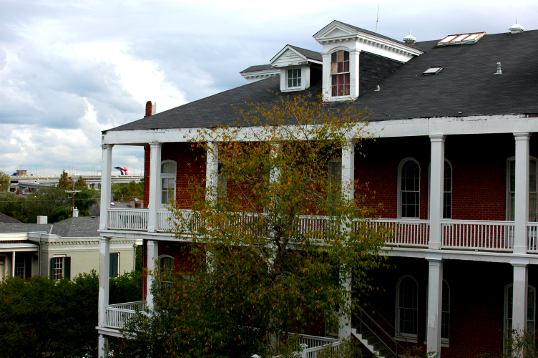
Our wing at St. Vincent’s. If you look closely on the horizon you can see the winged stack of a Carnival Cruise Ship on the Mississippi river.

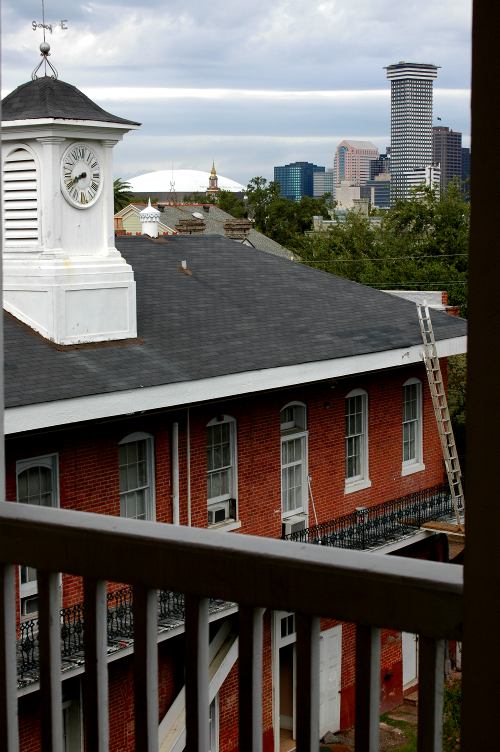
The carriage house at St. Vincent, with downtown New Orleans and the Superdome in the background.

Now, I certainly can’t recommend the place – it sure has its share of bad Internet reviews – but if you have a little imagination, a sliver of adventurous spirit and, most of all, an open mind, it’s a pretty damn cool place.

Plus, it’s in a great location and it’s only fifty dollars a night.

An old photo on the wall at St. Vincent’s Guest House, showing the original tenants, the young orphans that lost their parents to yellow fever, posed on the stairs.

The same spot, on the same stairs, today.

A tomb from Lafayette Cemetery #1

Everywhere in New Orleans you run into the ghosts of the yellow fever. This is a tomb from the Lafayette Cemetery #1 (not far from St. Vincent’s). I had to mess with the image, the top part was in deep shade. It reads:

Died of Yellow Fever
Sercy,
Born Aug. 29th 1878,
Died Aug. 30th 1878.
 
Mary Love,
Born Oct. 7th 1876,
Died Aug 30th 1878.
 
Edwin Given,
Born Dec. 3rd 1873,
Died Aug. 31st 1878.
 
Such is the Kingdom of Heaven.

In two days that family lost three children, age newborn, three, and five years old.

Karma

“Our lives are not our own. We are bound to others, past and present, and by each crime and every kindness, we birth our future.”

― David Mitchell, Cloud Atlas

Karma, Do-Ho Suh, New Orleans Museum of Art

Karma, a sculpture by Do-Ho Shuh, in the Besthoff Sculpture Garden at the New Orleans Museum of Art.

I rely on those below me to reach this height, and support so many others above, yet we are all blinded by our duties to the beauty around us. Trapped by the darkness of our burden. All we feel is the terrible weight.

Halloween in the Quarter

Decatur Street, New Orleans, Halloween, 2012

I knew a queen of toil with a crown of silver hair.
Garland of valour and sorrow, of beauty and renown…
—-Robert Louis Stevenson

Yeah, I know the Stevenson poem is about age… and the woman in the photo isn’t old. I still like the crown of silver hair… even if the queen of toil is stumbling through the French Quarter desperately clutching a to-go cup half-filled with some vile alcoholic fruit punch.

Nice boots.

Mojo Nola

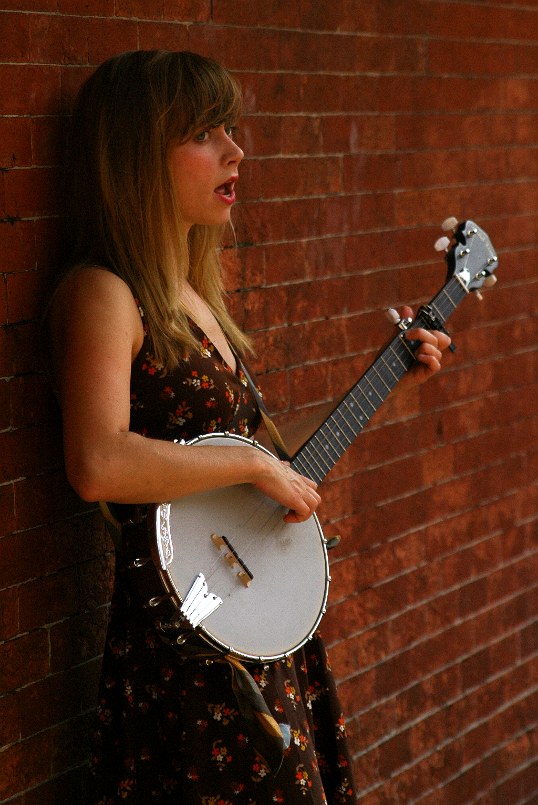
Banjo Player on Royal Street in the French Quarter, New Orleans

(Click for a larger and more detailed image on Flickr)

I only had a dollar left
and I gave it to the
Beautiful Girl
Playing the Banjo
on Royal and singing a simple sweet country tune.

My little dollar joined the sparse cluster of crumpled green in her banjo case on the sidewalk
– I saw there was a kazoo in there too
What else is there to spend your last dollar on?
Except for bus fare home. So it looks like a long walk on some sore and tired feet.
I wanted to take her picture and I didn’t want to do that without leaving at least a dollar.

I would have left more, but, like I said, that was my last. I wonder if it would mean anything to her – the banjo playing girl – if she knew it was my last dollar?

In the St. Louis Cemetery #1 there is a vault that was donated and is dedicated to the musicians of New Orleans that can’t afford to pay for their own burial.

Banjo Player on Royal Street, French Quarter, New Orleans

(Click for a larger and more detailed version on Flickr)

Writing in my Moleskine Journal outside the Mojo Lounge, Decatur Street, French Quarter, New Orleans

(Click for a larger and more detailed version on Flickr)

Plaque on the Musician’s Tomb, Saint Louis Cemetery #1, New Orleans.

Faces in the City


“Man was made for joy and woe
Then when this we rightly know
Through the world we safely go.
Joy and woe are woven fine
A clothing for the soul to bind.”

― William Blake

Another Chihuly

I’m still finding Chihuly Photographs I’ve taken that I like. Here’s another one.

In the world there is nothing more submissive and weak than water. Yet for attacking that which is hard and strong nothing can surpass it.
—-Lao Tzu