In Dallas, Deep Ellum is known for many things and, high among these, is the public art. One man’s mural is another’s graffiti – but in Deep Ellum, colorful art rules the brick.
Yeah, right.
It has been that way for a long time. I remember going down there almost two decades ago and watching a group paint some monument-like panels erected under the highway. Each artist had a different stele to paint – all different sizes and shapes. I watched them work with jealous desire – wanting to paint something worthwhile but aware that I lacked the talent.
There was a tunnel where Good Latimer Expressway coursed below some railroad tracks which had been painted in a long string of bizarre panels. It raised quite a bit of concern when the tunnel was torn out and the street raised to ground level along where the DART station now sits.
The capstone of the old tunnel is used as a backrest for one of the Traveling Man sculptures.
Now there are as many murals as ever down there. Everything from strangeness to music and back.
Last weekend I took advantage of some surprisingly good weather to go on a long bike ride and one stretch took me through Deep Ellum. I had a compact camera in a little bag on my handlebars, so I stopped and took some shots of some of the murals. These are across from the Deep Ellum Dart station – oddly enough not far from where the old Good Latimer tunnel used to be.
So today, here are a couple works by Amber Campagna, “Bait” and “Chomp.”
“Bait” by Amber Campagna. The paint is falling off the wall – which makes it especially interesting in an odd way.
A little way farther down the wall is “Chomp”, also by Amber Campagna
I enjoyed the warm weather Sunday by taking in a long bike ride from White Rock Lake down the Santa Fe Trail through East Dallas and on through the mirrored canyons of Main Street Downtown.
On the way back I took a detour from Deep Ellum down Exposition and cruised around Fair Park for a bit. I love the Art Deco art and architecture and sculpture (here and here) down there.
This time, I stopped by and snapped some photographs of an odd piece of Art Deco solid artistry outside the Swine Building – the Texas Woofus.
From the plaque:
According to sculptor Lawrence Tenney Stevens, the Texas Woofus is a composite figure with Texas long-horns, a sheep’s head, a stallion’s neck with mane, a hog’s body, the dulap of a sheep, turkey tail feathers, wings, and a highly decorated strip of a blanket.
The original was created in 1936 for the Texas Centennial. Its fate remains a mystery.
So, the story goes that the original was created – a 9 foot tall, 2,700 pound bronze – but a short time later it simply disappeared. Some people think the religious fundamentalists stole it because it resembled a pagan god – or that is was removed for repair and misplaced. At any rate, for 60 years it was forgotten, until Craig Holcomb, executive director of the Friends of Fair Park saw some old shots of the odd sculpture and thought it was very cool.
A fund raising dinner, The Woofus Dinner, was created and wealthy Dallasites attended, woofing hello and singing a specially-written ditty, “The Woofus Song,” ponied up about fifty grand, enough to rebuild the Woofus.
For something with this hallowed a history, it’s sure hidden away in an obscure nook. I had stumbled across it during the Fair one year while on a quest for a bathroom and always wanted to get back for a more leisurely look.
So here, without further ado, I give you, the Texas Woofus.
The Texas Woofus
The Woofus has a pipe in his mouth. During the State Fair a stream of water rushes forth. I’m going to have to see that someday.
.
.
When I was a kid, living in places like the Northeast or the Midwest I became fascinated by Spanish Moss. I don’t remember when I first heard about it…. These were the days long, long before the internet, of course, and even television was only in black and white and hard to see (only three channels anyway) so I would have had to have read about it in a book or maybe seen some in a film.
The thought of a thin, filmy plant growing in the air, hanging from trees, seemed so exotic to me, like it was an alien organism growing on our own earth. I did as much research as I could – which at the time consisted of looking up articles in the various encyclopedias in the school library – and thought about what the stuff looked like in real life.
We were going to move from Kansas to Panama and would be flying out of South Carolina. This would take a long drive, three days – with stops in Memphis and Atlanta. Thinking about the trip, I realized that there would be Spanish Moss along the way. As we moved farther south I eagerly stared out of the window. Somewhere out of Memphis, little bits of fuzz began to appear here and there until once we were close to Atlanta, it was all over the place.
That evening, I walked around our hotel looking at the Spanish Moss. It was everywhere and it was as amazing as I thought. I couldn’t believe that people actually lived in the midst of such wonder and didn’t give it a second thought. The next day, in Charleston, South Carolina, I found even more – it hung thick in the trees like a living cloud, an aerial wave of plant life. I still remember the feeling of seeing the stuff, feeling it in my fingers, looking at it up close.
There is an amazing quality to the curiosity of youth… a passionate sense of wonder.
Now I live in the South and see the stuff all the time…. But when I do I still feel the echoes of those days.
I been warped by the rain, driven by the snow
I’m drunk and dirty don’t ya know, and I’m still, willin’
Out on the road late at night, Seen my pretty Alice in every head light
Alice, Dallas Alice
—- Willin’ – by Lowell George
There was an event scheduled this Sunday that I had been really looking forward to. It was a bike ride, organized by the good folks at Bike Friendly Oak Cliff that started at the Klyde Warren Park in Downtown Dallas and went to tastings at a couple of local breweries, ending up at The Foundry/Chicken Scratch in West Dallas.
These local craft microbreweries are cropping up all over town. Dallas may be a bit behind the curve, but when it does something, it does it seriously. The Brewery Tours are very popular – you go to the place, pay a small fee, get a glass, sample beer. There is often live music, and there are always a bunch of cool people. I’ve been to Deep Ellum Brewery for their tours a few times… but this was the first one on a bicycle… with a bunch of people.
The day promised to be one of those preternaturally warm Texas Winter Weekend Afternoons – whick was perfect. My plan was to ride downtown to the park, twenty five miles or so, and then pick up the folks there. I futzed around a bit and left later than I intended, plus there was a strong wind from the south and I realized I would have to pedal hard to get there on time.
As my route passed near the Spring Valley DART station, I decided that I wanted to have fun today and riding against a deadline is not what I wanted so I hopped on the train downtown. I waited on the platform on the little rise in the pavement – knowing that was where the doors to the center car would open. These cars are tall and open – few seats – designed for wheelchairs, strollers, and bicycles. There are two hooks for hanging bikes – it works pretty well.
When the train pulled in and the doors opened I saw the car was packed. There were a half-dozen bicycles (and three strollers) jammed in there. Everybody shoved back as far as they could and I squeezed in for the ride downtown.
The crowd of bicyclists grew at Klyde Warren park until it was time for everyone to haul out down Harwood street. I’m estimating about a hundred and fifty riders packed past the Art Museum and down Ross to the West End, then turning north through Victory and under I35 into the design district.
Riding along Harwood – The Nasher on the left, Dallas Museum of Art on the right
Everybody stacked their bikes up and went into the first brewery, Community Beer Company. A big, shiny new facility, it has only been open a few weeks. They were sampling a couple of beers – a Vienna Lager and a Pale Ale. Both were very good – the ale had more bite, the lager was very smooth. We milled around, talked beer, talked bikes, talked routes (especially how to get home). The Community folks were really nice, their facility looked great, and I hope they have a long and successful run in the city.
Another brewery to go, we saddled up and headed across the Trinity River on the old Continental Viaduct next to the Calatrava Bridge. The Continental span is supposed to be redone as a park – hopefully with a good bike/pedestrian path (there is a lot of controversy on this – the Trinity remains a tough cross on a bicycle).
It is a blast to ride in the city in a group of over a hundred bicycles. Scouts shoot ahead and temper the traffic at intersections so the pack can go through. It might anger a driver or two – but we were moving quickly on streets that don’t get much use on a Sunday and the cars didn’t have to wait long.
The views of a city are so cool on a bike. I still haven’t worked out a way to take pictures while riding – especially in a pack like this (it’s easy riding, but you have to pay close attention to the bikes all around you). That’s just as well, it helps me enjoy my day.
Over the river and down into West Dallas. This is a part of town that nobody dared venture into a few years ago – now it’s hip and rapidly coming into its own from The Belmont to Bishop Arts and beyond. Right at the end of the Calatrava span sits Four Corners Brewing – another craft brewery that offers tours, live music, and food trucks. They’ve been around a bit longer and offer a big selection and cool graphics. A fun place.
I had a dark porter and a red ale – both excellent.
It was cool to look around at all the bikes. There were so many different kinds of pedalled transport – from expensive carbon fiber road bikes to fixies to a Brompton folder. Most common was probably beat up old mountain bikes converted into tough urban commuters – which is exactly what I building up at home. My ancient Raleigh Technium “vintage” (there is a thin line between vintage and old/cheap/poor) bike worked great, but the roads are a bit rough in a few places (when I made it home I discovered I had broken a spoke).
After an hour or so at Four Corners everybody split up. Most folks headed back over the bridge to Fair Park and a final stop a Craft and Growler and on home – but Candy was waiting at The Foundry/Chicken Scratch, where the riders from Oak Cliff were mostly headed to get something to eat.
The jam session group that plays on Sunday were at The Foundry, so we were able to get something to eat and listen to some music before packing my bike in the trunk for the drive home.
All in all, a pretty good day.
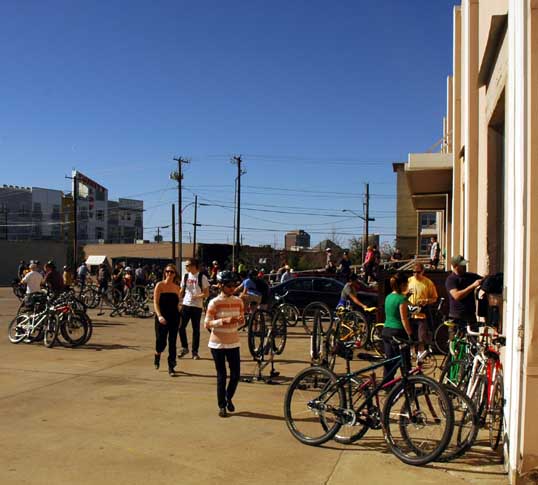
Outside Community Beer Company… a lot of bikes.
Pouring beer at Community
Arriving at the Community Beer Company, with the Dallas Skyline in the background
I noticed, while milling around the Bishop Arts District before the Mardi Gras Parade, a little piece of cardboard box down an alley, with two disposable cameras sitting on it.
Camera in the wild.
The box said:
I may not have mega-pixels
But I’m still pretty awesome
Facebooke.com/camera.bishop.arts
I thought about grabbing a camera and taking a shot, but hesitated and some other folks grabbed it first. You snooze, you lose. The idea of leaving a cheap film camera sitting around for people to use is pretty cool….
“The lizard brain is hungry, scared, angry, and horny.
The lizard brain only wants to eat and be safe.
The lizard brain will fight (to the death) if it has to, but would rather run away. It likes a vendetta and has no trouble getting angry.
The lizard brain cares what everyone else thinks, because status in the tribe is essential to its survival.
A squirrel runs around looking for nuts, hiding from foxes, listening for predators, and watching for other squirrels. The squirrel does this because that’s all it can do. All the squirrel has is a lizard brain.
The only correct answer to ‘Why did the chicken cross the road?’ is ‘Because it’s lizard brain told it to.’ Wild animals are wild because the only brain they posses is a lizard brain.
The lizard brain is not merely a concept. It’s real, and it’s living on the top of your spine, fighting for your survival. But, of course, survival and success are not the same thing.
The lizard brain is the reason you’re afraid, the reason you don’t do all the art you can, the reason you don’t ship when you can. The lizard brain is the source of the resistance.”
― Seth Godin
Born in New Orleans in 1912, Ida Kohlmeyer has been called one of the best Abstract Impressionist painters of the South. Her career as an artist did not begin until her 30s, after she graduated from Newcomb College at Tulane University with a degree in English literature. In 1934, she traveled to Mexico City and was inspired by Central and South American folk art, which would remain an influence throughout her life. Several years later she began taking painting and drawing classes at Tulane with Pat Trivigno, who encouraged her to pursue her study of artwork. Upon receiving her master’s she showed her first paintings at the Fifty-Fourth Annual Spring Exhibition at the Isaac Delgado Museum of Art in New Orleans.
In 1956, Kohlmeyer moved to Provincetown, Massachusetts to experiment with Abstract Expressionism alongside Hans Hoffmann. That same year she traveled to Paris and met Joan Miró, who also inspired her abstract work. However, by the mid 60s she tired of abstraction and moved on to create sculptures with wood and Plexiglas. After experimenting briefly with figurative painting, she returned to abstraction in the 70s. Kohlmeyer died in her hometown of New Orleans in 1997.
“It comes from a very ancient democracy, you see…”
“You mean, it comes from a world of lizards?”
“No,” said Ford, who by this time was a little more rational and coherent than he had been, having finally had the coffee forced down him, “nothing so simple. Nothing anything like so straightforward. On its world, the people are people. The leaders are lizards. The people hate the lizards and the lizards rule the people.”
“Odd,” said Arthur, “I thought you said it was a democracy.”
“I did,” said Ford. “It is.”
“So,” said Arthur, hoping he wasn’t sounding ridiculously obtuse, “why don’t people get rid of the lizards?”
“It honestly doesn’t occur to them,” said Ford. “They’ve all got the vote, so they all pretty much assume that the government they’ve voted in more or less approximates to the government they want.”
“You mean they actually vote for the lizards?”
“Oh yes,” said Ford with a shrug, “of course.”
“But,” said Arthur, going for the big one again, “why?”
“Because if they didn’t vote for a lizard,” said Ford, “the wrong lizard might get in. Got any gin?”
“What?”
“I said,” said Ford, with an increasing air of urgency creeping into his voice, “have you got any gin?”
“I’ll look. Tell me about the lizards.”
Ford shrugged again.
“Some people say that the lizards are the best thing that ever happenned to them,” he said. “They’re completely wrong of course, completely and utterly wrong, but someone’s got to say it.”
“But that’s terrible,” said Arthur.
“Listen, bud,” said Ford, “if I had one Altairian dollar for every time I heard one bit of the Universe look at another bit of the Universe and say ‘That’s terrible’ I wouldn’t be sitting here like a lemon looking for a gin.”
― Douglas Adams, So Long, and Thanks for All the Fish
A desire to make a choice of some kind… I am concerned with magic, awe and wonder, with ontological insecurity.
—-Michael Sandle
The Drummer, Michael Sandle
The Drummer, Michael Sandle, The Sydney and Walda Besthoff Sculpture Garden, New Orleans Museum of Art
I am very aware of the way that Britain has a habit of interfering overseas. Years ago I did a Mickey Mouse machine-gun sculpture as a comment on the Americans in Vietnam. I was interested to discover from my historical research how we’d meddled with the place after the Japanese surrender. It wasn’t the Americans who started it and it wasn’t the French. It was us.







 Bill Chance