There are only two kinds of people who do not experience painful emotions. The first kind are the psychopaths. The second kind are dead. There is a false understanding or expectation that a happy life means being happy all the time. No. Learning to accept and even embrace painful emotions is an important part of a happy life. —–Tal Ben-Shahar, The Happiness Paradox
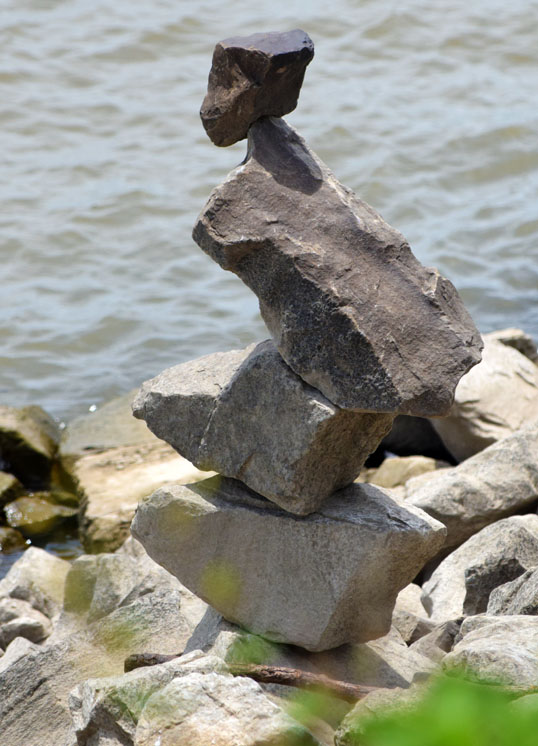
Riverbank Sculpture, Mississippi River, French Quarter, New Orleans
A growing body of research shows that the pursuit of happiness actually makes us miserable. This paradoxical finding likely results from people setting impossibly high standards, excessively monitoring their happiness, and misunderstanding what will make them truly happy. Positive psychologist Tal Ben-Shahar says that to be happier, we must find ways to pursue it indirectly while also accepting painful emotions.
Skateboarders regularly fail at their chosen activity. But that doesn’t make it a meaningless task of Sisyphean proportions
In the US talk show Comediansin Cars Getting Coffee (2012-19), the host Jerry Seinfeld remarks in a conversation with Chris Rock that ‘Those skateboard kids … are going to be all right.’ Rock expresses his agreement with Seinfeld, and they quickly move on to other topics. Their discussion about the value of skateboarding is quite brief (lasting about 20 seconds). But they agree that skateboarding provides skaters with a means of learning a life lesson. The lesson follows from the success of the skater in executing a manoeuvre after repeatedly failing (and falling). While some may nod their heads in agreement, it is worth considering whether Rock and Seinfeld are right. Does skateboarding teach a life lesson? If it does, is it a valuable lesson? Going further, why should we think that skateboarding is not, in fact, a meaningless activity that lacks any value?
“My message to you is this: pretend that you have free will. It’s essential that you behave as if your decisions matter, even though you know they don’t. The reality isn’t important: what’s important is your belief, and believing the lie is the only way to avoid a waking coma. Civilization now depends on self-deception. Perhaps it always has.” ― Ted Chiang, Stories of Your Life and Others
“Towards thee I roll, thou all-destroying but unconquering whale; to the last I grapple with thee; from hell’s heart I stab at thee; for hate’s sake I spit my last breath at thee” —-Herman Melville, Moby Dick
Deep Ellum
Dallas, Texas
Combs in Blue Water
Lieutenant Sampson looked across the heavy table at the armored screens, blinking lights, heavy duty keyboards, growling speakers, all connected with a tangle of cables. Right in the middle was a paper map of the area, worn on the edges, stained by spilled coffee, and obscured by layers of pencil and Sharpie scribblings. No matter how high-tech the electronics can be, people like him still had an affinity for paper maps – they conveyed the situation in a way no digital scan could.
At times of extreme stress, Sampson’s mind would always go back to strange, seemingly random memories, usually of his childhood.
Today he felt himself siting in a rural barber shop, nervous. This was from a time that people cared what your hair looked like – it was a statement of where you stood in the world. Sampson was too young to understand this exactly, but he knew that this was something important and that he didn’t really have any control over how it came out.
His father sat in the barber’s chair, covered in a checkered drape and his face lathered with white foam. The barber scraped away with a huge, deadly razor, the beard beneath giving up with a rasping sound. Sampson worried that the barber would use that razor on him… the buzzing electric scissors were scary enough.
He looked into the huge mirror that covered the entire wall behind the barber chairs. This was the twin of another on the wall behind the folding chair he waited in. The two parallel mirrors bounced off each other, creating a series of copies of the room, each smaller and slightly darker that the one before, falling off into a cave of infinity. This confused and fascinated the child – How does this work? -When does it end? Why does it do that?
But of all the things in the room, what intrigued and confused Sampson the most were the glass cylinders of blue liquid along the ledge in front of the mirror. Black rubber combs bobbed in the mysterious fluid, like the were waiting for something…. But What?
When he and his dad entered the barber shop he saw one of the vessels up close. It had the mysterious label, “Sanitized For Your Protection.” This confused, confounded, and frightened the boy. What danger was he in that the blue liquid and black combs were protecting him from?
The Lieutenant shook his head and the half-century old memory dissolved like grains of sugar in hot tea. “It’s time,” he said to the other shadowy figures moving around the room.
He lifted a plastic shield that covered a round red button inside a yellow protective ring. Without hesitation he pushed the button sending tons and tons of screaming metal death through the air, raining fire and pain down on thousands of (mostly) unsuspecting human beings he didn’t know and would never meet.
After he received conformation of the successful launches, Lieutenant Sampson sat down to await the reports of how much destruction had been successfully dealt out. He tried to stir up the memory again, to retreat back into the past, into the quiet isolated barber shop.
But the memories would not come. They were gone, forgotten, probably forever.
The strongest passion in humans is not hunger, sex or power, although these are quite strong; the very strongest passion is laziness. The longer I study human beings, including myself, the more I am inclined to agree. Laziness is the strongest passion.” —-Carl Jung
The interesting thing in this article is that we aren’t only one person – we are a series of different personalities – changing over time.
The British philosopher Derek Parfit espoused a severely reductionist view of personal identity in his seminal book, Reasons and Persons: It does not exist, at least not in the way we usually consider it. We humans, Parfit argued, are not a consistent identity moving through time, but a chain of successive selves, each tangentially linked to, and yet distinct from, the previous and subsequent ones. The boy who begins to smoke despite knowing that he may suffer from the habit decades later should not be judged harshly: “This boy does not identify with his future self,” Parfit wrote. “His attitude towards this future self is in some ways like his attitude to other people.”
That’s really interesting… even apart from procrastination (ie, why do something when you can delegate it to your future self – who is sort of a different person, even a stranger). I have to think about the implications of considering my future self as a stranger. To extend the thought, do we think about our past selves as strangers? Should we?
Another thought?
Of course, the way we treat our future self is not necessarily negative: Since we think of our future self as someone else, our own decision making reflects how we treat other people. Where Parfit’s smoking boy endangers the health of his future self with nary a thought, others might act differently. “The thing is, we make sacrifices for people all the time,” says Hershfield. “In relationships, in marriages.” The silver lining of our dissociation from our future self, then, is that it is another reason to practice being good to others. One of them might be you.
Yes, I am a worrier. I worry too much about things I can’t stop – though I usually worry because I know there are things I can do to prepare and/or protect but I can’t really figure out what those thing are or what they should be. As I get old my worrying is getting a lot better though not for good reasons. I worry less because I don’t give a shit anymore.
One thing I have always worried about is the Yellowstone Supervolcano. Over the years I have looked at potential ash depths to see how much would make it to the Dallas area. Not smart – not healthy.
So, according to the linked article, nothing will happen in the next year at least.
Strike up a conversation every day Ask Interesting Questions Follow Your Curiosity Take Yourself on Dates Listen to Good Podcasts Open Yourself Up to Other Perspectives Tap Into Your Unique Passions
“You can never get a cup of tea large enough or a book long enough to suit me.” ― C.S. Lewis
It was very cold this morning, but the sun was making it through the clouds a tiny bit, so I decided to go for a walk. I didn’t dress too warmly as I wanted to feel the cold in addition to seeing the sun.
I decided to walk to Starbucks. I haven’t been to Starbucks in a long time – since I upped my coffee game their coffee simply isn’t that good. Especially since I don’t drink fancy sugary milky concoctions – I only order a cup of black brewed coffee (I like coffee, why put other shit in it?). With fresh beans, my grinder, and my Aeropress I can make far, far, better coffee at home for much, much less cost.
However, I have never considered Starbucks to be a place to buy coffee. It’s an office rental place – you simply pay by buying overpriced drink items. I never understand people that drive through Starbucks, or pick up an order… make it yourself!
Viewed as an office or meeting place I realize I have a lot of really fond memories of various Starbucks. There was the one in Mesquite where I would stretch out a coffee for two hours listening to the various Saturday Morning Confessions while I would write and wait for my son Lee’s double art lessons. Some significant and meaningful aspects of my life were born in that Starbucks a long, long time ago. I wrote something about it during the previous century – I’ll have to look through my stuff, find where I put it.
Then there is the Plano Starbucks that I met with my writing group, every Wednesday for over a decade. I could calculate how much coffee I drank there, in hundreds of gallons, but I won’t.
So today, nothing dramatic. I walked there with my library book, The City and Its Uncertain Walls, by Murakami. It’s a popular book so I won’t be able to renew it – that means I only have three weeks to get through its prodigious pages, but thirty pages a day will be more than fast enough. I’m loving the book, so this won’t be hard.
After one large brew and thirty four pages I decided to hike home. Crossing Beltline I went by Gong Cha, one of the many Asian Boba Tea spots in my ‘hood – and considered if this might be another possible future destination. Unfortunately, most of their offerings have way, way too much sugar in them for my health… so I need to stick to American style black coffee.
In an empty parking spot was an abandoned mostly-drank Boba Tea. Its festive bright pink lid and specked black tapioca balls peeking through the clouds of milk tea looked festive on the cold morning, so I snapped a picture of it.
Oh, I found what I wrote… I think it was the first time I had ever been to Starbucks – I actually bought an iced tea with a gift certificate that Candy gave me. I bought the tea because I was intimidated with the coffee menu (this was a long, long time ago).
Here’s what I wrote – it’s silly- but it brings back good memories.
Saturday, August 29, 1998
Coffee foams
….. Coffee foams comes in a foam cup seashells hidden in the foam, spirals like an ear like time time flies Tea cold, iced, cubed the tea of the day is reddish, fruity cold and refreshing. Fresh tea is hot from the pot and steams hissing onto the cubes. The tea is iced, but the day is not the day is hot and sweaty
Round Green Tables
time flies blue eyes “I seldom talk to anyone anymore other than children and rednecks”
South American Beans Roasted, toasted, ground and boiled and percolate the suspension of disbelief
Once, I quit drinking coffee It made my stomach hurt
I feel something, sometimes as a burning worm in my stomach, my gut a monster of strain
“Probably for every man there is at least one city that sooner or later turns into a girl. How well or how badly the man actually knew the girl doesn’t necessarily affect the transformation. She was there, and she was the whole city, and that’s that.” ― J.D. Salinger, A Girl I Knew
Dallas Skyline at Night
I know very well not to take an article that lists “The Best Places to Live” very seriously.
The times noted that, EVERYONE IS MOVING TO TEXAS, and said that of the top ten best places to live in the United States, seven are in North Texas.
The list (North Texas Cities in Bold):
Euless
Woodlawn, Ohio
Edgecliff Village
Garland
Grand Prairie
Mesquite
DeSoto
Cedar Hill
Brooklyn Center, Minn.
Forest Park, Ohio
My wife is from Grand Prairie, I worked in Garland (and now live almost on the border) for a couple decades, and lived in Mesquite for a while. So, I know a bit about the Texas cities on this list and feel free to comment.
The interesting thing is that, for someone that lives here, these are not the best cities in North Texas. Most people would list Plano, Frisco, or some of the other more outer-ring suburbs. I am a big fan of Richardson, where I live, and cite its extreme diversity, high tech industry, and cycling infrastructure (of course) as small, but important, items that set it above its neighbors.
When I look at this list, the biggest thing that jumps out at me are the cities listed are generally not built out. That means that on at least one side, there are cotton fields waiting to be plowed under and concreted over. That tends to drop the cost of housing somewhat. Cedar Hill, DeSoto, Mesquite, Grand Prairie, and Garland all are considered a bit less expensive and a bit less desirable that their neighbors.
Euless is next to the massive DFW airport – the article mentions that the city boasts large numbers of Tongan residents – many immigrated to work at the airport and contribute to the dominant High School Football teams in that area.
I know little about Edgecliff Village – a tiny enclave in Fort Worth – may visit the next time I’m in those parts.
All in all, an interesting take… but I’m sure there are a few people who still manage to be happy even though they live somewhere that the New York Times doesn’t think is in the top ten.
There are these two young fish swimming along and they happen to meet
an older fish swimming the other way, who nods at them and says
“Morning, boys. How’s the water?” And the two young fish swim on for a
bit, and then eventually one of them looks over at the other and goes
“What the hell is water?”
—-David Foster Wallace, from the 2005 Kenyon Commencement Address
It’s a short work, actually a transcription of a commencement address, and readily available in book form or online.
There are a lot of good ideas here, but I want to look at one piece of text – a description of the hell everyone’s life can become if we give in.
By way of example, let’s say it’s an average day, and you get up in the morning, go to your challenging job, and you work hard for nine or ten hours, and at the end of the day you’re tired, and you’re stressed out, and all you want is to go home and have a good supper and maybe unwind for a couple of hours and then hit the rack early because you have to get up the next day and do it all again. But then you remember there’s no food at home — you haven’t had time to shop this week, because of your challenging job — and so now after work you have to get in your car and drive to the supermarket. It’s the end of the workday, and the traffic’s very bad, so getting to the store takes way longer than it should, and when you finally get there the supermarket is very crowded, because of course it’s the time of day when all the other people with jobs also try to squeeze in some grocery shopping, and the store’s hideously, fluorescently lit, and infused with soul-killing Muzak or corporate pop, and it’s pretty much the last place you want to be, but you can’t just get in and quickly out: You have to wander all over the huge, overlit store’s crowded aisles to find the stuff you want, and you have to maneuver your junky cart through all these other tired, hurried people with carts, and of course there are also the glacially slow old people and the spacey people and the ADHD kids who all block the aisle and you have to grit your teeth and try to be polite as you ask them to let you by, and eventually, finally, you get all your supper supplies, except now it turns out there aren’t enough checkout lanes open even though it’s the end-of-the-day-rush, so the checkout line is incredibly long, which is stupid and infuriating, but you can’t take your fury out on the frantic lady working the register.
Anyway, you finally get to the checkout line’s front, and pay for your food, and wait to get your check or card authenticated by a machine, and then get told to “Have a nice day” in a voice that is the absolute voice of death, and then you have to take your creepy flimsy plastic bags of groceries in your cart through the crowded, bumpy, littery parking lot, and try to load the bags in your car in such a way that everything doesn’t fall out of the bags and roll around in the trunk on the way home, and then you have to drive all the way home through slow, heavy, SUV-intensive rush-hour traffic, etcetera, etcetera.
—–David Foster Wallace, This is Water
The excellent piece goes on to explain how important it is to not let this sort of thing get to you, to realize that we are all in the same boat, that we need to look at life in a non-selfish way and go with it – or else we will go mad.
All good advice and interesting thought provoking… but I want to present an alternative. Find out about this shit and simply don’t do it… or rather, figure out something else.
For example, I know all too well the hell of exhausted grocery shopping. So I decided not to do it.
My goal for this year… and probably for next year too, is to never drive my car to the grocery store. My commuter bike has room for a pair of big, cheap panniers I found at Wal-Mart of all places. With those and a backpack I can carry a goodly bit of groceries – enough to get by for a few days.
This has transformed my grocery shopping from a gas-fueled frustration fest into a series of fun little mini-adventures, complete with fresh air and a little exercise.
It helps that I have five grocery choices within easy cycling distance from my house. I define that as less than, say three miles… and no killer streets.
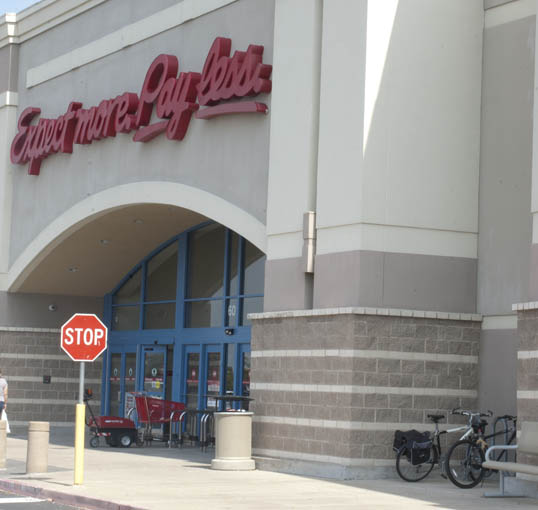
First is the Super Target – good for general shopping. They have bike racks sort of hidden in little alcoves near the entryways. This is the closest place to the hell described in Wallace’s speech. But, somehow, when you have ridden a bicycle to a store, it’s impossible to be overly frustrated at the inevitable delays. You simply feel too silly.
Bike racks tucked away at the Super Target store.
Then there is the Fiesta Mart – a Hispanic slanted grocery store. It’s the farthest away – maybe two miles – but a nice route, mostly bike trail. It has a beat-up but serviceable bike rack around by the propane cylinders.
My commuter bike, with panniers, waiting at the Fiesta Mart bike rack.
Those are the only two groceries with bike racks near where I live. No big problem – they all have cart racks, which can be locked to as well as a dedicated rack. In the other direction – in Garland, actually – is the Saigon Market Mall – a big, cool Asian Market – good for noodles, fresh vegetables, and fish.
Then, very close to where I live is an Aldi – great for staples like milk and eggs. It’s nice to buy milk there since it is uphill from my house and I can ride up there light and coast home heavy.
Finally, there is an India Bazaar in the same center. Great place for rice, beans, and, especially spices. Their spice aisle is a wonder – I love to stand there and simply smell.
Locked up on the cart rack in front of the India Bazaar
I know that the Wallace speech deals with much larger and more subtle issues than how to get your groceries. But in this tough world we need all the weapons we can muster and being able to roll out of the garage on a cheap, used, crappy bicycle instead of a smoke spewing SUV makes life a little bit easier to bear. For everybody.
Damian Priour, Austin Temple (detail) 2000 fossil limestone, glass, steel In Memory of Buddy Langston 1947-2004 Frisco, Texas
Life consists of making the decision of what you are going to do in the next split second. Nothing else exists other than the process of making that decision and executing it. Everything else is an illusion.
What if I make the wrong choice? What if I choose something that limits my future choices? What if I paint myself into a corner?
I didn’t say it was easy. I didn’t say it was a good thing. All I said is that that is all there is.
I thought that life was pain! I thought that life was suffering!
It is. Pain is choice. It is. Choice is suffering.
But if choice is all there is… and I can choose whatever I want – then I am totally free.
Choice is freedom. Total choice is total freedom. Freedom is all there is.
So I am totally free.
Yes – but if life is pain and suffering and choice is also freedom – then life is freedom.
But freedom is pain and suffering.
Lee, outside a soccer game at the Cotton Bowl. He likes shiny things
This was a game in 2002 where, in honor of the visiting Clint Mathis, everybody (that wanted one) got free Mohawks – all the kids on Nick’s soccer team did. .
2011 Mardi Gras
Lee, New Orleans, 2011 Mardi Gras. He still likes shiny things.








 T
T

 Bill Chance