Birds on a Sewer Line

Big Lake Park, Plano, Texas

Big Lake Park, Plano, Texas

It was unusually warm this weekend and since I was behind schedule in bicycling miles for the year I decided to give a shot at catching up. After work on Friday I rode the neighborhood trails with my lights.

On Saturday I did one of my favorite rides – after a bike ride to the bank and a few errands I rode to the station and then took my bike on the DART train downtown. By the time we reached the skyscrapers, there were five bicycles on my train car. Me, another woman with a road bike, she looked like she was going for a ride too. There was a young man with gold teeth and a tricked out BMX. Another young guy with a nice full-suspension mountain bike. Plus a homeless-looking fellow with a rusty mess of a bicycle lugging bags of scavenged aluminum cans and a workman that looked like he was on his way to a job on a beat-up department store cruiser.

An interesting and diverse bunch.

I rode my bike from the Plaza of the Americas down to the Arts District and hung out by the Crow museum, getting some tacos from a Food Truck. Then I rode down to Klyde Warren Park to check out the crowds. I bought a Stone IPA from the stand there – it was larger and stronger than I anticipated so I took an hour and a half to sit there and digest the alcohol before I rode my bike. There were a lot of folks hanging out, getting some sun – many walking in the Dallas way of seeing and being seen.

Then I rode home – Downtown through Deep Ellum, Santa Fe Trail to White Rock Lake, around the lake, White Rock Creek trail to the Cottonwood trail. That took me to the High Five where a steep side trail took me to Texas Instruments Boulevard… and I know the way home from there.

A nice day.

Then on Sunday I left the house going in the opposite way – going north. I rode my familiar routes up through Richardson into Plano and across the parking lots of Collin Creek Mall.

Thirty years ago, I remember when the mall was first constructed. It was a big deal. I had just moved to Dallas and we drove up there all the way from Oak Cliff to see what it looked like – this big shiny new shopping mall. It seemed so far north then.

Now the place is a bit haggard and lost in time. Riding a bicycle around a mall like this drives home how uninviting and inhuman a place it is, at least on the outside. It is a destination for cars, not for bicycles, or pedestrians, or even for human beings. No sidewalks, two way stop signs, oddly places concrete walls – all conspire to set the place as a fortress to anything not wrapped in steel and spewing fumes.

No wonder the monstrosities are dying.

So I fought my way across the vast expanse of cracked tarmac parking lot and found the terminus of the Chisholm Trail which follows a creekbed into the heart of Plano’s hike/bike trail system. Once there I spent the day exploring each arm of the system, mostly under enormous power line right of way desolate swaths… not a bad place to ride, all in all.

Of course, I overdid it and by the time I retraced my route back south I was sore and worn out and feeling old. Still, a better afternoon than sitting in front of the tube eating myself sick and watching the last football game of the season.

Oh, and now I’m twelve miles ahead of schedule. I think I’ll take Monday off. This morning, on the way to work, I realized that over the weekend I saw a large part of a large Texas city and never even entered an automobile at all.

Les Ondines and Technium

Henri Laurens
French 1885 – 1954

Les Ondines
1932
Placed in Memory of Ted Weiner 1911-1979

Les Ondines, Henri Laurens

Les Ondines, Henri Laurens

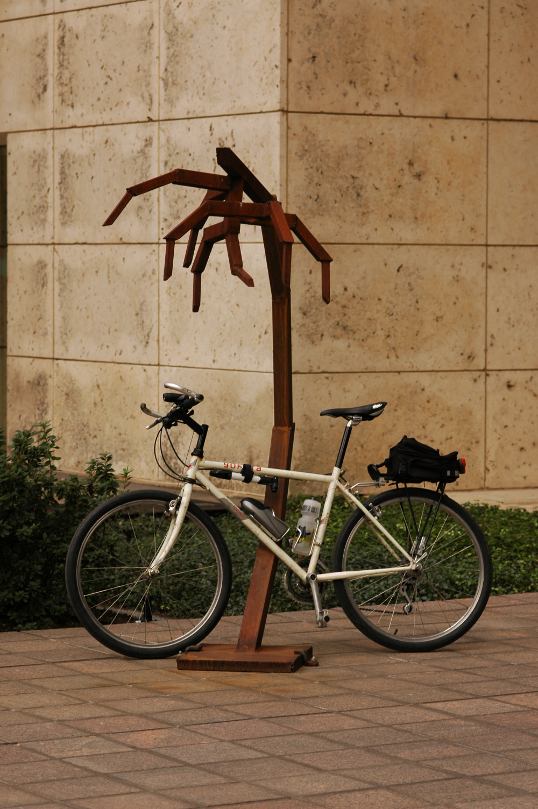
Raleigh Technium

Raleigh Technium

Technium 460
Raleigh USA
1986

Les Ondines, Henri Laurens

Les Ondines, Henri Laurens

Meyerson Symphony Center Garden, Dallas, Texas, Arts District

You Can’t Get There From Here

Though I am a ridiculous old fat man on a bicycle, I have been working on increasing my mileage and exploring how to integrate cycling into my daily activities better. My goal for 2013 is three thousand miles on my bike. I knew I would start out behind (the weather in the winter is too often simply too nasty to ride) but I try to get as many miles in as possible.

Saturday was a gray post-misty day, cool but not cold – usually considered depressing winter weather – but without a breath of wind, perfect for a bicycle ride. I cruised all over Richardson and North Dallas, getting in about thirty-four miles of city riding, which is a lot for me. I was pretty well worn out.

Sunday was more of the same, a little warmer and a little windier and I wanted to ride somewhere and get a few more miles in – somewhere more or less useful.

About eight miles away (as the bike rolls) is White Rock Coffee, one of my favorite independent coffee spots. There are a number of Starbucks within walking distance of my home, and a couple of bubble teas/smoothie emporiums, but White Rock is the closest non-national-chain coffee spot. There is a new branch of The Pearl Cup, under construction in Richardson, and when it is done it will be a nice bicycle destination. But they are still working on it – so until it’s done it’s White Rock Coffee.

The problem is, I can’t find a good route to White Rock Coffee. The biggest choke point is LBJ/635 Interstate Highway loop. The best crossing between my house and the coffee place is the pedestrian bridge next to the Skillman DART station.

The pedestrian bridge over LBJ at the Skillman Dart station - photo from Googlemaps.

The pedestrian bridge over LBJ at the Skillman Dart station – photo from Googlemaps.

Once you start looking at that crossing you realize a nefarious little bit of nasty city planning. The bridge is useful, mostly because it connects a couple of neighborhoods of rundown apartments (on either side of the freeway) with the train station and each other. The problem is that it is almost impossible to get into or out of those neighborhoods on foot or on bicycle.

I don’t think this is an accident. Streets running up to these areas lose their sidewalks – some residential streets are cut and blockaded. It is obvious that the powers-that-be don’t want folks walking out of their rundown apartment complexes into the more upscale areas of housing.

So I have been working on finding the best route. I came up with one and it’s not that great – there are several nasty road crossings (Yale and Walnut, Leisure and Forest,  and Adleta and Skillman are the some of the worst), four places where I have to walk my bike, and some heavy traffic. A long stretch of narrow, crowded residential street with parked cars filling both sides – the door zone fills the whole street. It’s especially tough because I’m riding my road bike right now – I’m rebuilding my commuter/bad weather bike. The narrow tires are pickier about terrain.

I decided to give it a go today – stuffed my laptop and an extra shirt into my backpack and set off. I know eight miles isn’t very far, but it’s a tough eight miles. The backpack was heavy and I was always riding into the wind (how does that work?). It’s all crowded urban stop-and-go riding.

That’s the thing about riding a bicycle in the city – you see things you never do from a car (or on foot, really, because you can’t travel that far). You see beauty, notice hills you never would otherwise, connect with the weather in an intimate, organic way… but you see a lot of nasty, brutish, and ugly stuff too. A lot of trash, homeless people, and neglect.

I hadn’t anticipated the amount of broken glass on the streets and sidewalks in some of these neighborhoods. Sure enough, crossing 635 on the pedestrian bridge I put a sliver of shattered malt liquor bottle through my rear tire and had to patch it in a nasty little parking lot covered in antifreeze and oil that had been dumped there, keeping an eye on the crack dealers that were keeping an eye on me.

Life in the big city in this best of all possible worlds.

I had better finish this up and drink the rest of my coffee and get home – I don’t want to do that ride in the dark.

Blur

The Universal view melts things into a blur.
—-Emile Cioran

You must have a colorful fork.

You must have a colorful fork.

New Orleans, French Quarter

I enjoy sitting at a little sidewalk table, sipping something – maybe my notebook is out – watching the world going by. If you move too much, you miss everything. Stay still, and it will come to you… sort of like hunting from a blind. It may not seem so exciting, but it’s how to bag the big game.

Having a camera does ruin things a bit. I don’t like looking at the world through a viewfinder. I don’t like closing my mind so I can think of angles, exposures, ISO.  But if I don’t make that sacrifice I can’t share it all with you, can I… so enjoy what you can… viddy well, my little droogies, viddy well.

Of course, another option is to set the camera on the table and simply reach out, now and then, and tap the shutter.

Vintage Bicycle on Magazine Street

Magazine Street, New Orleans

Magazine Street, New Orleans

Perfect urban bicycling… Mixte frame, rear rack, front basket, fenders, upright bars, warning bell, kickstand, chainguard,  leather pants, red shoes.

Three Bicycling Stories

A Photograph Doesn’t Do Justice 

I like taking photographs, though it is ultimately a frustrating and futile exercise. I see an image in my mind and I want to commit it to pixels, but I never can. What ends up on the screen is a poor echo, a warped ghost, of what was in my head. Still, I keep trying.

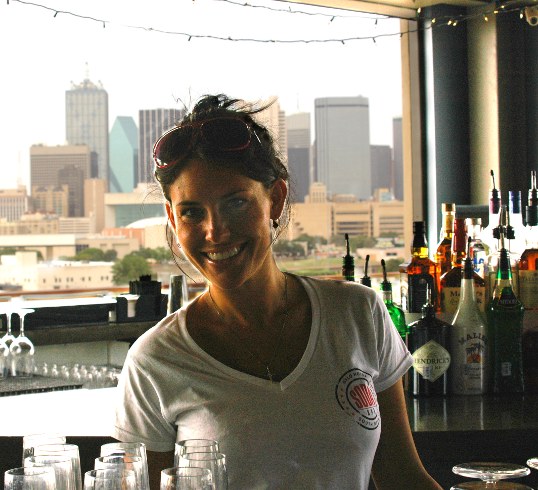
This woman, a bartender at the NYLO Southside, asked Candy, "Is your husband a professional photographer?"Candy answered, "He thinks he is."

This woman, a bartender at the NYLO Southside, asked Candy, “Is your husband a professional photographer?”
Candy answered, “He thinks he is.”

Sometimes, there are images, real images that appear in the eye, of such subtle and ephemeral beauty that a camera can never come close to capturing.

The other morning I was riding my bike to work. I had left before dawn and was moving west on Summit Drive just after Grove Road. It’s a quiet little residential street, perfect for bike riding. Going West, it’s a slight downhill, just right – steep enough to coast but not so much to require brakes – a nice little rest in the middle of my commute.

Behind me, the sun was breaking the horizon, the orange globe peeking out throwing a sudden bright warm light down the street. All along the street were thousands of black birds (grackles, I think) covering the yards, wires, and trees.

The birds did not like me or my bike. Maybe my flashing headlight helped spook them, but they all took off and began to fly away from me. As I moved down the street a massive wave of birds formed in front of me, a cacophony of squawking and flapping wings as they fled in formation.

It was like a giant, solid, noisy, black moving thing, this wave of birds, contrasted with the bare trees and piles of autumn leaves, all bathed in the coral light from the sunrise. A living shape, a rolling cloud, lasting only a few seconds until I reached the turn at the bottom of the hill when they scattered, the wave dissolving into the dawn air, the flock dissipating as quickly as it formed.

As surely as this scene could never be photographed… too evanescent and ethereal for a lens – words fail me. Trust me, it was beautiful – I smiled all the way to work and even for a few minutes in the land of the cubicals until the daily grind ground the moment out.

Still, it is there, in my memory. I’ve never been much of a morning person, but sometimes it’s nice to get up in time to see what the rising sun brings.

My First Fall 

At my age, I’m really afraid of bicycle accidents. I’m a lot more brittle than I used to be and I don’t heal as fast. Still, I ride slowly and carefully and hadn’t fallen for a long, long time.

Until now.

I was going West on Spring Valley (not far from the story above). There is a rail line that bisects my city north to south and is a surprising barrier to cycling – there are only a couple places where it can be crossed and none of them are very safe. The Spring Valley crossing is one of the best – open, wide, and not too much traffic.

Between the rails there are these rubber pads to fill in the gaps for the cars that cross. Unfortunately, the pads had a gap between them… not too much, maybe an inch. The gap, unfortunately  runs parallel to the curb – along the direction of travel. On a bike, cracks or gaps running across your path are a mere bump, but cracks running in the same direction your are – are a disaster.

I am starting to rebuild my commuter bike – an old mountain bike – so I am riding my road bike around town. The road bike has narrow tires. Narrow enough to fit right into the gap between the thick rubber mats.

So I wasn’t looking closely enough and my tire dropped into the gap. It immediately grabbed the rubber and stopped. Instant endo – a nasty crash where your forward momentum throws you over your front handlebars.

I felt the tire drop and grab so I had a split second to prepare myself. I was able to drop a shoulder and roll when I hit, so I wasn’t hurt. I was worried about my bike, but other than a broken toe clip and a missing bar end plug, not a scratch. Luckily, there weren’t any cars behind me, or that might have been a fatal crash.

All’s well that ends well. Hopefully, I’ll have another run of good luck.

It’s frustrating though. I’m sure the city thinks that railroad crossing is fine and doesn’t need any work even though it contains a hidden disaster to anyone riding a bike through there. I don’t have any choice, I’ll have to ride over the crossing at least twice a day when I’m riding to work and most other rides – it’s the only good way to get the the southwest part of town from where I live. I’ll have to be careful and not forget what happened – look out for that gap.

Of course, flying over the handlebars isn’t something you forget anytime soon.
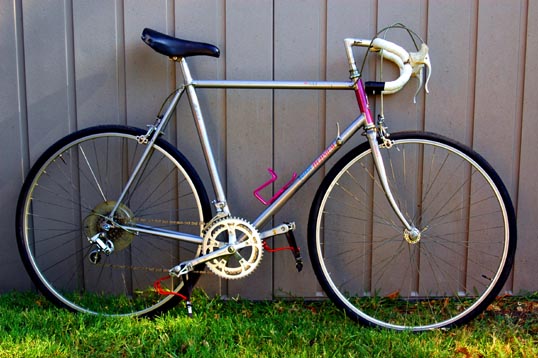
My road bike - an ancient Raleigh Technium.

My road bike – an ancient Raleigh Technium.

My commuter bicycle - I'm now taking it apart for a rebuild.

My commuter bicycle – I’m now taking it apart for a rebuild.

Riding in the Rain 

My goal for 2013 is three thousand miles on my bicycle. Not too hard, that’s only a bit under ten miles per day (my work commute is ten miles round trip). Still, it will require consistent riding, under less than ideal conditions. Texas winters are cold, spring is wet, and summers… well, they can be fatal.

Rain was predicted for today, but when I woke up in the morning, I checked out the internet weather and the radar maps and it looked like I had a couple hours before the thunderstorms arrived. So I decided to get going and get in twenty miles or so. Never trust anything you read on the ‘net.

The fog was thick as I headed out and withing a couple miles it started to mist and sprinkle. It was fairly warm, so the light rain actually felt nice. I decided to ignore the weather and kept heading out on the route I had in mind.

Over the next few miles the rain slowly increased. Still, it wasn’t too bad and I kept going. Once you are soaked… you can’t get any wetter, so I didn’t want to give up. My phone rang and it was Candy, offering to pick me up, but I said I was doing fine. By this time I was around Galatyn Parkway along Highway 75 and I wanted to go north into Spring Creek and the trails up there.

Then the sky opened up.

I’ve been thinking about rigging my commuter bike for riding in the rain and reading up about bicycle fenders. One article I read had this nice quote:

I’ve cycled through thunderstorms in the U.S. Midwest and Texas and even a typhoon or two in Tokyo. For the Californians on the list, fill a bucket with water, toss in a tray of ice cubes (for the hail) and have a friend throw the contents on you — that approximates about half a second of a typical Midwestern spring storm.

That’s what it felt like – someone dumping a five gallon bucket of iced water on my head twice a second. It’s true that once you are soaked, more water doesn’t make you wetter… but I couldn’t even see. Luckily, a few feet up ahead the trail scooted underneath Highway 75, so I was able to take shelter until the tempest subsided.

It was amazing, waiting there, dripping, under the highway, watching the trickle of a creek rising quickly to become a raging torrent. I was safe on the elevated trail, leaning up against a guardrail halfway between the stream and the roadway above. The various drainpipes associated with the highway all began spewing vast cascades of roaring water, some falling in brown cataracts and others splashing against trees and logs into great sprays of foam. I never noticed, but the roadway is drilled with a pattern of drainage holes and all these began to spew a grid of falling fountains from the bridge far above.

The scene was unexpected and beautiful and it made me laugh to look at my private spectacular water display.

The rain was falling so hard I knew it couldn’t last too long and once the storm subsided to a mere rainstorm I bundled up my wet clothes and headed home. I couldn’t ride the trail all the way because the low-water crossings along Duck Creek were submerged. The waterfowl were all lined up along their swollen eponymous waterway watching the flotsam and jetsam closely, picking out any edible particle that came floating by.

I did manage to get my twenty miles in, and all my stuff is hanging in the house trying to dry out. I’m not sure if I’ll go out in a thunderstorm like that again… but it was kind of fun.
Brakes

At a recent Vintage Bicycle Show I was fascinated by all the geriatric brake technology on display.

For example, I have been interested in the Flying Pigeon Bicycle from China, though I don’t know if I’d actually want to own one. They are, after all, the most popular single means of mechanical transport in history. When I read about them, I was especially interested in the rod brakes – very simple and reliable. They use a series of levers and rods to pull a pair of brake shoes into the inside of the rim. At the show, I saw a bike with rod brakes (not a Flying Pigeon).

Phillips Bicycle with rod brakes.

Phillips Bicycle with rod brakes.

It’s a Phillips. I talked to the guy that had bought it and restored it about the brakes. Another guy said, “If you think about it, a rod brake isn’t that much different, you replace the wire with a rod.”

I don’t know about that. I asked the owner how well they stopped. His reply was a classic, “Well, they stop well enough… when you consider you can’t get going very fast on this thing anyway. You have to be careful… really careful, if you find yourself going downhill.

Across the aisle was an even older and cruder technology.

brakes2

brakes3

The rod brakes on this bike push a rubber block right down onto the tire. I certainly wouldn’t want to be caught going too fast on that bad boy. Cool bike, though. Love the generator.

Finally, there was a bike with a Campagnolo Delta Brakeset.

Campagnolo Delta Brake

Campagnolo Delta Brake

I’ve always loved these. They are heavy, complicated, and don’t work very well… but what a work of art.


One fun story from the show. While I was standing around a guy came in with a vintage Raleigh – about the same age as my 1974 Super Course that I bought my freshman year in college. He was restoring the bike and was about half done – it was rideable, but still looked pretty ragged. I told him the story of how I lost that beloved bike.

“I lived in a third story apartment,” I told him. “I never thought about it, but I left it out on my balcony unlocked. Somebody stole it. It must have been a tree trimmer, working in the neighborhood with a ladder, and he yanked it off my balcony.”

“That’s how I got this bike,” he said to me.

“What, did you steal it off a balcony?”

“No, I saw this guy, he was a landscaping guy, riding this bike. It was in terrible shape, the bar tape was falling off, the paint peeling, but I recognized it as a vintage Raleigh. I asked him if he’d sell it to me. He said, ‘I can’t sell you my bike, it’s the only way I have to get to work.’ So I told him, ‘Tell you what, we’ll get in my car and I’ll drive you to Wal-Mart and you can pick out any bike you want. I take your beat up old bike and I’ll buy you a brand new Wal-Mart bike.’ He said it was a deal and that’s how I bought the Raleigh.”

I loved that story.


Now that I’ve decided I can’t afford a new bicycle I am concentrating on making do with what I’ve got.

I’m lucky in that my Raleigh Technium is old enough (1986 or so) to be vintage and therefore, semi-cool, it is not old enough that I need to keep it stock. So I took it apart and rebuilt it.

You would think that the parts that I would have to upgrade would be the drivetrain – new super gears and integrated shifters and whiz bang shit like that – but that’s not what I did. Old friction shifters and ancient freewheels still work pretty darn well. Dallas is flat, I don’t have to shift very often. What I did upgrade – the place where technology has improved – is brakes.

My Raleigh had old single pivot sidepulls (my even older Raleigh Supercourse from 1974 had center-pulls) and stopping was not a reliable thing. Riding in an urban area – you need to stop. Stop or die. Plus, the cables were rusting and I never liked the awkward cables looping up from the brake levers.

So I bought some new long-reach dual pivot sidepulls from Nashbar, some nice used aero levers from Ebay, and a set of high quality, high tech brake cables. I tore the bike apart, repacked everything that had grease in it, tightened everything down tight, and put the new brake system in. The Technium routes the rear brake cable inside the tubing, and that was a pain… a lot of fishing for cables, but I finished it up and now it rides like a dream. Well, except the engine, of course.

So, now I turn to rebuilding my commuter bike – the creaky old Yokota Mountain bike I bought used at a pawn shop around 1990. The rear shifter won’t shift down any more, so I needed new shift levers – so I bought new ones, and I bought new integrated brake levers too – so I bought new brakes. I’m replacing the old-school cantilever brakes with more modern V-brakes. All this I picked up from fire sales on various places, so I didn’t pay too much money for any of it.

Now, next, I’ll strip the bike down, then paint it (I’m thinking a dark English racing green) – and put all the new stuff on.

That’s the ticket.

http://vimeo.com/26504393#

A Thing of Beauty

I know I should not give things – physical objects – attributes beyond what they are – simply shapes of metal, rubber, and leather. Things are not as important as people.

Bicycles…. umm, that’s another matter.

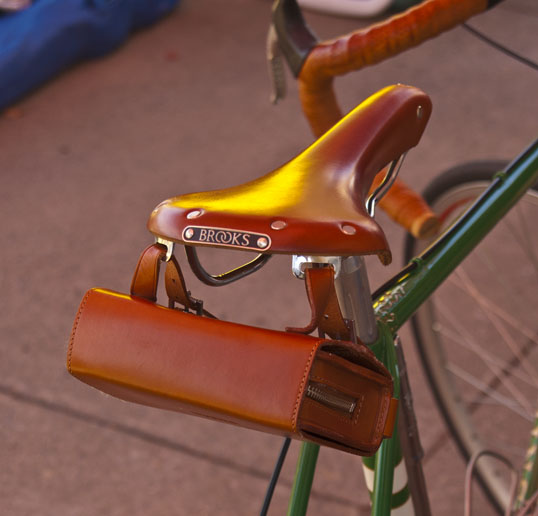
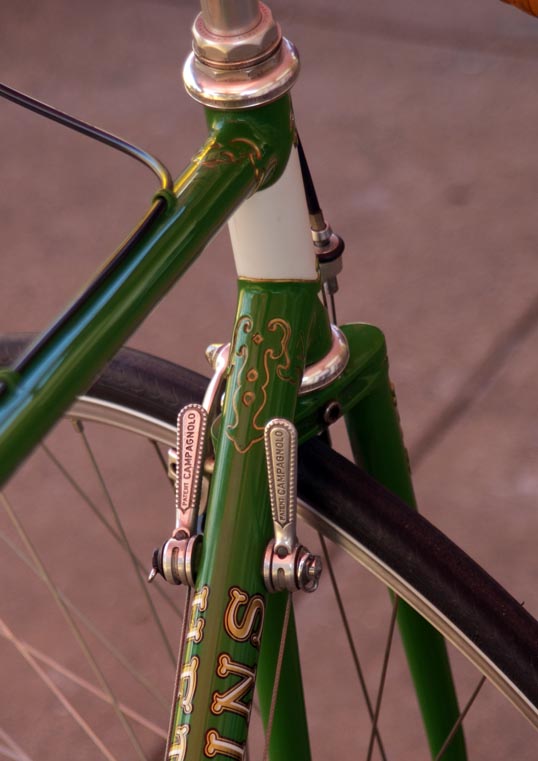
At a vintage bicycle ride/show/swap meet I attended a while back there was a Hetchins bicycle that was of such sublime beauty that I can’t really think of it as a physical object only. The Hetchins bikes are known for intricate lugwork and for being, well, transcendent works of art.

This one was painted green with the lugs set off with gold paint – and a full complement of Brooks leather saddle, bar tape, and tool bag. Vintage Campagnolo… of course.

A simple bicycle, yet such a thing of beauty.

vintage3

vintage2

vintage1

Cycling in Style

Stylish bike rider, French Quarter, New Orleans

Stylish bike rider, French Quarter, New Orleans

Despite the fact that (in additional to the least-cool) I am the least fashionable person on the planet I am interested in the idea of bicycling style, or chic, or whatever you want to call it. Not the old spandex, carbon, and logo style, but the more relaxed, European, style of riding a bike in the urban environs.

I went on a fun ride the other day with a nice group visiting some boutiques and such in a couple of stylish and hip neighborhoods of Dallas.

Yes, they exist.

Looking through the library I discovered a book by David Byrne, where he relates some of his experiences riding a folding bike through some of the more interesting cities of the world.

He starts out insulting my city… which is pretty world-renowned for cycling unfriendliness.

Bicycle Diaries

by David Byrne

Chapter One – American Cities

Most US cities are not very bike-friendly. They’re not very pedestrian-friendly either. They’re car-friendly – or at least they try very hard to be. In most of the cities one could say that the machines have won. Lives, city planning, budgets, and time are all focused around the automobile. It’s long-term unsustainable and short-term lousy living. How did it get this way? Maybe we can blame Le Corbusier for his “visionary” Radiant City proposals in the early part of the last century:

His utopian proposals — cities (or just towers really) enmeshed in a net of multilane roads — were perfectly in sync with what the car and oil companies wanted. Given that four of the five biggest corporations in the world still are oil and gas companies, it’s not surprising how these weird and car-friendly visions have lingered. In the postwar period general Motors was the largest company in the whole world. Its president, Charlie Wilson said, “What’s good for GM is good for the country.” Does anyone still believe that GM ever had the country’s best interests at heart?

Maybe we can also blame Robert Moses, who was so successful at slicing up New York City with elevated expressways and concrete canyons. His force of will and proselytizing had wide ranging effects. Other cities copied his example. Or maybe we can blame Hitler, who built the autobahns in order to allow German troops and supplies fast, efficient, and reliable access to all points along the fronts during World War II.

I try to explore some of these towns — Dallas, Detroit, Phoenix, Atlanta — by bike, and it’s frustrating. The various parts of town are often “connected” — if one can call it that — mainly by freeways, massive awe-inspiring concrete ribbons that usually kill the neighborhoods they pass through, and often the ones they are supposed to connect as well. The areas bordering expressways inevitably become dead zones. There may be, near the edges of town, an exit ramp leading to a KFC or a Red Lobster, but that’s not a neighborhood. What remains of the severed communities is eventually replaced by shopping malls and big-box stores isolated in vast deserts of parking. These are strung along the highways that have killed the towns that the highways were meant to connect. The roads, housing developments with no focus, and shopping centers eventually sprawl as far as the eye can see as the highways inched farther and farther out. Monotonous, tedious, exhausting… and soon to be gone, I suspect.

He’s right of course… but not completely right. There is hope. Dallas (and every big modern city) does have its notorious web of high speed freeways, concrete ribbons of death.

But they don’t cover the whole city. In between these barriers are real neighborhoods with real people living in them. The challenge is to get off the freeway and find what’s there – and a bicycle is the best way to do it.

The freeways become a barrier to pierce. The city is working on creating routes and I’m working on finding them.


What I learned this week, November 30, 2012


D Magazine: Why Does Dallas Hate Cyclists?

Bicycling in Dallas is too difficult and too dangerous. Bicycling magazine called Dallas the worst city for cyclists—twice (in 2008 and 2012). As a result, only heroes do it. And the solution is simple. We need only change the way we think.

When the story you are reading is published online, there will appear, without question, comments from people who will assail Mike McNair and hurl insults at cyclists of every stripe for getting in the way of their cars. A number of years ago, golf commentator David Feherty wrote a story for D Magazine about getting run over on his bike by a car in Dallas. He did a turn with Krys Boyd on 90.1 KERA to talk about the experience and his long rehabilitation. Online and on air, a sizable number of people said: “Screw the cyclists! They are a hazard and should get off the road!” Words to that effect.

That attitude is the first thing that must change if Dallas is ever to achieve its world-class ambitions. Bicyclists are like children. They are slow. They are sometimes unpredictable. They weave and wander and clearly think the world revolves around them. They infuriate. But they are our future. So we should not only tolerate them, we should encourage and coddle them.


Great News. The Dallas Museum of Art had free admission when it was first opened, and I was working downtown. While it is worth the paid admission, making it free enables a person to enjoy the place on a more informal basis. I used to go there and look at one piece of art only – really think about it. Hard to do that when you pay ten bucks to get in.


Museum Tower is an “attack” on the Nasher Sculpture Center’s garden, building and art

As Nasher Sculpture Center landscape architect Peter Walker sees it, the intense light reflecting off Museum Tower, the 42-story, $200 million condominium complex across from the center, is an “attack on the garden and on the building and on the art.” According to Walker, “What the reflection does is very much like putting light through a magnifying glass, it essentially burns everything that it sees.”


Writing in my Moleskine Journal outside the Mojo Lounge, Decatur Street, French Quarter, New Orleans

Anyone with free time in North Texas tomorrow, Saturday, December 1st, think about coming down to Deep Ellum for the first

Dallas Writing Marathon


Taps for growler filling behind the bar.

Craft and Growler, down on Exposition near fair park, is open and it’s a cool place. A long way for me to drive for a growler full of beer…. but it’s worth it (my car gets great mileage).


An Idea Pomodoro – timer, pen, composition book.

A freelance writer shares his thoughts and experiences using the Pomodoro Technique to cut down on distractions and squeeze more productivity out of his day.

How a tomato helps me get stuff done