“I fear the day technology will surpass our human interaction. The world will have a generation of idiots.”
—- Albert Einstein
There is something special about standing around in the middle of the night and talking with a bunch of your best friends. To stand around with them in front of a beautiful art museum is extra special.
So special, in fact, that it is something that you would have to text to a bunch of people… people that aren’t there.
“This is the whole point of technology. It creates an appetite for immortality on the one hand. It threatens universal extinction on the other. Technology is lust removed from nature. – Murray (WN 285)”
—- Don DeLillo, White Noise Critical: Text and Criticism
A group of friends in front of the Dallas Museum of Art, night, long exposure
“This was before voice mail, recorded phone messages you can’t escape. Life was easier then. You just didn’t pick up the phone.”
― Joyce Carol Oates, Beasts
I used to work a little closer to where I lived. Sometimes, I would go home for lunch… but not very often. One day, while I was home, the phone rang. This was before caller ID – back in the days when people would actually answer their phones. It was, however, after the invention and installation of the answering machine….
…do you remember when these had little tapes in them? Once, I left for a long business trip and when I returned I had a large collection of very interesting phone messages left from a number of my friends and even a couple of cool ones from strangers. I liked these so much I replaced the tape with a fresh one and carried the old one around with me for a year or so. Sometimes I’d listen to it for fun. I know that sounds stupid – but I wish I had that tape now, thirty years later. I’d love to hear it again.
…at any rate, back to the story. I was home, the phone rang, I picked it up. It was a friend. She said, “Oh, I didn’t think anyone would be home. I called to leave a message.”
“I’m home making a sandwich. But it’s ok,” I said. “I’ll hang up and you can call back and leave a message.”
So I did. And she did.
When the phone rang my hand quivered over the receiver. I was torn on whether I should pick it up (as a joke, you know) or to let it ring and let her leave her message. I decided the joke was too stupid (strange, I know – I don’t usually pass up an opportunity for a stupid joke). As the machine picked up, I walked out the door, left for work, and let her leave her message in private.
I took the DART train downtown to a Beer Festival and made my train on time. Because of this, I was an hour early and sat down in Klyde Warren to hang out and wait until the festival opened. The sun was near setting and the sky was glowing – the skyscrapers sharp and elegant.
Looking at the collection of crystal towers, my attention was drawn toward six in particular. Thinking about why these meant something to me; I realized I had watched these (and many others) while they were built. I worked in Downtown Dallas in the early eighties – for a couple years in the Kirby Building (now converted into condominiums) and for a couple more in the historic Dallas Cotton Exchange (I loved that building – unfortunately, it was dynamited in 1994 to make room for a parking garage for the 1st Baptist Church).
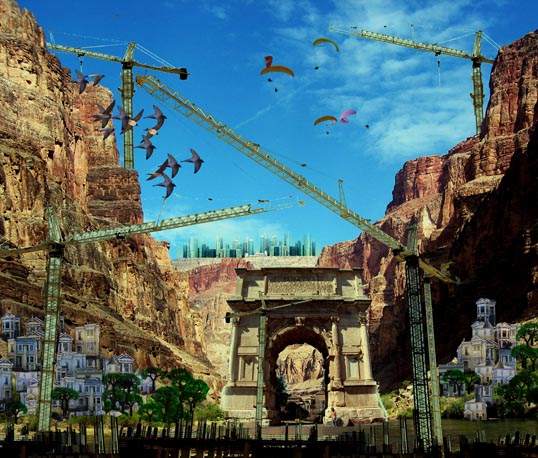
The early eighties were a time of frantic building in Texas, especially in downtown Dallas. The giant construction crane was considered the state bird. This all came to a spectacular stop in the Savings and Loan crash of the late eighties – but at the time nobody could see that disaster coming.
I was young and a recent immigrant to the big city and was absolutely fascinated with watching the towers going up. In those pre-internet days detailed news was unavailable to the unwashed masses – so the construction was always a surprise to me. Since it would take, say, two years or more to build these it was like a slow-motion reveal, a mystery unveiled piece by piece, day by day.
A block would be cleared and then a gigantic hole slowly carved deep down into the chalky bedrock. Then the steel, concrete, or combination skeleton would rise, floor by floor, emerging from the scurrying crowds of hard-hatted workers like a living thing.
Finally, the skin would be hung and, only then, would the real shape and color of the building revealed. It was never really what it looked like while it as going up – the architects played with shapes and forms, adding extra corners and geometric sleights of hand. The final form was always a gigantic pleasant surprise.
Those were exciting, innocent days. Now, looking at the buildings bring back those memories. I can see, in my imagination, beyond the glass and stone cladding to the hidden skeleton of these skyscrapers, remember when the supporting framework was fresh and exposed.
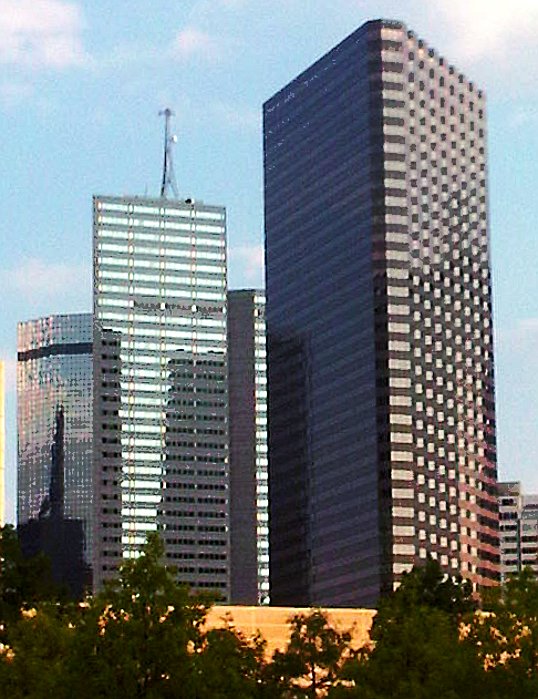
Three skyscrapers from Klyde Warren Park, Dallas, Texas
The three towers to the east
The Chase Tower
2200 Ross – 1987 – I recently took photos of a helicopter making a delivery here.
People call this one the building with a hole in it. On the 40th floor is a skylobby that offers good views of the Uptown area of the city – I haven’t visited this, but would like to. I watched it get started but was working out in Garland before it was finished. The skyscraper was designed by SOM and is 738 feet tall with 55 stories, making it the 4th tallest building in Dallas.
San Jacinto Tower
2121 San Jacinto – 1982
This is the tan triple building in the center. I watched this one go up in detail. While it was being built it was not obvious that it would have that unique, triple structure – the effect was made with add-ons at the end. The building is 456 feet tall and is 33 stories, making it the 20th tallest building in Dallas.
Trammell Crow Center
2001 Ross – 1985
This one was really cool to watch. It was very close to where I worked and was clearly visible outside a window near my cube. Although I left downtown before it opened, I did see all the visible construction right in front of my eyes. The skyscraper is Post Modern in styling and is 686 feet tall with 50 stories. The Trammel Crow Center is the 6th tallest building in Dallas and is named after its principal tenant.
Three more skyscrapers from Klyde Warren Park, Dallas, Texas
To the west are three more:
Lincoln Plaza
500 N. Akard – 1984
This triangular building went up on the site of the old YMCA – I watched them implode that building. It has a cool upper-crust restaurant (Dakota’s) in the basement – you go into an elevator sticking up in the sidewalk to get down to it. Lincoln Plaza is 579 feet high with 45 stories, and is the 13th tallest building in Dallas.
These last two flank Thanksgiving Square – one of my favorite spots back in the day. It’s getting a little run-down and forgotten now – but in the early 80’s it was the place to hang out for lunch on a warm spring day.
Energy Plaza
1601 Bryan – 1983
This is another building that I watched with interest – it ended up looking a lot different than I thought. I.M. Pei & Partners designed this 49 story building located on the north side of Thanksgiving Square. On top of the tower is a triangular communications tower that is modeled after the Eiffel Tower — only smaller and three sided. Energy Plaza is the 9th tallest building in Dallas and with a height of 629 feet.
Thanksgiving Tower
1601 Elm – 1982
The rearmost of these three is Thanksgiving Tower. This was was almost finished when I started working in Dallas – I was there when it opened. This 50 story all glass skyscraper faces into Thanksgiving Square. Thanksgiving Tower is 645 feet high and is the 8th tallest building in Dallas. If you look at it you can see the the distinctive reflection of Republic Center Tower – a skyscraper that has been there since 1954 – ancient by Dallas Standards.
“Those who dream by day are cognizant of many things which escape those who dream only by night.”
― Edgar Allan Poe, Eleonora
In front of the Dallas Museum of Art, night, long exposure (click to enlarge)
The sculpture is Ave, by Mark di Suvero – the same sculptor that did the Proverb piece not too far away.
“The sky grew darker, painted blue on blue, one stroke at a time, into deeper and deeper shades of night.”
― Haruki Murakami, Dance Dance Dance
They say you are not to touch the works of art. But I always used to see kids using the sloping steel structure – the one painted bright red in the middle of the preternatural green grass sward in front of the museum – as a slide. I don’t see that any more – security must be better.
But still I think of a slide when I see it – I think of the time we used a wax paper cup to lubricate an old, rusty piece of playground equipment down at the end of the block when I was ten years old. It became so smooth and frictionless…
The feeling of rocketing down that perilous slippery slope was intoxicating and frightening. The exhilaration was accelerated by the knowledge that we had figured it out and done it ourselves. We felt we were the only children in the world to understand the secret effects of rubbing wax paper cups on smooth steel.
A father came to fetch his kids and we boasted of how fast it was. Fathers were competitive then and he said it couldn’t be that fast because were were only little kids and we didn’t know what we were talking about.
It told him to try it. With a wry, dismissive grin he hauled his creaking, awkward bulk up the ladder much too small for him (I remember him as being oh so old, though now, of course, he would have been maybe thirty years younger than I am now) and sat bumbling down, unsure suddenly of the whole endeavor, giant feet reaching down the smooth steel – I remember a sudden, last look of doubt, almost panic flickering like a shadow across his expression… but fathers were stubborn then and there could be no turning back, no chickening out in front of his children and all their friends.
So he pushed off.
And you know what happened. I remember he shot off the end of that slide like a watermelon seed squeezed between your thumb and index finger on a hot summer afternoon.
That weekend his oldest kid told me he had to go to the hospital because he broke his coccyx.
From there, after six days and seven nights, you arrive at Zobeide, the white city, well exposed to the moon, with streets wound about themselves as in a skein. They tell this tale of its foundation: men of various nations had an identical dream. They saw a woman running at night through an unknown city; she was seen from behind, with long hair, and she was naked. They dreamed of pursuing her. As they twisted and turned, each of them lost her. After the dream, they set out in search of that city; they never found it, but they found one another; they decided to build a city like the one in the dream. In laying out the streets, each followed the course of his pursuit; at the spot where they had lost the fugitive’s trail, they arranged spaces and walls differently from the dream, so she would be unable to escape again.
This was the city of Zobeide, where they settled, waiting for that scene to be repeated one night. None of them, asleep or awake, ever saw the woman again. The city’s streets were streets where they went to work every day, with no link any more to the dreamed chase. Which, for that matter, had long been forgotten.
New men arrived from other lands, having had a dream like theirs, and in the city of Zobeide, they recognized something from the streets of the dream, and they changed the positions of arcades and stairways to resemble more closely the path of the pursued woman and so, at the spot where she had vanished, there would remain no avenue of escape.
The first to arrive could not understand what drew these people to Zobeide, this ugly city, this trap.
—-Invisible Cities, Italo Calvino
Invisible City – Gateway to Arcturus
Thin Cities 5
If you choose to believe me, good. Now I will tell how Octavia, the spider-web city, is made. There is a precipice between two steep mountains: the city is over the void, bound to the two crests with ropes and chains and catwalks. You walk on the little wooden ties, careful not to set your foot in the open spaces, or you cling to the hempen strands. Below there is nothing for hundreds and hundreds of feet: a few clouds glide past; farther down you can glimpse the chasm’s bed.
This is the foundation of the city: a net which serves as passage and as support. All the rest, instead of rising up, is hung below: rope ladders, hammocks, houses made like sacks, clothes hangers, terraces like gondolas, skins of water, gas jets, spits, baskets on strings, dumb-waiters, showers, trapezes and rings for children’s games, cable cars, chandeliers, pots with trailing plants.
Suspended over the abyss, the life of Octavia’s inhabitants is less uncertain than in other cities. They know the net will last only so long.
—-Invisible Cities, Italo Calvino
For a month, starting on June 1, I read a short story every day and wrote a journal entry about them. For me at least, (I don’t know about how it was for you) it was a fun, interesting, and educational experience and exercise. One thing I learned is how wide the world of short fiction is – how varied and variable, diverse and divisive the styles, techniques, and artistry.
So I vowed to continue reading widely… and that brought me to a book by Italo Calvino – Invisible Cities (PDF). Technically, it’s a novel – a short novel. However, it is made up of a long series of very short sketches, each one describing a different, fantastic city – fifty-five in total. These are framed by an outer story, where Marco Polo is talking to Kublai Khan and telling the tales, thereby describing the cities he has visited.
Kublai Khan does not necessarily believe everything Marco Polo says when he describes the cities visited on his expeditions, but the emperor of the Tartars does continue listening to the young Venetian with greater attention and curiosity than he shows any other messenger or explorer of his. In the lives of emperors there is a moment which follows pride in the boundless extension of the territories we have conquered, and the melancholy and relief of knowing we shall soon give up any thought of knowing and understanding them.
—-Invisible Cities, Italo Calvino
The descriptions can be read individually, in relation to each other, and to the deep philosophical questions raised by the framing story.
It is short and easy to read, yet complex – with hidden aspects and dimensions that have to be teased out. It is so full of unique and interesting ideas that it slowed my reading down… I’d devour a half page and then have to rest to let the concepts and thoughts born by the text stop vibrating and resonating inside my head, let it all calm down, before I could read some more.
The book shows a lot of influence of Jorge Luis Borges… and is one book that is referred to as Borgesian. It is full of self-referential conundrums, mysterious contradictions, and postmodern enigmas.
I have to be careful about what I am reading when I write, because my reading is such an influence on what I write. I put up an entry containing something I wrote, Free Breakfast, while reading Invisible Cities a few days ago.
I would love to write like Italo Calvino… though nobody would read it. His fiction is a lot of fun, but it isn’t, for example, something that will ever be as popular as, say Harry Potter.
Now that I think about it… wouldn’t that be cool? A postmodern, Borgesian Harry Potter.
It could explore the duality of Harry Potter’s life. He lives in a cupboard, ignored, miserable, and hopeless for part of the year, then spends the rest in a world of Magic… where he is the chosen one. Which life is the real one… which is the real Harry Potter? Could the dire tragic life of poor Orphan Harry be so demoralizing that it drives him crazy? – Is the whole magical world of Hogwarts born from Harry’s desperation – an imaginary world where he gains unthinkable power and importance – where he becomes the chosen warrior in a war against the ultimate evil?
And what about Voldemort? He shatters his soul into a handful of pieces and stores each one in a Horcrux. He achieves immortality, at the price of a broken soul. Do these items then become Voldemort? How can a soul exist without consciousness? The potential for paradox and existential exploration are endless.
Even something as simple as the paintings…. Dead people make an appearance in the moving, talking paintings of Hogwarts. Is this a form of limited immortality? Do the paintings know they are dead? Are they sad? Are there moving and talking paintings with subjects that were never alive? Why not? If so… what are their memories? Do the dead paintings sleep? Do they dream of the living?
That would be a book worth reading… if someone had the skill to pull it off.
Hidden Cities 1
In Olinda, if you go out with a magnifying glass and hunt carefully, you may find somewhere a point no bigger than the head of a pin which, if you look at it slightly enlarged, reveals within itself the roofs, the antennas, the skylights, the gardens, the pools, the streamers across the streets, the kiosks in the squares, the horse-racing track. That point does not remain there: a year later you will find it the size of half a lemon, then as large as a mushroom, then a soup plate. And then it becomes a full-size city, enclosed within the earlier city: a new city that forces its way ahead in the earlier city and presses its way toward the outside.
Olinda is certainly not the only city that grows in concentric circles, like tree trunks which each year add one more ring. But in other cities there remains, in the center, the old narrow girlde of the walls from which the withered spires rise, the towers, the tiled roofs, the domes, while the new quarters sprawl around them like a loosened belt. Not Olinda: the old walls expand bearing the old quarters with them, enlarged but maintaining their proportions an a broader horizon at the edges of the city; they surround the slightly newer quarters, which also grew up on the margins and became thinner to make room for still more recent ones pressing from inside; and so, on and on, to the heart of the city, a totally new Olinda which, in its reduced dimensions retains the features and the flow of lymph of the first Olinda and of all the Olindas that have blossomed one from the other; and within this innermost circle there are always blossoming–though it is hard to discern them–the next Olinda and those that will grow after it.
Though I am a ridiculous old fat man on a bicycle, I have been working on increasing my mileage and exploring how to integrate cycling into my daily activities better. My goal for 2013 is three thousand miles on my bike. I knew I would start out behind (the weather in the winter is too often simply too nasty to ride) but I try to get as many miles in as possible.
Saturday was a gray post-misty day, cool but not cold – usually considered depressing winter weather – but without a breath of wind, perfect for a bicycle ride. I cruised all over Richardson and North Dallas, getting in about thirty-four miles of city riding, which is a lot for me. I was pretty well worn out.
Sunday was more of the same, a little warmer and a little windier and I wanted to ride somewhere and get a few more miles in – somewhere more or less useful.
About eight miles away (as the bike rolls) is White Rock Coffee, one of my favorite independent coffee spots. There are a number of Starbucks within walking distance of my home, and a couple of bubble teas/smoothie emporiums, but White Rock is the closest non-national-chain coffee spot. There is a new branch of The Pearl Cup, under construction in Richardson, and when it is done it will be a nice bicycle destination. But they are still working on it – so until it’s done it’s White Rock Coffee.
The problem is, I can’t find a good route to White Rock Coffee. The biggest choke point is LBJ/635 Interstate Highway loop. The best crossing between my house and the coffee place is the pedestrian bridge next to the Skillman DART station.
The pedestrian bridge over LBJ at the Skillman Dart station – photo from Googlemaps.
Once you start looking at that crossing you realize a nefarious little bit of nasty city planning. The bridge is useful, mostly because it connects a couple of neighborhoods of rundown apartments (on either side of the freeway) with the train station and each other. The problem is that it is almost impossible to get into or out of those neighborhoods on foot or on bicycle.
I don’t think this is an accident. Streets running up to these areas lose their sidewalks – some residential streets are cut and blockaded. It is obvious that the powers-that-be don’t want folks walking out of their rundown apartment complexes into the more upscale areas of housing.
So I have been working on finding the best route. I came up with one and it’s not that great – there are several nasty road crossings (Yale and Walnut, Leisure and Forest, and Adleta and Skillman are the some of the worst), four places where I have to walk my bike, and some heavy traffic. A long stretch of narrow, crowded residential street with parked cars filling both sides – the door zone fills the whole street. It’s especially tough because I’m riding my road bike right now – I’m rebuilding my commuter/bad weather bike. The narrow tires are pickier about terrain.
I decided to give it a go today – stuffed my laptop and an extra shirt into my backpack and set off. I know eight miles isn’t very far, but it’s a tough eight miles. The backpack was heavy and I was always riding into the wind (how does that work?). It’s all crowded urban stop-and-go riding.
That’s the thing about riding a bicycle in the city – you see things you never do from a car (or on foot, really, because you can’t travel that far). You see beauty, notice hills you never would otherwise, connect with the weather in an intimate, organic way… but you see a lot of nasty, brutish, and ugly stuff too. A lot of trash, homeless people, and neglect.
I hadn’t anticipated the amount of broken glass on the streets and sidewalks in some of these neighborhoods. Sure enough, crossing 635 on the pedestrian bridge I put a sliver of shattered malt liquor bottle through my rear tire and had to patch it in a nasty little parking lot covered in antifreeze and oil that had been dumped there, keeping an eye on the crack dealers that were keeping an eye on me.
Life in the big city in this best of all possible worlds.
I had better finish this up and drink the rest of my coffee and get home – I don’t want to do that ride in the dark.
As it lurches wildly out of its Redneck Past, the City of Dallas – now completely strangled by its noose of suburbs – is forced to turn inward. It has to flip over its long-neglected flat rocks and deal with what scrambles out from underneath. It has to somehow transform its neglected barren shadowy hinterlands into fertile soil where it can grow shiny new developments for the future.
Few people in the city fully realize this yet, but the only successful path into the world of tomorrow leads directly and literally to the other side of the tracks and across the river. Success for the city will depend on how well this difficult process is done. It doesn’t have to (and can’t be) done perfectly… but it has to be done and has to be done thoughtfully and has to be done soon (faster, please).
One of the critical junctures in this process is a long-ignored wide spot in the road called Cedars West. If you look at an old aerial photograph of Cedars West from, say the 1930’s, you will see it was an island. The meandering Trinity River split into two branches forming the area that would become Cedars West, and then, only a short distance downstream, they joined back together. The Corinth Street Viaduct, a long, concrete structure joining Dallas North and South, gave access to this swampy little piece of land.
This cheap, almost useless, scrap of land quickly became home to the low-end forgotten businesses that none of the snootier residents wanted in their neighborhoods. Wrecking yards, scrap metal, wholesale auto parts, and oil and grease distributors settled in where they could be easily ignored and for decades thrived in that godforsaken tract.
Until now.
You see, the City of Dallas wants a developer to build a huge multi-use development nearby. The area was to be transformed into a hipster doofus haven (and I mean that in a good way, I really do) where the modern millennial could work, live, and play. Giant piles of scrap metal, reclaimed wood siding, and tanks of used grease were not considered good neighbors for such a cool crowd.
So, in typical heavy-handed corrupt government style, the City Council simply voted to change the zoning in Cedars West, and give all those ugly, smelly, and un-hip squatters five years to vamoose. This was going to force the present stewards of the land, who had been working their asses off trying to build their businesses, employing the otherwise unemployable, and making use of a part of the city that few others even knew existed (I sure didn’t) for several generations now, into oblivion to make way for the wave of the future.
But, in a surprising move, the businesses of Cedars West decided to fight back… and in a very cool and interesting way.
They organized and went to the council to point out that a new urban development that consisted of all shiny, fancy, clean, pre-planned white-bread construction was doomed to fail. Residents of such an area want to live in an urban environment, not in a high-rise version of Plano. Otherwise, they would live in Plano.
They offered to simply clean up their act. They would put up new, attractive fencing and metal walls to hide the ugly portions of their business and to actively encourage artistic uses of their products and to promote the “Green” aspects of their business. Yesterday’s scrap iron and wrecking yards ares tomorrow’s sustainable recycling.
So they did. And the council, in a shocking bit of intelligence, agreed. They gave the businesses of the area two years to clean up their act. Anyone that succeeded in pulling off a transformation from an ugly old low-tech business to a modern artistic vintage funky sort of urban oasis could stay. Anyone that didn’t… had to go.
A fascinating story… and one, I’m afraid, that I missed totally.
Until, looking through the web for something to do over the weekend, I came across mention of the First Annual Cedars West Arts Festival. At first, I was lukewarm to the idea… another Arts Festival? Haven’t I seen enough of these things? But then I heard that one of my favorite food trucks, The Bomb Fried Pies was going to be there, and I took another look.
It threw me when I pulled up the address (2021 Rock Island) in Google Maps and took a look at the aerial photo. There were the swampy Trinity River Bottoms and a little stretch of road that ran through the most awful stretch of industrial wasteland you will see anywhere. It looked like the last place on earth you would hold an arts festival. So I began to read the history of the area and the reason behind the festival. They were throwing this shindig to show off the work they had done to spruce up their area and to demonstrate to the city at large how these types of businesses can contribute to the cultural life of the city.
And I knew I had to be there.
So Candy and I made our plans. We knew it was going to be a hot day and Candy doesn’t like to be out in the Texas blast furnace heat any more than necessary so we wanted to go right when it opened at eleven. We didn’t want to drive and the festival advertised that it had blocked off a lane of the Corinth Street Viaduct so you could take the DART train to Oak Cliff and walk across. I wondered why they didn’t have folks walking from the Cedars Station which looked a little closer, but that was what they planned, so that is what we did.
It was a long walk; the Corinth Street Viaduct is about a mile long. Sure enough, they had barriers up the entire length, blocking off an entire lane. They went to a lot of expense for us – we didn’t see anyone else using the viaduct to walk in. I enjoyed the trek across and over the trackless wilderness of the Trinity River bottoms, with a view of Downtown on one side and the DART trains/Testle Trail and manmade river rapids on the other – but it was already too hot for Candy.
The Arts Festival was really a lot of fun. The local businesses went all out in making everyone welcome and showing off the work they had done in beautifying, hipster-ing, and funkifying their places. OKON Scrap Metals had a big pile of used iron which their employees were picking from and creating sculptures behind clear yellow welding screens.
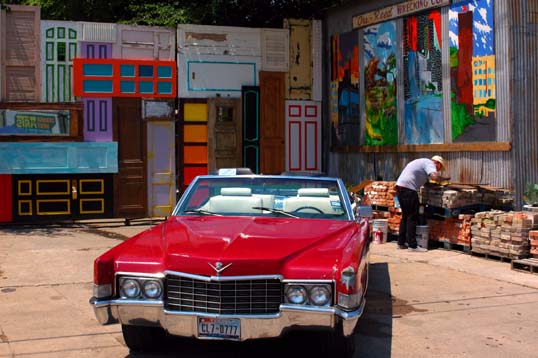
I was really impressed with Orr-Reed Wrecking Company. Their business is in tearing down old buildings and homes and preserving as much as they can. Their place in Cedars West is a big, long shed full of salvaged materials. From hardwood flooring, to bathroom fixtures, from vintage lighting to stained-glass windows… they had it all. If you are in the DFW Metroplex and are remodeling a home, be sure and go down there and see what they have to offer. It truly was an amazing place.
Beyond simply saving, preserving, and selling – Orr-Reed Wrecking was touting itself as a home and source for artists. There were rooms full of furniture and sculptures made with materials culled from their vintage collections for sale. They even offer low-cost studio space for anyone wanting to work with what they have to offer. Walking around was an eclectic crowd of relaxed artsy-looking young folks that worked there, both providing labor for the company and providing their inspiration for the aesthetic of their products.
Candy and I wandered around the place for a while, but it soon became too hot and we decided to head home. We were both really hungry and I wanted to find a local place that I had never tried before. Candy dreaded crossing that bridge again in the blistering afternoon sun so I suggested we walk the opposite direction to the Cedars DART station and get something to eat in that area.
Big mistake.
We soon discovered why the Arts Festival closed off the lane and suggested folks walk across from Oak Cliff. The stretch along Corinth to Lamar was the most awful, neglected, and scary war zone of urban decay you will ever see. It’s amazing how the city could even think of forcing out the businesses of Cedar’s West while they could let their own streets and sidewalks run down into a horrible condition like that.
Intrepid and idiotic as we are, we made it through, hungry and dehydrated. We ate at The Cedars Social bar and restaurant, a really nice cool oasis in the urban wasteland. It felt like stepping into the set of Mad Men… with a brunch menu.
I’m going to be keeping an eye on Cedar’s West going forward. Sometimes, not often, but sometimes, there are surprising things happening in places you don’t expect, and I think this may be one of them.
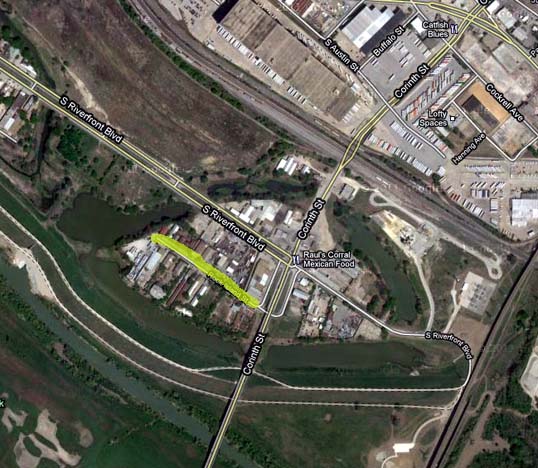
Although the Trinity River Channel has been redirected to the bottom of the photo, the Cedars West is still pretty much an island in the river bottoms. The Arts Festival was on Rock Island, the part colored in yellow.
Two employees/artists at Orr-Reed Wrecking. Her T-Shirt says, “Show Us Your Junk,” which is their motto.
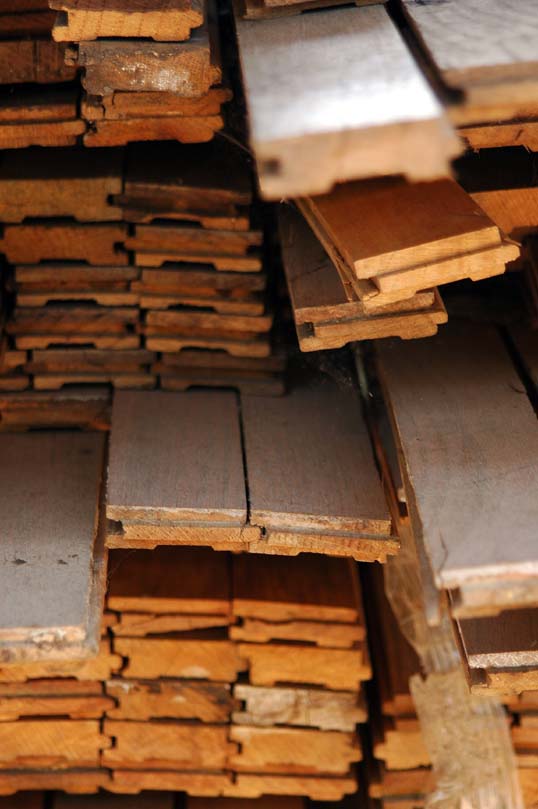
Reclaimed hardwood flooring from Orr-Reed. They had acres of the stuff.
Before and After. Recycled bathroom fixtures.
Using vintage products as art and architecture. The exterior of Orr-Reed Wrecking.
The King of Junk. Surveying his kingdom.
The Arts Festival had a nice, downhome, neighborhood feel to it. Here is a smoking grill a food vendor was using to make burgers and a little trailer selling refreshments.
The route we walked out along is so God-Awful that there is a proposal for a pedestrial bridge to skip over the whole thing. I doubt it will get built – but wouldn’t this be cool?
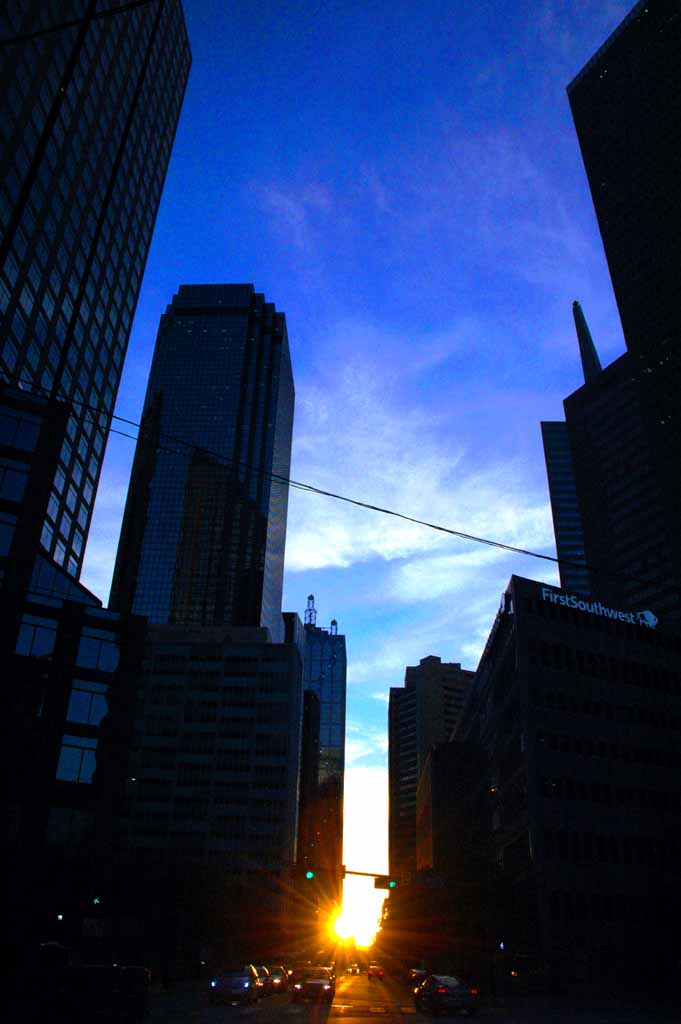
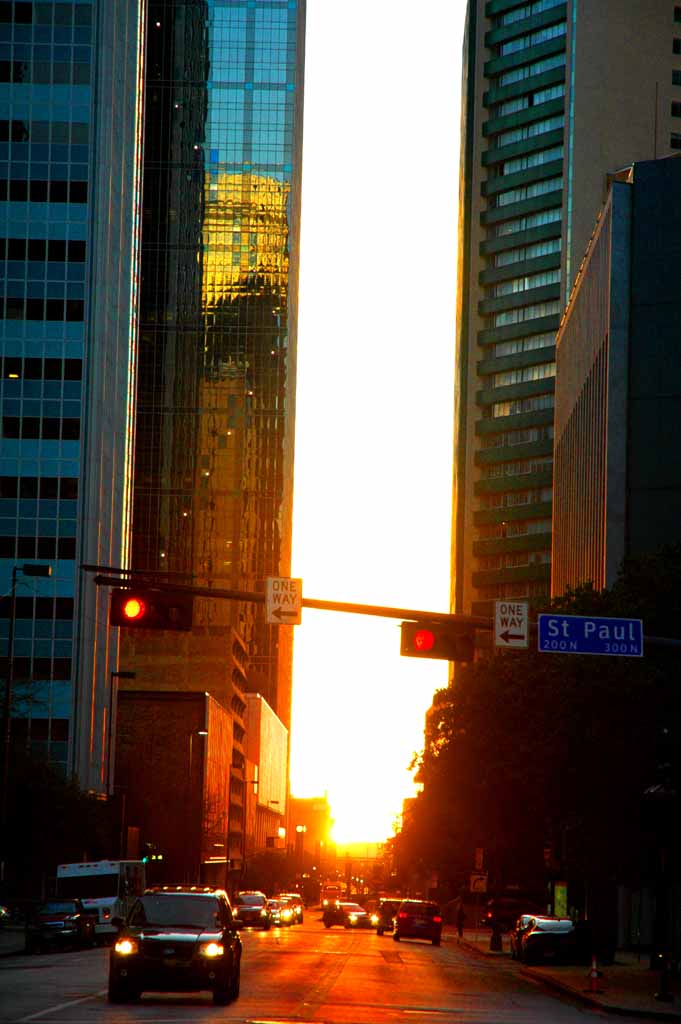
The day was here, Wednesday, February 15, 2012. Dallashenge. I had done the calculations via suncalc.net. I had done the test shots. And now, today, according to my best ciphering, the sun would set exactly in alignment with the canyons of highrise buildings in Downtown Dallas.
It would not be as spectacular as the very well-known Manhattanhenge, of course. As far as I know, I am the only person that recognizes this phenomenon in Dallas.
The forecast threatened thunderstorms. All day the sky was cloudy; fog wrapped the city. I had set 3PM as my decision time (I was thinking that maybe Friday would be a better day anyway for photographs) and as if by magic, the Texas sun burned the fog away, leaving the sky blue with only a few wisps of long rope-like clouds. The best I could hope for.
So I left work a little early and lugged my tripod and camera downtown on the train. It was very awkward – I need to find a way to carry/strap my tripod in/on a pack with my camera. After my test shots, I had decided to set up on a little spot of sidewalk at the intersection of Pacific, Live Oak, and St. Paul. It wasn’t the most “canyon-like” intersection, but it was impressive looking, gave me a spot to stand without dashing back and forth across the street, and Pacific Avenue isn’t blocked at the end by the Lew Sterrett Jail like the other downtown streets.
I set up the camera and tripod right at six and waited for the sun to set. Suncalc.net gave the sunset time as 6:13, which turned out to be the time the last bit of sun dropped below the horizon. Even on Pacific, the horizon isn’t unblocked, so the apparent sunset time was earlier; I took my last picture at about 6:10. It happened quickly – I was snapping, changing the camera position, adjusting the exposure, zooming in and out, and checking my photographs on the screen on the back of the Nikon.
I saw nobody else that was aware of the ‘henge. Only one person paid any attention to me. A man out walking his dogs stopped and I told him what I was doing. He said, “I walk my dogs every day at this time, and I noticed the sunsets were looking nice recently – but I didn’t realize it was because it was setting along the streets.”
Dallashenge (click to enlarge)
(Click to Enlarge) This is my new desktop wallpaper
Dallashenge (click to enlarge)
The Henge through a bus window.
I think I was there a day or two early. Even if this is the “official” henge date, the sun will be a little higher and a little more to the right in a couple days and that might make for better pictures. Next evening henge date I’ll go a little later. Also, I want to try some other intersections, especially the Elm and Harwood intersection by the Majestic Theater. I want to try and get into that pedestrian overpass – that should give a good shot.
This summer, on August 23 (6:57 AM) is a morning Dallashenge. Looking at the city maps, there is a parking garage at Lew Sterrett that might give a great view straight down Elm and Main. Sometime over the summer I need to check it out – see if the garage is public, how high its guard wall is, and if it is open at that hour of the morning.
Taking pictures of something this fleeting is sort of an all-encompassing activity. One henge day I want to go without a camera and just look at the thing.










 Bill Chance