One Book In My Hand And A Stack Of Others On the Floor

“I like best to have one book in my hand, and a stack of others on the floor beside me, so as to know the supply of poppy and mandragora will not run out before the small hours.”
Dorothy Parker, The Collected Dorothy Parker

Recycled Books, Denton, Texas (taken a long time ago, obviously)

There was a time when we could go to bookstores. Especially big ol’ huge used bookstores (like Recycled Books) with rooms – a confused labyrinth of passages between towering shelves – that odd quiet of millions of sheets of paper adsorbing the sound – the slight smell of mold and ancient wisdom. I would stand in a place like that (or the library) and feel panic because I would never live long enough to read one percent of this – so much knowledge that I would never possess – haunted by the thought that somewhere in there – in that massive agglomeration – is the one book that would enlighten me and tell me exactly what I need to know and I don’t know enough to find it and wouldn’t know it if I saw it.

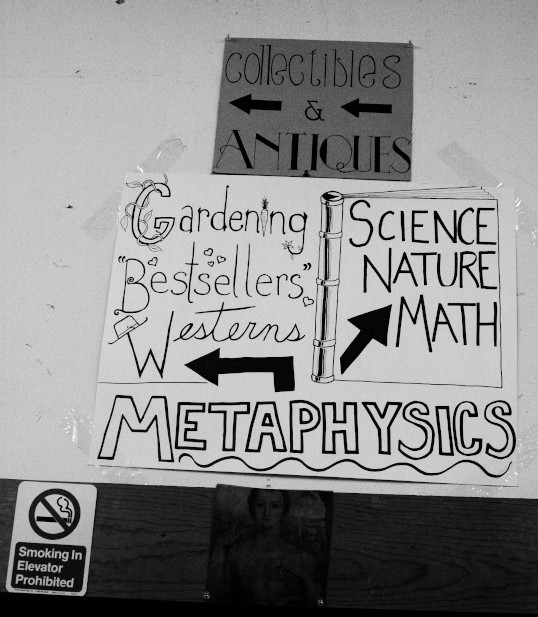
It feels like those days are so long in the past – it seemed like we could do anything (except smoke in the elevator) – the memories are fading – will those days ever come back again?

Recycled Books
Denton, Texas

Recycled Books Records CDs
Denton, Texas
(click to enlarge)

Recycled Books, Denton, Texas


Joy Cannot Fend Off Evil

“But, in the end, joy cannot fend off evil.
Joy can only remind you why you fight.”
Jeff VanderMeer, Dead Astronauts

(click to enlarge)
Mural, Deep Ellum
Dallas, Texas

OK, it was Monday, the end of work, I was so very tired, I didn’t have my car with me, I had to get clear across town, if I really wanted to go there, it was cold, it was raining, it was dark,  I thought about not going, I would get back home so very late, here’s how I would have to travel:

Work Shuttle – DART Red Line – walking downtown – Dallas Streetcar to Bishop Arts – Walk to Restaurant – eat a hamburger – Walk to BookstoreWild Detectives Book Club discussion of Dead Astronauts – Walk to Streetcar – Streetcar downtown – walk to DART station – Red Line to Spring Valley Station – wait for bus – DART bus 402 – walk home from Belt Line and Yale

Maybe I shouldn’t have gone, today is the next day and I’m tired I didn’t get enough sleep last night


But I realized I had to go because the book was so difficult and so WEIRD that I had to find out what the others thought about it. Also, I had fought my way to the end of a tough read – I had earned the trip and the meeting.


I asked the group, “Would you have finished this if you weren’t in a reading group? If there weren’t other people shaming you into plowing ahead and getting to the end?” Everyone (and I mean Every-One) replied enthusiastically “Hell No!”


What do I think about difficult books? What do I think about WEIRD books? What do I think about books that stretch the envelope of what text can do? What do I think about books that play with illustration and typography in odd and confusing ways? (think House of Leaves)


I did say that, usually, I judge difficult and WEIRD books… in the end… by an emotional connection. I don’t care if the plot makes no sense I don’t care if there is a conventional resolution I don’t care if the theme is obscure(d) – but I prefer it if I have some kind of emotional connection or some sort of inner payoff at the end


With Dead Astronauts there was some (but not a lot) especially in the Sarah section and at the very end. Was there enough? Is Batman a transvestite? Who knows


Now, the next big question is should I read more VanderMeer? (I did really like The Situation – a protoBorne novella)  Should I read Borne? (set in the same world as Dead Astronauts but different – the people in the group that had read it said it was character-driven) Should I read Annihilation?( I saw the movie without knowing it was from a book and thought it was very cool) Should I read the whole Southern Reach Trilogy (A guy sitting next to me said he really liked Annihilation but the sequels left him cold because they resolved too much of the mystery of Annihilation)


So Maybe I’ll read Annihilation and skip the rest of the Trilogy. I think I will read Borne.


But first… I have to read L’Assommoir – Have to keep troopering through my Zola project – and then, in March there’s another Wild Detectives Difficult Book Club project – we’re going to tackle The Brothers Karamazov (about six weeks of work)………………….

So little time, so many books.


Short Story (novella) of the day, The Situation by Jeff VanderMeer

My Manager was extremely thin, made of plastic,with paper covering the plastic. They had always hoped, I thought, that one day her heart would start, but her heart remained a dry leaf that drifted in her ribcage,animated to lift and fall only by her breathing. Some-times, when my Manager was angry, she would become so hot that the paper covering her would ignite, and the plastic beneath would begin to melt.

—-Jeff VanderMeer, The Situation

Art Deco mural from Fair Park in Dallas


The Situation, by Jeff VanderMeer

from Wired Magazine

About a year ago I started going to book club meetings at The Wild Detectives – a bookstore in Bishop Arts that features beer and coffee… a great place. Even though I don’t have much in common with the other readers and it’s really tough to get across town after work, I like to go. Actually, now that I think about it, the fact I don’t have much in common with the other readers is the best thing about going.

The book we will discuss the first Monday in February is The Dead Astronauts by Jeff VanderMeer. I’m cranking through the book and haven’t made up my mind yet. It’s very imaginative and well written but exceedingly weird. I like weird – but only if, at the end, there’s a point… some emotional connection. I’m not a big fan of weird for weird’s sake. I have a feeling that I will be a Jeff VanderMeer fan at the end.

I think that’s a good thing. It’s always good to find a new author isn’t it? Even though I have a ways to go on my Zola reading project and enough other books to… well, to fill up my rapidly declining lineup of years left.

Looking at other Jeff VanderMeer works there’s the Southern Reach Trilogy (I’ve seen the interesting movie Annihilation which was adapted from the first book in the trilogy) and I think those books will get added. Also there is the Borne novel which is set in the same insane world as The Dead Astronauts. That’s four more books to read. So little time, so many books.

As I was looking around for info (The Dead Astronauts is difficult enough I’m not worried about spoilers) on The Dead Astronauts and the Borne world I discovered an online short novella called The Situation. It is billed as a proto-Borne story – set in a preliminary version of that universe (are we reading about the origin of the giant bear named Mord?). So I sat down and read it.

And liked it. It is a sort-of comedy about the difficulty of surviving sane inside an evil bureaucracy. Quite a harrowing story. And well-worth the time and effort.

Shit. That means I’ll eventually have to read all those books. So many books, so little time.

Short Story of the Day, Sticks by George Saunders

The first time I brought a date over she said: what’s with your dad and that pole? and I sat there blinking.

—- George Saunders, Sticks

Modern Art Museum of Fort Worth
Conjoined, Roxy Paine

George Saunders is a writer that amazes me. If I could write like any one person I would want to write like him (though I have said the same thing about  Raymond Carver… so, well, maybe it’s a tie).

I’ve written about stories by Saunders before:

Today’s short story is a one minute piece of flash fiction that contains an entire life full of frustration and regret. It’s funny and sad, in the terrible way that only funny things can be so sad. It’s called Sticks.


You can read it here: Sticks, by George Saunders

In the introduction to the published version in “Story” magazine he explains how he developed the idea for the story (if you follow my link above you can find out for yourself). That short explanation is as amazing as the fiction itself. We all see things along the road, especially along our commute to work, that become part of our lives so intimately that they disappear. Still, your imagination is filled with these things and the stories they generate. Only a genius like George Saunders can imagine something so poignant and unforgettable, so buoyant and unforgivable.

Modern Art Museum of Fort Worth

A Stack Of Others On the Floor Beside Me

“I like best to have one book in my hand, and a stack of others on the floor beside me, so as to know the supply of poppy and mandragora will not run out before the small hours.”
Dorothy Parker, The Collected Dorothy Parker

I believe we all have our addictions. Life would be unbearably dull without addictions. The trick is to pick ones that won’t destroy you and then try and manage them.

One of my addictions is used books. In this Kindle age, my book addiction is tempered (that devilish device already has more words entombed in it than I can read in the brief time I have left to live) but every now and then it rears its ugly head. Today was one of those times.

It was the annual Half-Price Books Clearance sale at the Dallas Market Center.

Image a huge room – almost five acres in size – that usually holds massive collections of boats, recreational vehicles, or cars. That vast expanse of space is covered with hundreds of long tables and every table is stacked with books. All for two dollars apiece. That’s the Half-Price Books Clearance Sale.

Half-Price Books Clearance Sale, Market Hall, Dallas, Texas

The books (and other goodies) are only roughly organized – YA, Fiction, Cookbooks, Non-Fiction, Audio CDs, DVDs, Children’s Books, History, Vinyl, Comic Books, Coffee Table Books, and Vintage. If you are looking for a particular tome – it might be there, but you are not going to find it. The only way is to abandon yourself, walk up and down the tables, picking out what catches your eye.

I know that somewhere in that immense assortment there is one book that would change my life – and only cost two dollars.

Unfortunately, I didn’t find it.

When we arrived the outer edge of the room was almost completely filled with a long line of folks pushing big shopping carts piled with books. It looked like it would take hours to get through that queue and make a purchase. Luckily, the line shrank precipitously while we browsed – these were the true addicts that had shown up at first light for the prime books (though the staff was constantly restocking).

I saw the folks that I have spotted at library sales before – people with an app on their phones, working down the line scanning the barcodes. They have some online database they are working against that will tell them the value of the book they are passing. They will do this for hours – scanning through thousands of items looking for something they can sell on their online store. I guess this is cool – but what a hard way to make a buck.

I went to the sale with the idea of not buying anything other than maybe a book or two – simply enjoying the scene – like a junkie going somewhere to look at gigantic piles of heroin. Of course, that did not work. I bought a few books – less than ten – not too bad. I’ll have to get rid of that many – I control my addiction by limiting my shelf space (a book goes in – one goes out). So many  books, so little time left.

If you live in Dallas, you have two days left to get over there. They completely restock every morning.
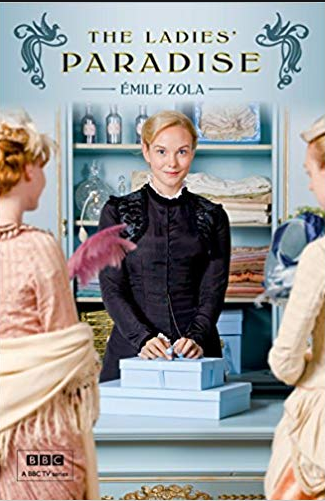
The Ladies Paradise

“I would rather die of passion than of boredom.”
Émile Zola, The Ladies’ Paradise

Cover of Au Bonheur des Dames by Emile Zola

I am now a good chunk into Emile Zola’s twenty volume Rougon Macquat series of novels. Attacking this pile of books in the recommended reading order:

  • La Fortune des Rougon (1871) (The Fortune of the Rougons)
  • Son Excellence Eugène Rougon (1876) (His Excellency Eugene Rougon/ His Excellency)
  • La Curée (1871-2) (The Kill)
  • L’Argent (1891) (Money)
  • Le Rêve (1888) (The Dream)
  • La Conquête de Plassans (1874) (The Conquest of Plassans/A Priest in the House)
  • Pot-Bouille (1882) (Pot Luck/Restless House/Piping Hot)
  • Au Bonheur des Dames (1883) (The Ladies’ Paradise/Shop Girls of Paris/Ladies’ Delight)
  • La Faute de l’Abbé Mouret (1875) (The Sin of Father Mouret/Abbe Mouret’s Transgression)
  • Une Page d’amour (1878) (A Lesson in Love/A Love Episode/A Page of Love/A Love Affair)
  • Le Ventre de Paris (1873) (The Belly of Paris/The Fat and the Thin/Savage Paris/The Markets of Paris)
  • La Joie de Vivre (1884) (The Joys of Living/Joy of Life/How Jolly Life Is/Zest for Life)
  • L’Assommoir (1877) (The Dram Shop/The Gin Palace/Drink/Drunkard)
  • L’Œuvre (1886) (The Masterpiece/A Masterpiece/His Masterpiece)
  • La Bête Humaine (1890) (The Beast in the Man/The Human Beast/The Monomaniac)
  • Germinal (1885)
  • Nana (1880)
  • La Terre (1887) (The Earth/The Soil)
  • La Débâcle (1892) (The Downfall/The Smash-up/The Debacle)
  • Le Docteur Pascal (1893) (Doctor Pascal)

The next one up was The Ladies Paradise.

The overall story is a very thin romance between a poor, country girl that comes to Paris and finds work in a new, rapidly expanding department store and the owner of the store. He is Octave Mouret, the relentless womanizer of the book before this one – Pot-Bouille. His desire to possess women has now metastasized into the need to dominate them commercially by creating a retail establishment that they cannot resist – literally a ladies’ paradise.

But the real protagonist of the story is the store itself – the eponymous Ladies Paradise. Large swaths of text are dedicated to detailed dreamy descriptions of the store, its wares, and the elaborate displays set up to show off the goods and lure in the women of Paris and, most importantly, to separate them from their money.

As the book progresses the store grows and grows, taking over building after building, until it dominates the area and all retail commerce. There is a heart-tearing description of the woeful ends of the various small shopkeepers of Paris – trying to scrape out a living selling cloth, shoes, or umbrellas – until they are inevitably ground under the heels of the behemoth growing through the streets – their owners are driven into bankruptcy, poverty, and madness.

The book was written a couple of centuries ago – but it is a story that is still going on today. We have all seen small businessmen destroyed by large corporate chains that offer lower prices, bigger selections, and spectacular shopping experiences. It is a story that could take place in the last couple of decades.

Except today, even those huge conglomerates are being driven out of business by a technology that Zola couldn’t even imagine – online shopping. Though, now that I think about it, The Ladies Paradise puts together a company of horse-drawn delivery vans, with advertisements plastered on the side, that resembles today’s fleet of Amazon-Prime vehicles.

The novel’s fictional department store was modeled after a real place – Le Bon Marché in Paris. The store is still open.

This was an enjoyable tome in the series, though the long, detailed descriptions of ranks upon ranks of goods placed on sale went on too long for my taste – but probably necessary to drive home the point of the plot. It was simultaneously a record of the past, an reverse echo of the present, and a warning of the future.

Pot Bouille

“When younger, he had been fun-loving to the point of tedium.”
Émile Zola, Pot Luck (Pot Bouille)

Pot Bouille, by Emile Zola

In September of last year (2018) I began the task of reading all twenty novels in Emile Zola’s Rougon Marquat cycle. There was a three month gap in this reading plan as I plowed through Gravity’s Rainbow with a reading group. But now I’m back at it – though not in too much of a hurry… I am reading other books too.

I finished The Conquest of Plassans (book number six) a week or so ago. It was an interesting read – especially how it began slowly as a story of small-town gossip and intrigue and built into a climax of madness, horror, and death. Now I am onto the seventh (in the recommended reading order), Pot-Bouille.

That title doesn’t translate to English very well. I’ve seen it as Pot Luck and other things. From Wikipedia:

The word pot-bouille is a 19th-century French slang term for a large cooking pot or cauldron used for preparing stews and casseroles and also the foods prepared in it. The title is intended to convey a sense of disparate ingredients, the various inhabitants of the building mixed together, to create a potent and heady mix like a strong stew. The impression is to hint at the greed, ambition and depravity which lies behind the pretentious façade of the outwardly well behaved bourgeois apartment block. There is no equivalent word in English to convey this. The closest English term would probably be an expression such as melting pot.

In the film The Life of Emile Zola, the novel’s title is rendered as Piping Hot.

So, I think of the book as being called “melting pot.”

It seems to be a complicated story about numerous residents in a multi story rental house in the center of Paris – most related to each other in one way or another. To help with the book I spent a few hours and complied a list of characters I could refer to… then discovered somebody else had already done it.

I’m on the road and working hard for the next week, but I should be able to find some slivers of time and finish the book. Then on to the next, Au Bonheur des Dames – a direct sequel to Pot-Bouille.


The Conquest of Plassans

Félicité kissed Marthe on the forehead as if the latter were still sixteen. She then extended her hand to Mouret. Their usual mode of conversation had a sharp edge of irony.

‘Well,’ she asked with a smile, ‘have the police not been to arrest you yet, you old revolutionary?’

‘Not yet,’ he replied, also with a laugh. ‘They are waiting until your husband gives them the order.’

‘Oh, very funny, ‘ Félicité replied, her eyes blazing.

Marthe appealed to Mouret with a pleading look; he had certainly gone too far. But he was off and there was no stopping him.

—- Emile Zola, The Conquest of Plassans

The Conquest of Plassans, by Emile Zola

Looking back, I started in September of last year – started an ambitious reading project – I set out to read the whole Les Rougon-Macquart cycle by Émile Zola   – all twenty books.

I started out cranking through them with some regularity


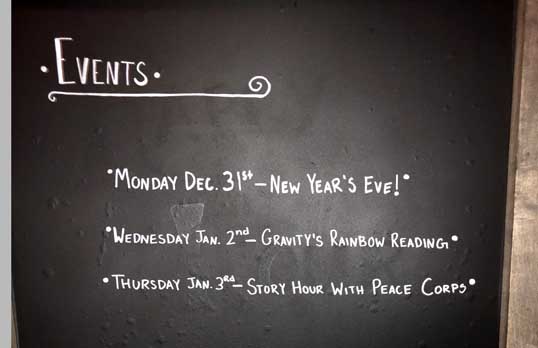
But then, as I walked out of The Wild Detectives (bookstore, coffee, beer) near the end of December, I saw this sign:

Sign at The Wild Detectives bookstore, Dallas, Texas

And that was all she wrote for Zola for three months. I fell into a group that met weekly and read Gravity’s Rainbow. That took up all my reading energies until the last week of March, when we finished and gave out trophies.

Then, after that was finished, I suffered from some allergy-related conjunctivitis and discovered that the inability to see puts a serious crimp in ones reading schedule. But now, my eyes are full of acceptable levels of goo and I turn back into the Zola books. I didn’t really like the last one, The Dream, and am happy to report that this one, The Conquest of Plassans is back in line with most of the other books in the series.

It feels like a return to a comfortable home. Plus, while a twenty volume French series from about a century and a half ago doesn’t sound like light reading – compared to Gravity’s Rainbow... it’s like reading the Sunday Comics. Will be done with this one in a couple days.


The Scope And Structure Of Our Ignorance

“Everybody gets told to write about what they know. The trouble with many of us is that at the earlier stages of life we think we know everything- or to put it more usefully, we are often unaware of the scope and structure of our ignorance.”
Thomas Pynchon, Slow Learner: Early Stories

Swedish Edition of Gravity’s Rainbow

I have never been much of a costume person. But it was time for our final party – our celebration – of the group that started on January 2 of this year – to read, together, Thomas Pynchon’s ridiculously difficult book, Gravity’s Rainbow. After that much work (not only reading the book, but taking the train to Bishop Arts every Wednesday after work for three months) I wanted to celebrate. I wanted my trophy. And it was to be a costume party. So I spray-painted a three dollar straw hat to simulate a White Stetson, bought a brace of dollar store dart guns to simulate a pair of 45’s, and put on an old army uniform top… and I was Major Marvy – one of the most odious characters in the book. He did come to a very, very bad end, after all. I packed the getup into a paper shopping bag and headed out across the city to The Wild Detectives on the DART train.

The party was fun. One woman wore a cardboard basket with a large helium balloon floating over her head and carried fruit pies – she won the costume contest. There were a couple Pointsman in white lab coats carrying stuffed dogs (one guy applied some paper saliva to his dog) and two Brigadier Puddings. A lot of Hawaiian shirts, harmonicas, toilets, bananas, and octopi (named Grigori). One rocket, serial number 00000.

And I got my trophy.

Trophy from the Gravity’s Rainbow Challenge. Yes, I read the whole thing.

We took turns giving a short summary of our opinions of the book and reading a short quote. Two people (including me) thought the book was great. A handful came to like the book as they came to accept its weird and unique nature. The majority didn’t like the book, but enjoyed the process of reading it, especially in a group. A few absolutely hated it and wished they had never read it (which I, although I disagree, can fully understand). I asked one person that hated it with a passion what their favorite book was and they said, Harry Potter. If that’s your favorite book, you will never, ever like Gravity’s Rainbow.

My quote was the third of the Proverbs for Paranoids:

If they can get you asking the wrong questions, they don’t have to worry about answers.

One eagerly awaited part of the party was the announcement of the next book in the Difficult Book reading series (they have already tackled Infinite Jest and Ulysses before Gravity’s Rainbow) which will start in September. In a bit of a departure, the choice is a Trilogy rather than a single book. It’s the “St Ives Trilogy”by Virginia Woolf – Jacob’s Room, To the Lighthouse, and and The Waves. I think I’ve read one of these – though it was a long time ago and I don’t remember very much. These aren’t books I’d ordinarily read – but that’s the point of a group like this, isn’t it – so I’m probably going to do it. If you’re interested (remember, it isn’t until September) get with me.

So:

There is time, if you need the comfort, to touch the person next to you, or to reach between your own cold legs … or, if song must find you, here’s one They never taught anyone to sing, a hymn by William Slothrop, centuries forgotten and out of print, sung to a simple and pleasant air of the period. Follow the bouncing ball:

There is a Hand to turn the time,
Though thy Glass today be run,
Till the Light that hath brought the Towers low
Find the last poor Pret’rite one …
Till the Riders sleep by ev’ry road,
All through our crippl’d Zone,
With a face on ev’ry mountainside,
And a Soul in ev’ry stone….

Now everybody—

A Streetcar Named Slothrop

Displaced Person’s Song

If you see a train this evening,
Far away, against the sky,
Lie down in your woolen blanket,
Sleep and let the train go by.

Trains have called us, every midnight,
From a thousand miles away,
Trains that pass through empty cities,
Trains that have no place to stay.

No one drives the locomotive,
No one tends the staring light,
Trains have never needed riders,
Trains belong to bitter night.

Railway stations stand deserted,
Rights-of-way lie clear and cold,
What we left them, trains inherit,
Trains go on, and we grow old.

Let them cry like cheated lovers,
Let their cries find only wind,
Trains are meant for night and ruin,
And we are meant for song and sin.”
― Thomas Pynchon, Gravity’s Rainbow

Dallas Streetcar


I enjoyed the initial meeting of the group that was to read Gravity’s Rainbow. My only problem was the distance. The drive, on a Wednesday evening, from my work, across town, fighting traffic all the way and back – was no fun at all. It made me doubt my commitment. Plus, one of my goals for the year was to reduce my (for me) already low driving mileage. A there-and-back-again trip across town every week would add to (maybe double) my driving.

But after thinking about it and then a good consultation of the Dallas Area Rapid Transit website I realized that I could leave from the LBJ/Central DART train station near my work, ride downtown on the Red line, and then after walking a couple short blocks, ride the new Dallas Streetcar across the Trinity River Bottoms to Bishop Arts – only a couple more blocks to my destination – The Wild Detectives.

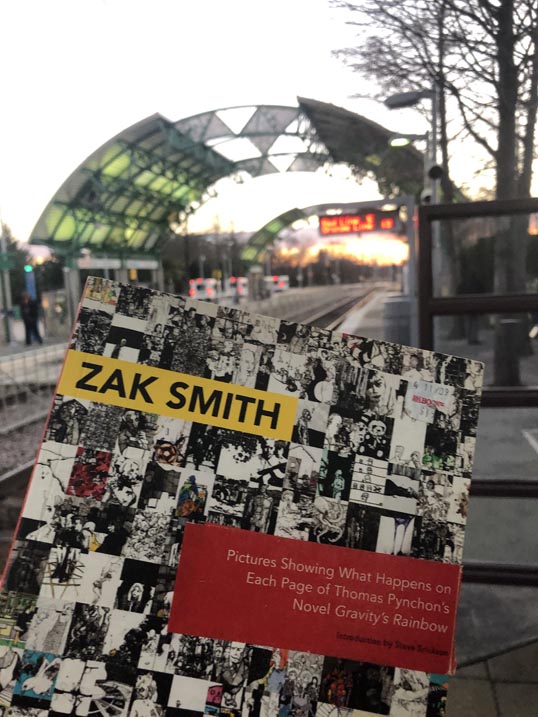
So that’s what I did – I filled my book bag with my tabbed copy of Gravity’s Rainbow and my copy of Zak Smith’s Pictures Showing What Happens on Each Page of Thomas Pynchon’s Novel Gravity’s Rainbow (for reference and grins) and headed for the station.

LBJ Central DART Train Station, looking at my book while waiting for the train.

The ride was enjoyable – or at least better than fighting the million other cars that are going somewhere at the same time as I was. Something about sitting in a train, relaxed, looking out the window at the miles of cars sitting still, on freeway and cross streets, all the white lights lines up on the left and the red ones on the right.

Woodall Rogers Expressway, Dallas, Texas

The streetcar is pretty cool. It crosses the river where there are no overhead power lines, so it is the first streetcar to rely on batteries to bridge an unelectrified stretch.

The trip isn’t fast – it took an hour each way… mostly spent waiting on a train or streetcar. The walks at each end or between stations weren’t bad at all, though.

Oh, and the discussion was enjoyable and cool. And someone brought banana bread.