For father’s day, Candy bought me a year-long membership to the Dallas Arboretum – so I can go as often as I want, sit around, and maybe stare at strangers. We were talking the other day when we had gone to the Zoo to see A Hard Night’s Day – a Beatles Tribute Band – about the fact that there weren’t any Rolling Stones tribute bands. So she also bought tickets to a concert at the Arboretum by Satisfaction… a Stones tribute band.
The Dallas Arboretum is massive and maze-like. When we were there, I wondered if we had missed any of Chihuly’s stuff. In the interim, I was able to learn the layout a bit better and I slipped away from the concert several times to walk the grounds, both in the evening light and the darkness (nighttime Chihluly photographs to come).
It turns out we did pretty well, only missing one Chihuly piece. It was a beautiful one though. In the second phase of the Woman’s Garden there is a little pond full of water plants (the Pool in the Genesis Garden). The artist had placed some white glass sculptures in amongst the green lily pads and colorful blooms.
Taking a quick look through the directory full of photos I took the other week at the Chihuly Exhibit at the Dallas Arboretum I found a few (well, a lot, actually) that I liked that I hadn’t put up yet.
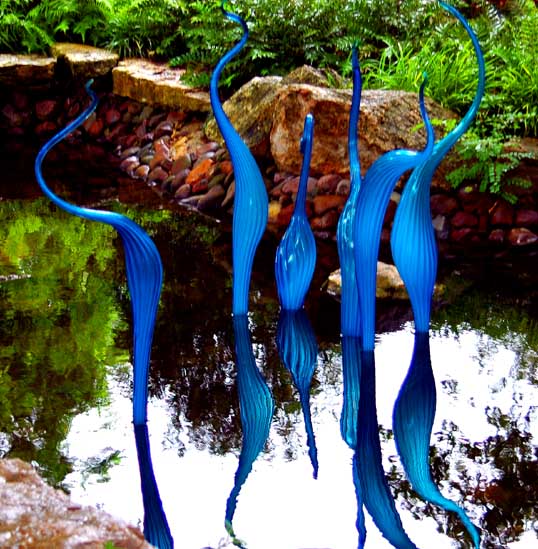
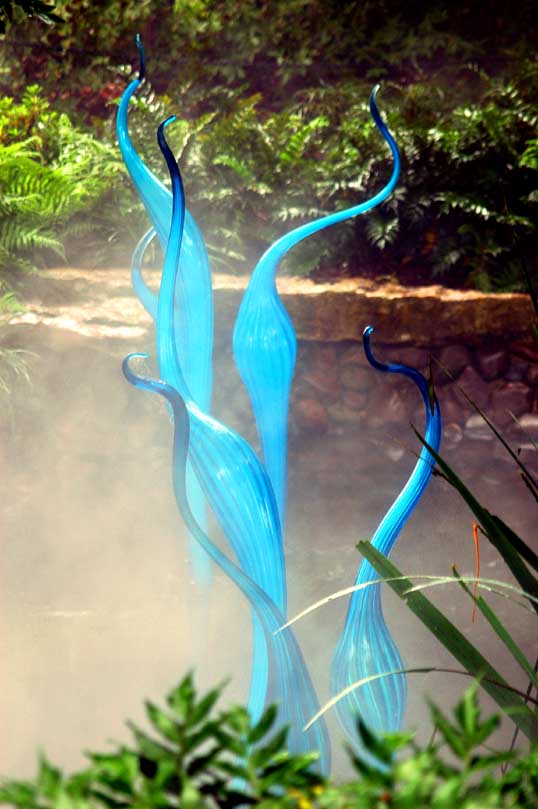
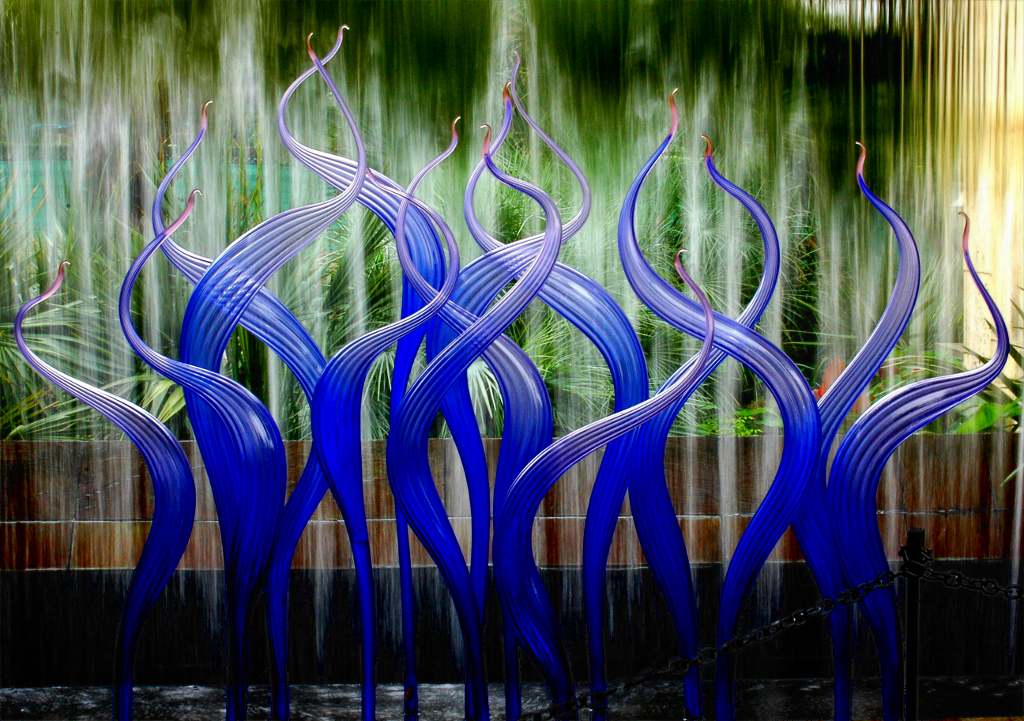
One group was some gorgeous blue glass that was set in the waters of the Palmer Fern Dell near the entrance to the Arboretum. This is a cool, shady spot that is a great escape from the killer Texas summer sun. The ferns are misted periodically from an automated system set on a timer and the rising fog gives the dell an otherworldly aura.
-Especially with that amazing glass sticking up through the mist.
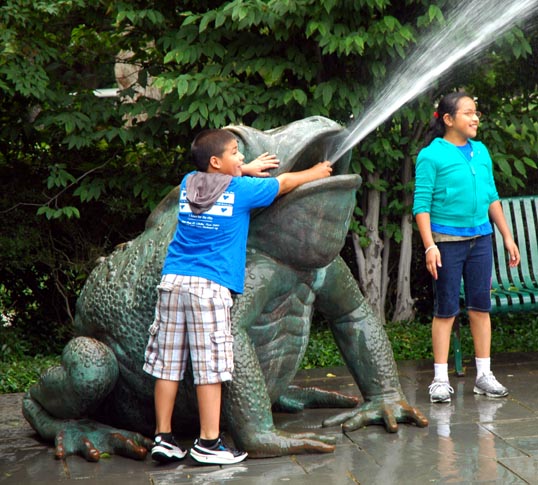
At the Dallas Arboretum, down at the end of the Crepe Myrtle Alee, sits a little square called Toad Corners. Four huge bronze toads spit water towards a metal sphere and a bubbling fountain in the center. This spot is popular with kids, especially on hot Texas summer days. They direct the water at each other and run through the spray, trying to cool off.
Sometime, somewhere, somehow, while perusing the ‘net on a day when, though I don’t remember the details, I most certainly should have been doing something more worthwhile, I came across some sort of magazine article or web page that was extolling the delicious risk of eating fiddlehead ferns. I’m not sure exactly where it came from, but there’s a lot out there… here’s a quick sample for reference purposes:
It is always tempting to put out a link to the Wikipedia entry on Fiddlehead Ferns. Except… how useless – everyone knows how to look something up on Wikipedia. To me, that reminds me of my childhood, when everyone would start their school essays with the phrase, “Webster defines (insert subject here) as (insert dictionary definition here). How lazy can you get? It was especially common with oral reports. If you had five minutes to kill, you could get a good forty seven seconds out of the way with ol’ Webster. I always wanted to start a report with, “Webster defines cunnilingus as (insert definition here) – which has nothing to do with my report on the petroleum industry in Venezuela. Ooops, I’m getting off-subject here. The Wikipedia Definition of Fiddlehead Fern.
The unwritten ethic among fiddlehead foragers is to take three violin tops. A fern produces five to nine fronds per growing season, so harvesting more than three can jeopardize the plant’s survival.Found Food | Fiddlehead Ferns
Think of fiddlehead ferns, those tightly coiled, emerald-green symbols of spring, as ferns interrupted.Fiddlehead-Fern Bruschetta
The ostrich fern is the safest fern to eat, even though it, too, can contain toxins. The fiddleheads of cinnamon fern (Osmunda cinnamomea), lady fern (Athyrium filix-femina), and bracken fern (Pteridium aquilinum) can also be eaten, but all are at least mildly toxic and can cause nausea, dizziness, and headache, so it’s probably best to avoid them.Fiddlehead facts
Fiddleheads have a bright, earthy flavor that calls to mind asparagus, artichokes, and green beans.Fiddlehead Ferns
It fascinated me for a good three minutes. The idea of eating foraged food is cool – the idea of eating foraged food that is toxic if not gathered or prepared properly is even more cool. I could almost taste the slight bitterness and feel the crunchy texture of the boiled coils.
After these slight impressions collected somewhere in my useless mess of gray matter I was on to other tasks, probably working on remembering things like where did I leave my car keys and what is my bank account pin number.
My thoughts on fiddlehead ferndom lay dormant somewhere in there until I was walking around the Dallas Arboretum with my writing group taking photographs of the Chihuly exhibition when I overheard a woman talking. She was staring intently at a guide to the exhibit which I had neglected to obtain at the entrance. She was rattling off the names and locations of the colorful glass sculptures and I heard her say, “It says here he did some sculptures called Fiddleheads but I haven’t seen them yet.”
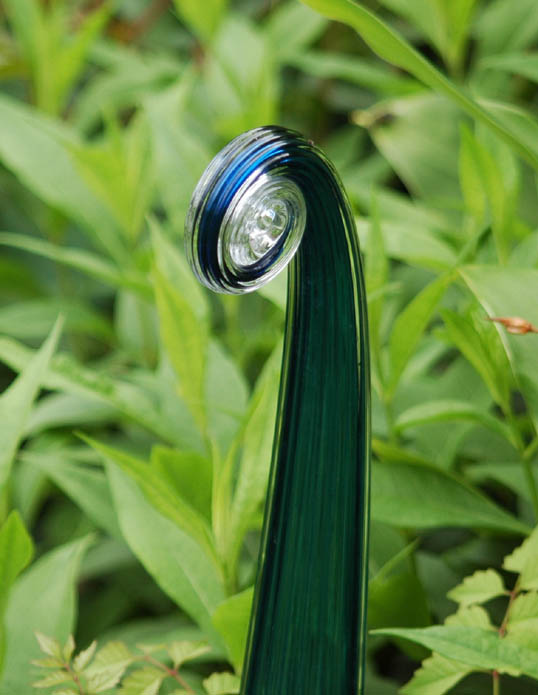
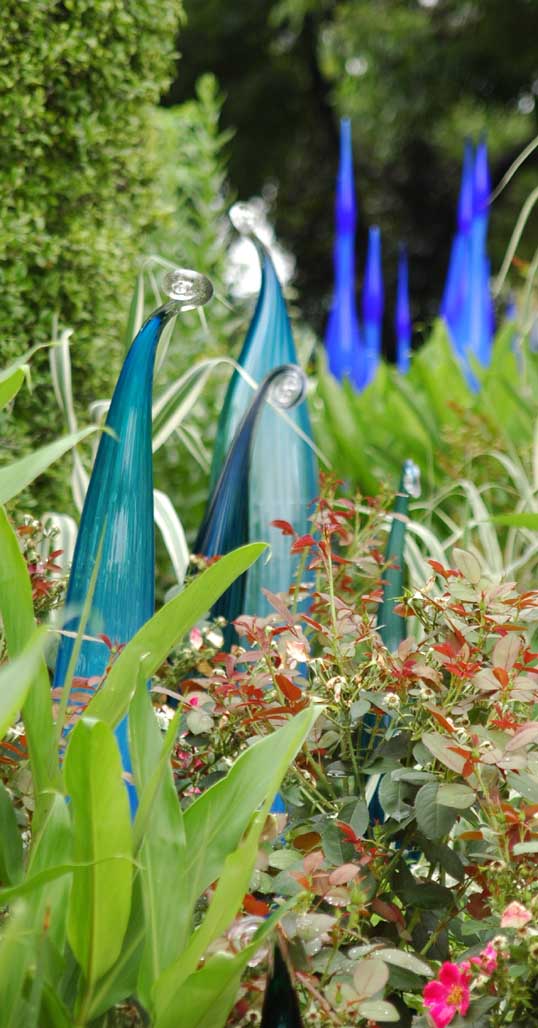
And that set off the memories. The rest of the day I couldn’t help but keep my eye out for some glass fiddlehead ferns. Finally, in the last garden at the end of all things, there were the fiddleheads sticking up amongst the greenery.
Now I can die in peace.
Fiddlehead fern fiddleheads
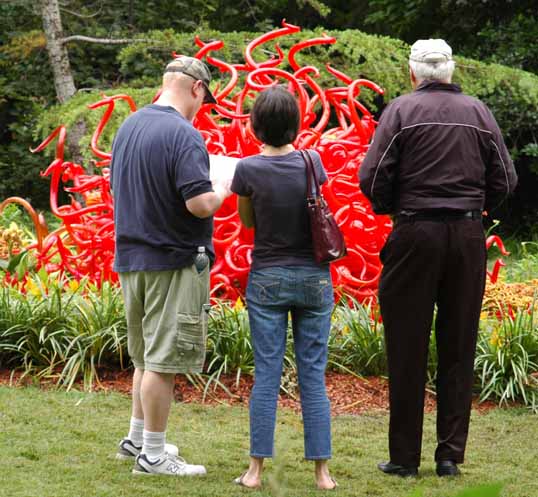
In case you think I’m full of shit when I write this stuff, here’s the woman I overheard asking about the fiddleheads. This was taken an hour later, and you can see, she is still looking at her guide book. She is now so tired of looking at it that she has her husband holding it for her. Or maybe that’s her husband on the other side and that’s her pool boy holding the guidebook. Or maybe the three aren’t related at all – maybe they are three technical writers that get together on the weekends to go various place and critique the guidebooks.
a Chihuly Fiddlehead
The glass ferns were growing in a bed of greenery.
A fly enjoying the Chihuly Sculpture. I bet he didn’t have to pay to get in.
We all hate wasting the ketchup that sticks in the bottle. Finally, at MIT, scientists have designed an FDA-approved, nonstick coating called InstaGlide that solves the problem. This is truly the best of all possible worlds.
It seems like there is nothing on to watch… so all you have to do is check another one off of this list:
There are a lot of people working on this… and the suburbs are better than Dallas itself… (I live in Richardson and it was chosen locally the best Dallas neighborhood for bicycling) but there is still the heat and all those giant pickup trucks. The problem isn’t that, though – it’s the beauracracy.
Conversely, Dallas was cited as one of America’s worst cycling cities for the second time since 2008 for creating almost no new cycling infrastructure even after its adoption of a bicycle master plan. Cycling advocates in Dallas, who were vocal in their frustration with the city’s progression, expressed hope that the “worst” designation will serve as a catalyst for a faster, more concentrated bike-friendly movement.
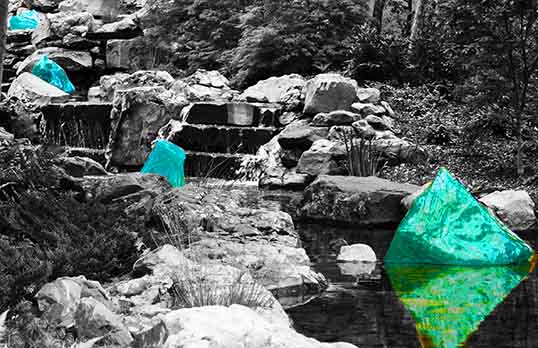
One of the many cool things about the installation is that you never knew when you would turn a corner and run into something unexpected. The artist placed large turquoise colored irregular blocks of glass in a rock creek that ran through the gardens. Water ran past the glass and tumbled down the artificial watercourse towards the lake. The glass looked like huge blocks of translucent ice – unexpected and beautiful.
The most powerful and ethereal beauty is that which is a surprise.
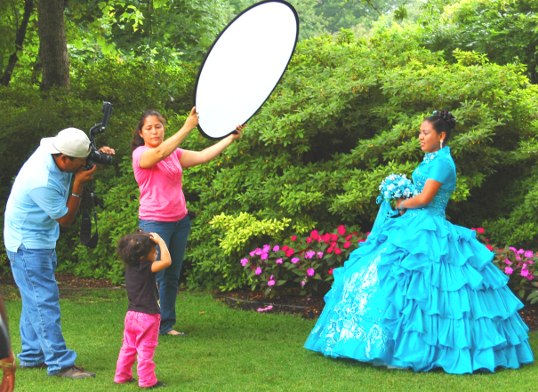
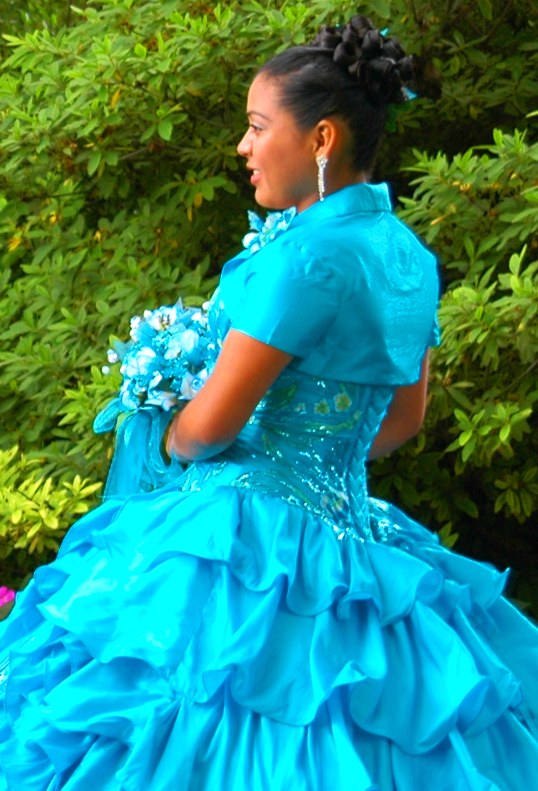
Everywhere I go there are crowds of people with cameras pointed at grinning subjects. From Canyon Creek to The Nasher, from the Arts District to New Orleans to the Farmer’s Market to the reflecting pool people are out posing while the photographer contorts with a huge hunk of semiconductors, injection molded plastic, and optical glass plastered to his eye.
Fashion, weddings, or engagements, there they are preserving the moment for posterity and relatives’ mantel pieces. The most common, in Texas, right now, is the Quinceañera.
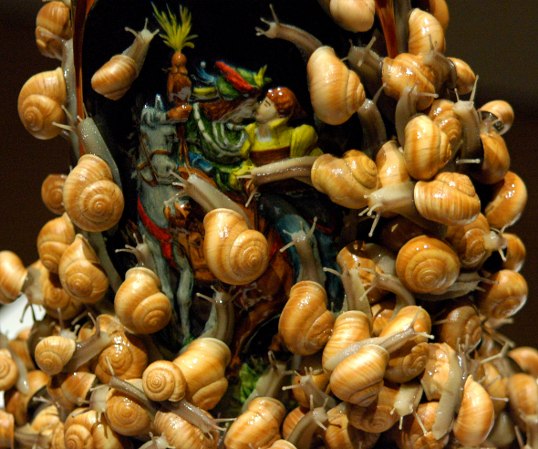
On the way to the restrooms, down in the cool, dim Basement (where the deadly burning rays of the Museum Tower cannot reach) of the Nasher Sculpture Center is a room with three oddly disturbing sculptures. This is the first installation at the Nasher by a local artist. His name is Erick Swenson, and he makes strange meticulous tableaux out of resin, most involving animals in some stage of death or decomposition. They are arrestingly realistic and strangely surreal at the same time.
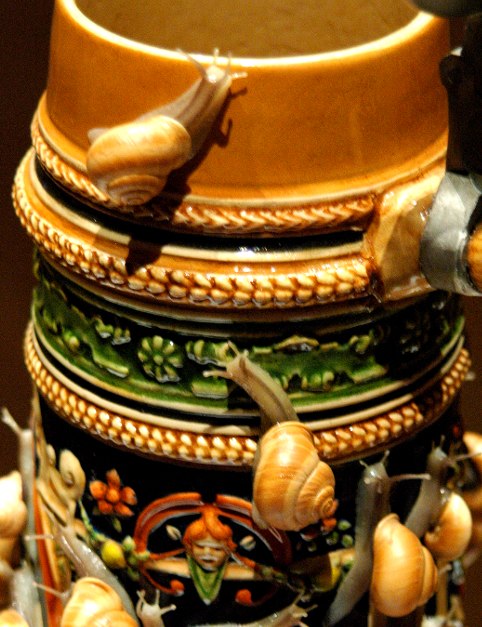
You can trap and kill snails and slugs in your garden with beer. This sculpture is called Schwärmerei – a German import to English that means something like fanatical enthusiasm, or the deadly insanity of the crowd (a word that could be fine-tuned and well-understood in Germany).
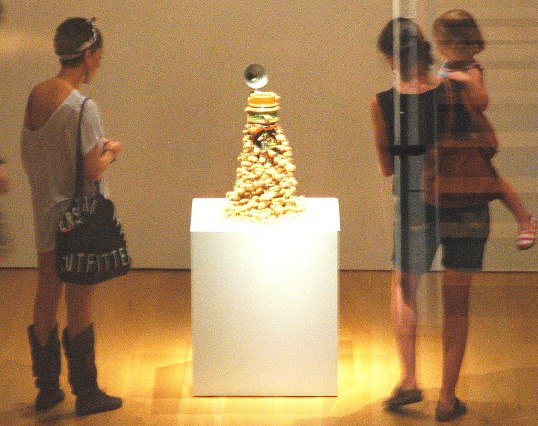
He says, “This is a static object. I’m asking you to look at this for more than three seconds. That’s hard to do sometimes. People just blow through stuff, you know. So it’s leaving things sort of enigmatic and open-ended.”
I granted his wish, staying and staring, then photographing the Stein ‘N Snails. Other than the obvious metaphorical underpinning, it was a gorgeous and highly skilled work of craftsmanship. I can see it as an advertising piece for a new chain of eateries called the Brewpub Escargot.
Unfortunately, I don’t posses a macro lens or decent flash lighting so the photos do not do due justice. For a good picture of a snail go here. So I suppose y’all will have to go down to the Nasher and see for yourself. By the way, the third sculpture, the one hidden from the squeamish public behind the little wall, is a doozy… you are forewarned.
Most folks were spending more than three seconds at the sculpture.
In addition to the interaction between the plants and the glass of Dale Chihuly’s installation at the Dallas Arboretum, there is the interaction between the glass and the other sculptures, mostly cast bronze, that already populate the gardens.
I haven’t been to the Dallas Arboretum in decades. I used to go the the DeGolyer Estate for concerts back in the day, but once it became the Arboretum I’ve only been once. It was close to when it opened and I was disappointed because the plants hadn’t grown out yet. I took Nick there as a toddler because they were giving away free trees. I picked up a little live oak in a coffee can and planted it in back of our house in Mesquite. Everyone gave me a hard time because it was only an inch high (it looked bigger when it was still in its can). Over the decades, though, the thing grew – it’s now a huge beautiful tree.
The problem always was that the Arboretum admission is so expensive. I always felt it was more a private playground for the wealthy members of the Dallas Garden Club than an asset for the city. That was a silly opinion, I know, and I wanted to go visit, but never was able to get around to it.
I have always been a fan of Dale Chihuly, but I hadn’t seen very much of his work, other than some glass flowers at the Dallas Museum of Art. When I read about his exhibition at the Dallas Arboretum I was excited.
Our writing group has branched out into photography. We decided to go down there as a group and take pictures together. Everyone liked that, and one member had a set of tickets in a goody bag from a recent purchase. We picked a day and met down there at the opening, cameras in hand. I had a pack with extra lenses and a tripod and was self-conscious about lugging all that stuff. I shouldn’t have worried, most of the people going in were carrying tons of gear – either photographic or picnic stuff.
For a day I set aside my goal of taking pictures of people and gave myself permission to do “postcard shots.”
There were thick crowds of photographers wandering around. As is typical of Dallas, everyone seemed to be a gearhead. Near the entrance I stood next to a couple – he had a big, manly, camera with a long lens. We were looking at a giant yellow glass tree raised up into the sky.
“It would be cool to come out at night with a tripod and shoot that with a long exposure,” I said, just to make conversation.
“Well, I’ll tell you,” the guy with the big camera said, with a superior air, “I can hand shoot under any circumstances, I just shoot at 3200 ISO.” He waved his expensive hunk of optical glass and circuitry in my face.
“Oh, you are such a show off,” his wife said, the pride evident in her voice. The two of them walked off into a bit of woods. I had to chuckle – gearheads are so funny. I’m happy you can buy all that stuff… but you’ve still got the same old eyes and brain – and that’s what you really take pictures with.
But that little exchange really brought the challenge I faced into focus… so to speak. With hundreds of photographers in the Arboretum snapping hundreds of photographs each all the time from now until the exhibit closes in November…. How can anyone take a picture that is in any way unique? I don’t want to have the same picture as everybody else.
Four of us from our writing group spent about four hours walking around taking pictures. That’s a surprising amount of work, and a lot of walking. It will be interesting to see how we see the same thing in different ways. Peggy already has some of her fantastic photos up – go take a look – plus some more here.
Now I have about a hundred images and a lot of work getting these edited and in a form where they are usable. I’m not sure what I’ll do with all of them – I’ll use my Flickr account to store some. I should be able to get at least a half-dozen blog entries out of it… which is always a good thing.
Oh, the Chihuly Exhibition at the Arboretum is absolutely stunning, by the way. There are many varied groups of glass pieces in all kids of settings. He has done an amazing job of blending the glass with the living plants. His works range from small works interspersed in beds of plants to giant trees, maybe thirty feet high, made completely of glass. Walking through the gardens is an unforgettable experience – as you enter each new area you can’t help but gasp at the unexpected beauty that is waiting there.
I enjoyed taking all these photographs, especially since I wasn’t alone. I’d like to go back without a camera and simply look at the place. I’d like to go down with a sketch pad and some colored pencils. I would love to go back and try to take pictures of real people there among the sculptures, greenery, and beautiful settings.
Still, photographs do not to the thing justice. If you live in the Metroplex, you need to make plans to go down to the Arboretum and see this exhibit. If you don’t live here… I think it’s worth a trip by itself.
We’re really broke right now, but I want to find some way to scrape up the money to buy a membership to the Arboretum. I would love to be able to go down there and simply find a place to sit, look around, and maybe sketch a little bit. Beautiful things are so rare and fleeting in this world and to be able to go to a place like that and… well, simply wallow in the beauty is a wonderful thing.
(click to enlarge)
For a larger and more detailed version – Go to Flickr
Detail of a gigantic yellow glass tree.
For a larger and more detailed version – Go to Flickr
(Click to Enlarge)
For a larger and more detailed version – Go to Flickr
(Click to Enlarge) These boats full of Chihuly glass aren’t really floating on White Rock Lake like it looks. They are on the Arboretum infinity pool – beautiful.
For a larger and more detailed version – Go to Flickr











 Bill Chance