.
.
When I was a kid, living in places like the Northeast or the Midwest I became fascinated by Spanish Moss. I don’t remember when I first heard about it…. These were the days long, long before the internet, of course, and even television was only in black and white and hard to see (only three channels anyway) so I would have had to have read about it in a book or maybe seen some in a film.
The thought of a thin, filmy plant growing in the air, hanging from trees, seemed so exotic to me, like it was an alien organism growing on our own earth. I did as much research as I could – which at the time consisted of looking up articles in the various encyclopedias in the school library – and thought about what the stuff looked like in real life.
We were going to move from Kansas to Panama and would be flying out of South Carolina. This would take a long drive, three days – with stops in Memphis and Atlanta. Thinking about the trip, I realized that there would be Spanish Moss along the way. As we moved farther south I eagerly stared out of the window. Somewhere out of Memphis, little bits of fuzz began to appear here and there until once we were close to Atlanta, it was all over the place.
That evening, I walked around our hotel looking at the Spanish Moss. It was everywhere and it was as amazing as I thought. I couldn’t believe that people actually lived in the midst of such wonder and didn’t give it a second thought. The next day, in Charleston, South Carolina, I found even more – it hung thick in the trees like a living cloud, an aerial wave of plant life. I still remember the feeling of seeing the stuff, feeling it in my fingers, looking at it up close.
There is an amazing quality to the curiosity of youth… a passionate sense of wonder.
Now I live in the South and see the stuff all the time…. But when I do I still feel the echoes of those days.
There is one gap in the buildings lining Flora Street – the avenue running through the heart of the Dallas Arts District – and that is the rough top of a parking garage across from the symphony hall. I have seen teenaged skaters run off the concrete. A high rise office tower is planned for this spot (like we need another one of those) but it has been vacant for years.
The odds and ends of the property have been used for some art installations before – most notably the Zen Garden and Ice Sculptures done for the installation Transcendence.
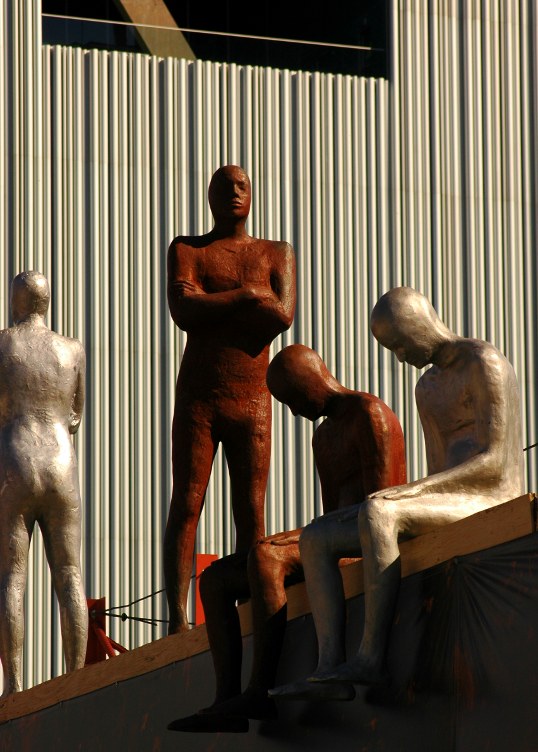
On my last visit, riding my bike through, I saw a bunch of figures – sculptures – hanging out on the thing. Riding up for a closer look I was interested in seeing that one figure was decorated with an orange safety vest and a blue hard hat. While I was lining up a photograph the figure jumped down and I realized that it was a worker adjusting the lighting system.
Borders, by Steinunn Thorarinsdottir, Dallas Arts District, with the cube of the Wyly Theater in the background
Borders, in the Dallas Arts District
“Borders” is a sculptural exhibition by Steinunn Thorarinsdottir. The sign says that the 13 pairs of figures, made from aluminum and cast iron are from the collection of the artist. It looks like the exhibition was originally done in New York City – I don’t know if these are actually the same figures or not.
“The lizard brain is hungry, scared, angry, and horny.
The lizard brain only wants to eat and be safe.
The lizard brain will fight (to the death) if it has to, but would rather run away. It likes a vendetta and has no trouble getting angry.
The lizard brain cares what everyone else thinks, because status in the tribe is essential to its survival.
A squirrel runs around looking for nuts, hiding from foxes, listening for predators, and watching for other squirrels. The squirrel does this because that’s all it can do. All the squirrel has is a lizard brain.
The only correct answer to ‘Why did the chicken cross the road?’ is ‘Because it’s lizard brain told it to.’ Wild animals are wild because the only brain they posses is a lizard brain.
The lizard brain is not merely a concept. It’s real, and it’s living on the top of your spine, fighting for your survival. But, of course, survival and success are not the same thing.
The lizard brain is the reason you’re afraid, the reason you don’t do all the art you can, the reason you don’t ship when you can. The lizard brain is the source of the resistance.”
― Seth Godin
Born in New Orleans in 1912, Ida Kohlmeyer has been called one of the best Abstract Impressionist painters of the South. Her career as an artist did not begin until her 30s, after she graduated from Newcomb College at Tulane University with a degree in English literature. In 1934, she traveled to Mexico City and was inspired by Central and South American folk art, which would remain an influence throughout her life. Several years later she began taking painting and drawing classes at Tulane with Pat Trivigno, who encouraged her to pursue her study of artwork. Upon receiving her master’s she showed her first paintings at the Fifty-Fourth Annual Spring Exhibition at the Isaac Delgado Museum of Art in New Orleans.
In 1956, Kohlmeyer moved to Provincetown, Massachusetts to experiment with Abstract Expressionism alongside Hans Hoffmann. That same year she traveled to Paris and met Joan Miró, who also inspired her abstract work. However, by the mid 60s she tired of abstraction and moved on to create sculptures with wood and Plexiglas. After experimenting briefly with figurative painting, she returned to abstraction in the 70s. Kohlmeyer died in her hometown of New Orleans in 1997.
“It comes from a very ancient democracy, you see…”
“You mean, it comes from a world of lizards?”
“No,” said Ford, who by this time was a little more rational and coherent than he had been, having finally had the coffee forced down him, “nothing so simple. Nothing anything like so straightforward. On its world, the people are people. The leaders are lizards. The people hate the lizards and the lizards rule the people.”
“Odd,” said Arthur, “I thought you said it was a democracy.”
“I did,” said Ford. “It is.”
“So,” said Arthur, hoping he wasn’t sounding ridiculously obtuse, “why don’t people get rid of the lizards?”
“It honestly doesn’t occur to them,” said Ford. “They’ve all got the vote, so they all pretty much assume that the government they’ve voted in more or less approximates to the government they want.”
“You mean they actually vote for the lizards?”
“Oh yes,” said Ford with a shrug, “of course.”
“But,” said Arthur, going for the big one again, “why?”
“Because if they didn’t vote for a lizard,” said Ford, “the wrong lizard might get in. Got any gin?”
“What?”
“I said,” said Ford, with an increasing air of urgency creeping into his voice, “have you got any gin?”
“I’ll look. Tell me about the lizards.”
Ford shrugged again.
“Some people say that the lizards are the best thing that ever happenned to them,” he said. “They’re completely wrong of course, completely and utterly wrong, but someone’s got to say it.”
“But that’s terrible,” said Arthur.
“Listen, bud,” said Ford, “if I had one Altairian dollar for every time I heard one bit of the Universe look at another bit of the Universe and say ‘That’s terrible’ I wouldn’t be sitting here like a lemon looking for a gin.”
― Douglas Adams, So Long, and Thanks for All the Fish
This go-round is the Tony Award winning play Red, by John Logan. It’s a two man play based on the artist Mark Rothko, set in Rothko’s studio in 1958, during the time he is working on a group of large murals for the new Four Seasons Restaurant in the Seagram Building in New York. Rothko and his fictional assistant, Ken, work and talk about art and life. The overarching conflict between the two is the very acceptance of the commission to decorate the walls of a restaurant frequented by the wealthiest people in the world. Rothko insists it is a subversive act, that he wants to paint, “something that will ruin the appetite of every son-of-a-bitch who ever eats in that room.” Ken counters that Rothko simply wants to feed his ego with the money and fame the prestigious commission offers.
At any rate, I was going alone, and went to catch the train downtown. Since I left from work, I felt underdressed – but that was fine; the crowd for “Pay What You Can” night was motley and wearing all sorts of styles at various levels.
I was interested in the staging of Red. King Lear is still running at the Wyly in the main stage above the lobby (the Wyly is revolutionary in its stacked structure – the lobby is at the bottom, the stage area above, with the support spaces higher up). For Red, they converted the rehearsal hall on the ninth floor into an artist’s studio.
While the patrons attending Lear were entering on the right side of the Lobby, we were divided into groups and sent up elevators to the ninth floor. The tickets had no seat assignments, so the crowd wandered around the edges of the studio, finding chairs lined against the wall on low risers. After I settled in, I noticed the actor playing Rothko silently sitting in a comfortable chair in the center of the room, staring and contemplating one of his in-progress color fields. Finally, the last patron came in looking around, looking lost – I noted his clothing was curiously dated… like something out of the fifties. Suddenly I realized that this was the actor playing the assistant, he spoke to Rothko, and the play began.
The play was simple – only two characters, one set, no intermission. Very intimate – you are there in the studio with the two characters. It was more intellectual than passionate – the only real moments of raw emotion was generated by Ken talking about the death of his parents… and that felt a bit forced. Still, it was enjoyable – the character of Rothko is a grand pompous bully – and a brilliant one. Ken was more of a blank canvass where Rothko would paint with his powerful personality and stubborn ideas, but Ken’s point of view somehow kept winning out in the end.
One highlight was a long, wordless passage where Rothko and Ken together slather the dark crimson undertone on a giant canvas, both working hard, slinging heavy brushfulls of paint in different sections of the wall-sized work, their breathing hard and passionate in the small space. To Rothko his paintings are living things… and he feels responsible for and concerned about their ultimate fate.
There is a lot of talk of the art of the time. It was fascinating how Rothko boasted of how he and the abstract expressionists dethroned Picasso and Matisse (“Nobody even thinks of painting cubism anymore, it’s dead”) and how Ken feels that Pop Art is now overthrowing Rothko.
Ken namedrops Warhol, Johns, Rauschenberg, and Lichtenstein – and Rothko asks, “Lichtenstein, who’s that?”
I was happy when, in my mind I thought, “Comic Books,” and then Ken says, “Comic Books.”
There is a lot of namedropping here, and it helps to know a thing or two about a thing or two – but not so much that it gets in the way of the entertainment.
After the play we rode the elevators back down to the lobby. It was full of patrons from King Lear, which was in intermission. They were all very nattily dressed, formal, seeing and being seen in that Dallas way while we cheapskates skittered away at the edges.
Outside, the glittering canyons of the city were shining at night while torn scraps of low cloud skimmed by overhead, illuminated by the lights below. It was beautiful and a bit of a shock – while the play was going on it was easy to think you were really in a dingy art studio and forget that you were really nine stories in the air in a huge aluminum cube-theater-machine.
Down Flora Street, between the hulking rows of the Arts District public edifices stood the Dallas Museum of Art. Inside, I knew, there was a Rothko painting. I’ve seen it before – but now I want to go back and stare at it for a while, watch it pulse, see it live, think about what the artist was thinking in that dark place where it was painted.
Mark Rothko, Orange, Red and Red, Dallas Museum of Art
A desire to make a choice of some kind… I am concerned with magic, awe and wonder, with ontological insecurity.
—-Michael Sandle
The Drummer, Michael Sandle
The Drummer, Michael Sandle, The Sydney and Walda Besthoff Sculpture Garden, New Orleans Museum of Art
I am very aware of the way that Britain has a habit of interfering overseas. Years ago I did a Mickey Mouse machine-gun sculpture as a comment on the Americans in Vietnam. I was interested to discover from my historical research how we’d meddled with the place after the Japanese surrender. It wasn’t the Americans who started it and it wasn’t the French. It was us.
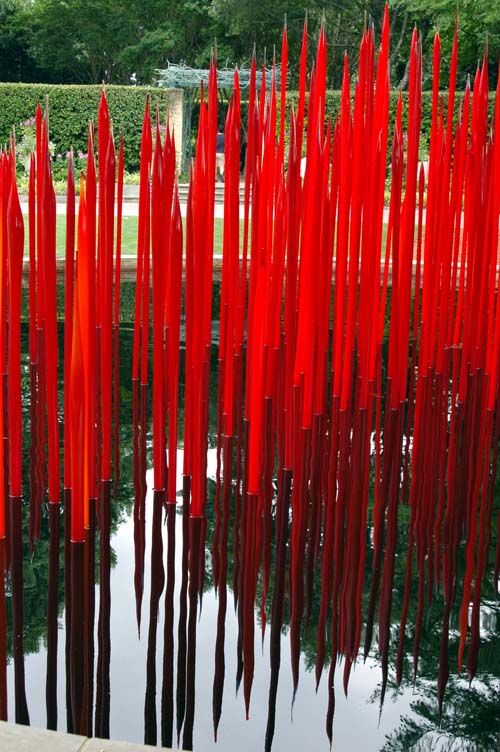
Trees reflected in a pond, inverted, with Chihuly, Red Reeds
A second version of a photograph I did the other day. One of my most overused and trite photographic techniques – taking a photograph of a reflection and then inverting it. This is one of trees reflected in the pond of Chihuly’s Red Reeds, at the Dallas Arboretum. So overused… I’ve done it again.
I think I like this one better, though I like the floating leaves in the other.
Looking at the photos I took during the last, winter days of the Chihuly exhibit at the Dallas Arboretum I like some of the shots of the glass ice-like sculptures he put in the creek that runs through the place.
I posted an entry about this before – but, even though the glass is the same, the time of year is different, I was different, and, hopefully, you are different.
So here are some more.
Chihuly glass sculptures in the creek, Dallas Arboretum
I have already written about Playdays – a sculpture in the Dallas Arboretum I love. When I went back the other day, the place looked so different in the winter, the light had changed so much from the Texas summer humid heat, that I couldn’t resist another round of photographs.
Playdays, by Harriet Whitney Frishmuth, A Woman’s Garden, Dallas, Texas
In the summer, the thick greenery keeps the sun from hitting the sculpture directly – now it’s well lit under bare branches and a slanting light. I never realized how close the lake was until winter’s sparseness revealed the chilly, choppy water.
The sculpture is located in A Woman’s Garden, with a nice view from my favorite (though uncomfortable) little bench in the Sunset Garden. Again, it looks different with the change in season.
Trees reflected in a pond, inverted, with Chihuly, Red Reeds
One of my most overused and trite photographic techniques – taking a photograph of a reflection and then inverting it. Here is a favorite of mine. Here is another. And a third. This is one of trees reflected in the pond of Chihuly’s Red Reeds, at the Dallas Arboretum.




 Bill Chance