Walking Along the Levee

“One who knows the Mississippi will promptly aver—not aloud, but to himself—that ten thousand River Commissions, with the mines of the world at their back, cannot tame that lawless stream, cannot curb it or confine it, cannot say to it, Go here, or Go there, and make it obey; cannot save a shore which it has sentenced; cannot bar its path with an obstruction which it will not tear down, dance over, and laugh at.”
― Mark Twain, Life on the Mississippi

Walking on the levee
New Orleans

Cyclist With Backpack on Royal

New Orleans – an Alternative

Pre-Katrina I biked around New Orleans many times. The city is pretty flat, which makes it easy on the knees. On one trip I discovered a bike path along the top of some of the earthen lebees. It was delightful; one could see the river on one side and the city spread out on the other.

Here there are few of the usual interstates that divide and wound cities. There’s mostly just I-10, on its massive concrete pilings, which snakes into the center of town, desperately trying to stay above most of the funk and humanity below. New Orleans was, and I suspect still is, one of a few large cities across the U.S.A. with character and personality, with its own food, culture, language, and music. It never fails to inspire, though it has clearly flourished despite much neglect and years of abuse that were revealed to the world when the hurricane struck.

I bike along Magazine Street and then on St. Charles where what at first glance appears to be Spanish moss in the trees turns out to be Mardi Gras beads, hanging from the weird branches, block after block – and it’s not even Mardi Gras season.
—- David Byrne, Bicycle Diaries

Royal Street, French Quarter, New Orleans

The Green Fairy

After the first glass of absinthe you see things as you wish they were. After the second you see them as they are not. Finally you see things as they really are, and that is the most horrible thing in the world.
—- Oscar Wilde

On my last trip to New Orleans, for the Writing Marathon, I was able to cross a line off of my bucket list. It was a small item, maybe the smallest – nothing like going to Cambodia, or living long enough to see the Sagrada Famila finished – but an item crossed-off nonetheless.

It was, I think, Thursday, and that day we would divide up more or less according to what we wrote. A fairly large poetry group set out (I would meet up with them later in the day, crossing the Mississippi on the Algiers ferry) while I joined a smaller fiction group.

We had coffee and wrote, and then the leader suggested, “Why don’t we go get an absinthe?” Despite the flurry of absinthe bars that swept Dallas a decade ago (and just as quickly disappeared) I had never drank one. And for no real reason, I always had wanted to – placing it on my list of things to do. What better time than now and what better place than the French Quarter in New Orleans. Because of its strong French ties, absinthe had always been a thing in the city.

I think the biggest reason I wanted an absinthe is my love of gadgetry, ritual, and complex preparations. I am a chemist after all and what could be more attractive than dripping ice cold water into a solution of alcohol and essential oils just until the oils are forced out of solution (because the water is making the solvent mixture more and more polar…. Nevermind).

For those that don’t know, that is the classic way that absinthe is prepared. The (often greenish) liquid (very strong – usually well over 100 proof) is poured into a glass. A flat, slotted absinthe spoon is placed over the glass and a sugar cube is set on the spoon. The large glass reservoir of an Absinthe Fountain is filled with ice and water. Then a tap is cracked open and the water slowly dripped onto the sugar cube, where it dissolves the sugar and then falls into the absinthe. The cold water then causes the absinthe to change from clear to cloudy, a process called louche.

This releases the aromatic flavored oils and indicates the absinthe is ready to drink.
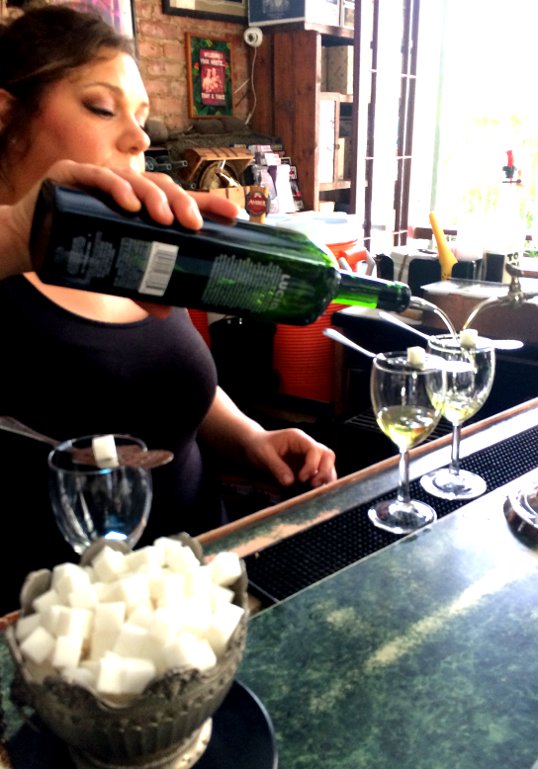
The bartender pouring the absinthe, note the clear green color.
Pirate’s Alley Cafe, New Orleans

Dripping the iced water over the sugar cube, into the absinthe.
Pirate’s Alley Cafe, New Orleans
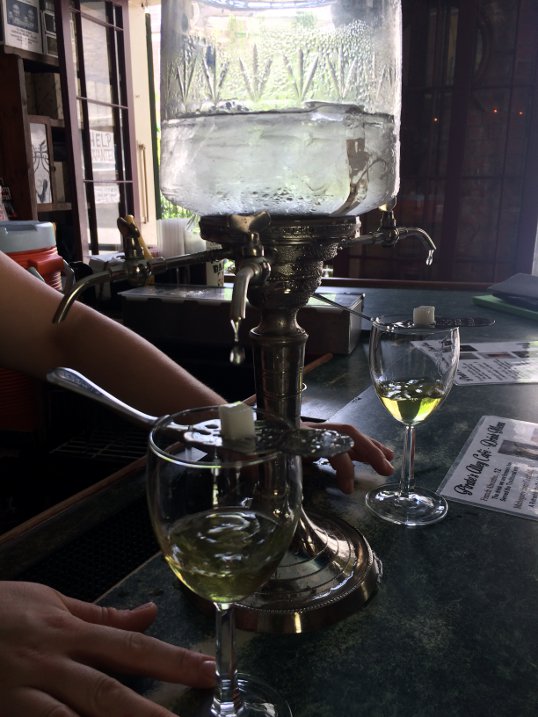
The absinthe fountain, dripping cold water over the sugar into a glass of absinthe.
Pirate’s Alley Cafe, New Orleans
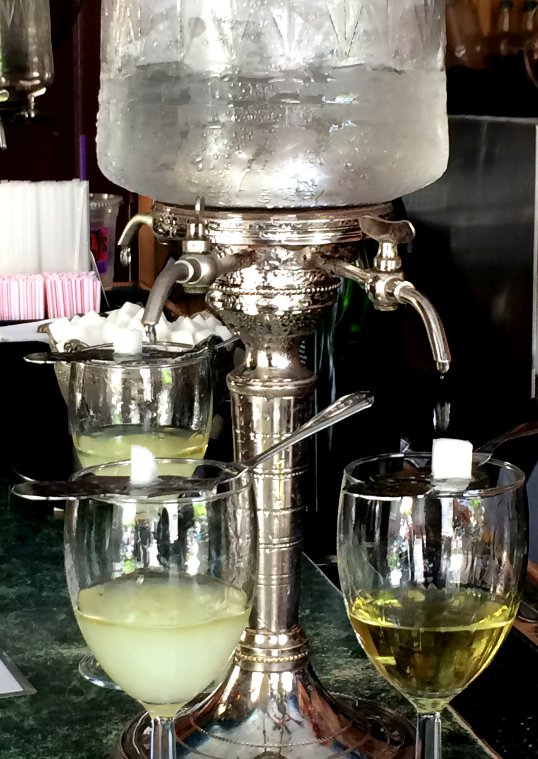
The louche (cloudy liquid) forms as the water dilutes the absinthe.
Pirate’s Alley Cafe, New Orleans

—How cool is that?!—

Now, of course, absinthe has a bad reputation – and I mean that in a good way. It was banned in the US from 1912 to 2007. Traditionally, it was the wormwood used in the drink, particularly the chemical thujone that enables the hallucinations that the drink traditionally provided. It looks like that is at best a huge exaggeration, if not a complete load of hokum. It seem it’s the liquid’s 125-175 proof alcohol, rather than some mysterious elixir, that provides the desired effects.

We walked down to a bar off of Pirate’s Alley (this is a favorite spot of mine – I stumbled across a fashion shoot there once before) right next to Faulkner House Books (William Faulkner’s old apartments). The bar is called Pirate’s Alley Café and specializes in absinthe. It seems a little touristy (sometimes the barkeep dresses like Jack Sparrow) but there was none of that early in the day in the summer (New Orleans’ offseason). I had to decide on my brand of poison, settling on Absinthe Lucid (it was relatively inexpensive, French, and green).

The barkeep went through the routine, setting up three glasses under the absinthe fountain and we were able to watch them go from clear to milky.

The only problem was that since I’m no huge fan of licorice, I assumed I wouldn’t like the absinthe and this would be a one-off bucket list thing. No luck, I really enjoyed the stuff.

Now I have to find a bar in Dallas and/or a bottle of the Green Fairy.

More information:
The Wormwood Society – America’s Premiere Absinthe Association & Information Network

“I am only sipping the second glass of that “fascinating, but subtle poison, whose ravages eat men’s heart and brain” that I have ever tasted in my life; and as I am not an American anxious for quick action, I am not surprised and disappointed that I do not drop dead upon the spot. But I can taste souls without the aid of absinthe; and besides, this is magic of absinthe! The spirit of the house has entered into it; it is an elixir, the masterpiece of an old alchemist, no common wine. And so, as I talk with the patron concerning the vanity of things, I perceive the secret of the heart of God himself; this, that everything, even the vilest thing, is so unutterably lovely that it is worthy of the devotion of a God for all eternity. What other excuse could He give man for making him? In substance, that is my answer to King Solomon.”
― Aleister Crowley, Absinthe The Green Goddess

The emerald hour–
when the poet’s pain is soothed
by a liquid jewel
held in the sacred chalice,
upon which rests
the pierced spoon,
the crystal sweetness–
Icy streams trickle down.
The darkest forest
melts into an open meadow
as waves of green seduce.
Sanity surrendered,
the soul spirals toward
the murky depths,
wherein lies
the beautiful madness–
absinthe.
—-Peggy Amond, “Rimbaud’s Poison

Morning on Decatur

“there was something about
that city, though
it didn’t let me feel guilty
that I had no feeling for the
things so many others
needed.
it let me alone.”
― Charles Bukowski

Decatur Street, French Quarter
New Orleans

What I learned this week, July 23, 2017

At Whataburger, ‘Take a Number’ Means Something Entirely Different


Parks Build Community Is Headed to New Orleans!

I had a really nice bike ride along the Lafitte Greenway on my last trip to the Big Easy. Glad to see it will be continually upgraded.


10 of the Best Long Rail Trails in the US

I hope I live long enough to see The NETT on this list.


Brawn in an Age of Brains


Television’s 10 Best Anti-Heroes of All Time


According to the hypothesis of formative causation, morphogenetic fields contain an inherent memory, transmitted from similar past organisms by the process of morphic resonance.


10 Terms Every Tequila Drinker Should Know

Bartender and Regular

Molly’s was home to the demimonde, to artists, journalists, retired teachers, lawyers, politicians, cops, and people of uncertain description. Laura and I wrote poetry together there, sometimes with other poets. For a time I became addicted to the video poker machines in the bar and lost a lot of money. I once brought Philip Glass, the musician, to Molly’s, and he sat before one of the machines and became instantly fascinated by their Zen randomness and sounds. We had a hard time getting him away from it. We snapped great moments in Molly’s photo booth, when there was one, immortalizing the goofiness and sweetness of ourselves.
—- Andrei Codrescu, Do You Know What It Means To Miss New Orleans – Some Prefatory Remarks, from New Orleans, Mon Amour, Twenty Years Of Writings From The City

The Bartender and a Regular, Molly’s, Decatur Street, French Quarter, New Orleans

The Window At Molly’s

He presided, he directed, he ruled, he snarled. From his perch at the Window of Molly’s which is where I mostly saw him, he listened indulgently to the speculative thrusts of the Window Gang, paid slightly more attention to opinion derived from inside info, and gave his full ear to inside info itself. Like everything that went by the Window on Saturday and Sunday afternoons, including a variety of humanity that would have made both Goya and Picasso shriek with delight, on couldn’t be sure of the exact percentage of B.S. Monaghan alone seemed to know. People vied to be in the Window Gang, but few could stand the Chief’s tests, which to the innocent must have often seemed rough, illiberal, crude, or so deliberately provocative as to preclude any rational response.
—-Andrei Codrescu – The Passing of Jim Monaghan, New Orleans Bar Owner, from New Orleans, Mon Amour, Twenty Years of Writings from the City

The best place to write… or to sit… possibly to drink… in the French Quarter is the window at Molly’s. Take my word for it.

A machine will squirt out Molly’s frozen Irish coffee (caffeine, ice cream, alcohol – three of the four major food groups) into a plastic to-go cup and you can sit inside the window, outside the window or even mill around on the Decatur sidewalk.

Today the bar was packed with a dozen young women, obviously a bachelorette party, all wearing identical denim shorts and t-shirts emblazoned with “I LIVE TO BE DRUNK” in glitter. They handed me a phone and asked me to take their photos lined up at the bar. I arranged them and took some shots, they were particularly giggly happy with the landscape photo.

The Window at Molly’s, the street (Decatur) unusually quiet, with notebook, vintage Esterbrook pen, and Molly’s frozen Irish Coffee

There are bikes locked up all over the French Quarter, mostly to the wrought iron columns supporting the ubiquitous overhead balconies. Most of these are heavy, beater bikes – in deference to New Orleans’ rough streets, giant potholes, and flat-as-a-pancake geography. Every day, though sitting in front of me, well-locked to the pole on the sidewalk was a nice Specialized road bike – looking fast standing still, if also well-used. One day, I arrived early enough to watch the owner arrive and lock up – he was obviously a worker in a nearby bar or restaurant. That day someone else had already locked up to his pole, but he maneuvered around and managed to lock on the other side, sharing the pole. It was his spot and he was going to use it.

Specialized road bike on pole outside The Window at Molly’s. French Quarter, New Orleans.
Notice the green shelf for drinks. Sometimes the crowd on the sidewalk outside The Window grows.

One would do well, as I have done many times, to investigate a single place over time, at different times of the day. Molly’s on Market, for instance, is home in the early afternoon to a lively Window Gang consisting of a varying crew of journalists, men-about-town, women-about-town, writers of fiction and poetry, mysterious characters either larger or brighter than life, led on by Jim Monaghan, proprietaire extraordinaire, Irish wit, and provocateur. Monaghan’s extravagant personality imbues the day, but the night belongs to the tribes of the tattooed and pierced young. At night a sloshed picture gallery displays itself with sensual impertinence.

—- Andrei Codrescu, Solution: Enivrez-Vous: The Bars of New Orleans, from New Orleans, Mon Amour, Twenty Years Of Writings From The City

Hipster Talking to a Girl on Decatur

“The beauty of Molly’s is that it is not, whether in the daytime or at night, the exclusive preserve of an age or income group. Unlike the sterile night scenes of pretentious San Francisco or New York, Molly’s (and most other New Orleans bars) welcomes all ages, all colors, and all sexual persuasions, provided they are willing to surrender to the atmosphere.”
― Andrei Codrescu, New Orleans, Mon Amour: Twenty Years of Writings from the City

Taken from the window at Molly’s – French Quarter, New Orleans

Molly’s at the Market

Stone Sculpture on the Riverbank

“Leaving New Orleans also frightened me considerably. Outside of the city limits the heart of darkness, the true wasteland begins.”
― John Kennedy Toole, A Confederacy of Dunces

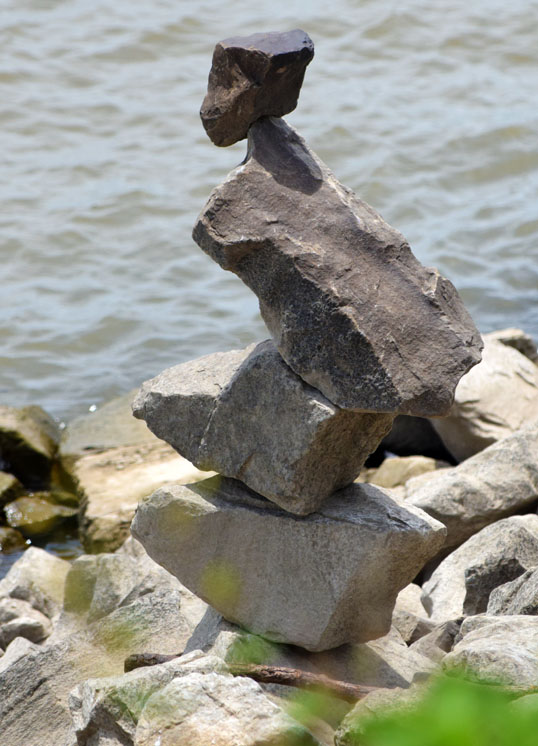
I was walking along the strip of concrete along the top of the Mississippi levee that separates the French Quarter from the vast moisture of the Big Muddy. There was the path, a narrow strip of weedy grass, a band of riparian riprap rock used for erosion control and then the water itself.

I noticed a pile of rock in a peculiar arrangement, down right next to the water. At first I thought someone had simply piled them up, but as I looked closer, it seemed that they would not hold together in that formation by themselves. Gravity would pull them asunder. Someone had gone down there with some industrial adhesive or quick-set epoxy and glued the stones together. It was a sculpture, a work of art.

An Internet search failed to reveal any information about this impromptu pile of granite.

Who knows how long they will hold together under the assault of the elements, but if you want to check – it’s right there near the entrance to Jackson Square.

Riverbank Sculpture, Mississippi River, French Quarter, New Orleans

Saxophonist and Bicycle

“Don’t play the saxophone, let the saxophone play you.”
― Charlie Parker, Parker, Charlie E-Flat Alto Saxaphone

Royal Street, French Quarter, New Orleans