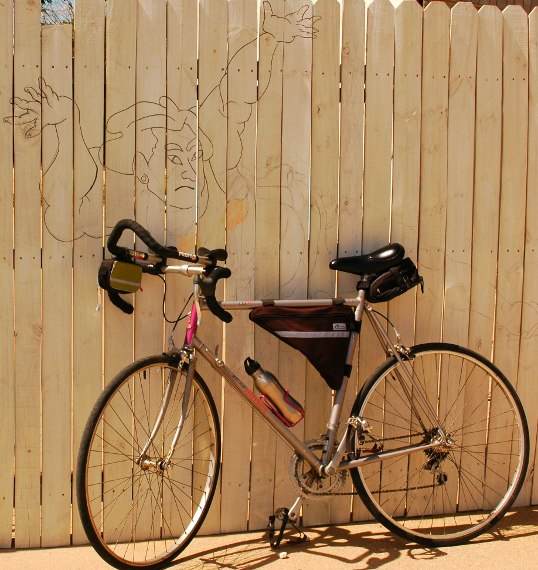
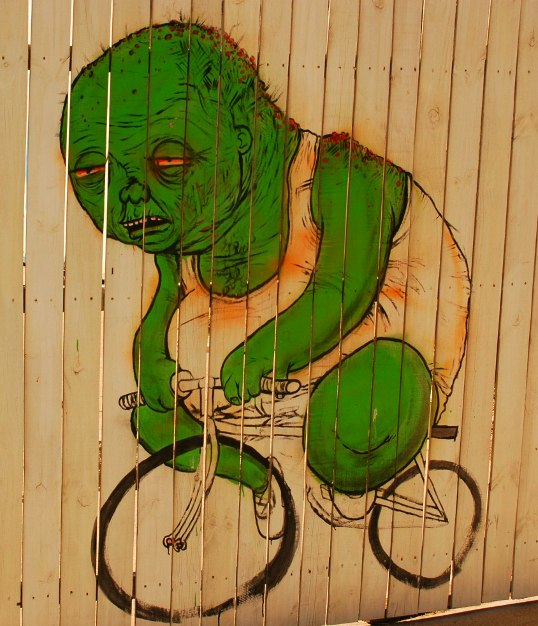
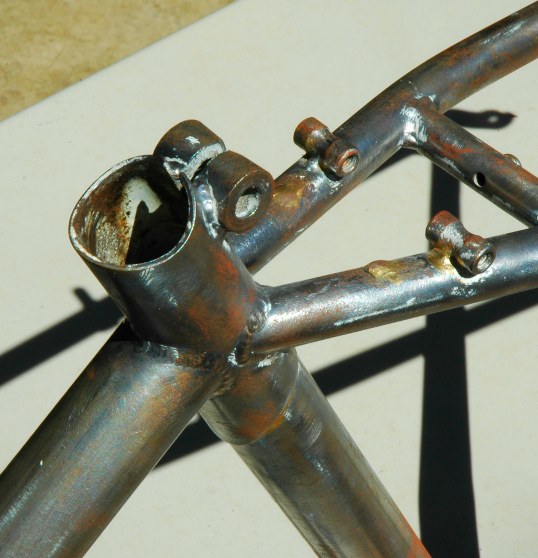
Painted on a wooden fence in Denton, Texas

This one had been defaced by someone that used white paint to add crude breasts. I photoshopped that out.
You are welcome.
A long time ago, when I was a young, avid bicyclist I had a salesman call on me. He shared my love of the human-powered two-wheel machines. We’d grab a bite and talk bikes. I remember him telling me, “My wife is really upset at the number of bikes I have. I’ve got my road racing bike, my triathalon racing bike, my around-the-neighborhood-beater bike, my mountain bike, my touring bike, my cargo bike that I take to the grocery store, a tandem, and a fun pavement bike. Eight bicycles are too many for one person, but I can’t think of any of them that I can live without. I want an ultralight road bike, but she says I have to get rid of two before I can buy one more. I don’t know what I’m going to do.”
I said that I knew exactly how he felt.
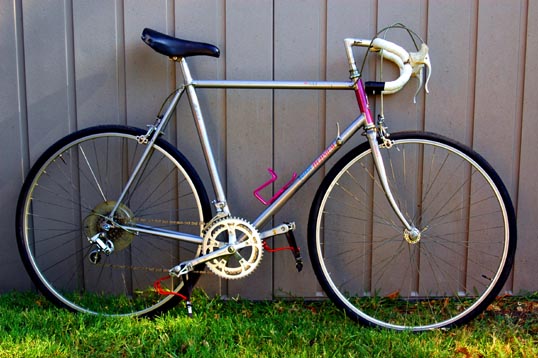
Right now, I can’t live with fewer than two bikes. I have my old road bike, my vintage Technium – I call it my “fun” bike. For a machine that’s almost thirty years old it’s light and nimble enough, fairly narrow tires, and I keep it as “clean” as I can and still carry what I need. It’s good when I want to crank out the miles.
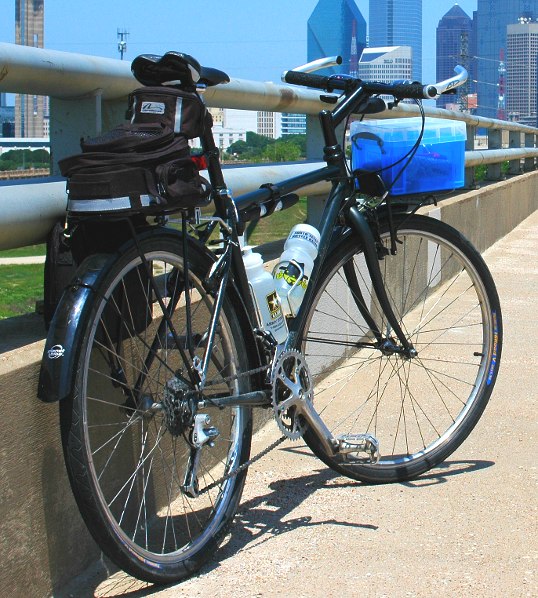
But I wanted another bike, a “commuter” bike. That bike is the opposite – a bike with all sorts of shit hanging on and off it. Wide gearing, wide tires, fenders, front and rear racks, two water bottles, room for locks and tools, lights, and upright handlebars. In other words, a bike that can go anywhere and carry anything.
European style bikes like that are now available with great accessories such as internal-geared hubs and generators for lights. I can’t afford that, however, so I began to rebuild something in my garage – my old 90’s-era Yokota Yosemite mountain bike (I bought it [used, probably hot] in a pawn shop around 1994 for sixty dollars). I scoured the Internet for bargains and sales, and picked cheap, used stuff up at swap meets and came up with the parts I needed.
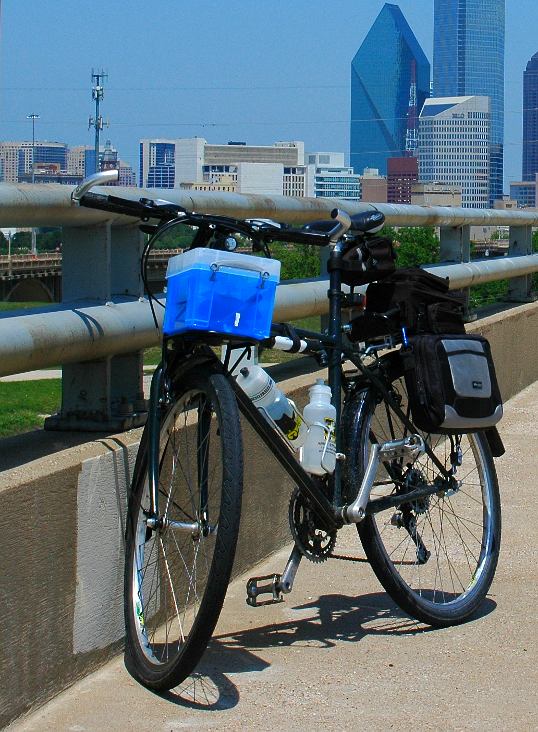
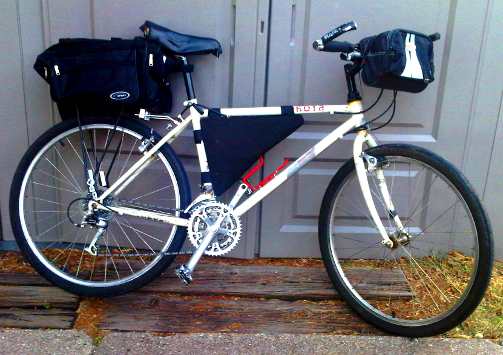
The last time I wrote about it – I had stripped the paint off the old, mostly white bike (the paint was hopelessly scratched and torn up). So now I’ve rattle-canned the thing a dark green (Charleston Green – almost black) and put it back together. The paint job is embarrassingly bad – but it won’t rust.
Some of the gear I have on it:
That looks like a lot – but I only spent a couple hundred dollars or so. A lot cheaper than a new bike.
I’ve been experimenting with mounting crap on the front and rear racks. I bought a used bag at a swap meet that works on either one – it holds my camera well. For a while, I’ve had some panniers and a cooler that I can carry cold water in – that helps get me through the summer. I have this nice little plastic box I bought at Staples and mount on the front with nylon wingnuts – it looks awful (it’s this bright translucent blue – I’ll go by there and get a grey one soon) but is handy to throw in last minute stuff – phone, lock, whatever.
Finally, I’ve been experimenting with ways to mount writing materials (pens, moleskine, and/or my Alphasmart keyboard) to carry for bicycle writing marathons. I’ve found a couple of compact bags that hang from the rear rack with two small carabiner clips. Works great (If I carry a full laptop I prefer to wear a backpack – for a little more cushioning and safety).
This gives it a junked-up appearance. I don’t care. This is my go-anywhere and do-anything bike. It’s not for looks.
Obviously.
So now I have my commuter bike. It’s a lot more work than the road bike (the wide tires, weight, and the upright position) but it gets me where I need to. Anything less than fifteen miles or so aren’t a real problem – and it can go anywhere in any weather (as long as I can hold up – it can).
Before:
During:
And After:
Trying to integrate bicycling into daily life – using a bike as transportation rather than a child’s toy – here in Dallas, the worst city in the country for cycling, I have become very sensitive to the barriers that cross potential cycling routes. Barriers… that leave chokepoints. All the trails in the world are merely outside exercise paths if they don’t have a way through the barriers. Barriers like highways, or railroads, or worst of all, rivers.
The Trinity River, as rivers go, isn’t much to write home about. In dry weather it’s not much more than a muddy green strip of particularly wet swamp. However, as a barrier, it’s more than river enough. Until recently, there has been no safe way to get across this riverbottom no-man’s land.
The City constructed a trail over an old railroad trestle (next to a failed attempt at a whitewater canoe feature) but they neglected to connect it to anything and it is useless for transportation. There are grand plans for the future, but I’ll believe those when I see it.
But now, there is something… something pretty good. There has always been twin roads over the Trinity, connecting downtown with Oak Cliff – the Houston and Jefferson viaducts. Built at different times, with different designs, they have been twinned, with one going in and the other going out.
Money has been found and now, the Houston Viaduct has been closed for construction of a Streetcar Line that will run from the Convention Center in Downtown across the river and over to the edge of the Bishop Arts District. In the meantime, both in and out traffic has been routed over the Jefferson Viaduct.
And, wonder of wonders, one lane has been blocked off and marked out for bicycle traffic, one lane going each way. There is now a safe and reliable route from Oak Cliff into downtown on a bicycle.
It’s been there for a few weeks now, but I haven’t had a chance to ride it until Sunday. I took the DART train down to the Convention Center with my commuter bike hanging from a hook in the middle car. A little girl in a stroller stared at me, sitting there holding my bike’s rear tire to keep it from swaying with the train’s motion, wearing a helmet and sunglasses, the entire way. Meanwhile, a con man with a little shell game monte played with tiny red plastic cups on a newspaper folded across his knees relieved her mother and a friend of a quick ten bucks.
I left the train in the parking garage under the Convention Center and wound my way up into the daylight by the new Omni Hotel, then looping around to the viaduct. I rode across, visited a little gateway park, then came back, pausing to take a few photographs here and there.
The bike route was nice – the bridge had a bit of a hill to it, but nothing too difficult. The views in all directions are pretty spectacular – you never notice how impressive when you are in a car.
The only downside is that the approaches to the bike lanes are very awkward on both ends. Since this is a converted one-way bridge, with both bike lanes on one side – there is no good way to get cars and bikes on and off without a lot of confusing and difficult signage and odd routing.
One odd thing is that there is an old deserted parking garage in the middle of the span. It had been built to service long-gone Reunion Arena and it now sits abandoned – acres of bare concrete and sweeping ramps. Surely something useful (maybe a rooftop park?) could be done with this monstrosity.
I didn’t spend too much time – I was meeting Candy for lunch at Lee Harvey’s in Southside and then I had about twenty five miles to get home. That’s a long way on the heavy, inefficient commuter bike… but the day was nice and I was in no hurry.
I am working on trying to minimize my reliance on the automobile here in the most car-centric of cities and have wanted an independent (aka not Starbucks) Coffee shop that is a good bike ride from my house for a long time. My wish finally came true. There is an excellent place down on Henderson, The Pearl Cup, that I have frequented and enjoyed… but it is a long and difficult drive from my house (and no train station nearby).
Almost a year ago they announced they were building a new location in Richardson. I began plotting a bicycle route to the place. It’s on the other side of a giant highway from where I live, in a more upscale neighborhood, but I was able to find a route with a good highway crossing (underneath) and that had most of the way on trails or dedicated bike lanes, with the only remaining roads low traffic.
It’s a hair under seven miles – about the perfect distance. Not too far, but fourteen miles round trip is a good workout.
This weekend was a beautiful warm day, so I was able to make to ride out. It’s a really nice route across Richardson, with some varied scenery along the way.
The first bit is down the Huffhines branch of Duck Creek on the last few yards of the Glenville trail. One of the reasons we bought our house was that they had planned and funded the trail in the creek behind us. We never thought it would take six years to get the thing finally built… but now it is.
Then the route crosses the neighborhood on the Duck Creek Linear Park.
And then north under the powerlines on the Owens Trail. A lot of bike routes in the Metroplex are through powerline right of way. It’s not very scenic, but gets the job done.
The nicest park of the ride is through the thick creekbottom woods of the Spring Creek Nature Area.
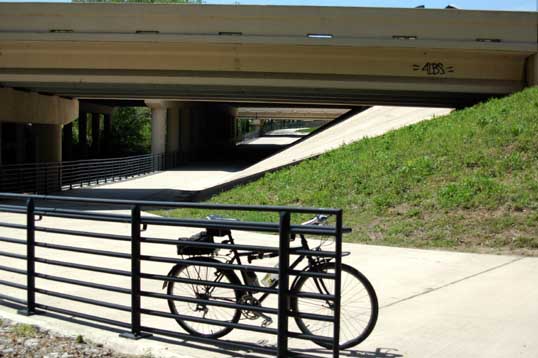
Then under Highway 75 along a creek bridge. The city is working on bicycle/pedestrian crossings of the highway, with success in the northern part of the city.
Up the highway on the east side, then down busy Renner road. A lot of fast cyclists use the road, but I’m slow and lazy and poke along the trail.
The last little bit is down a dedicated bike lane on Custer. These dedicated lanes have been popular and are cropping up all over the city. The only problem is that there is often parking in these lanes which forces the bikes through the “door zone” – so riders have to go slow and careful, looking into each parked car as you go by.
And finally, the coffee shop. A great place for some Java and maybe a book or some writing. Next door they opened up a burger place, Shady’s. Candy met me there for lunch. They had a nice selection of craft beers – Dogfish Head, Devil’s Backbone, and a couple others – but no local beers. We talked to the owner and suggested he get some Deep Ellum or Lakewood on tap.
So it was a nice lunch, and a nice ride – one I hope to be making a few more times.
I want a new bicycle but I simply can’t afford one. So I’m making do.
I’ve been riding my old Technium and it’s doing well. It’s a road bike and a lot of fun. Still, one of my long-term goals is to integrate biking with my daily life and I want a commuting/shopping/bombing around the neighborhood bike. I want a bike that can go anywhere, anytime – and I don’t really care how long it takes to get there.
So I’m rebuilding my old Yokota Yosemite steel mountain bike. I’ve scrounged up a set of fenders, front and back racks, and a cheap lighting system. I found bargains on new shifters, brake levers, and more modern V-brakes to replace the squealing cantilevers.
Looking at the bike, though, I realized the paint was really messed up. It was white, and showed every scratch and scrape… and twenty years of tough riding left a lot of scratches and scrapes.
I decided to paint the thing. If nothing else, this gave me an excuse to remove every little piece and part. One of the few good things about doing your own maintenance is that it teaches you about your bike and gives you a connection – the inanimate, mechanical object of metal, plastic, and rubber – becomes almost a living thing in your mind, and extension of your own body, so to speak.
The only problem is that stripping all the paint off the old steel frame was a ton of work. Paint stripper, flat bladed scrapers, and sandpaper… combined with helpings of time and elbow grease took the thing down to stripped bare steel. I don’t know what kind of paint they used, but it was tough.
I have become enamored of steel framed bikes. Nowadays, of course, it’s all aluminum and/or carbon fiber. Anything to shave off a few more ounces.
But now that I see the gleaming steel that was under that paint – I’ll take the toughness, versatility, and smooth ride of that steel even if I have to push around a couple more pounds.

The bare steel flash rusts almost immediately without any paint protecting it. I’ll have to give it a final sanding right before I prime it.
Now I’m ready. We have this little plastic outbuilding that I need to clean out and convert into a temporary paint booth. I’ll have to slot out the time and I’ll need a final sanding to clean the flash rust off the frame; then it’s primer-color-clear.
I thought about colors – I want something really simple that won’t show dirt. It looks like it’ll be Charleston Green. – which is almost black, but is supposed to show a green tint when the sun hits it right. That’s darker than I was thinking originally (I was looking for a dark British Racing Green) but the more I thought about it, and the more I read about the history of the color, Charleston Green it is.
Though I am a ridiculous old fat man on a bicycle, I have been working on increasing my mileage and exploring how to integrate cycling into my daily activities better. My goal for 2013 is three thousand miles on my bike. I knew I would start out behind (the weather in the winter is too often simply too nasty to ride) but I try to get as many miles in as possible.
Saturday was a gray post-misty day, cool but not cold – usually considered depressing winter weather – but without a breath of wind, perfect for a bicycle ride. I cruised all over Richardson and North Dallas, getting in about thirty-four miles of city riding, which is a lot for me. I was pretty well worn out.
Sunday was more of the same, a little warmer and a little windier and I wanted to ride somewhere and get a few more miles in – somewhere more or less useful.
About eight miles away (as the bike rolls) is White Rock Coffee, one of my favorite independent coffee spots. There are a number of Starbucks within walking distance of my home, and a couple of bubble teas/smoothie emporiums, but White Rock is the closest non-national-chain coffee spot. There is a new branch of The Pearl Cup, under construction in Richardson, and when it is done it will be a nice bicycle destination. But they are still working on it – so until it’s done it’s White Rock Coffee.
The problem is, I can’t find a good route to White Rock Coffee. The biggest choke point is LBJ/635 Interstate Highway loop. The best crossing between my house and the coffee place is the pedestrian bridge next to the Skillman DART station.
Once you start looking at that crossing you realize a nefarious little bit of nasty city planning. The bridge is useful, mostly because it connects a couple of neighborhoods of rundown apartments (on either side of the freeway) with the train station and each other. The problem is that it is almost impossible to get into or out of those neighborhoods on foot or on bicycle.
I don’t think this is an accident. Streets running up to these areas lose their sidewalks – some residential streets are cut and blockaded. It is obvious that the powers-that-be don’t want folks walking out of their rundown apartment complexes into the more upscale areas of housing.
So I have been working on finding the best route. I came up with one and it’s not that great – there are several nasty road crossings (Yale and Walnut, Leisure and Forest, and Adleta and Skillman are the some of the worst), four places where I have to walk my bike, and some heavy traffic. A long stretch of narrow, crowded residential street with parked cars filling both sides – the door zone fills the whole street. It’s especially tough because I’m riding my road bike right now – I’m rebuilding my commuter/bad weather bike. The narrow tires are pickier about terrain.
I decided to give it a go today – stuffed my laptop and an extra shirt into my backpack and set off. I know eight miles isn’t very far, but it’s a tough eight miles. The backpack was heavy and I was always riding into the wind (how does that work?). It’s all crowded urban stop-and-go riding.
That’s the thing about riding a bicycle in the city – you see things you never do from a car (or on foot, really, because you can’t travel that far). You see beauty, notice hills you never would otherwise, connect with the weather in an intimate, organic way… but you see a lot of nasty, brutish, and ugly stuff too. A lot of trash, homeless people, and neglect.
I hadn’t anticipated the amount of broken glass on the streets and sidewalks in some of these neighborhoods. Sure enough, crossing 635 on the pedestrian bridge I put a sliver of shattered malt liquor bottle through my rear tire and had to patch it in a nasty little parking lot covered in antifreeze and oil that had been dumped there, keeping an eye on the crack dealers that were keeping an eye on me.
Life in the big city in this best of all possible worlds.
I had better finish this up and drink the rest of my coffee and get home – I don’t want to do that ride in the dark.
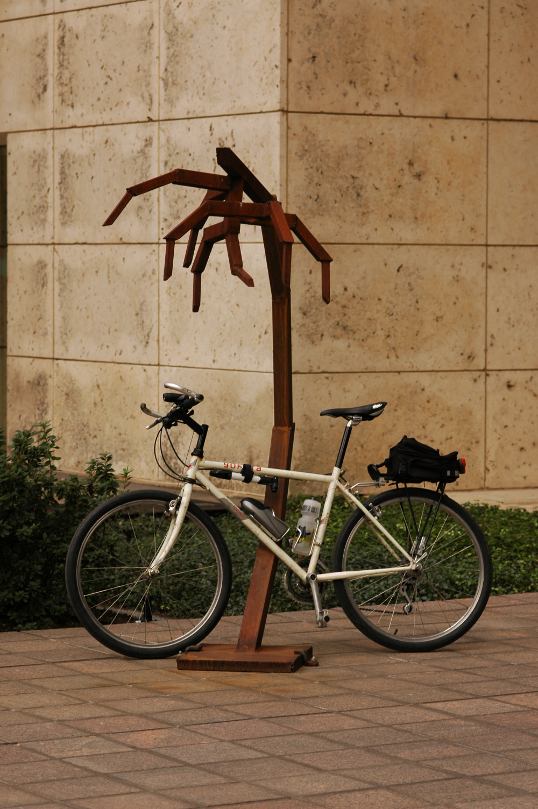
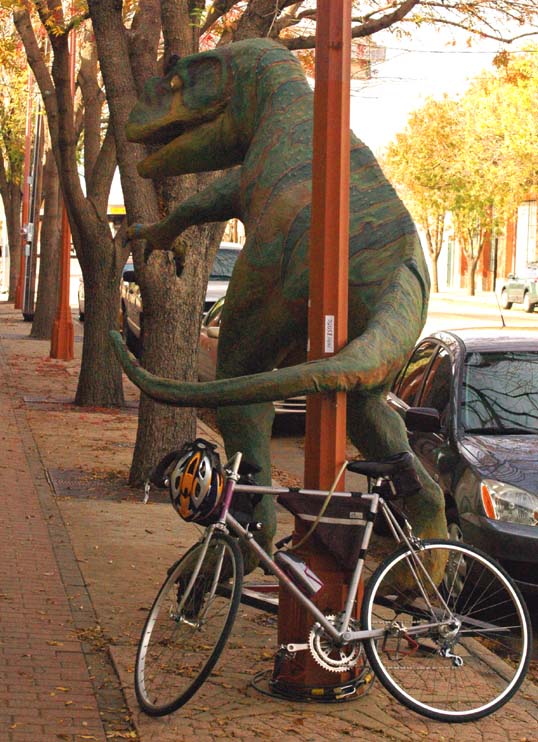
I love exploring the city by bicycle. Here’s my old Raleigh Technium locked up and guarded by the TRex in Exposition Park, Dallas.
Taken during the Deep Ellum Holiday Boutique Shop & Ride.
A Photograph Doesn’t Do Justice
I like taking photographs, though it is ultimately a frustrating and futile exercise. I see an image in my mind and I want to commit it to pixels, but I never can. What ends up on the screen is a poor echo, a warped ghost, of what was in my head. Still, I keep trying.

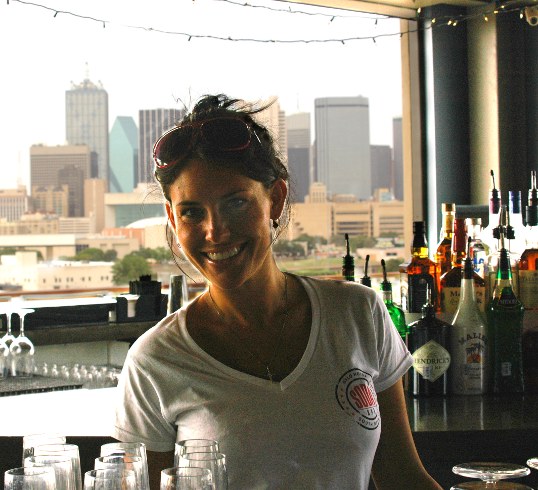
This woman, a bartender at the NYLO Southside, asked Candy, “Is your husband a professional photographer?”
Candy answered, “He thinks he is.”
Sometimes, there are images, real images that appear in the eye, of such subtle and ephemeral beauty that a camera can never come close to capturing.
The other morning I was riding my bike to work. I had left before dawn and was moving west on Summit Drive just after Grove Road. It’s a quiet little residential street, perfect for bike riding. Going West, it’s a slight downhill, just right – steep enough to coast but not so much to require brakes – a nice little rest in the middle of my commute.
Behind me, the sun was breaking the horizon, the orange globe peeking out throwing a sudden bright warm light down the street. All along the street were thousands of black birds (grackles, I think) covering the yards, wires, and trees.
The birds did not like me or my bike. Maybe my flashing headlight helped spook them, but they all took off and began to fly away from me. As I moved down the street a massive wave of birds formed in front of me, a cacophony of squawking and flapping wings as they fled in formation.
It was like a giant, solid, noisy, black moving thing, this wave of birds, contrasted with the bare trees and piles of autumn leaves, all bathed in the coral light from the sunrise. A living shape, a rolling cloud, lasting only a few seconds until I reached the turn at the bottom of the hill when they scattered, the wave dissolving into the dawn air, the flock dissipating as quickly as it formed.
As surely as this scene could never be photographed… too evanescent and ethereal for a lens – words fail me. Trust me, it was beautiful – I smiled all the way to work and even for a few minutes in the land of the cubicals until the daily grind ground the moment out.
Still, it is there, in my memory. I’ve never been much of a morning person, but sometimes it’s nice to get up in time to see what the rising sun brings.
My First Fall
At my age, I’m really afraid of bicycle accidents. I’m a lot more brittle than I used to be and I don’t heal as fast. Still, I ride slowly and carefully and hadn’t fallen for a long, long time.
Until now.
I was going West on Spring Valley (not far from the story above). There is a rail line that bisects my city north to south and is a surprising barrier to cycling – there are only a couple places where it can be crossed and none of them are very safe. The Spring Valley crossing is one of the best – open, wide, and not too much traffic.
Between the rails there are these rubber pads to fill in the gaps for the cars that cross. Unfortunately, the pads had a gap between them… not too much, maybe an inch. The gap, unfortunately runs parallel to the curb – along the direction of travel. On a bike, cracks or gaps running across your path are a mere bump, but cracks running in the same direction your are – are a disaster.
I am starting to rebuild my commuter bike – an old mountain bike – so I am riding my road bike around town. The road bike has narrow tires. Narrow enough to fit right into the gap between the thick rubber mats.
So I wasn’t looking closely enough and my tire dropped into the gap. It immediately grabbed the rubber and stopped. Instant endo – a nasty crash where your forward momentum throws you over your front handlebars.
I felt the tire drop and grab so I had a split second to prepare myself. I was able to drop a shoulder and roll when I hit, so I wasn’t hurt. I was worried about my bike, but other than a broken toe clip and a missing bar end plug, not a scratch. Luckily, there weren’t any cars behind me, or that might have been a fatal crash.
All’s well that ends well. Hopefully, I’ll have another run of good luck.
It’s frustrating though. I’m sure the city thinks that railroad crossing is fine and doesn’t need any work even though it contains a hidden disaster to anyone riding a bike through there. I don’t have any choice, I’ll have to ride over the crossing at least twice a day when I’m riding to work and most other rides – it’s the only good way to get the the southwest part of town from where I live. I’ll have to be careful and not forget what happened – look out for that gap.
Of course, flying over the handlebars isn’t something you forget anytime soon.
Riding in the Rain
My goal for 2013 is three thousand miles on my bicycle. Not too hard, that’s only a bit under ten miles per day (my work commute is ten miles round trip). Still, it will require consistent riding, under less than ideal conditions. Texas winters are cold, spring is wet, and summers… well, they can be fatal.
Rain was predicted for today, but when I woke up in the morning, I checked out the internet weather and the radar maps and it looked like I had a couple hours before the thunderstorms arrived. So I decided to get going and get in twenty miles or so. Never trust anything you read on the ‘net.
The fog was thick as I headed out and withing a couple miles it started to mist and sprinkle. It was fairly warm, so the light rain actually felt nice. I decided to ignore the weather and kept heading out on the route I had in mind.
Over the next few miles the rain slowly increased. Still, it wasn’t too bad and I kept going. Once you are soaked… you can’t get any wetter, so I didn’t want to give up. My phone rang and it was Candy, offering to pick me up, but I said I was doing fine. By this time I was around Galatyn Parkway along Highway 75 and I wanted to go north into Spring Creek and the trails up there.
Then the sky opened up.
I’ve been thinking about rigging my commuter bike for riding in the rain and reading up about bicycle fenders. One article I read had this nice quote:
I’ve cycled through thunderstorms in the U.S. Midwest and Texas and even a typhoon or two in Tokyo. For the Californians on the list, fill a bucket with water, toss in a tray of ice cubes (for the hail) and have a friend throw the contents on you — that approximates about half a second of a typical Midwestern spring storm.
That’s what it felt like – someone dumping a five gallon bucket of iced water on my head twice a second. It’s true that once you are soaked, more water doesn’t make you wetter… but I couldn’t even see. Luckily, a few feet up ahead the trail scooted underneath Highway 75, so I was able to take shelter until the tempest subsided.
It was amazing, waiting there, dripping, under the highway, watching the trickle of a creek rising quickly to become a raging torrent. I was safe on the elevated trail, leaning up against a guardrail halfway between the stream and the roadway above. The various drainpipes associated with the highway all began spewing vast cascades of roaring water, some falling in brown cataracts and others splashing against trees and logs into great sprays of foam. I never noticed, but the roadway is drilled with a pattern of drainage holes and all these began to spew a grid of falling fountains from the bridge far above.
The scene was unexpected and beautiful and it made me laugh to look at my private spectacular water display.
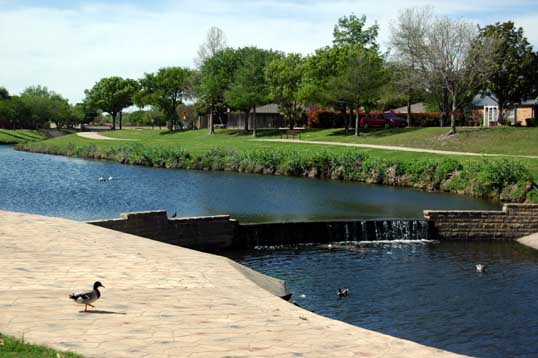
The rain was falling so hard I knew it couldn’t last too long and once the storm subsided to a mere rainstorm I bundled up my wet clothes and headed home. I couldn’t ride the trail all the way because the low-water crossings along Duck Creek were submerged. The waterfowl were all lined up along their swollen eponymous waterway watching the flotsam and jetsam closely, picking out any edible particle that came floating by.
I did manage to get my twenty miles in, and all my stuff is hanging in the house trying to dry out. I’m not sure if I’ll go out in a thunderstorm like that again… but it was kind of fun.
At a recent Vintage Bicycle Show I was fascinated by all the geriatric brake technology on display.
For example, I have been interested in the Flying Pigeon Bicycle from China, though I don’t know if I’d actually want to own one. They are, after all, the most popular single means of mechanical transport in history. When I read about them, I was especially interested in the rod brakes – very simple and reliable. They use a series of levers and rods to pull a pair of brake shoes into the inside of the rim. At the show, I saw a bike with rod brakes (not a Flying Pigeon).
It’s a Phillips. I talked to the guy that had bought it and restored it about the brakes. Another guy said, “If you think about it, a rod brake isn’t that much different, you replace the wire with a rod.”
I don’t know about that. I asked the owner how well they stopped. His reply was a classic, “Well, they stop well enough… when you consider you can’t get going very fast on this thing anyway. You have to be careful… really careful, if you find yourself going downhill.
Across the aisle was an even older and cruder technology.
The rod brakes on this bike push a rubber block right down onto the tire. I certainly wouldn’t want to be caught going too fast on that bad boy. Cool bike, though. Love the generator.
Finally, there was a bike with a Campagnolo Delta Brakeset.
I’ve always loved these. They are heavy, complicated, and don’t work very well… but what a work of art.
One fun story from the show. While I was standing around a guy came in with a vintage Raleigh – about the same age as my 1974 Super Course that I bought my freshman year in college. He was restoring the bike and was about half done – it was rideable, but still looked pretty ragged. I told him the story of how I lost that beloved bike.
“I lived in a third story apartment,” I told him. “I never thought about it, but I left it out on my balcony unlocked. Somebody stole it. It must have been a tree trimmer, working in the neighborhood with a ladder, and he yanked it off my balcony.”
“That’s how I got this bike,” he said to me.
“What, did you steal it off a balcony?”
“No, I saw this guy, he was a landscaping guy, riding this bike. It was in terrible shape, the bar tape was falling off, the paint peeling, but I recognized it as a vintage Raleigh. I asked him if he’d sell it to me. He said, ‘I can’t sell you my bike, it’s the only way I have to get to work.’ So I told him, ‘Tell you what, we’ll get in my car and I’ll drive you to Wal-Mart and you can pick out any bike you want. I take your beat up old bike and I’ll buy you a brand new Wal-Mart bike.’ He said it was a deal and that’s how I bought the Raleigh.”
I loved that story.
Now that I’ve decided I can’t afford a new bicycle I am concentrating on making do with what I’ve got.
I’m lucky in that my Raleigh Technium is old enough (1986 or so) to be vintage and therefore, semi-cool, it is not old enough that I need to keep it stock. So I took it apart and rebuilt it.
You would think that the parts that I would have to upgrade would be the drivetrain – new super gears and integrated shifters and whiz bang shit like that – but that’s not what I did. Old friction shifters and ancient freewheels still work pretty darn well. Dallas is flat, I don’t have to shift very often. What I did upgrade – the place where technology has improved – is brakes.
My Raleigh had old single pivot sidepulls (my even older Raleigh Supercourse from 1974 had center-pulls) and stopping was not a reliable thing. Riding in an urban area – you need to stop. Stop or die. Plus, the cables were rusting and I never liked the awkward cables looping up from the brake levers.
So I bought some new long-reach dual pivot sidepulls from Nashbar, some nice used aero levers from Ebay, and a set of high quality, high tech brake cables. I tore the bike apart, repacked everything that had grease in it, tightened everything down tight, and put the new brake system in. The Technium routes the rear brake cable inside the tubing, and that was a pain… a lot of fishing for cables, but I finished it up and now it rides like a dream. Well, except the engine, of course.
So, now I turn to rebuilding my commuter bike – the creaky old Yokota Mountain bike I bought used at a pawn shop around 1990. The rear shifter won’t shift down any more, so I needed new shift levers – so I bought new ones, and I bought new integrated brake levers too – so I bought new brakes. I’m replacing the old-school cantilever brakes with more modern V-brakes. All this I picked up from fire sales on various places, so I didn’t pay too much money for any of it.
Now, next, I’ll strip the bike down, then paint it (I’m thinking a dark English racing green) – and put all the new stuff on.
That’s the ticket.