A Thing of Beauty

I know I should not give things – physical objects – attributes beyond what they are – simply shapes of metal, rubber, and leather. Things are not as important as people.

Bicycles…. umm, that’s another matter.

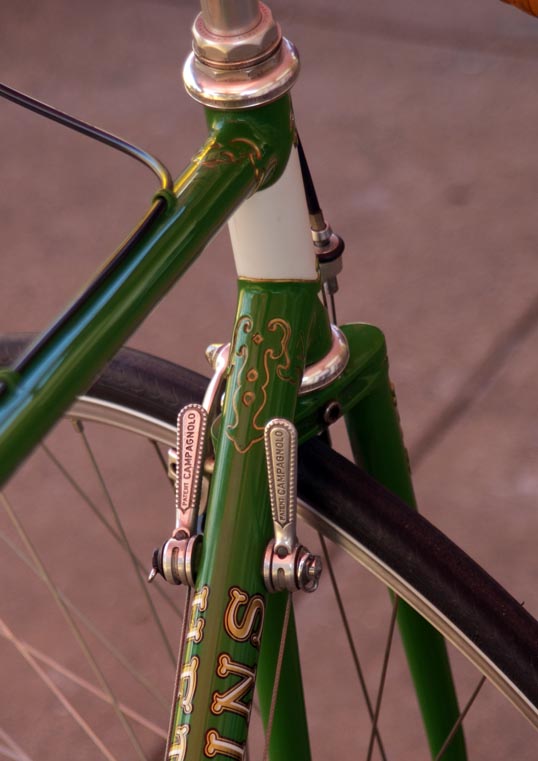
At a vintage bicycle ride/show/swap meet I attended a while back there was a Hetchins bicycle that was of such sublime beauty that I can’t really think of it as a physical object only. The Hetchins bikes are known for intricate lugwork and for being, well, transcendent works of art.

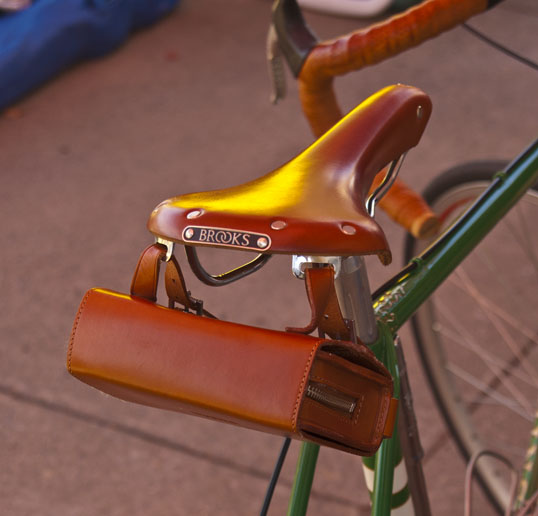
This one was painted green with the lugs set off with gold paint – and a full complement of Brooks leather saddle, bar tape, and tool bag. Vintage Campagnolo… of course.

A simple bicycle, yet such a thing of beauty.

vintage3

vintage2

vintage1

Cycling in Style

Stylish bike rider, French Quarter, New Orleans

Stylish bike rider, French Quarter, New Orleans

Despite the fact that (in additional to the least-cool) I am the least fashionable person on the planet I am interested in the idea of bicycling style, or chic, or whatever you want to call it. Not the old spandex, carbon, and logo style, but the more relaxed, European, style of riding a bike in the urban environs.

I went on a fun ride the other day with a nice group visiting some boutiques and such in a couple of stylish and hip neighborhoods of Dallas.

Yes, they exist.

Looking through the library I discovered a book by David Byrne, where he relates some of his experiences riding a folding bike through some of the more interesting cities of the world.

He starts out insulting my city… which is pretty world-renowned for cycling unfriendliness.

Bicycle Diaries

by David Byrne

Chapter One – American Cities

Most US cities are not very bike-friendly. They’re not very pedestrian-friendly either. They’re car-friendly – or at least they try very hard to be. In most of the cities one could say that the machines have won. Lives, city planning, budgets, and time are all focused around the automobile. It’s long-term unsustainable and short-term lousy living. How did it get this way? Maybe we can blame Le Corbusier for his “visionary” Radiant City proposals in the early part of the last century:

His utopian proposals — cities (or just towers really) enmeshed in a net of multilane roads — were perfectly in sync with what the car and oil companies wanted. Given that four of the five biggest corporations in the world still are oil and gas companies, it’s not surprising how these weird and car-friendly visions have lingered. In the postwar period general Motors was the largest company in the whole world. Its president, Charlie Wilson said, “What’s good for GM is good for the country.” Does anyone still believe that GM ever had the country’s best interests at heart?

Maybe we can also blame Robert Moses, who was so successful at slicing up New York City with elevated expressways and concrete canyons. His force of will and proselytizing had wide ranging effects. Other cities copied his example. Or maybe we can blame Hitler, who built the autobahns in order to allow German troops and supplies fast, efficient, and reliable access to all points along the fronts during World War II.

I try to explore some of these towns — Dallas, Detroit, Phoenix, Atlanta — by bike, and it’s frustrating. The various parts of town are often “connected” — if one can call it that — mainly by freeways, massive awe-inspiring concrete ribbons that usually kill the neighborhoods they pass through, and often the ones they are supposed to connect as well. The areas bordering expressways inevitably become dead zones. There may be, near the edges of town, an exit ramp leading to a KFC or a Red Lobster, but that’s not a neighborhood. What remains of the severed communities is eventually replaced by shopping malls and big-box stores isolated in vast deserts of parking. These are strung along the highways that have killed the towns that the highways were meant to connect. The roads, housing developments with no focus, and shopping centers eventually sprawl as far as the eye can see as the highways inched farther and farther out. Monotonous, tedious, exhausting… and soon to be gone, I suspect.

He’s right of course… but not completely right. There is hope. Dallas (and every big modern city) does have its notorious web of high speed freeways, concrete ribbons of death.

But they don’t cover the whole city. In between these barriers are real neighborhoods with real people living in them. The challenge is to get off the freeway and find what’s there – and a bicycle is the best way to do it.

The freeways become a barrier to pierce. The city is working on creating routes and I’m working on finding them.


Swap Meet and Bicycle Porn

(Please excuse the title, but I have learned that the inclusion of the word “Porn” in a post title results in a lot more hits – a lot more)

Getting up before dawn on a Saturday off work to drive up to Frisco by 8AM is not something I usually do, unless I have to. But there was a big bicycle swap meet up on the infield of the Superdrome bike racing track and I wanted to give it a go. Since I had tickets to the Deep Ellum Brewery’s 1st Anniversary party downtown at noon – I knew I’d have to get the bicycle thing done quickly.

As I get back into riding after all these decades, I am working with two ancient bicycles. I have my Raleigh Technium road bike, which I bought around 1986, and my generic mountain bike, which I bought used a few years later. The technology used in these bikes is long out of date, but they still move when I push on the pedals, more or less.

I want a new bike, but they are so expensive. I have been thinking lately that I should be able to make do with what I’ve got. Still, I need some replacement parts and especially some accessories to help me make my way in the big city and get in the miles I want. New parts are not readily available for bikes that old and I don’t want to spend any more money than I have to – so a swap meet, where I can buy old, worn-out crap at stupid cheap prices is exactly what the doctor ordered. Since I’m now commuting to work and bumming around town – I need storage options on my bike – the more options, the more often I can work in a ride in my busy schedule.

It was cold as the sun peeked up over the steep bank of the Superdrome Track but once it did the day warmed quickly. I walked the circuit, looking at the tables, and slowly picking out what I wanted and what I could afford.

So what did I buy?

Vintage Raleigh Seat – $5
Cage Rocket Storage Pod – $5
Two matching silver bottle holders (my bike now has a pink and a purple one) – $5
Retro Profile for Speed Aero Bars (don’t need these – but always wanted a pair) – $10
New tiny cable lock (not extremely secure – but good for a quick trip into a store) – $5
Zefal Rack Pack (already finding this really useful) – $5
Bar ends (mine are all beat up from falls) – $5

Working now on getting this stuff cleaned up and installed. Now I need to get out there and ride.

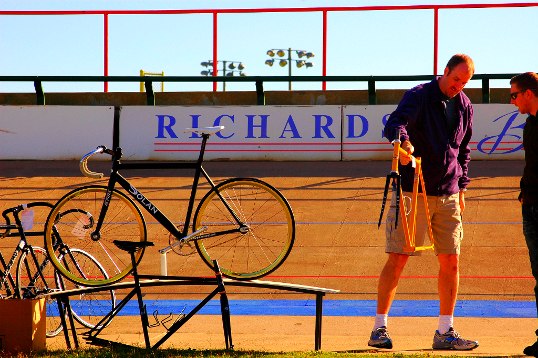
Bicycle Swap Meet inside the steep walls of the Frisco Superdrome racing track.

(Click for a larger version on Flickr)

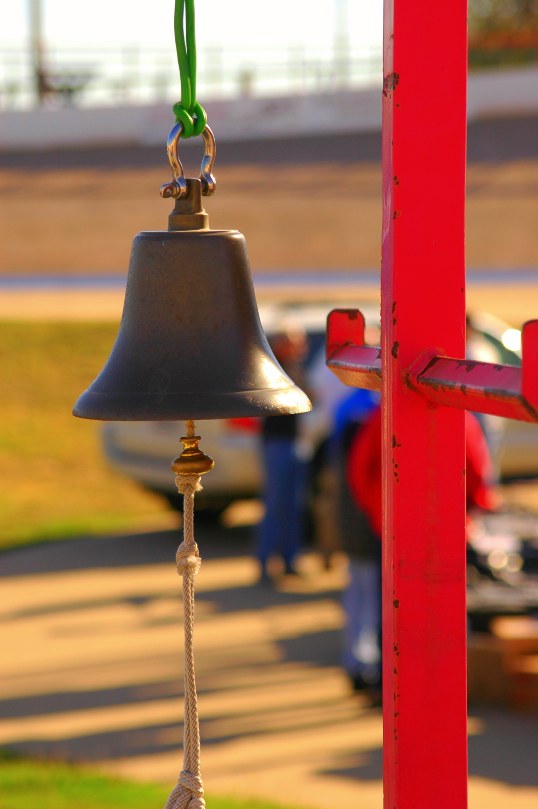
The bell for the last lap at the Frisco Superdrome racetrack.

Lots of buying and selling.

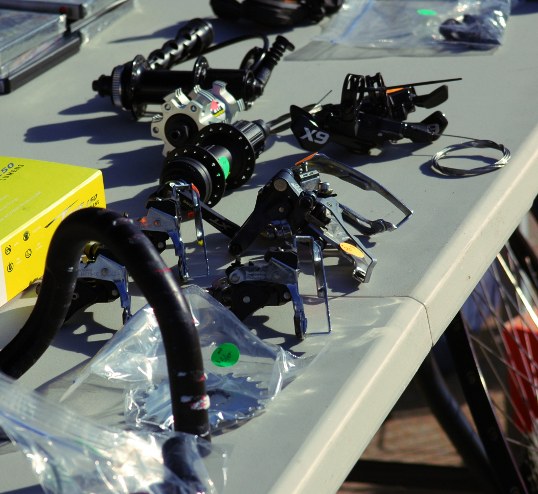
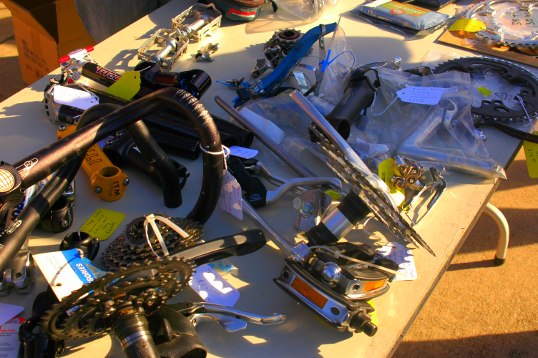
Bicycle Parts Porn

More bicycle parts porn

A beautiful bike is a work of art.

(Click for a larger version on Flickr)

Flats

I have been looking for new places to go for a bike ride – and willing to drive farther from home. With the seats folded down, my bike fits in the back of the Matrix and it gets nice gas mileage – so it’s all good.

Looking over Google Maps with the “Bicycling” option turned on, I spotted a green line going north from Highway 380, just east of Denton. It’s the 380 Greenway/Ray Roberts Greenbelt trail and runs ten miles north through the riperian forest of the Elm Fork of the Trinity River, ending up at the dam of Lake Ray Roberts.

So, after wasting the morning futsing and dutsing around the house, I loaded up my stuff and drove north through the big evil city until I reached the parking lot off of Highway 380. The Greenway trail is a branch of the Texas State Park system, so I had to pay to use it, sealing seven dollars into a little envelope and dropping it in a steel box. I checked all my gear out, saddled up and headed north into the woods.

The trail is flat as a pancake for the whole distance, which makes it easy and fast, though you never stop pedaling. The trail splits in two – with the equestrian trail on one side of the river and the hike/bike on the other. There were a few folks walking near the south end, but after a couple miles I only saw the occasional mountain bike. The southern section is locked in heavy woods – which is really nice, anything to shade the blazing Texas sun. As it goes north, the landscape opens out a little, with the occasional hayfield or open meadow breaking up the scenery.

It was a really nice ride through some bucolic scenery, but I made a tactical error. I didn’t read closely enough before I left and didn’t think about the trail surface. It is an improved hardpack with gravel surface. I left my thin, smooth, street tires on the bike. They are wide enough, so I didn’t have any problem riding – but the stones cut them to pieces.

I was no more than a couple miles up the trail when I stopped to take a photo of the trail through the woods. When I started back up my bike tire was flat. I carried an extra tube and a patch kit, so I sat along the trail and swapped the tube out. I couldn’t find a thorn or anything, but did find a small hole and patched it, keeping that tube as a spare.

Six miles up the trail, it crosses a highway and I stopped there for a protein bar and some water, and my tire went flat again. Out with the tire levers, off with the tire, on with another patch. This time I did find a tiny glass sliver – took it out. Since this was my second flat, I thought about heading back south to my car, but I sat there for twenty minutes and it seemed to be holding, so I went north to ride the whole trail.

I stopped again at the base of the Ray Roberts dam to rest for a bit. A big, expensive SUV drove up and a couple climbed out. They walked up to me and the driver, in a thick New Jersey accent, asked me, “Do you live around here?”

“Umm, I live a long way from here, but maybe I can answer your questions.”

“Well, we’re looking at a house near here and I wanted to see about this park. It says you have to pay to park here.”

“Oh, if you lived close, you could buy an annual pass. It’s about fifty bucks, I think. You could use this trail and the Ray Roberts park has a nice beach and a lot of stuff to do.”

We talked a bit about the trail (he had looked at it on Google Maps) and where it went and how it connected to the park. The two of them walked around and looked at stuff. I wished them good luck on their house hunting and they drove off. I packed up and headed back down the trail.

A few miles down the trail I felt my back wheel hit a rock hard and immediately the tire went flat again.

This time I found three holes in the tube, patched them, and pumped it up. I counted my patches, three left, plus one spare patched tube, so I was pretty sure I could make it back to my car, but I was getting tired of working on those flats, and my arms were sore from pumping up those fat tires with the little portable pump.

I was able to hammer on down the trail without any more trouble though. As I neared the southern end more walkers began to appear – the day was getting long and the temperature was cooling off.

I went past a woman walking along wearing an outrageous frilly bright red dress, thick makeup, and high heeled shoes that were completely useless on the gravel trail. She looked sheepish, stumbling along, and next to her was a man carrying a tall, transparent, lucite chair. I certainly hope the two of them were walking to do a photo shoot in the woods – otherwise… well, I don’t know.

It was nice to see my car in the parking lot while I still had some air in my tires.

The trail runs through thick forest near the south end. While I was taking this photo – my tire was losing air.
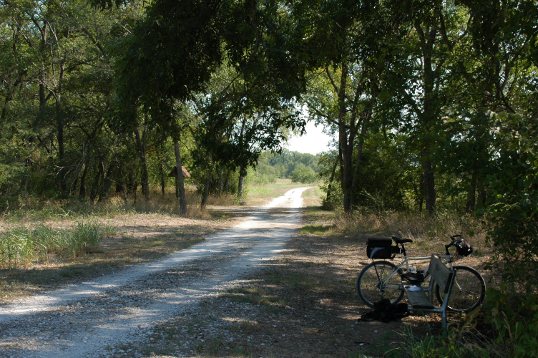
A nice rest spot near the north end of the trail.

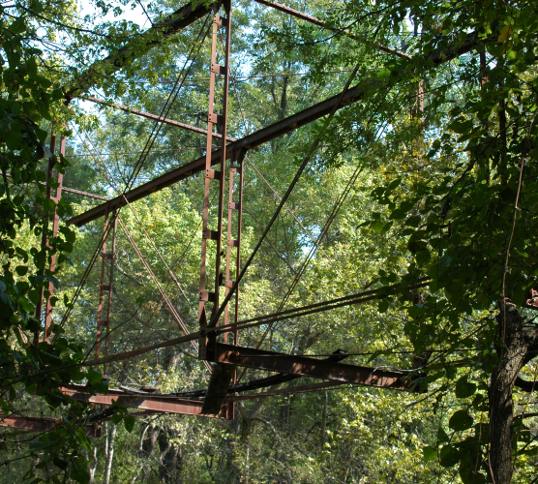
Ruins of an old bridge near where I took the photo above.

Under the old bridge – the Elm Fork of the Trinity is surprisingly clear and pleasant.
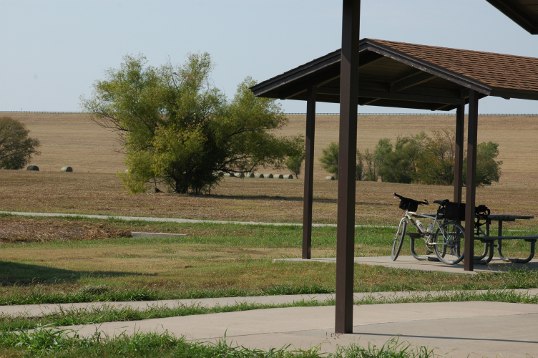
The northern terminus of the trail below the Lake Ray Roberts dam.
Arbor Hills and Carrollton Blue and Orange

The overlook at Arbor Hills Nature Preserve in Plano, Texas.

Slowly, I am able to ride farther and farther on my bike. I’m still slow – I am riding an old, inefficient mountain bike (which does have the advantage of being able to go anywhere). I have my ancient road bike which I’m trying to get into rideable condition… but I am struggling with mystery flats. When it is fixed I should be able to up my speed and distance. Right now I am limited not so much by my fitness but by time and the amount of water I can carry. I drink an amazing amount of water in this heat.

What I like to do on weekends sometime is to load up my bike in the back of the Matrix, fill a cooler with bottles of iced water, and set out across the city. I use GoogleMaps on my phone, with the Bicycling option turned on – showing up the bike trails and dedicated lanes bright green. I look for long stretches or connected clusters and give a shot at riding somewhere I haven’t been before.

On Sunday, I headed northwest and the first place I came across was the Arbor Hills Nature Preserve. This is a large Plano park which I had seen a couple years ago when I made a wrong turn leaving the hospital where Candy was getting surgery. It had an odd parking lot, beige rock buildings, and a big ol’ mess of hilly woods. I looked it up online and had wanted to pay a visit ever since.

It was an interesting place to ride a bicycle. First – it does lack distance – only a couple miles of paved trails (I wasn’t in the mood for hitting the dirt). It isn’t a very good place for speed either – the trails are lousy with clots of people wandering around and others walking their dogs.

What is nice, though, is its hills. There are a lot of wooded nature trails in the Dallas area, but almost all of them are located in worthless river bottom floodplain and are as flat as a pancake. Arbor Hills has a good bit of ups and downs – not enough to make it too difficult or even unpleasant, but enough for a good workout.

The trails all wind around and rise up to a stone lookout, a nice destination, a pretty place looking out over the trees and scrub fields with only a hint of the millions of rooftops rising along the horizon – a reminder of the fact that you are not really in a wilderness, but merely a forgotten pocket of vegetation left over somehow when the world was paved over.

I looped around a couple of times, then packed my bike up and drove on. I wanted to go down to Carrollton and check out their trails. I had read about how they had been doing a lot of work on extending their hike/bike trail network. I did a circuit of their Orange and Blue trail routes, about ten miles total.

I applaud their work, and some of their trails are nice… running beside some swampy ponds and wild green creeks. They need to do more to access the network, though. It was fine for some exercise, but the pavement doesn’t really go anywhere – it would not work for commuting to work or shopping.

Sitting at a little shaded bench I gulped down my last bottle of cold water and knew it was time to head back to the car and go home. There is always tomorrow, and more stretches of pavement in a different direction.

Neighborhood Upgrade

One of my favorite bike trails in Dallas is the Santa Fe Trail, which runs from the south end of White Rock Lake (it connects with the trail around the lake) down an old railroad right of way, ending in Deep Ellum. I rode it the other day and turned the other way – going under Interstate 30 and riding around in Fair Park.

What I like about the trail is that it is a rare urban trail. The northern end starts in the woods around White Rock Creek but the trail soon emerges into a bustling lower-income city neighborhood. It makes for interesting riding.
I have noticed that a lot of the houses along the route, some little more than shotgun shacks, have been upgraded since the trail opened. There is a lot of fresh paint and large piles of trash along the streets waiting to be hauled away. I don’t know if it is because the residents feel that they are now more exposed and want to put a better foot forward, or, more likely, the trail raised property values a bit and the landlords are cleaning up to get higher rents.

At any rate, one property does have an unusual sculptural addition along the rear roofline. There is a four-person bicycle mounted along the edge of what used to be an awning – the roof long rotted away. A satellite dish sprouts out from next to the rear-most tire. It looks pretty odd, sitting there – sort of a shout-out to the cyclists on the trail – “hey, look at me… a quadruple… and you thought you were something!”

But it looks pretty cool, anyway.

I like the different patterns in the chainrings.

Bicycle Lanes

While Dallas rates, again, its well-deserved award as the worst city in the nation for bicycling, my suburb of Richardson was awarded the most bike friendly neighborhood. The best of the worst… so to speak.

One piece of cycling infrastructure that Richardson has embraced is the idea of separate, striped, bicycle lanes on their broad residential avenues. The square mile neighborhood I live in, Duck Creek, is bisected north and south, plus east and west, at the half mile marks by two of these avenues – Apollo, going east and west, and Yale, north and south.

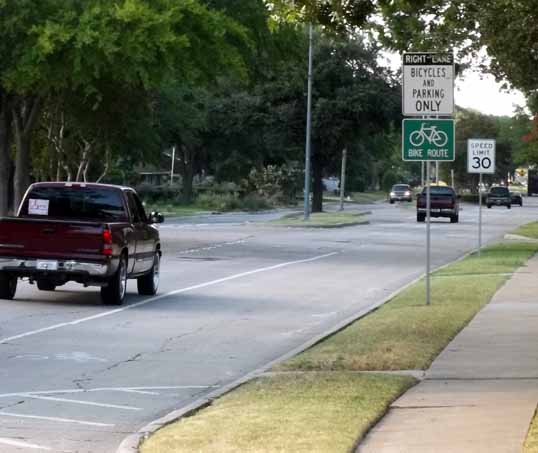
In the last year or so, both have had a bike lane striped off going each way. These are marked off on the right hand side and are shared with bikes and parked cars. The square mile is also sliced on the diagonal with the Duck Creek Linear Park and its trail, plus the Owens Trail branching off to the north under the power lines, Glenville Trail heading west through the trails snaking around Huffines Park – my neighborhood is not lacking for bicycle infrastructure (love the Googlemap green lines for bicycle routes – though they don’t have the one’s on my streets).

The city is expanding this program, and another road near me, Grove, has had the same treatment for at least two miles of its transit through the city.

These improvements have been very popular. Not so much for the bicycle infrastructure they provide – but for their “calming” effect on traffic. These roads were wide enough to allow passing before – which only encouraged excessive speed, and a lot of folks were confused over which lane to drive in. Now the roads are narrowed to a reasonable width and seem to be the better for it.

Recently the city improved the bike lanes in my neighborhood by adding a narrow “buffer zone” that restricts traffic a tad more and gives a bit of confidence to the bike riders.

Bike lane on Yale, near my house.

I’ve been experimenting with these lanes a bit over the last few weeks and have come up with a few opinions and observations.

The lanes themselves are great. Sometimes, sharing the lane with parked cars can be a problem – wide vehicles like lawn-mowing company trailers can force you too far to the left, and there’s always the fear of someone opening a car door in front of you. The drivers do respect the lanes, though. The lanes would be tough for a high speed rider on a hot road bike – but a slow tourist or commuter has no problem in the middle of the blocks.

One problem is the intersections. Left hand turns are harrowing on a bicycle – there isn’t enough sidewalk or shoulder to do the stop, turn, and cross. The cars use the bike lanes for right turns. Look at this picture.

Bike lane merging with right turn lane at Beltline road.

This is a very busy crossing and the cars are going by fast in all directions. There is simply not enough space to navigate a bike through there. If you ride a bike very much in traffic you will learn that bicycles are often invisible to turning cars – I am more afraid of cars making turns than I am of speeding motorists.

Another observation is a more generic one. Planners tend to look at long stretches of road. If they can open up a long stretch, they view that as a victory.

When you are planning a route for your own personal use you tend to think about choke points. These are locations or short stretches of road that cannot be easily or safety crossed on a bicycle. Your route will be developed not to take advantage of long stretches of good road as much as it is chosen to avoid these choke points.

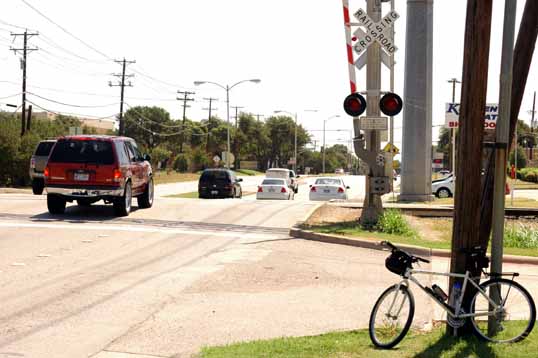
Some of the most notorious sets of these are the railroad crossings. Look at this one on Arapaho – a very busy major thoroughfare.

Rail crossing on Arapaho road.

There are three lanes of traffic both ways going through that little space – going fast, up to fifty miles per hour or more (don’t lecture me on speed limits… this is Texas). There is no sidewalk, no shoulder, no other way to cross. That hump has a set of rough wheel-swallowing steel rails sitting there on top of it. You hit that wrong on a bike and you are going down. There is no other crossing to the south for a mile. It’s two miles south to a safe crossing.

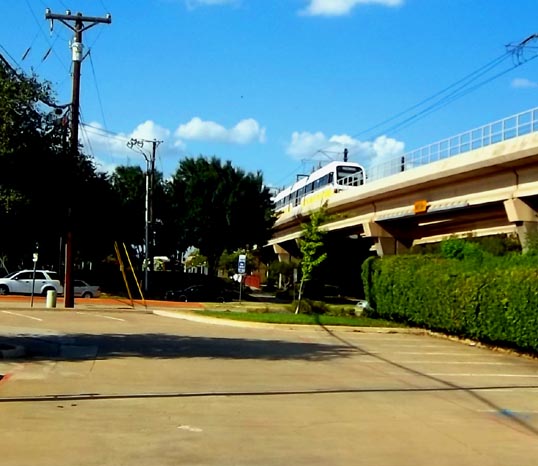
The Grove road bike lane is right behind me… as is the Arapaho DART station. If I want to ride my bike to the library; I have to go through there. If there is any traffic at all I have no alternative than to stop, get off my bike, and carry it over the tracks.

Which isn’t the worst thing in the world… but I wish someone would work on these choke points.

High Tension

As I look around this interweb thing at other people riding bicycles I see things such as a beautiful multiple day tour along the Danube, an afternoon on the streets of Paris, or a civilized ride through Napa valley, complete with wine and gourmet food.

Here’s a cool trailer for a documentary about a bunch of elite skilled mountain bikers in the most amazing isolated places you have ever seen. It’s not about me.

But I don’t live along the Danube, in Paris or in Napa Valley. I live in Dallas, Texas. I ride through horrible baking heat underneath high tension wires.

As the cities of North Texas struggle to backfill their infrastructure with transit options they have to do what they can with what they’ve got. One thing that has proved useful are abandoned rail lines – made in into rail transit corridors or rails-to-trails conversions. Another, less glamorous lemonade-from-lemons option is the open space beneath the high tension power lines.

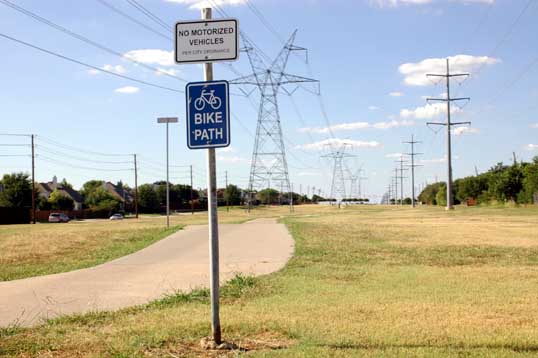
These lines contain rare and precious undeveloped land underneath their buzzing clusters of wires strung between tower steel transmission towers. Because of the enormous voltage carried on these lines, there can be nothing underneath – no houses, trees, or even scrub – only bare grass with an occasional road sneaking across. In theory this makes a perfect path for a new bicycle trail – all you have to do is pour a wide sidewalk snaking back and fourth along the right of way.

The only problem is that it is aesthetically awful. Bare grass, towering gantries of metal, and buzzing wires bursting with voltage… and nothing else. No beautiful meandering rivers, bustling city centers, or impressive distant views – only the wavy mirage of heat waves rising from bare concrete baking in the Texas sun.

What it does offer is mileage. These trails can go on for a long way, crossing huge swaths of dense city. Riding one of these trails gives the illusion of isolation – you forget you are in a hornet’s nest of millions of people – because you barely see anyone other than another rider every now and then. Even the suburban developments that line the right of way have high wooden privacy fences and appear from the trail as a long, ragged, wood stockade.

I went on a long ride the other weekend on a complex of these up in Plano – the Bluebonnet Trail running east and west – intersecting with the Preston Ridge Trail running north and south (which, unfortunately never connects with the Preston Ridge Trail running under the same power line farther south in Richardson).

I rode a long way, though I didn’t exhaust the possible mileage in the long intersecting Plano trail system. Maybe another day… maybe when it isn’t as hot. Don’t think I’ll miss anything in the meantime.

The trail winds beneath the giant towers

When you fall into the illusion that you are isolated in the middle of a bustling city, you come across an oasis of civilization – a busy cross street, a Whataburger, a Taco Delite

A rare and welcome amenity is a shady bench where I can sip some water and read a bit on my Kindle – I carry that in my handlebar bag.

Campion Trail, North Section, Irving, Texas

I had to take Nick to the airport and took a look at Google Maps for a bicycle trail in the area. I only recently learned of the “Bicycle” option on the maps – where any bike routes or trails show up as bright green lines. It makes it easy to spot good places to ride.

I was attracted to a long stretch of green along the eastern border of Irving. Looking closely I saw that it was the Campion Trail. The city wants to eventually hook it all up together into a twenty-mile long system, but for now the north and south sections are unconnected. The northern arm looked to be the longest – running from Las Colinas up past Interstate 635 into Valley Ranch – so I picked a parking area along Riverside Drive – Bird’s Fort Trail Park, and drove there after dropping Nick off.

It had been raining all afternoon, but as I pulled into the parking lot, it tapered to a stop and the sun peeked out from behind the clouds. I put everything together and began to ride. My idea was to go south and visit the two miles or so of trail that went that-a-way, and if the weather held and I felt good I’d then cross back past my car and explore to the north.

The Campion trail is really, really nice. It’s almost brand spankin’ new – miles of smooth, wide concrete with few road crosses and it’s flat as a pancake. I had it almost to myself as I started but as it became obvious that the rain had finished more riders, runners, and families on an evening stroll came out to enjoy the trail and the string of parks it connects.

The only difficulty was water over the trail underneath Northwest Highway. As I approached I saw bicycle tracks in the silt under the water so I forged on in, thinking it was only a few inches deep. It turned out to be about two feet – so I got plenty wet – but was able to force the mountain bike on through without much trouble.

I ended up riding almost the whole trail out and back – skipping only the very last part that winds through the urban areas of Valley Ranch. It was a really nice ride – easy, with a varied landscape. A lot of the trail is through the heavily wooded Trinity River Bottoms, and the various canals, lakes, and ponds of the Las Colinas Area, but there is also some really nice residential areas along the way and the giant concrete mountains of the Interstate 635 and President George Bush Turnpike interchanges.

I rode until the sun started setting. I thought I’d gone about ten miles or so, but my gmap pedometer route shows a tad over twelve.

I’d like to go back, but it sure is a long drive from where I live. There are some side trails and routes I’d like to check out. I’d like to try the South Section of the Campion Trail too. Maybe some day.

You have to keep an eye out for the tasteful and subtle trail markers for the Campion Trail or you will miss them. They are obviously designed to be unobtrusive and to blend into the natural setting.

All along the trail are little paved side trails leading to “River Viewing” areas. There are comfortable benches where you can sit and enjoy the crystal waters of the Trinity River as it roils and burbles down its rocky bed on the way to the sea. As you watch every now and then a Styrofoam cup will float by for your entertainment. If you are lucky, you might get to spot a murder victim’s body.

Especially after a rain, friendly woodland creatures emerge from the thick river bottom woods to greet you along the concrete trail.

The natural landscape is enhanced by the sight of the massive flyovers from the interchange of Interstate Highway 635 and the President George Bush Toll Road.

My Commute Home from Work

I used to tell people that I couldn’t ride a bike to work because the route wasn’t safe. The streets I drive on have a long, blind, fast curving stretch that would be fatal for a slow bicycle. But as I thought about it, I figured out that I could find a safe route – especially after the Glenville Trail that runs behind my house opened up. I thought about it for a year, then finally started to ride. It seemed like a big deal for me when I was thinking about it and when I rode the first time, but now it’s routine.

I don’t ride to work… there is no way for me to take a shower and I sweat like a stuck pig in this summer Texas heat – so I get someone to drive me in to work in the morning and I ride home. This has another advantage of taking away any time constraints so I can ride as slowly as I want. Friday I loaded a point and shoot into my handlebar bag and took some shots along the way.

Near my work I have a couple routes through the parking lots of an extensive area of small business parks. Looking at these businesses – of a tremendous variety – is always interesting to me. I admire and am fascinated by entrepreneurship and these strips of cheap space are the heart and birthplace of new industry.

Magrathea

Magrathea Incorporated? What a cool name. I looked them up – they are on facebook – they’re in the business of restoring classic old cars. A bit of a fall from making entire custom ordered planets – but still pretty interesting.

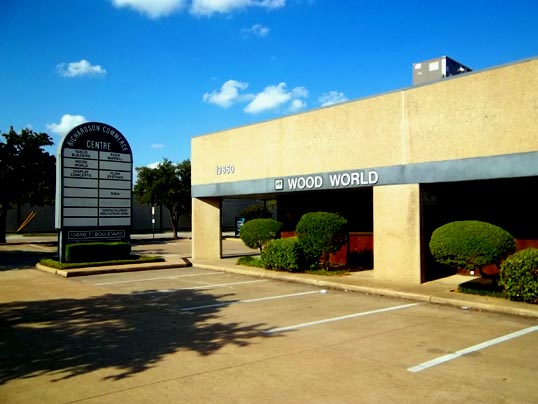
Wood World

Wood World – a neat store with all sorts of rare and useful wood raw materials, tools, and pen kits.

I emerge from the industrial parks and cross Spring Valley at a busy intersection next to the DART station. It’s a long, long light – then I play chicken with the transit busses turning left in front of me.

Here’s the hardest and most fun part of the ride. When you drive around Dallas, you think it is as flat as a pancake. But there are hills that you can notice on a bicycle – when you have to expend the energy to get up them. There’s this alley that I found – almost a mile long, and a slow steady uphill the whole way. When I first rode, it was a struggle riding that stretch. Now I barely even have to downshift. It’s a shock how quickly that changed.

Bike Lane on Grove.

The City of Richardson has started designating the right hand lanes on many of their neighborhood thoroughfares as bike lanes. It’s working out well – the bikes like it and it helps control the traffic. The only problem is making left turns out of the right-hand bike lanes – there is no way to do that safely.

One surprising barrier to bicycle transport are the rail lines. This one cuts right through the city and there are few routes across it – and they are narrow, busy roads.

Glenbrook Trail

The last mile and a half of my commute home is on the Glenbrook Trail – which starts out running under a power line right of way. It was supposed to go farther, but they could not get permission to cross the railroad right-of-way (see above).

The Glenbrook Trail crossing Beltline road.

The trail crosses the very busy Beltline Road (everything in the suburbs of Dallas is on Beltline Road) a block west of Plano Road. It’s a nasty intersection – when I went to meetings on the planning of the Glenville Trail they said they were really struggling with this section – there is simply not enough room.

The other day, while I was waiting for the light to turn, a woman in a VW made a left and a huge SUV was coming way, way too fast and she turned in front of him. There was a screech of brakes, horns, and skidding tires – the SUV went up on two wheels and swerved right past me – in the end nobody hit anything, though it was close. I stood there watching it thinking that if the truck hits the VW it will bounce off and crush me standing right there, four feet away, on the sidewalk with my bike.

The whole thing was over in three seconds.

The intersection is lousy with surveillance cameras and I wondered if I had died a sudden spectacular death would it be captured on one of the traffic cams. Would my demise make it onto Youtube? Texas bicyclist crushed by careening Tahoe. Would I go viral?

Plano Road crossing

Where the trails cross busy roads without lights (this one is on Plano Road) they have these S-Shaped islands. At the planning meetings it was explained that this design forces bicycles and pedestrians to stop in the middle of the crossing and then turn and face oncoming traffic to see and wait for a gap to continue across. It actually works really well – I feel safer at these crossings than I do at the lights (see above).

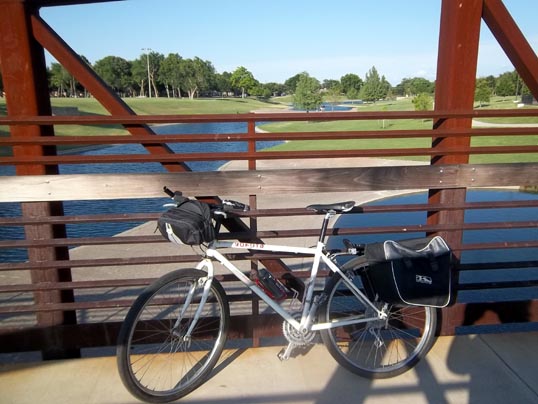
The ponds at Huffhines.

The last part of my commute is the easiest part – the trail goes through the ponds in the park at the end of my block. This is on the bridge over the ponds next to the new Huffhines Recreation Center.

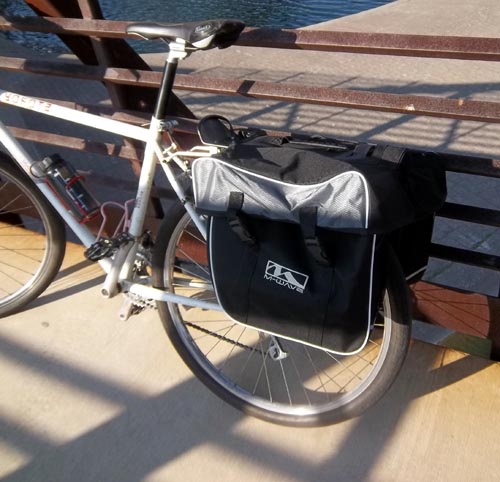
Wal-Mart panniers.

I bought these panniers on clearance from Wal-Mart, believe it or not. They are not the best quality in the world – I wouldn’t go on a cross-country cycle journey with them, but they are handy and work great for clothes and whatever work I have to take home.