“WIth silo mentality, organizations lose their collaborative advantage as they are being over managed and under led.”
― Digital Maturity: Take a Journey of a Thousand Miles from Functioning to Delight

Grapevine, Texas
“WIth silo mentality, organizations lose their collaborative advantage as they are being over managed and under led.”
― Digital Maturity: Take a Journey of a Thousand Miles from Functioning to Delight
Grapevine, Texas
“If my Valentine you won’t be,
I’ll hang myself on your Christmas tree.”
― 88 Poems

Grapevine, Texas
“I think if human beings had genuine courage, they’d wear their costumes every day of the year, not just on Halloween. Wouldn’t life be more interesting that way? And now that I think about it, why the heck don’t they? Who made the rule that everybody has to dress like sheep 364 days of the year? Think of all the people you’d meet if they were in costume every day. People would be so much easier to talk to – like talking to dogs. ”
― The Gum Thief

Cosplay, Grapevine, Texas
“Did not one spend the first half of one’s days in dreams of happiness and the second half in regrets and terrors?”
― The Joy of Life
I am now a good chunk (have been reading for over a year) into Emile Zola’s twenty volume Rougon Macquat series of novels. Attacking this pile of books in the recommended reading order:
The next one up was The Joy of Life (La Joie de Vivre/The Joys of Living/Joy of Life/How Jolly Life Is/Zest for Life).
It is a sort-of sequel to The Belly of Paris. The protagonist is Pauline Quenu – the daughter of the owners of the successful Paris charcuterie in that novel. Between the two novels she is orphaned, and sent at nine years of age, along with her substantial fortune inherited from the business, to live with distant relatives in a dismal seaside fishing village. She moves in with an older couple, the Chanteaus, and their 19 year old son, Lazare.
The title, The Joy of Life, is an ironic one – there is little joy in the Chanteau household. The old man is crippled with gout and his wife crippled by regret. The son is a dilettante and flits from one grandiose scheme to another – each one a greater disaster than the last. Pauline is a generous, good person – and is taken advantage of over and over by everyone else in the story. Her fortune is slowly wasted away, spent on wild ideas and hopeless charity until everyone is left in abject poverty. As she comes of age she inevitably falls in love with Lazare, which is the worst thing that could possibly happen to her.
The detailed portrait of Lazare and his wasted life is a fascinating chronicle of mental illness written before our modern understanding. Lazare suffers not only from depression, anxiety and ennui – but from what we would now call OCD:
With all this were mingled certain ideas of symmetry. He would take three steps to the right and then as many to the left, and touch the different articles of furniture on either side of a window or door the same number of times. And beneath this there lurked the superstitious fancy that a certain number of touchings, some five or seven, for instance, distributed in a particular fashion, would prevent the farewell from being a final one.
I guess it’s not surprising, given the detailed and heartbreaking description of mental illness and its disastrous consequences – The Joy of Life was the favorite book of Vincent van Gogh and is included in two of his paintings: Still Life with Bible and Vase with Oleanders and Books.

Still Life with Bible, Vincent van Gogh (1885) including a copy of The Joy of Life, by Zola

Vase with Oleanders and Books, van Gogh (1888) with The Joy of Life, by Zola
The book was interesting for its characters and dire setting, but isn’t one of the better books in the series. It’s relentless pessimism becomes predictable and repetitive – it makes its point about human weakness and disaster over and over – hammering it home with no subtlety or relief.
Another problem is that I only had access to the contemporary Vizettely translation and the most dramatic part of the book – a nine page section of chapter ten outlining a terribly difficult birth scene – was cut out and replaced with one short paragraph:
There came a cruel and affecting scene. It was one of those dread hours when life and death wrestle together, when human science and skill battle to overcome and correct the errors of Nature. More than once did the Doctor pause, fearing a fatal issue. The patient’s agony was terrible, but at last science triumphed, and a child was born. It was a boy.
It seems that a depiction of childbirth was too much for the delicate English-speakers of the time.
At any rate – I did enjoy the book and found it very interesting even though it became a bit of a depressing slog.
But now I have a decision to make – the next book in the series, L’Assommoir – along with four of the next five – I have already read. Years ago, before the internet, I was able to get my hands on L’Assommoir, Germinal, La Bête Humaine, and Nana – but none of the others in the Rougon-Macquart Cycle. So, do I re-read L’Assommoir? Or skip ahead to L’Œuvre (which looks really interesting).
The thing is, I have other reading to do – a lot of reading. So I should take a break and by skipping the three I have already read I’m only four books from the end.
But the other thing is… L’Assommoir is a great book – one of the best books I’ve ever read – better than the others in the cycle (so far). I’m sure I would get a lot out of it reading it as an old man and having read all the novels leading up to it. Likewise, Germinal is a classic, La Bête Humaine a heart-stopping thrill ride and Nana a guilty pleasure. So I’ll probably take a break – read my Dostoevsky – and then take up Zola’s cycle in full.
Wish me luck.
“Humanity has advanced, when it has advanced, not because it has been sober, responsible, and cautious, but because it has been playful, rebellious, and immature.”
― T

Grapevine, Texas
A cannon that breaks its moorings suddenly becomes some strange, supernatural beast. It is a machine transformed into a monster. That short mass on wheels moves like a billiard-ball, rolls with the rolling of the ship, plunges with the pitching goes, comes, stops, seems to meditate, starts on its course again, shoots like an arrow from one end of the vessel to the other, whirls around, slips away, dodges, rears, bangs, crashes, kills, exterminates. It is a battering ram capriciously assaulting a wall. Add to this the fact that the ram is of metal, the wall of wood.
—-Victor Hugo, A Fight With a Cannon

Commemorative Air Force, Wings Over Dallas, Dallas, Texas
All my life I have heard the phrase “A loose cannon” used to describe a person that, in some way or another, is dangerously out of control. Have heard it, as have you, thousands of times. I have never really thought about what it means.
Today’s short story A Fight With a Cannon by Victor Hugo explains what a loose cannon is and what it means in intricate, desperate, and horrific detail. Imagine a huge cylinder of metal, heavy and hard, on a carriage of wheels set loose unrestrained on a deck of a sailing ship on the high seas. It is a battering ram – full of random destructive motion. This is what a loose cannon is.
But what to do about it? And what to do after that? And after that? The story has the surprising solutions(s). Some people are not what they seem. There is truly more than one kind of loose cannon.
Some helpful definitions:
Carronade – an obsolete naval gun of short barrel and large bore
Assignat – one of the notes issued as paper currency from 1789 to 1796 by the revolutionary government on the security of confiscated lands.
Chevalier – French History. the lowest title of rank in the old nobility.
Cascabel – a knoblike projection at the rear of the breech of a muzzleloading cannon.
Cross of Saint-Louis – The Royal and Military Order of Saint Louis was founded in 1693. The king would award the Cross of Saint-Louis to reward outstanding service to France. The recipient then became a “knight of Saint Louis”.
Ambuscade – an ambush.
Hammock-shroud – A poetical expression which derives its force from the fact that the bodies of sailors or other persons dying at sea are sewed up in hammocks and committed to the deep.
“Pop guns! And bicycles! Roller skates! Drums! Checkerboards! Tricycles! Popcorn! And plums!
And he stuffed them in bags. Then the Grinch, very nimbly,
Stuffed all the bags, one by one, up the chimbley!”
― How the Grinch Stole Christmas!

Grapevine, Texas
“The man who believes that the secrets of the world are forever hidden lives in mystery and fear. Superstition will drag him down. The rain will erode the deeds of his life. But that man who sets himself the task of singling out the thread of order from the tapestry will by the decision alone have taken charge of the world and it is only by such taking charge that he will effect a way to dictate the terms of his own fate.”
― Blood Meridian, or the Evening Redness in the West

Fair Park, Dallas, Texas
“To be in hell is to drift; to be in heaven is to steer.”
―
As I worked on commuting the 5 miles to work on a regular basis – I realized I needed storage attached to my handlebars to keep some stuff that I could reach without getting off my bike.
First, and most important, I needed a place to keep my badge. I work on the big Texas Instruments campus at Hwy75 and 635 (though I don’t actually work for Texas Instruments) on a little peninsula of Dallas sticking up into Richardson, Texas. I need a badge as I ride past the security gate to get onto the campus. I can’t really ride the whole way with the thing banging around on my neck (for safety and comfort) so I would stop a block short of the gate, dig around in my pack or panniers and put my badge on. Although the quick rest was good (help my heart slow down and a little less sweat) I didn’t like wasting all that time looking for my badge mixed in with all the rest of the stuff. I realized I needed something small on my handlebars to keep my badge.
Also, after trying a lot of lights, I prefer some knockoff lights with a USB on the end that I run from portable cell phone battery packs. They are cheap and I can carry extras as backup. But I needed something on my bars to carry the battery. I had been running the wires all the way to the bag on the back of my bike and it kept getting caught on stuff. Finally, I wanted a place to keep my phone and wallet that I could keep my eyes on. Peace of mind, you know.
My cockpit is crowded with lights, bell, plus interrupter brake levers and a standard handlebar bag would take up too much space. So I started looking around and asking other cycling commuters that I know what they use. They all recommended a feed bag style of stem bag.

Feed Bag Cycling Pouch
These looked useful and I was leaning this way. However – I didn’t like the shape – they seem designed for a water bottle and I already have three cages on my bike. What I wanted to store was flat in shape. Also, these seemed a bit pricey (I know, you get what you pay for… I am horribly cheap) – so I held off and kept looking.
After looking around I came cross these things – Toughbuilt Fastener Bag – Heavy Duty Mesh Window, Hanging Grommets

Toughbuilt Fastener Bags
These were inexpensive – 3 for around twelve bucks. I knew they’d be strong and well made. People (carpenters, plumbers, electricians, etc.) that use these things don’t fuck around with stuff that breaks. Plus they were flat in shape, you could see into them, and had a stout metal grommet. So I bought some.
When they arrived I mounted one on the stem of my bike with a carabiner clip and an old bracket from a bike reflector that I had laying around. It worked great.
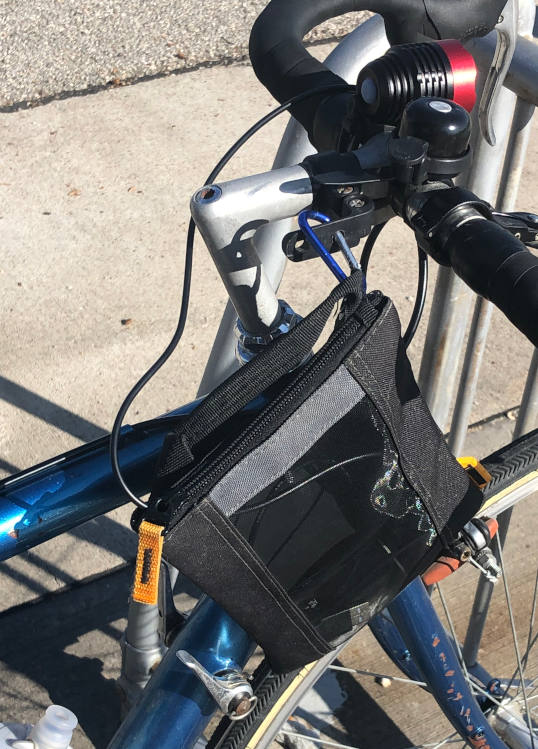
Toughbuilt Fastener Pouch on the stem of my commuting bike. It holds a battery pack, my badge, and usually my wallet and phone.
I know that my love for cheap gadgets and using things not for their original purpose is often self-defeating – but this is perfect – just big enough and it moves sideways through the wind without much resistance. I can keep an eye on my badge, phone, and wallet while I ride and get my badge out when I need it. In hot weather I keep a small paper towel in there too to wipe sweat or clean my glasses while waiting at a stop light. I’ve learned that with bike commuting – when you have to get out that door every morning – it isn’t only about what you carry – it’s about how you organize it.
These little indestructible pouches are a big help with the small things.
“I had noticed that both in the very poor and very rich extremes of society the mad were often allowed to mingle freely.”
― Ham on Rye

Deep Ellum, Dallas, Texas

Deep Ellum, Dallas, Texas
 Bill Chance