Three Bicycling Stories

A Photograph Doesn’t Do Justice 

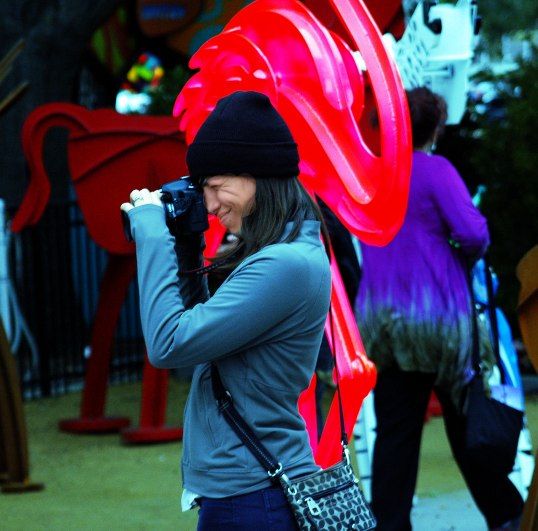
I like taking photographs, though it is ultimately a frustrating and futile exercise. I see an image in my mind and I want to commit it to pixels, but I never can. What ends up on the screen is a poor echo, a warped ghost, of what was in my head. Still, I keep trying.
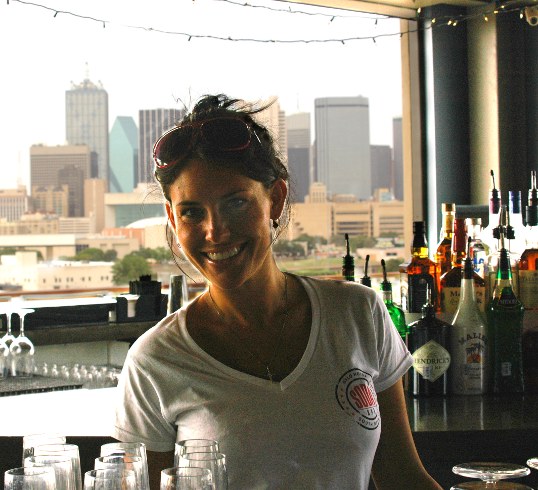
This woman, a bartender at the NYLO Southside, asked Candy, "Is your husband a professional photographer?"Candy answered, "He thinks he is."

This woman, a bartender at the NYLO Southside, asked Candy, “Is your husband a professional photographer?”
Candy answered, “He thinks he is.”

Sometimes, there are images, real images that appear in the eye, of such subtle and ephemeral beauty that a camera can never come close to capturing.

The other morning I was riding my bike to work. I had left before dawn and was moving west on Summit Drive just after Grove Road. It’s a quiet little residential street, perfect for bike riding. Going West, it’s a slight downhill, just right – steep enough to coast but not so much to require brakes – a nice little rest in the middle of my commute.

Behind me, the sun was breaking the horizon, the orange globe peeking out throwing a sudden bright warm light down the street. All along the street were thousands of black birds (grackles, I think) covering the yards, wires, and trees.

The birds did not like me or my bike. Maybe my flashing headlight helped spook them, but they all took off and began to fly away from me. As I moved down the street a massive wave of birds formed in front of me, a cacophony of squawking and flapping wings as they fled in formation.

It was like a giant, solid, noisy, black moving thing, this wave of birds, contrasted with the bare trees and piles of autumn leaves, all bathed in the coral light from the sunrise. A living shape, a rolling cloud, lasting only a few seconds until I reached the turn at the bottom of the hill when they scattered, the wave dissolving into the dawn air, the flock dissipating as quickly as it formed.

As surely as this scene could never be photographed… too evanescent and ethereal for a lens – words fail me. Trust me, it was beautiful – I smiled all the way to work and even for a few minutes in the land of the cubicals until the daily grind ground the moment out.

Still, it is there, in my memory. I’ve never been much of a morning person, but sometimes it’s nice to get up in time to see what the rising sun brings.

My First Fall 

At my age, I’m really afraid of bicycle accidents. I’m a lot more brittle than I used to be and I don’t heal as fast. Still, I ride slowly and carefully and hadn’t fallen for a long, long time.

Until now.

I was going West on Spring Valley (not far from the story above). There is a rail line that bisects my city north to south and is a surprising barrier to cycling – there are only a couple places where it can be crossed and none of them are very safe. The Spring Valley crossing is one of the best – open, wide, and not too much traffic.

Between the rails there are these rubber pads to fill in the gaps for the cars that cross. Unfortunately, the pads had a gap between them… not too much, maybe an inch. The gap, unfortunately  runs parallel to the curb – along the direction of travel. On a bike, cracks or gaps running across your path are a mere bump, but cracks running in the same direction your are – are a disaster.

I am starting to rebuild my commuter bike – an old mountain bike – so I am riding my road bike around town. The road bike has narrow tires. Narrow enough to fit right into the gap between the thick rubber mats.

So I wasn’t looking closely enough and my tire dropped into the gap. It immediately grabbed the rubber and stopped. Instant endo – a nasty crash where your forward momentum throws you over your front handlebars.

I felt the tire drop and grab so I had a split second to prepare myself. I was able to drop a shoulder and roll when I hit, so I wasn’t hurt. I was worried about my bike, but other than a broken toe clip and a missing bar end plug, not a scratch. Luckily, there weren’t any cars behind me, or that might have been a fatal crash.

All’s well that ends well. Hopefully, I’ll have another run of good luck.

It’s frustrating though. I’m sure the city thinks that railroad crossing is fine and doesn’t need any work even though it contains a hidden disaster to anyone riding a bike through there. I don’t have any choice, I’ll have to ride over the crossing at least twice a day when I’m riding to work and most other rides – it’s the only good way to get the the southwest part of town from where I live. I’ll have to be careful and not forget what happened – look out for that gap.

Of course, flying over the handlebars isn’t something you forget anytime soon.

My road bike - an ancient Raleigh Technium.

My road bike – an ancient Raleigh Technium.
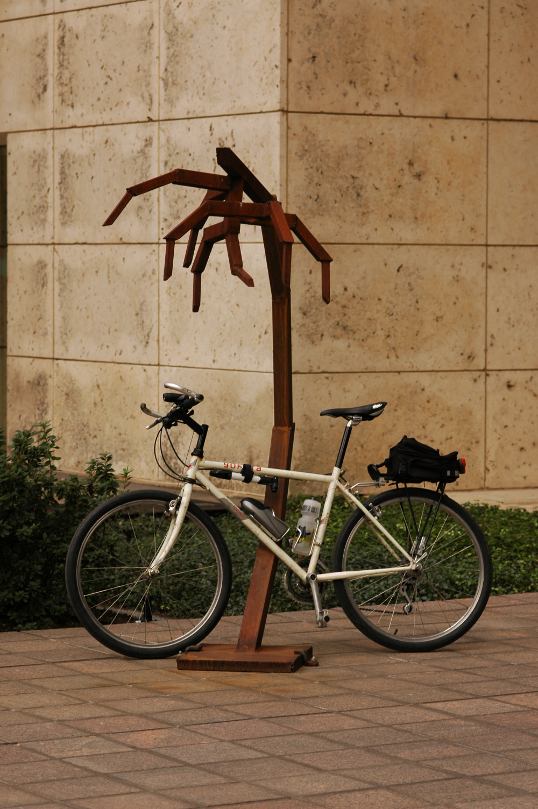
My commuter bicycle - I'm now taking it apart for a rebuild.

My commuter bicycle – I’m now taking it apart for a rebuild.

Riding in the Rain 

My goal for 2013 is three thousand miles on my bicycle. Not too hard, that’s only a bit under ten miles per day (my work commute is ten miles round trip). Still, it will require consistent riding, under less than ideal conditions. Texas winters are cold, spring is wet, and summers… well, they can be fatal.

Rain was predicted for today, but when I woke up in the morning, I checked out the internet weather and the radar maps and it looked like I had a couple hours before the thunderstorms arrived. So I decided to get going and get in twenty miles or so. Never trust anything you read on the ‘net.

The fog was thick as I headed out and withing a couple miles it started to mist and sprinkle. It was fairly warm, so the light rain actually felt nice. I decided to ignore the weather and kept heading out on the route I had in mind.

Over the next few miles the rain slowly increased. Still, it wasn’t too bad and I kept going. Once you are soaked… you can’t get any wetter, so I didn’t want to give up. My phone rang and it was Candy, offering to pick me up, but I said I was doing fine. By this time I was around Galatyn Parkway along Highway 75 and I wanted to go north into Spring Creek and the trails up there.

Then the sky opened up.

I’ve been thinking about rigging my commuter bike for riding in the rain and reading up about bicycle fenders. One article I read had this nice quote:

I’ve cycled through thunderstorms in the U.S. Midwest and Texas and even a typhoon or two in Tokyo. For the Californians on the list, fill a bucket with water, toss in a tray of ice cubes (for the hail) and have a friend throw the contents on you — that approximates about half a second of a typical Midwestern spring storm.

That’s what it felt like – someone dumping a five gallon bucket of iced water on my head twice a second. It’s true that once you are soaked, more water doesn’t make you wetter… but I couldn’t even see. Luckily, a few feet up ahead the trail scooted underneath Highway 75, so I was able to take shelter until the tempest subsided.

It was amazing, waiting there, dripping, under the highway, watching the trickle of a creek rising quickly to become a raging torrent. I was safe on the elevated trail, leaning up against a guardrail halfway between the stream and the roadway above. The various drainpipes associated with the highway all began spewing vast cascades of roaring water, some falling in brown cataracts and others splashing against trees and logs into great sprays of foam. I never noticed, but the roadway is drilled with a pattern of drainage holes and all these began to spew a grid of falling fountains from the bridge far above.

The scene was unexpected and beautiful and it made me laugh to look at my private spectacular water display.

The rain was falling so hard I knew it couldn’t last too long and once the storm subsided to a mere rainstorm I bundled up my wet clothes and headed home. I couldn’t ride the trail all the way because the low-water crossings along Duck Creek were submerged. The waterfowl were all lined up along their swollen eponymous waterway watching the flotsam and jetsam closely, picking out any edible particle that came floating by.

I did manage to get my twenty miles in, and all my stuff is hanging in the house trying to dry out. I’m not sure if I’ll go out in a thunderstorm like that again… but it was kind of fun.

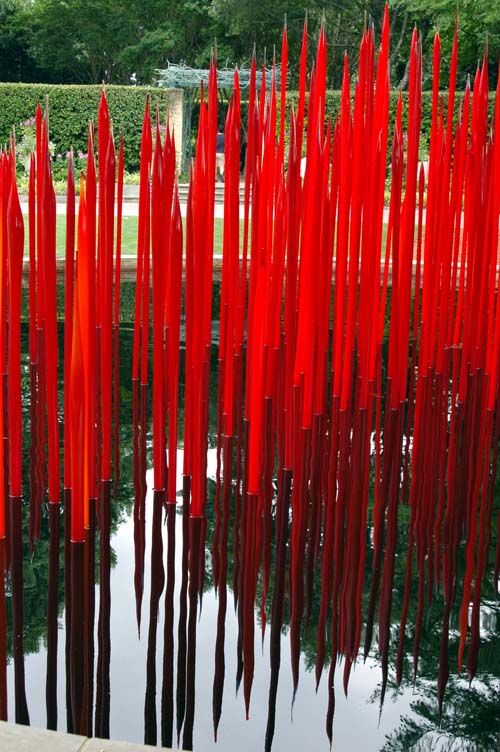
Reflected Trees With Chihuly Red Reeds

Trees reflected in a pond, inverted, with Chihuly, Red Reeds

Trees reflected in a pond, inverted, with Chihuly, Red Reeds

One of my most overused and trite photographic techniques – taking a photograph of a reflection and then inverting it. Here is a favorite of mine. Here is another.  And a third. This is one of trees reflected in the pond of Chihuly’s Red Reeds, at the Dallas Arboretum.

Chihuly, Red Reeds

Chihuly, Red Reeds

Lafayette Cemetery Angel

Lafayette Cemetery No. 1, New Orleans, Louisiana

Lafayette Cemetery No. 1, New Orleans, Louisiana

Young Faun

Now that the Chihuly Exhibit is packed up and leaving the Dallas Arboretum, I’m paying more attention to some of the other sculptures tucked in amongst the (now mostly brown) greenery.

I’ve already written about The Neighbor, the Bronze Couple, Playdays, and the fountain at Toad Corners.

There’s more.

Hidden away off a side path in the A Woman’s Garden is “Young Faun” – by Brenda Putnam.

Youn Faun, by Brenda Putnam, Dallas Arboretum, A Woman's Garden

Youn Faun, by Brenda Putnam, Dallas Arboretum, A Woman’s Garden

Brenda Putnam was born in Minneapolis, Minnesota on June 3rd 1890. Her father, Herbert Putnam, was the Liberian at the library of Congress in Washington DC. Putnam first studied sculpture at the age of 15 at the Boston Museum Art School from 1905 – 1907. She then studied sculpture under James Earl Fraser for a year and later enrolled in The Art Student’s League in New York City and at the Corcoran Art School in Washington DC.

Putnam’s first exhibit was in 1911 and in the years following the First World War she was commissioned to do several fountains, sundials and other garden accouterments. She won the Barnett Prize at the National Academe of Design in 1922 and the Wildner Gold Medal at the Pennsylvania Academe in 1923. Up until 1927 Putnam’s work was comprised mostly of children, cherubs, and garden ornaments and in 1927 she traveled to Florence, Italy to study. When Putnam returned to New York she continued sculpting and in 1935 she was awarded the Waterus Gold Medal at the National Academe of Design.

Throughout her career, Putnam was awarded many monumental commissions including: a Memorial to the women of Virginia in Lynchburg, Virginia; the Congressional Gold medal awarded to Fleet Admiral Ernest Joseph King; and the bas reliefs over the visitor’s gallery in the US House of Representatives. Her last large commission was a bust of Susan B. Anthony done for New York University in 1952.

Brenda Putnam was always an active member of the art community. She was a member of the National Academe of Design, a fellow of the National Sculpture society, and the author of a book titled The Sculptor’s Way.

 
Brenda Putnam, American sculptor, 1890-1975
 

Looking around the web, there are some cool sculptures of that she has done here and there. I need to make a list of these things so I can look for them when I travel. Her work seems to have become more serious and less playful as time went on. She did an amazing work for the 1939 World’s Fair in New York – The Crest – but I have no idea where that would be now. She has a well-known statue, Puck, in the Folger Shakespeare library in DC – it has an interesting history:

From the Wahsington Post:

The Folger’s Happy Mending

By Nicole M. Miller

Washington Post Staff Writer

Thursday, January 10, 2002

For all his mischievous doings and undoings, when it came down to it, Puck couldn’t save his own skin.

It took a bunch of mere mortals to get that job done.

Two years ago, the statue of the Shakespearean sprite that stood outside the Folger Shakespeare Library was in pretty bad shape. Acid rain had been eating away at the marble, and a skateboarder trying to give the imp a high-five had broken off the statue’s right hand.

Now, Puck is back. On Monday the statue, having undergone extensive restoration, will be formally reinstalled at the Folger — this time inside, at the entrance of its Elizabethan Theatre. Since 1932 it had been outside the building, perched above a fountain and facing the Capitol.

But his old fountain perch above the quote “What fooles these mortals be” won’t remain empty. An aluminum copy of the joker from “A Midsummer Night’s Dream” will now face the Capitol. The Folger expects the aluminum to withstand the brutal elements.

“There’s no way we could have had [the original] repaired and put him back outside. . . . That would have caused further damage,” says Frank Mowery, the Folger’s head of conservation.

Puck’s severed arm has been reattached, his broken fingertips repaired and his blackened curly locks bleached to their original snowy white. He actually returned to the Folger in October but has been sitting in a shipping crate in the exhibition hall. On Monday he will be moved to a new Ohio sandstone base in the theater’s lobby.

It was the nonprofit Save Outdoor Sculpture (SOS), a joint project of Heritage Preservation and the Smithsonian American Art Museum, that got Puck’s makeover underway with an $8,000 grant.

“They gave us the spark to say, ‘Look, guys, this is scandalous,’ ” Mowery says of the statue’s then-declined state.

SOS Director Susan Nichols is pleased about Puck’s return. Despite her organization’s focus on outdoor art, she says, “there are times and reasons that a piece needs to be moved indoors.”

Others across the country also offered financial support for Puck’s restoration. A couple in Oregon who regularly attend their local Shakespeare festival contributed. A Texan who played Puck in a high school production also sent money.

Even Peter Gazzola gave. At age 15, Gazzola posed as Puck for sculptor Brenda Putnam, a local artist and the daughter of then-Librarian of Congress Herbert Putnam. Gazzola sent $50 for Puck’s restoration in 1995 when he was 80, long before the restoration campaign began.

He was inspired to send the money after his son Ronald returned from a trip to Washington with pictures of himself beside the statue. Peter Gazzola, of Rye, N.Y., could see that Puck was already in bad shape.

“When the pictures were developed and I showed them to my father . . . he said, ‘Please fix me,’ ” Ronald says. Peter Gazzola corresponded with the Folger and pleaded that repairs be made. In 1999, he sent $25 more, as did Ronald. But Gazzola won’t see the restoration; he died in June, his son says.

Marble conservator Clifford Craine of Daedalus Inc. in Cambridge, Mass., repaired the obvious breaks, cracks, flakes and discoloration. But one thing couldn’t be fixed: the overall erosion on the sculpture’s surface.

Mowery estimates that one-sixteenth to one-eighth of an inch of Puck’s flesh is gone, exposing many small bumps of crystalline quartz — bits of harder stone that do not erode as quickly as the softer marble.

“You look at a piece like this, and maybe its aesthetics are diminished because it’s weathered. . . . I’d like to make it look new,” Mowery says. But conservationists don’t do that. “It is weathered, and you can’t change history.”

So the bumps remain.

Once the Folger decided it was best for Puck to move indoors, the library wanted to create a suitable replacement for the perch above the fountain. Marble was too expensive, so it turned to aluminum. The windows and doors of the Folger are also covered with aluminum grating.

“We decided we wanted to make the sculpture fit with the aluminum elements of the facade,” Mowery says.

Before returning to the Folger, the original, restored Puck was shipped to the Modern Art Foundry in New York, where a rubberized mold was made for the replica. The mold was exact, bumpy surface and all.

“It looked like he had chickenpox,” Mowery says. The foundry is sanding the replica’s silvery surface smooth. It will arrive at the Folger on Monday.

“He’ll tone down to this velvety gray that’s on the building . . . and look like he’s always been there,” Mowery says.

The price tag for the project is about $60,000, more than double what the Folger originally estimated. The library has has raised more than $40,000, and next Thursday it will host a benefit reception to celebrate Puck’s return.

There are two little hitches. One of marble Puck’s “Mr. Spock” ears, the right one, still has a small chip. Puck’s fingers need a bit more manicuring as well. That will all be taken care of with a final day of touch-ups, Mowery says.

”This will be the last time he’ll need this cosmetic work.”

Getting the Shot

Cottonwood Art Festival, Richardson, Texas

If the doors of perception were cleansed everything would appear to man as it is, infinite.

—-William Blake

Halloween is Gone

Garden District, New Orleans

Garden District, New Orleans


More fundamentally, it is a dream that does not die with the onset of manhood: the dream is to play endlessly, past the time when you are called home for dinner, past the time of doing chores, past the time when your body betrays you past time itself.

—-John Thorn


Brakes

At a recent Vintage Bicycle Show I was fascinated by all the geriatric brake technology on display.

For example, I have been interested in the Flying Pigeon Bicycle from China, though I don’t know if I’d actually want to own one. They are, after all, the most popular single means of mechanical transport in history. When I read about them, I was especially interested in the rod brakes – very simple and reliable. They use a series of levers and rods to pull a pair of brake shoes into the inside of the rim. At the show, I saw a bike with rod brakes (not a Flying Pigeon).

Phillips Bicycle with rod brakes.

Phillips Bicycle with rod brakes.

It’s a Phillips. I talked to the guy that had bought it and restored it about the brakes. Another guy said, “If you think about it, a rod brake isn’t that much different, you replace the wire with a rod.”

I don’t know about that. I asked the owner how well they stopped. His reply was a classic, “Well, they stop well enough… when you consider you can’t get going very fast on this thing anyway. You have to be careful… really careful, if you find yourself going downhill.

Across the aisle was an even older and cruder technology.

brakes2

brakes3

The rod brakes on this bike push a rubber block right down onto the tire. I certainly wouldn’t want to be caught going too fast on that bad boy. Cool bike, though. Love the generator.

Finally, there was a bike with a Campagnolo Delta Brakeset.

Campagnolo Delta Brake

Campagnolo Delta Brake

I’ve always loved these. They are heavy, complicated, and don’t work very well… but what a work of art.


One fun story from the show. While I was standing around a guy came in with a vintage Raleigh – about the same age as my 1974 Super Course that I bought my freshman year in college. He was restoring the bike and was about half done – it was rideable, but still looked pretty ragged. I told him the story of how I lost that beloved bike.

“I lived in a third story apartment,” I told him. “I never thought about it, but I left it out on my balcony unlocked. Somebody stole it. It must have been a tree trimmer, working in the neighborhood with a ladder, and he yanked it off my balcony.”

“That’s how I got this bike,” he said to me.

“What, did you steal it off a balcony?”

“No, I saw this guy, he was a landscaping guy, riding this bike. It was in terrible shape, the bar tape was falling off, the paint peeling, but I recognized it as a vintage Raleigh. I asked him if he’d sell it to me. He said, ‘I can’t sell you my bike, it’s the only way I have to get to work.’ So I told him, ‘Tell you what, we’ll get in my car and I’ll drive you to Wal-Mart and you can pick out any bike you want. I take your beat up old bike and I’ll buy you a brand new Wal-Mart bike.’ He said it was a deal and that’s how I bought the Raleigh.”

I loved that story.


Now that I’ve decided I can’t afford a new bicycle I am concentrating on making do with what I’ve got.

I’m lucky in that my Raleigh Technium is old enough (1986 or so) to be vintage and therefore, semi-cool, it is not old enough that I need to keep it stock. So I took it apart and rebuilt it.

You would think that the parts that I would have to upgrade would be the drivetrain – new super gears and integrated shifters and whiz bang shit like that – but that’s not what I did. Old friction shifters and ancient freewheels still work pretty darn well. Dallas is flat, I don’t have to shift very often. What I did upgrade – the place where technology has improved – is brakes.

My Raleigh had old single pivot sidepulls (my even older Raleigh Supercourse from 1974 had center-pulls) and stopping was not a reliable thing. Riding in an urban area – you need to stop. Stop or die. Plus, the cables were rusting and I never liked the awkward cables looping up from the brake levers.

So I bought some new long-reach dual pivot sidepulls from Nashbar, some nice used aero levers from Ebay, and a set of high quality, high tech brake cables. I tore the bike apart, repacked everything that had grease in it, tightened everything down tight, and put the new brake system in. The Technium routes the rear brake cable inside the tubing, and that was a pain… a lot of fishing for cables, but I finished it up and now it rides like a dream. Well, except the engine, of course.

So, now I turn to rebuilding my commuter bike – the creaky old Yokota Mountain bike I bought used at a pawn shop around 1990. The rear shifter won’t shift down any more, so I needed new shift levers – so I bought new ones, and I bought new integrated brake levers too – so I bought new brakes. I’m replacing the old-school cantilever brakes with more modern V-brakes. All this I picked up from fire sales on various places, so I didn’t pay too much money for any of it.

Now, next, I’ll strip the bike down, then paint it (I’m thinking a dark English racing green) – and put all the new stuff on.

That’s the ticket.

http://vimeo.com/26504393#

Change of Seasons

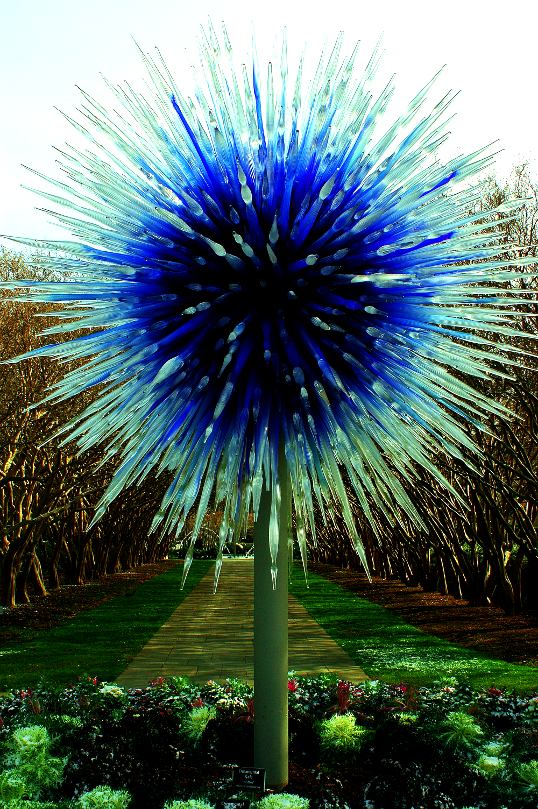
When I drove down to the Dallas Arboretum the day after Christmas for one last visit to the Chihuly Exhibit I took a series of photographs of The Dallas Star, the Crepe Myrtle Allee, and the Toad Corners Fountain beyond. They look much different, though still really attractive, in the leafless winter.

“When you’re young you prefer the vulgar months, the fullness of the seasons. As you grow older you learn to like the in-between times, the months that can’t make up their minds. Perhaps it’s a way of admitting that things can’t ever bear the same certainty again.”

― Julian Barnes, Flaubert’s Parrot

The Dallas Star

The Dallas Star

I know I’ve said it before, but I’ll say it again. I’m going to miss the Chihuly.

“We say that flowers return every spring, but that is a lie. It is true that the world is renewed. It is also true that that renewal comes at a price, for even if the flower grows from an ancient vine, the flowers of spring are themselves new to the world, untried and untested.

The flower that wilted last year is gone. Petals once fallen are fallen forever. Flowers do not return in the spring, rather they are replaced. It is in this difference between returned and replaced that the price of renewal is paid.

And as it is for spring flowers, so it is for us.”

― Daniel Abraham, The Price of Spring

Crepe Myrtle Allee, Dallas Arboretum

Crepe Myrtle Allee, Dallas Arboretum

(Click for a larger and more detailed version on Flickr)

I remember a long, long time ago, talking to a girl. I was talking about how much I liked the life-renewing rains of spring, she replied that she liked the storms of autumn. She liked the excitement, the change, the promise of hard times to come… but not quite here yet. It took me a couple of days of thinking about what she had said to understand that she was right and how unique and interesting her way of looking at things is.

It took me too long, she left me for somebody else. She may be long gone, but I still remember what she said. I will remember it on the day I die.

Expect to have hope rekindled. Expect your prayers to be answered in wondrous ways. The dry seasons in life do not last. The spring rains will come again.

― Sarah Ban Breathnach

season2_w

(Click for a larger and more detailed version on Flickr)

“That time of year thou mayst in me behold
When yellow leaves, or none, or few, do hang
Upon those boughs which shake against the cold,
Bare ruin’d choirs, where late the sweet birds sang.
In me thou seest the twilight of such day
As after sunset fadeth in the west,
Which by and by black night doth take away,
Death’s second self, that seals up all in rest.
In me thou see’st the glowing of such fire
That on the ashes of his youth doth lie,
As the death-bed whereon it must expire
Consumed with that which it was nourish’d by.
This thou perceivest, which makes thy love more strong,
To love that well which thou must leave ere long.”

― William Shakespeare, Shakespeare’s Sonnets

Beater Bike in the French Quarter

Nothing is old… it is vintage. And if it is vintage… it is cool. It’s not rust… it’s a patina.

All bicycles weigh fifty pounds. A thirty-pound bicycle needs a twenty-pound lock. A forty-pound bicycle needs a ten-pound lock. A fifty-pound bicycle doesn’t need a lock. ~Author Unknown

Bicycle, French Quarter, New Orleans

Bicycle, French Quarter, New Orleans

After your first day of cycling, one dream is inevitable. A memory of motion lingers in the muscles of your legs, and round and round they seem to go. You ride through Dreamland on wonderful dream bicycles that change and grow.
—-H.G. Wells, The Wheels of Chance