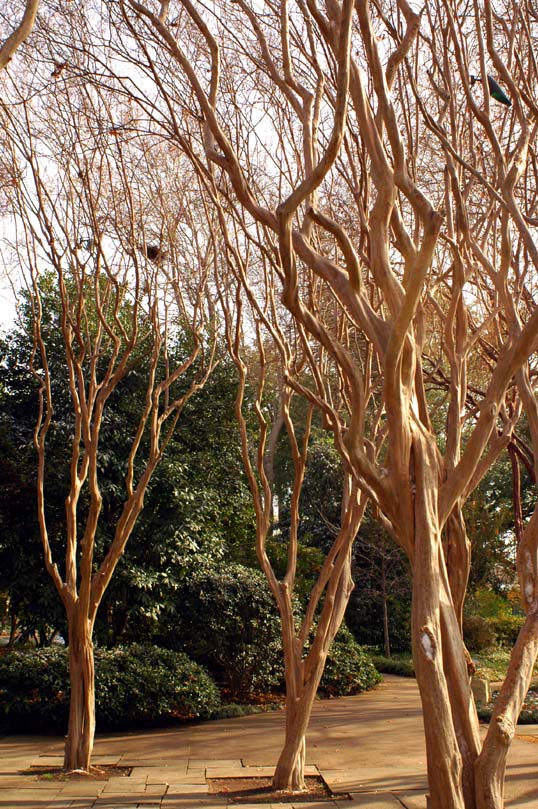
I never get tired of looking at the Crape Myrtle trees here in Texas. They are the Texas State Shrub (I’m sure you were wondering what the Texas State Shrub Was). They are about the only plant that blooms in the killer desert burning summer heat… and in the winter the bare branches make beautiful patterns (If you don’t do like so many folks do and cut the crap out of them – that bugs the hell out of me).
At the Dallas Arboretum there is the Crape Myrtle Allee (sometimes it’s Crepe Myrtle – I’m not sure which is preferred) which I’ve photographed here and here. An incredibly cool long massing of mature trees, a cool tunnel in summer – a tangled tube in winter.
But I like the shape of the individual trees too. The bark peels off and leaves the wood looking almost like skin, the branches twist and turn, and multiply into a thick, fractal towering forest of twigs.
They are so ubiquitous, it’s easy to take them for granted. You have to stop every now and then and simply look at the things.
“As flies to wanton boys are we to the gods. They kill us for their sport.”
—- Shakespeare, King Lear
As I’ve said before – I was excited to watch the fantastic new venues go up in the Dallas Arts District. I especially was fascinated by the Wyly theater. Designed by Pritzker Prize winner Rem Koolhaas and associates it was a unique building, resembling nothing more than a Borg Cube. I distinctly remember thinking that it was such a cool place that it was a shame I could never afford to see a production there.
The Wyly Theater.
“When we are born we cry that we are come
To this great stage of fools.”
I was wrong. It is quite easy to find affordable tickets to most of the productions. Especially on “Pay What You Can Night.” Most productions have one performance (actually, you might call it a dress rehearsal – but it’s the full thing) that they sell the tickets for whatever the audience wants to pay.
These can sell out quickly, of course. But I have the site bookmarked and the dates on my calendar, and I can jump in there and buy them quick. We have seen The Tempest on a cheap day and The Elaborate Entrance of Chad Deity on a Pay What You Can night.
I snagged two tickets to King Lear on Pay What You Can Night. I won’t say what I could pay… right now, it’s not very much, I’m afraid.
“Through tattered clothes small vices do appear.
Robes and furred gowns hide all. Plate sin with gold,
And the strong lance of justice hurtless breaks.”
Candy couldn’t go, though, and I ended up going by myself. On Friday morning I thought about bailing, things were so complicated. I didn’t have a car, would have to ride my bicycle in the cold to work, and then get to the theater. Thursday night I rolled all the possibilities in my head, where to ride, where to lock up my bike, what to take, all the timing.
“I am tied to the stake, and I must stand the course.”
I decided to give it a go when the day turned out to be sunny and warmer than I expected and I actually enjoyed my commute to work. Afterwards, I had to ride around to a couple DART stations looking for an open bike locker – I didn’t want to leave my road bike locked up outside for fear of finding it relieved of vital parts.
“We are not the first
Who with best meaning have incurred the worst.'”
I have only seen King Lear once. Decades ago, I took Lee to see a production outside at the Dallas Shakespeare Festival – I’m not sure of the year, but I guess he was ten or so. Lear is such a dark and complex work, I worried that he would be bored – but there was enough sword fighting and action that he was enthralled, even if he didn’t really understand what was going on. In the infamous eye-gouging scene, an actor actually threw two grapes on the stage and then stomped on them. Lee perked up.
“Hey, what just happened?” he asked.
“Oh, nothing, Lee.” A father has to lie a little now and then.
“I want that glib and oily art
To speak and purpose not; since what I well intend,
I’ll do’t before I speak.”
He especially liked the army scenes where they had a large crowd (probably every stagehand and a lot of local volunteers) moving through the trees around the outdoor venue with lamps and rattling swords. It was pretty impressive – he was a tiny bit afraid… just the right amount. He used to really love going to the Shakespeare plays and I wish I could have done more. We were so busy.
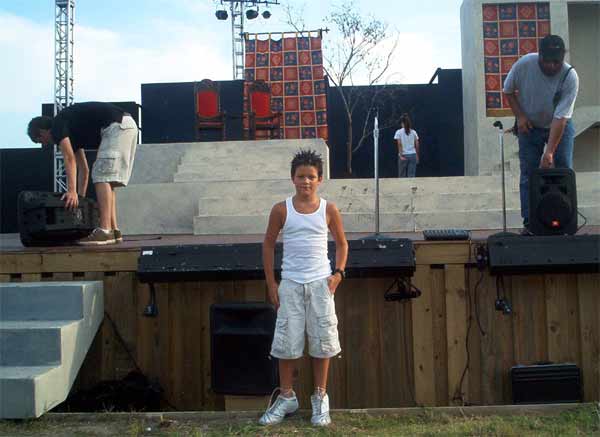
Lee, at the Dallas Shakespeare Festival’s production of Hamlet, a few years ago.
“How sharper than a serpent’s tooth it is
To have a thankless child!”
So, on Friday, I rode the DART train downtown and walked to the Wyly for the performance.
It started out with a very spare stage – a wooden wall, a door, a heavy chair, and a candelabra. I noticed before the performance a couple of stagehands on hands and knees, carefully wiping the stage down, as if they were worried about bits of slippery water.
“Time shall unfold what plaited cunning hides.”
The play started very formal and stiff. The actors stood arranged around the seated king in symmetric positions and delivered their lines. It was all very good, but not very exciting. King Lear is an avalanche of a play; it delivers its punches full-bore – heavy and hard. It doesn’t fuck around.
Still, to entertain a modern audience, you need something more than a static composition, no matter how talented. You need a gimmick, something to entertain the masses. I worried that they had decided to go all old-school, plain, simple, and it was starting to get a little boring. I thought it might be a long night of interesting but not very passionate storytelling.
I was wrong.
“Oh, that way madness lies; let me shun that.”
When I think of King Lear, I don’t usually think of the play itself… or even a film of the play. I think of Ran – the incredibly powerful film by Kurosawa. I saw it in a theater when it first came out and it affected me as much as any film ever did. Based on Lear, set in samurai-era Japan, it captures the tragedy and hopelessness of Lear in an amazing, colorful… Kurosawa style. A work of genius.
“Have more than thou showest,
Speak less than thou knowest,
Lend less than thou owest.”
Still, to this day, when I watch Lear, the back of my mind flashes to the battles and pathos of Ran. It is engraved there forever… I’m afraid.
“This is the excellent foppery of the world, that,
when we are sick in fortune,–often the surfeit
of our own behavior,–we make guilty of our
disasters the sun, the moon, and the stars: as
if we were villains by necessity; fools by
heavenly compulsion; knaves, thieves, and
treachers, by spherical predominance; drunkards,
liars, and adulterers, by an enforced obedience of
planetary influence; and all that we are evil in,
by a divine thrusting on: an admirable evasion
of whoremaster man, to lay his goatish
disposition to the charge of a star!”
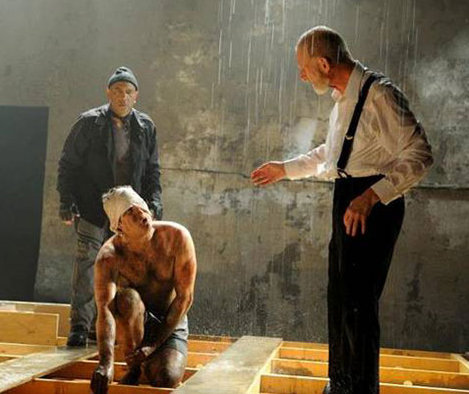
Then, suddenly, about a quarter way through, the formal stylized play ended. As Lear was thrown into the storm of madness the wooden walls that formed the back of the stage fell forward into a tumbledown confusion, huge doors swung down from above and a gigantic torrent of water waterfalled down (sort of Flashdance style – on steroids) onto the King.
And all Hell broke loose.
The rain comes down and madness conquers all.
“Blow, winds, and crack your cheeks! rage! blow!
You cataracts and hurricanoes, spout
Till you have drenched our steeples, drowned the cocks!
You sulphurous and thought-executing fires,
Vaunt-couriers to oak-cleaving thunderbolts,
Singe my white head! And thou, all-shaking thunder,
Strike flat the thick rotundity o’ the world!
Crack nature’s moulds, all germens spill at once
That make ingrateful man!”
The formality gone, torn to the four winds, the rest of the play was a tsunami of a powerful madness, a foil for the Kings insanity and despair. The fourth wall was broken, with actors fighting in the aisles and lightning screaming through the theater. I noticed that even the sound effects added to the disconcerting craziness – every time the King’s mind took a turn for the worst, a crackling buzz came from hidden speakers above the seats – a subtle effect that enforced the impression of insanity and doom.
“Rumble thy bellyful! Spit, fire! Spout, rain!
Nor rain, wind, thunder, fire, are my daughters:
I tax not you, you elements, with unkindness;
I never gave you kingdom, called you children,
You owe me no subscription: then, let fall
Your horrible pleasure; here I stand, your slave,
A poor, infirm, weak, and despised old man.”
And then, the tragedy. As the inevitable doom unfolds, the tragic events set in motion by the Lear’s egocentric arrogance in the first scene come to their conclusion, the horror sets in.
“The worst is not,
So long as we can say, ‘This is the worst.”
This is a play written four hundred years ago by a mysterious man living in a world that is so different than ours. I always wonder what Shakespeare would think, seeing his work performed in a place such as the Wyly theater – which is essentially a huge theater machine, a reconfigurable, hydraulic, giant metallic cube, able to morph into whatever shape is needed. It is thick with electrical wiring; looking up you can see wireless routers laced with tangles of blue Ethernet cables blinking yellow and green in the darkness. Shakespeare would shake with fear at this mechanism which has swallowed his actors and audience whole.
“Come not between the dragon and his wrath.”
Still, it is his words. The same words he must have scratched out with a quill on thick paper four centuries ago. It is a miracle that they are still so effective after all this time… and space.
“Who is it that can tell me who I am?”
Those of us in the audience must know what to expect. It is a tragedy. There is a warning on the sign out in the lobby that the play contains nudity. This story is not going to end well. Everyone is going to die.
“He’s mad that trusts in the tameness of a wolf, a horse’s health, a boy’s love, or a whore’s oath.”
But we have all been spoiled… softened and weakened by Hollywood Films and Television Productions that must have happy endings. The hero will be rescued at the end, despite all odds, and the villain will get his just comeuppance, after he repents and is forgiven. The performance will end with sweet music, with the hero kissing the girl, while a Technicolor sunset flares behind the closing credits.
Shakespeare plays with us. He always adds a little tiny bit of hope – the soldier is dispatched to stop the execution, the poison doesn’t seem to work at first, the bad guy seems to realize the folly of his ways. It is a ruse.
We should know better, but we don’t. When doom descends, we are shocked, shocked even though we knew it was coming, shocked even though we have seen this before, shocked even though we know this is how the world works.
“Poor naked wretches, wheresoe’er you are,
That bide the pelting of this pitiless storm,
How shall your houseless heads and unfed sides,
Your looped and windowed raggedness, defend you
From seasons such as these?”
So stunned we sit there. Then we realize what we have seen. A work of genius.
“The weight of this sad time we must obey;
Speak what we feel, not what we ought to say.
The oldest hath borne most: we that are young
Shall never see so much, nor live so long.”
So now I have set a mark on my calendar for February 1. That’s when the Pay What You Can tickets go on sale for Red – a play about the artist Mark Rothko. If you want to go, contact me and I’ll see if I can get an extra ticket or two.
Now that it has received a nomination for Best Original Screenplay, Focus Pictures has made the entire script available on their website. Check it out – it’s illustrated and colorful and a lot of fun.
I’ve eaten at over half of these (including Babes Chicken Dinner House). I was not overly impressed by the list. Most of these restaurants are not very good – they are touristy and over-hyped. They probably were excellent at one time but have jumped the shark and now exist as a caricature of themselves. Some may be excellent, such as, say, The Mansion on Turtle Creek, or Fearing’s but these are so famous you don’t really need an article to tell you that.
Give me an interesting new place over these hoary old chestnuts anyday.
At the heart of the enduring liberal ideal is a truth that is often forgotten in today’s political debates: the relationship between order and liberty does not have to be zero sum. More government can mean less freedom, and more freedom can mean less government—but things don’t always work out that way.
At one level this is obvious; people don’t so much surrender their liberty by forming a government and agreeing to live in an ordered society as they defend it. Life in an anarchy governed only by the law of the jungle is less free than life as a member of a democratic commonwealth. But this non-zero sum relationship holds in other ways. To have the freedom to drive at 65 miles per hour on an interstate highway, I must accept a lot of rules and restrictions. But the end result of all the requirements about driver’s licenses, insurance, registration and traffic laws is that I can go much faster and farther than I could in a state of nature. There is more order and more liberty in a modern industrial democracy than there is in the forest where our ancestors lived.
The secret of Anglo-American civilization has been its ability to combine the two elements of order and liberty at successively higher levels of both. To think constructively about our future we shouldn’t be thinking about a zero sum tradeoff between order and freedom; we should be thinking about how to build the kind of order that extends our liberty in new and important ways.
Looking at the photos I took during the last, winter days of the Chihuly exhibit at the Dallas Arboretum I like some of the shots of the glass ice-like sculptures he put in the creek that runs through the place.
I posted an entry about this before – but, even though the glass is the same, the time of year is different, I was different, and, hopefully, you are different.
So here are some more.
Chihuly glass sculptures in the creek, Dallas Arboretum
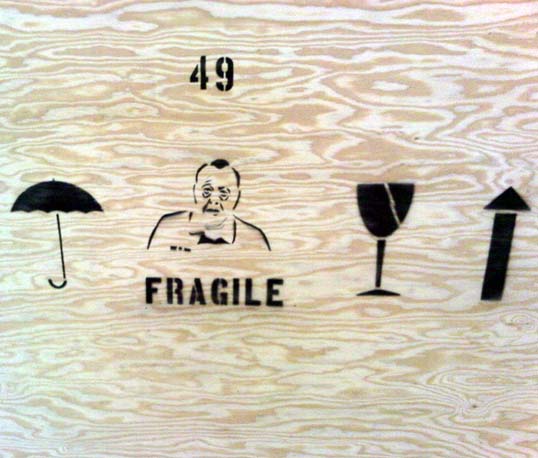
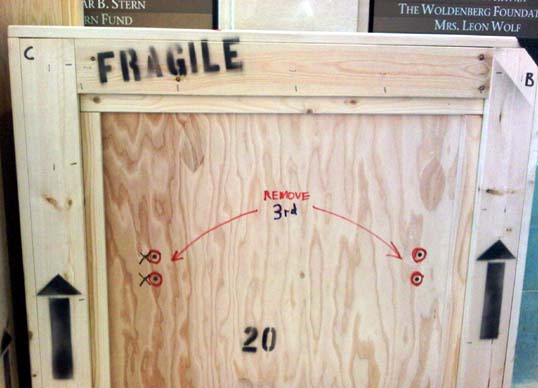
In a hallway in the New Orleans Museum of Art I saw a pile of wooden crates. Obviously a new exhibit on its way in – the plywood was stenciled with a set of transportation-related symbols.
OK, there’s the “this end up” symbol – the “do not let this get wet” symbol – a “Fragile” symbol – but what’s up with the stencil of the guy? Does it mean, “May contain Winston Churchill”? Does it mean, “Dangerous Bags Under Eyes”? “Please notify the butler”? “The old man may be constipated”?
OK, I’m not stupid, I can figure out that the stencil probably means that the crate contains art. Still, who picked that symbol? Why is it important that everybody knows it contains art? Who is that guy anyway?
The museum has some great art – but I sort of enjoyed the hieroglyphics on the packing crates as much as anything.
If I had to guess, I’d think that the crates had at least part of an exhibit called “Lifelike” in them.
I have already written about Playdays – a sculpture in the Dallas Arboretum I love. When I went back the other day, the place looked so different in the winter, the light had changed so much from the Texas summer humid heat, that I couldn’t resist another round of photographs.
Playdays, by Harriet Whitney Frishmuth, A Woman’s Garden, Dallas, Texas
In the summer, the thick greenery keeps the sun from hitting the sculpture directly – now it’s well lit under bare branches and a slanting light. I never realized how close the lake was until winter’s sparseness revealed the chilly, choppy water.
The sculpture is located in A Woman’s Garden, with a nice view from my favorite (though uncomfortable) little bench in the Sunset Garden. Again, it looks different with the change in season.










 Bill Chance