Mass Transit – On the Red Line

Dallas has never been seen as a city that is amenable to mass transit. Unlike an east coast megalopolis it was created in the age of the automobile – vast suburban tracts vomited out across the endless cotton fields along the pulsing arteries of constantly rebuilt freeways. But, for fifteen years now, we have had the DART rail. Always controversial, overly expensive, oft-reviled – the colored lines – Red, Blue, Green, Orange – crawled out inexorably across the map like vines on a brick wall.

Two tattooed guys – one skinny, one not – the skinny guy stands holding his skateboard, the other one sits hunched over a single speed bicycle – like a low slung bike for a kid a third his size. I am used to bicycles used as transport – this would be useless for that. It’s a bike used as a lifestyle statement. He rocks and stares at the chain like he’s afraid it will leap off the cogs if he lets it. Tired middle aged men slumped in seats, a guy playing a game on a smartphone, and a young couple standing in the door holding hands.

These are the people I live a lot of my life with. They are the same people you live a lot of your life with. Perfect strangers. Strangers on a train. I want to know these people and I want their stories.

The two guys, the skateboard and the inefficient but cool bicycle – they may be gutterpunks but they look like they are having fun. The guy on the bike moves back and forth at each stop to let folks get to the door or their seats. When their stop comes (one before mine) he shouts, “Off to another adventure” and shoots out the open door.

Looking at the young couple makes me ache. They may be poor and doomed… but together, today, right now, they are a thing of beauty. Beauty is so rare and so fleeting.

The others… all forgettable. But I know that the forgotten folks all have stories that will raise the hairs on the back of your necks. But we all sit and sway, look around, adjust our headphones, and get off at our stops.

What I learned this week, May 11, 2012


Ciao Publishers. Ciao Agents. Ciao slavery.


UNDER THE UNMINDING SKY


“It’s not catching, though.”

“Tell me you got that.”


What Kind of Literary Ecosystem Do We Want to Build?


Sunday Snippets

A very busy day today, out and about… I did manage to sit in the Espumoso Caffe in the Bishop Arts District in Oak Cliff and sketch out a short story in my notebook. I meant to type it up when I was home in the evening and let you see it here, but I’ve been hammering away and it’s nowhere near done. I have to drive to Oklahoma City tomorrow to pick up Nick, so I better get some sleep.

All I have for this week, therefore, are three little snips of text, signifying very little. I try to keep on file, well, several hundred little scenes or sketches… mostly culled from the wreckage of failed stories – in the hope that I might be able to use them someday. I pull them out in times of low ambition and massage them, water and fertilize them… see if something roots and grows from the barren cuttings of words.

For example….


The little boy came up out of the water like a sprite from a fountain. He shook the droplets off and watched the tiny rainbows as they flew from his body. He looked down at the dark footprints his wet soles left on the hot concrete – at the space between the toes and curved pads and as he gained speed there was only the toes and the ball, then finally nothing as his skin dried.

A sudden scream of air – a whistle – blown – designed to startle – stopped the boy in his tracks right at the foot of the ladder.

“No Running!” came the simple loud command from high.

The boy shook as he looked up at the voice from the chair – but the speaker was obscured by the bright haloing sun.

He walked carefully the rest of the day, little steps, glancing up at the chair.

That night he ate his dinner and cleaned his plate. Then he copied his lessons from the book onto his blue-lined three-holed paper using his number two lead pencil. He took his evening bath, and – remembering the instructions from his health textbook – combed his hair one hundred times. Finally, he crawled into bed, pulled his blanket up to his neck and quietly, almost silently, sobbed himself to sleep.


He sat on a thin high chair at a narrow bar of blond wood facing the broad windows sipping his drink and watching people drive up outside. Two scruffy guys wearing leather jackets sat smoking and talking – making wide, violent gestures and laughing – at a little table on the sidewalk. He was looking out over their heads. One guy had long stringy dirty hair, balding a little in front. The other had given up and shaved this pate.

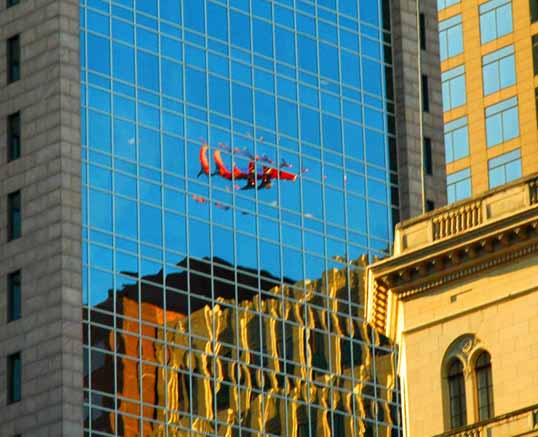
Across the busy intersection was a bank building of white marble alternating in vertical strips with blue reflective glass. It extended up past the top of the windows – he wasn’t sure how tall it eventually was. He glanced up and caught the reflection of an aircraft, an orange and red Southwest passenger jet, crossing the face of the building. It must have been on landing approach over his head; lined up with the bank building’s mirrored windows. The image would jump from one strip to the next, sometimes curved and distorted, sometimes magnified, sometimes shrunk to a pinpoint, depending on the flaw in that particular glass panel. The plane would dance, bend, and jump, flitting distorted and plastic.

He noticed the two guys staring at the dancing plane too. As the reflection disappeared off the left side of the bank they laughed and waved their arms bent in the air in imitation of the flexible jet. They turned and shared a silent smile with him through the window – for a split second.

Until he thought better of it and turned back down to his book.


(click to enlarge)

Paul woke up naked and crusted with what must have been vomit. His brain felt like it had swelled to twice its usual size but was still stuck in the same little head. He thought the pressure might separate his skull along some jagged line, exploding his brain in sweet relief. Every nerve in his body was firing quickly and randomly and the light pouring in from the end of the bridge felt toxic. Paul tried to protect himself by digging deeper under the pile of filthy blankets that was left to him. They weren’t thick enough and Paul was forced to try and figure out what to do. His elbows and knees were scraped bloody and his tongue felt torn on the underside, like it had been half pulled out.

He scrabbled around for his clothes, keys, and wallet and found nothing except a filthy pair of green shorts and a denim jacket that said Big Bambu on the back and a fresh bloodstain coursing across the front. He put those on, wrapped himself in the least-filthy rag he could find for warmth, slid down the concrete slope, and padded barefoot along the trail under the high Interstate overpass back to his car.

He wasn’t really surprised when he found the Chrysler missing. He dug around the camp trying to find anything of value but it had been stripped. The dirty shreds of rags, old shopping carts, and trash were still there as was a dark spot where the night’s campfire had burned itself out cold. But no food, drink, shoes, or anything else of any value remained.

Paul sat and cried for over an hour, until the sun rose and heated the mass of concrete overhead and it felt like a rumbling broiler. He could not figure out how to get home. He considered hitchhiking but couldn’t imagine anyone stopping for a horrible apparition like himself. He couldn’t find any change – not enough for a pay phone, and the thought of trying to panhandle… he couldn’t bear the thought of someone seeing him like that.

Then Paul realized that the creek at the bottom of the interchange was the same drainage system that coursed through his apartment complex. He thought he could follow the way, make the correct turns. He limped down into the stale slow-flowing water, the mud feeling good on his feet, but the filthy liquid stinging his wounded knees and elbows. He noted the direction the water was flowing, turned into it and began trudging upstream.

Wooden Canoe

I am now to the point where everything brings back memories… not even a single memory but a chain of them… separated by great space and greater time – yet linked by a single thing, the inside of my head.

Something as simple as a wooden canoe lying on a grassy bank:

I found a small dugout wooden canoe upside down in a tropical lake, abandoned and rotting in a bank of watery weeds along the shore. I came up under it with a scuba tank on my back, the bubbles catching in its concave interior and I, looking at the long oblong shape against the sun, wondered what it was. There was nobody in miles so I took it for my own.

The wood was soft and I could scrape out the rotten part with a hunting knife. The bow was broken but I fixed it with a piece of plywood and some marine glue. I found some half empty used cans of bilious old paint in a garage closet so I painted it black and gray. I cut a plastic Clorox bottle into a bailer and I was good to go.

I learned to paddle there on that humid lake. Learned to fish from a canoe, learned to navigate in the darkness, saw creatures I never thought existed in fresh water – they had followed ships in through the Gatun locks and most were slowly dying from the lack of salt.

Then I learned to maneuver a rented dented aluminum canoe through the spring flash flowing Ozark rivers on college weekends – the rocky adrenaline thrill of white water and the relaxing lazy languid sluggishness of deep dark green. I learned that a foot of water can be dangerous when it is moving fast under a fallen tree. Also, be careful when you stop in the middle of a ten mile stretch of isolated river for a quick refreshing swim on a gravel bank… don’t leave your car keys behind.

I paddled into the netherworld of Spanish Moss and Bald Cyprus in East Texas Caddo lake. A place out of time where you can find an abandoned church in a place where God has forgotten. I learned to always check the flow of the water before setting out. You are never as strong as you think you are – sometimes it is hard to get back.

Paddling on a lake with two little kids in the boat I learned that you not only have to check the flow of the water, but the strength of the wind. A damned up prairie lake can throw air fast enough to grab the bow and turn it the way you don’t want to go.

There is the sound of small waves banging against aluminum. The feeling of an ill-fitting life jacket while you are trying to work the paddle. The smell of old fish bait. The heat of the sun on the back of your neck. The sight of the little vortexes that spin off your paddle, the little drops of water when you swing it to the other side. There is the ache in your shoulders at the end of a long day and the anticipation when rounding a curve in the river.

Most of all the rhythm of boat, paddle, and water when you get moving across a lake. When it’s all working together and you feel sorry for the folks roaring by spewing oil out of their big outboards (though you do look jealously at that nice little sailboat).

Prison Shuttle

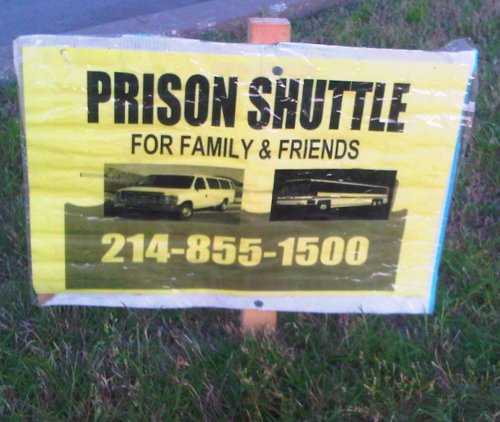
I didn’t feel like it (I was exhausted and my head was pounding) but I went for a little bike ride after work. My bike was in the back of the car so I drove down to the nearby Forest Lane train station – one that the Cottonwood Trail runs by. I changed clothes in the car, which is difficult for me, and pulled the bike out of the hatchback, which is easy. While I was getting my shit together I noticed this advertising sign stuck in the grass border around the parking lot.

i

For Family & Friends

This saddens me. Not so much that somebody has started a shuttle service to the local prisons (For Family and Friends) – if there is a need, there should be someone to fill it. It saddens me that there is such a need.

And look at that bus! I can see chartering a van to take my friends and family for an afternoon visit at the slammer… but who could fill up that bus? That thing has a dual rear axle – that’s a serious hunk of bus there. Are they are thinking about more than mere visits? That bus would be useful for a prison break. You could take a whole unit over the fence and drive them to a nice afternoon at a baseball game all for one low price. I wish that was true… over the obvious fact that there are enough folks up the river that you can fill a bus up on visiting day.

Across the parking lot is a cheap gas station that has a constant flow of shady characters moving in and out with bags full of bottles. I guess the people that run the shuttle service figured out (maybe with extensive research and a focus group or two) that friends and relatives of incarcerated jailbirds tend to walk through this lot – maybe carrying their cheap booze to the train. People riding the train with alcohol won’t have a car they can drive to the pen. They would need a shuttle.

I haven’t seen that ad anywhere else.

So I climbed on my bike and went for a short ride. My head never stopped pounding, so I only went a half-dozen miles or so, stopping at a shady bench to read a short story on my Kindle. While I was loading my bike back in the car for the trip home I watched a few folks walk through the lot… but nobody asked for a pen so they could write the phone number down.

Sunday Snippet – Historical Fiction

Today’s bit is from a confused collection of text that I have been working on for a long time. It was intended to be a piece of historical fiction – a form I love to read but have never really had luck writing.

I think I’m going to give up the historical aspects of this story and move it into the present day. That means I can remove everything from the past and tell it as a complete lie. Trying to do proper research and insure historically accurate details and language was more time than I wanted to waste and more energy than I wanted to expend.

The following is the end of what I used to mess with and it will have to go. But I thought I’d let you take a read before I send it up to that great delete key in the sky.


“Up, Up!” For the second time in the last day, someone was shaking me and shouting into my face. “We must go now!” It was my father. He was in such an agitated state I almost didn’t recognize him.

It took me a minute to get my bearings, to remember and start to understand why I was in bed yet still dressed. The clock showed it to be late afternoon. My face ached terribly and I gingerly touched my mouth and cheek, feeling the dried blood, which stained my shirt with an irregular dark streak. Father ignored my awful appearance, threw an old overcoat around my shoulders and dragged me out the front door.

The Beauregards and the Carrolltons were waiting there, on horseback. Carson held the reins of two more steeds, one for me, one for my father. Before we could mount, my father grabbed me roughly by the shoulders and shoved his face inches from mine. His usually deep and reserved eyes were swollen and bulged out, his cheeks red as beets, his hair, once carefully groomed, now dirty and wild. With a disturbed cracking and rising voice that I wouldn’t have believed could have come from that cultivated and meticulous man he screamed into my face.

“Listen! Listen to me. No matter what happens, no matter what they say or what questions they ask… remember, nothing could have been done! It was God’s will… an act of God alone!” “Do you understand.”

He said the last three words not like a question but as a statement of fact. With that I was grabbed roughly and pulled onto a horse and immediately the group rode off along the road. The rain had let up; only a light misting remained of the violent storm. Everyone was silent as we moved along behind the row of cottages. I couldn’t look out at the lake, it was screened from view by the buildings and landscaping, plus I had to pay attention as the horse worked his way through the deeply rutted road, maneuvering around the many small ponds of standing water. Before long we emerged before the bridge over the spillway but instead of crossing it to the dam the others were turning onto the rough path that led away into the woods. I followed.

They all halted and turned, staring out over the lake. I halted my horse and turned also. I’ll never forget the chill that struck all the way to my very core — the horrible sight that my eyes saw from that road.

The lake was gone. The view was so shocking and unexpected it took several seconds for my mind to comprehend what I was looking at.

Above the old waterline, everything was as it always was; the cottages lined up, the big lodge house, smoke still curling up against the light rain from its cluster of chimneys. The boardwalks still ran along the edge, extending out to the fishing and boat docks, which still stood in place. The hills still ran up and away, covered with the green growth of spring, the blue mountain mists still licked down the hollows to the old waterline.

Below this line, however, everything was horribly, horribly wrong. The lake was replaced with an enormous black wound in the earth. To look down, down into the gaping maw of mud, to see small rivulets of filthy water still running down the impossibly steep sides was to stare into the very depths of hell. I couldn’t stand it. I turned my head away and looked over at the dam itself and saw that it too, had simply ceased to exist. The huge earthen wall was represented now by two small, steep hillocks at each end of an immense chasm. The dam had been neatly sliced away entire by the unimaginable force of the water confined behind it.

Instinctively, I looked back at our own cottage. The dock still stood, except now it was perched high in the air, on stilted legs above an obscene slick, barren hillside. My sailboat hung from its mooring line at the bow, dangling in mid air, swinging in the breeze. Something else moved down there, and I had to look closely to make out the Italian workmen, wading down into the mud. They were grabbing the stranded fish, the bass flopping around helpless, and stuffing them into canvas bags.

For one second I felt sorry for myself. Our wonderful cottage, my beautiful boat, the summers all ruined. That instant of self-pity was drowned by a clear voice that welled up from somewhere deep within me, a voice of awful clarity in the confusion. That voice simply asked, “Where did the water go?”

The lake had been several miles long and up to seventy feet deep. Millions and millions of tons of water had rushed out in what must have been little more than minutes, carrying with it the untold tons more of earth and rock that made up the dam itself. I shuddered when I thought of the power of that giant wave, of how it would grow in deadly fury as it rushed down the mountainside, picking up trees, rocks, roadway… any thing that stood in its inexorable path.

I thought of the narrow canyon that carried the stream down off the mountain, the very valley that I had fought my way up the day before. There was nothing along that way to halt or even slow down the wave; it would actually focus the power, help it to build up upon itself.

Finally, I thought of the city of Johnstown far below. It was already flooded, waterlogged, completely at the mercy of the disaster that fell from the mountains above. The remains of the lake would descend upon the town like a falling mountain, a moving mountain of water and debris, a flying, boiling unstoppable wave of violent death.

Finally, I thought of Maggie in her little shack, perched right there on the bank by the water. Right where the Conemaugh River opened up into the doomed helpless hopeless city.

I let out a cry, a shriek like that of a pitiful useless animal and began to shake uncontrollably. An icy coldness held me in a merciless grip. I couldn’t move. My father saw my state and, still muttering “Act of God, nobody’s fault, Act of God” grabbed the reins of my horse and led us all away into the woods along the rough path.

Ciclovia Dallas

The crowd at Ciclovia Dallas on the Houston Street Viaduct with the Dallas downtown skyline

Saturday, April 14, was a day I had marked my calendar quite some time ago. It was the day of the first Ciclovia de Dallas, and that looked really cool to me. I had never heard of a Ciclovia before. It means bike path, or in this case, the temporarily closing of a road to automobiles so that it can be taken over by cyclists and pedestrians.

The good folks at Bike Friendly Oak Cliff had organized this event and the City of Dallas had closed off the Houston Street Viaduct to cars. The viaduct is a long bridge that reaches out of the skyscrapers of downtown over to Oak Cliff across the vast Trinity River Bottoms. Over the decades I’ve lived in Dallas I have driven across the Houston Street Viaduct many times and I knew it would be a dramatic place to hang out and ride a bike because of the view of downtown and the long drop down into the river.

My intention was to get up early and get to see the whole thing, but I had a rough Friday the Thirteenth the day before and I was so upset I didn’t get to sleep until about five in the morning. So I slept in and it took quite a bit of willpower to drag my aching and worn out body from the bed and into the day. My mind kept racing and coming up with a million reasons not to drive down there and ride my stupid crappy bicycle over an old bridge.

But I persevered, took my bike apart (reminding me why I want to save enough money for a folder) and shoved it into the trunk. Then I drove downtown and proceeded to get caught in several massive traffic jams and lost and lost. I was hungry, frustrated, and sleep-deprived and couldn’t find a parking spot or make the right turns. I fought my way through downtown at least four times, crossing over the Trinity, then making a mistake and ending up on a crowded Interstate going the wrong way. Twice, I went by so closely I could see the folks on bicycles riding back and forth, but couldn’t find a place to stop (or at least couldn’t spot one before I drove by it). I was getting very close to packing it in and going home, but I thought I’d take one more drive across the river.

Finally, after wasting an hour driving around, I gave up and turned down an obscure side street in Oak Cliff, deciding I’d park there, assemble my bike (reminding myself why I want to save enough money for a bike that folds) and ride around looking for the bridge on my bike. After heading off I realized that the entrance to the bridge on the Oak Cliff side was only fifty feet on down the road.

I was late and a lot of the Ciclovia festivities were past, but there was still a nice crowd there and it was a lot of fun. I rode back and forth over the bridge enjoying the views of downtown and the Trinity river bottoms and looking at all the interesting people.

Music at Ciclovia Dallas

Unicyle riders - I was too slow to get a photo of them riding.

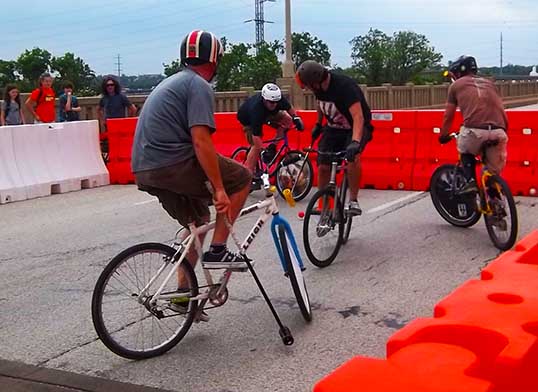
Bicycle Polo on the bridge

Bicycle Polo player

It was so much fun I didn’t pay much attention to getting photographs – I missed the bicycle powered smoothie maker. Didn’t get photos of the unicycle riders on their single wheels. There were food trucks on hand so I was able to get something to eat and I felt a lot better after that.

While I was eating I noticed a guy along the bridge sitting there with a manual typewriter. I’ve wanted a manual letter-hammerer for years and I asked him what he was up to .

His name is Thomas Cantu and he types up little chapbooks on that manual typewriter. I bought one (A Mexican American’s Guide to Your Parent’s Homeland) and chatted with him for a minute. Thomas writes about the Mexican-American experience and how drug violence is destroying Mexico. He says the typewriter is nice because people come up to ask about it and it’s an easy introduction. I told him I’ve always wanted one to put a roll of paper into – he recognized that was how Kerouac wrote.

Thomas Cantu and his typewriter.

So I rode one more lap of the bridge and then went back to my car, took my bike apart, and loaded it into the trunk (getting grease all over and reminding myself about how nice it would be to have a folding bicycle). It was a lot of fun, I hope the event was enough of a success for the city to take the ball and run with it. It would be a great annual thing – to close off the bridge and allow one day of slow riding and walking.

A Ciclovia… what a great idea.

Sunday Snippet – Swallow the Worm

It was in a third floor hotel corridor in Teacup, Mississippi that Kevin Buck met the love of his life. Hurricane Camille had torn open the belly of the Gulf Coast like a giant wind and water driven scythe and flooded what she didn’t wreck. The work and repair crews assembled, coming from all across the center of the continent and careening down in convoys of trucks – blue collar men piling up overtime and setting the world back to right… like they always did.

Kevin needed the money and used some of his last unspoiled connections to hook up with the power crew. His job was to set up a mobile laboratory and test the various oils brought to him by the workers trying to restore burned out or flooded transformers. He’d check for PCBs and then analyze the oil for water content or other contaminants. He could give the workers a pretty good educated guess at what was wrong with the machinery based on the properties of the oil that wrapped and cooled its core.

At the end of each day Kevin would hand write the days lab results in big block letters on thick opaque sheets of paper. He’d clip these to a heavy cylinder and lower that into a bulky machine hooked into a phone line. The cylinder would spin and a little arm would slowly trace its way down the paper – transmitting a crude image back to headquarters over the line. The other workers would sometimes come in and shoot the bull – amazed as they watched the thing spin and move. Every now and then Kevin would have to re-print and re-send a page or two if he hadn’t written large or clear enough the first time.

Kevin had a bachelors in math and a PhD in physics, but tried to conceal his education – especially on the road with the work crews. He liked being with them – liked their simple views, their lack of concern for the future… but especially, he liked the way they drank.

At the end of each day they would gather in the air conditioned interior corridor of the hotel (they rented an entire floor of the small Red Roof Inn) and would share coolers of beer and bottles of stronger stuff.

The women would show up too. Kevin didn’t really understand where they came from or why they were there… divorced women from Teacup or down the road, bored younger girls looking for a way out of town… maybe some professional women willing to ply a little trade on credit. Kevin didn’t pay much attention to them but appreciated the way they livened up the party – gave an edge, a primeval competition to the boasting and drinking.

Then one night… it was very late and Kevin was very drunk… he leaned back, sitting against the plaster wall, feeling the thin cheap carpet through his jeans, and noticed a slim young girl with short ragged dark hair, wearing a white halter top and a tight pair of jeans with the top button undone.

As Kevin watched her she snatched a bottle of Mezcal from a giant man hulking above her. The man was shirtless and covered with a thick layer of dark wiry hair but he was still wearing a bright yellow hard hat. Kevin knew the brand of Mezcal – it was cheap and nasty stuff – illegal in the US but readily available for almost nothing from the legions of workers that swarmed across the border whenever disaster struck.

The girl spun the cap off, stuck the bottle into her mouth and tipped her head straight back. The liquid level was maybe a quarter down and the air bubbled up to the top, making a delicious solvent noise. Kevin watched with his mouth slightly open as the girl held motionless – she must have stuck her tongue in the end of the bottle and plugged it because nothing was running out. The corridor lamps were dim but everyone could see the silvery worm sinking down through the clear liquid. The worm swam back and forth as if it was still alive before it finally tumbled out of sight down the glass neck past the girl’s lips.

She made a gulping sound and a convulsive twitch. Kevin saw a fresh healthy bubble pulse back up through the Mezcal, settling against the flat bottom of the inverted bottle. The girl quickly grabbed the bottle and pulled it from her mouth, flipping it right side up with a wide smile. The worm was gone. The clot of workers standing in a semi-circle erupted into applause… they had never seen anything like that.

“This is the woman I want to spend the rest of my life with,” Kevin said to himself as she took a little bow there outside the hotel room.

Sunday Snippet – Forklift Rodeo

Randall Zaphtig took his daughter Penelope by the hand and led her from the car. They were on a long roadtrip from his ex-wife’s (Penelope’s mother) funeral back to his home in Oklahoma. He had decided not to fly, thinking that the drive would give him time to get reacquainted with his daughter before introducing her to his new wife – her new mother – for the first time. The trip was turning out to be quiet and even more awkward than he had been afraid it would be. He was prepared for tears, but not for the withdrawn, silent, robot-like waif that his daughter had become.

On a whim, Randall left the Interstate at the New Calebtown exit. He turned off almost by habit – he had lived in New Calebtown for his first three years out of school and had worked in the Caleb Brother’s hat factory there as a production engineer.

For some reason, unknown even to him, he had a strong desire to show her the factory he had once worked in. He drove to the plant parking lot by reflex memory but when they both climbed out of the car he saw that the building was no more. All that was left was the cracked parking lot, with mean looking weeds starting to poke up through the fault lines in the asphalt.

Still he took Penelope’s hand and together they walked across to the broken lines of concrete footings that outlined where the factory used to be. Looking down at the parking lot next to that he saw peeling, faded, yet still visible orange lines stenciled in and over the almost invisible now yellow parking demarcations and a strong, long forgotten memory came flooding back, causing him to stumble a little.

The orange lines were from the forklift rodeo. The men in the shipping department took great pride in their ability to move undamaged product out of the door quickly and a great part of that was their ability to drive their forklifts. These were country boys and men, farmers, that had grown up driving trucks and farm equipment not long after they had shed their diapers. Industrial and agricultural machines were in their blood – hydraulic fluid, lubricating grease, and diesel fuel moved under their skin. Driving a forklift at the plant was nothing more than a further fulfilling of their destiny.

The highpoint of their year was the forklift rodeo. There were local, county, and finally State competitions and it was a sad year when somebody from Caleb Brother’s did not place high in the State Finals. A handful had won the competition over the decades and their trophies were displayed proudly in a glass case at the entrance to the office row.

A young hotshot out of college – Randall was expected to referee the factory rodeo. The orange lines were painted on the lot to the exact specifications of the annual contest. They were supplemented by piles of wooden pallets in strategically placed locations to form an obstacle course the contestants were expected to navigate with the heavy trucks, moving forward and backward, fast and slow, picking up, moving and dropping loads according to strict rules and regulations.

Randall had to stand on the dock over the aisle where a contestant would enter with a pallet on his forks, drop the pallet, back out, then turn around, re-inter and retrieve the pallet. He had a checksheet where he would note the proper use of the horn, back-up signal, and whether the driver would turn his head and look for oncoming traffic. He would note the angle of the forks when picking up or lowering, and the height of the forks when moving naked.

There were dozens of details that had to be adhered to and Randall used his checklist to grade the contestants. They would argue later over over whether their heads had turned or if they had looked closely enough or moved too fast backing out. In order to be victorious in the contests, there had to be practice and Randall was assigned to help out with this an hour a day for the month leading up to the Rodeo.

He hated standing out there for hours in the heat watching those men riding the smoke-belching machines, making little tick marks on his forms, and having to argue over every little detail. The men would rib him, especially teasing him endlessly over the fact that he couldn’t do what they did every day. It was humiliating.

Now, decades later, he wondered what happened to those men when the plant closed down. They all had families – sometimes three generations had worked there. Men like that had few options. There wasn’t anything else in New Calebtown for them. Randall had no idea how their families could survive.

He was pulled out of his sad reverie by his daughter. She had been walking along the cracks in the pavement and looking at the harsh spiny nettles that were fighting their way up. A few of them were blooming and she had carefully pulled the flowers off of the sharp stems.

“Here, Daddy, for you,” Penelope said, handing him the bunch of surprisingly colorful blossoms. He held them to his face and was surprised at how sweet they smelled.

“Come on, let’s go,” he said to his little girl, “We’ve still got a ways to go.”

Where I Used to Work

Construction going up

When I first moved to Dallas, in 1981, my first job was downtown. I remember the quiet thrill of riding the bus into the forest of skyscrapers every morning – it was an exciting time. I felt that something was really happening – I wasn’t sure what it was, but it was something (I still don’t know what it was, and am pretty sure it wasn’t anything after all).

For a year or so my office was in the Kirby Building on Main Street. The interesting thing about that is a year earlier I had visited Dallas and had seen the Kirby Building from the Adolphus Hotel and wondered to myself, “What would it be like to work in a building like that?” It was a complete coincidence that I found myself toiling away in that very same space only a year later. The Kirby was a grand old place, much too ornate for a whippersnapper like myself and after awhile we moved to less expensive digs.

One thing I remember about the Kirby is that it had old fashioned carpets (they might have been wool) and on dry winter days you had to walk around with a key in your hand to touch the heavy brass doorknob and ground yourself or the static spark would leap out like Lilliputian lightning and shock the crap out of your fingertips whenever you would open a door. An odd thing to remember after all that time, but you don’t forget that much pain easily.

In the decades since, the Kirby Building has been converted into condominiums. I don’t know if they put in new carpet – I suppose they would have to. I hope it is conductive and non-static.

We moved across downtown to another venerable old edifice, this one not so ornate. It was the Cotton Exchange Building. It was like working in a time warp – they had a cotton trading floor and a restaurant on the ground floor that had not changed a bit since the fifties. We were afraid to eat the salad dressing.

I loved working there. These were the salad days in Dallas and I could watch the high rise buildings going up all around. They sprouted like giant glass asparagus from every available scrap of space. I loved to note the various construction techniques and architectural details – mostly how they made the shape such that they had the maximum number of corner offices. It was a cool place.

But all good things must pass and the Cotton Exchange building was too old and not profitable enough. To prepare for demolition they stripped a modern tacky exterior off and found a classic deco building underneath. There was some talk of preservation, but it was too little, too late.

They imploded the building. I thought about going down there to watch the old lady collapse under the thumb of the dynamite – but it was too early in the morning and I told myself I preferred to remember it as it was. For decades the lot sat vacant and I wondered why they had blown it up.

Now, finally, there is construction. Across the street the First Baptist Church is undergoing a massive renovation and the place of the old Cotton Exchange is being used… as a parking garage. I walked by a while back and took a couple of pictures.

I’m a little disappointed that the beloved old Cotton Exchange has been reduced to a spot for a garage… but I guess at least it is something. People have to park somewhere.

Even Baptists.

The new church across the street.