As Flies to Wanton Boys

King Lear, Dallas Theater Center, Wyly Theater

King Lear, Dallas Theater Center, Wyly Theater

“As flies to wanton boys are we to the gods. They kill us for their sport.”
—- Shakespeare, King Lear

As I’ve said before – I was excited to watch the fantastic new venues go up in the Dallas Arts District. I especially was fascinated by the Wyly theater. Designed by Pritzker Prize winner Rem Koolhaas and associates it was a unique building, resembling nothing more than a Borg Cube. I distinctly remember thinking that it was such a cool place that it was a shame I could never afford to see a production there.

The Wyly Theater.

The Wyly Theater.

“When we are born we cry that we are come
To this great stage of fools.”

I was wrong. It is quite easy to find affordable tickets to most of the productions. Especially on “Pay What You Can Night.” Most productions have one performance (actually, you might call it a dress rehearsal – but it’s the full thing) that they sell the tickets for whatever the audience wants to pay.

These can sell out quickly, of course. But I have the site bookmarked and the dates on my calendar, and I can jump in there and buy them quick. We have seen The Tempest on a cheap day and The Elaborate Entrance of Chad Deity on a Pay What You Can night.

I snagged two tickets to King Lear on Pay What You Can Night. I won’t say what I could pay… right now, it’s not very much, I’m afraid.

“Through tattered clothes small vices do appear.
Robes and furred gowns hide all. Plate sin with gold,
And the strong lance of justice hurtless breaks.”

Candy couldn’t go, though, and I ended up going by myself. On Friday morning I thought about bailing, things were so complicated. I didn’t have a car, would have to ride my bicycle in the cold to work, and then get to the theater. Thursday night I rolled all the possibilities in my head, where to ride, where to lock up my bike, what to take, all the timing.

“I am tied to the stake, and I must stand the course.”

I decided to give it a go when the day turned out to be sunny and warmer than I expected and I actually enjoyed my commute to work. Afterwards, I had to ride around to a couple DART stations looking for an open bike locker – I didn’t want to leave my road bike locked up outside for fear of finding it relieved of vital parts.

“We are not the first
Who with best meaning have incurred the worst.'”

I have only seen King Lear once. Decades ago, I took Lee to see a production outside at the Dallas Shakespeare Festival – I’m not sure of the year, but I guess he was ten or so. Lear is such a dark and complex work, I worried that he would be bored – but there was enough sword fighting and action that he was enthralled, even if he didn’t really understand what was going on. In the infamous eye-gouging scene, an actor actually threw two grapes on the stage and then stomped on them. Lee perked up.

“Hey, what just happened?” he asked.

“Oh, nothing, Lee.” A father has to lie a little now and then.

“I want that glib and oily art
To speak and purpose not; since what I well intend,
I’ll do’t before I speak.”

He especially liked the army scenes where they had a large crowd (probably every stagehand and a lot of local volunteers) moving through the trees around the outdoor venue with lamps and rattling swords. It was pretty impressive – he was a tiny bit afraid… just the right amount. He used to really love going to the Shakespeare plays and I wish I could have done more. We were so busy.
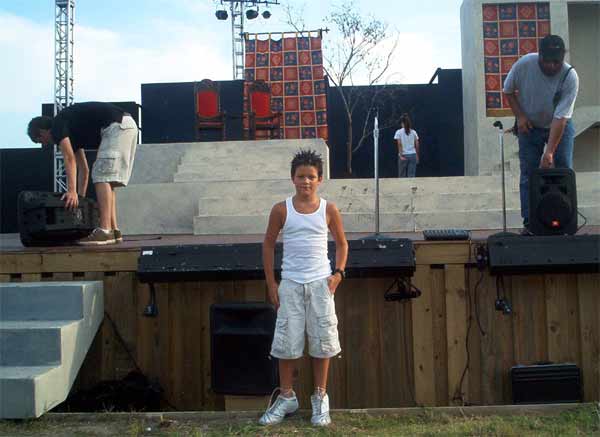
Lee, at the Dallas Shakespeare Festival's production of Hamlet, a few years ago.

Lee, at the Dallas Shakespeare Festival’s production of Hamlet, a few years ago.

“How sharper than a serpent’s tooth it is
To have a thankless child!”

So, on Friday, I rode the DART train downtown and walked to the Wyly for the performance.

It started out with a very spare stage – a wooden wall, a door, a heavy chair, and a candelabra. I noticed before the performance a couple of stagehands on hands and knees, carefully wiping the stage down, as if they were worried about bits of slippery water.

“Time shall unfold what plaited cunning hides.”

The play started very formal and stiff. The actors stood arranged around the seated king in symmetric positions and delivered their lines. It was all very good, but not very exciting. King Lear is an avalanche of a play; it delivers its punches full-bore – heavy and hard. It doesn’t fuck around.

Still, to entertain a modern audience, you need something more than a static composition, no matter how talented. You need a gimmick, something to entertain the masses. I worried that they had decided to go all old-school, plain, simple, and it was starting to get a little boring. I thought it might be a long night of interesting but not very passionate storytelling.

I was wrong.

“Oh, that way madness lies; let me shun that.”

When I think of King Lear, I don’t usually think of the play itself… or even a film of the play. I think of Ran – the incredibly powerful film by Kurosawa. I saw it in a theater when it first came out and it affected me as much as any film ever did. Based on Lear, set in samurai-era Japan, it captures the tragedy and hopelessness of Lear in an amazing, colorful… Kurosawa style. A work of genius.

“Have more than thou showest,
Speak less than thou knowest,
Lend less than thou owest.”

Still, to this day, when I watch Lear, the back of my mind flashes to the battles and pathos of Ran. It is engraved there forever… I’m afraid.

“This is the excellent foppery of the world, that,
when we are sick in fortune,–often the surfeit
of our own behavior,–we make guilty of our
disasters the sun, the moon, and the stars: as
if we were villains by necessity; fools by
heavenly compulsion; knaves, thieves, and
treachers, by spherical predominance; drunkards,
liars, and adulterers, by an enforced obedience of
planetary influence; and all that we are evil in,
by a divine thrusting on: an admirable evasion
of whoremaster man, to lay his goatish
disposition to the charge of a star!”

Then, suddenly, about a quarter way through, the formal stylized play ended. As Lear was thrown into the storm of madness the wooden walls that formed the back of the stage fell forward into a tumbledown confusion, huge doors swung down from above and a gigantic torrent of water waterfalled down (sort of Flashdance style – on steroids) onto the King.

And all Hell broke loose.
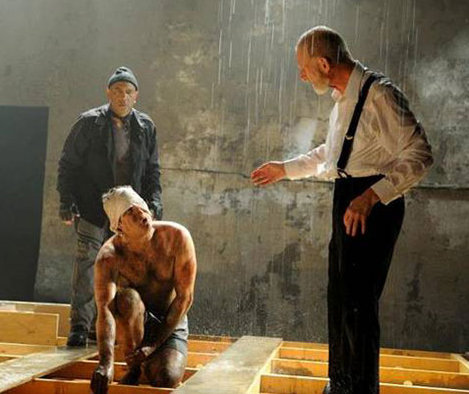
The rain comes down and madness conquers all.

The rain comes down and madness conquers all.

“Blow, winds, and crack your cheeks! rage! blow!
You cataracts and hurricanoes, spout
Till you have drenched our steeples, drowned the cocks!
You sulphurous and thought-executing fires,
Vaunt-couriers to oak-cleaving thunderbolts,
Singe my white head! And thou, all-shaking thunder,
Strike flat the thick rotundity o’ the world!
Crack nature’s moulds, all germens spill at once
That make ingrateful man!”

The formality gone, torn to the four winds, the rest of the play was a tsunami of a powerful madness, a foil for the Kings insanity and despair. The fourth wall was broken, with actors fighting in the aisles and lightning screaming through the theater. I noticed that even the sound effects added to the disconcerting craziness – every time the King’s mind took a turn for the worst, a crackling buzz came from hidden speakers above the seats – a subtle effect that enforced the impression of insanity and doom.

“Rumble thy bellyful! Spit, fire! Spout, rain!
Nor rain, wind, thunder, fire, are my daughters:
I tax not you, you elements, with unkindness;
I never gave you kingdom, called you children,
You owe me no subscription: then, let fall
Your horrible pleasure; here I stand, your slave,
A poor, infirm, weak, and despised old man.”

And then, the tragedy. As the inevitable doom unfolds, the tragic events set in motion by the Lear’s egocentric arrogance in the first scene come to their conclusion, the horror sets in.

“The worst is not,
So long as we can say, ‘This is the worst.”

This is a play written four hundred years ago by a mysterious man living in a world that is so different than ours. I always wonder what Shakespeare would think, seeing his work performed in a place such as the Wyly theater – which is essentially a huge theater machine, a reconfigurable, hydraulic, giant metallic cube, able to morph into whatever shape is needed. It is thick with electrical wiring; looking up you can see wireless routers laced with tangles of blue Ethernet cables blinking yellow and green in the darkness. Shakespeare would shake with fear at this mechanism which has swallowed his actors and audience whole.

“Come not between the dragon and his wrath.”

Still, it is his words. The same words he must have scratched out with a quill on thick paper four centuries ago. It is a miracle that they are still so effective after all this time… and space.

“Who is it that can tell me who I am?”

Those of us in the audience must know what to expect. It is a tragedy. There is a warning on the sign out in the lobby that the play contains nudity. This story is not going to end well. Everyone is going to die.

“He’s mad that trusts in the tameness of a wolf, a horse’s health, a boy’s love, or a whore’s oath.”

But we have all been spoiled… softened and weakened by Hollywood Films and Television Productions that must have happy endings. The hero will be rescued at the end, despite all odds, and the villain will get his just comeuppance, after he repents and is forgiven. The performance will end with sweet music, with the hero kissing the girl, while a Technicolor sunset flares behind the closing credits.

Shakespeare plays with us. He always adds a little tiny bit of hope – the soldier is dispatched to stop the execution, the poison doesn’t seem to work at first, the bad guy seems to realize the folly of his ways. It is a ruse.

We should know better, but we don’t. When doom descends, we are shocked, shocked even though we knew it was coming, shocked even though we have seen this before, shocked even though we know this is how the world works.

“Poor naked wretches, wheresoe’er you are,
That bide the pelting of this pitiless storm,
How shall your houseless heads and unfed sides,
Your looped and windowed raggedness, defend you
From seasons such as these?”

So stunned we sit there. Then we realize what we have seen. A work of genius.

“The weight of this sad time we must obey;
Speak what we feel, not what we ought to say.
The oldest hath borne most: we that are young
Shall never see so much, nor live so long.”

So now I have set a mark on my calendar for February 1. That’s when the Pay What You Can tickets go on sale for Red – a play about the artist Mark Rothko. If you want to go, contact me and I’ll see if I can get an extra ticket or two.

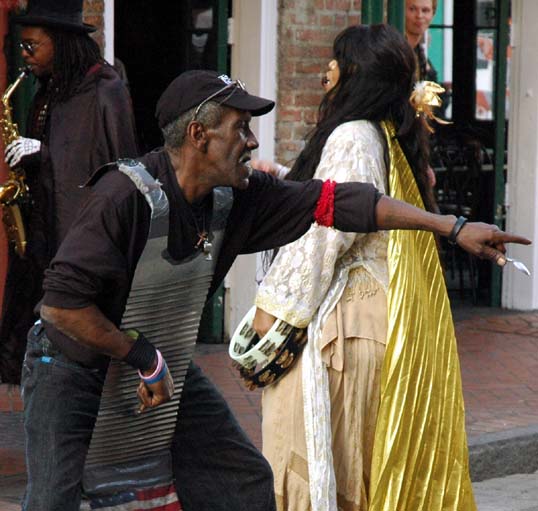
Washboard on Decatur Street

French Quarter, New Orleans

washboard2

washboard1

washboard

Chihuly, Winter, ice in the creek again

Looking at the photos I took during the last, winter days of the Chihuly exhibit at the Dallas Arboretum I like some of the shots of the glass ice-like sculptures he put in the creek that runs through the place.

I posted an entry about this before – but, even though the glass is the same, the time of year is different, I was different, and, hopefully, you are different.

So here are some more.

Chihuly glass sculptures in the creek, Dallas Arboretum

Chihuly glass sculptures in the creek, Dallas Arboretum

iceberg2

iceberg1

The Rise of the Robots

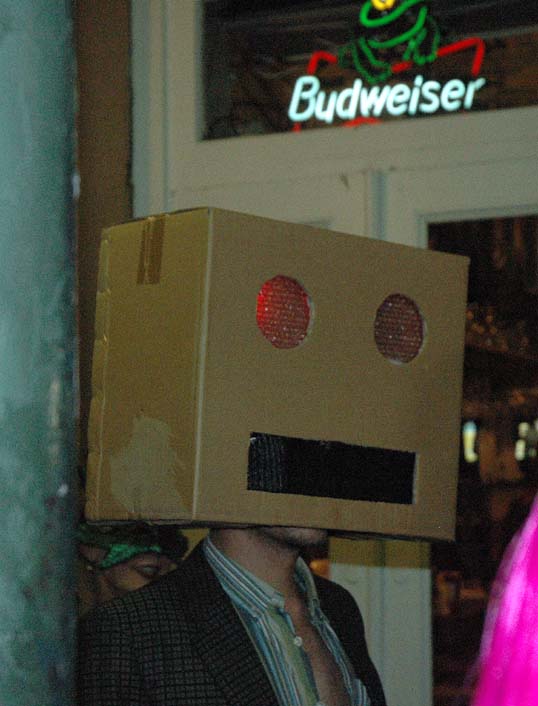
French Quarter, New Orleans, Halloween

robots1

robots2

robots3

Mysterious Hieroglyphics

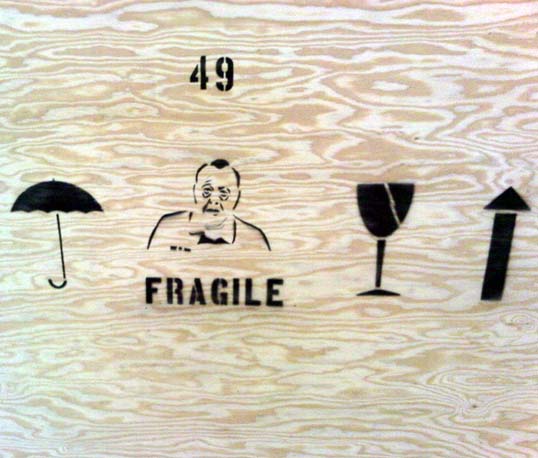
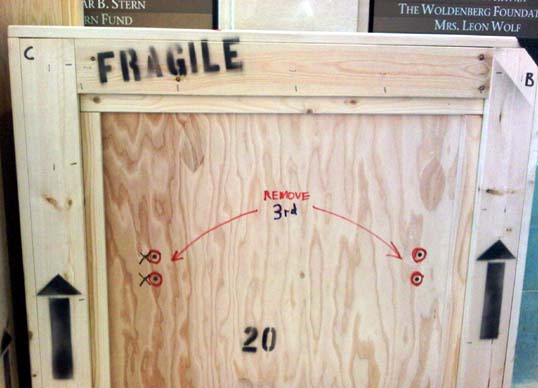
In a hallway in the New Orleans Museum of Art I saw a pile of wooden crates. Obviously a new exhibit on its way in – the plywood was stenciled with a set of transportation-related symbols.

mystery1

OK, there’s the “this end up” symbol – the “do not let this get wet” symbol – a “Fragile” symbol – but what’s up with the stencil of the guy? Does it mean, “May contain Winston Churchill”? Does it mean, “Dangerous Bags Under Eyes”? “Please notify the butler”? “The old man may be constipated”?

OK, I’m not stupid, I can figure out that the stencil probably means that the crate contains art. Still, who picked that symbol? Why is it important that everybody knows it contains art? Who is that guy anyway?

The museum has some great art – but I sort of enjoyed the hieroglyphics on the packing crates as much as anything.

If I had to guess, I’d think that the crates had at least part of an exhibit called “Lifelike” in them.

mystery2

mystery


mystery3

Vintage Bicycle on Magazine Street

Magazine Street, New Orleans

Magazine Street, New Orleans

Perfect urban bicycling… Mixte frame, rear rack, front basket, fenders, upright bars, warning bell, kickstand, chainguard,  leather pants, red shoes.

Playdays in the Winter

I have already written about Playdays – a sculpture in the Dallas Arboretum I love. When I went back the other day, the place looked so different in the winter, the light had changed so much from the Texas summer humid heat, that I couldn’t resist another round of photographs.

Playdays, by Harriet Whitney Frishmuth, A Woman's Garden, Dallas, Texas

Playdays, by Harriet Whitney Frishmuth, A Woman’s Garden, Dallas, Texas

In the summer, the thick greenery keeps the sun from hitting the sculpture directly – now it’s well lit under bare branches and a slanting light. I never realized how close the lake was until winter’s sparseness revealed the chilly, choppy water.

The sculpture is located in A Woman’s Garden, with a nice view from my favorite (though uncomfortable) little bench in the Sunset Garden. Again, it looks different with the change in season.

View from The Sunset Garden, Dallas Arboretum

View from The Sunset Garden, Dallas Arboretum

Reflected Trees With Chihuly Red Reeds

Trees reflected in a pond, inverted, with Chihuly, Red Reeds

Trees reflected in a pond, inverted, with Chihuly, Red Reeds

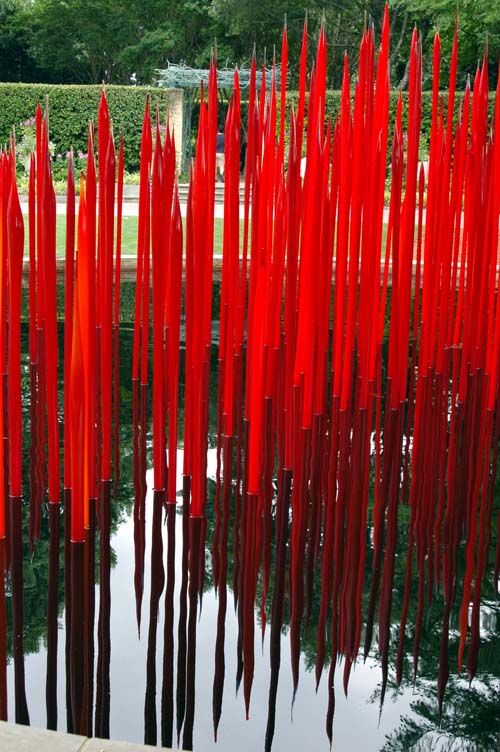
One of my most overused and trite photographic techniques – taking a photograph of a reflection and then inverting it. Here is a favorite of mine. Here is another.  And a third. This is one of trees reflected in the pond of Chihuly’s Red Reeds, at the Dallas Arboretum.

Chihuly, Red Reeds

Chihuly, Red Reeds

Lafayette Cemetery Angel

Lafayette Cemetery No. 1, New Orleans, Louisiana

Lafayette Cemetery No. 1, New Orleans, Louisiana

Young Faun

Now that the Chihuly Exhibit is packed up and leaving the Dallas Arboretum, I’m paying more attention to some of the other sculptures tucked in amongst the (now mostly brown) greenery.

I’ve already written about The Neighbor, the Bronze Couple, Playdays, and the fountain at Toad Corners.

There’s more.

Hidden away off a side path in the A Woman’s Garden is “Young Faun” – by Brenda Putnam.

Youn Faun, by Brenda Putnam, Dallas Arboretum, A Woman's Garden

Youn Faun, by Brenda Putnam, Dallas Arboretum, A Woman’s Garden

Brenda Putnam was born in Minneapolis, Minnesota on June 3rd 1890. Her father, Herbert Putnam, was the Liberian at the library of Congress in Washington DC. Putnam first studied sculpture at the age of 15 at the Boston Museum Art School from 1905 – 1907. She then studied sculpture under James Earl Fraser for a year and later enrolled in The Art Student’s League in New York City and at the Corcoran Art School in Washington DC.

Putnam’s first exhibit was in 1911 and in the years following the First World War she was commissioned to do several fountains, sundials and other garden accouterments. She won the Barnett Prize at the National Academe of Design in 1922 and the Wildner Gold Medal at the Pennsylvania Academe in 1923. Up until 1927 Putnam’s work was comprised mostly of children, cherubs, and garden ornaments and in 1927 she traveled to Florence, Italy to study. When Putnam returned to New York she continued sculpting and in 1935 she was awarded the Waterus Gold Medal at the National Academe of Design.

Throughout her career, Putnam was awarded many monumental commissions including: a Memorial to the women of Virginia in Lynchburg, Virginia; the Congressional Gold medal awarded to Fleet Admiral Ernest Joseph King; and the bas reliefs over the visitor’s gallery in the US House of Representatives. Her last large commission was a bust of Susan B. Anthony done for New York University in 1952.

Brenda Putnam was always an active member of the art community. She was a member of the National Academe of Design, a fellow of the National Sculpture society, and the author of a book titled The Sculptor’s Way.

 
Brenda Putnam, American sculptor, 1890-1975
 

Looking around the web, there are some cool sculptures of that she has done here and there. I need to make a list of these things so I can look for them when I travel. Her work seems to have become more serious and less playful as time went on. She did an amazing work for the 1939 World’s Fair in New York – The Crest – but I have no idea where that would be now. She has a well-known statue, Puck, in the Folger Shakespeare library in DC – it has an interesting history:

From the Wahsington Post:

The Folger’s Happy Mending

By Nicole M. Miller

Washington Post Staff Writer

Thursday, January 10, 2002

For all his mischievous doings and undoings, when it came down to it, Puck couldn’t save his own skin.

It took a bunch of mere mortals to get that job done.

Two years ago, the statue of the Shakespearean sprite that stood outside the Folger Shakespeare Library was in pretty bad shape. Acid rain had been eating away at the marble, and a skateboarder trying to give the imp a high-five had broken off the statue’s right hand.

Now, Puck is back. On Monday the statue, having undergone extensive restoration, will be formally reinstalled at the Folger — this time inside, at the entrance of its Elizabethan Theatre. Since 1932 it had been outside the building, perched above a fountain and facing the Capitol.

But his old fountain perch above the quote “What fooles these mortals be” won’t remain empty. An aluminum copy of the joker from “A Midsummer Night’s Dream” will now face the Capitol. The Folger expects the aluminum to withstand the brutal elements.

“There’s no way we could have had [the original] repaired and put him back outside. . . . That would have caused further damage,” says Frank Mowery, the Folger’s head of conservation.

Puck’s severed arm has been reattached, his broken fingertips repaired and his blackened curly locks bleached to their original snowy white. He actually returned to the Folger in October but has been sitting in a shipping crate in the exhibition hall. On Monday he will be moved to a new Ohio sandstone base in the theater’s lobby.

It was the nonprofit Save Outdoor Sculpture (SOS), a joint project of Heritage Preservation and the Smithsonian American Art Museum, that got Puck’s makeover underway with an $8,000 grant.

“They gave us the spark to say, ‘Look, guys, this is scandalous,’ ” Mowery says of the statue’s then-declined state.

SOS Director Susan Nichols is pleased about Puck’s return. Despite her organization’s focus on outdoor art, she says, “there are times and reasons that a piece needs to be moved indoors.”

Others across the country also offered financial support for Puck’s restoration. A couple in Oregon who regularly attend their local Shakespeare festival contributed. A Texan who played Puck in a high school production also sent money.

Even Peter Gazzola gave. At age 15, Gazzola posed as Puck for sculptor Brenda Putnam, a local artist and the daughter of then-Librarian of Congress Herbert Putnam. Gazzola sent $50 for Puck’s restoration in 1995 when he was 80, long before the restoration campaign began.

He was inspired to send the money after his son Ronald returned from a trip to Washington with pictures of himself beside the statue. Peter Gazzola, of Rye, N.Y., could see that Puck was already in bad shape.

“When the pictures were developed and I showed them to my father . . . he said, ‘Please fix me,’ ” Ronald says. Peter Gazzola corresponded with the Folger and pleaded that repairs be made. In 1999, he sent $25 more, as did Ronald. But Gazzola won’t see the restoration; he died in June, his son says.

Marble conservator Clifford Craine of Daedalus Inc. in Cambridge, Mass., repaired the obvious breaks, cracks, flakes and discoloration. But one thing couldn’t be fixed: the overall erosion on the sculpture’s surface.

Mowery estimates that one-sixteenth to one-eighth of an inch of Puck’s flesh is gone, exposing many small bumps of crystalline quartz — bits of harder stone that do not erode as quickly as the softer marble.

“You look at a piece like this, and maybe its aesthetics are diminished because it’s weathered. . . . I’d like to make it look new,” Mowery says. But conservationists don’t do that. “It is weathered, and you can’t change history.”

So the bumps remain.

Once the Folger decided it was best for Puck to move indoors, the library wanted to create a suitable replacement for the perch above the fountain. Marble was too expensive, so it turned to aluminum. The windows and doors of the Folger are also covered with aluminum grating.

“We decided we wanted to make the sculpture fit with the aluminum elements of the facade,” Mowery says.

Before returning to the Folger, the original, restored Puck was shipped to the Modern Art Foundry in New York, where a rubberized mold was made for the replica. The mold was exact, bumpy surface and all.

“It looked like he had chickenpox,” Mowery says. The foundry is sanding the replica’s silvery surface smooth. It will arrive at the Folger on Monday.

“He’ll tone down to this velvety gray that’s on the building . . . and look like he’s always been there,” Mowery says.

The price tag for the project is about $60,000, more than double what the Folger originally estimated. The library has has raised more than $40,000, and next Thursday it will host a benefit reception to celebrate Puck’s return.

There are two little hitches. One of marble Puck’s “Mr. Spock” ears, the right one, still has a small chip. Puck’s fingers need a bit more manicuring as well. That will all be taken care of with a final day of touch-ups, Mowery says.

”This will be the last time he’ll need this cosmetic work.”