Music is definitely getting worse over the years. There are a couple on the 1960’s list that I thought were pretty good songs (Downtown, Windy) but the other two…. Well, there’s one on the 1980’s that has sentimental value for me (Mickey, I can’t believe that made #1 – it really does suck) but otherwise that is a bunch of rank music. I would imagine that the 90’s and the ought’s would be even worse. What even makes a #1 song anymore anyway?
I didn’t make it to this beer festival in Fort Worth – I still haven’t completely recoverd from the Big One at Fair Park a couple of weeks ago… But had I realized it was sponsored by Paste Magazine – one of my favorite things, I might have made the trip.
A big shout out to Lakewood Brewing (located only a couple miles from where I live) in this nice writeup.
DALLAS is known for its conservative manner, an obsession with American football and oil—not so much for its culture. But recently, that has been changing.
I’m glad to have stumbled across this article. I actually had a teacher (seventh grade, I think) spend a day or so and taught the class how to do square roots on paper. A skill that will be very useful when the zombie apocalypse comes and our calculators stop working. Oh, and if memory serves, after learning the square root method (the same one in the linked article, I remember “bringing down the next two”), we quickly went over a way to do cube roots. Only a couple of us could do that. I don’t remember how, which is cool… because who would ever have a reason to do cube roots on paper?
This weekend we were at the North Texas Taco Festival in Deep Ellum. It’s a continuation of the events associated with the Deep Ellum Market (such as the Filipino Fest last year) and the most successful so far. There were a lot of people there. Unfortunately, more people than tacos and the lines were too long (I’ll talk more about that later).
But still, it was a beautiful day and a fun time. At the side of the street, next to the Curtain Club, I saw a sign that said, Taco Talk – 1 PM. Looking at my phone, it was about ten after, so we went in.
Inside was a lecture put on by three taco experts. It was sort of fun being a couple minutes late because we didn’t hear the introductions and had to figure out who they were by inference.
John Cuellar, Anastacia Quinones, and Alejandro Escalante – the panellists at the Taco Talk.
First was a man that kept referring to his “family restaurant.” He was the supporter of Tex-Mex among the three experts and knew a lot about the history of that branch of the Mexican food tree. He said, “When we needed to revamp a menu, we would go to California, Mexico City, or San Antonio. Each place has such a unique take on the history and style of Mexican Food, you could find something new to bring home and adapt.”
I realized that his was John Cuellar, of the El Chico founding family. His family sold their chain and now he is responsible for a restaurant in Oak Cliff, El Corazon de Tejas – a place we will have to check out. I’ll let you know about it.
Next to him was a woman that graduated from the CIA and was the representative of the expert culinary aspects of the humble taco – elevated to gourmet heights. She was Anastacia Quiñones, the chef at Komali. After the talk, we spoke to her for a few moments and she gave us a card and a free appetizer – so… well, another place to go and report.
She talked about the wonderful taste of fresh nixtamal. Most tortillas are made from commercial ground cornmeal or processed mix. She said her restaurant was the first in the city to make fresh nixtamal – whole kernel corn processed with lime (like hominy) and then ground fine on a metate each day. All three experts said that fresh nixtamal produces tortillas with a unique and wonderful taste and must not be missed.
Well, there you go then.
The third panelist was an expert on all things taco. He was Alejandro Escalante – the author of the book, Tacopedia. He talked passionately about the wide variety of tacos available throughout Mexico and all the variables in tortilla, meat, and salsa that can be used. The depth of his knowledge and the obvious love he had for the form made his contribution something to be enjoyed and savored.
One interesting point they made was when they were asked about Mexican Fast Food – about Taco Bell and Chipotle. These are Taco Experts and passionate about quality food and you would expect them to rant and complain about the bland and poor quality of fast food. They did not, however. Mr. Escalante pointed out that Mexican Food, tacos and nixtamal in particular, are an acquired taste and Taco Bell helps people become accustomed to the food style. Ms. Quiñones agreed and Mr. Cuellar used the phrase that occurred to me immediately – that Chipotle is the “Gateway Drug” to real Mexican Food. I thought their attitude to be refreshing and honest.
They all three spoke about their first memories of eating tacos and about their “Desert Island Tacos” – what they could not live without. In high school, in Nicaragua, there weren’t really any tacos, so my first real memories of great tacos were from Hutchinson, with flour tortillas filled with ground beef, sealed with toothpicks, and then fried crispy. You would crack them open and fill with lettuce, tomato, and salsa right before eating.
They talked about what makes a taco (who knows?) and the close relatives of enchiladas and tamales. I thought about the Nicaraguan Nacatamles – giant savory concoctions layered with masa and served in steaming packets of banana leaves – and how I can’t get them anywhere (although the Salvadoran tamal served in local pupuserias does come close).
They talked about the future, about lengua, cabeza, and authentic barbacoa, and about how far can the form be taken. I thought about the Ssahm Food Truck here in Dallas and their wonderful Korean style Kimchi tacos.
They even mentioned puff tacos – which were really popular when I first moved to Dallas in the 1980’s. That’s when you take a disk of masa and drop it in oil… and it puffs up crispy, so it can be cracked open and filled. John Cuellar said there was an art to getting everything, temperature, moisture, oil, just right and if you had a sixty percent success rate, you were doing good.
It was a very fun and interesting talk. We spoke to the folks for a minute afterward, but they had to get set up for the judging of a taco contest. We walked out the side door where a handful of local chefs were preparing their contest entries – they looked wonderful.
Back in 1991, the newest attraction at Woldenberg Park was an 18-foot-high marble statue titled Old Man River located behind Jax Brewery. The sculptor, Robert Schoen, decided to create a monumental male figure with arms stretched up, a stylized human figure made of 17 tons of Carrera marble. The figure’s circular movement seems to convey a harmony between the artwork and its location. The river is connected to the land through the openings of the legs and arms. Old Man River is supported by a twin-tiered base with ridged sides that imitate currents in the Mississippi River.
It has been suggested that the muscular figure is, like the port of New Orleans, cosmopolitan in spirit. Stylistically, the sculpture suggests sources as diverse as streamlined neo-classical statuary of the 1930s and Asian and pre-Columbian art.
“I wanted to make a sculpture that would reflect the river’s embrace of the city,” Schoen said of the statue. “The sculpture is a modern statement with European roots, which is what makes New Orleans unique in America.”
Old Man River A Man with a Past Arms reach empty handed, God to a city in Love with Water Robert Schoen Artist 1991
There are fewer people on a train before dawn on weekends, but there are still more than you would expect.
A lot of people that are on the train that early on the weekend look like they are involved in sports. I guess that makes sense. It looked like an entire woman’s tournament (maybe volleyball) was going somewhere south in Dallas.
It’s cold before the sun comes up.
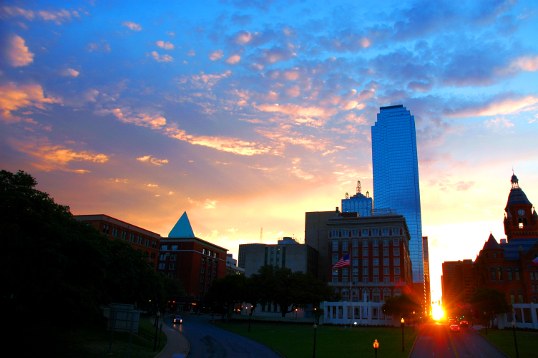
I estimated that the sun’s disk would rise up in the center of Main Street in Downtown Dallas two days after the official henge date.
I was pretty much right.
Dallashenge from the triple underpass in Dealey Plaza. This is an HDR image – three shots taken at different exposures and combined with software.
A wide angle view of Dealey Plaza at dawn on the morning henge day (or two days later). The brick building in shadow on the far left is the infamous Texas Schoolbook Depository. President Kennedy was shot on the curved road on the left, almost fifty years ago.
The sun rising in the canyons of Main Street, Dallas.
I took a lot of photographs in the short few seconds that the sun peeked up down Main Street. I’ll probably post some more as I post-process them.
So now I’ve done it, I don’t have to get up that early and go anymore. Well, maybe not. As I was walking back towards the train, I discovered another spot with a morning “henge” view directly down Elm street, right along the schoolbook depository. It wasn’t as scenic as main street, but had a more “canyon” appearance. Maybe next year I’ll go and shoot that one.
I am not a morning person and when my alarm went off at 5:15 it took more than a little effort to drag myself out and about. I was worried about the weather, but at the train station I saw stars glinting here and there through the thick city night sky soup and I knew it was cloudless. But as I waited for the train, I saw the telltale glow in the east which quickly grew into the start of a salmon-colored dawn and I began to think I was not going to make it in time.
The train arrived and I climbed aboard, wedging myself in with the morning’s crop of sleepy commuting workers, having to make room for my backpack filled with a camera and my folding tripod across my lap.
It was April 19, the morning Dallashenge. I first came across this concept well over a year ago, when I read about Manhattanhenge – the day that the setting (or rising) sun lines up with the east-west street canyons of central New York. In a city (like Chicago) where the streets run exactly along the points of the compass, the henge date is on the spring and fall equinox – but in cities like New York (or Dallas) where the downtown street grid, for geologic or historical reasons, is a few degrees off-kilter, the dates will fall somewhere else.
Using the very useful website, suncalc.net, I was able to calculate the henge dates for Dallas – an evening henge falls on February 15, and a morning henge on April 19 – at about ten minutes to seven.
In February of 2012, I went downtown in the evening and took some shots of the henge. It was sort of fun. Now I wanted to do a morning “henge” and Friday, April 19th was on its way. For a long time I worked on finding a suitable perch where I could look down the long downtown streets. I thought about the parking garage and the jail, but one day I discovered that there was a walkway along the infamous triple underpass in Dealey Plaza that had a great view down main street.
Despite my worries I made it down there in time. I set up my tripod and waited while the sky grew lighter and lighter. I wondered if my calculations were correct. Was I at the right place at the right time?
I was and I wasn’t. The sun did peek up right down main, but before the entire disk came up over the asphalt it had moved off to the side. I think a better photograph might come a couple days later, when the whole disk of the sun will appear over the dead center of the street.
So, maybe Sunday. I’m not sure if I can get up that early on a weekend morning… but we’ll see.
The morning Dallashenge from the Triple Underpass in Dealy Plaza. Maybe a couple days early.
Morning Dallashenge from the Triple Underpass in Dealy Plaza.
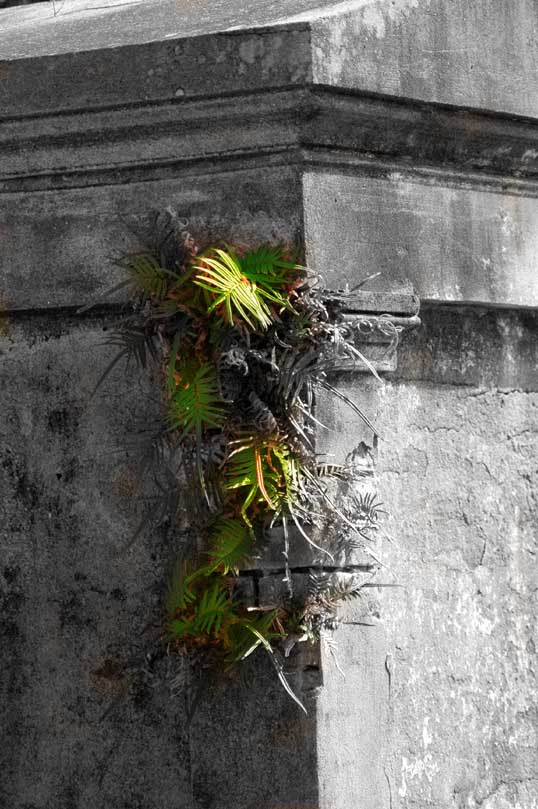
“We die containing a richness of lovers and tribes, tastes we have swallowed, bodies we have plunged into and swum up as if rivers of wisdom, characters we have climbed into as if trees, fears we have hidden in as if caves.
I wish for all this to be marked on my body when I am dead. I believe in such cartography – to be marked by nature, not just to label ourselves on a map like the names of rich men and women on buildings. We are communal histories, communal books. We are not owned or monogamous in our taste or experience.”
― Michael Ondaatje, The English Patient
Lafayette Cemetery #1, New Orleans, Louisiana
“The truth about the world, he said, is that anything is possible. Had you not seen it all from birth and thereby bled it of its strangeness it would appear to you for what it is, a hat trick in a medicine show, a fevered dream, a trance bepopulate with chimeras having neither analogue nor precedent, an itinerant carnival, a migratory tentshow whose ultimate destination after many a pitch in many a mudded field is unspeakable and calamitous beyond reckoning.
The universe is no narrow thing and the order within it is not constrained by any latitude in its conception to repeat what exists in one part in any other part. Even in this world more things exist without our knowledge than with it and the order in creation which you see is that which you have put there, like a string in a maze, so that you shall not lose your way. For existence has its own order and that no man’s mind can compass, that mind itself being but a fact among others.”
― Cormac McCarthy, Blood Meridian, or the Evening Redness in the West
Amir Omar is a two-term city councilman, running for mayor, against the wishes of the city’s established powers.
The Dallas Morning Snooze made the statement: “It’s telling that every former mayor and every council member who now serves with the two candidates endorse Maczka, 48, over Omar, 41.” They say it as if that was a good thing.
In fifty years, if not much sooner, half of the roughly 4,500 colleges and universities now operating in the United States will have ceased to exist. The technology driving this change is already at work, and nothing can stop it. The future looks like this: Access to college-level education will be free for everyone; the residential college campus will become largely obsolete; tens of thousands of professors will lose their jobs; the bachelor’s degree will become increasingly irrelevant; and ten years from now Harvard will enroll ten million students.
….
How do I know this will happen? Because recent history shows us that the internet is a great destroyer of any traditional business that relies on the sale of information.
The average American spends 50.8 minutes travelling to and from work every day. That time could be better spent exercising, working, making and enjoying a healthy meal or—for the indulgent—sleeping in.
I am fascinated by street photography but am frustrated by the poor quality of the images produced under the less-than-idea conditions that are always encountered. Johnny Tergo solved that problem – mount a portable high-quality photography studio, complete with lights, in a truck, pointing out the passenger side, and drive around shooting.
Most of our readers are aware that Social Security is a Ponzi scheme not a savings program, that the vaunted trust fund is an accounting mirage, and that nothing much is being done about it by anyone. But sometimes it takes some concrete numbers to properly get your head around what’s really going on.





 Bill Chance