It’s Impossible

“If you had a million years to do it in, you couldn’t rub out even half the “Fuck you” signs in the world. It’s impossible.”
― J.D. Salinger, The Catcher in the Rye

Shoe remains in crosswalk, Beltline Road, Richardson, Texas

Oblique Strategy: The tape is now the music

When you go around the city, on foot or especially on a pair of spoked wheels – or even when your car is stopped at a light and you look out the window – you see a lot of odd crap strewn about the road. Flotsam and jetsam – cast-off detritus, odd personal items: a shoe, a glove, an old toy, pair of headphones crushed under tires – that sort of shit.

I see this stuff, because I see stuff, and I remember it, because I remember stuff. Most of all, I wonder where the hell did it come from? Who leaves one glove in the road? Whey don’t people pick up their possessions when they drop them?

A week ago, I had a bit of an answer. I contributed to this sea of debris, this ocean of junk, this abundance of rubbish.

It all started out simply. One Saturday afternoon Candy and I wanted to go to Four Bullets, a local brewery, and grab a couple of beers. I intended to put a few miles on my bike – so she drove while I rode my bicycle.

I knew I’d want to walk around the brewery, so I didn’t want to wear my cleated cycling shoes. The pedals tear up the soles of my ordinary footwear, so I dragged an old pair of running shoes out of the depths of a closet, and rode to the brewery.

Walking around, I noticed that one shoe was sort of loose and kind of coming apart. I could see a bit of sole peeking out around the side. – I made a note to throw the pair away for good when I made it home. We were there longer than I intended and it grew dark, but I had packed a good set of lights – so no big deal.

I was riding home on the Glenville trail and crossing Beltline (a busy road that everyone in Dallas uses to get everywhere) on a green light when I felt something come loose. It was the bottom half of my shoe; it had given up the ghost and fallen off right as I crossed the road. The light wouldn’t be green for long, so I couldn’t go back and grab it – the only thing I could do was go on.

The remains of my shoe in the crosswalk at Glenville and Beltline, Richardson, Texas

The problem was that I still had about two miles to go. The rough pedal was now against my almost-bare foot and it hurt like hell. Luckily, it was mostly downhill and I could coast a lot of it.

Still, I limped around for a few days until my foot healed from its unexpected meeting with the sharp metal of the bicycle pedal.

That was pretty much a week ago. I drive past that spot, through that intersection at least twice a day, on the way to work. I ride the Glenville trail any time I’m going someplace West of my house on my bike. It’s been a week, and the piece of my shoe is still there. It’s right in the pedestrian crosswalk, at the edge of the road, where the traffic misses it.

So I have made my own contribution to the conglomeration of bizarre trash that litters our planet. I could ride out there and pick it up – but I’m curious how long it will stay there. I just stopped and took a couple of photographs.
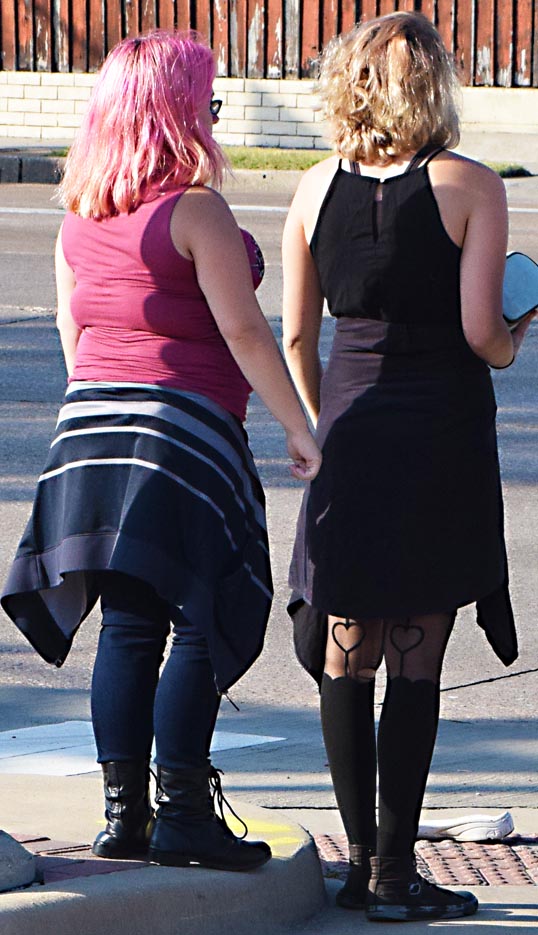
Some women walking by the piece of running shoe – they didn’t pick it up.

This is truly the best of all possible worlds.

Look Like Chopped Liver

“Don’t start an argument with somebody who has a microphone when you don’t. They’ll make you look like chopped liver.”
― Harlan Ellison

Mural (detail) at Bowls & Tacos, Deep Ellum, Dallas, Texas

Taken on the Friends of the Santa Fe Trail Pub Ride.

Oblique Strategy: Lowest common denominator

Another Snippet: From a short story – Slow Advance by me

I finally kicked down the noisy neighbors’ door to find they had moved out. The place was empty. All that was left was their disembodied voices, still arguing. At an incredible volume.

I had to look around, but finally found the eight track player. My father showed me one of those once and explained the tape inside was a loop. It would never stop. I stood there, gobsmacked, and reacted too slow as a cat ran out of the hallway and dashed out the still-open door.

The sound system, such as it was, was sitting on the floor making a dent in the filthy shag carpet. There wasn’t anything else for me to do but to turn the volume knob down and hit the oversize bright blue led-lit power switch. The light turned to red. I spun around and headed home. I had splintered the jamb with my boot, so the door wouldn’t latch. In the hallway I paused, returned, and pulled the plastic box of the eight track from its hole and quickly strode home.

“So, that was quick,” Jane said as I walked back in, “what the hell is that in your hand.” I set the tape down on the coffee table and she handed me my beer. It was still cold, with an archipelago of condensed moisture droplets sparkling on the amber glass. Jane picked the eight track up and stared at it.

“They weren’t home,” I said.

“No, that’s impossible. We’ve been listening to them both scream at each other all day.”

“It wasn’t them, It was that,” I gestured at the tape.

“Well, at least it’s quiet now,” Jane said. “Hand me the remote, I want to watch Glee.”

He Believes in Miracles

“The Warrior of the Light is a believer.

Because he believes in miracles, miracles begin to happen. Because he is sure that his thoughts can change his life, his life begins to change. Because he is certain that he will find love, love appears.”
― Paulo Coelho, Warrior of the Light

Warrior on the wall of Bowls and Tacos, Dallas, Texas

Taken on the Friends of the Santa Fe Trail Pub Ride.

Oblique Strategy: In total darkness, or in a very large room, very quietly

Snippet – from “The Death of Xaco” by me

The yellow vapors poured down the slope, choking the men. They all had rough masks made from torn T-shirts, but that offered scant protection. The decades of working in the toxic sulfur cloud did not give them any resistance – corrosive is corrosive. The men coughed and shook their heads, struggling to breathe. After a thick cloud passed by, Buelo pulled his hand across his bit of cloth and scraped off the yellow crystals that had condensed there.

The men depended on a network of crude ceramic pipes to channel the molten sulfur down from the vent so it would cool and solidify before it caught fire and burned – then they could break it up into chunks to carry down the mountain. The pipes were always breaking or plugging up and it was a harrowing, awful, dangerous job to climb into the even-thicker fumes and do the needed repairs. Xaco was the only man left crazy-tough enough for the job and Buelo could see his sharp eyes and wild yellow-crusted hair peeking out here and there, now and then, amongst the yellow clouds. There were three tugs on the rope and Buelo tied another section of replacement pipe on and tugged back three times. The rope jerked and the pipe rocked, then disappeared into the fumes.

After a few minutes Buleo could make out Xaco hefting the heavy pipe onto his shoulders and struggle upslope before the drifting clouds hid him from view again. Buelo smiled thinking of Xaco from their childhood. He had known Xaco since his earliest memory, from long before they had known or understood that they would all be sulfur miners.

What I learned this week, August 19, 2017

Solar eclipse of April 8, 2024

I really, really wanted to drive north next week and see the solar eclipse. Unfortunately, I can’t get off of work, so won’t witness the totality. I was bummed. But now, I feel better, because I discovered there will be another one in seven years and the path of totality will pass right over Dallas. Now I only have to survive seven more years.

Something else to live for.


Chemists Say You Should Add A Little Water To Your Whiskey. Here’s Why


12 Authors Share What it Takes to Make it as a Writer in Dallas


The front desk entrance to the Art Deco Belmont Hotel, with Smoke in the background.

10 Best Spots to Snap an Instagram in Dallas

Travelling Man – sculpture east of Downtown Dallas

People from the Seersucker Ride at Klyde Warren Park, Dallas, Texas


7 World-Famous Landmarks That Are Hiding Something From The Public


7 Wonders of the Horror Movie World


This week’s short film:

Kayak in the River

“Maybe freedom really is nothing left to lose. You had it once in childhood, when it was okay to climb a tree, to paint a crazy picture and wipe out on your bike, to get hurt. The spirit of risk gradually takes its leave. It follows the wild cries of joy and pain down the wind, through the hedgerow, growing ever fainter. What was that sound? A dog barking far off? That was our life calling to us, the one that was vigorous and undefended and curious.”
― Peter Heller, Hell or High Water: Surviving Tibet’s Tsangpo River

A while back, on my trip to New Orleans, my son Lee and I were in Crescent Park, hanging out for a few minutes, looking at the giant muddy expanse of the Mississippi River and the ships, tugs, and barges cruising past. A guy in an open-water kayak paddled by, going downstream, and I snapped a photo, wishing I had my longer lens. Other than the familiar automatic action of raising my camera and pushing the shutter, I didn’t think any more about it.

Ryan Caruso in his kayak, Mississippi River, New Orleans

Now, back home, I’m looking over the photos I took on my trip. I checked out the kayak zoomed in a bit closer and noticed it was covered in sponsor’s signs – including one for “Operation Smile.”

Ryan Caruso in his kayak, Mississippi River, New Orleans

It didn’t take much internet searching to learn that this was Ryan Caruso, kayaking a thousand miles from South Padre Island Texas, to Panama City Beach Florida, to raise money for Operation Smile – a charity to provide needed surgeries to children around the world.

He tracked his route here, and kept a blog of the trip. Lee and I saw him on Saturday, July 15 right at 12 noon – here’s his blog entry for the day:

JULY 15: Day 23

By 8 in the morning, my sailboat friend, which I finally learned his name but I will call him whom I’m calling “Military Man,” caught me up. We talked for a moment before he passed me once again. A half-hour later, I had entered the industrial harbor of New Orleans. For 5 miles, I passed barge push boats (no barges just the boat), sitting along the channel being fixed or repainted or pulled from the water to inspect the haul.

I radioed to the Harvey Locks letting them know I was five minutes away and slide in almost immediately into the lock. The guys running the lock were very interested in the voyage, and I explained as I always do what I was doing and why – it’s all for Operation Smile. They told me to make sure I updated New Orleans Traffic Control when I got onto the Mississippi. The lock filled with water and only my kayak, as the lock was empty besides for me, rose 6 feet so as to be level with the mighty Mississippi before the lock doors opened. One of the gentlemen of the lock lowered down two cold water bottles with the caps tied to a rope. The key to my heart – well, two keys to be precise.

“New Orleans Traffic Control, this is 18-foot white kayak entering the Mississippi from the Harvey locks and will be following the eastern bank to the industrial locks. Just giving you guys a heads up.”

“18 foot … what kind of boat?”

“A kayak, sir.”

“Kayak?” A chuckle. “Kayak, this is Traffic Control. Thank you for the update. We will ensure traffic knows you are out there.”

For the next hour, I left the radio on to channel 12 so I could listen to water traffic on the Mississippi. I heard a lot of the barges talking about the “kayaker.” They must have had a hard time seeing me because other boats would always have to update different boats of my location. I was asked to wait while a ferry boat started up and took of into the center of the river but after awhile I safely entered the inlet for the industrial lock.

A barge with chemicals was currently entering the lock and since no other boats can accompany barges with dangerous chemicals I was forced to wait. My sailboat friend was there, and the lock had told me to enter behind him. Military Man had been waiting for an hour and together we had to wait another one.

I pulled off the ICW after only 26 miles. I found a spot where the wake barrier rocks had fallen away and I slid into the main land. These rocks make landing impossible if I don’t want to destroy the haul of my boat. Yanking the boat through thick marsh and tall grass, didn’t take long and soon I was walking the 15 minutes to the main road. Upon reaching the main road, I only had to wait a minute or two before my Uber arrived to take me to Walmart. I feasted on Taco Bell across the street – since there was no Cajun restaurants near me – and then made my way to Walmart.

As I waited for the Uber back to my kayak, rain came down like I hadn’t seen in days. I dove into the passenger seat as the rain hammered the window. By the time we made it back to my hidden kayak, the rain had stopped and I slowly made my way back down the old forgotten gravel path. After arranging the food into dry bags, I realized I may have bought too much. I guess I will know tomorrow when I pack the kayak in the morning.

I leave the safety of the ICW for the next 5 days, tomorrow. Hoping for calm winds and no stories to write about.

So when Lee and I saw him, he was following the Gulf Intracoastal Waterway. He had entered the Mississippi at the Harvey Locks a bit upstream, and was paddling down the river past us until he reached the Industrial Canal Locks only a bit farther. At that point he would leave the river and enter the channels of the Intracoastal Waterway again (and stop to take an Uber to Walmart for supplies).

What an amazing thing. First, his kayak voyage – an impressive feat. Add to that the fact I, from only a glimpse of a kayak on the river, could track down the whole story while sitting here at my laptop.

Crescent Park

There is nothing more boring than riding an exercise bike. In order to try and get my bad-weather (ie over 100 degrees) exercise going, one thing I like to do is watch POV YouTube videos of other people riding their bikes in more interesting places than my spare room. I know that’s pretty bad – but you have to do what you have to do.

I mounted a monitor and speakers to my bike, and watch videos while I ride. One of the ones I like to ride to is this hour-long ride around New Orleans.

At the nine-minute fifty-second mark in the video, the riders climb over some crazy rusted-steel arch-shaped bridge. I’ve wondered what that thing is… it looks like it’s in the Bywater area, but I can’t be sure.

The other day, on my last day in New Orleans for the writing marathon, my son Lee and I drove down to the quarter for lunch and I mentioned the strange bridge. He knew exactly what I was talking about and we hopped in his car and drove there.

Crescent Park Bridge, New Orleans

It’s a really cool park, Crescent Park, built along the Mississippi from the French Market area down to the Bywater neighborhood.

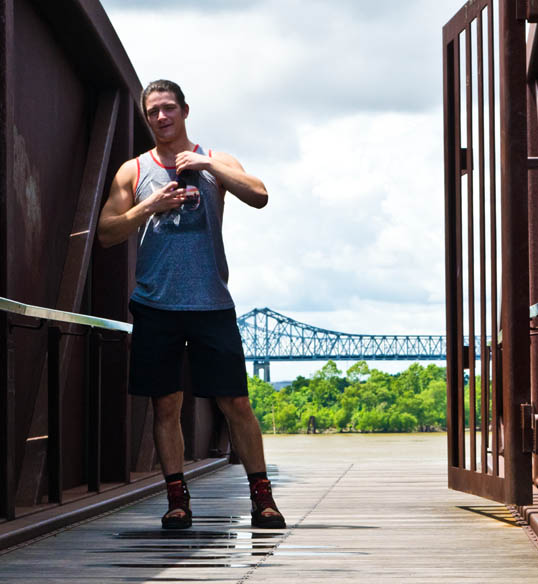
The bridge takes pedestrians (and cyclists, if they carry their bikes) over the levee and the railroad tracks into the park. It’s a beautiful spot – a new favorite in the Big Easy. I have to visit it with my bike next time.

My son, Lee, on the Crescent Park bridge.

The river and the Hwy 90 double bridge from the Crescent Park Bridge, New Orleans

Turning around, looking back the other way from the Crescent Park Bridge, Bywater Neighborhood, New Orleans

Bywater, from the Crescent Park Bridge, New Orleans

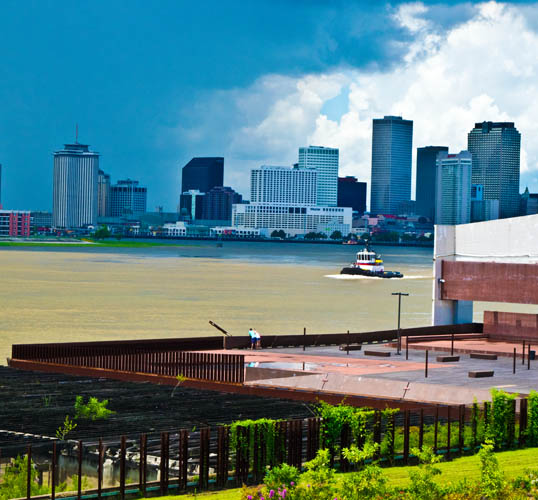
The river and downtown, from the Crescent Park Bridge, New Orleans

Cyclist With Backpack on Royal

New Orleans – an Alternative

Pre-Katrina I biked around New Orleans many times. The city is pretty flat, which makes it easy on the knees. On one trip I discovered a bike path along the top of some of the earthen lebees. It was delightful; one could see the river on one side and the city spread out on the other.

Here there are few of the usual interstates that divide and wound cities. There’s mostly just I-10, on its massive concrete pilings, which snakes into the center of town, desperately trying to stay above most of the funk and humanity below. New Orleans was, and I suspect still is, one of a few large cities across the U.S.A. with character and personality, with its own food, culture, language, and music. It never fails to inspire, though it has clearly flourished despite much neglect and years of abuse that were revealed to the world when the hurricane struck.

I bike along Magazine Street and then on St. Charles where what at first glance appears to be Spanish moss in the trees turns out to be Mardi Gras beads, hanging from the weird branches, block after block – and it’s not even Mardi Gras season.
—- David Byrne, Bicycle Diaries

Royal Street, French Quarter, New Orleans

The Green Fairy

After the first glass of absinthe you see things as you wish they were. After the second you see them as they are not. Finally you see things as they really are, and that is the most horrible thing in the world.
—- Oscar Wilde

On my last trip to New Orleans, for the Writing Marathon, I was able to cross a line off of my bucket list. It was a small item, maybe the smallest – nothing like going to Cambodia, or living long enough to see the Sagrada Famila finished – but an item crossed-off nonetheless.

It was, I think, Thursday, and that day we would divide up more or less according to what we wrote. A fairly large poetry group set out (I would meet up with them later in the day, crossing the Mississippi on the Algiers ferry) while I joined a smaller fiction group.

We had coffee and wrote, and then the leader suggested, “Why don’t we go get an absinthe?” Despite the flurry of absinthe bars that swept Dallas a decade ago (and just as quickly disappeared) I had never drank one. And for no real reason, I always had wanted to – placing it on my list of things to do. What better time than now and what better place than the French Quarter in New Orleans. Because of its strong French ties, absinthe had always been a thing in the city.

I think the biggest reason I wanted an absinthe is my love of gadgetry, ritual, and complex preparations. I am a chemist after all and what could be more attractive than dripping ice cold water into a solution of alcohol and essential oils just until the oils are forced out of solution (because the water is making the solvent mixture more and more polar…. Nevermind).

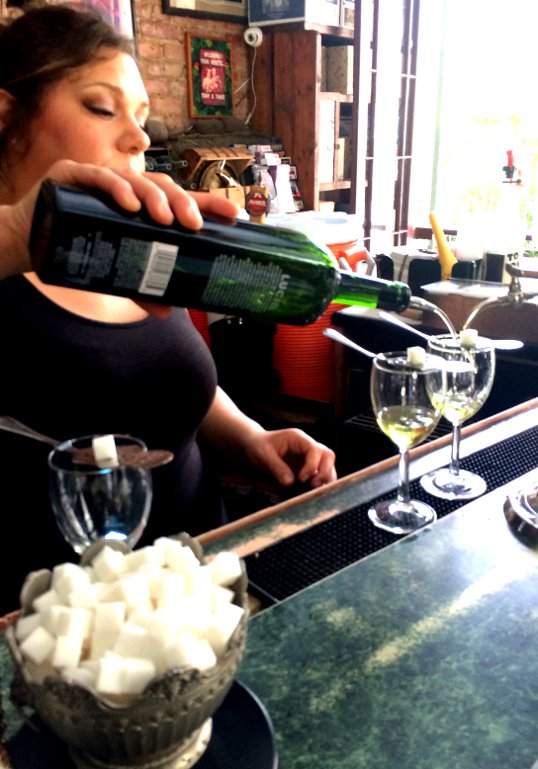
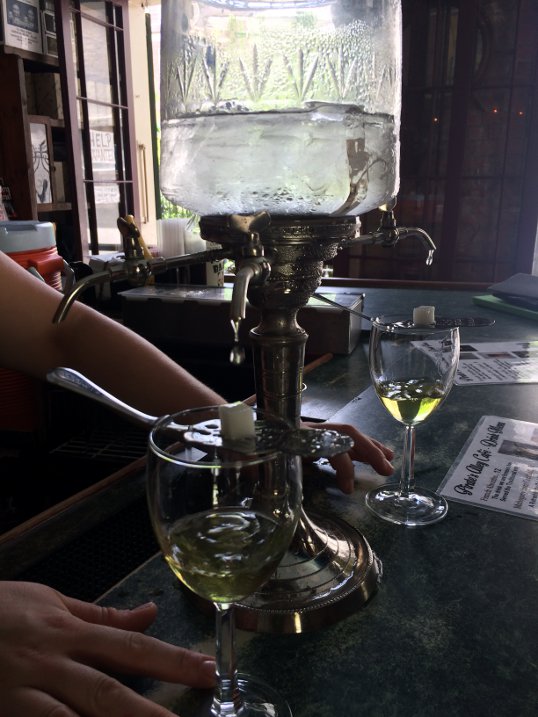
For those that don’t know, that is the classic way that absinthe is prepared. The (often greenish) liquid (very strong – usually well over 100 proof) is poured into a glass. A flat, slotted absinthe spoon is placed over the glass and a sugar cube is set on the spoon. The large glass reservoir of an Absinthe Fountain is filled with ice and water. Then a tap is cracked open and the water slowly dripped onto the sugar cube, where it dissolves the sugar and then falls into the absinthe. The cold water then causes the absinthe to change from clear to cloudy, a process called louche.

This releases the aromatic flavored oils and indicates the absinthe is ready to drink.

The bartender pouring the absinthe, note the clear green color.
Pirate’s Alley Cafe, New Orleans

Dripping the iced water over the sugar cube, into the absinthe.
Pirate’s Alley Cafe, New Orleans

The absinthe fountain, dripping cold water over the sugar into a glass of absinthe.
Pirate’s Alley Cafe, New Orleans

The louche (cloudy liquid) forms as the water dilutes the absinthe.
Pirate’s Alley Cafe, New Orleans

—How cool is that?!—

Now, of course, absinthe has a bad reputation – and I mean that in a good way. It was banned in the US from 1912 to 2007. Traditionally, it was the wormwood used in the drink, particularly the chemical thujone that enables the hallucinations that the drink traditionally provided. It looks like that is at best a huge exaggeration, if not a complete load of hokum. It seem it’s the liquid’s 125-175 proof alcohol, rather than some mysterious elixir, that provides the desired effects.

We walked down to a bar off of Pirate’s Alley (this is a favorite spot of mine – I stumbled across a fashion shoot there once before) right next to Faulkner House Books (William Faulkner’s old apartments). The bar is called Pirate’s Alley Café and specializes in absinthe. It seems a little touristy (sometimes the barkeep dresses like Jack Sparrow) but there was none of that early in the day in the summer (New Orleans’ offseason). I had to decide on my brand of poison, settling on Absinthe Lucid (it was relatively inexpensive, French, and green).

The barkeep went through the routine, setting up three glasses under the absinthe fountain and we were able to watch them go from clear to milky.

The only problem was that since I’m no huge fan of licorice, I assumed I wouldn’t like the absinthe and this would be a one-off bucket list thing. No luck, I really enjoyed the stuff.

Now I have to find a bar in Dallas and/or a bottle of the Green Fairy.

More information:
The Wormwood Society – America’s Premiere Absinthe Association & Information Network

“I am only sipping the second glass of that “fascinating, but subtle poison, whose ravages eat men’s heart and brain” that I have ever tasted in my life; and as I am not an American anxious for quick action, I am not surprised and disappointed that I do not drop dead upon the spot. But I can taste souls without the aid of absinthe; and besides, this is magic of absinthe! The spirit of the house has entered into it; it is an elixir, the masterpiece of an old alchemist, no common wine. And so, as I talk with the patron concerning the vanity of things, I perceive the secret of the heart of God himself; this, that everything, even the vilest thing, is so unutterably lovely that it is worthy of the devotion of a God for all eternity. What other excuse could He give man for making him? In substance, that is my answer to King Solomon.”
― Aleister Crowley, Absinthe The Green Goddess

The emerald hour–
when the poet’s pain is soothed
by a liquid jewel
held in the sacred chalice,
upon which rests
the pierced spoon,
the crystal sweetness–
Icy streams trickle down.
The darkest forest
melts into an open meadow
as waves of green seduce.
Sanity surrendered,
the soul spirals toward
the murky depths,
wherein lies
the beautiful madness–
absinthe.
—-Peggy Amond, “Rimbaud’s Poison

The Window At Molly’s

He presided, he directed, he ruled, he snarled. From his perch at the Window of Molly’s which is where I mostly saw him, he listened indulgently to the speculative thrusts of the Window Gang, paid slightly more attention to opinion derived from inside info, and gave his full ear to inside info itself. Like everything that went by the Window on Saturday and Sunday afternoons, including a variety of humanity that would have made both Goya and Picasso shriek with delight, on couldn’t be sure of the exact percentage of B.S. Monaghan alone seemed to know. People vied to be in the Window Gang, but few could stand the Chief’s tests, which to the innocent must have often seemed rough, illiberal, crude, or so deliberately provocative as to preclude any rational response.
—-Andrei Codrescu – The Passing of Jim Monaghan, New Orleans Bar Owner, from New Orleans, Mon Amour, Twenty Years of Writings from the City

The best place to write… or to sit… possibly to drink… in the French Quarter is the window at Molly’s. Take my word for it.

A machine will squirt out Molly’s frozen Irish coffee (caffeine, ice cream, alcohol – three of the four major food groups) into a plastic to-go cup and you can sit inside the window, outside the window or even mill around on the Decatur sidewalk.

Today the bar was packed with a dozen young women, obviously a bachelorette party, all wearing identical denim shorts and t-shirts emblazoned with “I LIVE TO BE DRUNK” in glitter. They handed me a phone and asked me to take their photos lined up at the bar. I arranged them and took some shots, they were particularly giggly happy with the landscape photo.

The Window at Molly’s, the street (Decatur) unusually quiet, with notebook, vintage Esterbrook pen, and Molly’s frozen Irish Coffee

There are bikes locked up all over the French Quarter, mostly to the wrought iron columns supporting the ubiquitous overhead balconies. Most of these are heavy, beater bikes – in deference to New Orleans’ rough streets, giant potholes, and flat-as-a-pancake geography. Every day, though sitting in front of me, well-locked to the pole on the sidewalk was a nice Specialized road bike – looking fast standing still, if also well-used. One day, I arrived early enough to watch the owner arrive and lock up – he was obviously a worker in a nearby bar or restaurant. That day someone else had already locked up to his pole, but he maneuvered around and managed to lock on the other side, sharing the pole. It was his spot and he was going to use it.

Specialized road bike on pole outside The Window at Molly’s. French Quarter, New Orleans.
Notice the green shelf for drinks. Sometimes the crowd on the sidewalk outside The Window grows.

One would do well, as I have done many times, to investigate a single place over time, at different times of the day. Molly’s on Market, for instance, is home in the early afternoon to a lively Window Gang consisting of a varying crew of journalists, men-about-town, women-about-town, writers of fiction and poetry, mysterious characters either larger or brighter than life, led on by Jim Monaghan, proprietaire extraordinaire, Irish wit, and provocateur. Monaghan’s extravagant personality imbues the day, but the night belongs to the tribes of the tattooed and pierced young. At night a sloshed picture gallery displays itself with sensual impertinence.

—- Andrei Codrescu, Solution: Enivrez-Vous: The Bars of New Orleans, from New Orleans, Mon Amour, Twenty Years Of Writings From The City

Stone Sculpture on the Riverbank

“Leaving New Orleans also frightened me considerably. Outside of the city limits the heart of darkness, the true wasteland begins.”
― John Kennedy Toole, A Confederacy of Dunces

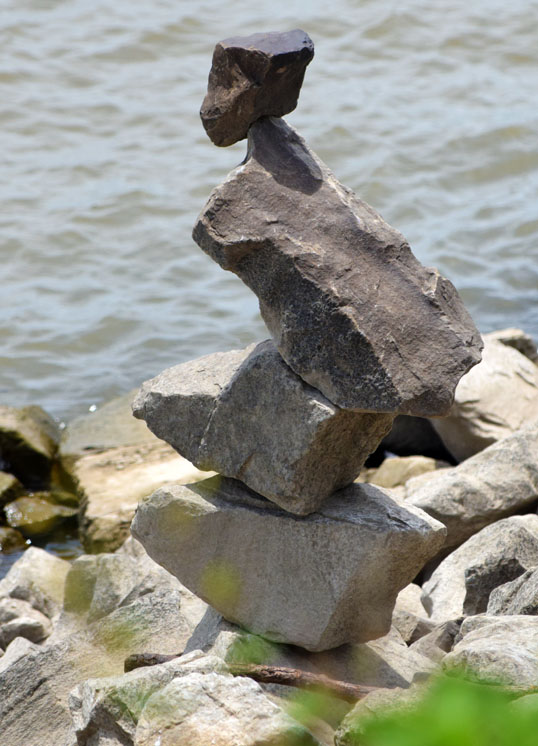
I was walking along the strip of concrete along the top of the Mississippi levee that separates the French Quarter from the vast moisture of the Big Muddy. There was the path, a narrow strip of weedy grass, a band of riparian riprap rock used for erosion control and then the water itself.

I noticed a pile of rock in a peculiar arrangement, down right next to the water. At first I thought someone had simply piled them up, but as I looked closer, it seemed that they would not hold together in that formation by themselves. Gravity would pull them asunder. Someone had gone down there with some industrial adhesive or quick-set epoxy and glued the stones together. It was a sculpture, a work of art.

An Internet search failed to reveal any information about this impromptu pile of granite.

Who knows how long they will hold together under the assault of the elements, but if you want to check – it’s right there near the entrance to Jackson Square.

Riverbank Sculpture, Mississippi River, French Quarter, New Orleans