Son Excellence Eugène Rougon

“He [Eugène Rougon] believed exclusively in himself; where another saw reasons, Rougon possessed convictions; he subordinated everything to the incessant aggrandisement of his own ego. Despite being utterly devoid of real self-indulgence, he nevertheless indulged in secret orgies of supreme power.”
― Émile Zola, His Excellency

Virginia Oldoini, Countess of Castiglione, real life basis for Clorinde Balbi, from the book His Excellency, by Emile Zola

I just finished another book in Zola’s Rougon-Macquart cycle. This one was Son Excellence Eugène Rougon (His Excellency, in English). This was the sixth book written, but the second one in the recommended order – that I am following. The book was excellent (even though I was reading an inferior translation) although I didn’t enjoy it as much as the first book The Fortune of the Rougons.

The book is a finely-drawn portrait of the highest reaches of power during France’s Second Empire. It follows the rise and fall and rise and fall and rise of Eugène Rougon – a power mad politician and one of the branches of the Rougon trunk of the Rougon-Macquart family that spreads across the twenty novels. Rougon has a diverse crew of hangers-on that depend on his influence for their ill-gotten gains – but are more than ready to throw him under the bus at any time.

His main rival is Clorinde Balbi – a young, beautiful ambitious woman that is forced to depend on her own skills and machinations – all behind the scenes – to advance her own cause and bring her revenge upon Rougon – who rejects her and marries her off to one of his friends. She is by far the most interesting character in the novel – a woman before her time doing the best she can. Still, the novel is more of a portrait of an age and place than a gripping story – its one weakness is that none of the characters are really worth caring about. I am glad I read it, though – it does a great job of transporting the reader to an exotic time and place – one that in its corruption and grubbing for power is still frighteningly familiar.

I finished the book on vacation, on a Caribbean cruise. The last few pages were turned (more accurately clicked – I was reading on a Kindle) lounging on a remote uncrowded deck, while the turquoise waves rumbled past. Reading on vacation seems like a waste of precious leisure time, but I enjoy it immensely. What could be better than being in one exotic location (on a ship at sea) and being transported to another – Paris in the Second Empire?

Now, on the the next, La Curée (The Kill). This one looks especially good.

Short Story of the Day – “Driven Snow” by Nancy M. Michael

“Life is a bucket of shit with a barbed wire handle.”
― Jim Thompson

Crepe Myrtle trunk in the snow

I read a lot of short stories. I read A LOT of short stories. In most cases I read pretty much a short story a day. I like to read them, I don’t have much time for long novels, and I like to write them.I have learned that it is best that I read what I am writing.

Over time, I have spent months where I review and online short story each day –

Short Story Months:
Day One 2013

Day One 2015

Day One 2017

Instead of doing an entire month, I think I’ll put up stories I enjoy one at a time.

There is a fantastic independent publishing house, Akashic Books. From their website:

Akashic Books is a Brooklyn-based independent company dedicated to publishing urban literary fiction and political nonfiction by authors who are either ignored by the mainstream, or who have no interest in working within the ever-consolidating ranks of the major corporate publishers.

In particular, I enjoy their Noir series – each book consisting of a group of savage short stories based in a particular city. I have written about their Noir books based on the two cities I am most familiar with: Dallas Noir and New Orleans Noir.

They have a tasty extensive list of short and flash fiction available online.

Today I have a free online short story put out by Akashic Books. It’s a warped little romantic tale about how a relationship handles a snowstorm on I70 in Colorado. The flash fiction piece is a lot of fun – though it seems to have one obvious little error (Isn’t it nights in WHITE satin?).

Driven Snow by Nancy M. Michael – Loveland Pass, Colorado

Like the city-themed Noir books, fiction, especially thrillers or horror, is always more fun when it is set somewhere that you are familiar with. I am somewhat familiar with I70 through the mountains, Loveland Pass and Ski Basin, the scenic route off the Interstate to A Basin, and the feeling of snow whiteout conditions.

I remember jockeying down that stretch of highway in a blinding blizzard with a tiny Datsun jockying with a string of monstrous snowplows going 80 miles an hour inches off my bumper and looking bigger than the surrounding Rocky Mountains.

Whew! just the memory makes me feel frozen and sweaty at the same time.

So take a few minutes to go read the story and while you are there – check out Akashic Books and their other offerings. They deserve our support.

A Month of Short Stories 2017, Day 18 – Feral by Christopher Moyer

Patricia Johanson, Sagitaria Platyphylla (Delta Duckpotato), Fair Park, Dallas, Texas

Over several years, for the month of June, I wrote about a short story that was available online each day of the month…. It seemed like a good idea at the time. My blog readership fell precipitously and nobody seemed to give a damn about what I was doing – which was a surprising amount of work.

Because of this result, I’m going to do it again this year – In September this time… because it is September.

Today’s story, for day 18 – Feral by Christopher Moyer

Read it online here:
Feral by Christopher Moyer

Our grandmother watches us some of the time. The rest of the time, we do what we want. At school, the adults asked a lot of questions about that, so we stopped going. We haven’t gone down to the school in weeks or maybe months, I don’t know—our watches stopped a long time ago, too, and after that we threw them in the creek down by the park just to watch them splash.

—-Christopher Moyer, Feral

I had always wanted to own a home on a creek lot. Our house technically is, though it is more of a ditch than a creek. At any rate, there is quite a cavalcade of critters parading by, other than the joggers and dog-walkers. If you sit in my back yard at dawn and sip a cup of coffee you will see the coyotes trotting back to their dens – I assume hidden in the clumps of trees along the fairways of the golf course. A family of beavers live under the road and sometimes can be seen on the jogging trail bridges at night. Rabbits, ducks, and possums are common, sometimes a fox will show up. There is a bobcat terrorizing the neighborhood – not much can be done.

Nature is never as far away as we think it is.

Today’s bit of flash fiction by Christopher Moyer reminds us, not only of the wild presence, but how easy it is to slip back… to lose our humanity… to become feral. Easy, and maybe not so bad.

Christopher Moyer:

The first time I bid on a freelance job to ghostwrite a doomsday survival guide, I was only asked one question: Did I have experience writing for middle-aged Republican men? I told the client that I had experience writing for a wide variety of ages and political affiliations, which was noncommittal enough to be true.

The client said, “Sounds good, bro.”

We were off to the races.
—From Confessions of a Former Apocalypse Survival Guide Writer, at Vice Motherboard

They don’t call it Duck Creek for nothing.

A Month of Short Stories 2017, Day 17 – The Mice by Lydia Davis


Over several years, for the month of June, I wrote about a short story that was available online each day of the month…. It seemed like a good idea at the time. My blog readership fell precipitously and nobody seemed to give a damn about what I was doing – which was a surprising amount of work.

Because of this result, I’m going to do it again this year – In September this time… because it is September.

Today’s story, for day 17 – The Mice by Lydia Davis

Read it online here:

The Mice by Lydia Davis

Although we are pleased, we are also upset, because the mice behave as though there were something wrong with our kitchen. What makes this even more puzzling is that our house is much less tidy than the houses of our neighbors. There is more food lying about in our kitchen, more crumbs on the counters and filthy scraps of onion kicked against the base of the cabinets. In fact, there is so much loose food in the kitchen I can only think the mice themselves are defeated by it.

—-Lydia Davis, The Mice

Lydia Davis is a writer known for ultra-short works of flash fiction. I haven’t read very much of what she has written – though I think I’ll pick up a book of her stories now.

There is something about flash fiction that is appropriate for the way we live our lives today. Who has time for a giant novel anyway? Bits and little tales you can fit in before meetings, while waiting for something, or riding the train. That is all the freedom we have anymore – those tiny slivers of time when the world forgets about you for a moment.

Sure, it’s tough for a deep connection or for strong emotion to take hold in such little slivers of seconds. But that is what we are left with.

Interview with Lydia Davis:

in those days (fall of 1973, age 26, living in the country in France), I would force myself to stay at the desk for a certain number of hours, giving myself admonitions (written in my notebook) like “Alright, let’s establish one firm rule: from when I get up—at 7 or 7:30—until, say, 12:30 … allowing one break for a modest, circumscribed, abrupt meal of porridge or eggs at about 10:30, nothing else will be allowable—no cooking, no cleaning, no walking, no talking or playing, etc.”

At the desk, I would write and write, in my notebook, whatever came to mind, as a way of working up to the point of writing something like a story. This would not be free-association writing—I never did that—but thoughts, descriptions of what was around me, always written carefully, revised. I might write something incomplete, possibly the beginning of a story, but possibly just a fragment:

Although the house seemed very bright, clean, and elegant, one could tell by the number of flies that swarmed in it, landed on the furniture, and crept up and down the windowpanes, that something about the house was rotten.

A Month of Short Stories 2017, Day 16 – War of the Clowns by Mia Couto

Klyde Warren Park,
Dallas, Texas


Over several years, for the month of June, I wrote about a short story that was available online each day of the month…. It seemed like a good idea at the time. My blog readership fell precipitously and nobody seemed to give a damn about what I was doing – which was a surprising amount of work.

Because of this result, I’m going to do it again this year – In September this time… because it is September.

Today’s story, for day 16 – War of the Clowns by Mia Couto

Read it online here:
War of the Clowns by Mia Couto

The following morning, the two remained, obnoxious and outdoing
each other. It seemed as though, between them, even yucca soured. In the
street, meanwhile, those present were exhilarated with the masquerade.
The buffoons began worsening their insults with fine-edged and finetuned
barbs. Believing it to be a show, the passersby left coins along the
roadside.

—-Mia Couto, War of the Clowns

Today, we have a brief bit of flash fiction by Mia Couto, an excellent writer from Mozambique.

At first, the parable seems like a bit of literary fluff. But it also feels terribly familiar. It feels like watching the evening news.

Are you afraid of clowns?

The biggest movie right now is It – from the Steven King novel. Like today’s flash fiction, It plays on our fear of clowns. The clowns in today’s parable are even more frightening, in the end, than the horrific Pennywise. They are the end of the world.

Interview with Mi Couto:

We know we are made of memories, but we don’t know the extent to which we are made up of forgetfulness. We think of oblivion as an absence, an empty space, a lack. But in most cases, with the exception of neurological disease, forgetting is an activity—it’s a choice that demands the same effort as remembrance. This is equally valid for individuals and communities. If you visit Mozambique, you’ll see that people have decided to forget the war years. It is not an omission. It’s a tacit decision to forget what were cruel times, because people fear that this cruelty is not a thing of the past but can again become our present. And moreover, in rural parts of Mozambique the notion of nonlinear time is still dominant. For them, the past has not passed.

—-from Paris Review

Laissez les bons temps rouler

A Month of Short Stories 2017, Day 15 – Limited Edition by Tim Maughan

Over several years, for the month of June, I wrote about a short story that was available online each day of the month…. It seemed like a good idea at the time. My blog readership fell precipitously and nobody seemed to give a damn about what I was doing – which was a surprising amount of work.

Because of this result, I’m going to do it again this year – In September this time… because it is September.

Today’s story, for day 15 – Limited Edition by Tim Maughan

Read it online here:
Limited Edition by Tim Maughan

Avonmeads is less than ten minutes walk from Barton Hill, from his ends, but it feels like a different world to him. Whenever there’s any trouble with youth in places like this the timelines erupt with opinions, people angry and shouting, saying why are people like him making trouble and tearing up their own community. He shakes his head and laughs to himself. Community? There’s no community down here. This isn’t a community space – it’s nowhere, a non-place. Nobody lives here, it’s populated only fleetingly by transient visitors – van drivers getting lunch, shoppers buying the few things they still can’t buy through their spex or print at home. Even the staff in the shops here – none of them live here, they just come for a few hours a day, a few days a week. And most of them don’t even hold that down for long – there’s about as much a sense of career down here as there is community. For a start the shops never stay for long – something opens, fills a short-term need, then closes. Storefronts lie dead and abandoned, until someone thinks they’ve found another fleeting need, moves in, shuts down. Open, close, repeat.

—-Tim Maughan, Limited Edition

I am an old man, old enough to know a time when athletic shoes were called sneakers, or maybe tennis shoes – and were made of a single, simple layer of canvas with a simple rubber sole. The only “brand” I remember were PF Flyers (PF stood for Posture Foundation – bet you didn’t know that) and there were ads for them on television. I do remember a bit of the thrill and envy when I saw a pair – always on somebody else.

Now, of course, the innocent and silly tropes of my ancient youth have been distorted and blown up by technology and the shallowness of modern life until they have become reality. Sneakers have been replaced by Kicks, and Johnny Quest replaced by millionaire athletes.

Throw these ingredients into the soup of social media and powerful portable devices and you have the world of today’s story, Limited Edition.

This truly is the best of all possible worlds.

Interview with Tim Maughan:

Odo: Current technologies such as virtual reality, social networks and online games are prominently featured in your stories. How would you say that the use of these technologies is changing our way of thinking, our way of interacting with other people?

TM: That’s a good question. That’s a big question! I’m not sure we know yet, I think we’re still feeling our way. That’s why I’m writing about them, I think, to try and understand myself. I think everything is so double edged now – online communities for example, they can be both embracing and alienating, both to degrees we couldn’t possibly imagine a couple of decades ago. The same goes for the anonymity and distance that ‘net culture grants us – it can be liberating, allowing people to express themselves in ways they would be too scared to in real life – but of course the flip of that is it lets people get away with saying or doing terrible things with no consequence. I was reading a forum recently where someone used a homophobic slur, and when they were confronted about it they said nobody should be offended as it was ‘only pixels’. That struck me as simultaneously both horrifying and logical – it’s a defence that must make some sense if you’ve grown up spending a large percentage of your communicating life online. It’s the complete stripping of meaning, postmodernism made real, I guess. How do you argue against that? In fact, with meaning gone in that way, how do you argue about anything?

Odo: Trust (and distrust) is an important theme in your stories, where characters are often deceived by their friends. Do you think that trusting other people is more dangerous today than, say, twenty years ago?

TM: No, I don’t think so – the media would love us to all believe that, it feeds on fear, and is constantly looking to spread the illusion of distrust so that consumers turn to it for a kind of fake truth. I hear a lot of media talk here about the ‘blitz spirit’, about how British society was more unified during the war in the ’40s. I largely suspect that’s bullshit, and some terrible things happened when the lights were out, there was looting, people cheated on departed lovers and so on. When I’m writing about distrust I’m not saying that it’s a new thing, or a futuristic thing – to be honest it’s sometimes just a plot device! – but more that it’s there, and our media and culture likes to amplify it, to separate and alienate us, to make us better, competing consumers. Consumerism doesn’t work well if everyone trusts each other, it only works if we feel the need to compete with our neighbours, friends, even families.

—-from Sense of Wonder

On the way home from the store with a bag of Miller High Life.

A Month of Short Stories 2017, Day 14 – Dog by Joe R Lansdale

Deep Ellum, Dallas, Texas
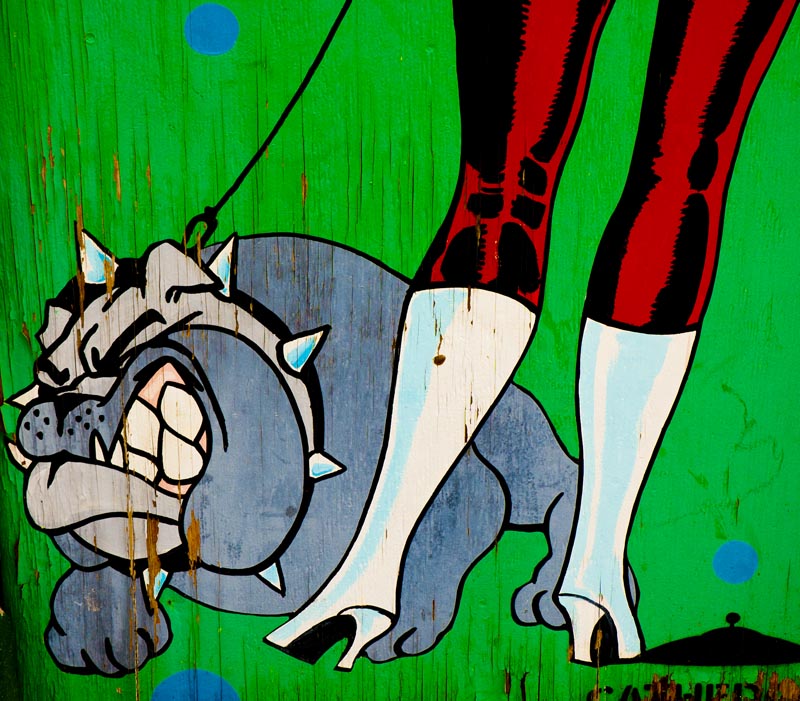
Cathey MIller, Cathedonia
(click to enlarge)

Over several years, for the month of June, I wrote about a short story that was available online each day of the month…. It seemed like a good idea at the time. My blog readership fell precipitously and nobody seemed to give a damn about what I was doing – which was a surprising amount of work.

Because of this result, I’m going to do it again this year – In September this time… because it is September.

Today’s story, for day 14 – Dog by Joe R Lansdale

Read it online here:

Dog by Joe R Lansdale

The money had made him worthless, and he missed writing the column, wished now he hadn’t quit the job when the money came in. Should have stayed at it, he thought. He considered possibly getting his old job back, or maybe trying to write a humor book. Right now, however, it was all just a daydream from the seat of a bicycle.

—-Joe R Lansdale, Dog

I have become quite a fan of Joe R Lansdale. First of all, he’s a Texan, which is always a good thing.

The first story of his I read was God of the Razor – a scary little tale of ultra-horror. That’s not usually my thing but the story was so stark and well-written – it hooked me. I have been reading his stuff every since.

Now, today’s story, Dog, is not for animal lovers… not at all. It is about a guy on a bicycle, which is usually a good thing.

But in this story… not so much. It is a story of a nightmare fight to the death between pretty good and absolute evil. Shame about poor Cuddles.

Interview with Joe R Lansdale

You recently talked on Facebook about writers who complain about loneliness and other aspects of the craft, and you noted, “If you want to be miserable writing, that’s your choice.” Why do you think some writers describe it as some painful, soul-sapping drudge?

I’m sure there are some people out there who are just miserable . . .

They’d be miserable if they were plumbers.

Right. But I think also it’s a pose for a lot of people, because they think they’re doing something that doesn’t require that they dig a ditch or fix a car. I think because it’s intangible. When you take a job, you get paid when you first start out whether you know what you’re doing or not, but in writing you’re not necessarily getting paid when you’re starting out, so are you a writer or are you not a writer? So I think a lot of it too is insecurity, that feeling that it’s like, “Look, I’m really working, this really is important and it’s really hard.” And it’s not that it isn’t hard sometimes—it is. I’m not saying it isn’t hard work; I beat my head against the wall sometimes thinking, I just can’t get that right. But that’s not the same thing as saying I’m miserable doing it. It may be a hard thing to do, but I enjoy doing it. And I feel lucky, because I’ve never wanted to do anything else. It’s not the same for everybody, but I feel like I just got the best break in the world.

One recent tip you offered was, “Actually start out with Once upon a time and continue.” Have you done that?

Yeah, I’ve done it. I even have one story that begins, “Once upon a time.” I’ve done it several times. I just type “Once upon a time,” and then I’m into it

—-from Nightmare Magazine

Bark Park Central
Deep Ellum
Dallas, Texas

A Month of Short Stories 2017, Day 13 – Hop-Frog by Edgar Allan Poe

Deep Ellum
Texas

Over several years, for the month of June, I wrote about a short story that was available online each day of the month…. It seemed like a good idea at the time. My blog readership fell precipitously and nobody seemed to give a damn about what I was doing – which was a surprising amount of work.

Because of this result, I’m going to do it again this year – In September this time… because it is September.

Today’s story, for day 13 – Hop-Frog by Edgar Allan Poe

Read it online here:

Hop-Frog by Edgar Allan Poe

The eight ourang-outangs, taking Hop-Frog’s advice, waited patiently until midnight (when the room was thoroughly filled with masqueraders) before making their appearance. No sooner had the clock ceased striking, however, than they rushed, or rather rolled in, all together–for the impediments of their chains caused most of the party to fall, and all to stumble as they entered.

—-Edgar Allan Poe, Hop-Frog

Everyone has read Poe’s The Tell-Tale Heart in school. Everyone is familiar with The Raven, The Pit and the Pendulum, or A Cask of Amontillado. But I bet you haven’t read Hop-Frog.

It is a brutally simple tale of revenge and horror. Never one for subtlety, Poe goes for the jugular here, and delivers. I’m surprised this tale hasn’t been used more often (as has Poe’s other tropes) in modern horror films. It’s a yarn that holds up well, almost two centuries after it was written.

An interesting fact about the story is that, apparently, Poe wrote it as a literary “revenge” against a woman, Elizabeth F. Ellet, and her circle of friends. They had been trafficking in gossip about Poe and alleged improprieties to the extent that Poe’s wife felt they had driven her to her deathbed.

Don’t mess with a short story writer, or you will be immortalized in horror.

https://youtu.be/LMvEHiZzt6w

Poe on Writing:

I prefer commencing with the consideration of an effect. Keeping originality always in view — for he is false to himself who ventures to dispense with so obvious and so easily attainable a source of interest — I say to myself, in the first place, “Of the innumerable effects, or impressions, of which the heart, the intellect, or (more generally) the soul is susceptible, what one shall I, on the present occasion, select?” Having chosen a novel, first, and secondly a vivid effect, I consider whether it can best be wrought by incident or tone — whether by ordinary incidents and peculiar tone, or the converse, or by peculiarity both of incident and tone — afterward looking about me (or rather within) for such combinations of event, or tone, as shall best aid me in the construction of the effect.
—-from THE PHILOSOPHY OF COMPOSITION

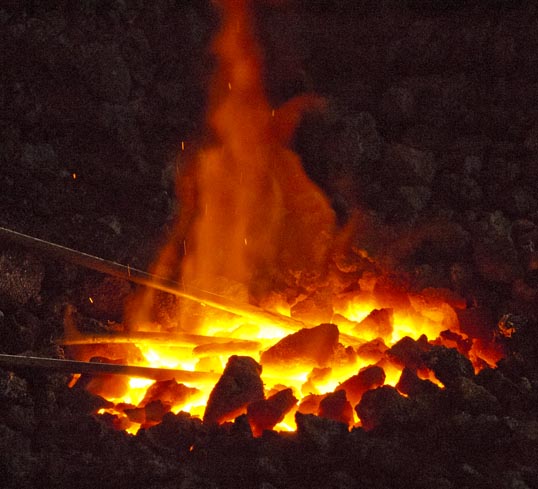
Coal and coke fire, Frisco, Texas.

A Month of Short Stories 2017, Day 12 – The Balloon, by Donald Barthelme

Over several years, for the month of June, I wrote about a short story that was available online each day of the month…. It seemed like a good idea at the time. My blog readership fell precipitously and nobody seemed to give a damn about what I was doing – which was a surprising amount of work.

Because of this result, I’m going to do it again this year – In September this time… because it is September.

Today’s story, for day 12 – The Balloon, by Donald Barthelme

Read it online here:
The Balloon, by Donald Barthelme

Another man, on the other hand, might view the balloon as if it were part of a system of unanticipated rewards, as when one’s employer walks in and says, “Here, Henry, take this package of money I have wrapped for you, because we have been doing so well in the business here, and I admire the way you bruise the tulips, without which bruising your department would not be a success, or at least not the success that it is.” For this man the balloon might be a brilliantly heroic “muscle and pluck” experience, even if an experience poorly understood.

—-Donald Barthelme, The Balloon

When reading The Balloon I first thought of the artist Christo – though I have never seen one of their works, I did watch a fascinating and provocative documentary of their environmental installation in Central Park, The Gates. It made me wish I had been able to visit while the gates were up.

The Gates and The Balloon share the location of New York City and they share the confusion, adulation, and consternation of the crowds that interact with them.

The genius of Barthelme is that even in the brief work linked to here, he gives us an explanation in the end. The Balloon has a purpose, a very concrete one, even if it is only understood by two people. And it’s in a warehouse, waiting to be used again.

Donald Barthelme:

Art is not difficult because it wishes to be difficult, but because it wishes to be art. However much the writer might long to be, in his work, simple, honest, and straightforward, these virtues are no longer available to him. He discovers that in being simple, honest, and straightforward, nothing much happens: he speaks the speakable, whereas what we are looking for is the as-yet unspeakable, the as-yet unspoken.
from Not-Knowing: The Essays and Interviews of Donald Barthelme

Buckingham Road, Richardson, Texas

A Month of Short Stories 2017, Day 11 – The Old Man at the Bridge, by Ernest Hemingway

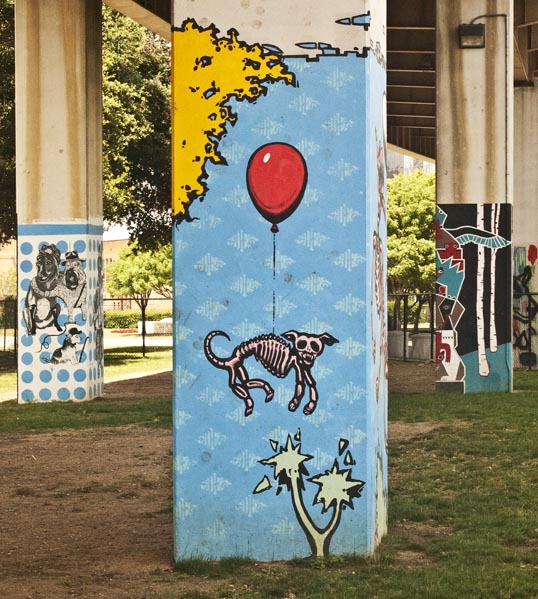
Railroad Bridge, Waco, Texas

Over several years, for the month of June, I wrote about a short story that was available online each day of the month…. It seemed like a good idea at the time. My blog readership fell precipitously and nobody seemed to give a damn about what I was doing – which was a surprising amount of work.

Because of this result, I’m going to do it again this year – In September this time… because it is September.

Today’s story, for day 11 – The Old Man at the Bridge, by Ernest Hemingway

Read it online here:
The Old Man at the Bridge, by Ernest Hemingway

An old man with steel rimmed spectacles and very dusty clothes sat by the side of the road. There was a pontoon bridge across the river and carts, trucks, and men, women and children were crossing it. The mule-drawn carts staggered up the steep bank from the bridge with soldiers helping push against the spokes of the wheels. The trucks ground up and away heading out of it all and the peasants plodded along in the ankle deep dust. But the old man sat there without moving. He was too tired to go any farther.
—-Ernest Hemingway, The Old Man at the Bridge, opening paragraph.

I love reading Ernest Hemingway. More than anything else, I feel he respects his readers. We are all busy, we have real lives to live. Hemingway doesn’t waste our time with any extra words.

Look at two sentences in this very short story:

It was my business to cross the bridge, explore the bridgehead beyond and find out to what point the enemy had advanced. I did this and returned over the bridge.

A lesser writer, a different writer, would have filled pages with description at this point, of how afraid the narrator was, of the close calls he had with the enemy, of how satisfied he was that he completed his mission and returned alive. The author would have been very pleased with himself – with his skill, artistry, and clever way with words.

But Hemingway knows that none of that matters. He knows the real story is the old man waiting at the bridge. The rest is fluff and we don’t have time for fluff.

That’s why I like reading Hemingway. The unnoticed old man at the bridge tells the story of the world.

Interview with Hemingway:

“That’s something you have to learn about yourself. The important thing is to work every day. I work from about seven until about noon. Then I go fishing or swimming, or whatever I want. The best way is always to stop when you are going good. If you do that you’ll never be stuck. And don’t think or worry about it until you start to write again the next day. That way your subconscious will be working on it all the time, but if you worry about it, your brain will get tired before you start again. But work every day. No matter what has happened the day or night before, get up and bite on the nail.”

Margaret Hunt Hill Bridge, from the Commerce Street Viaduct
Dallas, Texas