A Month of Short Stories 2017, Day 13 – Hop-Frog by Edgar Allan Poe

Deep Ellum
Texas

Over several years, for the month of June, I wrote about a short story that was available online each day of the month…. It seemed like a good idea at the time. My blog readership fell precipitously and nobody seemed to give a damn about what I was doing – which was a surprising amount of work.

Because of this result, I’m going to do it again this year – In September this time… because it is September.

Today’s story, for day 13 – Hop-Frog by Edgar Allan Poe

Read it online here:

Hop-Frog by Edgar Allan Poe

The eight ourang-outangs, taking Hop-Frog’s advice, waited patiently until midnight (when the room was thoroughly filled with masqueraders) before making their appearance. No sooner had the clock ceased striking, however, than they rushed, or rather rolled in, all together–for the impediments of their chains caused most of the party to fall, and all to stumble as they entered.

—-Edgar Allan Poe, Hop-Frog

Everyone has read Poe’s The Tell-Tale Heart in school. Everyone is familiar with The Raven, The Pit and the Pendulum, or A Cask of Amontillado. But I bet you haven’t read Hop-Frog.

It is a brutally simple tale of revenge and horror. Never one for subtlety, Poe goes for the jugular here, and delivers. I’m surprised this tale hasn’t been used more often (as has Poe’s other tropes) in modern horror films. It’s a yarn that holds up well, almost two centuries after it was written.

An interesting fact about the story is that, apparently, Poe wrote it as a literary “revenge” against a woman, Elizabeth F. Ellet, and her circle of friends. They had been trafficking in gossip about Poe and alleged improprieties to the extent that Poe’s wife felt they had driven her to her deathbed.

Don’t mess with a short story writer, or you will be immortalized in horror.

Poe on Writing:

I prefer commencing with the consideration of an effect. Keeping originality always in view — for he is false to himself who ventures to dispense with so obvious and so easily attainable a source of interest — I say to myself, in the first place, “Of the innumerable effects, or impressions, of which the heart, the intellect, or (more generally) the soul is susceptible, what one shall I, on the present occasion, select?” Having chosen a novel, first, and secondly a vivid effect, I consider whether it can best be wrought by incident or tone — whether by ordinary incidents and peculiar tone, or the converse, or by peculiarity both of incident and tone — afterward looking about me (or rather within) for such combinations of event, or tone, as shall best aid me in the construction of the effect.
—-from THE PHILOSOPHY OF COMPOSITION

Coal and coke fire, Frisco, Texas.

A Month of Short Stories 2017, Day 12 – The Balloon, by Donald Barthelme

Over several years, for the month of June, I wrote about a short story that was available online each day of the month…. It seemed like a good idea at the time. My blog readership fell precipitously and nobody seemed to give a damn about what I was doing – which was a surprising amount of work.

Because of this result, I’m going to do it again this year – In September this time… because it is September.

Today’s story, for day 12 – The Balloon, by Donald Barthelme

Read it online here:
The Balloon, by Donald Barthelme

Another man, on the other hand, might view the balloon as if it were part of a system of unanticipated rewards, as when one’s employer walks in and says, “Here, Henry, take this package of money I have wrapped for you, because we have been doing so well in the business here, and I admire the way you bruise the tulips, without which bruising your department would not be a success, or at least not the success that it is.” For this man the balloon might be a brilliantly heroic “muscle and pluck” experience, even if an experience poorly understood.

—-Donald Barthelme, The Balloon

When reading The Balloon I first thought of the artist Christo – though I have never seen one of their works, I did watch a fascinating and provocative documentary of their environmental installation in Central Park, The Gates. It made me wish I had been able to visit while the gates were up.

The Gates and The Balloon share the location of New York City and they share the confusion, adulation, and consternation of the crowds that interact with them.

The genius of Barthelme is that even in the brief work linked to here, he gives us an explanation in the end. The Balloon has a purpose, a very concrete one, even if it is only understood by two people. And it’s in a warehouse, waiting to be used again.

Donald Barthelme:

Art is not difficult because it wishes to be difficult, but because it wishes to be art. However much the writer might long to be, in his work, simple, honest, and straightforward, these virtues are no longer available to him. He discovers that in being simple, honest, and straightforward, nothing much happens: he speaks the speakable, whereas what we are looking for is the as-yet unspeakable, the as-yet unspoken.
from Not-Knowing: The Essays and Interviews of Donald Barthelme

Buckingham Road, Richardson, Texas

A Month of Short Stories 2017, Day 11 – The Old Man at the Bridge, by Ernest Hemingway

Railroad Bridge, Waco, Texas

Over several years, for the month of June, I wrote about a short story that was available online each day of the month…. It seemed like a good idea at the time. My blog readership fell precipitously and nobody seemed to give a damn about what I was doing – which was a surprising amount of work.

Because of this result, I’m going to do it again this year – In September this time… because it is September.

Today’s story, for day 11 – The Old Man at the Bridge, by Ernest Hemingway

Read it online here:
The Old Man at the Bridge, by Ernest Hemingway

An old man with steel rimmed spectacles and very dusty clothes sat by the side of the road. There was a pontoon bridge across the river and carts, trucks, and men, women and children were crossing it. The mule-drawn carts staggered up the steep bank from the bridge with soldiers helping push against the spokes of the wheels. The trucks ground up and away heading out of it all and the peasants plodded along in the ankle deep dust. But the old man sat there without moving. He was too tired to go any farther.
—-Ernest Hemingway, The Old Man at the Bridge, opening paragraph.

I love reading Ernest Hemingway. More than anything else, I feel he respects his readers. We are all busy, we have real lives to live. Hemingway doesn’t waste our time with any extra words.

Look at two sentences in this very short story:

It was my business to cross the bridge, explore the bridgehead beyond and find out to what point the enemy had advanced. I did this and returned over the bridge.

A lesser writer, a different writer, would have filled pages with description at this point, of how afraid the narrator was, of the close calls he had with the enemy, of how satisfied he was that he completed his mission and returned alive. The author would have been very pleased with himself – with his skill, artistry, and clever way with words.

But Hemingway knows that none of that matters. He knows the real story is the old man waiting at the bridge. The rest is fluff and we don’t have time for fluff.

That’s why I like reading Hemingway. The unnoticed old man at the bridge tells the story of the world.

Interview with Hemingway:

“That’s something you have to learn about yourself. The important thing is to work every day. I work from about seven until about noon. Then I go fishing or swimming, or whatever I want. The best way is always to stop when you are going good. If you do that you’ll never be stuck. And don’t think or worry about it until you start to write again the next day. That way your subconscious will be working on it all the time, but if you worry about it, your brain will get tired before you start again. But work every day. No matter what has happened the day or night before, get up and bite on the nail.”

Margaret Hunt Hill Bridge, from the Commerce Street Viaduct
Dallas, Texas

A Month of Short Stories 2017, Day 10 – Shooting an Elephant, by George Orwell

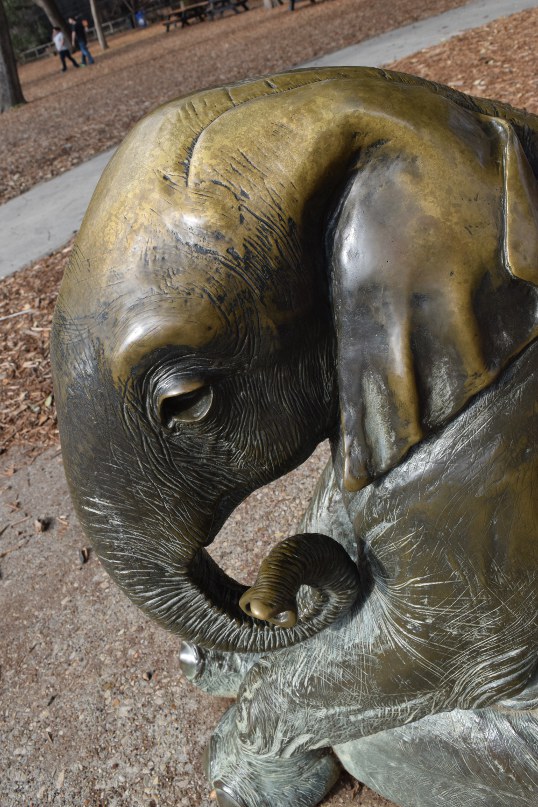
Dallas Zoo

Over several years, for the month of June, I wrote about a short story that was available online each day of the month…. It seemed like a good idea at the time. My blog readership fell precipitously and nobody seemed to give a damn about what I was doing – which was a surprising amount of work.

Because of this result, I’m going to do it again this year – In September this time… because it is September.

Today’s story, for day 10 – Shooting an Elephant, by George Orwell

Read it online here:
Shooting an Elephant, by George Orwell

In Moulmein, in lower Burma, I was hated by large numbers of people–the only time in my life that I have been important enough for this to happen to me.
—-George Orwell, Shooting an Elephant, opening line.

When you think of George Orwell, you think of 1984 first, and then, a little later, you think of Animal Farm.

And rightfully so – few works of literature have coined as many frightening words and phrases that have entered our daily life as 1984 – Big Brother, Thought Police, Doublethink, thoughtcrime, memory hole. When watching the news today the phrase, “Oceania was at war with Eurasia; therefore Oceania had always been at war with Eurasia,” keeps ghosting through my mind without me willing it.

But for me, the most impressive book by Orwell isn’t fiction, it is his (pretty much) autobiographical book, Down and Out in Paris and London. Somewhere on the early internet I found some kid recommending this tome, saying it was the best book he had ever read. He wrote about it in a way that I tended to think he was on to something, so I bought and read the book.

There is plenty of misinformation on the internet (Oceania was at war with Eurasia) but in this case, the kid was right

Excerpt from Down and Out in Paris and London, chapter III:

It is altogether curious, your first contact with poverty. You have
thought so much about poverty–it is the thing you have feared all your
life, the thing you knew would happen to you sooner or later; and it, is
all so utterly and prosaically different. You thought it would be quite
simple; it is extraordinarily complicated. You thought it would be
terrible; it is merely squalid and boring. It is the peculiar LOWNESS of
poverty that you discover first; the shifts that it puts you to, the
complicated meanness, the crust-wiping.

You discover, for instance, the secrecy attaching to poverty. At a
sudden stroke you have been reduced to an income of six francs a day. But
of course you dare not admit it–you have got to pretend that you are
living quite as usual. From the start it tangles you in a net of lies, and
even with the lies you can hardly manage it. You stop sending clothes to
the laundry, and the laundress catches you in the street and asks you why;
you mumble something, and she, thinking you are sending the clothes
elsewhere, is your enemy for life. The tobacconist keeps asking why you
have cut down your smoking. There are letters you want to answer, and
cannot, because stamps are too expensive. And then there are your meals–
meals are the worst difficulty of all. Every day at meal-times you go out,
ostensibly to a restaurant, and loaf an hour in the Luxembourg Gardens,
watching the pigeons. Afterwards you smuggle your food home in your
pockets. Your food is bread and margarine, or bread and wine, and even the
nature of the food is governed by lies. You have to buy rye bread instead
of household bread, because the rye loaves, though dearer, are round and
can be smuggled in your pockets. This wastes you a franc a day. Sometimes,
to keep up appearances, you have to spend sixty centimes on a drink, and go
correspondingly short of food. Your linen gets filthy, and you run out of
soap and razor-blades. Your hair wants cutting, and you try to cut it
yourself, with such fearful results that you have to go to the barber after
all, and spend the equivalent of a day’s food. All day you are telling
lies, and expensive lies.

You discover the extreme precariousness of your six francs a day. Mean
disasters happen and rob you of food. You have spent your last eighty
centimes on half a litre of milk, and are boiling it over the spirit lamp.
While it boils a bug runs down your forearm; you give the bug a flick with
your nail, and it falls, plop! straight into the milk. There is nothing for
it but to throw the milk away and go foodless.

You go to the baker’s to buy a pound of bread, and you wait while the
girl cuts a pound for another customer. She is clumsy, and cuts more than a
pound. ‘PARDON, MONSIEUR,’ she says, ‘I suppose you don’t mind paying two
sous extra?’ Bread is a franc a pound, and you have exactly a franc. When
you think that you too might be asked to pay two sous extra, and would have
to confess that you could not, you bolt in panic. It is hours before you
dare venture into a baker’s shop again.

You go to the greengrocer’s to spend a franc on a kilogram of
potatoes. But one of the pieces that make up the franc is a Belgian piece,
and the shopman refuses it. You slink out of the shop, and can never go
there again.

You have strayed into a respectable quarter, and you see a prosperous
friend coming. To avoid him you dodge into the nearest cafe. Once in the
cafe you must buy something, so you spend your last fifty centimes on a
glass of black coffee with a dead fly in it. Once could multiply these
disasters by the hundred. They are part of the process of being hard up.

You discover what it is like to be hungry. With bread and margarine in
your belly, you go out and look into the shop windows. Everywhere there is
food insulting you in huge, wasteful piles; whole dead pigs, baskets of hot
loaves, great yellow blocks of butter, strings of sausages, mountains of
potatoes, vast Gruyere cheeses like grindstones. A snivelling self-pity
comes over you at the sight of so much food. You plan to grab a loaf and
run, swallowing it before they catch you; and you refrain, from pure funk.

You discover the boredom which is inseparable from poverty; the times
when you have nothing to do and, being underfed, can interest yourself in
nothing. For half a day at a time you lie on your bed, feeling like the
JEUNE SQUELETTE in Baudelaire’s poem. Only food could rouse you. You
discover that a man who has gone even a week on bread and margarine is not
a man any longer, only a belly with a few accessory organs.

This–one could describe it further, but it is all in the same style
–is life on six francs a day. Thousands of people in Paris live it–
struggling artists and students, prostitutes when their luck is out,
out-of-work people of all kinds. It is the suburbs, as it were, of poverty.

I continued in this style for about three weeks. The forty-seven
francs were soon gone, and I had to do what I could on thirty-six francs a
week from the English lessons. Being inexperienced, I handled the money
badly, and sometimes I was a day without food. When this happened I used to
sell a few of my clothes, smuggling them out of the hotel in small packets
and taking them to a secondhand shop in the rue de la Montagne St
Genevieve. The shopman was a red-haired Jew, an extraordinary disagreeable
man, who used to fall into furious rages at the sight of a client. From his
manner one would have supposed that we had done him some injury by coming
to him. ‘MERDE!’ he used to shout, ‘YOU here again? What do you think this
is? A soup kitchen?’ And he paid incredibly low prices. For a hat which I
had bought for twenty-five shillings and scarcely worn he gave five francs;
for a good pair of shoes, five francs; for shirts, a franc each. He always
preferred to exchange rather than buy, and he had a trick of thrusting some
useless article into one’s hand and then pretending that one had accepted
it. Once I saw him take a good overcoat from an old woman, put two white
billiard-balls into her hand, and then push her rapidly out of the shop
before she could protest. It would have been a pleasure to flatten the
Jew’s nose, if only one could have afforded it.

These three weeks were squalid and uncomfortable, and evidently there
was worse coming, for my rent would be due before long. Nevertheless,
things were not a quarter as bad as I had expected. For, when you are
approaching poverty, you make one discovery which outweighs some of the
others. You discover boredom and mean complications and the beginnings of
hunger, but you also discover the great redeeming feature of poverty: the
fact that it annihilates the future. Within certain limits, it is actually
true that the less money you have, the less you worry. When you have a
hundred francs in the world you are liable to the most craven panics. When
you have only three francs you are quite indifferent; for three francs will
feed you till tomorrow, and you cannot think further than that. You are
bored, but you are not afraid. You think vaguely, ‘I shall be starving in a
day or two–shocking, isn’t it?’ And then the mind wanders to other
topics. A bread and margarine diet does, to some extent, provide its own
anodyne.

And there is another feeling that is a great consolation in poverty. I
believe everyone who has been hard up has experienced it. It is a feeling
of relief, almost of pleasure, at knowing yourself at last genuinely down
and out. You have talked so often of going to the dogs–and well, here
are the dogs, and you have reached them, and you can stand it. It takes off
a lot of anxiety.

Dallas Zoo


A Month of Short Stories 2017, Day 9 – The Hurricane, by Lord Dunsany

(click to enlarge) “Approaching Storm” by Claude-Joseph Vernet, Dallas Museum of Art

Over several years, for the month of June, I wrote about a short story that was available online each day of the month…. It seemed like a good idea at the time. My blog readership fell precipitously and nobody seemed to give a damn about what I was doing – which was a surprising amount of work.

Because of this result, I’m going to do it again this year – In September this time… because it is September.

Today’s story, for day 9 – The Hurricane, by Lord Dunsany

Read it online here:
The Hurricane, by Lord Dunsany

‘Old friend,’ said the Hurricane, ‘there are cities everywhere. Over thy head while thou didst sleep they have built them constantly. My four children the Winds suffocate with the fumes of them, the valleys are desolate of flowers, and the lovely forests are cut down since last we went abroad together.’

—-Lord Dusany, The Hurricane

Today, with Houston starting its long recovery from Harvey and Irma bearing down on Florida with its horrors to come, I thought I’d link to a short little bit of fantasy called The Hurricane.

Article on Lord Dunsany

It’s hard to underestimate the impact that Dunsany had in the fantasy genre, and he remains one of the literary movement’s most notable figures, influencing many authors who would become major figures in and of themselves. Authors such as H.P. Lovecraft and Robert E. Howard noted their appreciation and influence of the man, with Lovecraft saying of The King of Elfland’s Daughter: “Inventor of a new mythology and weaver of surprising folklore, Lord Dunsany stands dedicated to a strange world of fantastic beauty.”

Dallas, Texas

A Month of Short Stories 2015, Day Seven – Forty-Four Goats

The last two years, for the month of June, I wrote about a short story that was available online each day of the month… you can see the list for 2014 and 2015 in the comments for this page. It seemed like a good idea at the time. My blog readership fell precipitously and nobody seemed to give a damn about what I was doing – which was a surprising amount of work.

Because of this result, I’m going to do it again this year.

Today’s story, for day xx – Forty-Four Goats, by Simon Harris

Read it online here:

Forty-Four Goats (page 2 of the PDF)

Flash Fiction. Longer than 140 characters – more than a tweet, but something that only takes about two minutes or so to read. Something impossibly short that still tells a story.

The only way to tell a complete story, with a beginning, middle, and end in that short of a time – in those few words – is to tell a story with mystery. The author has to use what’s not there as a storytelling tool, because when there isn’t much – there is a lot that isn’t there.

Today’s little snippet, Forty-Four Goats tells a story, complete with several unsolved mysteries at the end. It’s a good use of a precious two minutes.

Red and White

(click to enlarge)

(click to enlarge)

The aliens of Altair Six developed an interstellar drive – but it required such immense amounts of energy that the probe sent through the time/space vortex could be no larger than a mote of dust and the temporal rift so unstable that only one blurry image could be sent back.

They had established Earth as a good candidate for life and the high priests had blessed the probe (they had long ago abandoned the difference between science and religion – both relied on faith) and were confident that if life existed on the distant rock, it would show up in the image.

They were right. The single image returned showed an ordered collection of what were undoubtedly life forms. But exactly what were they looking at? Why were the individuals on one side all bedecked in bright white, while the others shone blazing red?

The debate raged on Altair Six. The accepted theory is one of racism – the photo showed a border with the white-lighted denizens restricted on one side, the red on the other. There is obviously no mixing of the two races – the apartheid is complete.

Others believed the dichotomy was age-based. Noting that the white creatures shone brighter than the red, the theory was advanced that the red were larval forms, while the white were full-grown. It was thought that they were separated to keep the developed individuals from eating the fry.

One controversial idea, put forth by Professor Yo’rin Cake of the University of Vultur Volans that the objects in the image aren’t actually life forms, but some sort of dwelling. The color of the lighting, red or white, is merely a marker to help delineate different neighborhoods.

This was dismissed by the learned councils out of hand. It was considered impossible to have that many dwellings in the image without capturing any of the life forms themselves.

Still, the debate between these and many other factions, some completely ridiculous, others more studied and mainstream, continued and only grew in intensity and cacophony. In an attempt to find an answer to this question an enormous portion of Altair Six’s economy was dedicated to building a huge power facility and a corresponding time/space vortex generator. The plans were laid to send a larger probe with a better camera and more sensors to finally answer the mysteries of the rock called Earth.

Unfortunately, their reach exceeded their grasp and the interstellar probe complex broke down and exploded. It was a terrible planet-wide disaster and set the society back by millennia. They were reduced to a level of advancement only slightly higher than ours.

And Shipping is Always Free

(click to enlarge)

(click to enlarge)

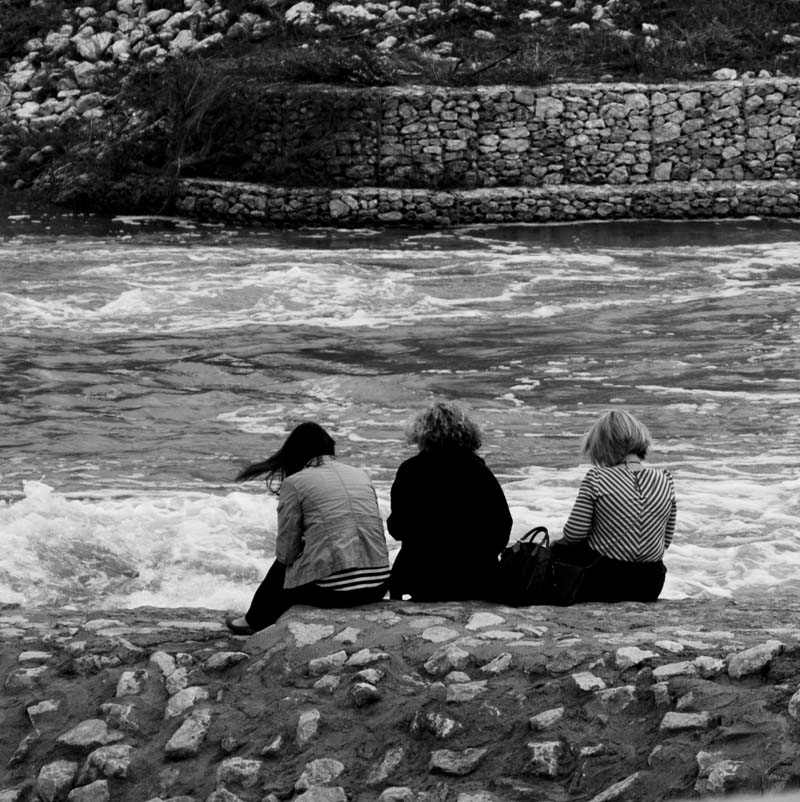
After church the three ladies liked to buy sack lunches from a truck and a bottle of Chianti from the shabby old liquor store on the way down to the river. They would sit on the bank by the rapids with their lunch and catch up on the weekly gossip.

There used to be old men fishing down there. The fishermen would sometimes whistle or shout at the ladies, which they, correctly, took as a complement. Now, though, the levels of polychlorinated biphenyls in the fish have been determined to be unsafe and the fishermen have been run off by the police. Sometimes the women miss the fishermen a little – but they also enjoy the quiet.

The ladies have a little pool going. Every week each kicks in a ten dollar bill and the first one to spot a body floating down the river wins the pot.

“There's one!” the lady in the middle shouts.

“That doesn't count, that's a swimmer.”

“It's a body isn't it?”

“But the bet is on a corpse, and you know it.”

“OK.” She sounds disappointed.

“There's one!” the lady furthest upstream calls out.

The middle one is not happy. She gives the object a close look. “Wait, I don't think it's a body, I think it's an inflatable woman.”

She pulls her Sig Sauer P229 out of her purse and lets off a round. She is an expert shot. The inflatable pops and shrivels up into the churning water. The ladies hear giggling from a copse of willow trees upstream. The ladies have been pranked.

“Those kids! At it again. Where did they get that thing?” They shout at the kids. “Where did you get that thing?!”

A reedy voice, hard to hear over the roar of the rapids, comes giggling back from the willows. “Dealdash Dot Com.”

“Children now-a-days. What is this world coming to?” the lady in the center complains. The other two nod in agreement. She pulls a little kit out of her purse, screws the handle on the end of the aluminum rod, and begins to swab out the barrel of her handgun.

“Cleanliness is next to Godliness. That's what my mother taught me.”

The other two nod in agreement again, but don't move their gaze from the water. They want to win the pot.

Sunday Snippet – Night Guitar (opening scene)

This week’s snippet is the first scene from the worst short story I’ve written in the last few years. It’s so bad I should simply delete the files and get on with my life, such as it is, but I haven’t done that yet. The mere existence of that pile of silly randomness bugs me like a hangnail and I can’t help but pick at it. I’ve taken it apart and am editing some of the parts that might work sometime and trying to create a creaking framework to hang everything on.

And because I am just too damn tired to come up with anything worthwhile this evening I give you what I’ve written for a opening scene so I can humiliate myself and you can wallow in some shallow schadenfreude before you click away.

Night Guitar

Copernicus Mayhem was the lead singer and guitar player of the band Sweetmeat Valentine. He made damn sure nobody called him anything else. The name his parents had chosen for him was Doug Chandler. But nobody called him that. Not any more.

“Oh, come on Copernicus, please, pretty please, let’s go. I wanna go,” said Serena Twist. She was his West Coast girlfriend, and that was where they were, so she was his girlfriend.

“Oh, babe, I’m beat. This is the first three days off I’ve had in a month. Let’s stay here, the suite’s big and nice, hit some weed, soak in the tub.”

“Hit some weed and soak in the tub? That’s all you wanna do. I’m bored. I’m bored. Let’s go.” Serena had switched her voice into her high sniveling mode – like fingernails on chalkboard. Copernicus knew that he would be giving in, but he wanted to hold out for a minute or two. Have to keep up appearances. He had a sliver of pride left – or he hoped he did.

“What kind of stupid concert is this anyway?” Copernicus asked without any intention of listening to the answer.

“It’s classy. It’s classical. This composer, Tyrone Page, has done a new symphony. It’s never been performed before. You’ve been invited and I want to go. It’s a humongous honor.”

Copernicus had heard of Tyrone Page though he had never actually heard his work. Page was a mystery, an enigma, nobody knew who or where he was.

The scores of Page’s works arrived on the desks of famous conductors at random intervals. Copernicus wondered why he had never heard anything written by the infamous mystery composer… then he remembered. Page never allowed his stuff to be recorded. It had to be heard live. And though the composer was hidden, his lawyers weren’t. Nobody dared put the sound down on tape, or disk, or anything else.

Copernicus was interested. Now, he actually wanted to go; intrigued. It had been a long time since he had felt intrigued.

“Ok, ok, If you want this thing so much, I’ll go,” Copernicus said. “But I want you to call Skinner and make the transportation arrangements. I want a stretch this time, no van. And I want some weed in the car and a bottle of Maker’s Mark. And plenty of ice.”

“Sure honey, I’ll set it up. Thank you, Thank you.” Serena seemed truly grateful.

“Yeah, you do that. And Serena? I’m gonna be hungry when we get back. I want some good room service this time. Not that usual stale crap. Oh, and please change. If this is a big deal like you say, I want you to wear something… something shiny.”

Sunday Snippet – Swallow the Worm

It was in a third floor hotel corridor in Teacup, Mississippi that Kevin Buck met the love of his life. Hurricane Camille had torn open the belly of the Gulf Coast like a giant wind and water driven scythe and flooded what she didn’t wreck. The work and repair crews assembled, coming from all across the center of the continent and careening down in convoys of trucks – blue collar men piling up overtime and setting the world back to right… like they always did.

Kevin needed the money and used some of his last unspoiled connections to hook up with the power crew. His job was to set up a mobile laboratory and test the various oils brought to him by the workers trying to restore burned out or flooded transformers. He’d check for PCBs and then analyze the oil for water content or other contaminants. He could give the workers a pretty good educated guess at what was wrong with the machinery based on the properties of the oil that wrapped and cooled its core.

At the end of each day Kevin would hand write the days lab results in big block letters on thick opaque sheets of paper. He’d clip these to a heavy cylinder and lower that into a bulky machine hooked into a phone line. The cylinder would spin and a little arm would slowly trace its way down the paper – transmitting a crude image back to headquarters over the line. The other workers would sometimes come in and shoot the bull – amazed as they watched the thing spin and move. Every now and then Kevin would have to re-print and re-send a page or two if he hadn’t written large or clear enough the first time.

Kevin had a bachelors in math and a PhD in physics, but tried to conceal his education – especially on the road with the work crews. He liked being with them – liked their simple views, their lack of concern for the future… but especially, he liked the way they drank.

At the end of each day they would gather in the air conditioned interior corridor of the hotel (they rented an entire floor of the small Red Roof Inn) and would share coolers of beer and bottles of stronger stuff.

The women would show up too. Kevin didn’t really understand where they came from or why they were there… divorced women from Teacup or down the road, bored younger girls looking for a way out of town… maybe some professional women willing to ply a little trade on credit. Kevin didn’t pay much attention to them but appreciated the way they livened up the party – gave an edge, a primeval competition to the boasting and drinking.

Then one night… it was very late and Kevin was very drunk… he leaned back, sitting against the plaster wall, feeling the thin cheap carpet through his jeans, and noticed a slim young girl with short ragged dark hair, wearing a white halter top and a tight pair of jeans with the top button undone.

As Kevin watched her she snatched a bottle of Mezcal from a giant man hulking above her. The man was shirtless and covered with a thick layer of dark wiry hair but he was still wearing a bright yellow hard hat. Kevin knew the brand of Mezcal – it was cheap and nasty stuff – illegal in the US but readily available for almost nothing from the legions of workers that swarmed across the border whenever disaster struck.

The girl spun the cap off, stuck the bottle into her mouth and tipped her head straight back. The liquid level was maybe a quarter down and the air bubbled up to the top, making a delicious solvent noise. Kevin watched with his mouth slightly open as the girl held motionless – she must have stuck her tongue in the end of the bottle and plugged it because nothing was running out. The corridor lamps were dim but everyone could see the silvery worm sinking down through the clear liquid. The worm swam back and forth as if it was still alive before it finally tumbled out of sight down the glass neck past the girl’s lips.

She made a gulping sound and a convulsive twitch. Kevin saw a fresh healthy bubble pulse back up through the Mezcal, settling against the flat bottom of the inverted bottle. The girl quickly grabbed the bottle and pulled it from her mouth, flipping it right side up with a wide smile. The worm was gone. The clot of workers standing in a semi-circle erupted into applause… they had never seen anything like that.

“This is the woman I want to spend the rest of my life with,” Kevin said to himself as she took a little bow there outside the hotel room.