A Guy, His Girlfriend, and His Uncle

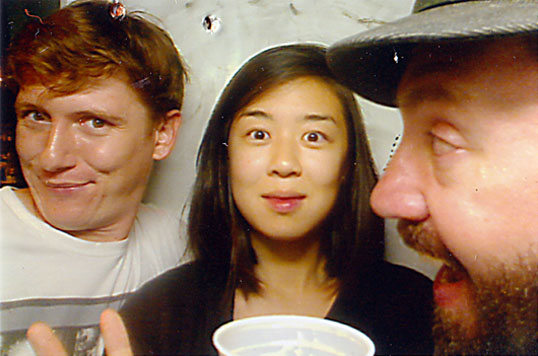
I’ve stolen something. There is a bar that I visited this year, one that had an old fashioned photo booth back in the back, next to the filthy bathrooms. On the wall by the booth was a torn up cork board. A lot of people thumbtacked their strips of four photos into the cork, leaving them for posterity. I picked up a handful that looked interesting and stole them.

I’ve scanned the strips and I think I’ll take them, one at time, four photos at a time, and write a few words about the people in the photographs. Or, more accurately, what I imagine about the two people.

I wrote a story about the first strip here – now I’m fiddling with the second.


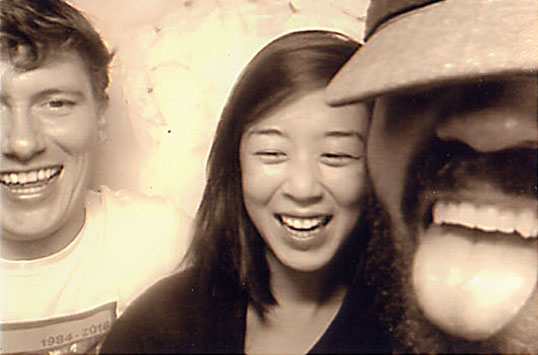
A Guy, His Girlfriend, and His Uncle

Kipling Butter was in town to meet his long-lost uncle, Sandhurst Myers, and wanted to bring his girlfriend, Sealey Wood for support..
His parents had never even mentioned his uncle. Sandhurst had left The Church at the same time Kipling was born.

Kipling was brought up in The Church and had never doubted its tenets… until he met Sealey.

They met when Kipling’s van broke down in an unfamiliar part of town and Sealey gave him a ride. The Church didn’t approve of cellphones – at least not carried by their members out of control of The Church elders and without Sealey’s help, Kipling was in a jam. He had never met any women socially from outside of The Church and was smitten immediately. He even tried to convince Sealey to join The Church, but she recognized it as the crazy cult that it was and refused. She was a woman of many resources, however, and did her research.

Sealey found Kipling’s uncle Sandhurst, who in the decades since leaving the church had established an organization to help members of The Church to escape the cult’s clutches. He was elated to be able to contact his nephew outside of the control of Kipling’s parents and The Church.

The meeting was in a bar in the heart of the city. Kipling was nervous, he had never been in a bar in his life. Since The Church strictly forbade alcohol or contact with anyone associated with alcohol, Sealey and Sandhurst knew it would be a safe meeting place.

All the stress involved melted away when the three finally sat down and talked. Kipling realized his uncle was a kindred spirit and wondered why he had not done this before. Plans were made to utilize Sandhurst’s organization to spirit Kipling out of The Church‘s clutches and help his set up a new life in another city with Sealey.

The three were happy and giddy and celebrated with four sessions inside the bar’s photo booth. They each took one as a remembrance and left one tacked to the wall as a way to mark the place where all three lives changed forever.

Two Women

I was talking to someone at work about the viral video that is going around, the one about the NASA scientist that made the elaborate, over-engineered, hilarious booby trap to revenge upon thieves that steal Amazon packages. My point is that he made the package look too tempting – he was creating thieves. The other guy disagreed – he felt that people either were thieves or not. I think that it is more a matter of degree, and everyone, sometimes, steals something.

I’ve stolen something. There is a bar that I visited this year, one that had an old fashioned photo booth back in the back, next to the filthy bathrooms. On the wall by the booth was a torn up cork board. A lot of people thumbtacked their strips of four photos into the cork, leaving them for posterity. I picked up a handful that looked interesting and stole them.

I’ve scanned the strips and I think I’ll take them, one at time, four photos at a time, and write a thousand or so words about the people in the photographs. Or, more accurately, what I imagine about the two people.


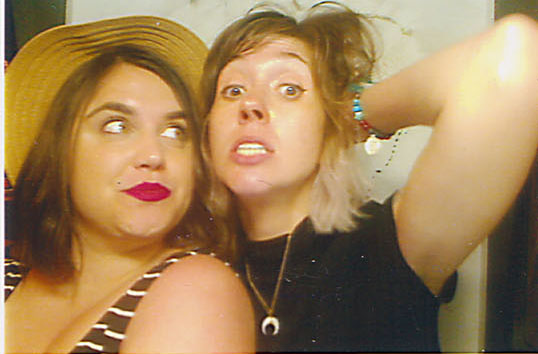
Two Women


One day, due to a mix-up at a department store wedding registry two weeks before the scheduled weddings, Moss Williams and Isabel Green discovered they were both engaged to the same man, Augustus Piper.

Moss William’s condominium was on the twenty third floor and she had always been disappointed that the windows didn’t open. She lifted up an expensive, exquisite abstract marble sculpture that Augustus Piper had bought her on one of his business trips to Venice and fixed the window. The marble made an appropriate expensive explosive boom when it hit the concrete over two hundred feet below – followed by an exquisite tinkle as the shards of broken glass caught up. Augustus had bought her the condo and had planned on moving in too after the wedding.

She enjoyed the sting of the cold wind whipping through the open wound in the glass wall of the building as she collected everything that either belonged to Augustus or had been bought by him and would fit through the hole in the window left by the marble. This was everything in the place other than the furniture. With amazing energy and rapidity she threw it all out.

The only thing she saved was the cocaine. Moss lined it all up in a group that looked like a tiny neatly plowed field of snowy ground on the glass coffee table – then hurled the expensive sterling necklace with its hidden compartment out too. He had bought her the jewelry in San Francisco. He had bought the cocaine too, but it was too good to waste… even in fury. She visited the little field on the coffee table whenever her energy began to fade.

“Here, dear,” Isabel’s mother called, “I’m back from the store with the ice cream.” She began unloading the pints from the shrink-wrapped cardboard flat and loaded them into her daughter’s freezer. “It’s a little soft from the trip back from the store, but I think it’s still edible… do you want a pint now?”

The loud sobbing from the bedroom paused for a few seconds. “Yes,” Isabel said, “Bring me a pint and a spoon.”

“What flavor? They sold these variety flats and that’s what I bought.”

“Who cares mother? Just bring me something.”

“Chunky Monkey OK?” asked Isabel’s mother.  The sobbing didn’t stop this time, so she assumed that Chunkey Monkey wasn’t good, so she exchanged it with a pint of chocolate mint. The spoon she chose from her daughter’s drawer didn’t look quite right, so she bent over the sink and gave it a quick scrubbing before heading back to the bedroom.

It took two hours and three pints of ice cream to get Isabel to quit crying enough for her mother to feel like she could leave and head home. Alone, Isabel felt that one more pint might hit the spot.  After all, she had been starving herself for almost a year in order to fit into the wedding dress that Augustus had picked out.

Before all this her mother had been wondering how she was going to spend the insurance settlement from her third husband’s death and when, at last, her only daughter was engaged she had her outlet. She paid for the elaborate and expensive wedding dress without hesitation. She bought that hideous marble sculpture at the gallery and insisted Isabel give it to Augustus for his birthday. Her mother gave Isabel the money for the little silver cocaine vault that Augustus had his eye on. Augustus always liked his coke and Isabel always was willing beg cash from her mom and  to drive down to the South Side of town to pick some up for him – though, of course, she always lied to her mother about what the money was for.

Now all that was over. Isabel sat up on the edge of the bed and forced herself to try and imagine what life was going to be like now… how it was going to go on without Augustus. She picked up the little drop knife she kept on her bed stand. Even that reminded her of Augustus. One evening she was standing in a dingy alley in the South Side of town waiting for her connection to show up. She was kicking at the dirt and felt something with the toe of her show. It was the knife, buried in the oily dust of the alley. She fished it out, took it home, and cleaned it up. She liked to think of what horrors that little lifeless piece of stainless steel had seen.

Isabel flicked the knife open and closed a couple of times, thinking about one more horror.


———————————————————————————————————————————–


Moss looked at the piece of paper for the thousandth time. There was the name of the store, and Augustus’ name and then, under that, instead of, “Moss Williams” it said, “Isabel Green.” She stared at it and wondered what kind of evil worthless harpy that name represented, a name that stole her fiancé. Then she stared at the next line, a phone number. She had seen that number on Augustus’ cell… seen it many times. She had assumed it was his work.

She dialed.

“Why are you mad at me?’ Isabel cried, “I didn’t do anything!”

“Yes you did, you stole my fiancé,” Moss said.

“No I didn’t! I didn’t know anything about you. You stole my fiancé too.  He’s the bastard that screwed both of us. Literally.”

Moss hadn’t thought of that.

A long silence on the line. “What?” asked Isabel, “Are you still there?”

“Yes… I’m here. Give me a minute. I hadn’t thought of that.”

Finally Moss decided.

“Isabel?” she said, “I think we need to meet. We need to hash this out.”

“Are you sure that’s a good idea?”

“No, not at all. But I don’t see any choice.”

“Ok, Where?”

“You know the pub down on Carol Street, the Golden Horse?”

“Yeah I know the place.”

“Eight tonight.”


———————————————————————————————————————————


The two sat at a dark table in the back corner. At first they did more staring than talking. But after a few rounds – Moss drank Jameson, Isabel light beer – they began to open up. Each was surprised at how easy it was to get along with the other. They did, after all, have a lot in common.

“I have a confession to make,” said Isabel.

“What?” asked Moss.

“I didn’t know how this was going to go, so I brought this.” She reached in her purse and brought out the drop knife. “I hope you’re not pissed.”

“Oh,” replied Moss, “That’s nothing.”

“Really?’

“Really, look at this.” She reached into her purse for something also. “You know I’m a seamstress? Have been since I was a little girl.”

“No idea, really.”

“So, like you brought your knife, I brought this.” She brandished a heavy, wicked looking pair of pinking shears. She moved it so the light sparked across the wavy saw teeth.

“Wow.”

“Yeah wow.”

“Yeah, I know there’s only one thing we’d both like to use these on now,” said Isabel with an evil chuckle. “I’d love to see what those shears would do to it.”

“Ughh, as much fun as that would be… that’s one thing I don’t ever want to see ever again.”

The two women started laughing and seeing each other laugh, couldn’t stop until the both doubled over with pain in their diaphragms.”

“You know?” said Moss, “I’ve had another idea, one a lot less violent. Something simple. Something to do first, put the fear of God into the rat bastard.”

“What?”

“Back there, by the bathroom, there’s a photo booth. One of those old fashioned ones. The ones that take a strip of four pictures.”

“Yeah?”

“Let’s take some shots. Together. And send them to that son of a bitch. That will scare the shit out of him – the thought that we are together, plotting”

“Yeah lets. Let’s flip him off.”


Sunday Snippet – The Spirit Duplicator

There is no limit to the extension of the curious mind. It reaches to the end of the imagination, then beyond into the mysteries of dreams, hoping always to convert even the dreams into reality for the greater well-being of all mankind.
—-The Outer Limits, Control Voice, Keeper of the Purple Twilight [2.12]
Yell

Oblique Strategy: Only a part, not the whole

The Spirit Duplicator

Trout Slobber had many reasons for hating his parents. Somewhere in the middle of the pack was, of course, his name. It was an old family name, they explained. He thought it was a tradition that should have been abandoned long ago.

Trout’s favorite thing was to read in his bed at night, under the quilt. The thick, soft fabric tented up over his knees, squinting at the slowly fading yellow circle of a flashlight. His parents rationed his supply of batteries – the sort of thing he hated them for even more than his name. They always admonished him not to “waste things.” For a long time he would steal batteries from the foreign man that ran the gas station. Trout hated to steal, hated the idea that he was a thief, but until Aurora helped him out he felt he had no choice.

He was in love with Aurora Schoner, a tall, skinny girl that caught the school bus at his stop. She wore a silver headgear that looped out from her braces and bent around to hook into an elastic band on the back of her head. Trout knew she hated how the headgear made her look, but he thought it was charming. Aurora had been riding the bus for almost a year and the two of them slowly became friends, as close as awkward kids could be. Trout wondered if Aurora loved him as much as he loved her, but could never uncover the courage to ask.

Aurora gave him batteries. Her parents never seemed to ask questions.

If other kids were around Aurora always referred to Trout as “Master Slobber,” because she thought it was cute – but if the two of them were alone she called him Trout. Aurora was bookish, like Trout, though they never read the same books, other than their school assignments. She liked to read woman’s books full of romance and adverbs.

Their neighborhood was divided by a heavily wooded creek. Years before a road cut through the creek and connected the two halves but the bridge was decrepit and unsafe and nobody wanted to spend the money to rebuild it. The road petered out on each side of the creek with concrete barriers blocking traffic from the crumbling bridge.

The bridge, the creek, and the overgrown vacant floodplain lots behind the housing development were the playgrounds for all the kids in the neighborhood. There was the creek, brown and green with dirt and algae, trickling over rocks and hunks of old concrete. There was an old molding pile of hay up in the lot from when someone had tried to have a horse. There were the thick tangles of riparian trees and vines. This was the geography of the children’s world – inflated and colored by their imaginations into a mystical and mysterious land of canyons, jungles, and ancient ruins.

There was always an ebb and flow across this landscape, groups of boys throwing rocks from the creek, older kids poking their heads up from the piles of hay, shouts and insults, mean laughter and sniffles. Trout didn’t like this aggression and bragging (it always reminded him of his parents and their friends) so he imagined himself a scout, a spy, a lone agent, flitting unseen along the edges. He would slink through the tangled woods, following faint trails that he imagined only he could see, and hid behind bundles of vegetation to spy on the caterwauling clots of rowdy kids.

One day while exploring a wide loop of the creek he stumbled across a brown paper bag wedged down in a corner of abandoned concrete. The spot was bent far enough out to be within a few feet of a busy alley and Trout had found mysterious stuff thrown away into the brush there before.

Trout picked up the bag and realized it had something heavy and rectangular concealed within. He braced himself and slid a deep steel tray out onto his lap. It was a covered with white porcelain and filled with some amber material. He carefully reached out and touched the smooth surface and realized that it was some sort of firm jelly. It was stiff enough to stay steady in the tray, but still jiggled a bit when he tapped on it. He tipped the tray a bit to let a shaft of sunlight fall into the jelly, and he realized that there was some sort of ragged purple stuff running through the mass, an irregular pattern, lines, curves, bits here and there.

He shoved the thing back into the bag, and, heart pounding, headed for home. He had to snake around to avoid a group of kids that were chasing each other with dried shafts of weeds attached to round balls of dirt pulled from the ground. They would club each other or throw the things whistling through the air.

Trout was able to escape unseen and slid the bag under a thick bush on the side of his house. Later, after dark, at chore time, he trundled two bags of trash out to the cans in the alley. On his way back he retrieved the bag and hustled it up to his room hiding it under his bed.

That night he hid under his blanket and carefully examined his prize with his flashlight. He could not imagine what it was, the cool metal tray, the firm jelly and the purple squiggles. His mind filled with exotic possibilities, but nothing seemed to make sense. Trout would slip the tray back into its bag and hide it under his bed, but he would toss and turn and then fetch it out for another look. He barely slept.

The next morning, at the bus stop, he pulled Aurora aside and told her what he had found. She kept asking him for details.

“How big was it again?” she asked.

“I don’t know, maybe as big as my notebook.”

“It was full of jelly? Up to the top.”

“Almost, not quite to the top.”

“What did the jelly taste like?”

“God! I didn’t eat any of it! Do you think I’m crazy?”

“Okay. Now. Tell me again about the purple stuff.”

“It was like marks, all over the jelly.”

The bus pulled up and they piled on. They didn’t want to talk about the tray on the bus, afraid someone would overhear them. Trout kept glancing sideways at Aurora, who was silent and looking down the entire bus ride, serious, like she was thinking hard about something.

Finally, as they were walking up to the big double doors of the school building, Aurora said, “I want to see this thing. Don’t tell anybody else about it. Meet me an hour after school down at the playground. Bring the bag.”

Trout nodded and slipped into class. All day he struggled to pay attention to his teachers and his work. He was too excited. He would stare at the big clocks at the front of the rooms. The red second hand seemed to creep around the dial and the tiny jumps the minute hand would make seemed miniscule and rare.

On the way home, Aurora and Trout didn’t sit together on the bus. They didn’t want to raise any suspicion. Trout’s parents were watching television and they only nodded when he said he was going down to the playground. He quickly sneaked the bag out from under his bed, piled his leather glove and a baseball on top, and flew down the stairs and out of the door.

Aurora was late. Trout hid the bag in the gravel under the slide and tried to look relaxed as he threw the baseball in the air and tried to catch it coming down. He felt his stomach would bust until he finally saw Aurora walking up the sidewalk. She was carrying some loose blank sheets of typewriter paper and a little bottle. It had a rubber bulb on it and a nozzle – Trout thought it was what girls sometimes kept perfume in.

“What’s that?” he asked, gesturing.

“Oh, it’s only water,” Aurora said. She paused for a moment and said, “I know what the thing is.”

“How…”

“My parents knew.”

“You told your parents?”

“Of course, dummy. They don’t care. My dad knew exactly what it was and told me what to do.”

Trout couldn’t speak. He was torn between the horror of knowing his mystery had been revealed to Aurora’s mom and dad and the excitement of finding out what it was. Aurora whistled for a minute and he realized she was enjoying his consternation and impatience.

“Well, what is it?” he finally said.

“My dad says it’s called a hectograph. He says they also call it a jellygraph. It’s used to copy stuff.”

“Copy?”

“Yeah. Those purple markings? That’s a special ink. It goes into the jelly and then you put a piece of paper over it. The ink comes out. You can make a bunch of copies that way.”

“But I looked at the purple things. They didn’t make any sense.”

“That’s ‘cause it’s backward. It’s like a mirror. You can’t read it like that. That’s why I brought the paper.”

She wriggled the sheets in her hand.

“What about the water?”

“Dad says that it might dry out, the water will help pull the ink out. Well, what are you waiting for? You brought it didn’t you?Let’s get the thing.”

Trout fished the tray out from under the slide. They crouched over the jelly surface and Aurora gave it a few spritzes of water from the bottle. Once the surface was glistening, he carefully slid a page of paper on top of the jelly and gently smoothed it over the surface.

“How long do we have to wait?”

“Don’t know,” said Aurora, “My dad didn’t say.”

Trout picked at a corner of the paper.

“Let’s see,” he said and raised it up. They turned it over and spread it out on the grass. Clear, bright purple letters covered the sheet.

“Yeah, I can read it,” said Aurora, and the two of them started in.
A Month of Short Stories 2017, Day 30 – SCHOOL by Melissa Goodrich

Sundance Square, Fort Worth, Texas

Over several years, for the month of June, I wrote about a short story that was available online each day of the month…. It seemed like a good idea at the time. My blog readership fell precipitously and nobody seemed to give a damn about what I was doing – which was a surprising amount of work.

Because of this result, I’m going to do it again this year – In September this time… because it is September.

Today’s story, for day 30 – SCHOOL by Melissa Goodrich
Read it online here:
SCHOOL by Melissa Goodrich

They eat spicy Cheetos and Ramen noodles, have the kind of beautiful faces that crack rearview mirrors.
—-Melissa Goodrich, SCHOOL

We were talking today, like we often do, about Game of Thrones, gratuitous nudity, and little person sex. I said, as I often do, “The problem with the world that Game of Thrones is set in, is that everybody’s life is miserable. From the most destitue peasant to the kings of the world, nobody is happy and life is so difficult and, despite the gratuitous nudity and little person sex, so joyless… If I lived there, I’d just kill myself, and anyone else would too.”

Someone else said, as they often do, “It’s like the life we live today.”

I replied, “No, we don’t live in miserable times… we live in the crazy times.”

Interview with Melissa Goodrich:

Is writing more of a blessing or a curse?
God. Both. I usually think I’m not writing enough. I’m haunted by those people who write every day, and run ten miles, and read new books and journals, and eat organically nurtured produce…I’m still a cereal-eater, a sleeper-inner, a person who writes slowly and then binge-watches TV.

But the blessing is I trust my voice now. And I trust that writing should be joyous and surprising, and that none of it is wasteful.
—-from Cultured Vultures

Kyde Warren Park, Dallas, Texas

A Month of Short Stories 2017, Day 29 – Counterfeit Money by Charles Baudelaire

Sunflower

Over several years, for the month of June, I wrote about a short story that was available online each day of the month…. It seemed like a good idea at the time. My blog readership fell precipitously and nobody seemed to give a damn about what I was doing – which was a surprising amount of work.

Because of this result, I’m going to do it again this year – In September this time… because it is September.

Today’s story, for day 29 – Counterfeit Money by Charles Baudelaire
Read it online here:
Counterfeit Money by Charles Baudelaire

We encountered a poor man who held out his cap with a trembling hand‹I know nothing more disquieting than the mute eloquence of those supplicating eyes that contain at once, for the sensitive man who knows how to read them, so much humility and so much reproach. He finds there something close to the depth of complicated feeling one sees in the tear-filled eyes of a dog being beaten.
—-Charles Baudelaire, Counterfeit Money

It’s later than I thought and I’m more tired that I like, so it will be a piece of flash fiction tonight.

Again, like yesterday, we have a short story based around giving alms to a beggar.

In today’s world, giving money to homeless panhandlers is problematic. I, myself, subscribe to the idea of not contributing – in a modern urban setting you will inexorably meet “professional” beggars and money given to them is undoubtedly enabling and will go for drugs, alcohol, or waste, making their plight even more miserable. I do feel pangs of guilt and the suspicion that my carefully-reasoned excuse may be more about selfishness than I can admit to myself.

I would not stoop to the level of the devil in today’s short piece, however.

Baudelaire is best known for his poetry – I keep a translation of Les Fleurs du mal around to read whenever life is too pedestrian to stand. However, he was a pioneer in what has now come to be called “Flash Fiction” – which he referred to as “Poems in Prose.” And what a cool idea – short little snippets that are actually poems without rhyme or rhythm – simply carefully selected words.

Charles Baudelaire:

Be always drunken. Nothing else matters: that is the only question. If you would not feel the horrible burden of Time weighing on your shoulders and crushing you to the earth, be drunken continually.

Drunken with what? With wine, with poetry, or with virtue, as you will. But be drunken.

And it sometimes, on the stairs of a palace, or on the green side of a ditch, or in the dreary solitude of your own room, you should awaken and the drunkenness be half or wholly slipped away from you, ask of the wind, or of the wave, or of the star, or of the bird, or of the clock, of whatever flies, or sighs, or rocks, or sings, or speaks, ask what hour it is; and the wind, wave, star, bird, clock, will answer you: “It is the hour to be drunken! Be drunken, if you would not be martyred slaves of Time; be drunken continually! With wine, with poetry, or with virtue, as you will.
—-Be Drunken

A Month of Short Stories 2017, Day 19 – The Pomegranate by Kawabata Yasunari

The Sweepers
Wang Shugang
Cast Iron (2012)
Crow Collection of Asian Art

The Sweepers
Wang Shugang
Cast Iron (2012)
Crow Collection of Asian Art

Over several years, for the month of June, I wrote about a short story that was available online each day of the month…. It seemed like a good idea at the time. My blog readership fell precipitously and nobody seemed to give a damn about what I was doing – which was a surprising amount of work.

Because of this result, I’m going to do it again this year – In September this time… because it is September.

Today’s story, for day 19 – The Pomegranate by Kawabata Yasunari

Read it online here:
The Pomegranate by Kawabata Yasunari

Two weeks or so before, her seven-year-old nephew had come visiting, and had noticed the pomegranates immediately. He had scrambled up into the tree. Kimiko had felt that she was in the presence of life.

“There is a big one up above,” she called from the veranda.

“But if I pick it I can’t get back down.”

It was true. To climb down with pomegranates in both hands would not be easy. Kimiko smiled. He was a dear.

—-Kawabata Yasunari, The Pomegranate

Today’s delicate short story is by Kawabata Yasunari, the first Japanese winner of the Nobel Prize for Literature in 1968. He wrote several acclaimed novels, including Snow Country and the semi-fictional The Master of Go. But he was also known for his very short works, which he called “palm-of-the-hand” stories.

Kawabata Yasunari:

In Zen there is no worship of images. Zen does have images, but in the hall where the regimen of meditation is pursued, there are neither images nor pictures of Buddhas, nor are there scriptures. The Zen disciple sits for long hours silent and motionless, with his eyes closed. Presently he enters a state of impassivity, free from all ideas and all thoughts. He departs from the self and enters the realm of nothingness. This is not the nothingness or the emptiness of the West. It is rather the reverse, a universe of the spirit in which everything communicates freely with everything, transcending bounds, limitless. There are of course masters of Zen, and the disciple is brought toward enlightenment by exchanging questions and answers with his master, and he studies the scriptures. The disciple must, however, always be lord of his own thoughts, and must attain enlightenment through his own efforts. And the emphasis is less upon reason and argument than upon intuition, immediate feeling. Enlightenment comes not from teaching but through the eye awakened inwardly. Truth is in “the discarding of words”, it lies “outside words”. And so we have the extreme of “silence like thunder”, in the Vimalakirti Nirdesa Sutra. Tradition has it that Bodhidharma, a southern Indian prince who lived in about the sixth century and was the founder of Zen in China, sat for nine years in silence facing the wall of a cave, and finally attained enlightenment. The Zen practice of silent meditation in a seated posture derives from Bodhidharma.

—From his Nobel Prize Lecture

Buddah
Liu Yonggang, Chinese, b. 1964
China, 2013
Painted Steel
Crow Collection of Asian Art
Dallas, Texas

A Month of Short Stories 2017, Day 18 – Feral by Christopher Moyer

Patricia Johanson, Sagitaria Platyphylla (Delta Duckpotato), Fair Park, Dallas, Texas

Over several years, for the month of June, I wrote about a short story that was available online each day of the month…. It seemed like a good idea at the time. My blog readership fell precipitously and nobody seemed to give a damn about what I was doing – which was a surprising amount of work.

Because of this result, I’m going to do it again this year – In September this time… because it is September.

Today’s story, for day 18 – Feral by Christopher Moyer

Read it online here:
Feral by Christopher Moyer

Our grandmother watches us some of the time. The rest of the time, we do what we want. At school, the adults asked a lot of questions about that, so we stopped going. We haven’t gone down to the school in weeks or maybe months, I don’t know—our watches stopped a long time ago, too, and after that we threw them in the creek down by the park just to watch them splash.

—-Christopher Moyer, Feral

I had always wanted to own a home on a creek lot. Our house technically is, though it is more of a ditch than a creek. At any rate, there is quite a cavalcade of critters parading by, other than the joggers and dog-walkers. If you sit in my back yard at dawn and sip a cup of coffee you will see the coyotes trotting back to their dens – I assume hidden in the clumps of trees along the fairways of the golf course. A family of beavers live under the road and sometimes can be seen on the jogging trail bridges at night. Rabbits, ducks, and possums are common, sometimes a fox will show up. There is a bobcat terrorizing the neighborhood – not much can be done.

Nature is never as far away as we think it is.

Today’s bit of flash fiction by Christopher Moyer reminds us, not only of the wild presence, but how easy it is to slip back… to lose our humanity… to become feral. Easy, and maybe not so bad.

Christopher Moyer:

The first time I bid on a freelance job to ghostwrite a doomsday survival guide, I was only asked one question: Did I have experience writing for middle-aged Republican men? I told the client that I had experience writing for a wide variety of ages and political affiliations, which was noncommittal enough to be true.

The client said, “Sounds good, bro.”

We were off to the races.
—From Confessions of a Former Apocalypse Survival Guide Writer, at Vice Motherboard

They don’t call it Duck Creek for nothing.

A Month of Short Stories 2017, Day 17 – The Mice by Lydia Davis


Over several years, for the month of June, I wrote about a short story that was available online each day of the month…. It seemed like a good idea at the time. My blog readership fell precipitously and nobody seemed to give a damn about what I was doing – which was a surprising amount of work.

Because of this result, I’m going to do it again this year – In September this time… because it is September.

Today’s story, for day 17 – The Mice by Lydia Davis

Read it online here:

The Mice by Lydia Davis

Although we are pleased, we are also upset, because the mice behave as though there were something wrong with our kitchen. What makes this even more puzzling is that our house is much less tidy than the houses of our neighbors. There is more food lying about in our kitchen, more crumbs on the counters and filthy scraps of onion kicked against the base of the cabinets. In fact, there is so much loose food in the kitchen I can only think the mice themselves are defeated by it.

—-Lydia Davis, The Mice

Lydia Davis is a writer known for ultra-short works of flash fiction. I haven’t read very much of what she has written – though I think I’ll pick up a book of her stories now.

There is something about flash fiction that is appropriate for the way we live our lives today. Who has time for a giant novel anyway? Bits and little tales you can fit in before meetings, while waiting for something, or riding the train. That is all the freedom we have anymore – those tiny slivers of time when the world forgets about you for a moment.

Sure, it’s tough for a deep connection or for strong emotion to take hold in such little slivers of seconds. But that is what we are left with.

Interview with Lydia Davis:

in those days (fall of 1973, age 26, living in the country in France), I would force myself to stay at the desk for a certain number of hours, giving myself admonitions (written in my notebook) like “Alright, let’s establish one firm rule: from when I get up—at 7 or 7:30—until, say, 12:30 … allowing one break for a modest, circumscribed, abrupt meal of porridge or eggs at about 10:30, nothing else will be allowable—no cooking, no cleaning, no walking, no talking or playing, etc.”

At the desk, I would write and write, in my notebook, whatever came to mind, as a way of working up to the point of writing something like a story. This would not be free-association writing—I never did that—but thoughts, descriptions of what was around me, always written carefully, revised. I might write something incomplete, possibly the beginning of a story, but possibly just a fragment:

Although the house seemed very bright, clean, and elegant, one could tell by the number of flies that swarmed in it, landed on the furniture, and crept up and down the windowpanes, that something about the house was rotten.

A Month of Short Stories 2017, Day 16 – War of the Clowns by Mia Couto

Klyde Warren Park,
Dallas, Texas


Over several years, for the month of June, I wrote about a short story that was available online each day of the month…. It seemed like a good idea at the time. My blog readership fell precipitously and nobody seemed to give a damn about what I was doing – which was a surprising amount of work.

Because of this result, I’m going to do it again this year – In September this time… because it is September.

Today’s story, for day 16 – War of the Clowns by Mia Couto

Read it online here:
War of the Clowns by Mia Couto

The following morning, the two remained, obnoxious and outdoing
each other. It seemed as though, between them, even yucca soured. In the
street, meanwhile, those present were exhilarated with the masquerade.
The buffoons began worsening their insults with fine-edged and finetuned
barbs. Believing it to be a show, the passersby left coins along the
roadside.

—-Mia Couto, War of the Clowns

Today, we have a brief bit of flash fiction by Mia Couto, an excellent writer from Mozambique.

At first, the parable seems like a bit of literary fluff. But it also feels terribly familiar. It feels like watching the evening news.

Are you afraid of clowns?

The biggest movie right now is It – from the Steven King novel. Like today’s flash fiction, It plays on our fear of clowns. The clowns in today’s parable are even more frightening, in the end, than the horrific Pennywise. They are the end of the world.

Interview with Mi Couto:

We know we are made of memories, but we don’t know the extent to which we are made up of forgetfulness. We think of oblivion as an absence, an empty space, a lack. But in most cases, with the exception of neurological disease, forgetting is an activity—it’s a choice that demands the same effort as remembrance. This is equally valid for individuals and communities. If you visit Mozambique, you’ll see that people have decided to forget the war years. It is not an omission. It’s a tacit decision to forget what were cruel times, because people fear that this cruelty is not a thing of the past but can again become our present. And moreover, in rural parts of Mozambique the notion of nonlinear time is still dominant. For them, the past has not passed.

—-from Paris Review

Laissez les bons temps rouler

A Month of Short Stories 2017, Day 14 – Dog by Joe R Lansdale

Deep Ellum, Dallas, Texas
Cathey MIller, Cathedonia
(click to enlarge)

Over several years, for the month of June, I wrote about a short story that was available online each day of the month…. It seemed like a good idea at the time. My blog readership fell precipitously and nobody seemed to give a damn about what I was doing – which was a surprising amount of work.

Because of this result, I’m going to do it again this year – In September this time… because it is September.

Today’s story, for day 14 – Dog by Joe R Lansdale

Read it online here:

Dog by Joe R Lansdale

The money had made him worthless, and he missed writing the column, wished now he hadn’t quit the job when the money came in. Should have stayed at it, he thought. He considered possibly getting his old job back, or maybe trying to write a humor book. Right now, however, it was all just a daydream from the seat of a bicycle.

—-Joe R Lansdale, Dog

I have become quite a fan of Joe R Lansdale. First of all, he’s a Texan, which is always a good thing.

The first story of his I read was God of the Razor – a scary little tale of ultra-horror. That’s not usually my thing but the story was so stark and well-written – it hooked me. I have been reading his stuff every since.

Now, today’s story, Dog, is not for animal lovers… not at all. It is about a guy on a bicycle, which is usually a good thing.

But in this story… not so much. It is a story of a nightmare fight to the death between pretty good and absolute evil. Shame about poor Cuddles.

Interview with Joe R Lansdale

You recently talked on Facebook about writers who complain about loneliness and other aspects of the craft, and you noted, “If you want to be miserable writing, that’s your choice.” Why do you think some writers describe it as some painful, soul-sapping drudge?

I’m sure there are some people out there who are just miserable . . .

They’d be miserable if they were plumbers.

Right. But I think also it’s a pose for a lot of people, because they think they’re doing something that doesn’t require that they dig a ditch or fix a car. I think because it’s intangible. When you take a job, you get paid when you first start out whether you know what you’re doing or not, but in writing you’re not necessarily getting paid when you’re starting out, so are you a writer or are you not a writer? So I think a lot of it too is insecurity, that feeling that it’s like, “Look, I’m really working, this really is important and it’s really hard.” And it’s not that it isn’t hard sometimes—it is. I’m not saying it isn’t hard work; I beat my head against the wall sometimes thinking, I just can’t get that right. But that’s not the same thing as saying I’m miserable doing it. It may be a hard thing to do, but I enjoy doing it. And I feel lucky, because I’ve never wanted to do anything else. It’s not the same for everybody, but I feel like I just got the best break in the world.

One recent tip you offered was, “Actually start out with Once upon a time and continue.” Have you done that?

Yeah, I’ve done it. I even have one story that begins, “Once upon a time.” I’ve done it several times. I just type “Once upon a time,” and then I’m into it

—-from Nightmare Magazine

Bark Park Central
Deep Ellum
Dallas, Texas