Klyde Warren Park, Dallas, Texas
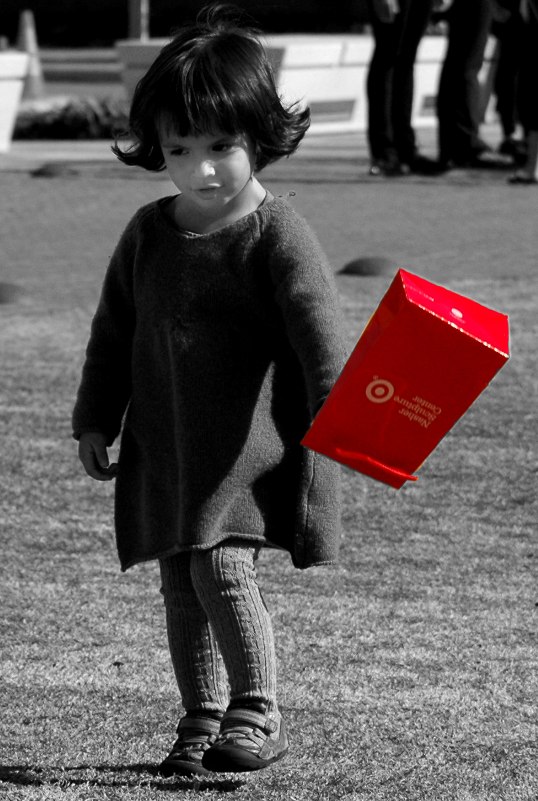
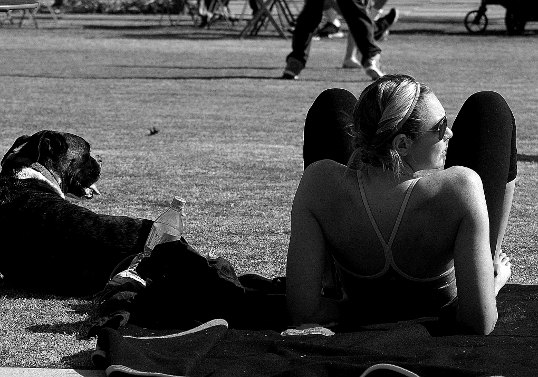
Klyde Warren Park, Dallas, Texas
It even comes to Dallas and Klyde Warren Park
I like the guy in the yellow cowboy hat.
I really enjoyed Red at the Dallas Theater Center’s Wyly Theater.
It’s nice to see it get a good review.
I have been thinking about Big Bend a lot. I miss the place. I used to go there to reconnect. I need to figure out how to get back.
Sometimes you get ideas that you really like but know they are crazy and will never happen. That’s when you feel stupid.
Sometimes… not too often… you find out that your crazy idea isn’t that insane and that somebody else is trying to actually do it. That’s when you no longer feel stupid, but instead feel lazy, cowardly, and ineffectual.
Affordable artist housing potentially coming to Dallas Arts District
8 New Punctuation Marks We Desperately Need
I’ve read all these – a pretty good list.
Bring Good Brews Home From Craft and Growler
That guy Guy Fieri – from that food show that shows him eating all sorts of stuff you should not eat – accomplished a rare feat. He opened a restaurant that garnered a zero star review from the New York Times (read it, it’s well written and pretty funny).
He also neglected to register the whole URL for his restaurant’s name… so somebody else did, and posted a
Shame it’s satire… wouldn’t you want to get something like:
Guy’s Big Balls – $26.95
Snuggle up to two 4-pound Rice-A-Roni crusted mozzarella balls endangered with shaved lamb and pork and blasted with Guy’s signature Cadillac Cream sauce until dripping off the plate. Served Nestled inside a tempura pickle, with a side of maximum-well-done duck skin.
Extra Wet Naps – $3.50.

Photograph by Jamie Chung for Bloomberg Businessweek
Sriracha Hot Sauce Catches Fire, Yet ‘There’s Only One Rooster’
Like ketchup, sriracha is a generic term, its name coming from a port town in Thailand where the sauce supposedly was conceived. When people in America talk about sriracha, what they’re really talking about is Huy Fong’s version. It’s been name-checked on The Simpsons, is featured prominently on the Food Network, and has inspired a cottage industry of knockoffs, small-batch artisanal homages, and merchandise ranging from iPhone cases to air fresheners to lip balm to sriracha-patterned high heels.
15 Great David Foster Wallace Quotes
por ejemplo:
12. “I do things like get in a taxi and say, ‘The library, and step on it.’”
– Infinite Jest (1996)
Just go there and read them all.
This looks really, really cool:
Nasher Sculpture Center and Mayor Mike Rawlings announce landmark public art initiative in conjunction with the museum’s 10th anniversary
Official site: Nasher X-Change
100 icebreakers for talks with strangers
But I think that we are looking at something even deeper than that: the Mandarinization of America.
The Chinese imperial bureaucracy was immensely powerful. Entrance was theoretically open to anyone, from any walk of society–as long as they could pass a very tough examination. The number of passes was tightly restricted to keep the bureaucracy at optimal size.
Passing the tests and becoming a “scholar official” was a ticket to a very good, very secure life. And there is something to like about a system like this . . . especially if you happen to be good at exams. Of course, once you gave the imperial bureaucracy a lot of power, and made entrance into said bureaucracy conditional on passing a tough exam, what you have is . . . a country run by people who think that being good at exams is the most important thing on earth. Sound familiar?
The people who pass these sorts of admissions tests are very clever. But they’re also, as time goes on, increasingly narrow. The way to pass a series of highly competitive exams is to focus every fiber of your being on learning what the authorities want, and giving it to them. To the extent that the “Tiger Mom” phenomenon is actually real, it’s arguably the cultural legacy of the Mandarin system.
….
In fact, I think that to some extent, the current political wars are a culture war not between social liberals and social conservatives, but between the values of the mandarin system, and the values of those who compete in the very different culture of ordinary businesses–ones outside glamor industries like tech or design.
Meddle not in the affairs of the dragon; for you are crunchy and taste good with ketchup.
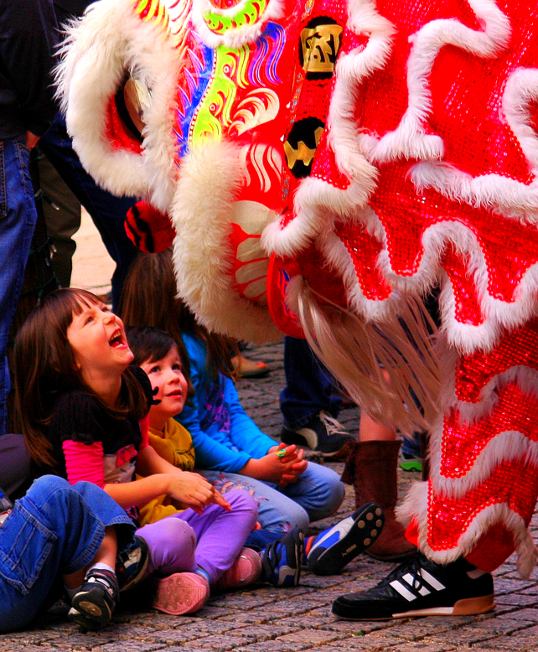
Crow Collection of Asian Art, Dallas, Texas
“Never laugh at live dragons.”
—- J.R.R. Tolkien
“It does not do to leave a live dragon out of your calculations, if you live near him.”
—-J. R. R. Tolkien
“What do you know about dragons?”
“They’re big, scaly, four-legged creatures with wings who terrorized small villages until a virgin was offered up as a sacrifice.”
His grinned again. “I do miss the virgins.”
—- Katie MacAlister, You Slay Me
“Puff, the Magic Dragon, lived by the sea, and frolicked in the Autumn Mist in a land called Honah Lee, little Jacky Paper loved that rascal Puff, and gave him strings and sealing wax and other fancy stuff.”
—- Peter Yarrow, Puff, The Magic Dragon
“For instance, dragons are deeply revered by the Chinese. According to legend they have megapowers that include weather control and life creation. And they’re seen as kind, benevolent creatures. Funny. Every fairy tale I’d ever heard involving dragons starred daring knights trotting off to kill said dragons. Probably the real reason every time East meets West they get pissed off and throw tea in our faces.”
—- Jennifer Rardin
“The townspeople took the prince for dead
When he never returned with the dragon’s head
When with her, he stayed
She thought he’d be too afraid
But he loved her too much instead.”
—-Jess C. Scott, Piety, Dragon Poems
“Everybody knows who dragons are. They are enourmous,fierce,bloodthirsty creatures appearing in fairytales and legends primarily as accessories, functioning mainly to set of the bravery of the knights challenging them. Dragons are obscure,mysterious characters described only in broad terms, little more than foils to enhance a hero’s valor. Dragons though are much more than this. They are intelligent and educated creatures who lead entralling lives.”
—- H.G. Ciruelo Cabral
“A dragon’s heart burns fiercely, even in the face of evil.”
—- S.G. Rogers, Jon Hansen and the Dragon Clan of Yden
“Fairy tales are more than true: not because they tell us that dragons exist, but because they tell us that dragons can be beaten.”
—- Neil Gaiman, Coraline
“But it is one thing to read about dragons and another to meet them.”
—- Ursula K. Le Guin, A Wizard of Earthsea
“How should we be able to forget those ancient myths that are at the beginning of all peoples, the myths about dragons that at the last moment turn into princesses; perhaps all the dragons of our lives are princesses who are only waiting to see us once beautiful and brave. Perhaps everything terrible is in its deepest being something helpless that wants help from us.
So you must not be frightened if a sadness rises up before you larger than any you have ever seen; if a restiveness, like light and cloudshadows, passes over your hands and over all you do. You must think that something is happening with you, that life has not forgotten you, that it holds you in its hand; it will not let you fall. Why do you want to shut out of your life any uneasiness, any miseries, or any depressions? For after all, you do not know what work these conditions are doing inside you.”
—- Rainer Maria Rilke, Letters to a Young Poet
“I do not care what comes after; I have seen the dragons on the wind of morning.”
—- Ursula K. Le Guin, The Farthest Shore
“My nightly craft is winged in white, a dragon of night dark sea.
Swift born, dream bound and rudderless, her captain and crew are me.
We’ve sailed a hundred sleeping tides where no seaman’s ever been
And only my white-winged craft and I know the wonders we have seen.”
—- Anne McCaffrey, Dragonsong
There is one gap in the buildings lining Flora Street – the avenue running through the heart of the Dallas Arts District – and that is the rough top of a parking garage across from the symphony hall. I have seen teenaged skaters run off the concrete. A high rise office tower is planned for this spot (like we need another one of those) but it has been vacant for years.
The odds and ends of the property have been used for some art installations before – most notably the Zen Garden and Ice Sculptures done for the installation Transcendence.
On my last visit, riding my bike through, I saw a bunch of figures – sculptures – hanging out on the thing. Riding up for a closer look I was interested in seeing that one figure was decorated with an orange safety vest and a blue hard hat. While I was lining up a photograph the figure jumped down and I realized that it was a worker adjusting the lighting system.
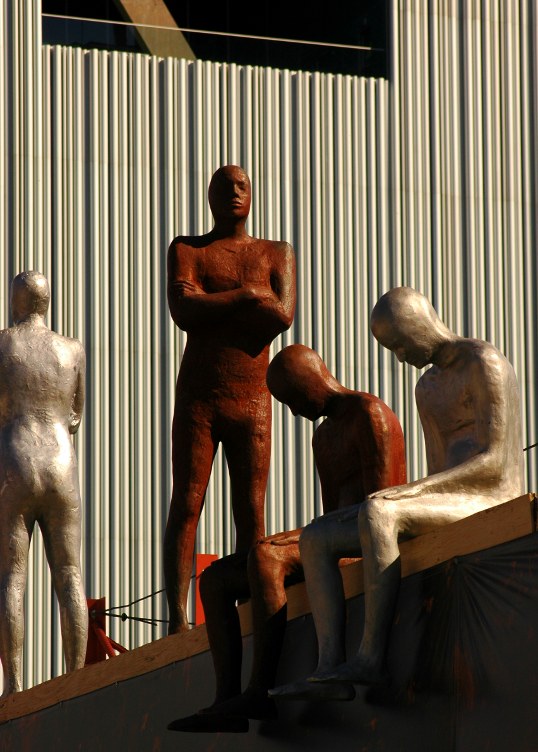
Borders, by Steinunn Thorarinsdottir, Dallas Arts District, with the cube of the Wyly Theater in the background

Borders, in the Dallas Arts District
“Borders” is a sculptural exhibition by Steinunn Thorarinsdottir. The sign says that the 13 pairs of figures, made from aluminum and cast iron are from the collection of the artist. It looks like the exhibition was originally done in New York City – I don’t know if these are actually the same figures or not.
I been warped by the rain, driven by the snow
I’m drunk and dirty don’t ya know, and I’m still, willin’
Out on the road late at night, Seen my pretty Alice in every head light
Alice, Dallas Alice
—- Willin’ – by Lowell George
There was an event scheduled this Sunday that I had been really looking forward to. It was a bike ride, organized by the good folks at Bike Friendly Oak Cliff that started at the Klyde Warren Park in Downtown Dallas and went to tastings at a couple of local breweries, ending up at The Foundry/Chicken Scratch in West Dallas.
These local craft microbreweries are cropping up all over town. Dallas may be a bit behind the curve, but when it does something, it does it seriously. The Brewery Tours are very popular – you go to the place, pay a small fee, get a glass, sample beer. There is often live music, and there are always a bunch of cool people. I’ve been to Deep Ellum Brewery for their tours a few times… but this was the first one on a bicycle… with a bunch of people.
The day promised to be one of those preternaturally warm Texas Winter Weekend Afternoons – whick was perfect. My plan was to ride downtown to the park, twenty five miles or so, and then pick up the folks there. I futzed around a bit and left later than I intended, plus there was a strong wind from the south and I realized I would have to pedal hard to get there on time.
As my route passed near the Spring Valley DART station, I decided that I wanted to have fun today and riding against a deadline is not what I wanted so I hopped on the train downtown. I waited on the platform on the little rise in the pavement – knowing that was where the doors to the center car would open. These cars are tall and open – few seats – designed for wheelchairs, strollers, and bicycles. There are two hooks for hanging bikes – it works pretty well.
When the train pulled in and the doors opened I saw the car was packed. There were a half-dozen bicycles (and three strollers) jammed in there. Everybody shoved back as far as they could and I squeezed in for the ride downtown.
The crowd of bicyclists grew at Klyde Warren park until it was time for everyone to haul out down Harwood street. I’m estimating about a hundred and fifty riders packed past the Art Museum and down Ross to the West End, then turning north through Victory and under I35 into the design district.
Riding along Harwood – The Nasher on the left, Dallas Museum of Art on the right
Everybody stacked their bikes up and went into the first brewery, Community Beer Company. A big, shiny new facility, it has only been open a few weeks. They were sampling a couple of beers – a Vienna Lager and a Pale Ale. Both were very good – the ale had more bite, the lager was very smooth. We milled around, talked beer, talked bikes, talked routes (especially how to get home). The Community folks were really nice, their facility looked great, and I hope they have a long and successful run in the city.
Another brewery to go, we saddled up and headed across the Trinity River on the old Continental Viaduct next to the Calatrava Bridge. The Continental span is supposed to be redone as a park – hopefully with a good bike/pedestrian path (there is a lot of controversy on this – the Trinity remains a tough cross on a bicycle).
It is a blast to ride in the city in a group of over a hundred bicycles. Scouts shoot ahead and temper the traffic at intersections so the pack can go through. It might anger a driver or two – but we were moving quickly on streets that don’t get much use on a Sunday and the cars didn’t have to wait long.
The views of a city are so cool on a bike. I still haven’t worked out a way to take pictures while riding – especially in a pack like this (it’s easy riding, but you have to pay close attention to the bikes all around you). That’s just as well, it helps me enjoy my day.
Over the river and down into West Dallas. This is a part of town that nobody dared venture into a few years ago – now it’s hip and rapidly coming into its own from The Belmont to Bishop Arts and beyond. Right at the end of the Calatrava span sits Four Corners Brewing – another craft brewery that offers tours, live music, and food trucks. They’ve been around a bit longer and offer a big selection and cool graphics. A fun place.
I had a dark porter and a red ale – both excellent.
It was cool to look around at all the bikes. There were so many different kinds of pedalled transport – from expensive carbon fiber road bikes to fixies to a Brompton folder. Most common was probably beat up old mountain bikes converted into tough urban commuters – which is exactly what I building up at home. My ancient Raleigh Technium “vintage” (there is a thin line between vintage and old/cheap/poor) bike worked great, but the roads are a bit rough in a few places (when I made it home I discovered I had broken a spoke).
After an hour or so at Four Corners everybody split up. Most folks headed back over the bridge to Fair Park and a final stop a Craft and Growler and on home – but Candy was waiting at The Foundry/Chicken Scratch, where the riders from Oak Cliff were mostly headed to get something to eat.
The jam session group that plays on Sunday were at The Foundry, so we were able to get something to eat and listen to some music before packing my bike in the trunk for the drive home.
All in all, a pretty good day.
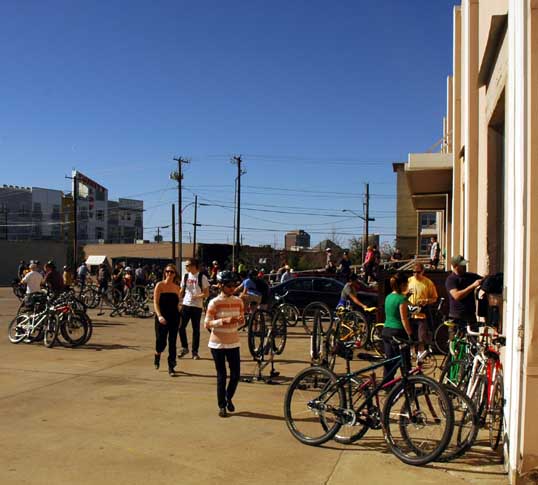
Outside Community Beer Company… a lot of bikes.

Pouring beer at Community

Arriving at the Community Beer Company, with the Dallas Skyline in the background
An Article about the ride – Craft beer scene spawns bike and bus brewery tours in North Texas
Mardi Gras, Bishop Arts District, Oak Cliff, Dallas, Texas


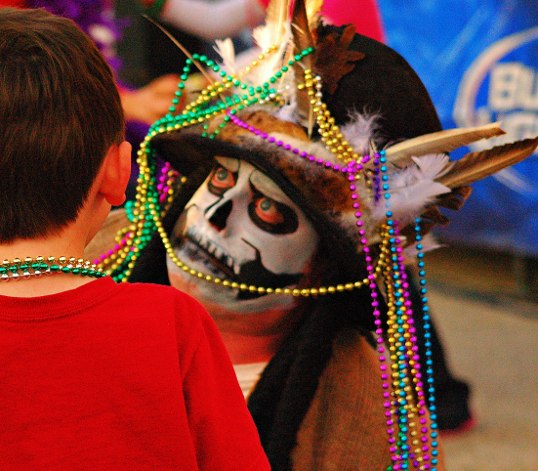
I noticed, while milling around the Bishop Arts District before the Mardi Gras Parade, a little piece of cardboard box down an alley, with two disposable cameras sitting on it.

Camera in the wild.
The box said:
I may not have mega-pixels
But I’m still pretty awesome
Facebooke.com/camera.bishop.arts
I thought about grabbing a camera and taking a shot, but hesitated and some other folks grabbed it first. You snooze, you lose. The idea of leaving a cheap film camera sitting around for people to use is pretty cool….
And now the pictures from the Mardi Gras Parade are up on the facebook page.
As far as the note goes… I have no idea about the misspelled URL.
I’ll keep checking back though, see what develops.
Mardi Gras Parade, Bishop Arts, Oak Cliff, Dallas, Texas

Fight for the beads.
I have this thing about Mardi Gras beads. I love to catch parade throws – yelling “Beads! Beads!” or “Big Beads!” – making eye contact with the Krewe member on the float – the cheap bilious plastic string floating through the air – the jump – the catch – and finally, adding the string to the growing collection around my neck. It’s stupid, but I love it.
Two years ago, in New Orleans, we went out to a night of smaller parades on Thursday or something… sort of a warm-up for the big Super Krewes that were coming up on the weekend. I like these smaller Krewes – they have an irreverent sense of humor that the big, expensive parades can’t match.
At any rate, after a day and night of catching, my neck was festooned with a thick collar of plastic beads – especially the smaller ones thrown by the less-well-financed Krewes of that afternoon and evening. We were hungry so at two in the morning or so we ducked into an Italian Restaurant out on St. Charles past Tulane.
As we sat there I became a little self-conscious about the beads and decided to take them off. That’s when I realized that they were terribly tangled around my neck and that I was trapped, slowly choking in a noose of bright plastic spheres strung on string. I sat there trying to work on the beads while fighting back panic.
“Just cut them off, here I have scissors in my purse,” said Candy.
“No, I can’t,” I said.
“Why not?”
“They’re Mardi Gras Beads! I can’t cut them.”
“They’re just cheap plastic. Cut ’em off.”
But I couldn’t. I have no idea why, but the fact they were thrown through the air and caught made them special, somehow. It took me an hour of careful, patient untangling to get them off.
Now, I’ve accumulated a big plastic tote full over the last few years. It sits in the bottom of a closet and I should throw them away… but I can’t do it. What I need to do is find a parade and walk – throw them myself – return them from whence they came. Back into the wild – catch and release.
That I could do.
Well, for the last two years we are way too broke to go to New Orleans for Carnival. The best we could do, last year and this, is go to Oak Cliff for the Bishop Arts Mardi Gras parade.
It isn’t New Orleans… but it will do . It has to.
Bishop Arts Mardi Gras Parade, Oak Cliff, Dallas, Texas

Laissez les bons temps rouler
The Girl With Many Eyes
One day in the park
I had quite a surprise.
I met a girl
who had many eyes.
She was really quite pretty
(and also quite shocking!)
and I noticed she had a mouth,
so we ended up talking.
We talked about flowers,
and her poetry classes,
and the problems she’d have
if she ever wore glasses.
It’s great to know a girl
who has so many eyes,
but you really get wet
when she breaks down and cries.
—- Tim Burton
The real voyage of discovery consists not in seeking new landscapes, but in having new eyes.
—-Marcel Proust
I think the eyes flirt most. There are so many ways to use them.
—-Anna Held
The tree which moves some to tears of joy is in the eyes of others only a green thing that stands in the way. Some see nature all ridicule and deformity… and some scarce see nature at all. But to the eyes of the man of imagination, nature is imagination itself.
—-William Blake
When a woman is talking to you, listen to what she says with her eyes.
—-Victor Hugo
Men are born with two eyes, but with one tongue, in order that they should see twice as much as they say.
—-Charles Caleb Colton
When you are old and gray and full of sleep, and nodding by the fire, take down this book and slowly read, and dream of the soft look your eyes had once, and of their shadows deep.
—-William Butler Yeats
The hardest thing to see is what is in front of your eyes.
—-Johann Wolfgang von Goethe
Wicked thoughts and worthless efforts gradually set their mark on the face, especially the eyes.
—-Arthur Schopenhauer
So if you’re down on your luck, I know you all sympathize
Find a girl with far away eyes
And if you’re downright disgusted
And life ain’t worth a dime
Get a girl with far away eyes
—-Mick Jagger/Keith Richards
“There is only one thing I fear in life, my friend: One day, the black will swallow the red.” – John Logan, from Red

It was time for another “Pay What You Can” night at Dallas Theater Center’s Wyly theater. I have seen King Lear and The Elaborate Entrance of Chad Deity at rock-bottom prices and now watch the web site for any new opportunities.
This go-round is the Tony Award winning play Red, by John Logan. It’s a two man play based on the artist Mark Rothko, set in Rothko’s studio in 1958, during the time he is working on a group of large murals for the new Four Seasons Restaurant in the Seagram Building in New York. Rothko and his fictional assistant, Ken, work and talk about art and life. The overarching conflict between the two is the very acceptance of the commission to decorate the walls of a restaurant frequented by the wealthiest people in the world. Rothko insists it is a subversive act, that he wants to paint, “something that will ruin the appetite of every son-of-a-bitch who ever eats in that room.” Ken counters that Rothko simply wants to feed his ego with the money and fame the prestigious commission offers.
At any rate, I was going alone, and went to catch the train downtown. Since I left from work, I felt underdressed – but that was fine; the crowd for “Pay What You Can” night was motley and wearing all sorts of styles at various levels.
I was interested in the staging of Red. King Lear is still running at the Wyly in the main stage above the lobby (the Wyly is revolutionary in its stacked structure – the lobby is at the bottom, the stage area above, with the support spaces higher up). For Red, they converted the rehearsal hall on the ninth floor into an artist’s studio.
While the patrons attending Lear were entering on the right side of the Lobby, we were divided into groups and sent up elevators to the ninth floor. The tickets had no seat assignments, so the crowd wandered around the edges of the studio, finding chairs lined against the wall on low risers. After I settled in, I noticed the actor playing Rothko silently sitting in a comfortable chair in the center of the room, staring and contemplating one of his in-progress color fields. Finally, the last patron came in looking around, looking lost – I noted his clothing was curiously dated… like something out of the fifties. Suddenly I realized that this was the actor playing the assistant, he spoke to Rothko, and the play began.
The play was simple – only two characters, one set, no intermission. Very intimate – you are there in the studio with the two characters. It was more intellectual than passionate – the only real moments of raw emotion was generated by Ken talking about the death of his parents… and that felt a bit forced. Still, it was enjoyable – the character of Rothko is a grand pompous bully – and a brilliant one. Ken was more of a blank canvass where Rothko would paint with his powerful personality and stubborn ideas, but Ken’s point of view somehow kept winning out in the end.
One highlight was a long, wordless passage where Rothko and Ken together slather the dark crimson undertone on a giant canvas, both working hard, slinging heavy brushfulls of paint in different sections of the wall-sized work, their breathing hard and passionate in the small space. To Rothko his paintings are living things… and he feels responsible for and concerned about their ultimate fate.
There is a lot of talk of the art of the time. It was fascinating how Rothko boasted of how he and the abstract expressionists dethroned Picasso and Matisse (“Nobody even thinks of painting cubism anymore, it’s dead”) and how Ken feels that Pop Art is now overthrowing Rothko.
Ken namedrops Warhol, Johns, Rauschenberg, and Lichtenstein – and Rothko asks, “Lichtenstein, who’s that?”
I was happy when, in my mind I thought, “Comic Books,” and then Ken says, “Comic Books.”
There is a lot of namedropping here, and it helps to know a thing or two about a thing or two – but not so much that it gets in the way of the entertainment.
After the play we rode the elevators back down to the lobby. It was full of patrons from King Lear, which was in intermission. They were all very nattily dressed, formal, seeing and being seen in that Dallas way while we cheapskates skittered away at the edges.
Outside, the glittering canyons of the city were shining at night while torn scraps of low cloud skimmed by overhead, illuminated by the lights below. It was beautiful and a bit of a shock – while the play was going on it was easy to think you were really in a dingy art studio and forget that you were really nine stories in the air in a huge aluminum cube-theater-machine.
Down Flora Street, between the hulking rows of the Arts District public edifices stood the Dallas Museum of Art. Inside, I knew, there was a Rothko painting. I’ve seen it before – but now I want to go back and stare at it for a while, watch it pulse, see it live, think about what the artist was thinking in that dark place where it was painted.

Mark Rothko, Orange, Red and Red, Dallas Museum of Art
 Bill Chance