
Dealey Plaza, Dallas, Texas
(click to enlarge)
Dealey Plaza, Dallas, Texas
(click to enlarge)
“I will not let anyone walk through my mind with their dirty feet.”
― Mahatma Gandhi
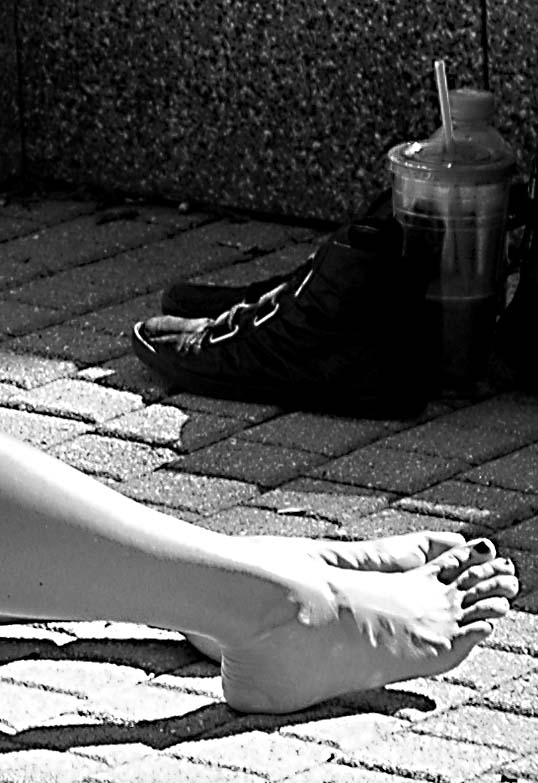
New Orleans Museum of Art, New Orleans, Louisiana
“I spent an hour yesterday watching the ladies bathe. What a sight! What a hideous sight! The two sexes used to bathe together here. But now they are kept separate by means of signposts, preventive nets, and a uniformed inspector – nothing more depressingly grotesque can be imagined. However, yesterday, from the place where I was standing in the sun, with my spectacles on my nose, I could contemplate the bathing beauties at my leisure. The human race must indeed have become absolutely moronic to have lost its sense of elegance to this degree. Nothing is more pitiful than these bags in which women encase their bodies, and these oilcloth caps! What faces! What figures! And what feet! Red, scrawny, covered with corns and bunions, deformed by shoes, long as shuttles or wide as washerwomen’s paddles. And in the midst of everything, scrofulous brats screaming and crying. Further off, grandmas knitting and respectable old gentlemen with gold-rimmed spectacles reading newspapers, looking up from time to time between lines to savor the vastness of the horizon with an air of approval. The whole thing made me long all afternoon to escape from Europe and go live in the Sandwich Islands or the forests of Brazil. There, at least, the beaches are not polluted by such ugly feet, by such foul-looking specimens of humanity.”
― Gustave Flaubert, Selected Letters

A sketch of the Casino at Montelimar, Nicaragua – once Somoza’s beach house.
I stumbled across a wonderfully interesting book this weekend; Iguanas on my Roof – Funny, Sad, and Scary OVERSEAS ADVENTURES of a Foreign Service Family in Third-World Countries during the Vietnam War and Watergate Era. I found it on its Facebook Page and then bought a copy from Amazon for my Kindle.
Say what you want about e-books… but to learn about a publication from the web while riding on a commuter train, have it in my hand seconds later, and instantly start reading it – that’s something amazing.
The book is a slim, simple, heartfelt family memoir written by Nancy Stone, the mother of five. I went to high school with two of her kids in Managua, Nicaragua. One son was my age, a grade below me and in a lot of my classes, and a daughter was my little brother’s age. We all ran around a lot together my senior year (I graduated and left for Kansas University in 1974).
I immediately recognized the title – we had iguanas on our roof. I remember when we first moved to Nicaragua trying to sleep with some tremendous racket overhead. I crept outside and leaned a ladder up to the wall, climbing up to find out what it was. There were a half-dozen huge iguanas and an equal number of cats all chasing each other around on the corrugated galvanized roofing. I couldn’t tell who was chasing who – but it was a mess. After I learned what it was up there – it was easy to ignore the cacophony and sleep.
Although I knew the kids well, I don’t recall ever even meeting their parents and I certainly never knew their story. We were military and they were embassy – that didn’t matter to the young’uns, but there was a difference. Their father, Al Stone, was a railroad brakeman in the late fifties when he was inspired by the harrowing plight of hordes of desperate Mexican immigrants fleeing a drought to try and do something. He spent years in education and effort until he was able to go to work for the Department of State and the USAID program.
So the big family was off on a tour of the disasters of the third world. From living in the Philippines while Al was in Vietnam, to Lagos, to Washington DC, to Managua after the 1972 earthquake (where they crossed paths with your humble narrator), the book describes the shocking, the strange, the scary, and the silly of a long, often difficult trip.
I’ve always said that living in the third world is months of boredom punctuated by moments of sheer terror.
Most of what was in the book was familiar to me, even the sections from the Philippines and Nigeria. There are certain stock scenes common to life in any poverty-cursed tropical place. Every incident brought back memories of similar episodes and adventures from my own youth.
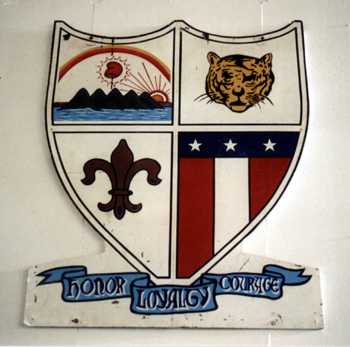
The crest from the American Nicaraguan School
What was most interesting was seeing these recognizable installments from a different point of view. The book is told by an adult – a person where everything is new and strange. Nancy Stone was from California – thrust by fate, love, and dedication into a bizarre world of giant insects, bad infrastructure, iffy transport, dangerous and incomprehensible societies, and odd food. It was all so… foreign. Cultural and work protocols, manners, and etiquette were consummate challenges. But it all comes to an end. The final chapter is titled, “We Went Back Home.”
Where is home? I don’t understand the concept. People talk to me about being “homesick” – I have no idea what they are talking about.
You see, It felt differently to go through a journey like that as a kid. When you are young… it is simply how things are. You don’t know any better.
A few paragraphs of the story were written by the kids I knew – familiar voices I understand.
For me, for example, the place and time where I had the most trouble adapting was when I went to college in the states. My nickname for a couple years was “Banana Boat” – as in, “Bill, you’re an American like the rest of us, but you act like you just fell off a banana boat.” I was so happy to find four students from Barcelona that I could relate to – though I was bothered by their lispy Spanish and the incredible amounts of wine they drank.
I realize that the youngsters were able to assimilate into the local culture in a way the adults couldn’t even imagine. To this day, I’m ashamed of my terrible Spanish – but I learned that if I simply kept my mouth shut I could move around at will without anyone knowing I was an American. As a matter of fact – nobody would notice me at all. I could become invisible. That’s an amazing thing to be able to do in a place like that.
That even affects the memories I try to hang onto in my incipient dotage. For example, there are a lot of anecdotes like those in the book that I am willing to let go as they fade into the misty cobwebs of my crumbling brain. What I hang onto desperately are some of the ethereal emotions of youth, the colors of the country, and the smells of the culture.
For example (full disclosure – I’ve been writing notes about this recently for a short story I’m working on) there is the smell of the third world. It’s a smell of pork grease and wood fires – of sour sweat and homemade soap, of heat and desperation. A few years ago I walked out onto the deck of a ship as it cruised into Montego Bay at dawn. A fisherman in a tiny wooden skiff was off the port bow and I watched him untangle his nets. As the salmon glow of the sun, still hidden behind the mountains, filled the sky we moved into a thin cobalt mist of the morning cooking fires wafting offshore and there was that third world smell. I had forgotten… but it all came back in a rush.
That is what I am desperate to hold on to.
So, I any of y’all are curious enough to read about what it was like, over there, back then, go to Amazon, load up your ereader or wait for the bound paper, whatever. It’s worth your money and your time, trust me. Thanks for doing the work, Mrs. Stone, for collecting the memories, writing them down, and sending them out into the world.
It’s late, so late. I think I’ll pour a little Flor de Caña (I was so happy when that became available in Dallas), get my writing in, and call it a day.

The land of lakes, volcanoes, and sun. A painting I bought on my last trip to Nicaragua.
As I rode up for the All Out Trinity Festival on the Margaret Hunt Hill Bridge the Yoga classes were in full swing. Restful music spouted from a PA system set up along the edge of the blocked up traffic lanes. The leader was talking into a microphone. Thousands of people were spread out over hundreds of yards of roadway, all stretched out on their mats. It was something to see.

Yoga on the bridge.
(click to enlarge)
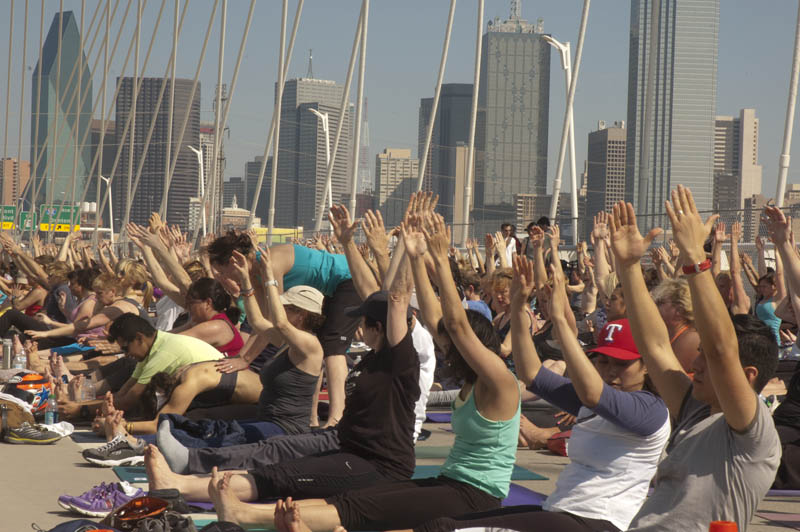
Yoga on the bridge.
(click to enlarge)
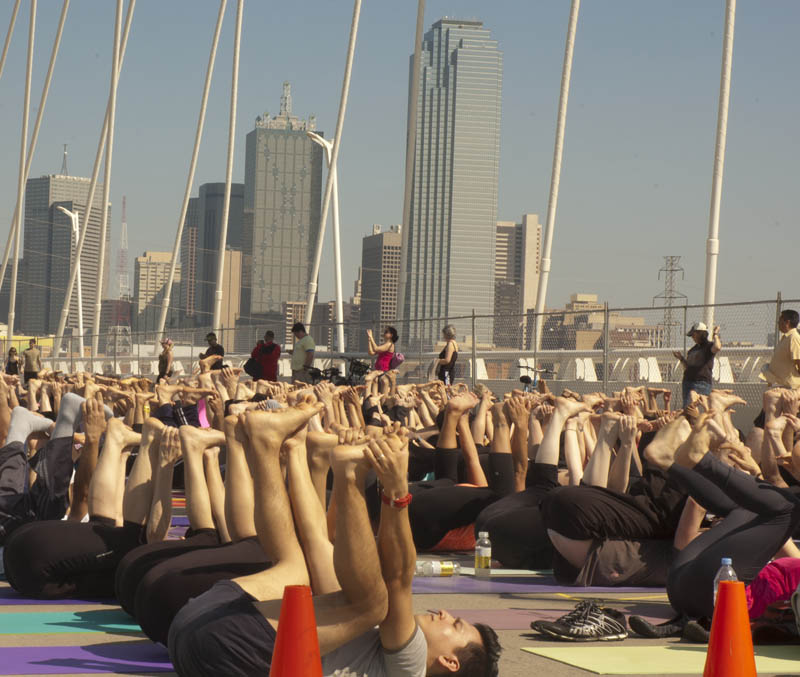
Yoga on the bridge.
(click to enlarge)
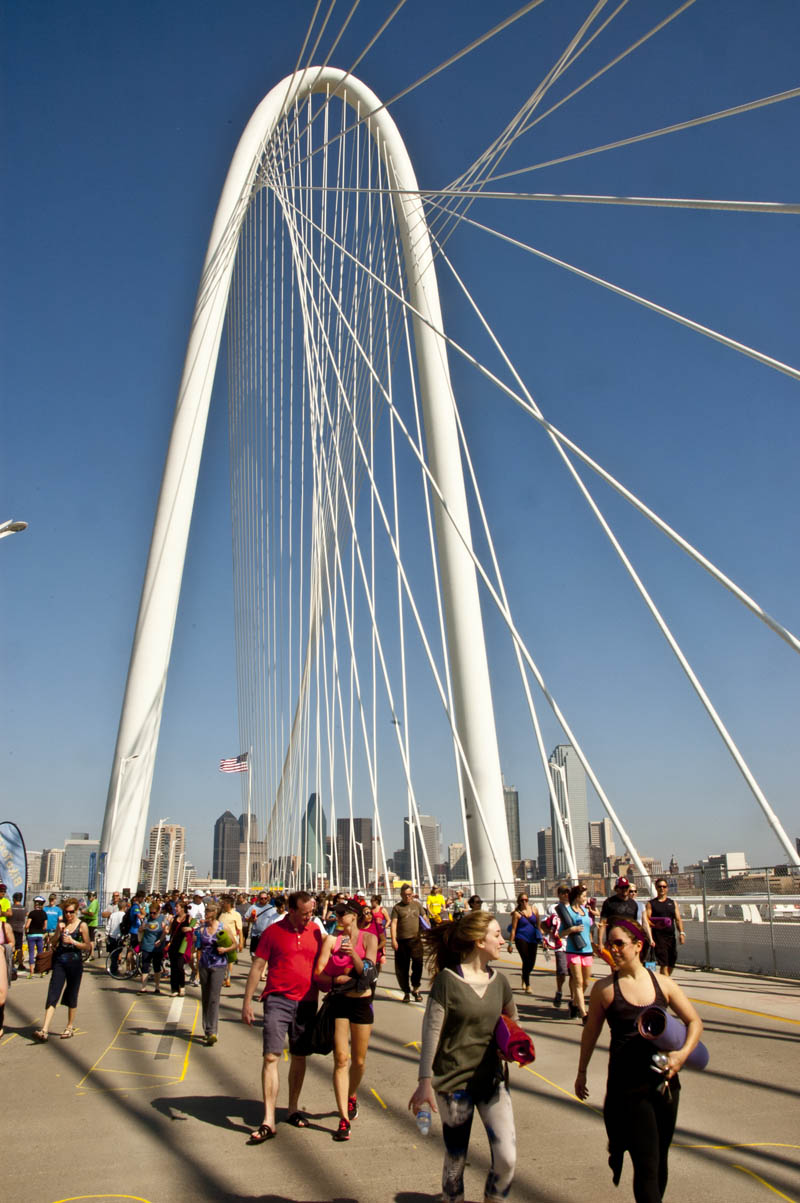
People walking from the yoga event with their mats under their arms.
All Out Trinity Festival – Margaret Hunt Hill Bridge, Dallas, Texas
(click to enlarge)
When the plans for Santiago Calatrava’s Margaret Hunt Hill bridge were finalized a lot of folks were disappointed that it did not include pedestrian or bicycle lanes. We were promised that a crossing would be provided on the proximate Continental Bridge, which was being converted to a park. There is no other good way to cross the Trinity in that part of town without an internal-combustion engine. The final designs still don’t have the promised through-lanes – but it will open in June, we’ll see how it works out.
At any rate, there is a powerful urge to cross the bridge without a car. It is an impressive, imposing, work of art – and you don’t get a good look from a speeding vehicle. There was a big celebration on opening day, where people were allowed to walk across, but I was out of town and missed it.
Finally, last Saturday, after two years, they had another event planned – the All Out Trinity Festival and I would be able to ride my bike across the bridge. I wanted to get down there right when the ramps opened, but Notting Hill was on TV – so I had to watch the end again.
I packed up my commuter bike and rode down to the Arapaho DART station. As usual, the train was pulling out just as I arrived on the platform, so I had to wait for the next one.
I was later than planned, but the timing worked out as I met a couple of friends riding through Downtown Dallas on the way to the bridge. We fought our way up the steep entry ramps onto the bridge itself.
It was a real thrill to ride on the bridge. Everybody was on the Westbound lanes – across the divider the Eastbound traffic still roared by. The pavement would vibrate like a monstrous guitar string whenever a big truck would rattle past.
There were a lot of events planned and I wasn’t sure what I wanted to do, but a group from Bike Texas gathered together for a ride through West Dallas – that sounded like a plan.

Bike Texas Group on the Margaret Hunt Hill Bridge, Dallas, Texas
(click for larger version on Flickr)
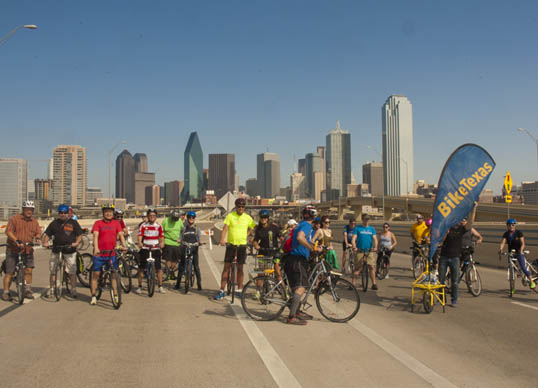
Bike Texas group on the bridge, with the Dallas skyline in the background.
(click for full size version on Flickr)

Margaret Hunt Hill Bridge, Dallas, Texas
(click for larger version on Flickr)
We headed West on Singleton. After a couple miles we passed Fish Trap Lake on the right – where I had ridden a couple months ago to visit the rainbow-colored pier, Dear Sunset, by Ugo Rondinone. The chromatic jetty was part of the Nasher XChange installation – now that the project has ended I wonder how long the pier will remain. It was good to see it still in place. People were out on the pier, so maybe they have even cleaned the bird shit off the wood.

dear sunset
Ugo Rondinone
West Dallas, Texas
(click to enlarge)
We rode down another mile and turned up to Tipton Park, where there is a new trail and pedestrian bridge.

Bike Texas ride at the Pedestrian Bridge in Tipton Park, West Dallas, Texas
(click for full sized version on Flickr)

Pedestrian bridge, Tipton Park, Dallas, Texas
(click for full sized version on Flickr)

Pedestrian bridge, Tipton Park, Dallas, Texas
(click for full-sized version on Flickr)
Riding back to the bridge, I was struck by the reaction of the people in the neighborhood. They acted like they had never seen a bicycle before – excited and astounded; some laughed, some clapped, some merely stared.
We arrived back in time for beers at Four Corners Brewery. The only thing better than a fresh local brew is one earned. I had an Oatmeal Stout and their IPA – both excellent. While we were standing around chatting, a thick column of smoke appeared to the south. Fire trucks were dispatched and the black soon turned to gray, then disappeared. Today, I found out that the fire was in a new construction across the street from the Belmont Hotel. Luckily, nobody was hurt.
The entertainment continued as we watched the police arrest a belligerent drunken woman that was stumbling down the street. She fought mightily, but in vain as they strapped her in the back of a cruiser and hauled her to the clink.
It was getting late, the sun had set, and until the Continental Bridge opens, Trinity Groves is a tough place from which to reach a DART station. I decided to ride down into the Trinity River bottoms and go a few miles south to the Corinth station, next to the Santa Fe Trestle Trail. This is the same route I took to visit the Dear Sunset Pier.
I certainly don’t recommend riding alone in the river bottoms at night – but it worked out for me. My lights were adequate to find my way in the pitch wilderness, while the multicolored jeweled towers of Downtown Dallas reached skyward off to the east. The day’s route was a fifteen mile bike ride (plus the four miles from my home to the DART station) with a lot of time spent hanging out and around with a lot of cool people – a good day.
It had been warm, on the edge of hot, a good eighty degrees – but as I rode home from the station I felt the wind switch around to the north and the temperature begin to drop. In twelve hours the temperature would be around twenty degrees and the ground covered in a healthy layer of tiny balls of ice. Springtime in Texas.
For only the second time in its short history pedestrians and bicyclists were allowed to walk across the Margaret Hunt Hill Bridge – the westbound lanes were closed for the All Out Trinity Festival.
All Out Trinity Festival – Margaret Hunt Hill Bridge, Dallas, Texas
(click to enlarge)

(click to enlarge)
I have written below about a presentation I attended concerning a small piece of freeway near Dallas’ Downtown. It was an important and interesting meeting, but what I wrote about it goes on a little long, and I wanted to write a little about what I think is the real crux of the matter.
I’ll write more at length about it later, I need to do some thinking and some research and some more thinking first.
This is the speaker, traffic planner Ian Lockwood’s presentation. Watch the whole thing. His talk should be available on youtube soon.
What jumped at me in particular were two slides (13 and 14 in the presentation). The first, printed from a book, was this statement:
In his 1911 book The Prinicples of Scientific Management, Frederick Winslow Taylor, a pioneer in the efficiency movement, wrote: “The goal of human labor and thought is efficiency. Technical calculation is in all respects superior to human judgement, in fact human judgement cannot be trusted because it is pagued by laxity, ambiguity and unnecessary complexity. Subjectivity is an obstacle to clear thinking…. That which cannot be measured either does not exist or is of no value….The affairs of citizens are best guided and conducted by experts.”
The bolded part of the quote was underlined, with a handwritten note and arrow that said, “THE BEGINNING OF THE END.”
The bullet at the bottom of the slide emphasized the point, “That which cannot be measured either does not exist or is of no value….The affairs of citizens are best guided and conducted by experts.”
This is contrasted to the next slide, which is a quote by Thomas Jefferson:
“I know no safe depository of the ultimate powers of the society but the people themselves. And if we think them not enlightened enough to exercise their control with a wholesome discretion, the remedy is not to take it from them, but to inform their discretion.”
Thomas Jefferson September 28, 1820
The contrast, the frisson between the two ways of looking at the world illuminated by these quotes is an amazing concept. If I learned nothing else, this was worth taking the train downtown after work.

I-345 near downtown Dallas
Dallas has this nasty, falling down 1.4 miles of freeway on the east side of downtown. It’s name is I-345, though nobody knows that. It is an elevated monstrosity that is an ugly barrier between the city center and Deep Ellum.
It also needs replacing. A movement is growing to remove the freeway instead of rebuilding it.
How Dallas is Throwing Away $4 Billion
The more I thought about that idea – the more sense it made.
Of course, the government has no imagination and soon, this headline came out.
TxDOT to Repair, Not Tear Down I-345: Lipstick on a Traffic-Fed Pig?
TxDOT tells Dallas it will repair and not remove the highway separating Deep Ellum and downtown
TxDOT has decided to keep the highway separating Deep Ellum and downtown, but Mayor Rawlings hasn’t
This pissed a lot of people in Dallas off, including me.
So I found out about a meeting at D Magazine (Great write-up about it here) with a presentation on how the modern American Urban High Speed traffic system is killing the city. I sent off for a ticket and rode the train downtown after work. I was more than a little ragged after a tough day at work and felt out of place – but the talk by Ian Lockwood was more than interesting.
They were taping the talk and I think I heard someone say it would be going onto Youtube. I’ll put it on here if I find it, but in the meantime, this one covers most of what he said. I know it’s long, but take the time to watch it if you can, it’s a revelation.
Here’s another photo I took of a typical day on I-345

Car fire just north of downtown, Dallas.
Hall & Oates “Rich Girl” wasn’t about a girl after all.
I feel as if I have been living a lie all my life.
“Daryl wrote it,” John confessed, talking about his other musical half. “It was about a guy who was the heir to a fast food fortune.” We can’t help but feel like everything we know in life is a lie now. “He realized ‘Rich Girl’ sounded a lot better than ‘Rich Guy.’”
11 Books That Will Definitely Disturb You
This is an interesting list – there are some amazingly strange films on this. And they all can be piped directly into your living room.
The 50 Best Movies on Netflix Instant (My Version)
After I left the Trans.lation Market in Vickery Meadow I took the DART train across the Trinity River. As we were crossing I saw a large group of bicyclists going past on the Santa Fe Trestle Trail. It was the Ye Olden Tymes Vintagey Retro Ride & Picnic – I had hoped to get down there before them, but I wasn’t all that very late.
As I rode down from the train station all the walkers coming the other way said, “They’re a long ways ahead of you.” All of them, really.
“I’ll catch up, don’t worry,” I replied.
And I did. It was a lot of fun.

Skipping rope at Ye Olden Tymes Vintagey Retro Ride & Picnic.
(click to enlarge)
As I was working my way through South Dallas on my bicycle exploring three of the Nasher XChange sites – between Flock in Space and Black & Blue: A Cultural Oasis in the Hills – I took a look at the GPS on my phone to make sure I wasn’t lost. I realized that I wasn’t far from something I wanted to visit. Even though I was behind schedule and getting tired I would be passing close enough to make a side trip.
So I did.
I turned off of Bonnie View Road into a neighborhood until I reached College Park. Past some guys playing basketball I found what I was looking for – a new park pavilion designed by the Oslo-New York firm Snøhetta. A review of the structure had shown up in the Dallas paper and around – gathering some architectural praise.
It looked pretty interesting, enough for me to visit.

Snøhetta Pavillion, College Park, Dallas, Texas
(click to enlarge)

Picnic Tables and Grills, Snøhetta Pavillion, Dallas, Texas
(click to enlarge)
I couldn’t stay long, but it was pretty cool in person. An ingenious design – unusual, yet in harmony with the site. Striking, yet useful. It seems to have been economical to build and designed to last a long time.
The picnic tables and outdoor grills were an unexpected treat – I loved the design of these. I didn’t think there was much you could do with public picnic tables – but these were unique and cool.
Later, at home, I did some web research and found a publication that extolls the virtues of the Pavilions in Dallas parks – listing a whole slew of them.
Now that I’ve finished with the Nasher XChange, maybe that’s something I can cycle through town and look at. Picnic Pavilions are pretty pedestrian objects and I have to say I haven’t noticed them for a long time.
But isn’t that the point? To try and ride around my own city and notice things that everyone usually ignores?
Maybe so.
 Bill Chance