The Ladies Paradise

“I would rather die of passion than of boredom.”
Émile Zola, The Ladies’ Paradise

Cover of Au Bonheur des Dames by Emile Zola

I am now a good chunk into Emile Zola’s twenty volume Rougon Macquat series of novels. Attacking this pile of books in the recommended reading order:

  • La Fortune des Rougon (1871) (The Fortune of the Rougons)
  • Son Excellence Eugène Rougon (1876) (His Excellency Eugene Rougon/ His Excellency)
  • La Curée (1871-2) (The Kill)
  • L’Argent (1891) (Money)
  • Le Rêve (1888) (The Dream)
  • La Conquête de Plassans (1874) (The Conquest of Plassans/A Priest in the House)
  • Pot-Bouille (1882) (Pot Luck/Restless House/Piping Hot)
  • Au Bonheur des Dames (1883) (The Ladies’ Paradise/Shop Girls of Paris/Ladies’ Delight)
  • La Faute de l’Abbé Mouret (1875) (The Sin of Father Mouret/Abbe Mouret’s Transgression)
  • Une Page d’amour (1878) (A Lesson in Love/A Love Episode/A Page of Love/A Love Affair)
  • Le Ventre de Paris (1873) (The Belly of Paris/The Fat and the Thin/Savage Paris/The Markets of Paris)
  • La Joie de Vivre (1884) (The Joys of Living/Joy of Life/How Jolly Life Is/Zest for Life)
  • L’Assommoir (1877) (The Dram Shop/The Gin Palace/Drink/Drunkard)
  • L’Œuvre (1886) (The Masterpiece/A Masterpiece/His Masterpiece)
  • La Bête Humaine (1890) (The Beast in the Man/The Human Beast/The Monomaniac)
  • Germinal (1885)
  • Nana (1880)
  • La Terre (1887) (The Earth/The Soil)
  • La Débâcle (1892) (The Downfall/The Smash-up/The Debacle)
  • Le Docteur Pascal (1893) (Doctor Pascal)

The next one up was The Ladies Paradise.

The overall story is a very thin romance between a poor, country girl that comes to Paris and finds work in a new, rapidly expanding department store and the owner of the store. He is Octave Mouret, the relentless womanizer of the book before this one – Pot-Bouille. His desire to possess women has now metastasized into the need to dominate them commercially by creating a retail establishment that they cannot resist – literally a ladies’ paradise.

But the real protagonist of the story is the store itself – the eponymous Ladies Paradise. Large swaths of text are dedicated to detailed dreamy descriptions of the store, its wares, and the elaborate displays set up to show off the goods and lure in the women of Paris and, most importantly, to separate them from their money.

As the book progresses the store grows and grows, taking over building after building, until it dominates the area and all retail commerce. There is a heart-tearing description of the woeful ends of the various small shopkeepers of Paris – trying to scrape out a living selling cloth, shoes, or umbrellas – until they are inevitably ground under the heels of the behemoth growing through the streets – their owners are driven into bankruptcy, poverty, and madness.

The book was written a couple of centuries ago – but it is a story that is still going on today. We have all seen small businessmen destroyed by large corporate chains that offer lower prices, bigger selections, and spectacular shopping experiences. It is a story that could take place in the last couple of decades.

Except today, even those huge conglomerates are being driven out of business by a technology that Zola couldn’t even imagine – online shopping. Though, now that I think about it, The Ladies Paradise puts together a company of horse-drawn delivery vans, with advertisements plastered on the side, that resembles today’s fleet of Amazon-Prime vehicles.

The novel’s fictional department store was modeled after a real place – Le Bon Marché in Paris. The store is still open.

This was an enjoyable tome in the series, though the long, detailed descriptions of ranks upon ranks of goods placed on sale went on too long for my taste – but probably necessary to drive home the point of the plot. It was simultaneously a record of the past, an reverse echo of the present, and a warning of the future.

Back From the Shadows Again

“We are born in an age when only the dull are treated seriously, I live in terror of not being misunderstood”—- Oscar Wilde


Let’s see, the last blog entry I wrote was on July 7, 2019 – on the eve of my annual trip to New Orleans for the Writing Marathon. That was almost three months ago – a long gap for me.

I’d like to say that I’ve simply been busy with other things and decided to take a break for no real reason. I’d like to say that… but it wouldn’t be true. It’s a long and complicated story and some of it I’m going to keep under wraps – a lot of it isn’t just my story – but here’s the ten cent version. It may not be completely accurate – my memory is hazy.

Every year I look forward to the writing marathon in New Orleans. But this year, I thought about skipping. First, Candy had some surgery and wasn’t really up and around completely. She assured me that it would be cool if I went. As the day approached I realized I didn’t feel very good. Among other symptoms I was weak and tired all the time.

It took me a few minutes to realize this originally said “art changed my life” — French Quarter NewOrleans.

Checking into what it would take to cancel I realized everything (two hotels, parking, the conference fee etc.) was already paid for and non-refundable. A week of vacation was scheduled and my work arranged. So I decided to go.

The drive to New Orleans wasn’t too bad – I’ve made that trip more than a few times. To make the trip easier I had a hotel in Gonzales – most of the way. I could sleep there, get up fresh and drive the last few miles. There was no hurry, but I had a hell of a time getting out of bed. Eventually I hauled myself into the car and drove on into the Big Easy… and checked into my French Quarter Hotel. It was a beautiful piece of luxurious historical lodging and I was excited… though a bit worn out.

The first evening reception of the Writing Marathon was great. This was the third year I had attended and there were a lot of familiar faces and old stories going around. I was excited for the week of walking around and writing.

The only problem was, everybody kept saying the same thing, “Bill, you don’t look too good.” And I felt really weak. I begged off going out to eat and live music and went back to my hotel.

And proceeded to get really, really sick.

One scary thing is that I remember spending one day in that room but it turns out I might have been there for three. I must have been unconscious/delirious and unaware of the passage of time. I do remember looking around my hotel room and seeing things as they were, but when I’d close my eyes I would see someplace else – some kind of seaside scene. Back home, Candy and Nick were upset because they couldn’t find me (I wasn’t answering my cell phone). Lee was on his way back to New Orleans from the Galapagos Islands.

Finally, I realized how much trouble I was in and called the front desk. The kicker is that I couldn’t breathe. It felt like a panic attack – but I realized that there is a big difference between not being able to breathe because you are having a panic attack and having a panic attack because you can’t breathe. I was able to stagger to the front desk and they put me in a cab that was always at the step and sent me to an urgent care center.

The cab driver, a grizzled old veteran of the French Quarter said, “Hey, you look like you’re having congestive heart failure. The last guy I had like that was dead in three days.”

The urgent care center took one look at me and realized I was too far gone for them and stuck me in an ambulance. At that time, Lee had come back from the airport and called the hotel. They said they sent me to an urgent care center, but didn’t know which one.

Lee lives car-less in downtown New Orleans so he looked up urgent care on his phone and rented a bike. Later, he told me that it was a good thing – that he could get around in the quarter faster on the bike than in a car. The first two places he checked were wrong and then he rode up to the place I was at as they were loading me into the ambulance. He said I didn’t look too good. They wouldn’t tell him anything until he begged and they said they were taking me to the Tulane Medical Center.

So, what happened? It turns out that it started with a urinary tract infection that then spread to my bloodstream and set off a serious attack of Diabetic Ketoacidosis. I don’t want to sound too dramatic, but alone I probably would have been dead in about six hours. However, they knew immediately what was wrong and with treatment, I improved quickly.

I spent a couple days in intensive care. Going through my mind constantly was the Dorothy Parker quote, “What fresh hell is this?” The worst was the fact I had eight (yes, I counted ‘em – including one triple on my right arm) IV tubes and needles stuck in both arms and one foot. Whenever I would move it would set an alarm off and I would lay there listening to that awful BEEP BEEP until someone would come by and reset the machines.

It was a lot better when I was moved into a regular hospital bed and after a few days I was released. Lee’s apartment was only a few blocks away and I felt like I could walk there. But the minute I hit the pavement and the Louisiana summer heat I realized that I didn’t have the strength, sat down on a bench and waited for a ride.

That turned into a theme as I stayed at Lee’s place for almost a week until I regained enough strength to make it back to Dallas. If I rested I would feel OK, but as soon as I actually moved it would take all my energy. Simply taking a shower was about all I could muster.

The view from my son Lee’s apartment – New Orleans, Louisiana

One day, while Lee was at work I decided I could walk to the grocery store, Rouses. I made it to the store, bought some food, then realized I wasn’t going to be able to walk back (only two blocks or so). I waited outside until Lee came by after work – and was able to shuffle back with him carrying the bags.

Even after returning home, regaining my strength was a slow process. I did go back to work as soon as I could – walking across the parking lot the first day back was a serious effort.

Then I found myself having not ridden a bicycle in two months. That first day I climbed on and rode two miles. After that short distance, I felt like I had finished the Tour de France. So I made up a chart and some goals and have been working on building up my mileage since – up to ten miles per day – I was able to ride 300 miles total in September and am almost getting to where I need to be.

There has been this personal journey to put my life back together. One last thing is my writing – and I’m about there. I’m not sure if I’ll be able to write here every day, there are a lot of other things going on, but I promise I won’t have another gap like that if I can help it.

Off to the Big Easy

I’ll be in New Orleans for the New Orleans Writing Marathon for the next week. I’m taking my laptop, but I’m not sure if I’ll be posting here.

See you on the flipside.

(click to enlarge) Sixth and Camp in New Orleans – a beautiful row of Camelback Shotgun Houses

Short Story of the Day – Marooned, by Edward Wolf

I remember enjoying the peacefulness by floating around on a child’s ducky-tube while sipping on a jigger of a bottom-shelf tequila.

—-Edward Wolf, Marooned

Somewhere in the Caribbean

Marooned, by Edward Wolf

from Flash Fiction Magazine


Short Story of the Day – Jackalope Run by CJ Hauser

It’s a sloppy, grey Connecticut winter, and this is a bad town for Mexican food. You are a white girl in the vestibule of Rancho Allegre waiting to pick up three Chile Relleno dinners. You will pay with your father’s American Express card. You are thirty years old, unemployed, and have recently moved in with your parents.

—-CJ Hauser, Jackalope Run

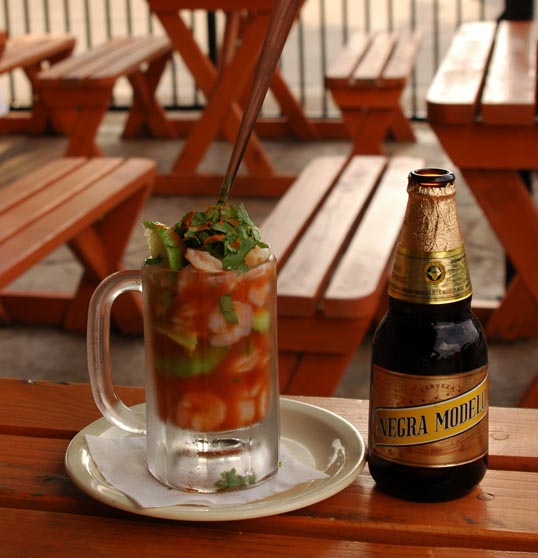
Mexican Shrimp Cocktail and Negra Modelo at Big Shucks.

Jackalope Run by CJ Hauser

from Hobart

About the Author:

CJ Hauser

CJ Hauser teaches creative writing and literature at Colgate University. Her most recent novel. Family of Origin, will be published by Doubleday in July 2019. She is also the author of the novel The From-Aways and her fiction has appeared or is forthcoming in Tin House, Narrative Magazine, The Paris Review, TriQuarterly. Esquire, Third Coast, and The Kenyon Review. She holds an MFA from Brooklyn College and a PhD from Florida State University. She lives in Hamilton, NY.

About the Story:

If I want to find out if a Mexican Restaurant is worth returning to – if they have the chops – I will order a chile relleno. This is the most difficult thing most Mexican restaurants shell out. It their chile relleno is good – the rest of the food probably is.

I too hate it when the restaurant has its staff come to my table and sing Happy Birthday. I hate it even more when they go to someone else’s table.

Short Story of the Day – We Are Other People Tonight by ​T Kira Madden

No wonder her daughter hated her, what a bore she has become. If only she could have something of her own, something for which she could be recognized: horn-rimmed glasses, a special rhythm to her walk, a nickname. She imagines a scenario in which several suited men lean in close over cigars in a dimly lit restaurant. Her name is mentioned. Oh Ramona, one of them would say, And what a woman she is.

—-T Kira Madden, We Are Other People Tonight

Crystal Beach, Texas

We Are Other People Tonight by ​T Kira Madden

from Midnight Breakfast

About the Author:

T Kira Madden

T Kira Madden is an APIA writer, photographer, and amateur magician living in New York City. Her work has most recently appeared in The Kenyon Review, Tin House Online, Puerto del Sol, and HYPHEN. She is a 2014 and 2016 MacDowell fellow, and the founding Editor-in-Chief of No Tokens Journal.


About the Story:


Boca Raton means “Rat’s Mouth.” Well… not really….

The Spanish named it Boca de Ratones. Although Boca translates, literally, as mouth, here it means inlet. Ratones, literally, means mice, but it was also a term used by navigators to refer to sharp rocks below the surface of the water. … The name Boca Raton shifted to a new inlet that formed later.

Short Story of the Day – A Bruise the Size and Shape of a Door Handle by Daisy Johnson

Until Salma turned thirteen the house was just a house. It was too big for the two of them, an up-and-down warren of rooms neither of them had the compulsion to fill. She did not have friends to invite round, did not like those girls at school, their careful observations of one another, the way they moved and talked. Sometimes she wondered why her father did not bring back dates, long-legged women filling the house with the smell of bacon and eggs, wearing her father’s dressing gown and slippers, their thin lips purple from the cold. She liked to think it was because he could not imagine there being anybody other than her mother. She liked to think he thought of her by the minute, her dark hair wrapped around his fist, her angry words in the crevices of his mouth.

—-Daily Johnson, A Bruise the Size and Shape of a Door Handle

House Being Remodeled, The Cedars, Dallas, Texas

A Bruise the Size and Shape of a Door Handle by Daisy Johnson

from American Short Fiction

About the Author:

Daisy Johnson

A British novelist and short story writer. Her debut novel, Everything Under, was shortlisted for the 2018 Man Booker Prize, and is the youngest nominee in the prize’s history. For her short-stories, she has won three awards since 2014.

About the Story:

This short coming of age tale does not end like you think it will, although you are warned… you don’t pay attention. Delicately written, fine turns of phrase conceal the evil and power beneath.

It reminds me of one of my favorite (even if it is unnecessarily twee and gimmicky) novels – House of Leaves. One of the interwoven stories is about a man that discovers that the house he lives in is a few centimeters larger on the inside than on the outside. Then all hell breaks loose.

A section of the book is used in the Poe song “Hey Pretty” (the author, Mark Z. Danielewski, is the singer, Poe’s brother).

Kyrie suggested we go for a drive in her new 2-door BMW coupe In the parking lot, we slipped into her bucket seats, Kyrie took over from there.

At nearly 90 miles per hour she zipped us up to that windy edge Known to some as Mullholland, that sinuous road running the ridge of the Santa Monica Mountains Where she then proceeded to pump her vehicle in and out of turns Sometimes dropping down to 50 miles per hour, only to immediately gun it back up to 90 again Fast, slow, fast fast slow Sometime a wide turn sometimes a quick one she preferred the tighter ones The sharp controlled jerks, swinging left to right before driving back to the right

Only so she could do it all over again until after enough speed, and enough wind, and more distance than I had been prepared to expect Taking me to parts of the city I rarely think of and never visit…

I can’t remember the inane things I started babbling about then, I know it didn’t really matter, she wasn’t listening She just yanked up on the emergency brake, dropped her seat back, and told me to lie on top of her On top of those leather pants of hers, extremely expensive leather pants mind you, her hands immediately guiding mine over those soft, slightly oily folds

Positioning my fingers on the shiny metal tab, small and round, like a tear Then murmuring a murmur so inaudible that even though I could feel her lips tremble against my ear, she seemed far, far away Pinch it, she said, which I did, lightly, until she also said pull it, which I also did, gently parting the teeth, one at a time, down under and beneath, the longest unzipping of my life…

We never even kissed, or looked into each other’s eyes, our lips just Trespassed on those inner labyrinths hidden deep within our ears, Filled them with the private music of wicked words Hers in many languages, mine in the off-color of my only tongue, until as our tones shifted and our consonants spun and squealed, rabbled faster, hesitated, raced harder Syllables soon melting into groans or moans, finding purchase in new words, or old words, or made-up words Until we gathered up our heat and refused to release it, enjoying too much the dark lane which we had suddenly stumbled upon

Prayed to, carved to, not a communication really, but a channeling of our rumored desires, hers for all I know gone to black forests and wolves, mine banging back to the familiar form, that great revenant mystery I still could only hear the shape of Which in spite of our separate lusts and individual prize, still continued to drive us deeper into stranger tones, our mutual desire to keep gripping the burn Fueled by sound, hers screeching, mine… I didn’t hear mine, only hers, probably counter-pointing mine A high pitched cry, then a whisper dropping unexpectedly, to practically a bark, a grunt, whatever, no sense anymore, and suddenly no more curves either, just the straightaway

Too bad dark languages rarely survive…


Short Story of the Day – A Hundred and Twenty Muscles, by Rachel Heng

When it came to Lea’s turn, she held him up to her face. He wriggled between her hands, a warm, alive thing. She felt his delicate ribs under the flesh and fur, thin bones interlocking like puzzle pieces, protecting some squirming secret within.

—-Rachel Heng, A Hundred and Twenty Muscles

H.O.P. Rabbits, by David Iles

A Hundred and Twenty Muscles, by Rachel Heng

from The Offing

About the Author:

Rachel Heng

Rachel Heng is the author of the novel, Suicide Club  (Henry Holt / Sceptre, 2018). Suicide Club was a national bestseller in Singapore, named a most anticipated book of the summer by the Huffington Post, The Millions, Gizmodo, Bustle, New Scientist, ELLE, Bitch Media, The Independent, Stylist, The Irish Times, NYLON, Tor.com and The Rumpus, and will be translated into 10 languages worldwide.

Rachel was named one of The Independent’s ‘Emerging Authors To Look Out For in 2018‘, won Singapore Women’s Weekly’s Great Women of Our Time (Arts and Media) 2018 Award, and has been profiled by the BBC, The Evening Standard, The Telegraph, The Straits Times, Channel News Asia, Electric Literature, Library Journal and The Rumpus. Rachel’s short fiction has received a Pushcart Prize Special Mention, Prairie Schooner‘s Jane Geske Award, and have been published or are forthcoming in Glimmer TrainKenyon Review, Tin House, Guernica, The Offing and elsewhere. She has received grants and fellowships from the Fine Arts Work Center, Sewanee Writers’ Conference, Vermont Studio Center, Kenyon Review Writers Workshop and the National Arts Council of Singapore.

Rachel was born and raised in Singapore. After graduating from Columbia University with a BA in Comparative Literature & Society, she spent several years working in private equity in London. She now lives in Austin, where she is a fiction fellow at UT Austin’s Michener Center for Writers.

About the Story:

Not a very pleasant story, but a well-written one. You feel the vitality and the delicacy of the pet bunny… and… well, read it to find out. There are monsters among us, and they don’t even know what they are.

I reminds me of something recent – I wrote about it only a couple of months ago:

We have had Isaak, our dog, our rescue, for a year now. We don’t know exactly how old he is, but he was a young puppy when he came to us, so he is a bit over a year old. He’s pretty much as big as he’s going to get, but still has a lot of puppy spirit, for good and bad, in him. Other than excitement over tennis balls and the squirrels in our backyard trees that taunt him – he’s a well behaved and relatively calm dog.

We also have my son’s black lab with us – he and Isaak get along great. It isn’t unusual for us to have other people’s dogs too – kept as a favor for friends while they are on vacation or foster dogs (especially ones that need some socializing) or people pay us to watch their pooches.

The other day, we had another black lab mix staying, a little smaller than my son’s dog. So we had three… if not big, then good-sized dogs at the house.

I was having some trouble sleeping, and it was work the next day, so I was laying in bed, awake, trying to relax and get some rest before having to go back into the breach the next morning. A little after midnight… the guest dog wasn’t too comfortable with the doggie door, so Candy got up and let the three of them out the back door.

I’m not sure why she did this, but as the dogs ran by she reached out and flipped on the light switch for the back yard (I mean… the dogs can pee in the dark, can’t they?) and there, right in the middle of the yard, illuminated by a circle of spotlights, sat a rabbit.

The dogs went nuts – all three bolted for the bunny – and the rabbit made a mistake. The rabbit ran to the east side of the house, where the fence runs along the wall, a few feet away, until it ends near the front. The rabbit hit that dead end and had nowhere to go but to turn around. The three dogs were on him.

Our dog, Isaak, like most dogs rescued from the Dallas pound, is a pit bull mix. He doesn’t really look like a pit (he has long legs and a long snout) but is, according to his DNA scan, one quarter American Staffordshire Terrier – which is a polite term for Pit Bull. The poor rabbit didn’t have a chance. He was dead in a few seconds.

Candy, of course, went crazy. You see, to her the dogs are like people. They live in the house, most of the time, eat the food you give them, and chase tennis balls around. But right under that domesticated surface is a wild animal… and seeing a big fat rabbit standing there right in the middle of their territory, the back yard, is enough to bring that wild animal boiling out in a split second.

I jumped out of bed, chased the dogs back inside and, with more than a little trepidation walked around to the side of the house (at this time, I didn’t know what had happened); I only knew that the dogs had run down something. There was the rabbit, a big one, freshly dead with a big hunk missing from its side.

Isaak was walking around, coughing.

“We need to take him to the emergency room,” Candy said.

“Naw, he’ll be alright, though you’d better keep an eye on him, he’ll probably yakk up a big ball of rabbit fur any minute,” I said.

So it fell to me to go out and pick up the poor dead rabbit and throw him over the fence. We live on a creek lot so I went around and took the body down by the water, so the coyotes will have a snack sometime later that night.

I feel bad about the bunny, but not too bad. There are hundreds of rabbits along that creek after all. I wonder why the rabbit ventured into our yard. Surely they have some survival instincts and our yard smells of dog as much as any – it’s like the rabbit tried to sneak into a kennel.

I didn’t get much sleep – Candy and my son’s dog were freaked out by the whole thing. Isaak was just excited.

He’s a city domesticated pit bull mix – this was probably the high point of his entire life.

Short Story of the Day – Hall of Small Mammals, by Thomas Pierce

We were at the back of a very long line that began near the Panda Plaza and wound all the way around the Elephant House. Nobody was very interested in the elephants or the pandas at the moment. Everyone was at the zoo for the baby Pippins. If just one of the three Pippin Monkeys survived to maturity, it would apparently be a major feat for the zoo, since no other institution had been able to keep its Pippins alive for very long in captivity. The creatures came from somewhere in South America. They were endangered and probably would go extinct soon. But before they did, Val wanted to see one up close: the gray fuzzy hair, the pink face, the giant empty black eyes. Val wanted to take a picture to show his friends.

—-Thomas Pierce, Hall of Small Mammals

Deep Ellum, Dallas, Texas

Another Short Story available online:

Hall of Small Mammals, by Thomas Pierce

from Literary Hub

The Author:

Thomas Pierce

The following is the title story from Thomas Pierce’s collection, Hall of Small Mammals. Pierce was born and raised in South Carolina. His stories have appeared in The New Yorker, The Atlantic, Oxford American, and elsewhere. A graduate of the University of Virginia creative writing program, he lives in Charlottesville, Virginia, with his wife and daughter.

The Story:

A man and a slightly obnoxious diabetic twelve-year-old boy are waiting in line at a zoo exhibit. The line is going slow and the boy is not the man’s son. The boy’s mother is beautiful, but the man has his doubts about the relationship.

We all have to wait in line and we all have to decide how much we are going to take. We always have to wait too long. Sometimes we take too much. Every day. Every damn day. And that line moves to slow, until you need it to wait and then it speeds up.

I looked up “Pippin Monkeys” and they don’t exist outside of this short story. Shame, I’d like to see one, though I never really liked monkeys. I wouldn’t wait in line very long, however.

Short Story of the Day, The 37, by Mary Miller

I was living in a city now, a city with many buses that could take you many places you might want to go and many places you would not want to go and I had to figure them out because I was afraid to drive for the same reasons and some additional ones: I didn’t know how to get to where I was going or where to park once I got there or if I’d have the right parking pass, if one was required, or whether the meters were active, if there were meters, and whether they took coins only.

—–Mary Miller, The 37

Downtown Dallas at Night, (Click to Enlarge)

Another Short Story available online:

The 37, by Mary Miller

From Joyland Magazine

The Author:

Mary Miller grew up in Jackson, Mississippi. She is the author of two collections of short stories, Big World (Short Flight/Long Drive Books, 2009), and Always Happy Hour (Liveright/Norton, 2017), as well as a novel, The Last Days of California (Liveright/Norton, 2014).

Her stories have appeared in the Oxford American, New Stories from the South, McSweeney’s Quarterly, American Short Fiction, Mississippi Review, and many others. She is a former James A. Michener Fellow in Fiction at the University of Texas and John and Renée Grisham Writer-in-Residence at Ole Miss. She currently lives on the Mississippi Gulf Coast and is on faculty at the low-residency MFA program at Mississippi University for Women.

The Story:

A woman from Mississippi quits her PhD program and starts anew, alone, in Austin. A common story. It isn’t easy for her – transportation seems to be a particular monster.

I remember when I first moved to Dallas. I was about the same age, I suppose, as the narrator in the story… I never went to graduate school and had been working at a salt mine in Kansas for three years. This was 1981 – the economy was in the dumpster and the only place in the country where you could get a job was Texas.

I stayed with friends until I had enough money for an apartment. I moved into a cool, but extremely dated small apartment complex off of Lower Greenville (The Turtle Dove – it’s still there today). When I wasn’t on the road (Superfund toxic waste sites, chemical spills) I worked downtown. I rode the bus to work.

It was the Belmont #1 bus. Very easy to recognize. I could go to happy hour downtown (this was before the happy hour laws and they could offer three for one) and all I had to do was recognize the #1 bus and I was home. One evening I looked up as saw the Belmont #1 bus on its way. I looked down, fished my pass out of my wallet and made sure I had some punches left. When I looked up, the open door of the bus was right in front of me. I boarded and slumped into the seat.

Unfortunately, it was the wrong bus. Some other mystery bus had passed mine and stopped, with the number out of view overhead. By the time I realized it, I was somewhere in far East Dallas and I didn’t recognize anything. I waited for a while to see if it entered a familiar neighborhood but things kept getting sketchier and sketchier. I had no choice but to get off and wait at the stop across the street, going back the other way. This was decades before the internet and smart phones and definitely before Uber, and there wasn’t a pay phone in sight and it didn’t look like the kind of place I wanted to go exploring especially now that the sun was setting.

It took about an hour (which, of course, seemed like days) for a bus to come and take me back downtown. By then all the buses had stopped running and I had to find a pay phone and order a cab. Luckily, I had the cash on me.

From then on, I learned to be careful about the bus that I jumped on. You learn something every day.