Beauty is in the eye of the beer holder.
—-Kinky Friedman
Deep Ellum, then and now.
I am old enough and have lived in Dallas long enough to have seen Deep Ellum rise, fall, and now rise again. When I first moved here in 1981 it was an urban industrial wasteland – known only for cheap space for marginal businesses.
Yet, even then, the neighborhood had a long and famous history. The music from the 1920’s, lead by Blind Lemon Jefferson, Huddie “Leadbelly” Ledbetter, Texas Bill Day and Bessie Smith paved the way for modern jazz, blues, and rock and roll as much as any other place. But in 1969 a giant elevated freeway choked off the urban oxygen and the vibrant area fell into decay.
Then in the 1980’s fueled by cheap funky space and the punk revolution in music Deep Ellum regained its reputation as a spawning ground for music and nightlife. I was there for that – and it was something.
But again, the city zoning laws, rising crime, and the fact that the wealthy edge of the city was vomiting out over the cotton fields over an hour north threw Deep Ellum back into disrespect and disrepair.
Now, though, the population is moving back in and Deep Ellum is coming back with a vengeance. This time it is different, the rebirth is fueled by people actually living in and around the area. This time it feels like it might last.
The last Friday of the month is Dallas Critical Mass. I always enjoy these, a lot, even though it took all my will power to get my stuff together and catch a train downtown – work wore me out so much, the siren song of the couch was almost irresistible. This is a rare sweet spot in Dallas weather – and a big group showed up in the park for the ride. One of the fun things about the Critical Mass Ride is that nobody knows where it is going. This month we wound around downtown, then headed out Main Street through Deep Ellum.
When we crossed Exposition the bicyclists were clumping up in a big group right in the middle of the street, and I realized we had reached our destination. It was the Cold Beer Company – a new bar/restaurant/place to hang out on the edge of Deep Ellum.
I realized that I had seen this little building before, and had even photographed it and posted a blog entry. It was once the rundown and abandoned spot that used to hold Vern’s Kitchen until it closed in 2009. I liked the place, even with the broken windows and graffiti, but didn’t think that Deep Ellum would grow enough to resurrect a business on such a wayward spot.
I was wrong. We stayed at the Cold Beer Company for a couple of cold beers (PeticolasVelvet Hammer to be exact) and I pronounce the location to be back and back for the better. The room is small, but they have done a great job with their patio and garden areas. They even have a cool custom bike rack out in front.
The building that would become The Cold Beer Company, in March of 2013
The Cold Beer Company today… from about the same angle.
Today was Candy’s birthday and, along with some friends that have done it before, we decided to celebrate with a Segway tour in downtown Dallas.
My first impression of the idea was a little iffy. I would rather have ridden my bike around downtown (as I am wont to do) than stand there lazily on two electric-powered wheels. Plus, I’ve seen these groups of touristy-looking folks, wearing helmets and standing stiffly on the slow-moving vehicles, moving in a line along the downtown sidewalks. It looked rather silly to me.
Well, I thought about it and realized that, as usual, I was full of shit. Let’s face it, everyone wants to at least try out a Segway and see how it is. I remember the crazy hype back in 2001 when the thing (code name “Ginger”) was introduced and, although it could never live up to its promotion, it still made an impression. All in all, it had to be fun.
There are a couple companies that offer Segway tours, and we chose one based on… well, we had a Groupon.
Candy and I had gone to our third Dallas Savor Wine Tour yesterday and then gone to Lee Harvey’s for a Naked Lunch concert last night and stayed out too late. When I crawled out of bed – too early for a Saturday – I didn’t feel too well. I’m getting too old. But I gutted it out and we drove downtown to the Segway place – in a cool old brick building.
We had a few minutes of lessons, a quick pep talk, then off we went.
That might be the most amazing thing about the Segway – how easy it is to learn. After all, this is a completely unique and new transportation form. It has no controls at all – only a platform to stand on and a stick with a handle. There is no seat or restraint – you just stand there. Still, after only a minute of practice, we were off along the streets and sidewalks of a big city. We had to maneuver along narrow twisting paths, through curb cuts, and over precarious routes along concrete dropoffs.
It was a piece of cake. The only difficulty I had was that, at first, I stood too stiffly and my feet and ankles were painful and cramping. After a bit I was able to relax and flex better and it became comfortable.
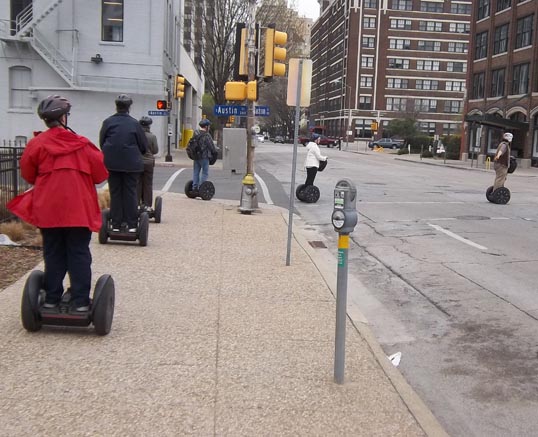
I was surprised at how far the tour went. We started out on the edge of the West End area (near the bus station) and headed out to the famous bronze steer sculpture and City Hall, then north clear through the heart of downtown. We visited the Arts District and then on to Klyde Warren where we took a break. Finally we rode west to visit Dealey Plaza before heading back.
That’s a complete tour of downtown.
The Segway is a great way to tour an area. You cover a lot more distance than you can walking, of course. You see so much more than in a bus or car tour. I’ll give it a nod even over a bicycle because you are able to keep your head up and look around while you ride.
The last leg of the tour was a blast. By then I was very comfortable on the machine and was able to enjoy myself – doing a bit of slalom between landscape trees along a stretch of sidewalk, swinging around in close spaces, or simply picking up the speed (a little bit). It’s an odd experience – the key to comfortably riding a Segway is to forget you are on one and let your instincts take over. I really can’t tell you how to go forward or backward, how to stop or turn – you just do.
Most of the people in the tour were not from Dallas and I asked them if they thought the Segway Tour was a good way to see a new city and they all were enthusiastic.
So, the next time you visit someplace or even revisit the place where you live – check out and see if a Segway Tour is available. Do it if you can. It doesn’t look as silly when you are in the bowels of the thing than it does from outside looking in.
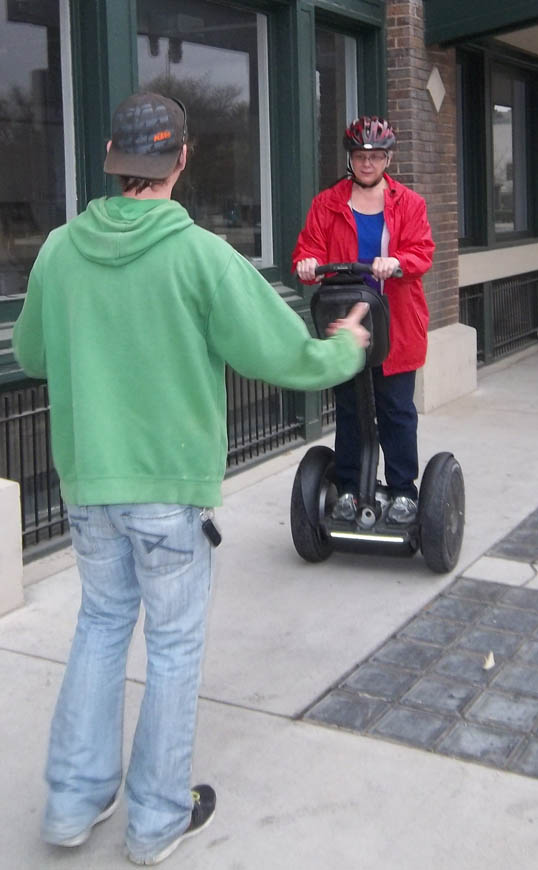
Candy getting her Segway Lesson.
The tour stops at the Dallas Eye.
Segways lined up at Dealey Plaza. The Texas School Book Depository in the background.
As I was working my way through South Dallas on my bicycle exploring three of the Nasher XChange sites – between Flock in Space and Black & Blue: A Cultural Oasis in the Hills – I took a look at the GPS on my phone to make sure I wasn’t lost. I realized that I wasn’t far from something I wanted to visit. Even though I was behind schedule and getting tired I would be passing close enough to make a side trip.
It looked pretty interesting, enough for me to visit.
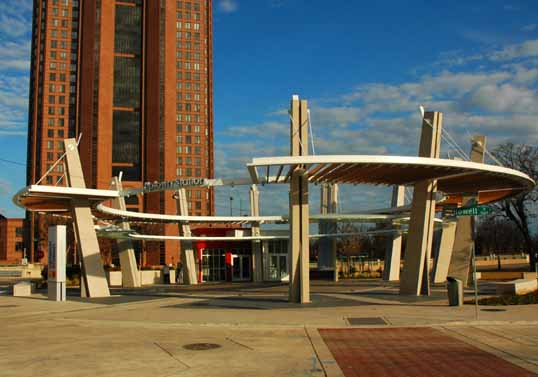
Snøhetta Pavillion, College Park, Dallas, Texas (click to enlarge)
Picnic Tables and Grills, Snøhetta Pavillion, Dallas, Texas (click to enlarge)
I couldn’t stay long, but it was pretty cool in person. An ingenious design – unusual, yet in harmony with the site. Striking, yet useful. It seems to have been economical to build and designed to last a long time.
The picnic tables and outdoor grills were an unexpected treat – I loved the design of these. I didn’t think there was much you could do with public picnic tables – but these were unique and cool.
Later, at home, I did some web research and found a publication that extolls the virtues of the Pavilions in Dallas parks – listing a whole slew of them.
Now that I’ve finished with the Nasher XChange, maybe that’s something I can cycle through town and look at. Picnic Pavilions are pretty pedestrian objects and I have to say I haven’t noticed them for a long time.
But isn’t that the point? To try and ride around my own city and notice things that everyone usually ignores?
The 50th anniversary of the Kennedy assassination is this November and Dallas is bracing for the event. When you live in Dallas, the assassination is an odd thing. It is the most famous historical event that has occurred here and it is what most people still think about when they think about Dallas. When the television show became wildly popular back in the day the people here were relieved because they figured that people would associate Dallas with J. R. Ewing, rather than the assassination. Same thing when the Cowboys are winning.
But those things have faded and with the half-century mark coming up, it’s time to live in infamy again. Dallas and most of the people that live here wish that the memory that horrible event occurred here – well, we wish that would be forgotten.
Everyone my age or older remembers where they were when they found out about the assassination. I was in third grade, in New York (state, a little up the Hudson from the city) and I remember going out to catch the bus home, and the bus was not there. I guess we were sent home from school early. We were waiting with our teacher with us and someone came up to talk to her, both women were very upset. We didn’t know what was going on and all I heard was “shot and killed.”
At that age, the world looks different. I put the phrase “shot and killed” together with our missing bus and assumed that our bus driver had been murdered. Later, when I found out it was the president, I was sort-of relieved. I knew my bus driver personally, after all.
At any rate, the tour was inexpensive and looked like fun – I am always up for learning about my city – so we signed up. It started, not surprisingly, at Lee Harvey’s – a beer garden/restaurant/live music spot/dive bar – in the Cedars. We met there, piled into an air-conditioned coach, and set off.
Our first stop was Dealey Plaza. There are always a lot of tourists there, and a lot of tours, guides and sellers of conspiracy theory books and materials. Our guide was really good. He was Jerry Dealey, the great grand-nephew of George Dealey – the guy that Dealey Plaza was named after. He said he was from the poor branch of the family.
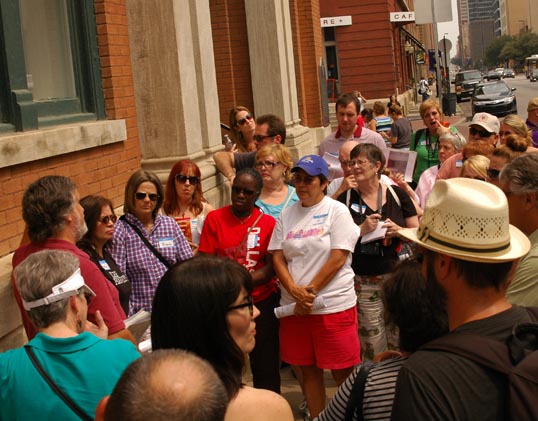
Our tour in front of the Texas School Book Depository
Our tour in Dealey Plaza.
What was nice was that he gave a “fair” tour – as far as all the conspiracy theories go. He said something that makes sense to me, “We will never know for certain exactly what happened, and anyone that thinks they know is wrong.” So he covered a lot of the more well-known theories… but also did point out those that are clearly completely impossible or flat out wrong (many having to do with Oliver Stone’s film).
For a rare moment, the area cleared. This is the spot of the fatal shot, marked by the X. Abraham Zapruder was standing on that white concrete pillar in the foreground when he made his famous film.
I remember when I first moved to Dallas, I lived in Oak Cliff and worked downtown. My bus would go through Dealey Plaza twice a day – it was a month before I realized that was the assassination site.
The Texas School Book Depository from Dealey Plaza.
Then we drove over to Oak Cliff to see where Oswald lived, then visited the site where Officer Tippit was murdered, and then on to the Texas Theater where Oswald was arrested (for shooting Tippit). That was surreal, because I spend so much time in Oak Cliff, especially on my bicycle, that I am very familiar with the streets and hadn’t really thought about the web of history that is overlain on such familiar turf. I have ridden my bike past Oswald’s rooming house, for example, a dozen times in the last few months, without knowing its infamy.
Then we headed out west, to Fort Worth to visit Oswald’s grave. It’s a fairly isolated spot, and hard to find (the cemetery will not give directions or help locating it). We parked the bus on a side street and then trudged over to the grave. It was more interesting than you would think… not because of Oswald per se. It’s especially interesting because of the mystery of NICK BEEF.
Oswald and NICK BEEF
Lee Harvey Oswald’s original tombstone was stolen and replaced with a simple marker that says, “Oswald.” Then, in 1997, right next to his grave appeared a mysterious stone, the same size and type that said, simply, “NICK BEEF.”
Of course, that mysterious stone supplied fodder for all sorts of wild stories. It wasn’t until this year that the New York Times finally was able to run it to ground. No wild conspiracy, simply an eccentric New Yorker – nonperforming performance artist with a morbid artistic sensibility – that as a child saw Kennedy at Carswell Air Force Base the day before he died. It left a lifelong impression and when he found out that nobody wanted to buy the plot next to Oswald… well, NICK BEEF was, umm born.
We headed back to Dallas to see some spots related to Jack Ruby and his killing of Oswald. Then we returned to Lee Harvey’s for a couple beers and hamburgers.
It was a fun day. They are going to do some more tours – a Haunted Dallas tour around Halloween, a “Dirty Dallas” about the history of the city’s seamy side, and (the one that I am really interested in) a Bonnie and Clyde tour.
Sounds like a plan.
There was a famous person on our tour. They announced that the music artist/rapper MC 900 Ft Jesus was a member of the company. They wouldn’t say which person he was, but… after a bit of looking and thinking, I figured it out.
Dallashenge from the triple underpass in Dealey Plaza. This is an HDR image – three shots taken at different exposures and combined with software.
I took the DART train downtown to a Beer Festival and made my train on time. Because of this, I was an hour early and sat down in Klyde Warren to hang out and wait until the festival opened. The sun was near setting and the sky was glowing – the skyscrapers sharp and elegant.
Looking at the collection of crystal towers, my attention was drawn toward six in particular. Thinking about why these meant something to me; I realized I had watched these (and many others) while they were built. I worked in Downtown Dallas in the early eighties – for a couple years in the Kirby Building (now converted into condominiums) and for a couple more in the historic Dallas Cotton Exchange (I loved that building – unfortunately, it was dynamited in 1994 to make room for a parking garage for the 1st Baptist Church).
The early eighties were a time of frantic building in Texas, especially in downtown Dallas. The giant construction crane was considered the state bird. This all came to a spectacular stop in the Savings and Loan crash of the late eighties – but at the time nobody could see that disaster coming.
I was young and a recent immigrant to the big city and was absolutely fascinated with watching the towers going up. In those pre-internet days detailed news was unavailable to the unwashed masses – so the construction was always a surprise to me. Since it would take, say, two years or more to build these it was like a slow-motion reveal, a mystery unveiled piece by piece, day by day.
A block would be cleared and then a gigantic hole slowly carved deep down into the chalky bedrock. Then the steel, concrete, or combination skeleton would rise, floor by floor, emerging from the scurrying crowds of hard-hatted workers like a living thing.
Finally, the skin would be hung and, only then, would the real shape and color of the building revealed. It was never really what it looked like while it as going up – the architects played with shapes and forms, adding extra corners and geometric sleights of hand. The final form was always a gigantic pleasant surprise.
Those were exciting, innocent days. Now, looking at the buildings bring back those memories. I can see, in my imagination, beyond the glass and stone cladding to the hidden skeleton of these skyscrapers, remember when the supporting framework was fresh and exposed.
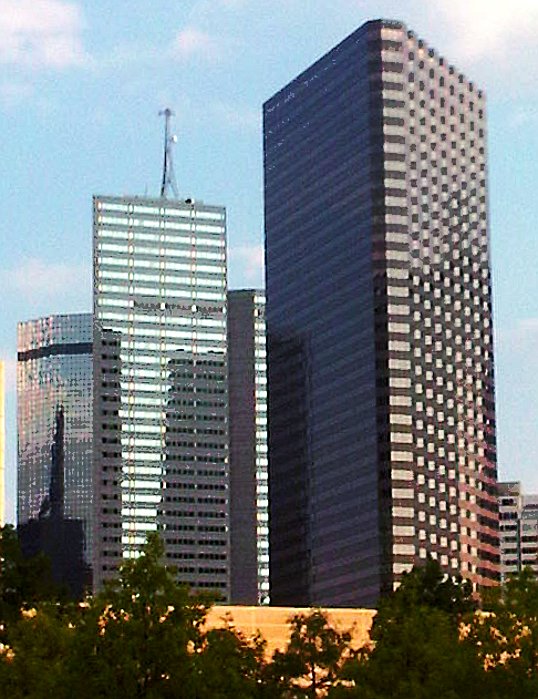
Three skyscrapers from Klyde Warren Park, Dallas, Texas
The three towers to the east
The Chase Tower
2200 Ross – 1987 – I recently took photos of a helicopter making a delivery here.
People call this one the building with a hole in it. On the 40th floor is a skylobby that offers good views of the Uptown area of the city – I haven’t visited this, but would like to. I watched it get started but was working out in Garland before it was finished. The skyscraper was designed by SOM and is 738 feet tall with 55 stories, making it the 4th tallest building in Dallas.
San Jacinto Tower
2121 San Jacinto – 1982
This is the tan triple building in the center. I watched this one go up in detail. While it was being built it was not obvious that it would have that unique, triple structure – the effect was made with add-ons at the end. The building is 456 feet tall and is 33 stories, making it the 20th tallest building in Dallas.
Trammell Crow Center
2001 Ross – 1985
This one was really cool to watch. It was very close to where I worked and was clearly visible outside a window near my cube. Although I left downtown before it opened, I did see all the visible construction right in front of my eyes. The skyscraper is Post Modern in styling and is 686 feet tall with 50 stories. The Trammel Crow Center is the 6th tallest building in Dallas and is named after its principal tenant.
Three more skyscrapers from Klyde Warren Park, Dallas, Texas
To the west are three more:
Lincoln Plaza
500 N. Akard – 1984
This triangular building went up on the site of the old YMCA – I watched them implode that building. It has a cool upper-crust restaurant (Dakota’s) in the basement – you go into an elevator sticking up in the sidewalk to get down to it. Lincoln Plaza is 579 feet high with 45 stories, and is the 13th tallest building in Dallas.
These last two flank Thanksgiving Square – one of my favorite spots back in the day. It’s getting a little run-down and forgotten now – but in the early 80’s it was the place to hang out for lunch on a warm spring day.
Energy Plaza
1601 Bryan – 1983
This is another building that I watched with interest – it ended up looking a lot different than I thought. I.M. Pei & Partners designed this 49 story building located on the north side of Thanksgiving Square. On top of the tower is a triangular communications tower that is modeled after the Eiffel Tower — only smaller and three sided. Energy Plaza is the 9th tallest building in Dallas and with a height of 629 feet.
Thanksgiving Tower
1601 Elm – 1982
The rearmost of these three is Thanksgiving Tower. This was was almost finished when I started working in Dallas – I was there when it opened. This 50 story all glass skyscraper faces into Thanksgiving Square. Thanksgiving Tower is 645 feet high and is the 8th tallest building in Dallas. If you look at it you can see the the distinctive reflection of Republic Center Tower – a skyscraper that has been there since 1954 – ancient by Dallas Standards.
“The Guide says there is an art to flying”, said Ford, “or rather a knack. The knack lies in learning how to throw yourself at the ground and miss.”
― Douglas Adams, Life, the Universe and Everything
“When we started the show, ‘Dallas’ was known as the city where JFK was assassinated. By the end it was known as JR’s home town.”
—-Larry Hagman
“But there is so much more to do for the city we love… a Dallas with roads as strong as our businesses, parks as beautiful as our children, a downtown as tall as our imagination.”
—-Laura Miller
Last year I went into downtown Dallas at sunset for Dallashenge.
Dallashenge
Dallashenge, for those that never read or can’t remember my entries from over a year ago, is the date when the sun sets directly down one of the vast glittering canyons formed by the reflecting glass-clad rows of skyscrapers lining the streets. It is derived (by me) from the more famous Manhattanhenge, from New York.
Dallas and New York are interesting because their central business district streets don’t run on a direct east-west grid. Those that do, such as Chicago, will have their ‘henge dates on the summer and winter solstices… plus their morning and evening ‘henges will be on the same day. For a city on the bias, you have to calculate the henge dates – luckily the website Suncalc makes all that very easy.
So, last year, I calculated the evening Dallashenge as February 15th, took some test shots, and then went down there at sunset and made some photos. I don’t know if the photos do justice, but it was a fun exercise in research, travel, and photography anyway. It was fun answering questions about why I was running out into a crosswalk with a camera on a tripod at sunset.
I have been thinking about a morning voyage to a Dallashenge. Other than the sheer laziness in avoiding getting up that early, I have put it off because I didn’t have a good spot. I was thinking about a parking garage at the city jail – but it wasn’t perfect and I wasn’t sure if photography would be welcome. Then, one day I was riding the DART line to the Convention Center and as the train crossed over the famous triple underpass I realized that there was a walkway along the rail lines. The sight line went straight down Main street and would be perfect for a morning Dallashenge.
During a downtown bike ride I decided to head over to that end of downtown and do some test shots. The spot turned out to be a perfect view down the street, plus it’s a well known spot – you enter the railroad overpass from the infamous “grassy knoll” and look out over the area where the Kennedy Assassination took place almost fifty years ago.
The morning Dallashenge date will be April 19, with the sun rising at six fifty-three in the morning. Now, I have to get up enough gumption to get up that early and head down to get some photos.
The view east down Main Street from the Triple Underpass. The sun will rise right down the middle of the street on April 19, morning Dallashenge.
This is the walkway along the rail tracks over the underpass, with the Dallas Hyatt Regency and Reunion Tower in the background.
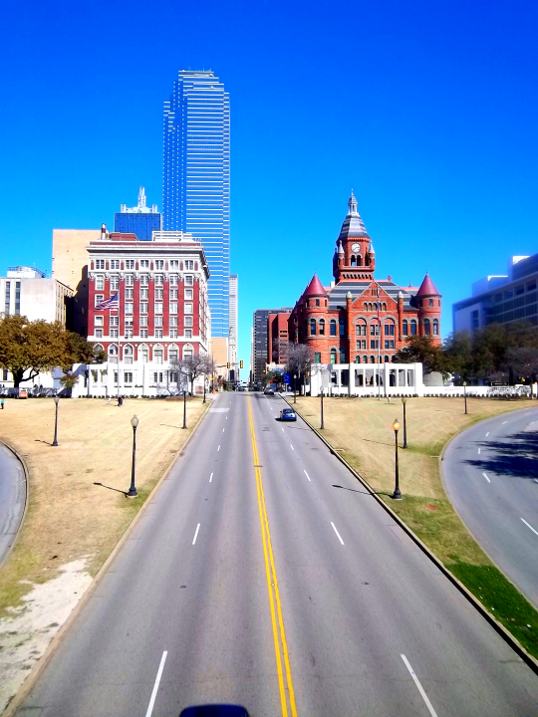
The view a little to the left of Main Street. That’s the curve of Elm Street. The grassy knoll is on the left, the Texas Schoolbook Depository is the lighter brick building over the trees. The assassination site is right in front of the two cars coming down the road.
Last weekend, Candy and I drove down to the Bishop Arts District for lunch at Eno’s and on the way back, we decided – spur of the moment thing – to stop off at a spot Candy had seen on the web. There is a new boutique hotel – The NYLO opening up in Southside – and they had a bar and infinity pool on the roof. The person writing the article said the view of the Dallas Skyline from the bar was the best in the city.
We parked and walked up at about one in the afternoon. The place wasn’t even officially open – it was in the middle of a “soft opening.” The woman from the front desk gave us a tour of the lobby and the restaurant. Pretty damn cool, if you ask me – especially the lobby room called “The Library” with a case full of books and funkified seating all around. Then she walked us over to the elevator and took us up to The Soda Bar on the roof.
The article wasn’t kidding, the view from up there is jaw-dropping.
We hung around chatting with the folks that worked there and some customers. They didn’t have any beer on tap – but I made sure they would have some local Deep Ellum Brewing Company products available (they will have the Double Brown Stout and Deep Ellum IPA) when they officially open (which they have by the time you read this).
I kept thinking what the view would look like at sunset, so we sneaked across the street for dinner at Cedars Social and then came back to watch the sunset.
When we finally left to drive back to suburbia we came across the same woman in the lobby that had given us our tour. She said, “Are you still here – I’ve been home and changed and come back again and you’re just leaving?” I said we came back for the sunset.
The place may get too uppity and twee after it gets established – it’s also a bit too far to be a neighborhood hangout – but I’m sure I’ll be back. I could get used to hanging out there. That view is too good to miss.
As it lurches wildly out of its Redneck Past, the City of Dallas – now completely strangled by its noose of suburbs – is forced to turn inward. It has to flip over its long-neglected flat rocks and deal with what scrambles out from underneath. It has to somehow transform its neglected barren shadowy hinterlands into fertile soil where it can grow shiny new developments for the future.
Few people in the city fully realize this yet, but the only successful path into the world of tomorrow leads directly and literally to the other side of the tracks and across the river. Success for the city will depend on how well this difficult process is done. It doesn’t have to (and can’t be) done perfectly… but it has to be done and has to be done thoughtfully and has to be done soon (faster, please).
One of the critical junctures in this process is a long-ignored wide spot in the road called Cedars West. If you look at an old aerial photograph of Cedars West from, say the 1930’s, you will see it was an island. The meandering Trinity River split into two branches forming the area that would become Cedars West, and then, only a short distance downstream, they joined back together. The Corinth Street Viaduct, a long, concrete structure joining Dallas North and South, gave access to this swampy little piece of land.
This cheap, almost useless, scrap of land quickly became home to the low-end forgotten businesses that none of the snootier residents wanted in their neighborhoods. Wrecking yards, scrap metal, wholesale auto parts, and oil and grease distributors settled in where they could be easily ignored and for decades thrived in that godforsaken tract.
Until now.
You see, the City of Dallas wants a developer to build a huge multi-use development nearby. The area was to be transformed into a hipster doofus haven (and I mean that in a good way, I really do) where the modern millennial could work, live, and play. Giant piles of scrap metal, reclaimed wood siding, and tanks of used grease were not considered good neighbors for such a cool crowd.
So, in typical heavy-handed corrupt government style, the City Council simply voted to change the zoning in Cedars West, and give all those ugly, smelly, and un-hip squatters five years to vamoose. This was going to force the present stewards of the land, who had been working their asses off trying to build their businesses, employing the otherwise unemployable, and making use of a part of the city that few others even knew existed (I sure didn’t) for several generations now, into oblivion to make way for the wave of the future.
But, in a surprising move, the businesses of Cedars West decided to fight back… and in a very cool and interesting way.
They organized and went to the council to point out that a new urban development that consisted of all shiny, fancy, clean, pre-planned white-bread construction was doomed to fail. Residents of such an area want to live in an urban environment, not in a high-rise version of Plano. Otherwise, they would live in Plano.
They offered to simply clean up their act. They would put up new, attractive fencing and metal walls to hide the ugly portions of their business and to actively encourage artistic uses of their products and to promote the “Green” aspects of their business. Yesterday’s scrap iron and wrecking yards ares tomorrow’s sustainable recycling.
So they did. And the council, in a shocking bit of intelligence, agreed. They gave the businesses of the area two years to clean up their act. Anyone that succeeded in pulling off a transformation from an ugly old low-tech business to a modern artistic vintage funky sort of urban oasis could stay. Anyone that didn’t… had to go.
A fascinating story… and one, I’m afraid, that I missed totally.
Until, looking through the web for something to do over the weekend, I came across mention of the First Annual Cedars West Arts Festival. At first, I was lukewarm to the idea… another Arts Festival? Haven’t I seen enough of these things? But then I heard that one of my favorite food trucks, The Bomb Fried Pies was going to be there, and I took another look.
It threw me when I pulled up the address (2021 Rock Island) in Google Maps and took a look at the aerial photo. There were the swampy Trinity River Bottoms and a little stretch of road that ran through the most awful stretch of industrial wasteland you will see anywhere. It looked like the last place on earth you would hold an arts festival. So I began to read the history of the area and the reason behind the festival. They were throwing this shindig to show off the work they had done to spruce up their area and to demonstrate to the city at large how these types of businesses can contribute to the cultural life of the city.
And I knew I had to be there.
So Candy and I made our plans. We knew it was going to be a hot day and Candy doesn’t like to be out in the Texas blast furnace heat any more than necessary so we wanted to go right when it opened at eleven. We didn’t want to drive and the festival advertised that it had blocked off a lane of the Corinth Street Viaduct so you could take the DART train to Oak Cliff and walk across. I wondered why they didn’t have folks walking from the Cedars Station which looked a little closer, but that was what they planned, so that is what we did.
It was a long walk; the Corinth Street Viaduct is about a mile long. Sure enough, they had barriers up the entire length, blocking off an entire lane. They went to a lot of expense for us – we didn’t see anyone else using the viaduct to walk in. I enjoyed the trek across and over the trackless wilderness of the Trinity River bottoms, with a view of Downtown on one side and the DART trains/Testle Trail and manmade river rapids on the other – but it was already too hot for Candy.
The Arts Festival was really a lot of fun. The local businesses went all out in making everyone welcome and showing off the work they had done in beautifying, hipster-ing, and funkifying their places. OKON Scrap Metals had a big pile of used iron which their employees were picking from and creating sculptures behind clear yellow welding screens.
I was really impressed with Orr-Reed Wrecking Company. Their business is in tearing down old buildings and homes and preserving as much as they can. Their place in Cedars West is a big, long shed full of salvaged materials. From hardwood flooring, to bathroom fixtures, from vintage lighting to stained-glass windows… they had it all. If you are in the DFW Metroplex and are remodeling a home, be sure and go down there and see what they have to offer. It truly was an amazing place.
Beyond simply saving, preserving, and selling – Orr-Reed Wrecking was touting itself as a home and source for artists. There were rooms full of furniture and sculptures made with materials culled from their vintage collections for sale. They even offer low-cost studio space for anyone wanting to work with what they have to offer. Walking around was an eclectic crowd of relaxed artsy-looking young folks that worked there, both providing labor for the company and providing their inspiration for the aesthetic of their products.
Candy and I wandered around the place for a while, but it soon became too hot and we decided to head home. We were both really hungry and I wanted to find a local place that I had never tried before. Candy dreaded crossing that bridge again in the blistering afternoon sun so I suggested we walk the opposite direction to the Cedars DART station and get something to eat in that area.
Big mistake.
We soon discovered why the Arts Festival closed off the lane and suggested folks walk across from Oak Cliff. The stretch along Corinth to Lamar was the most awful, neglected, and scary war zone of urban decay you will ever see. It’s amazing how the city could even think of forcing out the businesses of Cedar’s West while they could let their own streets and sidewalks run down into a horrible condition like that.
Intrepid and idiotic as we are, we made it through, hungry and dehydrated. We ate at The Cedars Social bar and restaurant, a really nice cool oasis in the urban wasteland. It felt like stepping into the set of Mad Men… with a brunch menu.
I’m going to be keeping an eye on Cedar’s West going forward. Sometimes, not often, but sometimes, there are surprising things happening in places you don’t expect, and I think this may be one of them.
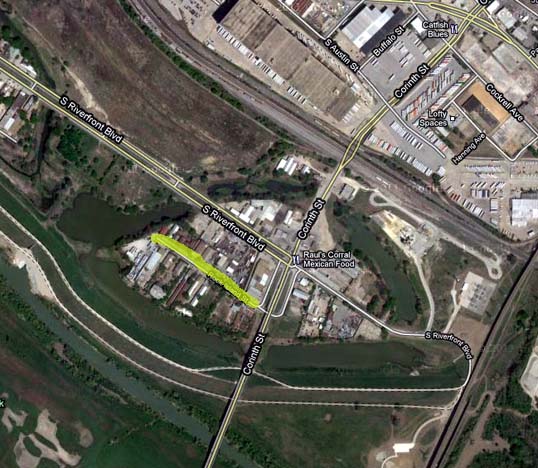
Although the Trinity River Channel has been redirected to the bottom of the photo, the Cedars West is still pretty much an island in the river bottoms. The Arts Festival was on Rock Island, the part colored in yellow.
Two employees/artists at Orr-Reed Wrecking. Her T-Shirt says, “Show Us Your Junk,” which is their motto.
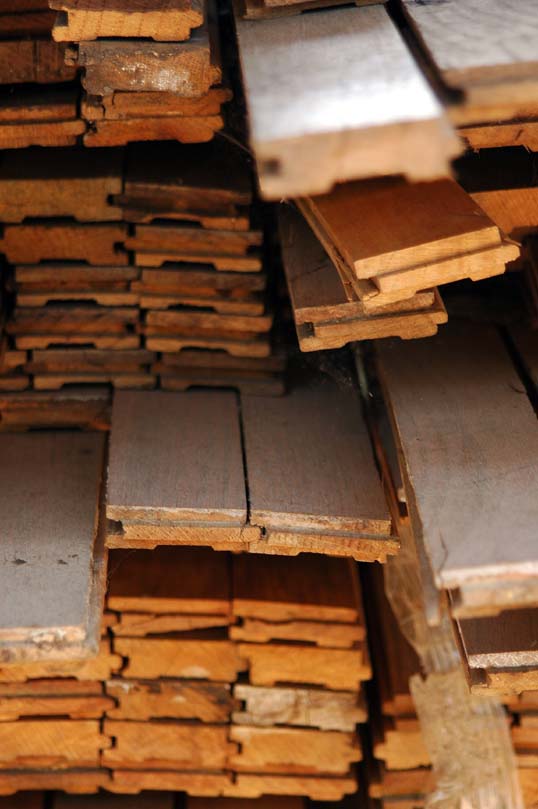
Reclaimed hardwood flooring from Orr-Reed. They had acres of the stuff.
Before and After. Recycled bathroom fixtures.
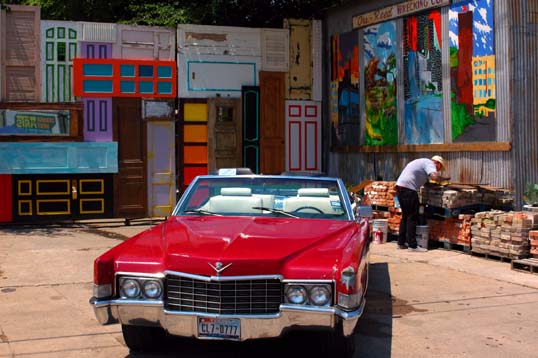
Using vintage products as art and architecture. The exterior of Orr-Reed Wrecking.
The King of Junk. Surveying his kingdom.
The Arts Festival had a nice, downhome, neighborhood feel to it. Here is a smoking grill a food vendor was using to make burgers and a little trailer selling refreshments.
The route we walked out along is so God-Awful that there is a proposal for a pedestrial bridge to skip over the whole thing. I doubt it will get built – but wouldn’t this be cool?
At the Central Expressway portion of the McKinney Avenue Transit Authority trolley line there always has been a dead end of the trolley tracks at the spot where the giant escalators plunge down into the earth for the CityPlace DART station, deep under the ground. That worked fine – the four trolley cars, Petunia, Rosie,Matilda, and The Green Dragon, all were double ended. They have dual driver’s stations, one on each end, and can run in either direction equally well.
The problem was, not all trolley cars are like that. The MATA began accumulating several cars that would only run one way. With the drastic expansion of the Dallas Streetcar System (into the new park being built over the Woodall Rogers Freeway, down into the West End, and across the Trinity River into Oak Cliff) they would need to restore and utilize these cars.
New tracks could be added into the downtown grid to allow trains to make a round trip, but at the CityPlace station there was no way to build in a loop. That station is the best connector between MATA and the DART trains, so it was impossible to abandon.
The decision was made to build a turntable, and money was found to put it in. That would allow the use of single-direction cars and would be a nice tourist attraction in and of itself. I’ve been following the progress of the construction and it was finished around the start of the year.
It looks really cool. It was designed to look good and is lit up at night with multicolored spotlights. There are some nice artworks near the turntable and places to sit and wait for the cars.
I rode the streetcar to the turntable, hoping it would go ’round, but all they did was drive onto the turntable and then go back the same way. Even with the turntable, they can’t use the single end cars until the tracks are extended on the other end. So I guess they don’t want to wear out the turntable until it is needed.
Still, it’s a nice, unique thing to take a look at. I’m looking forward to the expansion of the system, the new cars, and riding one around on the turntable. The wheels of development move slowly. Extreme patience is needed. I hope I live long enough.

















 Bill Chance