I know the Vickery Meadow area of Dallas very well. When I showed up in Dallas in 1981, unemployed and with twenty-five dollars to my name (Texas was the only place in the country you could find a job in 1981) I stayed with some friends in the Timbercreek Apartments on Melody Lane (they have since been torn out) for a short time. Moving there from the rural plains of Kansas seemed like the height of big city living – and they were pretty cool at the time. We soon moved to Oak Cliff, and then I came back to Lower Greenville when I found a job and saved enough for a deposit.
I loved living down there (especially in the 80’s) but my social life was mostly in Vickery Meadow (and The Village across Northwest Highway). You see, it’s hard to imagine now, but in 1982 interest rates hit sixteen percent. At that rate nobody… and I mean nobody, could afford to buy a house. So all these apartment complexes sprouted up like mushrooms and hordes of young people, and a few not so young people, moved in.
It was a wild social scene. One complex was full of a combination of strippers and Dallas Cowboy Cheerleaders. That was a popular swimming pool on a hot summer afternoon. It was a good time.
But good times never last and this one fell faster than anyone thought possible. When the interest rates came down, many fled the rental complexes for the northern suburbs and the endless expanses of single family homes that were vomiting out across the cotton fields of North Texas. Then, in 1988, the Federal Government started enforcing the Fair Housing Act (making it illegal to exclude families from rental properties) – which doomed the singles apartment complexes that were the lifeblood of the area. That was the death knell. Occupancy rates fell. Rents dropped. And soon the owners couldn’t get enough from their rents to maintain the properties, which fell into disrepair – and the cycle repeated until it fell into a spiral of catastrophe.
Within a few short years the whole area was crack city. Sometimes I would drive through on my way to the Big Main Half-Price Bookstore and I would feel sad – the echoes of such good times gone to bad.
But then Vickery Meadow made a comeback of sort. Not one of wealth – quite the opposite – but one of culture. The area had fallen so far that the only people that would live there were the ones that could not afford to live anywhere else – the immigrant, the tired and poor, the huddled masses, yearning to breathe free.
And now Vickery Meadow is a dense package of diverse humanity. It is still dirt poor, but it feels different. It feels like there might be a little hope in the most unlikely of places.
The tenth, and, for me, the last exhibition of the Nasher XChange works was a pop up market called Trans.lation by Rick Lowe. I had missed the first few dates and February 22 was my last chance. As always, I had my commitment to visit all ten sites without using a car. This one was easy. I rode my bike down to the Arapaho and caught the Red Line down to the Park Lane station and fought my way across Greeville Avenue and on into Vickery Meadow.
I was immediately struck by that odd layering of strong old memories with the present that has changed – but not enough that it does not stir ancient echoes. Many of the apartment buildings that contained some of my best friends, places I spent a lot of time, have been torn down and replaced by sprawling school campuses to accommodate the children of the new residents. I rode up to the heart of Vickery Meadow – a complex bustling intersection called “Five Points.”
My memory isn’t as good as it should be and I took the wrong one of the five roads and pedaled out down Park Lane instead of Ridgecrest. By the time I realized my error and looped back up another memory was brought back to me – the streets there can be very steep. I remembered exercising my way up these hills on a road bike back in the day. Unfortunately, I’m not twenty-five years old any more, and I had to wait a bit to catch my breath.
Finally, I picked the right road and found the market. I locked my bike up to a fence and went in – enjoying the arts and crafts for sale… I especially loved the music coming from the stage. There were a lot of people of every age and nationality you could imagine and everyone was having a great time.
That was something I will remember for a long time.
Trans.lation Market: Vickery Meadow
Trans.lation Market: Vickery Meadow
Trans.lation Market: Vickery Meadow
Trans.lation Market: Vickery Meadow
Trans.lation Market: Vickery Meadow – There were three pop up art galleries along the street featuring neighborhood artists and concerns.
Insomnia is an exquisite torture. Life must be boring for those who sleep well.
There is a different world in the wee hours of the morning – a world of offbeat television. I grew up with only three television channels – plus maybe a PBS station if you lived near a big city. Then I discovered those channels that you had to use a funny circle of wire antenna screwdrivered into little posts labeled UHF. The kind that you had to tune in by hand – no clicking channel selector. One UHF channel featured old monster movies. All night long. I’d watch them in the pitch black kitchen on a tiny portable television.
Now there are a thousand digital channels – and after a certain time, the channel matrix guide simply says “Paid Program.” Everything is for sale….
Once I saw an infomercial for a product that appeared to be a pointed delta-shaped piece of metal with a large plastic handle attached. You would plug in in, add water through a tiny port, and then rub it over a wrinkled garment. The wrinkles would disappear.
“It’s a miracle,” the pitchman would exclaim.
“It’s an iron,” I’d shout at the television. “They’ve been around for centuries.”
The next exhibition in the series of Nasher XChange works was the one that required me to go the least distance. I basically had to roll over and look at the television.
Denton’s Good/ Bad Art Collective filmed a 28 minute infomercial in a downtown office building. They had a call for volunteers, but I wasn’t paying enough attention and missed the casting call. That was the first part of the exhibition. The next was a static display of the studio they had built on an empty floor of the skyscraper. I had ridden my bike past this many times, but decided (for no real reason) not to stop and look. I wanted to see the infomercial blind, in its native habitat, so to speak, the bedroom television.
My DVR wasn’t working, so I set my alarm for the middle of the night, on a worknight, but it wasn’t needed. Like Gregor Samsa, after a night of uneasy dreams, I awoke, reached over, groggy, but conscious, and pawed the button before the buzzer was able to do its duty.
I clicked the remote and then waited for the Good/Bad Art Collective’s promised subversive infomercial to start. Instead, there was Deborah Norville and Inside Edition. What was this? I watched while Deborah talked about the freaky, the hopeless, and the lurid – a parade of freaks moving between strange eccentricity, and eccentric strangeness. It left me wanting to rinse my eyeballs and afraid of falling asleep – what dreams would this stuff bring?
Maybe I was too early, so I watched the next half-hour. Here, suddenly, was Larry King, selling Omega XL – a miracle material made from green mussel lips (instead of fish) or something like that. The claims were so outrageous and odd – this is truly another world, where truth is lies and money is king.
And that was all I could take – I reset the alarms, mashed the remote and before I knew it, was on to work the next day.
Checking the Good/Bad page the next day I learned there was a mistake, a lack of communication and the mock infomercial was delayed for 24 hours.
So I woke again and watched the real thing. There was the sleazy announcer in front of a bank of multicolored draperies. Every now and then there was an interlude with the volunteer actors and a phone number (What walks on four legs in the morning, two legs in the afternoon, and three legs in the evening) – I should have called the number, I’m sure it was something Good/Bad subversive – but I didn’t.
Something was wrong with the pitchman – he would stumble and clutch his head. Finally, he collapsed, apparently deceased. His feet protruded from the curtains.
The funny thing is, I have no idea what the man said. I was paying attention, I heard him clearly. It seemed to make some sort of sense at the time, but that is another world, that time of night, and the ideas don’t make the transition to the light of day.
Insomnia is an exquisite torture. Life must be boring for those who sleep well.
Good/Bad Art Collective is a Denton, Texas based group of artists that created well over 250 events in Texas and New York from 1993-2001. For the Nasher XChange exhibition, the Good/Bad Art Collective is creating a project entitled CURTAINS that will be part one-night event, part exhibition and part television broadcast exploring notions of viewership and interaction. The Collective’s XChange project will be their first major project in more than 10 years, and coincides with the 20th anniversary of the group.
In the months leading up to the opening of XChange, the Collective will produce a 28-minute infomercial, which will be filmed in a newly created television studio on an empty floor of Bryan Tower, a downtown Dallas highrise managed by Spire Realty. At the one-night opening event on Saturday, October 19, 2013, attendees will be given the opportunity to participate in the filming of the infomercial. Visitors throughout the run of XChange will be able to walk the space in which the infomercial was filmed and see sculptural elements used as props during the opening and in the finished infomercial, as well as select edits of video documenting the one-night event. The finished infomercial will be broadcast on late night and early morning television timeslots in local, regional, and national markets.
Throughout its ten year history over 110 artists and creatives were members of the Good/Bad Art Collective, developing unique one-night events of art, music, and film programming at a break-neck pace, resulting in what The Village Voice described as “Fluxus with ADD.” Partly inspired by conceptual art programs at the University of North Texas offered by artist Vernon Fisher, the group created installations and events that were often interactive, humorous, and thought-provoking.
Past large-scale projects include Very Fake, But Real (1997), a one-night-only event at DiverseWorks Art Space, Houston, in which they built an exact replica of their Denton studio inside the gallery and used the surrounding interior space as a roller skating rink and concert hall; and We’re On Our Way to Dinner, But We Have to Pick Up Something First (1999) for a photography exhibition at the Arlington Museum of Art in which they transformed the mezzanine of the museum into a 1970s-style garden apartment building and used one of the spaces to throw impromptu surprise parties for each of the guests at the opening, installing the polaroid photographs on the apartment refrigerator for the duration of the exhibition
I had a cycling route picked out from the Audubon Center to Paul Quinn College, where the next Nasher XChange installation was located. It involved a trail through the Great Trinity Forest across the Trinity River. I was a little nervous about that – the green lines were clear enough on the Google Maps Cycling Layer, but I wasn’t sure the trails were finished or even if they went exactly where the map said they did. Documentation on trails when they are finished is light and unreliable and I was going to be alone and a long way from home.
…Shouldn’t have worried – the route through the forest was a beautiful ride. New, smooth, level trail, gentle winding, and that feeling that, in only a few feet, you have left a giant city for some remote wooded wilderness. Of my entire ride that day, this is the part I will return to. There are more trails under construction – hopefully there will eventually be a complete complex that can be used for recreation and transportation.
The forest was, of course bare, the sky leaden and gray – but the promise of green spring isn’t very far away. There will be a narrow sliver of time between when the vegetation comes alive yet before the killer summer heat slams home. I’ll have to plan a trip in that window – maybe a picnic somewhere. On this day I had it all to myself and it’s hard to imagine other people down in that isolated forest – but maybe someday.
As I emerged from the trail system onto Simpson Stewart Road I began to see some familiar landmarks. I was surprised at how far south I had ridden. Off to the side was an incongruous mountain rising from the tabletop flat river bottom lands – a treeless smooth, undulating highland beginning to cast a long shadow over the winter afternoon. This is the McCommas Bluff Landfill – a gigantic pile used to dispose of the city’s detritus – a massive hidden cache of flotsam and jetsam.
Then I rode past a building, the city’s Eco Park structure. I had been there several times for meetings or educational events – and had always looked at the abandoned roads stretching out into the floodplain and wondered about riding a bike there. I was surprised to find myself coming the other way.
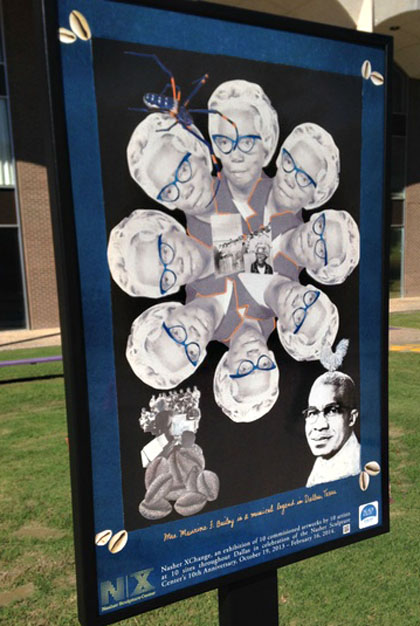
At that point I arrived back into civilization… and road traffic. There was a nasty steep hill leading up to the entrance to Paul Quinn College and the next stop on the Nasher XChange tour – Vicki Meek’s Black & Blue: Cultural Oasis in the Hills. The exhibition is a series of artworks posted around as signs that illustrate the history of Bishop College – a historic educational institution that sat on the site.
I was exhausted from the hill climb and running late, so I wasn’t able to take the time or energy to find all of the exhibit or to give it proper thrift – but I could feel the history, the promise, and the difficulties that an institution like Bishop College offers or offered and faces or faced.
I still had miles to go, another XChange site to visit – and after that a train station to find and two trains to take home. I was getting tired and slowing down more and more. Nothing to do but keep pedaling.
Vicki Meek, Black & Blue: A Cultural Oasis in the Hills
Vicki Meek, Black & Blue: A Cultural Oasis in the Hills
DALLAS, Texas (August 16, 2013) – The Nasher Sculpture Center is pleased to reveal the plans for a newly commissioned work by artist Vicki Meek that will be located on the campus of Paul Quinn College. The work is one of ten commissions for the Nasher’s 10th anniversary, city-wide exhibition Nasher XChange, which will be on view October 19, 2013 through February 16, 2014.
Entitled Black & Blue, Cultural Oasis in the Hills, Vicki Meek plans to celebrate Bishop College’s role in the intellectual and cultural life of Dallas through a series of historical markers commemorating important people and moments from the college, and which will also include an interactive web component and video interviews. Bishop College was a historically black college founded in Marshall, Texas in 1881 that moved to southern Dallas in 1961 and closed in 1988. The campus is now occupied by Paul Quinn College.
To develop her project, Vicki Meek is working with former Bishop College faculty and alumni, and members of the Highland Hills and Singing Hills neighborhoods around the school. Bishop College played a significant role in the development of academic and cultural life in Dallas, giving birth to important cultural institutions such as the African American Museum and the Dallas Black Dance Theatre.
She describes the motivation behind her work as a desire, “to reclaim African American history, restore our collective memory and illuminate critical issues affecting the Black community through visual communication.”
Meek, a native of Philadelphia, PA, is a nationally-recognized artist residing in Dallas, Texas. Trained as a sculptor, she has focused on installation art for the past 25 years that asks for direct engagement from the viewer in an effort to foster dialogue on often difficult subject matter. Meek’s work is in the permanent collections of the African American Museum in Dallas, The Museum of Fine Arts in Houston and Norwalk Community College in Norwalk, Connecticut. She was awarded three public art commissions with the Dallas Area Rapid Transit Art Program and was co-project artist on the largest public art project in Dallas, the Dallas Convention Center Public Art Project. In addition, Meek is an independent curator and writes cultural criticism for her blog, Art & Racenotes. Meek is currently the Manager of the South Dallas Cultural Center and serves as Chair of the Board of Directors for National Performance Network.
Inside – Music (Everything I know I learned the day my son was born), Alfredo Jaar, Nasher Sculpture Center, Dallas, Texas (click to enlarge)
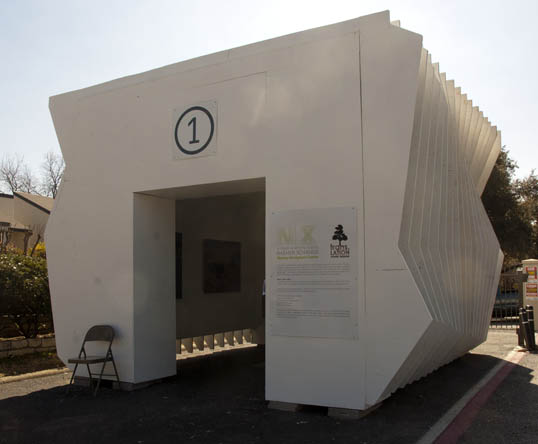
I didn’t have to go very far to visit Alfredo Jaar’s Music (Everything I know I learned the day my son was born) at the Nasher. All I had to do was walk across the garden to the structure made of pine and plastic, tinted green. It was newly constructed and the timber still smelled of moist-cut forest. With a raised wooden floor reached by some wooden steps and a row of folding canvas director’s chairs arranged along the walls it was a tranquil, peaceful spot – separated from the din and hustle of the city both by its walls and the insulating layer of the Nasher garden itself.
I sat down and waited… waited to hear something….
Even though I only had to walk a few feet to get to the art the day still counted as a bike ride day – I had ridden the DART rail from Richardson to downtown and ridden over to the Bishop Arts District to meet some folks – and we rode back across the Jefferson Viaduct to the Nasher. It was a beautiful day, even though I had to fight the State Fair crowds on the train.
We were there for a lecture on the Nasher XChange exhibition – ten works of art spread out over the vast expanse of Dallas. As I have said before, the lecturers kept talking about how big and sprawling Dallas was (true, of course) and of the many miles in a car necessary to travel to the sites. This, I knew was not necessarily so – though it took a paradigm shift to understand that it was not only possible, it was fun, to move around the city using only feet, a bicycle, and a DART pass.
After all, I was sitting there in the lecture (sweating a bit) after having traveled from Richardson, to Oak Cliff, and back to downtown without getting in a car.
And I decided to see all ten without firing up an internal combustion engine.
The exhibition was in honor of the Nasher’s tenth anniversary. I could not look at Music (Everything I know I learned the day my son was born) without thinking of the time I came to the Nasher with my own son only a few months after it opened. He posed with some of the sculptures, I wrote it up in my old journal The Daily Epiphany and was able to rewrite it as a magazine article and sold it to Richardson Living. The Nasher sent me some free tickets.
Night (La Nuit) – 2011 (they had moved the sculpture)
Eve, by Rodin, 2004
Eve, by Rodin, 2011
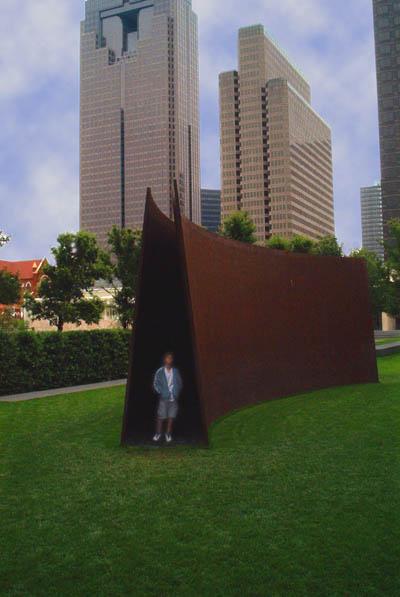
My Curves are Not Mad – Richard Serra, 2004
Richard Serra – My Curves are Not Mad – 2011 Look at how much the trees in the garden have grown.
Now, back to sitting in Alfredo Jaar’s room of wood and green plastic. It is quiet, only the murmur of some folks talking and an occasional foot tread. Sunlight streams in from the open door and the skylights overhead, mixing with the emerald glow from the translucent panels.
Suddenly, there is a sound, recorded and amplified, pouring from unseen speakers. It is an odd sound, almost unearthly. It isn’t really a cry… but it is. It is the recorded first sound of a newborn baby. The exhibit will record the first utterances of newborns in three Dallas hospitals and replay these ever day at the same time they were born. This has only been going on for a short time, so you have to wait for the sounds, but they should grow until mid-February when there will be a cacophony of first cries.
Alfredo Jaar
New York, New York Music (Everything I know I learned the day my son was born)
2001 Flora St.
Nasher Sculpture Center
An installation that celebrates newborns and their limitless futures as Dallas citizens, bringing their voices together in a touching, symphonic experience.
Jaar’s project is inspired by what it means for a museum to celebrate an anniversary: What does it mean to be born, grow and then reflect back on 10 years of life? Most importantly, how can an institution like the Nasher Sculpture Center acknowledge the community it is a part of? Instead of reflecting on important institutional moments, Jaar intends to celebrate the births of newborn citizens and the limitless possibilities of their futures. Inside a pavilion designed by Jaar and located in the Nasher Garden, visitors will hear recordings of the first cries of babies born in Dallas between October 1, 2013 and February 1, 2014.
In collaboration with Baylor University Medical Center at Dallas, Methodist Dallas Medical Center and Parkland Health & Hospital System, the sounds of the first moments of life will be recorded and uploaded to the pavilion. Throughout the duration of the exhibition, the recordings will be played each day at the precise times of the births and new recordings will be added continuously. The diversity of voices and their intermittent occurrence within the space create an ever-changing musical composition that provides simple yet profound reminders of our city’s continuing growth. For the hundreds of families that choose to become a part of this artwork, the Nasher Sculpture Center will provide special memberships to the museum – a one-year Giacometti Level Membership for the participating families and a first-ever Lifetime Membership for the babies.
I dug around on my hard drive and found the journal entry I wrote on Saturday, May 1, 2004 – about the visit that Lee and I paid to the newly-opened Nasher. Here’s the text of the entry.
The Daily Epiphany
Saturday, May 01, 2004
The Nasher Sculpture Center
Were art to redeem man, it could do so only by saving him from the seriousness of life and restoring him to an unexpected boyishness.
—-José Ortega y Gasset
Even though it’s been open since last October, I haven’t had the chance to go visit the new Nasher Sculpture Center in downtown Dallas. I wanted to go and I wanted to take Lee. The other day, I asked him if he wanted to see, “The best sculpture in the world.” He replied, “Dad, I sort of like sculpture; those cows and horses in front of the car show we saw downtown, they were really cool.” Still, though I ached to see the place and Lee wanted to go too we are so busy I haven’t been able to put together the time. It costs ten bucks to get in so it’s not a drop by proposition; for that much cash I want to take my time.
This weekend was soccer-full, so I didn’t think we’d be able to make it. All night Friday was full of booming storms, the sky lit up light electric fireworks, the wind blowing bending trees and whipping clouds of water through the neighborhood – real rainout weather. At dawn this morning the phone started ringing with the cancellation news – the games in Arlington, the games in Mesquite, even the games in various spots that Nicholas had agreed to ref (he’s trying to save enough money to buy a portable DVD player) were all called off due to submerged fields. Although the sky was overcast, dreary, and featureless slate gray, the rain stopped by ten and the day, though a bit chilly, was passable and Lee and I took off for the new sculpture center – driving to White Rock and catching the DART train downtown.
I had heard good things about the place but upon walking in and seeing it up close and personal I was totally blown away. It is magnificent.
The building that houses the inside part of the collection is at the north end of the site. It is an incredible construction of light – steel, pale stone, and glass arranged in a series of feathery pavilions full of stunning art. We took a swing through a visiting show of Picasso work, arranged alongside Nasher’s own Picasso pieces. We didn’t stay inside very long (I knew we’d come back and look closer) because, as beautiful as it is, the building’s most stunning function is as a frame for the sculpture garden outside and the allure of that green sward was irresistible.
Lee sitting on Scott Burton’s Schist Furniture Group (Settee with Two Chairs) near the northern end of the garden. In the far background you can see one of the curved pavilions of the main building.
The Nasher Sculpture Center sits right in the heart of the city; at the crossroads of giant busy screaming highways (three different interstates and two state highways cross within a mile of the center), at the feet of clusters of towering glass, stone, and steel office buildings, and with bustling crowds of workers packing the sidewalks and tunnels of a monstrous center of commerce. One rectilinear patch of land is yanked from this ugly knot of hustle and bustle and transformed into a peaceful oasis of three-dimensional art. At first, you don’t even notice the sculptures dotting the lawn. The trees, the grass, bits of stone, pools and sprays of water are art enough. Only after you drink in this unexpected bucolic landscape do you notice the other artwork – the arranged piles of steel, stone, or bronze that are carefully arranged among the rooms marked out by the careful plantings of trees, bamboo, and areas of water.
Lee and I walked around grinning like idiots. It was wonderful.
I liked this spot. To the right is Eve, by Auguste Rodin, the rectangular piece with round holes is Squares with Two Circles (Monolith) by Barbara Hepworth¸ and the copper-gold colored work on the left end of the pool is Working Model for Three Piece No. 3: Vertebrae by Henry Moore. Beyond the green reeds to the right, you can see the dark rectangle which is the entrance to Tending (Blue) – the gray stone on the far right side is the outer wall of the installation of the work itself.
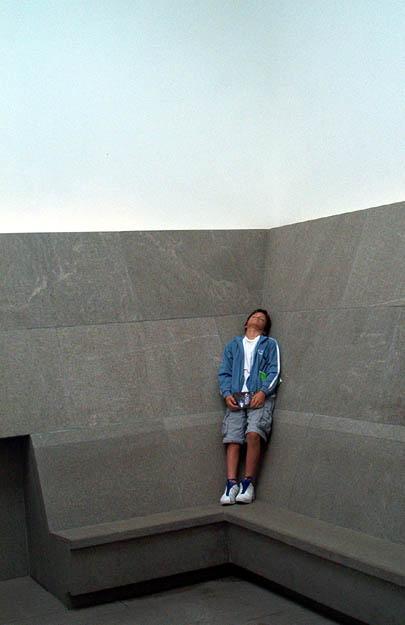
My favorite piece might have been the installation Tending (Blue) by James Turrell. We walked into a little opening lit by odd, shifting colors into the wall at the north end of the garden. The passage made a right turn and opened into a small room lined with dark stone benches. The walls on the upper half were featureless and smooth. A gray skylight lighted the whole chamber. The effect was strange and very peaceful. I liked it a lot.
Lee inside of James Turrell’s Tending (Blue).
Lee and I left the chamber and walked back up the garden and inside the building. We wandered downstairs and into the auditorium where a film was showing. It told the story of Raymond Nasher and his late wife, how they started out building Northpark Mall, acquired a fortune, and then became premiere collectors of modern sculpture. Mr. Nasher talked about his life, his wife, and his passion for the new sculpture center. The film then showed the construction of the center, how a handful of visionary architects and a few thousand men in hard hats converted a grimy downtown parking lot (I’ve parked there many times, put my quarters or dollar bills into a rusty numbered slot) into a thing of great value and beauty. They talked a lot of how it will be there forever. The film was fun and interesting – it really helped me appreciate the place.
On opening day Raymond Nasher said, “I put Patsy (his wife, the collector, who had passed away a couple years before) in charge of the weather today, and, as you can see, it’s beautiful.
One thing was odd, though. On the part of the film that covered opening day, Nasher and Turrell themselves went into the Tending (Blue) chamber that Lee and I had walked out of only minutes before. The benefactor and the artist sat on the benches and looked around. The skylight rectangle in the ceiling wasn’t gray like we saw it, but a deep cerulean blue.
“What’s up with that?” I asked.
“Let’s go back and check it out,” Lee said.
We hiked back down and entered the chamber again. The skylight was still gray. Something didn’t look right, though. I stood under it, looking up, trying to figure out what I was seeing and how it could change colors so dramatically. I was halfway convinced that it was a rectangle of light projected on the ceiling by some hidden apparatus (the upper walls are washed in subtle changing color from hidden computer controlled LED’s) when I was suddenly struck between the eyes with a big, cold drop of water. I wiped my face in surprise and looked down at some small pools of water at my feet.
“That’s weird, Lee,” I said, “I can’t believe it, but this roof is leaking.”
I looked back up, trying to find the telltale discoloration of a water leak, when, with a sudden shock, I realized what the hell I was actually looking at. That wasn’t a skylight, that wasn’t a projected rectangle at all, it was simply a big hole in the ceiling. I was looking directly at the sky. Once my eyes and my brain were in sync I could see the subtle variation of the clouds passing by overhead. The edges of the hole must have been cut back like razors – there was no visible frame around the opening, simply a featureless rectangle of light. It was amazing.
That’s why the rectangle looked blue in the film – it was a cloudless day. Now I want to go back. I want to go at sunset… I want to figure out how to go at dawn. The city sky at night… will it be brown? I want to sit in there during a rainstorm. I especially want to go there on that rarest of Texas days, a snowstorm.
Lee and I wandered around for a long time; we took a bunch of pictures (I have material for quite a few entries from the camera – hope y’all don’t get sick of them) and had, all in all, a wonderful time.
We were looking at a few last pieces up by the entrance, getting ready to leave, when I noticed an older balding man in a tan leather coat come into the building. He was alone and nobody said anything to him as he walked slowly past the desks and into the center itself.
“Lee, look who that is,” I whispered.
“Dad! That’s him!”
It was Raymond Nasher himself – the guy who had built the place, the guy that owned all the sculptures. There was no doubt about it – we had seen several long interviews with him in that film and I was sure who he was. He passed through the Picasso exhibit on into the gallery that held the greatest concentration of smaller sculptures.
I watched as he moved through the displays stopping at a half-dozen pieces. He’d gaze closely at each, intently examining it for a few seconds and then move on. What must be going through his mind? In the film we had seen the men moving the works from Nasher’s private house. These are works of art that have spent years, sometimes decades, in his private home. They must feel so familiar to him… bring back so many memories. Now he has to walk among strangers to view his own prized possessions – the pieces that he and his wife spent their lives finding, the collection they put together together.
I wanted to say hello to him – to thank him, but it didn’t seem right, especially inside where it was so quiet. I decided if he walked outside I’d speak to him but he descended a flight of stairs and went through the glass doors into the private management offices.
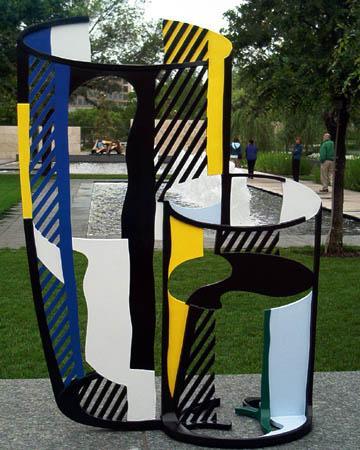
Double Glass, by Ray Lichtenstein
I was a wonderful afternoon for me, and I hope for Lee too. I was very glad he went with me. There was a lot of talk in the film how the Nasher Sculpture Center will become a mecca for art lovers all over the world especially when combined with the Dallas Museum of Art right across the street. Now, on the day we were there, there weren’t too many folks – maybe the weather. That was fine for the day; it gave Lee and I a nice chance to see the place at our leisure and not have to fight the crowds. Still, I feel my life is a little better simply for having gone to that place, and I hope you will go there someday too.
dear sunset Ugo Rondinone West Dallas, Texas (click to enlarge)
When I looked at the Dallas map of the ten Nasher XChange locations, the one that jumped out at me as being in a tough spot to reach without a car was Ugo Rondinone’s dear sunset – a multi-colored pier built out into Fishtrap Lake in far West Dallas. There was no DART station near there, so I started working on a route.
There are some Green line DART stations to the north, but no good way to get across the river. Another idea was to take the train into Downtown Dallas and cross the Trinity River on the Jefferson Viaduct, then ride north and west to Fishtrap Lake. This was doable and I started to plan the details of the route.
But the more I thought about it, the more I thought about an alternate route – a longer route, but one that runs through an area I’ve wanted to explore. I could take the Red Line from Richardson down to the Corinth Station, then head along the Santa Fe Trestle Trail into the river bottoms. A combination of paved bike trails and gravel construction roads would lead me to Hampton Road, and a short ride to Fish Trap Lake. The entire route was six and a half miles one-way, thirteen altogether.
It was a fun ride – the only problem was a strong south wind. There is nothing in the empty river bottoms to stop the wind. Going North I barely had to pedal, but returning South I had to drop down into my low gears and grind it out.
Even with the wind, I enjoyed the ride enough to think about organizing a group ride to return to the lake and the pier. Never was able to pull it off though, the weather took a turn for the worse and I didn’t feel confident bringing other folks down there in the cold.
I’ll go back soon, though. The odd scenery of the wide-open river bottoms surrounded by the crystalline towers of glass skyscrapers is amazing.
You can see the gravel road I rode on in the foreground (click to enlarge)
From the Nasher Website:
Ugo Rondinone
New York, New York dear sunset
3200 Fish Trap Rd.
Fish Trap Lake
A vibrant and colorful pier encourages visitors to reflect and bask in the beauty of the sunset over Fish Trap Lake in West Dallas.
Ugo Rondinone is a New York-based mixed-media artist from Switzerland with an international reputation for a body of work that is endlessly inventive and poetic. For Nasher XChange, Rondinone has designed a wooden pier, finished in vibrant colors, to be installed at Fish Trap Lake in West Dallas. Rondinone, who grew up near a lake in Switzerland, is interested in experiences unique to a pier. He describes how the artwork may encourage poetic, romantic and contemplative moments. The pier will face west so that visitors can experience sunset with the intense colors of the sky reflected on the surface of the water around them.
Fish Trap Lake is a small body of water on a 30-acre site owned by the Dallas Housing Authority, just minutes from downtown Dallas. It is surrounded by several schools, a YMCA, a Girls Inc. of Metropolitan Dallas location, a Dallas Public Library branch, and a senior living community. The site originally was part of La Reunion, a utopian community of French, Belgian and Swiss settlers founded in the 1850s. The lake and adjacent cemetery are named for the fishing technique used by the colony in the nearby Trinity River.
One of the surprisingly few times that I regret being poor is when I think about how I can’t afford to support artists or collect works of art as much as I would like… – especially local work.
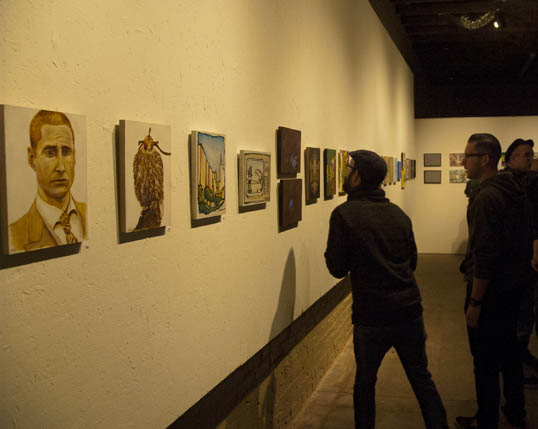
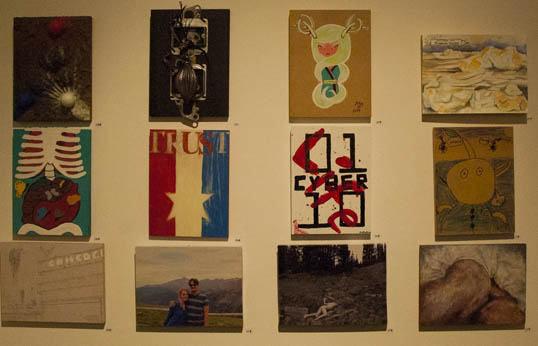
Because of that, whenever an opportunity presents itself for me to pick up something affordable – well, it’s a good thing. For a long time, I have been a fan of Kettle Art in Deep Ellum and the artists they support. So I read about an annual event they put on For the Love of Kettle – I jumped all over it. It’s a fundraiser for the gallery. Participating artists donate a small work which are sold off for 50 dollars each – with the funds going to support the gallery. It is billed as a “competitive shopping event.”
I can come up with fifty bucks. I can pack a sack lunch for a couple of weeks.
On Facebook, over three hundred people has said they were going, but there were only going to be a hundred and fifty works of art. Looking through the selections on the website, I realized that there was going to be a feeding frenzy on this stuff when the doors opened, so I went down there an hour and a quarter early and stood in line. There were only a half dozen folks there when I arrived, but the line stretched out down the block, getting longer by the minute.
Most of the people in the front part of the line were participating artists – it was fun talking to them. Also, a lot of people said that this sale was popular not only for the price, but for the small size of the art. So many said they had art they couldn’t put out because they were out of wall space.
These were my kind of people.
Looking into the windows of the Kettle Gallery, waiting for the show to start.
Everybody peered through the windows at the art on the walls. The rules of the sale were distributed on little slips of paprer. You had to get the number (printed on the wall beside the painting) of the piece you wanted and then register with the volunteers. You wouldn’t necessarily know if someone had already bought the one you chose until you get to the desk. Later, your name would be called at the cashier station and you would pay. Then, you take your receipt to another desk to get your purchase. These careful rules were necessary to handle the surge of people desperate to buy something.
One woman said she fought somebody for a painting a couple years ago. Wouldn’t that be cool? I’d love to have a painting hanging in my hall that I could boast I punched someone for… maybe a splotch of dried blood on the back for proof.
We all talked about the art we could see from the sidewalk and the works that were in the back room. The cry went out, “One Minute!” and everyone tensed. I began to get nervous – this was going to be a lot of pressure to find and purchase the exact right painting under these competitive conditions. I had a three by five card in my had and a pen at the ready.
The door swung open and we rushed in. I went to a spot I had chosen from outside and started to look at the art up close. Knowing I didn’t have much time, I wrote numbers down on the card – paintings I liked in order… 26, 28, 30, 7, 136. Surely one of those five would be available. The line at the volunteer table was quickly growing so I jumped in. Within three more minutes the line reached the length of the gallery behind me.
A man was standing in line right in front of me. An out-of-breath woman came up and lifted up her phone. They had gone in with a plan. He had grabbed a spot in line while she ran up and down the walls taking shots of the paintings (with their associated numbers) with her phone. Now, the two of them were going over the artworks and deciding which one(s) they wanted to buy.
After a few minutes (I was the twentieth in line) it was my turn. Number 26, my first choice, was available. It was a work I had noticed on the website… and it had looked even better in person.
For the Love of Kettle Looking at the art
For the Love of Kettle
For the Love of Kettle
Now, finally, I had time to leisurely push through the crowd and take a careful look at all of the hundred fifty works. They were all good. I thought that they could have sold them at random and I would have been happy – there were no more than two or three that I actually didn’t like. Still, I was pleased with what I chose.
The crowd was thick and happy. A lot of artists were there and some folks were taking pictures with the artists posing next to the artwork they had bought. That’s pretty cool.
A lot of people crowded into the gallery.
They called my name and I went to pay. Since I was one of the first I had a discount and only paid forty two dollars. I milled around talking to people about what they had chosen, until the paintings were starting to disappear and I turned in my receipt and picked up my artwork.
A row of paintings. I chose the one in the middle.
Clay Stinnett painting on the wall at Kettle Gallery.
On my way to the door, someone looked at my artwork and said, “Oh, you’ve got the Clay Stinnett,” then he read the text off the front – “Tumbling Tumbleweeds.”
The Weird and Wicked World of the Singing Cowboy by Clay Stinnett
The title, written on the back, is The Weird and Wicked World of the Singing Cowboy. I really like it.
Last weekend I went on a bike ride in Fort Worth with some friends (will get a trip report written, I promise). We loaded up our bikes, rode the DART train to downtown Dallas and then took the TRE train to Forth Worth.
Our rail destination was the T&P Station south of downtown Fort Worth. This is a recently restored historic building built in 1931 as a beautiful example of Zigzag Moderne Art Deco (what a cool name!) architecture.
I love Art Deco – and there are some great examples in the Metroplex. The best known are the buildings, murals, and sculptures (here, here, here, and here) of Fair Park in Dallas
But the old ticket lobby of the T&P is a beautiful concentrated example of Art Deco excess and beauty. It’s a big room lost in time, available for wedding rentals, and dripping with history. You can almost feel the millions of travelers moving through on their way to the trains. Today, there were only some guys with their bicycles looking around… but at least it is still there, waiting for the next chapter.
Abstract Art Deco design in the T&P Waiting Room ceiling, modified in Adobe Illustrator. (click to enlarge)
T&P Waiting Room, Fort Worth, Texas (click to enlarge)
Art Deco ventilation screen, T&P Waiting Room, Fort Worth, Texas
T&P Waiting Room, Fort Worth, Texas (click to enlarge)
“I drank for some time, three or four days. I couldn’t get myself to read the want ads. The thought of sitting in front of a man behind a desk and telling him that I wanted a job, that I was qualified for a job, was too much for me. Frankly, I was horrified by life, at what a man had to do simply in order to eat, sleep, and keep himself clothed. So I stayed in bed and drank. When you drank the world was still out there, but for the moment it didn’t have you by the throat. ”
― Charles Bukowski, Factotum
Ever since I went on the Dallas Contemporary bike tour of murals I have been paying attention to where more of these are. There are a lot more than you would think.
Today, I walked past another work by the local street artists, Sour Grapes. This one was on the side of a liquor store in Oak Cliff, near Bishop Arts – at 501 W. Davis.
Street Mural by Sour Grapes, Oak Cliff, Texas (click to enlarge)
“Baby,” I said, “I’m a genius but nobody knows it but me.”
She looked down at me. “Get up off the floor you damn fool and get me a drink.”
― Charles Bukowski, Factotum
Some more photos I have from the amazing Dallas Aurora.
On Flora Street in front of the Nasher was a stunning, fun, and very popular installation/sculpture called Data Flow. It was made by Erik Glissmann, Scott Horn, and Nicole Cullum Horn. It was a walk-through complex of v-shaped troughs, fed by a constant flow of florescent yellow liquid and brightly lit by ultraviolet lights.
The artists describe the artwork as:
“Data Flow” reflects on the expansion of human consciousness in the digital era. For most of our history, our experiences have been limited to our immediate horizons, securing our sense of the world and our place in it. Digital technology has transformed that stability, shattering and expanding it a thousandfold – like a river divided by a thousand tiny waterfalls. Data Flow physically interprets this phenomenon; a single stream falls onto many planes, reaching its destination by a seemingly random multitude of paths.
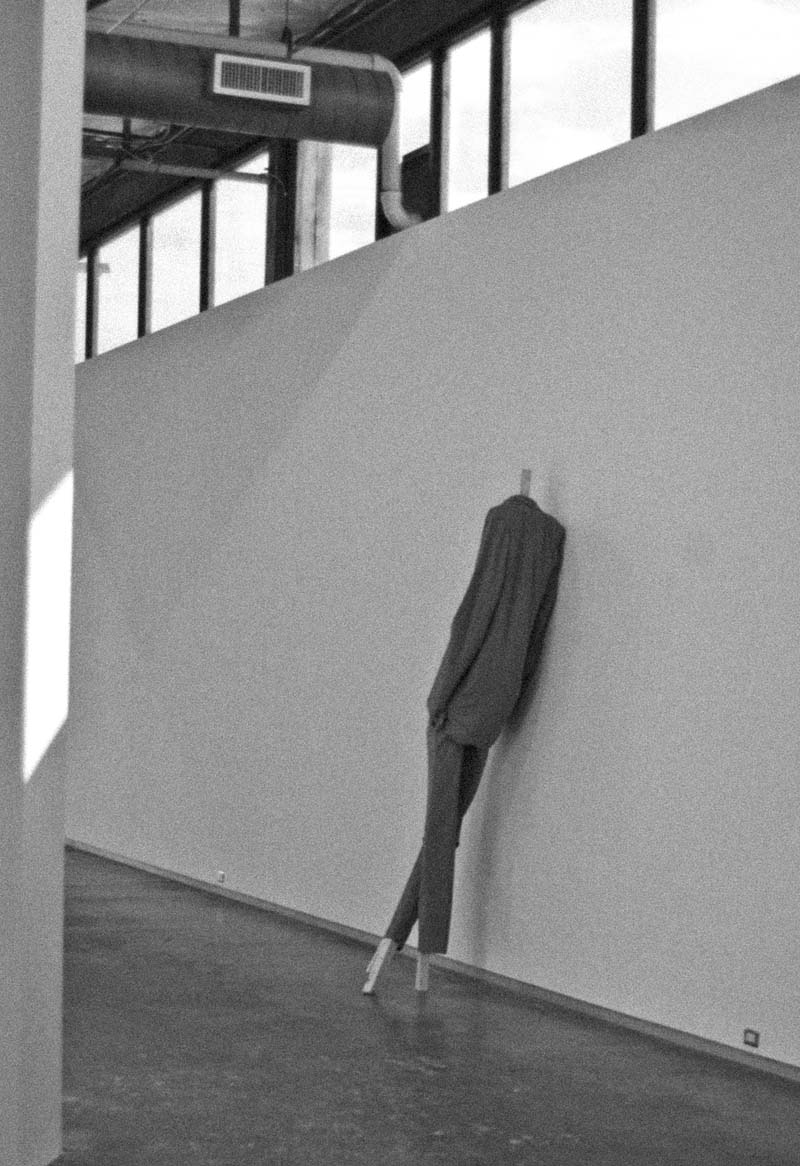
“Fashion changes, but style endures.”
― Coco Chanel
Georg Herold, Dallas Contemporary (click to enlarge)
“One should either be a work of art, or wear a work of art.”
― Oscar Wilde
Georg Herold, Dallas Contemporary (click to enlarge)
Style is the answer to everything.
A fresh way to approach a dull or dangerous thing
To do a dull thing with style is preferable to doing a dangerous thing without it
To do a dangerous thing with style is what I call art
― Charles Bukowski














 Bill Chance