Forty Thousand Years of Art in Fifty Eight Minutes

Plaza of the Americas
Dallas, Texas

glass_steel

During the week, after work, I am so tired. All I can think of is getting home and falling into bed. The whole world feels dim and tilted – sloping toward the land of nod.

This is not a good thing – I don’t want to sleep my life away. I try and figure out something to do after work every day. I’m not always successful – but that doesn’t mean I can’t keep trying.

So I saw that tonight was an Art History lecture at Kettle Art in Deep Ellum (this is the gallery where I bought my bargain painting a month ago). Painter and educator Justin Clumpner was giving a talk in BYOB Art History:

Justin Clumpner’s titillating presentation on this-thing-we-call-art kicks off the final weekend of “Love, Death, + The Desert”. Join us tomorrow night at 7 for the first installment of Justin’s behind-the-scenes glimpse into the strange and mysterious world of art through the ages.

That sounded like fun – so I decided to go.

I’ve always had a soft spot for Art History. I took a year of it in college, as a break from my chemistry classes (and in a vain attempt to meet women). It turned out to be a revelation.

My instructor was an interesting person. On the first day of class he said, “We are supposed to go from ancient art to the present, but we are going to stop at 1860, because there hasn’t been anything worthwhile done since.” He lived in a world of his own – a world filled exclusively with the art of yesteryear. He talked about the Roman Colosseum and how it had canvas shades that would extend out over the audience. He asked, “Those astro-dome things nowadays have that too, don’t they?” The man had no idea what a modern sports stadium was.

But he was able to teach. I was fascinated by how, with a little instruction and after looking at thousands of projected 35mm slides from a rotating carousel in a darkened room (these were the days before powerpoint – and possibly better for it) – I could look at a totally unknown painting and tell who had painted it and in what year, give or take a few.

My biggest problem is that I would have four hours of chemistry lab before the art history class. I had to make a difficult left brain-right brain switch in only a few minutes of walking across campus. I remember looking at a slide of a beautiful Byzantine Mosaic and all I could think of was, “What pigment did they use to get that blue?”

One day I left my lab, walked to art history, ate lunch, studied on campus for a few hours, then walked the two miles to my apartment. I started cooking dinner when my roommates came home. They stared at me and said, “Bill, what the hell is that on your face?” I realized I still had my big heavy laboratory goggles on. I was so used to them I forgot to take them off and still felt normal. I can’t believe nobody had said anything to me yet that day – I must have looked like an idiot.

Today, after work, I caught the Red DART line downtown and then transferred to the Green to get to Deep Ellum. The Transit Gods smiled on me and I didn’t have a wait – so I arrived early. The talk was billed as BYOB and I wish I had gone to pick up a growler of local beer – but I settled for a little metal flask loaded with a few draughts of precious Ron Flor de Cana.

The Altamira Bison

The Altamira Bison

The talk was really interesting. Of course, it could only be a quick overview, from cave paintings of forty thousand years ago to post-modernism in one hour is a tough and fast voyage – but Justin Clumpner is a high school art teacher and knows how to bring an audience along with him.

He said he wanted to make the BYOB Art History Talks a regular thing, maybe once a month. I hope so – it will be cool to hear him talk about some themes and topics in a more detailed, comprehensive way. If you want to give it a shot, like Kettle Art and watch their feed – I’ll see ya there.

Maybe I’ll be able to get a growler of beer to bring. Some fresh local beer and an art history lecture… that’s a good way to spend a work night. Better than collapsing at home.

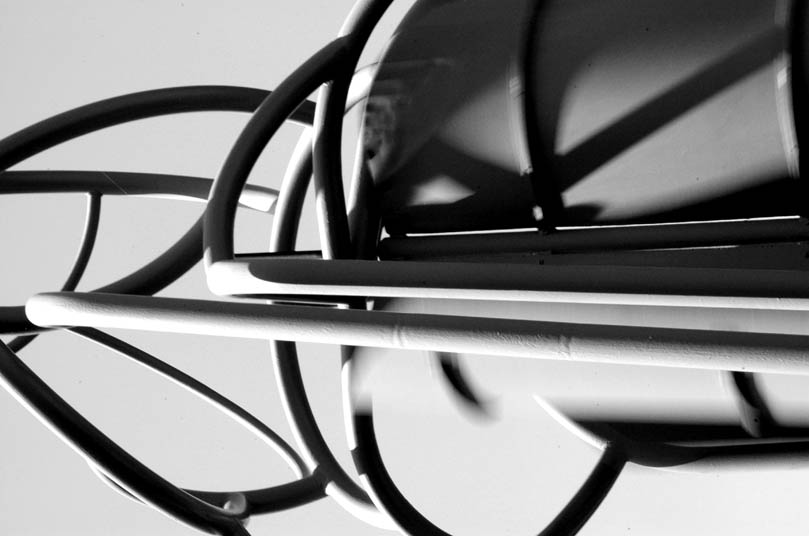
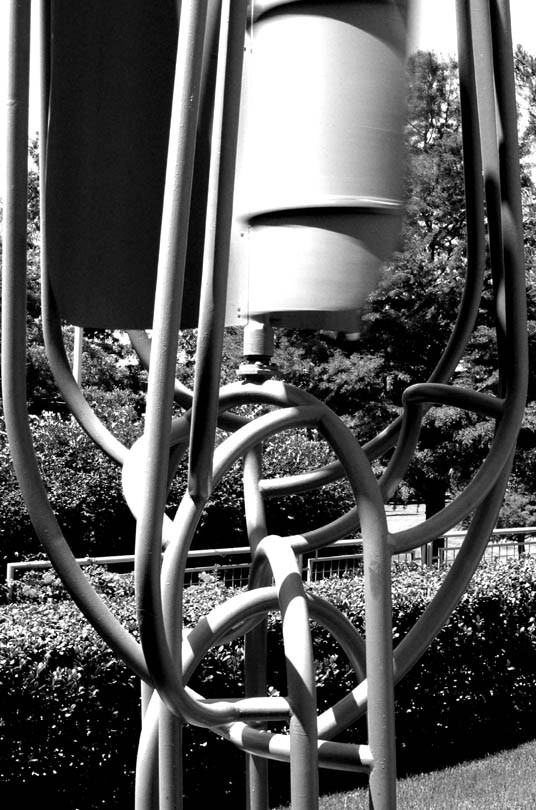
Quanta: Celtic Spirit Catcher

“The aim is to balance the terror of being alive with the wonder of being alive.”

― Carlos Castaneda

“The stars are reflected from within the black water in the cistern. I find comfort in the omen I glean from this: light in the darkness, truth when it seems there is none.”

― Alice Hoffman, The Dovekeepers

David McCullough, Dallas
Quanta: Celtic Spirit Catcher
2000, Acrylic, F6 Cement, Foam, Wire
Frisco, Texas

David McCullough, Dallas Quanta: Celtic Spirit Catcher

David McCullough, Dallas
Quanta: Celtic Spirit Catcher

David McCullough, Dallas Quanta: Celtic Spirit Catcher

David McCullough, Dallas
Quanta: Celtic Spirit Catcher

<

Periodic Tales

From the Telegraph Review of Periodic Tales: The Curious Lives of the Elements by Hugh Aldersey-Williams:

Chemists have long had to put up with the condescension of physicists. In one especially egregious case, the physicist Robert Oppenheimer – scientific director of the Manhattan Project, which developed the atomic bomb – informed his colleague George Kistiakowsky that he was no longer classed as a “first-rate chemist”, but as a “second-rate physicist”. This, Oppenheimer assured him, was a promotion. The project’s chemists thought this insulting; the physicists thought it hilarious.

Those pesky physicists….

I remember a physics professor extolling the ultimate virtues of his science (I’m not sure if he was aware that I – a lowly chemist – was sitting in front of him… he probably was) saying that physics is the most noble of sciences because it is the most pure – the basis of all other science. I simply nodded though I thought that, using his logic, mathematics would rise high above his craft. Now, the way I looked at it, without chemistry physics is only a bunch of squiggly lines on paper.

At any rate from both these disciplines, along with the various flavors of engineering and production, computer science, marketing and what-not…. comes e-ink, and from e-ink comes e-readers.

And from e-readers come Amazon’s periodic sales, which I peruse carefully. And from one of those periodic sales, came the book Periodic Tales: A Cultural History of the Elements, from Arsenic to Zinc – delivered through the ether for only a couple bucks right into my hot little hands.

That’s the book’s name in the US – in Europe it’s called Periodic Tales: The Curious Lives of the Elements – a better title in my opinion.

To you, I’m sure the book would seem to be the most boring pile of useless words imaginable – but I thought it fun and interesting. The author has had the lifelong hobby of collecting examples of the elements. He obviously also had the hobby of collecting engaging tidbits and stories about same. One day he had the bright idea of combining the two and coming up with a book. From the way the story is laid out – he used his publisher’s advance to travel to some of the more obscure locations where some of these elements were discovered or can still be found.

So, to extract a sample of phosphorus the author started out – as the early chemists did – by collecting a large amount of pee and letting it evaporate.

Each element’s discovery is spelled out as an adventure tale – many coming on the obscure transition from Alchemy to Modern Chemistry. Many great discoveries came from very odd places. For example, Ytterby – an obscure village in Sweden that gave birth to a slew of new rare earth elements – yttrium, erbium, terbium, and ytterbium.

I’m always getting yttrium and ytterbium mixed up.

I read the book through – though I wanted to slow down and take notes. You never know what interesting conversational anecdotes you may need to impress beautiful women in bars.

  • Dried blood is slightly attracted to magnets because of its iron content.
  • At one time radium was added to many products, especially those that supposedly had a therapeutic effect: Radium Butter, Radium Chocolate, Radium Beer, Radium Condoms, Radium Suppositories, Radium was put in Chicken Feed in hopes of producing Self-Incubating if not Self-Cooking Eggs.
  • The French Scientist Vauquelin isolated chromium by crushing emeralds and rubies. He proved the same element colored both.
  • Jezebel, from the Bible, used compounds of antimony as dark eye makeup.
  • Extremium and Ultimium were proposed as the name of a new element – Plutonium was used instead.
  • In Jean Cocteu’s 1949 film Orphee, Orpheus enters the underworld by passing through a mirror. This shot is achieved by having the actor push his hands into a pool of mercury that is disguised as glass.


from Orphee - the hands (protected by latex gloves) push through the mirror of mercury.

from Orphee – the hands (protected by latex gloves) push through the mirror of mercury.

Every page is chock-a-block with interesting tidbits like these.

The only letdown of the book was at the end, when the author tried vainly to sum up and leave the reader with an emotional connection with the periodic table. He should have simply run out of elements.

Now, again, I’m a chemist, not a physicist. But I do know physics. I was able to pass three semesters of physical chemistry… which I consider one of the greatest achievements of my life. With that knowledge, I realized that the author also left out one of the most interesting, if technically challenging aspects of his subject. He treats the very periodicity of the periodic table as a great mystery, one that was figured out by long scientific research but never completely explained.

He doesn’t talk about the electron shell model or atomic orbitals. That’s a shame. When you understand this concept, even without the daunting math involved, suddenly it all makes sense. A handful of simple laws are what define the outer-shell electron configuration of every element and that is what makes our world possible. It’s really amazing – if you do the work to understand it.

There are a surprising number of books on the periodic table and I have read a few in the past (Uncle Tungsten: Memories of a Chemical Boyhood by Oliver Sachs is a favorite) – but Periodic Tales is among the most entertaining and readable.

Finally, as a chemist, a book on the elements ignores the most fascinating aspect of chemistry. It will be, almost by definition, limited to describing Inorganic Chemistry. Carbon is given short-shrift in the book. He talks about it mostly in terms of charcoal and the carbon oxygen cycle.

But it is Organic Chemistry that most people find so fascinating. I still remember the thrill I felt when I was first learning how to manipulate matter, not by the elements it contained, but by arranging the shape of a compound made of a single element (with a few other contaminants maybe thrown in for variety) – how the pattern made by its versatile bonds could give rise to an unlimited cornucopia of new compounds, with wild and outlandish properties….

But that’s a whole ‘nother book.

LBJ/Central Station

There is art where you least expect it. There is beauty in the most mundane.

The scenes you see every day, the dreary landscape of grinding drudgery is too often not seen. Take a look.

LBJ/Central StationDART Red Line

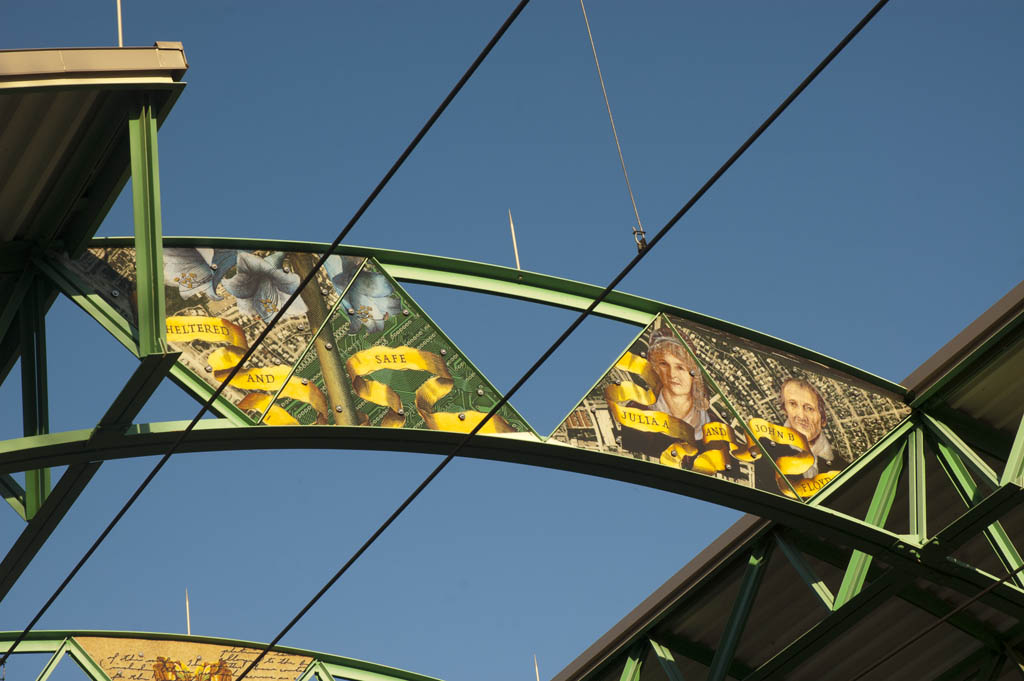
LBJ/Central Station, providing easy access to Texas Instruments’ main campus, links nature and technology with cast stone columns with circuit board designs imbedded as insets. Built on the historic John B. Floyd farm acreage, the station also features a trellis gateway to the station platform. Station design team artist Frances Merritt-Thompson also produced the translucent panels in the overhead truss openings depicting images of the area.

DART LBJ/Central Station Frances Merritt-Thompson (click to enlarge)

DART LBJ/Central Station
Frances Merritt-Thompson
(click to enlarge)

Circuit Board Details in support columns DART LBJ/Central Station Frances Merritt-Thompson (click to enlarge)

Circuit Board Details in support columns
DART LBJ/Central Station
Frances Merritt-Thompson
(click to enlarge)

DART LBJ/Central Station Frances Merritt-Thompson (click to enlarge)

DART LBJ/Central Station
Frances Merritt-Thompson
(click to enlarge)

Other entries/photos from DART Stations:
Carrollton Collages
Plaza of the Americas, DART Station at Night
Gateway
Bike Lids
Next Stop
Dart Sunset

The Wiz

“I understood that fate could not be eluded forever; it came on leathery wings, swooping through the darkness like the bats in the orchards.”

― Alice Hoffman, The Dovekeepers

Zeke: It’s a twister! It’s a twister!

The Wizard of Oz

Art Shirer, Dallas
The Wiz, 2001, Steel, Paint
Frisco, Texas

Art Shirer, Dallas The Wiz

Art Shirer, Dallas
The Wiz

Art Shirer, Dallas The Wiz

Art Shirer, Dallas
The Wiz

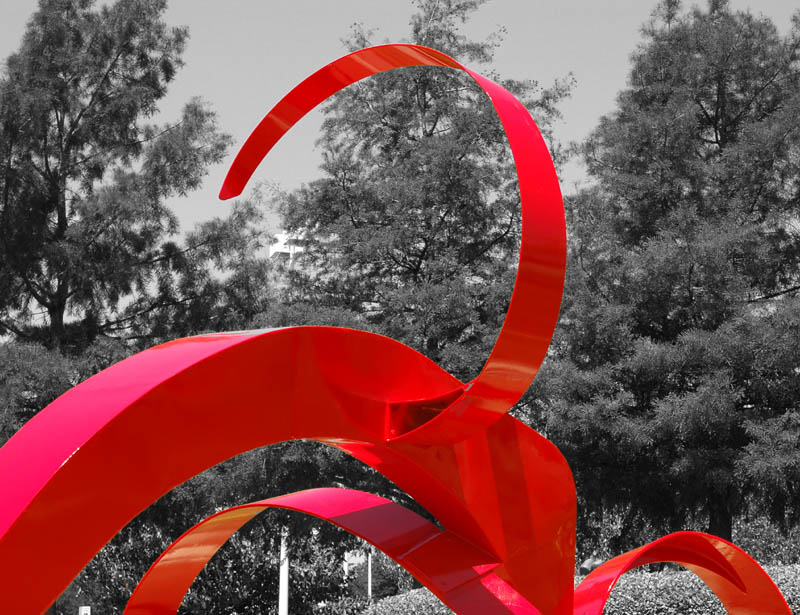
La Mujer Roja

“Even as a small child, I understood that woman had secrets, and that some of these were only to be told to daughters. In this way we were bound together for eternity.”
― Alice Hoffman, The Dovekeepers

Michelle O’Michael, Houston
La Mujer Roja
2000, Steel, paint
Frisco, Texas

Michelle O’Michael, Houston La Mujer Roja (click to enlarge)

Michelle O’Michael, Houston
La Mujer Roja
(click to enlarge)

Michelle O’Michael, Houston La Mujer Roja (click to enlarge)

Michelle O’Michael, Houston
La Mujer Roja
(click to enlarge)

The Fortress of Solitude

The Wyly Theater in the Dallas Arts District

The Wyly Theater in the Dallas Arts District

The Dallas Theater Center has this thing, these “pay what you can” nights. These are opening performances where you can get a ticket for whatever you want. These are great for me, because I couldn’t afford to go to the Wyly otherwise.

So far, I’ve seen King Lear, The Tempest, Red, and The Elaborate Entrance of Chad Deity, at the Wyly and enjoyed the hell out of every one. This time it was the premiere of The Fortress of Solitude – a new musical adapted from the bestselling book by Johnathan Lethem. The show will run here in Dallas and then move onto New York.

I have never read the book, so I knew nothing of the story. There was nothing on the web about the musical – which isn’t surprising, because this is the premiere. That was actually sort of exciting – other than workshops and previews and such, this was the first time anyone had seen The Fortress of Solitude.

My son Lee is in town after graduation, staying for a few days before going back to New Orleans to work. We took the DART train downtown and walked over to the Wyly. Before the curtain came up, Lee asked, “Where is the orchestra pit?” I said there wasn’t one and I guessed they would use tape. Once the play started, however, a screen rose to show the musicians up on a scaffold above most of the action. There was a conductor down in front, facing a blank wall, directing into a small video camera – and her image was displayed on several carefully placed screens for the musicians and singers.

The musical was crackerjack. I imagine the source material isn’t the most obvious place to pull song and dance – and that made the story a lot more subtle and complex that the usual “girl meets boy” plot. The songs were great, especially when they were used to give a sense of time passing from the 1970’s to the turn of the century – from rock to soul to folk to rap to punk and finally, even a little Talking Heads thrown in.

It was a good time.

Our original seats were up on the third balcony (all good – there isn’t a bad seat in the Wyly) but a numbering mess-up had us move down into the orchestra level. I noticed a man sitting next to Lee holding a small notepad and scribbling all through the first act. During intermission I looked through the program and realized that the man was Daniel Aukin (I think), who conceived and directed the play. It must have been exciting for him to see his creation in front of a full audience for the first time.

Later, after the ovation died down, he asked Lee, “Well, how did you guys like it?” Lee said it was awesome. And it was.

Now, the next play is Sherlock Holmes and pay what you can tickets will be sold on April 21. Get in quick, they go fast.

What I learned this week, March 7, 2014

This is not a frame from a science fiction movie

This is Real

This is not a frame from a science fiction movie


5 Ways to Drink in the Great Outdoors


Foldylock


sri

The 17 Greatest Sriracha Hot Sauce Food Recipes


This video explains the current crisis in international relations


How to wake someone up with a laser pointer and a dog.


A New Dallas


Why Everyone Needs to Read Steve Blow’s Pro-Highway Argument


M. Emmet Walsh!


I read in a lot of places – car drivers that are hostile to bicyclists because, “They don’t pay gas taxes, so why should they be allowed on our roads.”

(click to enlarge)

(click to enlarge)

from the Oregon Bicycle Transportation Alliance

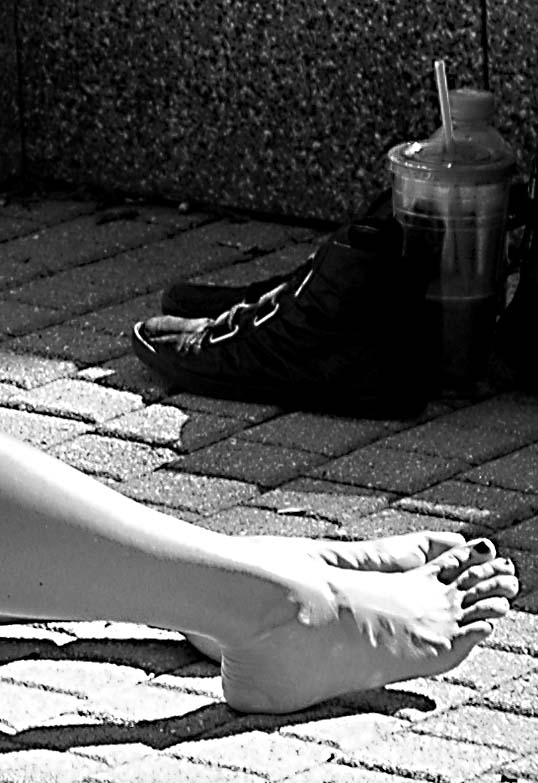
Feet

“I will not let anyone walk through my mind with their dirty feet.”

― Mahatma Gandhi

New Orleans Museum of Art, New Orleans, Louisiana

New Orleans Museum of Art, New Orleans, Louisiana

“I spent an hour yesterday watching the ladies bathe. What a sight! What a hideous sight! The two sexes used to bathe together here. But now they are kept separate by means of signposts, preventive nets, and a uniformed inspector – nothing more depressingly grotesque can be imagined. However, yesterday, from the place where I was standing in the sun, with my spectacles on my nose, I could contemplate the bathing beauties at my leisure. The human race must indeed have become absolutely moronic to have lost its sense of elegance to this degree. Nothing is more pitiful than these bags in which women encase their bodies, and these oilcloth caps! What faces! What figures! And what feet! Red, scrawny, covered with corns and bunions, deformed by shoes, long as shuttles or wide as washerwomen’s paddles. And in the midst of everything, scrofulous brats screaming and crying. Further off, grandmas knitting and respectable old gentlemen with gold-rimmed spectacles reading newspapers, looking up from time to time between lines to savor the vastness of the horizon with an air of approval. The whole thing made me long all afternoon to escape from Europe and go live in the Sandwich Islands or the forests of Brazil. There, at least, the beaches are not polluted by such ugly feet, by such foul-looking specimens of humanity.”

― Gustave Flaubert, Selected Letters