Tuesday Snippet – The Fatted Calf

Prodigal Son, Thomas Hart Benton, Dallas Museum of Art

Prodigal Son, Thomas Hart Benton, Dallas Museum of Art

The Fatted Calf
(First Scene of a Short Story)

It had been a decade since Sam had rented a car. He always had his assistant arrange for a limousine. Those days were gone – long gone.

At the rental counter the first three credit cards were rejected but the fourth went through and after a short, polite argument he was allowed a subcompact car. Red-faced he took the vehicle out onto the old highway – the one he remembered from his childhood – now gone over to cracked asphalt and weeds creeping over the edges. He blared the radio and tore down the rough road with the windows down – looking across the bright green bristles of spring wheat at the lines of huge trucks on the newer Interstate – parallel – a mile distant.

He remembered his mother driving him to the airport twenty years earlier – his small bag packed. His mother teared and resigned – her wet eyes locked on the road ahead. His father was plowing the east forty. Sam could see the cloud of brown dust raised by the steel blades slicing and turning the dry soil. He watched the distant tractor stop – the dust cloud blowing past and leaving the huge machine alone and tiny in the distance. Sam had to imagine his father watching the pickup flying by on the road clear past the end of the field carrying his son away.

The hamlet was closer to the city than Sam had remembered and he drove down the main street before heading out to the family farm. Everything was so familiar – nothing had changed in the two decades – except it all seemed smaller somehow. Smaller and quieter – the streets deserted and more than a few windows boarded up or taped over with paper.

It was like driving through a miniature model of his childhood memories – perfect in detail, yet missing something essential – a soulless reproduction.
This strange living mutation of what he remembered frightened him. He accelerated, squealing his tires in the dust that leaked in thin waves onto the streets, and turned off the paved highway at the edge of town. He drove down the familiar washboarding sanded country lane – the hedgerows on each mile section taller than he remembered or often taken out altogether, leaving a gap like a missing tooth.

As he approached the farm he felt his heart beating like a fluttering bird – his breath coming with some difficulty.

At first he didn’t recognize the place. The weeds had grown high across the yard – once kept cropped short by a small herd of sheep – now gone riot. The familiar barn to the left of the drive was gone. Sam looked closer and saw the expanse of scorched earth where the wood and stored hay must have burned. The encroaching weeds were greener and taller here – fertilized by the ash.

The house – always a clean white wash – was speckled with a gray peeling – revealing the weathered old wood underneath. The windows, which Sam remembered as bright rectangles showing his mother’s colorful handmade curtains were now bare shadow pits adorned only with crystal scythes – shards of shattered windowglass.

Although it was obvious that the place was uninhabitable, for some reason Sam took his suitcase – no larger than the one he had left with two decades ago – out of the trunk after he climbed out of the tiny car.

For a long time, he stood in the remaining bit of sandy road, trying not to touch the invading weeds, with his hand on his jaw, trying to comprehend. Off to the side, behind a few strands of rusted barbed wire, was the skeleton of a cow, now bleached by the sun to a bright white. He wondered if this was the calf he had left behind –the one he had been getting up before dawn to feed. It wasn’t of course – those onerous chores were twenty years in the past – that calf was hamburger long, long ago.

The skeleton seemed to pull Sam out of his reverie and, looking past the house, he saw a structure still intact. It was the old windmill. Green vines climbed the four metal struts that supported the structure, but the zinc-coated blades were still creaking, spinning in the breeze.

Sam pushed his way through the weeds and found the path that ran from the kitchen to the windmill. The well below was too shallow – the water too contaminated and salty for humans to drink, but the cows and sheep seemed to like it fine. A series of troughs, now twisted and junked, ran from the pump attached to the mill to a half dozen watering stations that the farm animals could use.

It had another use, though. The farm was too far out for city utilities, and potable water was precious. Halfway up the tower was a tank that could be filled by the windmill, and underneath that a compartment, about the size and shape of a phone booth, was constructed of galvanized steel. A big old-fashioned shower head hung below the tank like a drooping sunflower.
Sam had hated going out to the windmill and taking his shower before school – especially in the winter. It was humiliating even when it wasn’t brutally uncomfortable.

Staring at the mechanism now, Sam was oddly drawn to it. He reached out and yanked a few stray vines out of the way and then pulled the familiar lever. Sam jumped back when the pump arm let out a huge metallic groan, but it started to move again and he heard rumbling and the telltale splash of water starting to fill the tank. As if on cue, the breeze picked up and the blades began turning faster.

Sam looked around at the vast expanse of nothing, nobody. It was silent except for the clicks and hissing of insects moving through the weeds. The sun was directly overhead and the day had turned hot – Sam felt the streams of sweat trickling across his face.

As the tank filled, Sam pulled off his suit and hung his clothes on the old hooks that ran up the windmill strut. As he waited for the tank to top off he stood naked, leaning back in the sun. As a child, he was always shy and would dash from the house with a towel held firmly, but now he didn’t care. There was nobody within miles anyway.

He reached out and pulled on the rusty handle that opened the valve to the shower head. At first there was only a hiss, then some lumps of old mud-dauber wasp nest tumbled out, followed by little more than a thin rusty trickle. It did not take long for the pipes to clean themselves and the stream gained in strength and clarity. Soon the water was pure and strong, and Sam stepped into the shower, ducking his head into the cold liquid, sparkling in the sunlight.

Christmas Lights, Barbed Wire, and Paint

Near Lee Harvey’s, Cedars, Dallas, Texas

“Information is the oxygen of the modern age. It seeps through the walls topped by barbed wire, it wafts across the electrified borders.”
—-Ronald Reagan

lights

“All anyone really needs to know about barbed wire is that it can tear the arse out of your trousers, give a cow a good fright, entangle a Yorkshire terrier for life, and is nasty stuff made by greedy men.”
― Billy Connolly

Gateway

I find myself working towards an art which includes a spiritual dimension. I have become increasingly aware of art as a dialogue between matter and spirit. In recent works, I have emphasized myth, symbol and dream to evoke an atmosphere in which the sculpture and its environment speak to the subconscious to make the observer aware of the dreamlike nature of life, of which we all are part.
—-Hans Van de Bovenkamp

Not too far, not very far at all, from the pile of steel boxes I wrote about yesterday, is the Arapaho DART station with another sculpture. This is a good one, by a famous sculptor, Hans Van de Bovenkamp, that you have never seen.

I’ve seen it, though. Richardson’s Central Trail – a hike-and-bike strip of concrete that runs through the city, parallel to the DART tracks and Highway 75, now being extended to the south – goes right by it. Otherwise, commuters on the bus or train never get more than a glimpse. It is exposed to the traffic going by on Greenville Avenue – but everyone is driving too fast to notice.

I didn’t look too hard and didn’t see a label or plaque. This is a public sculpture, though, so there is information on the internet. The sculpture is called Gateway, and, as I’ve said is by Hans Van de Bovenkamp. It’s painted aluminum (begining to fade a bit – might need a recoat) and is a variation of a theme of Bovenkamp – there is a bigger version in Oklahoma City.

The sculpture "Gateway" at the Arapaho DART station, Richardson, Texas.

The sculpture “Gateway” at the Arapaho DART station, Richardson, Texas.

A DART train pulls in. Arapaho Station, Gateway Sculpture

A DART train pulls in. Arapaho Station, Gateway Sculpture

Gateway, by Hans Van de Bovenkamp

Gateway, by Hans Van de Bovenkamp

Gateway, by Hans Van de Bovenkamp, Richardson, Texas

Gateway, by Hans Van de Bovenkamp, Richardson, Texas

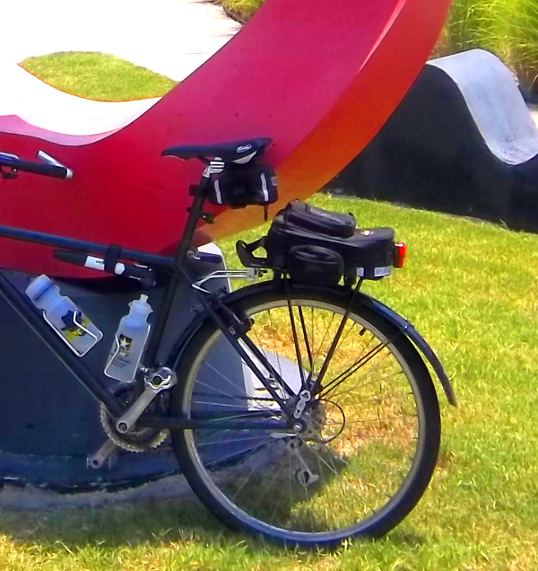
Gateway sculpture and commuter bike

Gateway sculpture and commuter bike

Steel Boxes

One of the nice things about being a fan of sculpture is that you run into it all the time – if you are able to keep moving and your eyes open.

On a bike ride the other day, I pulled over for a minute to look at a sculpture I spotted in an unexpected place. It was off of Arapaho Road, not far from the DART station – in a stretch of very unartistic industrial buildings.

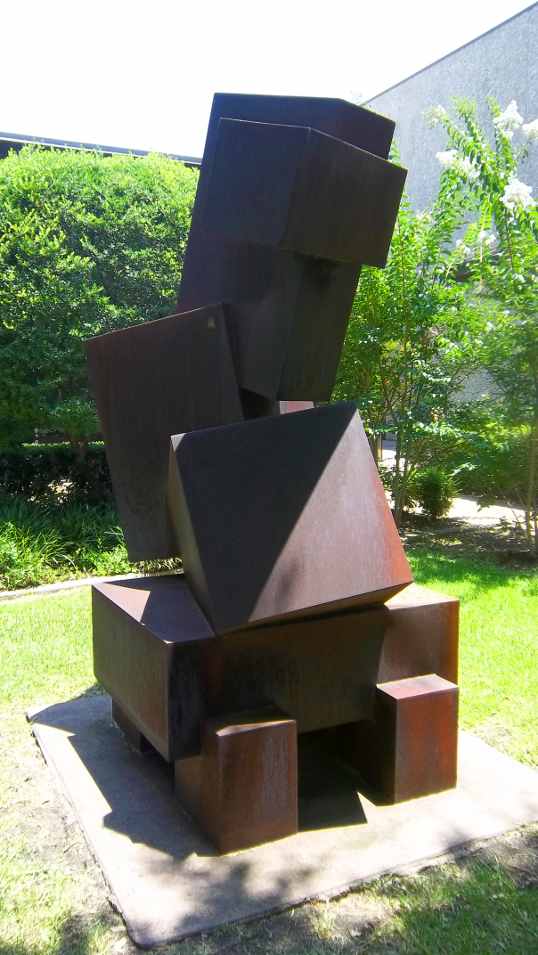
The Richardson Factory that belonged to General Packaging Corporation had a steel sculpture (probably welded of Cor-Ten) in a grassy spot next to the main entrance. You would never spot this from a car – but it’s obvious from the cockpit of a bicycle. I turned in (it was a holiday and the place was closed) and took a good look.

I was not able to find a label or plate, so I don’t know the sculpture’s name or artist. The only thing that turned up on a web search is a sculpture called Strange Romance by a sculptor from Taos named Ted Egri (he passed away a couple of years ago). I’m not sure if this is the sculpture – it doesn’t look like a Strange Romance… and the style is a little different from the rest of Ted Egri’s work.

But, the thing was obviously commissioned for the spot – the factory makes cardboard cartons and wooden boxes – the sculpture was made to commemorate the products.

At any rate – for any reason and by any artist – I liked the thing. I sipped from my water bottle and took a rest before riding on. I tipped my helmet to the folks at General Packaging for spending the money and having the thing built and installed in front of their otherwise nondescript factory. They made my day a little more pleasant… for a few minutes at least.

Sculpture at General Packaging.

Sculpture at General Packaging.

200 East Arapaho Road, Richardson, TX

200 East Arapaho Road, Richardson, TX

Sculpture and Commuter Bike. All Steel.

Sculpture and Commuter Bike. All Steel.

boxes4

Flying Over the City

Graffiti, Deep Ellum, Dallas, Texas

“The Guide says there is an art to flying”, said Ford, “or rather a knack. The knack lies in learning how to throw yourself at the ground and miss.”
― Douglas Adams, Life, the Universe and Everything

flying2

“When we started the show, ‘Dallas’ was known as the city where JFK was assassinated. By the end it was known as JR’s home town.”
—-Larry Hagman

flying1

“But there is so much more to do for the city we love… a Dallas with roads as strong as our businesses, parks as beautiful as our children, a downtown as tall as our imagination.”
—-Laura Miller

Ladybug in a Flower Pot

“Did I ever tell you my pet peeve?’

No,’ I said.

People who dress up their pets to look like Little Lord Fauntleroys or cowboys, clowns, ballerinas. As if it’s not enough just to be a dog or cat or turtle.”
― Jerry Spinelli, Love, Stargirl

—————————–

“i made myself a snowball
As perfect as can be.
I thought I’d keep it as a pet,
And let it sleep with me.
I made it some pajamas
And a pillow for it’s head.
Then last night it ran away,
But first – It wet the bed.”
― Shel Silverstein

Deep Ellum Arts Festival Pet Parade, Dallas, Texas

Deep Ellum, Dallas, Texas

Deep Ellum, Dallas, Texas

“If you are a dog and your owner suggests that you wear a sweater, suggest that he wear a tail.”
― Fran Lebowitz

—————————–

“Dogs are the leaders of the planet. If you see two life forms, one of them’s making a poop, the other one’s carrying it for him, who would you assume is in charge.”
― Jerry Seinfeld

—————————–

“The strangest thing has happened. I really missed my dog. That’s never happened to me before. You know, on a long tour you do hear people saying they miss their pets. I never have. But last night I started really missing my dog.
It’s very odd, ’cause I don’t have a dog.”
― Bono

Ride That Spray Can

“I mean, they say you die twice. One time when you stop breathing and a second time, a bit later on, when somebody says your name for the last time.”
― Banksy

can

Graffiti, Deep Ellum, Dallas, Texas

“Imagine a city where graffiti wasn’t illegal, a city where everybody could draw whatever they liked. Where every street was awash with a million colours and little phrases. Where standing at a bus stop was never boring. A city that felt like a party where everyone was invited, not just the estate agents and barons of big business. Imagine a city like that and stop leaning against the wall – it’s wet.”
― Banksy

“Graffiti is one of the few tools you have if you have almost nothing. And even if you don’t come up with a picture to cure world poverty you can make someone smile while they’re having a piss.”
― Banksy

Heavy Lifting

He stands erect by bending over the fallen. He rises by lifting others.
—-Douglas Horton

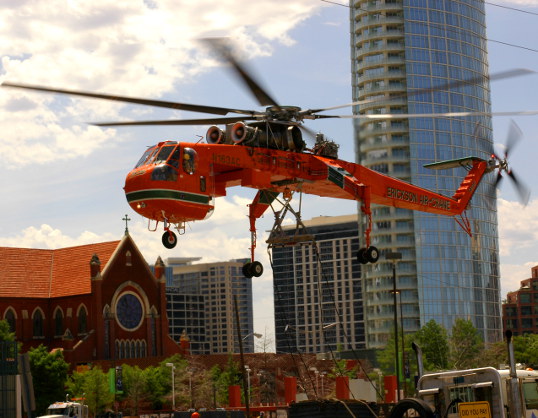
I rode the DART train into Downtown Dallas for the last Dallas Writing Marathon and as the short line of yellow electric cars climbed out of the tunnel under Central Expressway I could hear a distinct WUP-WUP-WUP sound. Looking out the window, I saw a gigantic lifting helicopter delivering a load to the top of the Chase Tower (the skyscraper with a big hole in it). By the time the train pulled into the station, it had already settled into a parking lot behind the Plaza of the Americas.

A few hours later, after we had finished writing, I returned to the station and discovered the skycrane was taking off again. I ran around, up to the police lines, and watched it carry a load (it looked like electrical equipment) up to the notch in the top of the vaulted cap of the skyscraper.

The helicopter was a Sikorsky S-64, modified by Erickson Air-Crane. It had a plastic bubble facing backward into the cargo area where a crewman could sit and direct a precision lift. The whole operation was extensive – from police security to a line of trucks delivering cargo to be lifted to a tanker truck of jetfuel to keep the copter going.

It was all pretty cool. I took some pictures.

Sikorsky S-64 delivering a load to the top of the Chase Tower, Dallas, Texas

Sikorsky S-64 delivering a load to the top of the Chase Tower, Dallas, Texas

Music has generally involved a lot of awkward contraptions, a certain amount of heavy lifting.
—-Tom Waits

Erickson Air-Crane and the Dallas Skyline

Erickson Air-Crane and the Dallas Skyline

As I get older, the present and the past shift and become the past and the future… A lot of it is a new awareness of time and life and the wheel of fortune crushing you and lifting you and crushing you and lifting you.
—-Feist

Erickson Air-Crane

Erickson Air-Crane

Another mode of accumulating power arises from lifting a weight and then allowing it to fall.
—-Charles Babbage

Short Story Day Thirty-One – Carnation, Lily, Lily, Rose

31. Carnation, Lily, Lily, Rose
Kelly Link
http://www.fenceportal.org/?page_id=2327

This is day Thirty-One of my Month of Short Stories – the last day – a story a day for June (and one day in July).

Carnation, Lily, Lily, Rose - by John Singer Sargent

Carnation, Lily, Lily, Rose – by John Singer Sargent

Today, for the last post of my Month of Short Stories – I present to you a story I have definitely read before. It’s been a long time, though, and I wanted you to know about this story, this book, and the writer.

I remember clearly, back then… 2002? probably… I was looking for something to read. I came across an article in Salon that listed their favorite books of the year. There, nestled in with such literary giants of our time like The Corrections, Bel Canto, and Austerlitz, was an odd looking little book of stories called Stranger Things Happen by Kelly Link. The magazine raved about it.

Surfing around the web I found plenty of other folks giving it a lot of love. So I bought the thing.

And it was amazing. The stories are best described as adult fairly tales – fantastic and imaginative – passionate and very, very odd. It lived up to expectations.

So please go out and get this book. If you are cheap, it’s available for free download – as are her other works. If you download it and like it as much as I did, you will buy a copy (I think I’ve bought three over the years). She’s coming out with a hardback special limited edition later this year – but it’s a little over my price range right now.

Today’s story, Carnation, Lily, Lily, Rose is a strange piece of fantastic fiction. A recently deceased man, stuck is some sort of odd limbo, is writing letters to his still-living wife. Unfortunately, he can’t remember her name, though he does remember a girl, Looly Bellows, that beat him up in fourth grade.

As time goes on, the scene gets stranger and stranger as his mind continues to drift further away from the mortal plane. I’m not sure if it is an accurate depiction of what happens when we die, and I don’t know if I want it to be, but it’s the sort of thing that should happen if the universe has as much of a sense of perverse humor and strange surprises in the next life as it does in this one.

Now, like all obsessions – this story led me down a long rabbit-hole. The title, Carnation, Lily, Lily, Rose is taken from a painting by John Singer Sargent. I had to do a little research on him, and came across the famous story of Madame X.

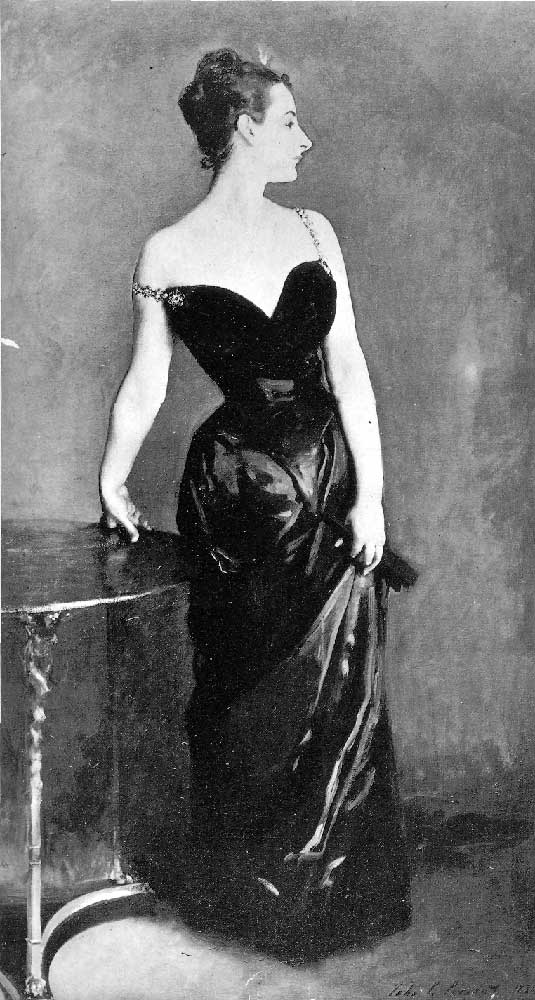
In Paris he did a portrait of Madame Pierre Gautreau, an young American woman from New Orleans. She was a rising star in Parisian High Society and her portrait caused a huge stir when it was unveiled. A huge stir of the wrong kind.

Sargent had painted her with one strap of her gown hanging down off her shoulder. This, along with her plunging neckline and powder-white skin gave the painting a sensual excitement that wasn’t acceptable at the time.

A photograph of the original painting of Madame X.

A photograph of the original painting of Madame X.

The repainted Madame X - her gown strap is back up on her shoulder.

The repainted Madame X – her gown strap is back up on her shoulder.

He re-did the painting with the strap in a more demure position – but the damage was done. Ms. Gautreau had to slink back to Louisiana to escape the social ridicule. Sargent had to flee to England to regain his reputation.

None of this has anything to do with the story – but it’s cool anyway. I’ve become a fan of Sargent because of this story, even though I’ve never been big on portraiture. I always stop and look at Dorothy whenever I visit the Dallas Museum of Art.

Dorothy, by John Singer Sargent, in the Dallas Museum of Art.

Dorothy, by John Singer Sargent, in the Dallas Museum of Art.

So, my advice is to read all of Stranger Things Happen – the other stories are just as odd, but in surprisingly different ways. Then go to the nearest good art museum and take a look at a Sargent – see what you can see in the eyes. It might be useful, help you remember things when you are stuck in limbo. We all will be there, sooner than we think.

I hope you enjoyed some of my month of short stories – it was fun and educational putting it together (though a surprising amount of work). Don’t know what I’ll do tomorrow… maybe a photograph.

Later.

I’ve been here for 3 days, and I’m trying to pretend that it’s just a vacation, like when we went to that island in that country. Santorini? Great Britain? The one with all the cliffs. The one with the hotel with the bunkbeds, and little squares of pink toilet paper, like handkerchiefs. It had seashells in the window too, didn’t it, that were transparent like bottle glass? They smelled like bleach? It was a very nice island. No trees. You said that when you died, you hoped heaven would be an island like that. And now I’m dead, and here I am.
—-Carnation, Lily, Lily, Rose, by Kelly Link

Short Story Day Thirty – Passion

30. Passion
Alice Munro
http://www.newyorker.com/archive/2004/03/22/040322fi_fiction

As we are in the ninth inning, the home stretch, of my month of short stories we come across Alice Munro. She is the master – the best of the best.

I have been voraciously reading Alice Munro for decades now… and she should be in my list of writers that I have read everything – but she writes so much (all short stories) that there is always more. Most of what she writes shows up first in the New Yorker – she is the quintessential New Yorker fictioner.

What she does is magical. Read her stories and pay attention to how she plays with time. There is usually several different time planes going on – complex, yet made clear by careful attention to detail. The story is often told by illuminating subtle changes in a character between fictional scenes that take place on different sides of a shift in the story. Often times this shift is never actually shown or described… merely inferred from what has scarred or uplifted (or both) the characters before and after. There are subtle connections across time and place – you have to look closely to figure them out – but they resonate deep in your mind as you read.

Today’s story, Passion, is pure Munro. A woman is looking back over a critical period of her life – how critical it was and in what way isn’t clear until the final sentence.

I didn’t do this on purpose – but it is very interesting to compare this story to yesterday’s – The Garden Party. Both are tales of class differences. But Passion – the Munro story – is the opposite… a mirror image, of Mansfield’s The Garden Party.

In this one, the protagonist is a poor girl that stumbles into contact with the wealthy. However, as occurs in yesterday’s tale – once in the other’s camp she is exposed to death, and is changed in complex and subtle ways. Both women (both about the same age) are smart, resourceful, and perceptive beyond their years and expectations and are relied upon to help keep things going smoothly. However, both learn that the world is a harder, more complicated, and dangerous place – with darkness, passion, and beauty all wrapped up and twined, twisted, and knotted together.

The wealthy Traverse family in today’s story is not as isolated or as heartless as the Sheridans in yesterday’s – but they are every bit as flawed and are quietly doomed.

Munro spells out this doom without embellishment or symbolism – she simply tells the story – with great skill. It’s perfect. It’s why she is the best.

She had thought that it was touch. Mouths, tongues, skin, bodies, banging bone on bone. Inflammation. Passion. But that wasn’t what she’d been working toward at all. She had seen deeper, deeper into him than she could ever have managed if they’d gone that way.

What she saw was final. As if she were at the edge of a flat dark body of water that stretched on and on. Cold, level water. Looking out at such dark, cold, level water, and knowing that it was all there was.

It wasn’t the drinking that was responsible. Drinking, needing to drink—that was just some sort of distraction, like everything else, from the thing that was waiting, no matter what, all the time.
—-Passion, by Alice Munro