When the Wyly theater was constructed I remember being excited about the building and its architecture, even more than the other venues in the Arts District. Its unique design and resemblance to a Borg Cube made it fascinating in my eyes.
But one thought I had was, “This is a cool place – but once it’s finished I’ll never be able to afford to see a play in such an expensive and opulent venue.”
Kids Splashing in front of the Wyly Theater. An HDR image I took on the opening day of the theater.
I was wrong. Sure, there are plenty of expensive seats at the shows at the Wyly, but if you play your cards right you can get in inexpensively. You can get in cheaper than a 3-D movie. We saw The Tempest there a while back for only a few measly bucks. Today, we saw a play that I had never heard of, The Elaborate Entrance of Chad Deity, for… well, for whatever I felt like paying.
The operators of the Wyly, The Dallas Theater Center, have these Pay What You Can Nights – so I logged in and bought a couple tickets. I thought for a minute about how much to pay… and ended up paying less than I should have but more than I could have. There is a thin line between cheap and poor.
At any rate, we took the DART train down to the Arts District. There was a lot going on – the Friday night late night music, food trucks, crowds, and a preview (A Glimpse) of the upcoming Aurora light and sound installation/exhibition (which I do not want to miss again this year).
We walked past the giant floating red/orange jellyfish writhing in the air outside the theater and went in to take our seats.
The play is about wrestling. I have never been a big fan of the “sport” (though it is in my blood, I guess, I’ll post something about that this weekend). The play was a blast, though.
The Wyly can best be described as a theater machine. The entire interior of the building is infinitely reconfigurable. For this play it was set up as seats surrounding a real wrestling ring, and one side would open up, the seats sliding sideways, to allow the wrestlers to enter through a cloud of smoke. High above were four giant video screens showing the wrestler’s publicity films or the output from handheld cameras showing the action in the ring or the announcing outside.
The narrator of the story is the wrestler Macedonio Guerra, known as Mace, who is a professional loser. He is so skilled that he makes the headline wrestler look good, even when he’s lousy. Wrestling has been Mace’s lifelong dream, and although he has a lot of complaints, he is quiet about them. He doesn’t want to upset the apple cart and lose whatever sliver of his dreams he is allowed to keep.
The first half of the play is a colorful, funny exposé of the funhouse mirror world of professional wresting – where money is king, and the performers are a brotherhood dedicated not to winning, but to entertaining, telling a story, and making sure nobody gets hurt.
After the intermission things get more confused and serious and Mace is inevitably faced with the need to make a choice and decide whether he will have to abandon the moral neutral ground he has been hiding in and take some sort of stand. There also is some real wrestling, which is rousing, fast, and exciting, even if it isn’t a real sport.
Every body in the hall had a hell of a good time, learned a little, and left smiling.
The cast of The Elaborate Entrance of Chad Diety
What shocked me was the number of empty seats. The performance was on a pleasant Friday evening, in the midst of an Arts District full of fun things to do, and cost, potentially, pennies. Why wasn’t every seat taken? I never understand why more folks don’t go to live theater. They pay more money than this to go to a crowded suburban googleplex to see the newest remake of some scumsucking hollywood slimebucket and eat stale popcorn while listening to teenagers’ phones going off.
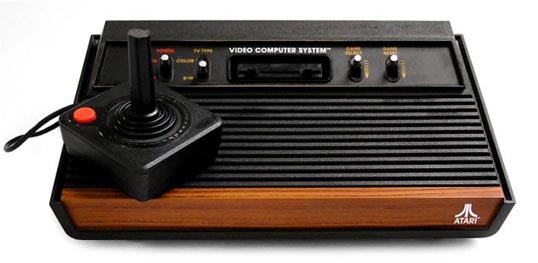
Yes, I had one of these… and I thought it was the coolest thing ever. The sounds of the Space Invaders guys as they moved down, inexorably, faster and faster, is burned in to my memory forever. For some reason, I enjoyed the crude golf game. And I was really excited when the ultimate twitch-game Defender came out – though it wasn’t as cool as the arcade version – it must have really pushed the console’s capabilities. The thing only had 128 bytes of RAM. That’s bytes, not kilobytes.
Guy Pearce, Nick Nolte also are cast in the indie dramedy from “Return” writer-director Liza Johnson. The project starts shooting next week in New Orleans.
Based on Hateship, Friendship, Courtship, Loveship, Marriage, a book of short stories by Alice Munro, the project centers on a nanny (Wiig) hired to care for a rather wild teenage girl (Steinfeld). Using email, the girl orchestrates a romance between the nanny and the father (Pearce), a recovering addict living in a different town.
I am a huge fan of Alice Munro – I think she’s the best Short Story writer… pretty much ever. Sometimes her stories are too subtle to translate to film or video very well, but still… this has to be pretty good.
1. “A reader lives a thousand lives before he dies. The man who never reads lives only one.”
— George R.R. Martin
2. “Show me the books you read, and I’ll show you who you are.”
— Unknown
3. “If you cannot enjoy reading a book over and over again, there is no use reading it at all.”
— Oscar Wilde
4. “For all I know, writing comes out of a superior devotion to reading.”
— Eudora Welty
5. “These are not books, lumps of lifeless paper, but minds alive on the shelves.”
— Gilbert Highet
6. “We don’t need lists of rights and wrongs, tables of dos and don’ts; we need books, time, and silence. Thou shalt not is soon forgotten, but Once upon a time lasts forever.”
— Philip Pullman
7. “The walls of books around him, dense with the past, formed a kind of insulation against the present world and its disasters.”
— Ross McDonald
8. “Never judge a book by its movie.”
— Unknown
9. “A man who does not read good books has no advantage over the man who can’t read them.”
— Mark Twain
10. “If you don’t have time to read, you don’t have the time (or the tools) to write. Simple as that.”
— Stephen King
11. “Books are the quietest and most constant of friends; they are the most accessible and wisest of counselors, and the most patient of teachers.”
― Charles William Eliot
12. “You think your pain and your heartbreak are unprecedented in the history of the world, but then you read. It was books that taught me that the things that tormented me most were the very things that connected me with all the people who were alive, or who had ever been alive.”
― James Baldwin
For folks that are around my age, the most influential person in our upbringing and general outlook on this best of all possible worlds may be Samuel Z. Arkoff. Just looking at that name brings a flood of almost subliminal memories from my childhood. Arkoff was one of the founders of American International Pictures – the source of the flood of B-movie oddness that was the main warped window we had into the world at large.
American International Pictures made films for years based on the ARKOFF formula –
Action (exciting, entertaining drama)
Revolution (novel or controversial themes and ideas)
Killing (a modicum of violence)
Oratory (notable dialogue and speeches)
Fantasy (acted-out fantasies common to the audience)
Fornication (sex appeal, for young adults)
Which pretty much says it all.
When I look at a list of American International Releases from say, 1956 up to 1981… It looks like about 232 films – I am horrified by how many, well more than half, of them I have seen – and remember seeing. There were the horror films that I saw late at night on a tiny 12-inch b&w television after discovering the amazing new world of UHF television (more than three channels – wow!…Do you remember the little loop antennas?). There were the beach films. There were the Poe films (capped by The Conqueror Worm). Blacksploitation. Bad Science Fiction.
I lived on a lot of military bases growing up and they would show at least three different movies every week; I think it cost a quarter. One of the oddest experiences I had as an adult is when I realized they don’t play the Star Spangled Banner before every movie (Army brats will know what I’m talking about). American International Pictures schlock…. Most of those would wind their way around the bases sometime.
Now they are on Netflix Streaming… though I wouldn’t advise wasting too much of your time.
But I noticed one film that had really left its mark and I wanted to re-watch it (although I knew it wasn’t a very good film) to see if my memory served me well. This was The Dunwich Horror.
It came out in 1970, so I may have seen it at a theater in Panama, but probably saw it in Managua. We would get three films a week on 16mm there and would show them at the Embassy, the Marine Compound, or our house.
It’s pretty standard Arkoff horror fare – let’s see how it stands up to the ARKOFF formula:
Actionthem til they’re dizzy. Don’t stop. It must be in your screenplay and in your director’s head. Employ only film editors who are as movement-crazy as you are. Kid’s love action…and they”ll go back…and will tell their peers, inferiors, and superiors what’s good.
-The Dunwich Horror definitely has action – though it doesn’t always make sense. Well, actually, it starts a little slow, but does build to a frenzy of monstrous murders with the traditional villagers pursuing and being pursued by an unseen fiend.
Revolutionaryscenes get talked of. Use some new photographic devices…editing techniques…locales…smells…stunts or something. Make ’em so the sheer experience of seeing them is unique. New language, new juxtapositions, new shocks, new relationships, new attire, new oncepts…new, new, new. Revolve situations, relationships, hell, even the camera if it will get your movie talked about.
-Although it came out in 1970 – it is full of (now dated) 60’s psychedelic effects – grating electronic music/noise and solarized stylized colorized fisheye scenes of naked actors in bodypaint making grotesque faces at the camera… the usual stuff. Now it’s silly… it was sort of silly back then… but it was unique enough to leave an unpleasant memory then on a kid watching it – enough for me to remember it to this day.
The attack of the garish, gaudy Evil Dream Hippies
Killcolorfully and often. Young audiences… like to experience death. Vicariously, of course. But then all storytelling is experiencing something that happens to someone else and you come out alive.
You should be sure to kill and do so in bizarre ways so your audience will get their money’s worth, and so they will tell others…Without death or the glamourous threats of it, I would never have been able to make the highest grossing independently-produced, independently-released film of all time, The Amityville Horror.
-Plenty of death. Again, some of it is diluted by the cheap and garish sixties effects – but still there.
Orate!Tell the world about your picture! Talk about it but more important…get people talking about it. Best way is through publicity. As my old buddy Jack Warner used to say, “The movie good enough to sell itself has not yet been produced!”
-I guess this is more concerned with publicity, which I can’t speak for. The characters do like to orate within the film, of course…
Fantasyis what audiences spend money for. Give them fantastic adventures. Entertain them by rushing them into worlds you dreamed up for them. Avoid the prosaic and commonplace. When they’re in those fantastic environments, keep everything moving ultra-fast. Action will help suspend disbelief.
-There was the fantastic element that I didn’t know anything about when I first saw the film – Lovecraft. The movie is adapted from one of his short stories. I didn’t read any H.P. Lovecraft until I was in college – they had these cheap paperbacks at the bookstore with lurid covers.
There were a whole series of these collections – I read them all.
I would read a story from one of the collections and think, “no big deal,” and then try to go to sleep. It is only in the half-world between waking and somnolence that the true horror of the tales would emerge. I was hooked and am still a fan.
The Dunwich Horror of the film only bears a passing resemblance to Lovecraft’s tale, but it features more than a few touchstones of his fiction: Arkham, Miskatonic University, Yog-Sothoth, The Necrominicon, and the strong hint that the protagonist and his twin brother are actually children of Cthulhu.
Fornicatingis the answer to an exhibitor’s dreams. You can’t get an ingredient in most movies that draws better than sex. Of course, you have to use it wisely…You gotta have taste. Foreplay is as important in dramaturgy as in bed. But avoid too much visual sex. It is embarassing and if it goes on too long it puts audiences to sleep. Arouse but don’t offend!
Look at me, I’m Sandra Dee!
-Ah… here it is. This is what etched The Dunwich Horror into young minds. It stars Sandra Dee, for God’s sake… Gidget. She was the symbol of the innocent, wholesome teenager – so much so that she is now known mostly as the subject of ridicule in a song from “Grease.”
The Dunwich Horror, for all its Lovecraftian touchstones, is really the story of the sexual corruption of Sandra Dee. She starts out as a prim and proper university librarian that trusts an odd but handsome stranger too much, offers him a ride home, and falls under his evil spell. Before she knows what’s going on she’s up on writhing around on an altar in an unforgettable skimpy costume as the centerpiece of a ritual to bring a monstrous race of ancient horrors back to life.
This is not how she imagined this day would go.
At the very end, even after the sudden, inexplicable, defeat of the evil brothers, it is shown that now she is pregnant with Cthulhu’s grandson… the horror continues.
There is nothing explicit here – a modern film would not even bother with this sort of silliness. That’s sort of a shame – the schlock masters knew what they were doing, how powerful on a subliminal level the image of once innocent Sandra Dee writhing on that altar would be. Nothing much is shown, everything is implied, the imagination fills in the blanks so powerfully.
In lieu of expensive special effects, we have skimpy outfits, strange facial expressions, and odd awkward hand gestures.
I’ve rambled on too long about a second-rate B movie that’s almost a half-century old and deservedly mostly forgotten. But these are the memories that we live with every day – some are so deep we don’t even know they are there.
On a little ride through my neighborhood, still working on my old Raleigh Technium, I saw that the Bois D’Arc trees were shedding their odd, green, brain-like convoluted, inedible, fruit. I’ve written of these before.
I usually struggle when writing about film to find something useful to write about without giving too much of the movie away. I have stopped watching or reading film reviews (before I see a film) at all – they all take the surprise away. I want to be stunned, if possible.
No such problem with Melancholia – the movie itself tells you the ending in the first few minutes. The director has said he doesn’t want there to be any suspense. He wants everyone to know how the movie ends. It ends with the destruction of the earth.
Since I don’t read film reviews any more I had never heard of Melancholia, even though I have been a semi-fan of the controversial and provocative director Lars von Trier for many years. It came on cable with an irresistible summary – “A woman’s troubled relationship with her sister is complicated by the appearance of a mysterious planet on a collision course with earth.” How could anyone resist a film like that?
The movie is divided into two chapters – each one named after one of the sisters. The first is “Justine” – and it concerns the events surrounding Justine’s (played by Kirsten Dunst) wedding reception. It’s a fancy, expensive affair, paid for by her sister’s fabulously wealthy brother-in-law John (Keifer Sutherland), and put together by a strange wedding planner (Udo Keir – he keeps walking by with his hand in front of his face to keep from looking at the bride – she has ruined “his wedding”). There’s the incredibly bitter mother (Charlotte Rampling), the asshole boss (Stellan Skarsgård), and plenty of other colorful characters.
The driving force, however, is Justine’s depression. She is crippled by melancholia to the extent that she often can’t even move. Lars von Trier has said that the movie was inspired by his own bouts with depression which make it impossible for him to work. Justine tries to put on a happy face at her own wedding celebration and to appreciate her husband, but it’s all hopeless. She is doomed.
Kirsten Dunst gives an amazing performance of a woman destroyed by depression, drowning in sadness so deep it can’t be swept away. It is painful to watch, but feels true to life – she helps us understand how she feels and how hopeless it all is.
The second chapter is titled “Claire” and the focus shifts to Justine’s sister as the mysterious planet, ironically named Melancholia appears and skims by the earth. Claire is played by Charlotte Gainsbourg, the daughter of Jane Birkin and Serge Gainsbourg – and has already had a long influential career in film, music, and fashion. As the doom earth is about to suffer become more and more obvious the roles of Claire and Justine become reversed.
The ultimate irony of Melancholia is that suffering from crippling depression makes you surprisingly equipped to deal with the end of the world.
So that’s the story of the film. Depressed woman finds out that reality is even worse than what she feared and then everybody dies.
Obviously, this isn’t a tale for everybody. At times it is maddeningly slow, and the lack of hope takes away the suspense that usually feeds a moviegoer’s hunger for entertainment. However, there is a strange beauty in doom, especially cinematic doom, and once the curtain comes down our little blue planet is still spinning out there. There really isn’t a giant killer planet lurking on the other side of the sun and we can take a little joy out of that.
I was surprisingly buoyed by Justine’s struggle (and Dunst’s performance) and her doom will, ultimately, be shared by us all – it’s only a matter of timing. She was able to muster up a little dignity at the end, and that might be enough.
Martyn Ashton takes the £10k carbon road bike used by Team Sky’s Bradley Wiggins & Mark Cavendish for a ride with a difference. With a plan to push the limits of road biking as far as his lycra legs would dare, Martyn looked to get his ultimate ride out of the awesome Pinarello Dogma 2. This bike won the 2012 Tour de France – surely it deserves a Road Bike Party!
Shot in various locations around the UK and featuring music from ‘Sound of Guns’. Road Bike Party captures some of the toughest stunts ever pulled on a carbon road bike.
Blood Meridian used to be a much different novel. McCarthy’s early drafts reveal how an American masterpiece was born.
At least this is what I pictured after I came across a recipe for homemade gunpowder in McCarthy’s notes. The laminated recipe, scrawled in small cursive letters on a bail bondsman’s notepad, is part of the Cormac McCarthy Papers—98 boxes of notes, letters, drafts, and correspondences on all of the reclusive author’s works—archived at Texas State University-San Marco’s Wittliff Collections. Bought for $2 million in 2008 as a joint venture between the university and Bill Wittliff (screenwriter of Lonesome Dove), the collection includes unpublished material such as a screenplay, Whales and Men, and drafts of an upcoming novel, The Passenger (not available for reading until after publication). But of primary interest to McCarthy’s most devoted fans are the multiple drafts of the Tennessean’s magnum opus, Blood Meridian or the Evening Redness in the West. The archives give us a unique look inside the working method of an artist who speaks little about his own work—and gives us clues as to how his reticence, when brought into Blood Meridian itself, transformed a good book into a cold-blooded masterpiece.
I’m not generally a big fan of bridal photograph shoots – but this one will do:
I live in a… well, in a completely different world than Camile Paglia. However, I’ve been reading some of her work online, am very interested in the book she is about to publish, and surprised how much we think alike, though our points of view are so very different.
Some meaty thought in some of these articles:
How Capitalism Can Save Art
Camille Paglia on why a new generation has chosen iPhones and other glittering gadgets as its canvas.
WHITHER THE ARTS? At Ricochet, Dave Carter links to Camille Paglia’s essay in the Wall Street Journal on the decline of the art world with a reminder of the wonders of the 700-year old Cologne Cathedral.
I hate to burst anybody’s bubble about the ‘miraculous’ survival of Cologne Cathedral in WWII, but it was anything but that. When my parents were touring the cathedral years ago and the tour guide began describing this miracle, my father, who actually had bombed Cologne, whispered to my mother, “We left it standing because it was perfect for targetting the rest of the city.” On the same trip, sitting at a cafe enjoying his morning weiss beer and veal sausage, a local struck up a conversation with him, eventually asking, “Have you been to Cologne before, Herr Malone?” My father casually replied, “No, but I’ve flown over it a couple times. . .”
And finally, a very interesting interview with some surprising points:
I don’t like the situation where the Democratic Party is the party of art and entertainment, the party of culture, while the Republicans have become the party of economics and traditional religion. What that does is weaken both sides. One of the themes in my book is the current impoverishment of the art world because of its knee-jerk hostility to religion, which is everywhere. That kind of sneering at religion that Christopher Hitchens specialized in, despite his total ignorance of religion and his unadmirable lifestyle, was no model for atheism. I think Hitchens was a burden to atheism in terms of his decadent circuit of constant parties and showy blather. He was a sybaritic socialite and roué – not a deep thinker — whose topical, meandering writing will not last. And I’m no fan of Richard Dawkins’ sniping, sniggering style of atheism, either.
A responsible atheist needs to be informed about religion in order to reject it. But the shallow, smirky atheism that’s au courant is simply strengthening the power of the Right. Secular humanism is spiritually hollow right now because art is so weak. If you don’t have art as a replacement for the Bible, then you’ve got nothing that is culturally sustaining. If all you have is “Mad Men” and the Jon Stewart “Daily Show,” then religion is going to win, because people need something as a framework to understand life. Every great religion contains enormous truths about the universe. That’s why my ’60s generation followed the Beat movement toward Zen Buddhism and then opened up that avenue to Hinduism – which is why the Beatles went to India with the Maharishi Mahesh Yogi. Then it all disappeared, when people became disillusioned with gurus. But spiritual quest was one of the great themes of the ’60s that has been lost and forgotten – that reverent embrace of all the world religions. This is why our art has become so narrow and empty. People in the humanities have sunk into this shallow, snobby, liberal style of stereotyping religious believers as ignorant and medieval, which is total nonsense. And meanwhile, the entire professional class in Manhattan and Los Angeles is doping themselves on meds and trying to survive in their manic, anxiety-filled world. And what are they producing that is of the slightest interest? Nothing. Nothing is being produced in movies or the fine arts today (except in architecture) that is not derivative of something else.









 Bill Chance