Six Flags

If someone says “Six Flags” or even “Six Flags Over Texas” most people will think of the amusement park(s). Few outside of the Lone Star State know the historical implications of the six flags. There really have been six different flags flying over the state – a couple of them twice each.

First was the flag of Spain. From 1519-1685 and again from 1690-1821 most of Texas was a Spanish colony. In between, for the five years from 1685 to 1690, the area was under French rule. For more than a decade, from 1821 to 1836, Texas was a part of the newly-independent country of Mexico.

For ten years, from 1836 to 1845, Texas was a Republic… its own country. Some people think it was the only state to be independent, but that’s not true.

Then, in 1845, Texas joined the US as the 28th state, only to secede and join the Confederate States in 1861. Finally, in 1865, after the Civil War (or The War Between the States, as it is still called in the South) it rejoined the US.

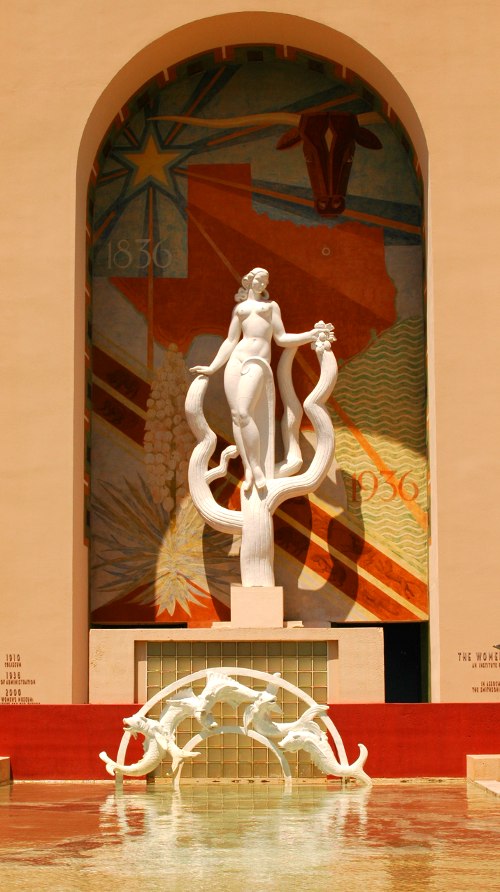
Along the Esplanade, in Dallas’ Fair Park, are six huge porticoes lining a massive pool… three on the north and three on the south. Each portico represents one of the flags that flew over the state. There is a huge female statue outside each representing each country… I’ll look at them another time. What I want to show you is what is inside each portico.

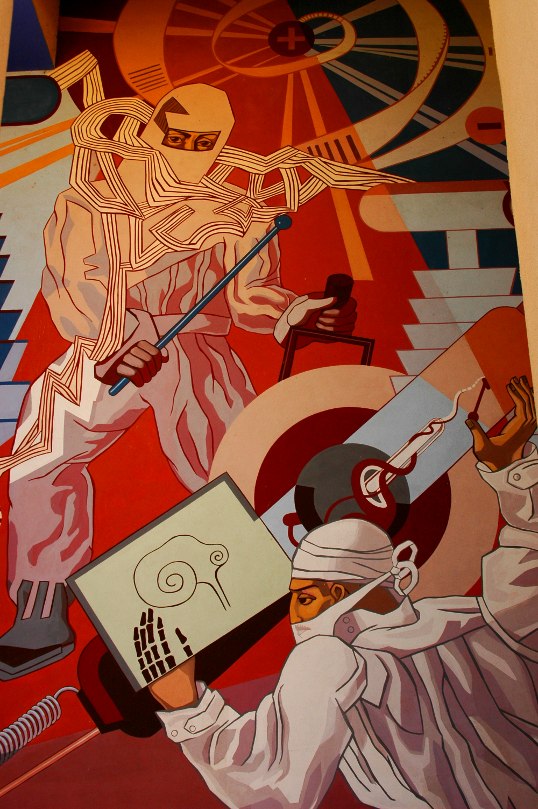
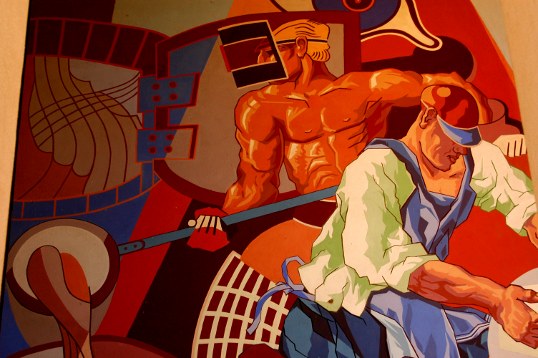
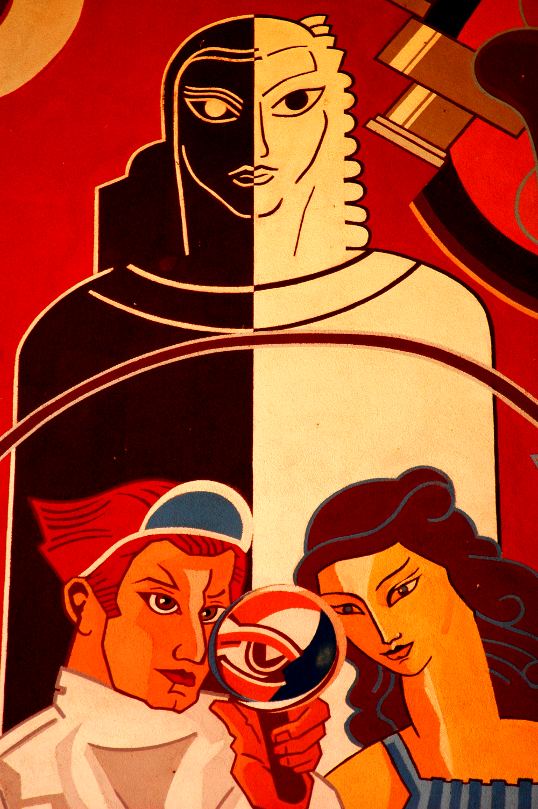
Every entry boasts a massive mural painted on the wall. They are done in a beautiful, powerful, art deco style. I think they are among the coolest things in the city.

And they are virtually unknown. Each fall, millions attend the Texas State Fair and wander around eating their corny dogs, riding the ferris wheel, or looking at the newest car models or the fattest livestock and nobody bothers to peek inside the porticoes at the artwork – even though they are about forty feet tall.

I love to walk the mostly deserted park on non-fair days and look at the paintings. The ones on the south side, facing the north, have been beautifully restored. The ones on the north side, facing south – where the burning sun reaches in – are in worse shape and are very difficult to see because they are behind protective screens. I hope they are restored some time… I’m sure someone is working on it.

The murals are very difficult to photograph. They are in shade and reach up tall and wide in alcoves where you can’t get any distance away for a good shot.

So I did the best I could. If you have the time and are in town – go down and take a look for yourself. Otherwise… here you go.

The Esplanade pool at Fair Park in Dallas. You can see the huge porticoes on the south side on the right.

Art Deco mural from Fair Park in Dallas
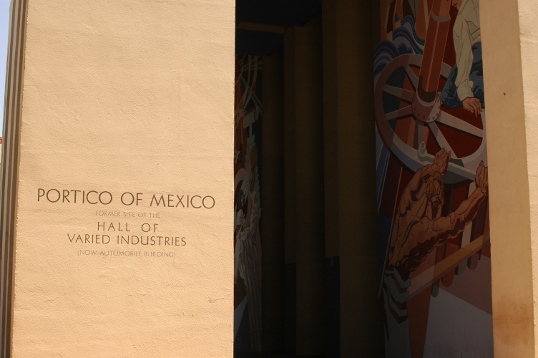
The huge murals are tucked inside the massive porticoes and are very difficult to photograph.

The northern three porticoes are facing the sun and their murals are badly faded.

I hope these are restored – they would be beautiful. This one includes a space ship – painted in 1936.

What I learned this week, September 14, 2012

5 Simple Mind Hacks That Changed My Life

  1. Making yourself impervious to criticism.
  2. How to make a final decision.
  3. The key to getting over mistakes.
  4. How to stop overreacting to minor issues.
  5. How to have a more active life.

I’ve been working on #5 lately. Shame I’m always so exhausted when I get home from work.


The Worst Rock Band Ever

I love the systematic method used in this article. He has Motley Crue barely beating out Creed as the worst ever. But he has one line about Creed that is money: “Rock and roll is supposed to be fun, not like passing an impacted stool, and then telling all your friends about it.” I wish I had written that.


The 10 Most Damaging Chick Flicks Ever Made

Too bad they also send some of the worst messages to women in the history of mankind. Horrible stereotypes, insulting characters, idiotic relationship advice… it’s all there. Some chick flicks are better at hiding it than others, but generally, you can count on the same thing each time. The worst part is, women are actually starting to believe the lunacy they see in these movies!


The 7 Most Overrated Blockbuster Movies of the Last 20 Years


News You Can Use:

10 Reasons There Won’t Ever Be an Aquaman Movie


5 Great Pieces Of R-Rated Life Advice from the Movies


Fiction:

A Village After Dark

by Kazuo Ishiguro, author of Never Let Me Go


I know I keep posting stuff about Cloud Atlas – but I’m really excited about the film (even though I know it might not be that good – the possibly of glorious failure is strong) – Plus… more importantly, I want to give everyone every opportunity to read the book first. It’s an amazing read, in many ways… in every way.

Plus, how can you miss Hugo Weaving playing Nurse Ratchet.


A woman, Annie Clark, that went to a local High School, has hit the big time as St. Vincent. She has released an album in partnership with David Byrne – Love This Giant. This is truly the best of all possible worlds.

Same as it ever was.

Art Deco Fountain

Fair Park, Dallas, Texas

(Click for a larger version on Flickr)

Spirit of the Centennial

Fair Park is one of the underutilized gems in Dallas. Other than the few weeks of the Texas State Fair – the art deco wonderland goes neglected – shunned by most folks. I love to ride my bike down there and hang out – looking at the art. One of my favorite (among many) works is the sculpture Spirit of the Centennial, in front of the Woman’s Museum.

Spirit of the Centennial, Fair Park, Dallas

From Dallas City Hall:

Spirit of the Centennial Sculpture was designed by Raoul Josett and Jose Martin to sit in front of the Hall of Administration building (now the Women’s Museum). Carlo Ciampaglia designed the mural that serves as a backdrop to the sculpture, also titled Spirit of the Centennial. The woman featured in the sculpture has been a source of controversy with two different women claiming to have been the model. There is dispute over whether the model was Marry Ellen Bensterdt, a Duchess and 1930’s model, or the wife of K. Keiser, a big band leader during that era. Raoul Josett and Jose Martin also designed the Fish Fountain Sculpture, depicting flying fish swimming over a reflecting pond, which sits in front of the building. Stashka Star recreated renovated the Spirit of the Centennial mural and sculpture in 1998 and John Dennis recreated the Fish Fountain Sculpture in 2000.

Self Portrait

I have always been stupidly fascinated by the reflection in Campbell Centre from the DART Red Line train.

Red Line DART Train reflected in the gold mirror of Campbell Centre at Northwest Highway and 75.

The Neighbor

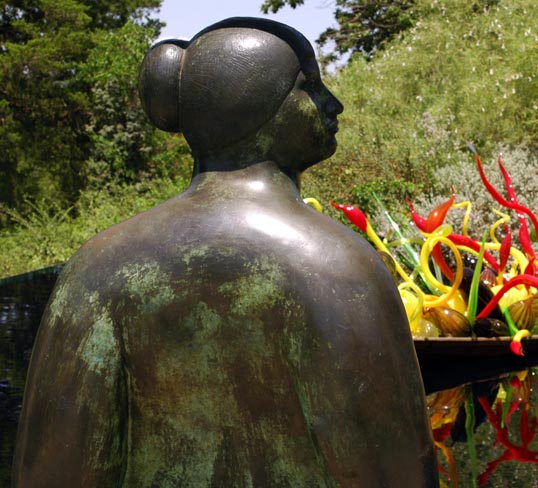
A sculpture, The Neighbor, by Joe Rosenthal in A Woman’s Garden in the Dallas Arboretum. A bit of Chihuly is visible floating in the infinity pool beyond.


.

Never Let Me Go

After slogging through the seven Harry Potter tomes I wanted to read something completely different – so I decided to read the novel, “Never Let Me Go,” by Kazuo Ishiguro, the author best known for “Remains of the Day.” It was one of Time Magazine’s Top 100 novels of all time.

It is a subtle story, told in three parts. The first is set in Hailsham, a boarding school in England. The story is told as a memory by Kathy and concentrates on her and two other children at the school, Tommy and Ruth. The three are followed through the short time they stay together after they leave school and then their fate as adults.

I’m not sure how to describe the genre of the novel. It is usually described as a Dystopian Science Fiction Novel – or even as a “Sci-fi Thriller” – but that does the story short shrift. It is not set in a distant future, but in an alternate recent past, one shaped by fictional postwar scientific advances that are by no means beyond probability or comprehension to readers of today. I won’t discuss exactly what these are in order to not spoil the novel, in case you want to read it (and you should). If you want to know, you can read here.

But it is not a typical Science Fiction novel. It is told in Kathy’s voice, and is full of her concerns. She concentrates on the small, everyday interactions between her and the people that she loves, while the terrible truths lie sleeping, just off screen, ready to wake at any moment. She knows, but does not know. As one of the teachers at Hailsham says, “You are told, but not told.”

In the end it is a romance. Kathy loves… but she doesn’t have enough time.

Neither do any of us.


Now, after finishing, I realize that, even though my intention was to read something completely different than Harry Potter, there are a lot of similarities. The style and intent are opposites – Never Let Me Go is an elegiac postmodern literary tour-de-force while the Harry Potter books are, for all their sound and fury, children’s stories.

Yet they both start in exclusive British boarding schools for very special children. There isn’t much difference, really, between Hailsham and Hogwarts. The students are cut off from normal society – hidden from and shunned by ordinary people. The theme of children trying to find their way without parents is central to both, as are the issues of fate, duty, and sacrifice.

Both feature childhood love triangles – in Never Let Me Go it is two girls and a boy – and the difficulties of navigating the riptides of love as the three move from being children to adults.

Oh, and finally, both have been made into films… though not very many people saw the cinematic version of Never Let Me Go. I picked it up from the library and it is good – though without Kathy’s hopeful voice narrating things it is terribly sad. Somehow, actually seeing the awful fate that awaits these doomed children from Hailsham is so much harder to take.


The title of the book and film is from a song on a cassette tape that Kathy picks up at a school swap meet. For the film, they had to come up with the actual music of the fictional Judy Bridgewater.

These two songs have nothing to do with the book or film… but I like them anyway.

NEVER LET ME GO Featurette – Working Together

Official Trailer (possible spoilers)

Steel Horses

Steel Horses sculpture by Peter Busby. Plano Parkway and Windhaven. Austin Ranch, Plano, Texas.

Harry Potter and the Too Many Pages

My kids have a history with the Harry Potter books. They were just the right age… Well, Nick was at first. He read the first three or so – I remember going to the bookstore in Mesquite at midnight and picking up the books as they were released, so he could start in the next morning. He would devour them.

Nick reading Harry Potter.

Nick reading Harry Potter. Is this the first one?

As the years went by, the books came out while we were out of town, in the middle of summer vacation. Once, we knew we would be in Santa Fe, New Mexico. So I reserved a copy at a bookstore there and Nick and I (he was old enough to stay up now – I don’t know which book it was) went down to pick it up. I remember the night – there was some serious nerdery going on in that bookstore – kids in costume, groups, organized events. I also remember one girl that had a friend in St. Louis. Since midnight there was an hour earlier, her friend was reading her the first chapter over her cell phone while she waited.

Nick sort of grew out of the books. He says he hasn’t read the last two. Lee took over… catching up and reading the rest as they came out. We learned the last book would come out while we were driving through West Texas so we reseved a copy in Amarillo. Back in the hotel, he went down to the lobby and stayed up all night (he has always been a night owl) – reading the thing. He said some strange people came into the hotel after three AM, but they left him alone. He finished the whole book about the time we left in the morning.

I had read the first book, gobbled it down quickly not long after it came out but never read any of the others. I saw… some of the films… maybe three of them. I sort of put them out of my mind as the years went by. I thought about reading them – but the massive size and the time it would require put me off.

But now that they are available as ebooks – I decided to read them on my Kindle. Somehow, the invisible digital bytes hiding inside the tiny tablet seemed less onerous than lugging around giant paper tomes and over four thousand pages of the US edition. So I charged through all seven, one after another. It took a few weeks – I have been busy, but with the Kindle I can carry it with me and grab spare minutes here and there. I liked to take it with me on my bicycle and stop to read when I wanted to take a bit of a rest.

So… what did I think about the beloved series?

First, the experience of reading this much in one gulp is overwhelming. I’ve said before that I have to be careful about what I’m reading because it has such a strong effect on my writing. I was pretty much unable to write any fiction while wallowing in the world of Harry Potter. I did squeeze out a couple mediocre tales of children or teens that didn’t fit in anywhere – lonely, confused, and abandoned… not my usual fare.

But it was an interesting experience – being immersed in J. K. Rowling’s world.

Unfortunately, reading like that does show the flaws in the books pretty starkly. Without a gap between the books the repetitive nature of the first six is obvious and tiring. It’s really the same story told six times. The last one breaks the chain… it is a fully realized grown-up novel.

Also, her overuse of creaky literary crutches – hackneyed plot devices – stuck out. The Harry Potter series is the home of the Hallowed MacGuffin. If you don’t know what a MacGuffin is… read this. Every book revolves around some object (or person), sometimes referred to in the title, that have all the characters dancing around like puppets on strings. But, in the end, that object (or person) really has nothing to do with the actual story at all. That makes it a MacGuffin. The later books have multiple MacGuffins.

There’s nothing wrong with a MacGuffin, of course. You could not have detective stories without them. Hitchcock loved them. The Maltese Falcon is the classic MacGuffin… and there’s no better story than that. But Harry Potter overused them – and when you read all the books and they keep hitting you one after another… a bit much.

She also likes to have all her characters stand around at the end of the books and speak directly about what was really going on – giving out plenty of information that was crudely, cruelly and sometimes arbitrarily withheld from the reader up until then.

And then there’s the Pensieve. Every writer struggles with backstory and point of view. In the Harry Potter books the point of view is held tightly to the hero (with the exception of a prolog or afterward here or there) and she needed a way to bring in information that wasn’t otherwise available to Harry, either by time, space, or the needs of the plot.

So, invent a Pensieve – basically a big bucket – and whenever you need to bring in information that Harry isn’t privy to, have the hero stick his head into the bucket – he falls in, and exactly what you need to have the story go forward (and nothing more) is delivered… by magic.

I shouldn’t complain – it works – but it’s a bit obvious, awkward, and lazy.

Still, though, after all the creaky prose and obvious plot devices it is one hell of a story. Especially when it’s read in one enormous gulp – like a professional eater and a mountain of hot dogs – the world of Harry Potter is irresistible and addictive. You can’t stop reading.

There is plenty there to strike a chord, plenty more to think about. It’s easy to see how it has sold so many copies and become such a touchstone for so many people of several different generations.

I’m just glad I’m done so I can get back to my own pitiful little world.