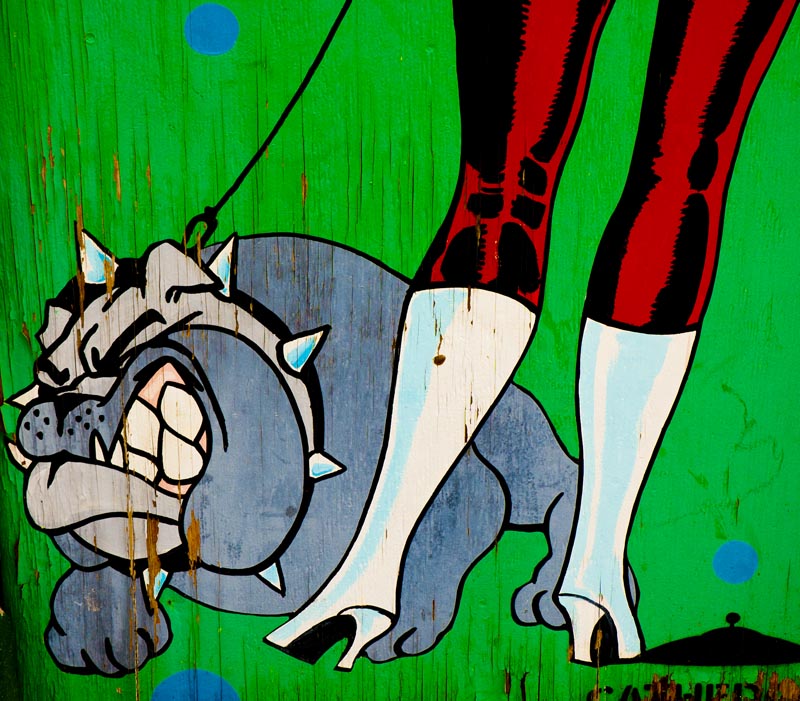
A Month of Short Stories 2017, Day 14 – Dog by Joe R Lansdale

Deep Ellum, Dallas, Texas
Cathey MIller, Cathedonia
(click to enlarge)

Over several years, for the month of June, I wrote about a short story that was available online each day of the month…. It seemed like a good idea at the time. My blog readership fell precipitously and nobody seemed to give a damn about what I was doing – which was a surprising amount of work.

Because of this result, I’m going to do it again this year – In September this time… because it is September.

Today’s story, for day 14 – Dog by Joe R Lansdale

Read it online here:

Dog by Joe R Lansdale

The money had made him worthless, and he missed writing the column, wished now he hadn’t quit the job when the money came in. Should have stayed at it, he thought. He considered possibly getting his old job back, or maybe trying to write a humor book. Right now, however, it was all just a daydream from the seat of a bicycle.

—-Joe R Lansdale, Dog

I have become quite a fan of Joe R Lansdale. First of all, he’s a Texan, which is always a good thing.

The first story of his I read was God of the Razor – a scary little tale of ultra-horror. That’s not usually my thing but the story was so stark and well-written – it hooked me. I have been reading his stuff every since.

Now, today’s story, Dog, is not for animal lovers… not at all. It is about a guy on a bicycle, which is usually a good thing.

But in this story… not so much. It is a story of a nightmare fight to the death between pretty good and absolute evil. Shame about poor Cuddles.

Interview with Joe R Lansdale

You recently talked on Facebook about writers who complain about loneliness and other aspects of the craft, and you noted, “If you want to be miserable writing, that’s your choice.” Why do you think some writers describe it as some painful, soul-sapping drudge?

I’m sure there are some people out there who are just miserable . . .

They’d be miserable if they were plumbers.

Right. But I think also it’s a pose for a lot of people, because they think they’re doing something that doesn’t require that they dig a ditch or fix a car. I think because it’s intangible. When you take a job, you get paid when you first start out whether you know what you’re doing or not, but in writing you’re not necessarily getting paid when you’re starting out, so are you a writer or are you not a writer? So I think a lot of it too is insecurity, that feeling that it’s like, “Look, I’m really working, this really is important and it’s really hard.” And it’s not that it isn’t hard sometimes—it is. I’m not saying it isn’t hard work; I beat my head against the wall sometimes thinking, I just can’t get that right. But that’s not the same thing as saying I’m miserable doing it. It may be a hard thing to do, but I enjoy doing it. And I feel lucky, because I’ve never wanted to do anything else. It’s not the same for everybody, but I feel like I just got the best break in the world.

One recent tip you offered was, “Actually start out with Once upon a time and continue.” Have you done that?

Yeah, I’ve done it. I even have one story that begins, “Once upon a time.” I’ve done it several times. I just type “Once upon a time,” and then I’m into it

—-from Nightmare Magazine

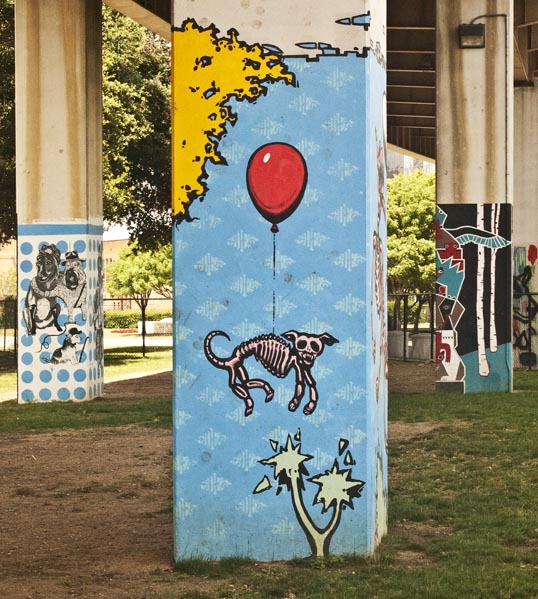
Bark Park Central
Deep Ellum
Dallas, Texas

A Month of Short Stories 2017, Day 13 – Hop-Frog by Edgar Allan Poe

Deep Ellum
Texas

Over several years, for the month of June, I wrote about a short story that was available online each day of the month…. It seemed like a good idea at the time. My blog readership fell precipitously and nobody seemed to give a damn about what I was doing – which was a surprising amount of work.

Because of this result, I’m going to do it again this year – In September this time… because it is September.

Today’s story, for day 13 – Hop-Frog by Edgar Allan Poe

Read it online here:

Hop-Frog by Edgar Allan Poe

The eight ourang-outangs, taking Hop-Frog’s advice, waited patiently until midnight (when the room was thoroughly filled with masqueraders) before making their appearance. No sooner had the clock ceased striking, however, than they rushed, or rather rolled in, all together–for the impediments of their chains caused most of the party to fall, and all to stumble as they entered.

—-Edgar Allan Poe, Hop-Frog

Everyone has read Poe’s The Tell-Tale Heart in school. Everyone is familiar with The Raven, The Pit and the Pendulum, or A Cask of Amontillado. But I bet you haven’t read Hop-Frog.

It is a brutally simple tale of revenge and horror. Never one for subtlety, Poe goes for the jugular here, and delivers. I’m surprised this tale hasn’t been used more often (as has Poe’s other tropes) in modern horror films. It’s a yarn that holds up well, almost two centuries after it was written.

An interesting fact about the story is that, apparently, Poe wrote it as a literary “revenge” against a woman, Elizabeth F. Ellet, and her circle of friends. They had been trafficking in gossip about Poe and alleged improprieties to the extent that Poe’s wife felt they had driven her to her deathbed.

Don’t mess with a short story writer, or you will be immortalized in horror.

https://youtu.be/LMvEHiZzt6w

Poe on Writing:

I prefer commencing with the consideration of an effect. Keeping originality always in view — for he is false to himself who ventures to dispense with so obvious and so easily attainable a source of interest — I say to myself, in the first place, “Of the innumerable effects, or impressions, of which the heart, the intellect, or (more generally) the soul is susceptible, what one shall I, on the present occasion, select?” Having chosen a novel, first, and secondly a vivid effect, I consider whether it can best be wrought by incident or tone — whether by ordinary incidents and peculiar tone, or the converse, or by peculiarity both of incident and tone — afterward looking about me (or rather within) for such combinations of event, or tone, as shall best aid me in the construction of the effect.
—-from THE PHILOSOPHY OF COMPOSITION

Coal and coke fire, Frisco, Texas.

A Month of Short Stories 2017, Day 12 – The Balloon, by Donald Barthelme

Over several years, for the month of June, I wrote about a short story that was available online each day of the month…. It seemed like a good idea at the time. My blog readership fell precipitously and nobody seemed to give a damn about what I was doing – which was a surprising amount of work.

Because of this result, I’m going to do it again this year – In September this time… because it is September.

Today’s story, for day 12 – The Balloon, by Donald Barthelme

Read it online here:
The Balloon, by Donald Barthelme

Another man, on the other hand, might view the balloon as if it were part of a system of unanticipated rewards, as when one’s employer walks in and says, “Here, Henry, take this package of money I have wrapped for you, because we have been doing so well in the business here, and I admire the way you bruise the tulips, without which bruising your department would not be a success, or at least not the success that it is.” For this man the balloon might be a brilliantly heroic “muscle and pluck” experience, even if an experience poorly understood.

—-Donald Barthelme, The Balloon

When reading The Balloon I first thought of the artist Christo – though I have never seen one of their works, I did watch a fascinating and provocative documentary of their environmental installation in Central Park, The Gates. It made me wish I had been able to visit while the gates were up.

The Gates and The Balloon share the location of New York City and they share the confusion, adulation, and consternation of the crowds that interact with them.

The genius of Barthelme is that even in the brief work linked to here, he gives us an explanation in the end. The Balloon has a purpose, a very concrete one, even if it is only understood by two people. And it’s in a warehouse, waiting to be used again.

Donald Barthelme:

Art is not difficult because it wishes to be difficult, but because it wishes to be art. However much the writer might long to be, in his work, simple, honest, and straightforward, these virtues are no longer available to him. He discovers that in being simple, honest, and straightforward, nothing much happens: he speaks the speakable, whereas what we are looking for is the as-yet unspeakable, the as-yet unspoken.
from Not-Knowing: The Essays and Interviews of Donald Barthelme

Buckingham Road, Richardson, Texas

A Month of Short Stories 2017, Day 11 – The Old Man at the Bridge, by Ernest Hemingway

Railroad Bridge, Waco, Texas

Over several years, for the month of June, I wrote about a short story that was available online each day of the month…. It seemed like a good idea at the time. My blog readership fell precipitously and nobody seemed to give a damn about what I was doing – which was a surprising amount of work.

Because of this result, I’m going to do it again this year – In September this time… because it is September.

Today’s story, for day 11 – The Old Man at the Bridge, by Ernest Hemingway

Read it online here:
The Old Man at the Bridge, by Ernest Hemingway

An old man with steel rimmed spectacles and very dusty clothes sat by the side of the road. There was a pontoon bridge across the river and carts, trucks, and men, women and children were crossing it. The mule-drawn carts staggered up the steep bank from the bridge with soldiers helping push against the spokes of the wheels. The trucks ground up and away heading out of it all and the peasants plodded along in the ankle deep dust. But the old man sat there without moving. He was too tired to go any farther.
—-Ernest Hemingway, The Old Man at the Bridge, opening paragraph.

I love reading Ernest Hemingway. More than anything else, I feel he respects his readers. We are all busy, we have real lives to live. Hemingway doesn’t waste our time with any extra words.

Look at two sentences in this very short story:

It was my business to cross the bridge, explore the bridgehead beyond and find out to what point the enemy had advanced. I did this and returned over the bridge.

A lesser writer, a different writer, would have filled pages with description at this point, of how afraid the narrator was, of the close calls he had with the enemy, of how satisfied he was that he completed his mission and returned alive. The author would have been very pleased with himself – with his skill, artistry, and clever way with words.

But Hemingway knows that none of that matters. He knows the real story is the old man waiting at the bridge. The rest is fluff and we don’t have time for fluff.

That’s why I like reading Hemingway. The unnoticed old man at the bridge tells the story of the world.

Interview with Hemingway:

“That’s something you have to learn about yourself. The important thing is to work every day. I work from about seven until about noon. Then I go fishing or swimming, or whatever I want. The best way is always to stop when you are going good. If you do that you’ll never be stuck. And don’t think or worry about it until you start to write again the next day. That way your subconscious will be working on it all the time, but if you worry about it, your brain will get tired before you start again. But work every day. No matter what has happened the day or night before, get up and bite on the nail.”

Margaret Hunt Hill Bridge, from the Commerce Street Viaduct
Dallas, Texas

A Month of Short Stories 2017, Day 10 – Shooting an Elephant, by George Orwell

Dallas Zoo

Over several years, for the month of June, I wrote about a short story that was available online each day of the month…. It seemed like a good idea at the time. My blog readership fell precipitously and nobody seemed to give a damn about what I was doing – which was a surprising amount of work.

Because of this result, I’m going to do it again this year – In September this time… because it is September.

Today’s story, for day 10 – Shooting an Elephant, by George Orwell

Read it online here:
Shooting an Elephant, by George Orwell

In Moulmein, in lower Burma, I was hated by large numbers of people–the only time in my life that I have been important enough for this to happen to me.
—-George Orwell, Shooting an Elephant, opening line.

When you think of George Orwell, you think of 1984 first, and then, a little later, you think of Animal Farm.

And rightfully so – few works of literature have coined as many frightening words and phrases that have entered our daily life as 1984 – Big Brother, Thought Police, Doublethink, thoughtcrime, memory hole. When watching the news today the phrase, “Oceania was at war with Eurasia; therefore Oceania had always been at war with Eurasia,” keeps ghosting through my mind without me willing it.

But for me, the most impressive book by Orwell isn’t fiction, it is his (pretty much) autobiographical book, Down and Out in Paris and London. Somewhere on the early internet I found some kid recommending this tome, saying it was the best book he had ever read. He wrote about it in a way that I tended to think he was on to something, so I bought and read the book.

There is plenty of misinformation on the internet (Oceania was at war with Eurasia) but in this case, the kid was right

Excerpt from Down and Out in Paris and London, chapter III:

It is altogether curious, your first contact with poverty. You have
thought so much about poverty–it is the thing you have feared all your
life, the thing you knew would happen to you sooner or later; and it, is
all so utterly and prosaically different. You thought it would be quite
simple; it is extraordinarily complicated. You thought it would be
terrible; it is merely squalid and boring. It is the peculiar LOWNESS of
poverty that you discover first; the shifts that it puts you to, the
complicated meanness, the crust-wiping.

You discover, for instance, the secrecy attaching to poverty. At a
sudden stroke you have been reduced to an income of six francs a day. But
of course you dare not admit it–you have got to pretend that you are
living quite as usual. From the start it tangles you in a net of lies, and
even with the lies you can hardly manage it. You stop sending clothes to
the laundry, and the laundress catches you in the street and asks you why;
you mumble something, and she, thinking you are sending the clothes
elsewhere, is your enemy for life. The tobacconist keeps asking why you
have cut down your smoking. There are letters you want to answer, and
cannot, because stamps are too expensive. And then there are your meals–
meals are the worst difficulty of all. Every day at meal-times you go out,
ostensibly to a restaurant, and loaf an hour in the Luxembourg Gardens,
watching the pigeons. Afterwards you smuggle your food home in your
pockets. Your food is bread and margarine, or bread and wine, and even the
nature of the food is governed by lies. You have to buy rye bread instead
of household bread, because the rye loaves, though dearer, are round and
can be smuggled in your pockets. This wastes you a franc a day. Sometimes,
to keep up appearances, you have to spend sixty centimes on a drink, and go
correspondingly short of food. Your linen gets filthy, and you run out of
soap and razor-blades. Your hair wants cutting, and you try to cut it
yourself, with such fearful results that you have to go to the barber after
all, and spend the equivalent of a day’s food. All day you are telling
lies, and expensive lies.

You discover the extreme precariousness of your six francs a day. Mean
disasters happen and rob you of food. You have spent your last eighty
centimes on half a litre of milk, and are boiling it over the spirit lamp.
While it boils a bug runs down your forearm; you give the bug a flick with
your nail, and it falls, plop! straight into the milk. There is nothing for
it but to throw the milk away and go foodless.

You go to the baker’s to buy a pound of bread, and you wait while the
girl cuts a pound for another customer. She is clumsy, and cuts more than a
pound. ‘PARDON, MONSIEUR,’ she says, ‘I suppose you don’t mind paying two
sous extra?’ Bread is a franc a pound, and you have exactly a franc. When
you think that you too might be asked to pay two sous extra, and would have
to confess that you could not, you bolt in panic. It is hours before you
dare venture into a baker’s shop again.

You go to the greengrocer’s to spend a franc on a kilogram of
potatoes. But one of the pieces that make up the franc is a Belgian piece,
and the shopman refuses it. You slink out of the shop, and can never go
there again.

You have strayed into a respectable quarter, and you see a prosperous
friend coming. To avoid him you dodge into the nearest cafe. Once in the
cafe you must buy something, so you spend your last fifty centimes on a
glass of black coffee with a dead fly in it. Once could multiply these
disasters by the hundred. They are part of the process of being hard up.

You discover what it is like to be hungry. With bread and margarine in
your belly, you go out and look into the shop windows. Everywhere there is
food insulting you in huge, wasteful piles; whole dead pigs, baskets of hot
loaves, great yellow blocks of butter, strings of sausages, mountains of
potatoes, vast Gruyere cheeses like grindstones. A snivelling self-pity
comes over you at the sight of so much food. You plan to grab a loaf and
run, swallowing it before they catch you; and you refrain, from pure funk.

You discover the boredom which is inseparable from poverty; the times
when you have nothing to do and, being underfed, can interest yourself in
nothing. For half a day at a time you lie on your bed, feeling like the
JEUNE SQUELETTE in Baudelaire’s poem. Only food could rouse you. You
discover that a man who has gone even a week on bread and margarine is not
a man any longer, only a belly with a few accessory organs.

This–one could describe it further, but it is all in the same style
–is life on six francs a day. Thousands of people in Paris live it–
struggling artists and students, prostitutes when their luck is out,
out-of-work people of all kinds. It is the suburbs, as it were, of poverty.

I continued in this style for about three weeks. The forty-seven
francs were soon gone, and I had to do what I could on thirty-six francs a
week from the English lessons. Being inexperienced, I handled the money
badly, and sometimes I was a day without food. When this happened I used to
sell a few of my clothes, smuggling them out of the hotel in small packets
and taking them to a secondhand shop in the rue de la Montagne St
Genevieve. The shopman was a red-haired Jew, an extraordinary disagreeable
man, who used to fall into furious rages at the sight of a client. From his
manner one would have supposed that we had done him some injury by coming
to him. ‘MERDE!’ he used to shout, ‘YOU here again? What do you think this
is? A soup kitchen?’ And he paid incredibly low prices. For a hat which I
had bought for twenty-five shillings and scarcely worn he gave five francs;
for a good pair of shoes, five francs; for shirts, a franc each. He always
preferred to exchange rather than buy, and he had a trick of thrusting some
useless article into one’s hand and then pretending that one had accepted
it. Once I saw him take a good overcoat from an old woman, put two white
billiard-balls into her hand, and then push her rapidly out of the shop
before she could protest. It would have been a pleasure to flatten the
Jew’s nose, if only one could have afforded it.

These three weeks were squalid and uncomfortable, and evidently there
was worse coming, for my rent would be due before long. Nevertheless,
things were not a quarter as bad as I had expected. For, when you are
approaching poverty, you make one discovery which outweighs some of the
others. You discover boredom and mean complications and the beginnings of
hunger, but you also discover the great redeeming feature of poverty: the
fact that it annihilates the future. Within certain limits, it is actually
true that the less money you have, the less you worry. When you have a
hundred francs in the world you are liable to the most craven panics. When
you have only three francs you are quite indifferent; for three francs will
feed you till tomorrow, and you cannot think further than that. You are
bored, but you are not afraid. You think vaguely, ‘I shall be starving in a
day or two–shocking, isn’t it?’ And then the mind wanders to other
topics. A bread and margarine diet does, to some extent, provide its own
anodyne.

And there is another feeling that is a great consolation in poverty. I
believe everyone who has been hard up has experienced it. It is a feeling
of relief, almost of pleasure, at knowing yourself at last genuinely down
and out. You have talked so often of going to the dogs–and well, here
are the dogs, and you have reached them, and you can stand it. It takes off
a lot of anxiety.

Dallas Zoo

A Month of Short Stories 2017, Day 9 – The Hurricane, by Lord Dunsany

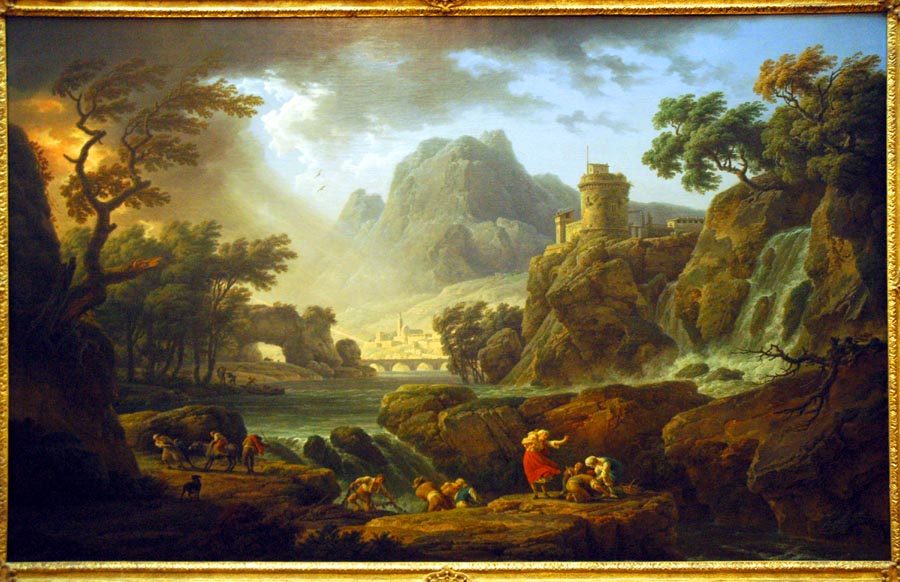
(click to enlarge) “Approaching Storm” by Claude-Joseph Vernet, Dallas Museum of Art

Over several years, for the month of June, I wrote about a short story that was available online each day of the month…. It seemed like a good idea at the time. My blog readership fell precipitously and nobody seemed to give a damn about what I was doing – which was a surprising amount of work.

Because of this result, I’m going to do it again this year – In September this time… because it is September.

Today’s story, for day 9 – The Hurricane, by Lord Dunsany

Read it online here:
The Hurricane, by Lord Dunsany

‘Old friend,’ said the Hurricane, ‘there are cities everywhere. Over thy head while thou didst sleep they have built them constantly. My four children the Winds suffocate with the fumes of them, the valleys are desolate of flowers, and the lovely forests are cut down since last we went abroad together.’

—-Lord Dusany, The Hurricane

Today, with Houston starting its long recovery from Harvey and Irma bearing down on Florida with its horrors to come, I thought I’d link to a short little bit of fantasy called The Hurricane.

Article on Lord Dunsany

It’s hard to underestimate the impact that Dunsany had in the fantasy genre, and he remains one of the literary movement’s most notable figures, influencing many authors who would become major figures in and of themselves. Authors such as H.P. Lovecraft and Robert E. Howard noted their appreciation and influence of the man, with Lovecraft saying of The King of Elfland’s Daughter: “Inventor of a new mythology and weaver of surprising folklore, Lord Dunsany stands dedicated to a strange world of fantastic beauty.”

Dallas, Texas

A Month of Short Stories 2017, Day 8 – Haunting Olivia, by Karen Russell

Dallas Arts District
Dallas, Texas

Over several years, for the month of June, I wrote about a short story that was available online each day of the month…. It seemed like a good idea at the time. My blog readership fell precipitously and nobody seemed to give a damn about what I was doing – which was a surprising amount of work.

Because of this result, I’m going to do it again this year – In September this time… because it is September.

Today’s story, for day 8 – Haunting Olivia, by Karen Russell

Read it online here:
Haunting Olivia, by Karen Russell

The goggles are starting to feel less like a superpower and more like a divine punishment, one of those particularly inventive cruelties that you read about in Greek mythology.
—-Karen Russell, Haunting Olivia

Magical realism is a tricky thing. It is much easier to pull off in Spanish than in English. If not done correctly it simply feels strange and twee.

But if done right it is entertaining and can carry an emotional wallop.

I like what Karen Russell has done in today’s story. It is mostly realism tinged with just the right amount of magic. At first you aren’t sure – the story of two young boys looking for the ghost of their beloved baby sister – their imaginations are expected to run wild. But there are just enough clues to tell you that the world of Haunting Olivia isn’t quite the same dreary one that we get up and go to work in every day.

She pulls it off. In English.

Interview with Karen Russell from Guernica:

Guernica: The term “magical realism” refers to a specific movement in Latin American literature, though it’s now used to encompass a range of writers, from Rushdie to Díaz, Kafka to Aimee Bender. To what extent have magical realist writers influenced you? Do you see yourself in that tradition?

Karen Russell: It’s funny, for a long time I would go watermelon-red and deny that I was a magical realist. It felt imprecise to me, a misrepresentation. Because, as you say, that term refers to a very specific historical moment and movement in Latin American literature. Now, of course, you see the term “magical realist” applied to basically any story told with a little shimmer on the lens.

I still get shy about applying the term “magical realism” to my own work. But I would not be writing the way I do today had I not fallen in love with Borges, Rulfo, Márquez. I was hugely excited to read One Hundred Years of Solitude, and Rulfo, and Julio Cortázar’s Blow-Up: And Other Stories and Hopscotch. European fabulists like Calvino and Kafka and American dark romantic weirdos like Poe also expanded my ideas of what fiction could be, and could do.

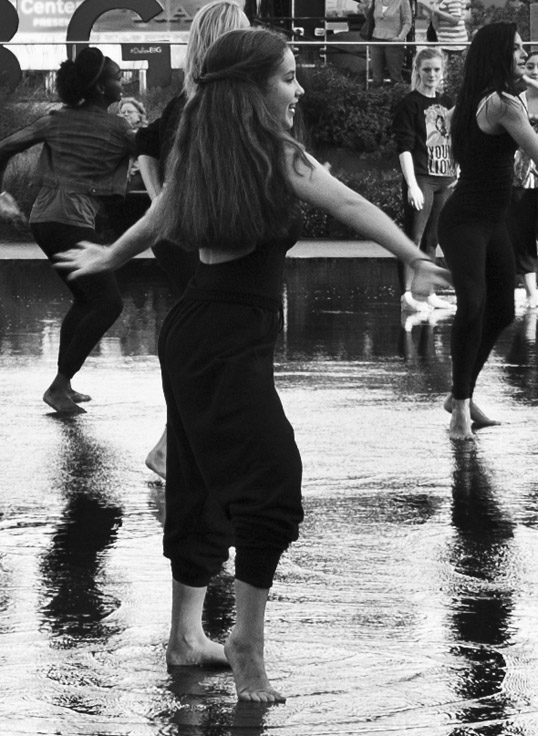
Dancers, Arts District, Dallas

A Month of Short Stories 2017, Day 7 – Why Don’t You Dance?, by Raymond Carver

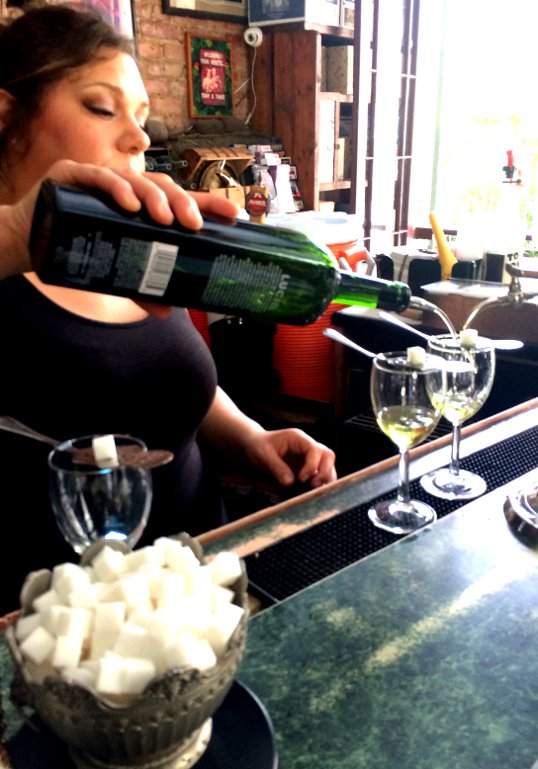
The bartender pouring the absinthe, note the clear green color.
Pirate’s Alley Cafe, New Orleans

Over several years, for the month of June, I wrote about a short story that was available online each day of the month…. It seemed like a good idea at the time. My blog readership fell precipitously and nobody seemed to give a damn about what I was doing – which was a surprising amount of work.

Because of this result, I’m going to do it again this year – In September this time… because it is September.

Today’s story, for day 7 – Why Don’t You Dance?, by Raymond Carver

Read it online here:
Why Don’t You Dance?, by Raymond Carver

He considered this as he sipped the whiskey.

—-Raymond Carver, Why Don’t You Dance?

If I could write like anyone, I would want to write like Raymond Chandler.

His stories are a revelation to me. His characters real, with flaws and good points, – with the flaws winning out in the balance by quite a bit.

What I like the best is the way he leaves stuff out. He doesn’t tell us everything, only what’s important. In today’s story, he doesn’t tell us how or why everything has come to the state it is, because that isn’t important. He doesn’t even tell us what happened… because that isn’t important.

He does tell us that they drank, and that they drank too much, and that they danced, and that the records were crappy.

Because that is what is important.

Interview with Raymond Carver:

INTERVIEWER
But what made you want to write?
CARVER
The only explanation I can give you is that my dad told me lots of stories about himself when he was a kid, and about his dad and his grandfather. His grandfather had fought in the Civil War. He fought for both sides! He was a turncoat. When the South began losing the war, he crossed over to the North and began fighting for the Union forces. My dad laughed when he told this story. He didn’t see anything wrong with it, and I guess I didn’t either. Anyway, my dad would tell me stories, anecdotes really, no moral to them, about tramping around in the woods, or else riding the rails and having to look out for railroad bulls. I loved his company and loved to listen to him tell me these stories.
—-Raymond Carver, from the Paris Review

A cute couple.

A Month of Short Stories 2017, Day 6 – And of Clay Are We Created, by Isabel Allende, translated by Margaret Sayers Peden

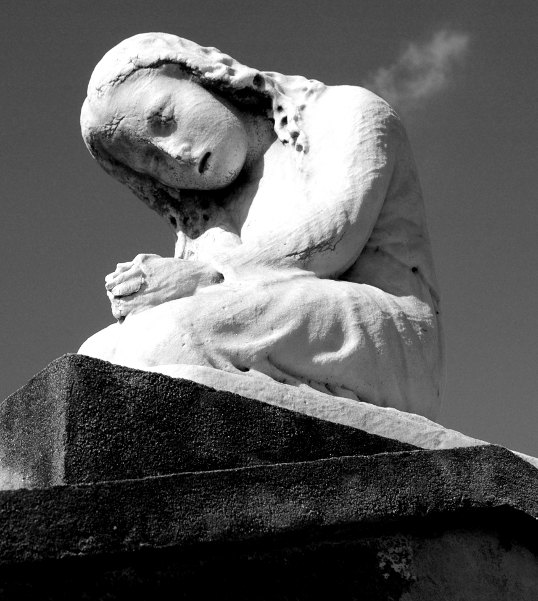
Statue on top of a crypt, Saint Louis Cemetery Number One, New Orleans

Over several years, for the month of June, I wrote about a short story that was available online each day of the month…. It seemed like a good idea at the time. My blog readership fell precipitously and nobody seemed to give a damn about what I was doing – which was a surprising amount of work.

Because of this result, I’m going to do it again this year – In September this time… because it is September.

Today’s story, for day 6 – And of Clay Are We Created, by by Isabel Allende, translated by Margaret Sayers Peden

Read it online here:

And of Clay Are We Created by Isabel Allende, translated by Margaret Sayers Peden

First a subterranean sob rocked the cotton fields, curling them like waves of foam. Geologists had set up their seismographs weeks before and knew that the mountain had awakened again. For some time they had predicted that the heat of the eruption could detach the eternal ice from the slopes of the volcano, but no one heeded their warnings; they sounded like the tales of frightened old women. The towns in the valley went about their daily life, deaf to the moaning of the earth, until that fateful Wednesday night in November when a prolonged roar announced the end of the world, and walls of snow broke loose, rolling in an avalanche of clay, stones, and water that descended on the villages and buried them beneath unfathomable meters of telluric vomit.

—-Isabel Allende, And of Clay Are We Created

There isn’t much I can add to today’s story. Any comment would seem trivial and trite. This one is the real deal. Just read it.

Interview with Isabel Allende:

Q. Can you elaborate on the idea of writing fiction—of telling a truth, of telling lies, of uncovering some kind of reality? Can you also talk about how these ideas might work together or against one another?

A. The first lie of fiction is that the author gives some order to the chaos of life: chronological order, or whatever order the author chooses. As a writer, you select some part of a whole. You decide that those things are important and the rest is not. And you write about those things from your perspective. Life is not that way. Everything happens simultaneously, in a chaotic way, and you don’t make choices. You are not the boss; life is the boss. So when you accept as a writer that fiction is lying, then you become free. You can do anything. Then you start walking in circles. The larger the circle, the more truth you can get. The wider the horizon—the more you walk, the more you linger over everything—the better chance you have of finding particles of truth.

Q. Where do you get your inspiration?

A. I am a good listener and a story hunter. Everybody has a story and all stories are interesting if they are told in the right tone. I read newspapers, and small stories buried deep within the paper can inspire a novel.

Q. How does inspiration work?

A. I spend ten, twelve hours a day alone in a room writing. I don’t talk to anybody. I don’t answer the telephone. I’m just a medium or an instrument of something that is happening beyond me, voices that talk through me. I’m creating a world that is fiction but that doesn’t belong to me. I’m not God; I’m just an instrument. And in that long, very patient daily exercise of writing I have discovered a lot about myself and about life. I have learned. I’m not conscious of what I’m writing. It’s a strange process—as if by this lying-in-fiction you discover little things that are true about yourself, about life, about people, about how the world works.

—-Isabel Allende, from her website

The land of lakes, volcanoes, and sun. A painting I bought on my last trip to Nicaragua.

A Month of Short Stories 2017, Day 5 – Pending Vegan, by Jonathan Lethem

The Wyly Theater in the Dallas Arts District

Over several years, for the month of June, I wrote about a short story that was available online each day of the month…. It seemed like a good idea at the time. My blog readership fell precipitously and nobody seemed to give a damn about what I was doing – which was a surprising amount of work.

Because of this result, I’m going to do it again this year – In September this time… because it is September.

Today’s story, for day 4 – Pending Vegan, by Jonathan Lethem
Read it online here:

Pending Vegan, by Jonathan Lethem

And, after the insipid triumphalist overture of music and video and prancing androgynous spandex, when the orcas finally entered the arena and began their leaping, SeaWorld was overwritten by their absolute and devastating presence. By their act of stitching two realms together, sky and water, merely for the delight of a stadium full of children—children who, in response, leaped, too, and vibrated in their seats, and gurgled incoherently, practically speaking in tongues. Other kids, older and more intrepid than his own, raced down to the plastic barrier to be splashed, to stand with their arms flapping. The killer whales, with their Emmett Kelly eyes, were God’s glorious lethal clowns. Their plush muscular bodies were the most unashamed things Pending Vegan had ever seen. Like panda bears redesigned by Albert Speer.

—-Jonathan Lethem, Pending Vegan

A few years ago, my son Lee and I went down to the Dallas Theater Center’s Wyly Theater to see a new musical, The Fortress of Solitude, adapted from Jonathan Lethem’s eponymous novel. It was Pay What You Can Night (pretty much the only way I can see quality live theater on an ongoing basis) – which is cool, though what we saw was essentially a dress rehearsal open to the public. Because of this, there was a bit of confusion and we discovered that our assigned seats weren’t there (the Wyly is infinitely reconfigurable and they had configured our seats out of existence). No problem, the box office had alternate seats which were better anyway (not that the Wyly has any bad seats) – we were placed in a line of vacant seats right up front. Two men sat next to us at the last minute.

The play was excellent, very enjoyable. I never read the novel, so I don’t know if it followed or did justice, but as a night of live musical entertainment, it fit the playbill. As the play ended, the man sitting next to Lee started asking him a series of questions, “Did you like the musical?” “What songs did you like?” – the inquiry seemed more pointed than curious. I looked at the man and at the Playbill folder in my hand and realized this was the author (of the play, not Jonathan Lethem, alas). The idea was to premiere the musical in the hinterlands (Dallas), iron out the rough spots, them move to Off Broadway (Public Theater) then, eventually, to the Great White Way.

It looks like the momentum has stalled and it probably never will make it to Broadway… but at least I saw it.

Today’s story, also by Jonathan Lethem, is a chronicle of a family’s trip to Sea World in San Diego. The protagonist is struggling with a sudden attack of giving a damn about animals and, possibly more importantly, just now coming off his prescription to anti-depressants. His doctor warns him he might, “see bums and pickpockets.” Worried that he might hallucinate, the doctor assures him that he won’t imagine them, he may simply notice them.

I, of course, have been to Sea World (the San Antonio version) with unruly children a couple of times. I dealt with it a little bit differently than the father in the story – I didn’t think about it. It was a day for the kids and all I was responsible for was trying my best they didn’t get eaten by sharks or destroy an expensive exhibit. All other thoughts were put on hold.

For about a quarter century.

—–

In the interview below, Lethem says, “I’d also have trouble imagining a fiction writer who, after visiting the place, wouldn’t start fooling around with story ideas.” When I first read this I disagreed – I couldn’t think of any story ideas from SeaWorld.

Then I remembered seeing the Shamu show one year. The Orca wasn’t in a good mood and basically stayed at the bottom of his tank and refused to do any tricks. He was the male in the pod and the two females were in the lake outside of the arena. They kept surfacing and making these loud sounds. There is no doubt they were laughing at him.

The neoprene-wet-suited show people tried to get on with the act. They even brought a volunteer from the audience out to try and coax him into getting to work. I thought, “Man, if I had a humiliated, cranky, and uncooperative killer whale at the bottom of a tank, the last thing I’d want to do is lean out and wiggle a fish over him.”

Hmmm. I guess that is an idea for a story.

Interview with Jonathan Lethem about this story:

This week’s story, “Pending Vegan,” follows one family, a husband and wife and their four-year-old twin daughters, on a trip to San Diego’s SeaWorld. When did you start thinking about using SeaWorld as the setting for a story? Did you ever consider inventing the theme park and fictionalizing everything, or was it important that the story be set in a real place?

This story really began with a class I taught, called Animals in Literature. I assigned Jack London, William Faulkner, Franz Kafka, Olaf Stapledon, Lydia Millet, J. R. Ackerley, and a bunch of other stuff, including some essays and theory. (Animals are actually pretty “hot” in theory now.) In the spirit of due diligence, I also read a bunch of animal-rights and vegan manifestos, which is how I blundered into the realm of “Fear of the Animal Planet” and so forth—books I purchased, and which sit staring at me from the shelf, even if I failed to assign them or, in many cases, even to read them. I suppose some of this bad faith leaked into the characters: What would it be to think you’ve gone about halfway, or not even halfway, down some irreversible ethical path, then got stuck there?

Of course all this remained inchoate until suddenly I visited SeaWorld. I can’t imagine anyone setting a story there who hadn’t visited. (I’d also have trouble imagining a fiction writer who, after visiting the place, wouldn’t start fooling around with story ideas.) Long ago, I’d have been certain to disguise it as “Fathomverse,” or “Poseidon’s Playhouse,” or “Orcasm,” or something. But that wouldn’t really be likely to fool anyone, would it? A lot of fiction—most?—derives some of its effects, and energy, from its hybrid nature: half documentary, or half confession or argument or whatever, and full of references outside itself, whether obvious to the reader or not. I’ve made my peace with this. Besides, I’d have had to give up “Sea World, Eat World.”

The story’s protagonist, Paul Espeseth, is going through a crisis of sorts, which he has hidden from both his family and his shrink. He’s renamed himself Pending Vegan as a way of acknowledging his increasing uneasiness with the relationship between man and beast, yet he’s acutely aware of his daughters’ ability to reconcile “their native animal-love and the pleasures of eating.” What’s it like to imagine a child’s version of the animal world versus an adult’s?

Forget “animal world” —what about just “world”? Where’s the script for breaking the news, to a kid, of reality’s roaring wackness? Its moral bankruptcy? Imagine a scene from the breakfast table with a six-year-old listening to an NPR report on the firing of nine air-force commanders over cheating on the tests to qualify as officers for oversight of nuclear missiles.
Six-year-old: “What did they cheat on?”
Father (already in trouble): “Well, see, they were in, like, ‘soldier school’…”
Six-year-old: “Don’t they know it was wrong?”
Father: “———”
Six-year-old: “What are nuclear missiles?”
Father: “———”
Six-year-old: “Why would they cheat? Don’t they want to be good at fighting?”
Father (suddenly impassioned, intense): “Well, actually, the reason this matters so much is that nuclear missiles are these weapons we don’t want anyone ever to use…” (He stops at brink of disaster.)
Six-year old: “—?!?—”
Father: “Uh, eat your pineapple.”
Six-year old: “My teacher told me that pineapple was bad for your skin.”
Father (with relief): “She’s definitely wrong.”

A dog bounds into the story in its final page. It’s not the first time dogs have shown up in your work (“Ava’s Apartment,” for example, an excerpt we published from your novel “Chronic City,” features a memorable three-legged dog). Do dogs hold a particular place in your imagination? Can you imagine a cat exercising as much power?

Cat person or dog person? Funny about that. I grew up with cats; I’m more familiar with them, more fond of them, and I identify with them more. My parents bred Siamese cats for a while, and in a lot of baby pictures I’m seen swimming in a mass of kittens. Dogs were in stories, first: “Nobody’s Boy,” “The Incredible Journey,” Jack London’s and—especially—Albert Payson Terhune’s work. I was probably the last boy in the history of boys to drink deep at the well of “Lad: A Dog” and “His Dog.” Meanwhile, real dogs terrified me. This lasted a while. Even after we got a dog, other people’s dogs terrified me. I was 33clear to me. As in the case of my character, dogs are a problem I can’t solve; they throw me back into the question of self and other. For a writer, that’s good. Writing a story about a cat would be like writing a story about my arm or my ear.

—- Interview with Jonathan Lethem in The New Yorker
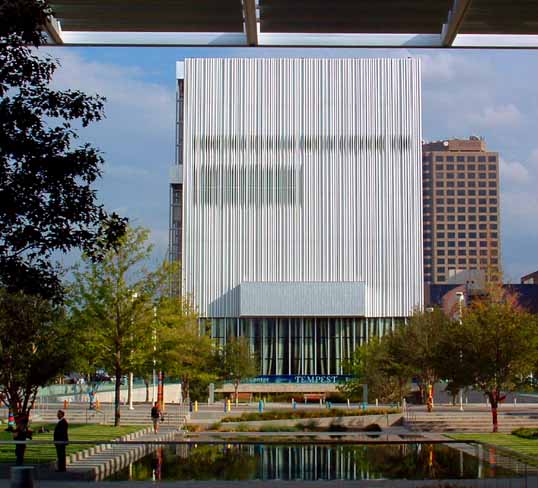
The Wyly Theater.