Chihuly Wallpaper

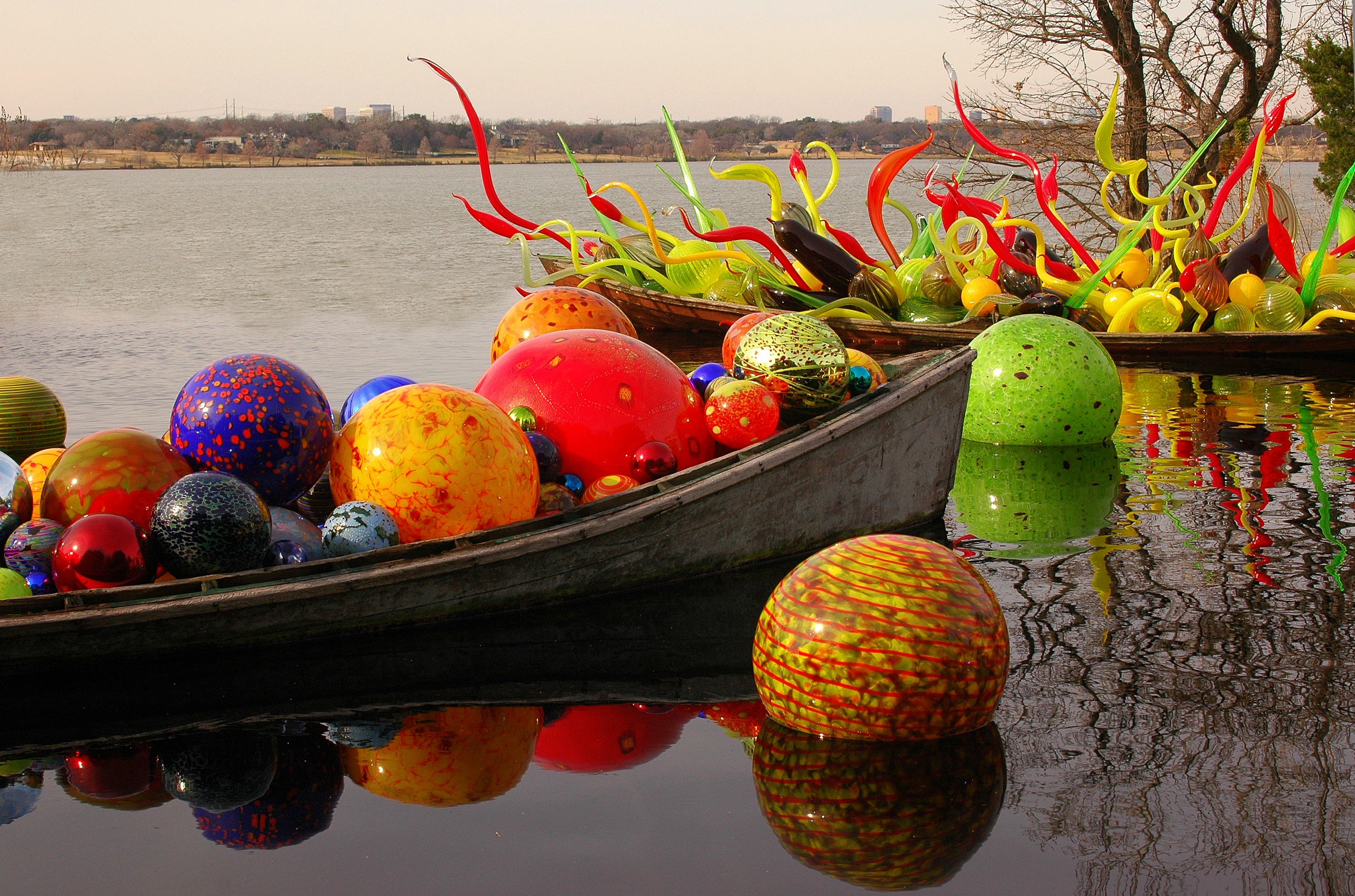
I wanted some Chihuly Wallpaper for my computer at work, so on the last week of last year I went down to the Arboretum for the end of the exhibit and took another photograph of the boats full of glass on the infinity pool. I added a little Photoshop to disguise the transition from the pool to White Rock Lake.

Click on the image for the full-sized version.

Chihuly Boats full of glass at the Dallas Arboretum. White Rock Lake in the background.

Chihuly Boats full of glass at the Dallas Arboretum. White Rock Lake in the background.

Borders

There is one gap in the buildings lining Flora Street – the avenue running through the heart of the Dallas Arts District – and that is the rough top of a parking garage across from the symphony hall. I have seen teenaged skaters run off the concrete. A high rise office tower is planned for this spot (like we need another one of those) but it has been vacant for years.

The odds and ends of the property have been used for some art installations before – most notably the Zen Garden and Ice Sculptures done for the installation Transcendence.

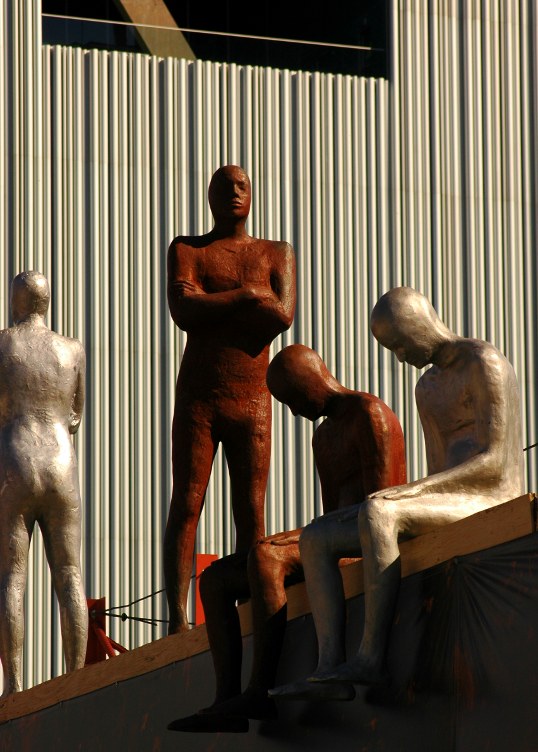
On my last visit, riding my bike through, I saw a bunch of figures – sculptures – hanging out on the thing. Riding up for a closer look I was interested in seeing that one figure was decorated with an orange safety vest and a blue hard hat. While I was lining up a photograph the figure jumped down and I realized that it was a worker adjusting the lighting system.

Borders, by Steinunn Thorarinsdottir, Dallas Arts District, with the cube of the Wyly Theater in the background

Borders, by Steinunn Thorarinsdottir, Dallas Arts District, with the cube of the Wyly Theater in the background

Borders, in the Dallas Arts District

Borders, in the Dallas Arts District

Borders” is a sculptural exhibition by Steinunn Thorarinsdottir. The sign says that the 13 pairs of figures, made from aluminum and cast iron are from the collection of the artist. It looks like the exhibition was originally done in New York City – I don’t know if these are actually the same figures or not.

Napping in the Sculpture Garden

I usually take a two hour nap from one to four.
—-Yogi Berra

Sydney and Walda Besthoff Sculpture Garden, outside of the New Orleans Museum of Art, New Orleans

Taking a nap in the Besthoff Sculpture Garden, New Orleans

Taking a nap in the Besthoff Sculpture Garden, New Orleans

“I do not particularly like the word ‘work.’ Human beings are the only animals who have to work, and I think that is the most ridiculous thing in the world. Other animals make their livings by living, but people work like crazy, thinking that they have to in order to stay alive. The bigger the job, the greater the challenge, the more wonderful they think it is. It would be good to give up that way of thinking and live an easy, comfortable life with plenty of free time. I think that the way animals live in the tropics, stepping outside in the morning and evening to see if there is something to eat, and taking a long nap in the afternoon, must be a wonderful life. For human beings, a life of such simplicity would be possible if one worked to produce directly his daily necessities. In such a life, work is not work as people generally think of it, but simply doing what needs to be done.”
—- Masanobu Fukuoka, The One-Straw Revolution

Lizard of Death

I am the lizard king. I can do anything.
—- Jim Morrison

Lafayette Cemetery No. 1, New Orleans

Lafayette Cemetery No. 1, New Orleans

“At noon in the desert a panting lizard
waited for history, its elbows tense,
watching the curve of a particular road
as if something might happen.”
—-William Stafford

Chihuly, Winter, ice in the creek again

Looking at the photos I took during the last, winter days of the Chihuly exhibit at the Dallas Arboretum I like some of the shots of the glass ice-like sculptures he put in the creek that runs through the place.

I posted an entry about this before – but, even though the glass is the same, the time of year is different, I was different, and, hopefully, you are different.

So here are some more.

Chihuly glass sculptures in the creek, Dallas Arboretum

Chihuly glass sculptures in the creek, Dallas Arboretum

iceberg2

iceberg1

Playdays in the Winter

I have already written about Playdays – a sculpture in the Dallas Arboretum I love. When I went back the other day, the place looked so different in the winter, the light had changed so much from the Texas summer humid heat, that I couldn’t resist another round of photographs.

Playdays, by Harriet Whitney Frishmuth, A Woman's Garden, Dallas, Texas

Playdays, by Harriet Whitney Frishmuth, A Woman’s Garden, Dallas, Texas

In the summer, the thick greenery keeps the sun from hitting the sculpture directly – now it’s well lit under bare branches and a slanting light. I never realized how close the lake was until winter’s sparseness revealed the chilly, choppy water.

The sculpture is located in A Woman’s Garden, with a nice view from my favorite (though uncomfortable) little bench in the Sunset Garden. Again, it looks different with the change in season.

View from The Sunset Garden, Dallas Arboretum

View from The Sunset Garden, Dallas Arboretum

Lafayette Cemetery Angel

Lafayette Cemetery No. 1, New Orleans, Louisiana

Lafayette Cemetery No. 1, New Orleans, Louisiana

Young Faun

Now that the Chihuly Exhibit is packed up and leaving the Dallas Arboretum, I’m paying more attention to some of the other sculptures tucked in amongst the (now mostly brown) greenery.

I’ve already written about The Neighbor, the Bronze Couple, Playdays, and the fountain at Toad Corners.

There’s more.

Hidden away off a side path in the A Woman’s Garden is “Young Faun” – by Brenda Putnam.

Youn Faun, by Brenda Putnam, Dallas Arboretum, A Woman's Garden

Youn Faun, by Brenda Putnam, Dallas Arboretum, A Woman’s Garden

Brenda Putnam was born in Minneapolis, Minnesota on June 3rd 1890. Her father, Herbert Putnam, was the Liberian at the library of Congress in Washington DC. Putnam first studied sculpture at the age of 15 at the Boston Museum Art School from 1905 – 1907. She then studied sculpture under James Earl Fraser for a year and later enrolled in The Art Student’s League in New York City and at the Corcoran Art School in Washington DC.

Putnam’s first exhibit was in 1911 and in the years following the First World War she was commissioned to do several fountains, sundials and other garden accouterments. She won the Barnett Prize at the National Academe of Design in 1922 and the Wildner Gold Medal at the Pennsylvania Academe in 1923. Up until 1927 Putnam’s work was comprised mostly of children, cherubs, and garden ornaments and in 1927 she traveled to Florence, Italy to study. When Putnam returned to New York she continued sculpting and in 1935 she was awarded the Waterus Gold Medal at the National Academe of Design.

Throughout her career, Putnam was awarded many monumental commissions including: a Memorial to the women of Virginia in Lynchburg, Virginia; the Congressional Gold medal awarded to Fleet Admiral Ernest Joseph King; and the bas reliefs over the visitor’s gallery in the US House of Representatives. Her last large commission was a bust of Susan B. Anthony done for New York University in 1952.

Brenda Putnam was always an active member of the art community. She was a member of the National Academe of Design, a fellow of the National Sculpture society, and the author of a book titled The Sculptor’s Way.

 
Brenda Putnam, American sculptor, 1890-1975
 

Looking around the web, there are some cool sculptures of that she has done here and there. I need to make a list of these things so I can look for them when I travel. Her work seems to have become more serious and less playful as time went on. She did an amazing work for the 1939 World’s Fair in New York – The Crest – but I have no idea where that would be now. She has a well-known statue, Puck, in the Folger Shakespeare library in DC – it has an interesting history:

From the Wahsington Post:

The Folger’s Happy Mending

By Nicole M. Miller

Washington Post Staff Writer

Thursday, January 10, 2002

For all his mischievous doings and undoings, when it came down to it, Puck couldn’t save his own skin.

It took a bunch of mere mortals to get that job done.

Two years ago, the statue of the Shakespearean sprite that stood outside the Folger Shakespeare Library was in pretty bad shape. Acid rain had been eating away at the marble, and a skateboarder trying to give the imp a high-five had broken off the statue’s right hand.

Now, Puck is back. On Monday the statue, having undergone extensive restoration, will be formally reinstalled at the Folger — this time inside, at the entrance of its Elizabethan Theatre. Since 1932 it had been outside the building, perched above a fountain and facing the Capitol.

But his old fountain perch above the quote “What fooles these mortals be” won’t remain empty. An aluminum copy of the joker from “A Midsummer Night’s Dream” will now face the Capitol. The Folger expects the aluminum to withstand the brutal elements.

“There’s no way we could have had [the original] repaired and put him back outside. . . . That would have caused further damage,” says Frank Mowery, the Folger’s head of conservation.

Puck’s severed arm has been reattached, his broken fingertips repaired and his blackened curly locks bleached to their original snowy white. He actually returned to the Folger in October but has been sitting in a shipping crate in the exhibition hall. On Monday he will be moved to a new Ohio sandstone base in the theater’s lobby.

It was the nonprofit Save Outdoor Sculpture (SOS), a joint project of Heritage Preservation and the Smithsonian American Art Museum, that got Puck’s makeover underway with an $8,000 grant.

“They gave us the spark to say, ‘Look, guys, this is scandalous,’ ” Mowery says of the statue’s then-declined state.

SOS Director Susan Nichols is pleased about Puck’s return. Despite her organization’s focus on outdoor art, she says, “there are times and reasons that a piece needs to be moved indoors.”

Others across the country also offered financial support for Puck’s restoration. A couple in Oregon who regularly attend their local Shakespeare festival contributed. A Texan who played Puck in a high school production also sent money.

Even Peter Gazzola gave. At age 15, Gazzola posed as Puck for sculptor Brenda Putnam, a local artist and the daughter of then-Librarian of Congress Herbert Putnam. Gazzola sent $50 for Puck’s restoration in 1995 when he was 80, long before the restoration campaign began.

He was inspired to send the money after his son Ronald returned from a trip to Washington with pictures of himself beside the statue. Peter Gazzola, of Rye, N.Y., could see that Puck was already in bad shape.

“When the pictures were developed and I showed them to my father . . . he said, ‘Please fix me,’ ” Ronald says. Peter Gazzola corresponded with the Folger and pleaded that repairs be made. In 1999, he sent $25 more, as did Ronald. But Gazzola won’t see the restoration; he died in June, his son says.

Marble conservator Clifford Craine of Daedalus Inc. in Cambridge, Mass., repaired the obvious breaks, cracks, flakes and discoloration. But one thing couldn’t be fixed: the overall erosion on the sculpture’s surface.

Mowery estimates that one-sixteenth to one-eighth of an inch of Puck’s flesh is gone, exposing many small bumps of crystalline quartz — bits of harder stone that do not erode as quickly as the softer marble.

“You look at a piece like this, and maybe its aesthetics are diminished because it’s weathered. . . . I’d like to make it look new,” Mowery says. But conservationists don’t do that. “It is weathered, and you can’t change history.”

So the bumps remain.

Once the Folger decided it was best for Puck to move indoors, the library wanted to create a suitable replacement for the perch above the fountain. Marble was too expensive, so it turned to aluminum. The windows and doors of the Folger are also covered with aluminum grating.

“We decided we wanted to make the sculpture fit with the aluminum elements of the facade,” Mowery says.

Before returning to the Folger, the original, restored Puck was shipped to the Modern Art Foundry in New York, where a rubberized mold was made for the replica. The mold was exact, bumpy surface and all.

“It looked like he had chickenpox,” Mowery says. The foundry is sanding the replica’s silvery surface smooth. It will arrive at the Folger on Monday.

“He’ll tone down to this velvety gray that’s on the building . . . and look like he’s always been there,” Mowery says.

The price tag for the project is about $60,000, more than double what the Folger originally estimated. The library has has raised more than $40,000, and next Thursday it will host a benefit reception to celebrate Puck’s return.

There are two little hitches. One of marble Puck’s “Mr. Spock” ears, the right one, still has a small chip. Puck’s fingers need a bit more manicuring as well. That will all be taken care of with a final day of touch-ups, Mowery says.

”This will be the last time he’ll need this cosmetic work.”
Change of Seasons

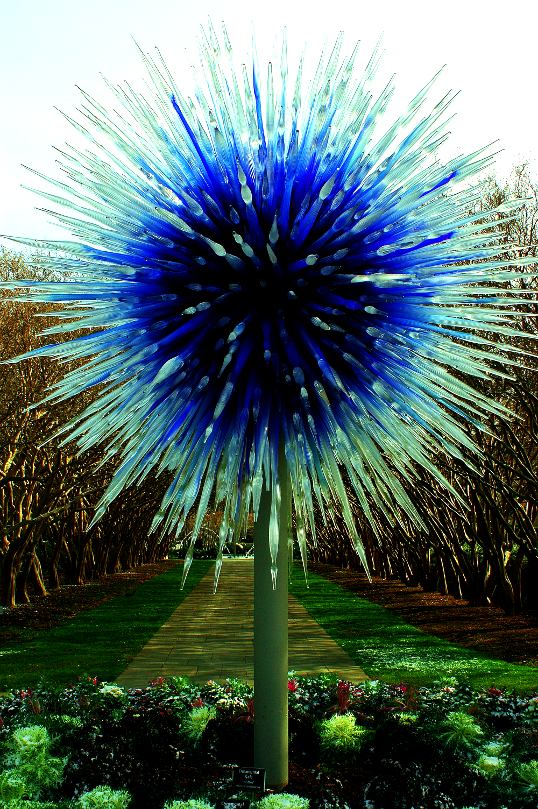
When I drove down to the Dallas Arboretum the day after Christmas for one last visit to the Chihuly Exhibit I took a series of photographs of The Dallas Star, the Crepe Myrtle Allee, and the Toad Corners Fountain beyond. They look much different, though still really attractive, in the leafless winter.

“When you’re young you prefer the vulgar months, the fullness of the seasons. As you grow older you learn to like the in-between times, the months that can’t make up their minds. Perhaps it’s a way of admitting that things can’t ever bear the same certainty again.”

― Julian Barnes, Flaubert’s Parrot

The Dallas Star

The Dallas Star

I know I’ve said it before, but I’ll say it again. I’m going to miss the Chihuly.

“We say that flowers return every spring, but that is a lie. It is true that the world is renewed. It is also true that that renewal comes at a price, for even if the flower grows from an ancient vine, the flowers of spring are themselves new to the world, untried and untested.

The flower that wilted last year is gone. Petals once fallen are fallen forever. Flowers do not return in the spring, rather they are replaced. It is in this difference between returned and replaced that the price of renewal is paid.

And as it is for spring flowers, so it is for us.”

― Daniel Abraham, The Price of Spring

Crepe Myrtle Allee, Dallas Arboretum

Crepe Myrtle Allee, Dallas Arboretum

(Click for a larger and more detailed version on Flickr)

I remember a long, long time ago, talking to a girl. I was talking about how much I liked the life-renewing rains of spring, she replied that she liked the storms of autumn. She liked the excitement, the change, the promise of hard times to come… but not quite here yet. It took me a couple of days of thinking about what she had said to understand that she was right and how unique and interesting her way of looking at things is.

It took me too long, she left me for somebody else. She may be long gone, but I still remember what she said. I will remember it on the day I die.

Expect to have hope rekindled. Expect your prayers to be answered in wondrous ways. The dry seasons in life do not last. The spring rains will come again.

― Sarah Ban Breathnach

season2_w

(Click for a larger and more detailed version on Flickr)

“That time of year thou mayst in me behold
When yellow leaves, or none, or few, do hang
Upon those boughs which shake against the cold,
Bare ruin’d choirs, where late the sweet birds sang.
In me thou seest the twilight of such day
As after sunset fadeth in the west,
Which by and by black night doth take away,
Death’s second self, that seals up all in rest.
In me thou see’st the glowing of such fire
That on the ashes of his youth doth lie,
As the death-bed whereon it must expire
Consumed with that which it was nourish’d by.
This thou perceivest, which makes thy love more strong,
To love that well which thou must leave ere long.”

― William Shakespeare, Shakespeare’s Sonnets

Blue

I feel sad that the Chihuly Exhibit at the Dallas Arboretum is now over. They are carefully packing the glass up and loading it on to trucks – I suppose that it will eventually go to some other urban garden somewhere, but I don’t know where. It’s been in a few places over the years and see no reason to quit now. I’d love to visit it in a new home, see what the glass looks like in a different setting, in a different arrangement.

In the meantime, I still have a lot of photographs. I went down to the Arboretum with my camera at least three times (plus a few more with only my eyes). I can dredge through my archives… find some that I like and put them here.

Blue Reeds, Dale Chihuly, Dallas Arboretum

Blue Reeds, Dale Chihuly, Dallas Arboretum