One reason I always head down to the Deep Ellum Arts Festival as soon as I can after it opens (after work on Friday) every years is so that I can get a look at David Pound’s work before too many are sold.
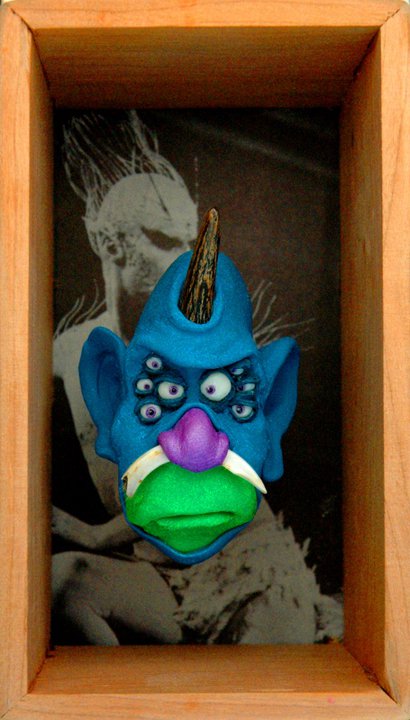
David Pound, TwentyHeads.com, is a sculptor that makes little monster heads in wooden boxes. I have loved his work ever since I saw it a few years ago and I save up to buy something each year. This would be the fourth.
Two years ago, I had David make a commission of a pair of earrings for Candy for Mother’s Day that were modeled on our dog, Rusty.
Earrings I had David Pound make for Candy for Mother’s Day.
They do look like Rusty
As always, he had a large collection of cool little monster heads in boxes. As always, it was tough for me to choose. I think I gravitate to the simpler works – I seem to look for little guys that have interesting expressions on their faces. At any rate, after two visits (I looked for a bit, walked around, and came back to make up my mind) and some input from Candy, I chose Lumbo – a little unhappy looking purple guy with three orange eyes and some delicate bones (mouse bones?) sticking up out of his head.
Now he takes his place with his three buddies on a little shelf over our television (they share their spot with a couple Zulu Coconuts).
The raw material for bronze in antiquity was copper ore that, unknown to the metalworkers of the day, contained enough tin to make the alloy. In many place, bronze and copper must have been thought of as distinct metals. There was no quest for the elements and no incentive to try to separate bronze into ingredients since it was already the superior metal for so many purposes. In a few places, pure tin was smelted from its own ore, cassiterite, and, too soft for weapons and utensils, wsa formed into ornaments. Where tin and copper were obtained from separate ores, it was naturally not long before bronze was being made purposely by putting the two metals together. Once it was known that bronze could be made in this way rather than relying on ores that happened to contain the right proportions of copper and tin, the hunt was on for the miraculous metal which had the power to make copper both more useful and more beautiful.
—-Periodic Tales: A Cultural History of the Elements, from Arsenic to Zinc – Hugh Aldersey-Williams
I had a cycling route picked out from the Audubon Center to Paul Quinn College, where the next Nasher XChange installation was located. It involved a trail through the Great Trinity Forest across the Trinity River. I was a little nervous about that – the green lines were clear enough on the Google Maps Cycling Layer, but I wasn’t sure the trails were finished or even if they went exactly where the map said they did. Documentation on trails when they are finished is light and unreliable and I was going to be alone and a long way from home.
…Shouldn’t have worried – the route through the forest was a beautiful ride. New, smooth, level trail, gentle winding, and that feeling that, in only a few feet, you have left a giant city for some remote wooded wilderness. Of my entire ride that day, this is the part I will return to. There are more trails under construction – hopefully there will eventually be a complete complex that can be used for recreation and transportation.
The forest was, of course bare, the sky leaden and gray – but the promise of green spring isn’t very far away. There will be a narrow sliver of time between when the vegetation comes alive yet before the killer summer heat slams home. I’ll have to plan a trip in that window – maybe a picnic somewhere. On this day I had it all to myself and it’s hard to imagine other people down in that isolated forest – but maybe someday.
As I emerged from the trail system onto Simpson Stewart Road I began to see some familiar landmarks. I was surprised at how far south I had ridden. Off to the side was an incongruous mountain rising from the tabletop flat river bottom lands – a treeless smooth, undulating highland beginning to cast a long shadow over the winter afternoon. This is the McCommas Bluff Landfill – a gigantic pile used to dispose of the city’s detritus – a massive hidden cache of flotsam and jetsam.
Then I rode past a building, the city’s Eco Park structure. I had been there several times for meetings or educational events – and had always looked at the abandoned roads stretching out into the floodplain and wondered about riding a bike there. I was surprised to find myself coming the other way.
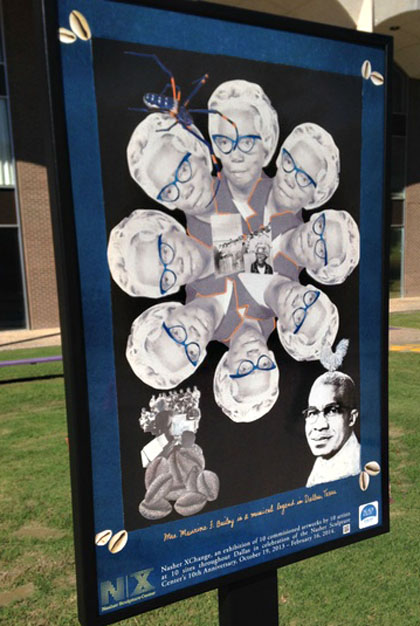
At that point I arrived back into civilization… and road traffic. There was a nasty steep hill leading up to the entrance to Paul Quinn College and the next stop on the Nasher XChange tour – Vicki Meek’s Black & Blue: Cultural Oasis in the Hills. The exhibition is a series of artworks posted around as signs that illustrate the history of Bishop College – a historic educational institution that sat on the site.
I was exhausted from the hill climb and running late, so I wasn’t able to take the time or energy to find all of the exhibit or to give it proper thrift – but I could feel the history, the promise, and the difficulties that an institution like Bishop College offers or offered and faces or faced.
I still had miles to go, another XChange site to visit – and after that a train station to find and two trains to take home. I was getting tired and slowing down more and more. Nothing to do but keep pedaling.
Vicki Meek, Black & Blue: A Cultural Oasis in the Hills
Vicki Meek, Black & Blue: A Cultural Oasis in the Hills
DALLAS, Texas (August 16, 2013) – The Nasher Sculpture Center is pleased to reveal the plans for a newly commissioned work by artist Vicki Meek that will be located on the campus of Paul Quinn College. The work is one of ten commissions for the Nasher’s 10th anniversary, city-wide exhibition Nasher XChange, which will be on view October 19, 2013 through February 16, 2014.
Entitled Black & Blue, Cultural Oasis in the Hills, Vicki Meek plans to celebrate Bishop College’s role in the intellectual and cultural life of Dallas through a series of historical markers commemorating important people and moments from the college, and which will also include an interactive web component and video interviews. Bishop College was a historically black college founded in Marshall, Texas in 1881 that moved to southern Dallas in 1961 and closed in 1988. The campus is now occupied by Paul Quinn College.
To develop her project, Vicki Meek is working with former Bishop College faculty and alumni, and members of the Highland Hills and Singing Hills neighborhoods around the school. Bishop College played a significant role in the development of academic and cultural life in Dallas, giving birth to important cultural institutions such as the African American Museum and the Dallas Black Dance Theatre.
She describes the motivation behind her work as a desire, “to reclaim African American history, restore our collective memory and illuminate critical issues affecting the Black community through visual communication.”
Meek, a native of Philadelphia, PA, is a nationally-recognized artist residing in Dallas, Texas. Trained as a sculptor, she has focused on installation art for the past 25 years that asks for direct engagement from the viewer in an effort to foster dialogue on often difficult subject matter. Meek’s work is in the permanent collections of the African American Museum in Dallas, The Museum of Fine Arts in Houston and Norwalk Community College in Norwalk, Connecticut. She was awarded three public art commissions with the Dallas Area Rapid Transit Art Program and was co-project artist on the largest public art project in Dallas, the Dallas Convention Center Public Art Project. In addition, Meek is an independent curator and writes cultural criticism for her blog, Art & Racenotes. Meek is currently the Manager of the South Dallas Cultural Center and serves as Chair of the Board of Directors for National Performance Network.
Poppies, by W. Stanley Proctor Liberty Plaza Farmer’s Branch, Texas (click to enlarge)
I was riding the DART Green line that runs out from Downtown Dallas Northwest, roughly following I35, and had a nice window seat. I was looking out at an area I don’t get to visit very often, looking for something… anything… interesting. Of course, one thing I always look for is public sculpture.
It was only a quick glimpse and I wasn’t sure what I saw. It looked like a nice little park with a nice little concrete walking trail around it. On the side facing the train tracks it looked like a sculpture, but I couldn’t be sure. Made of dark bronze metal, it spread out in a triangular shape, almost like a draped fabric.
In the split second I had, it almost looked like Batman sitting on a bench.
The other day I was in the area for something else and decided to swing by and to get a closer look at what I had seen. I wondered if I had imagined the whole thing.
I wasn’t too far wrong. It was a sculpture called Poppies, by W. Stanley Proctor. It was not Batman, but a World War Two veteran. He had a long flowing coat and I had seen it from behind.
I have always been interested in art that looks completely different from a different direction. The classic example is the San Francisco de Asis Church in Taos, New Mexico – made famous by Georgia O’keeffe. I’ll never forget visiting it – I was surprised at how cool it looked from the front.
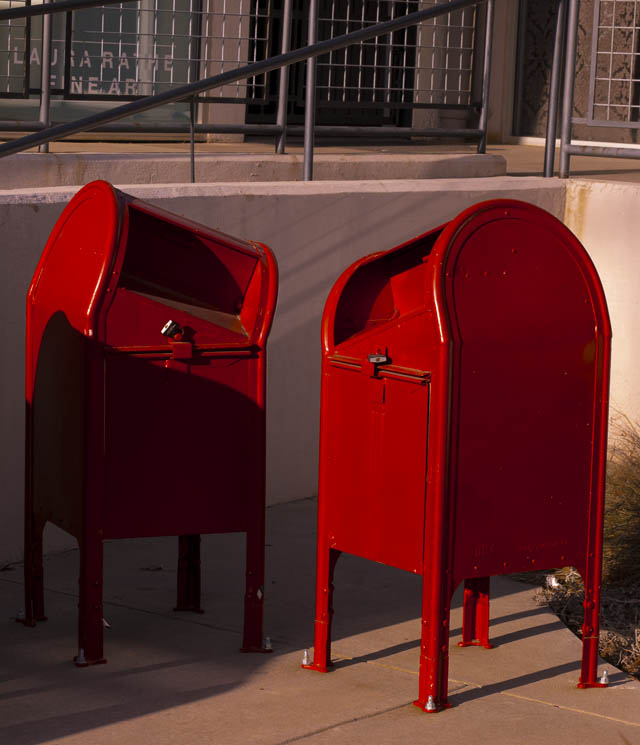
Something there is that doesn’t love a postman,
That sends the cardinal steel twisting willy nilly.
And spills the upper hemicycle lines akimbo,
And makes the lid lean for two arms too bent.
The work of welders is another thing:
I have come after them and tried to make repair,
To find their fiery alchemy is too staunch,
Where they have left not one steel plate on plate,
But they would have the parcels and pouches out of hiding, exposed to the rain and sleet.
To please the yelping dogs.
“A well-known scientist (some say it was Bertrand Russell) once gave a public lecture on astronomy. He described how the earth orbits around the sun and how the sun, in turn, orbits around the center of a vast collection of stars called our galaxy. At the end of the lecture, a little old lady at the back of the room got up and said: “What you have told us is rubbish. The world is really a flat plate supported on the back of a giant tortoise.” The scientist gave a superior smile before replying, “What is the tortoise standing on?” “You’re very clever, young man, very clever, ” said the old lady. “But it’s turtles all the way down!”
― Stephen Hawking, A Brief History of Time
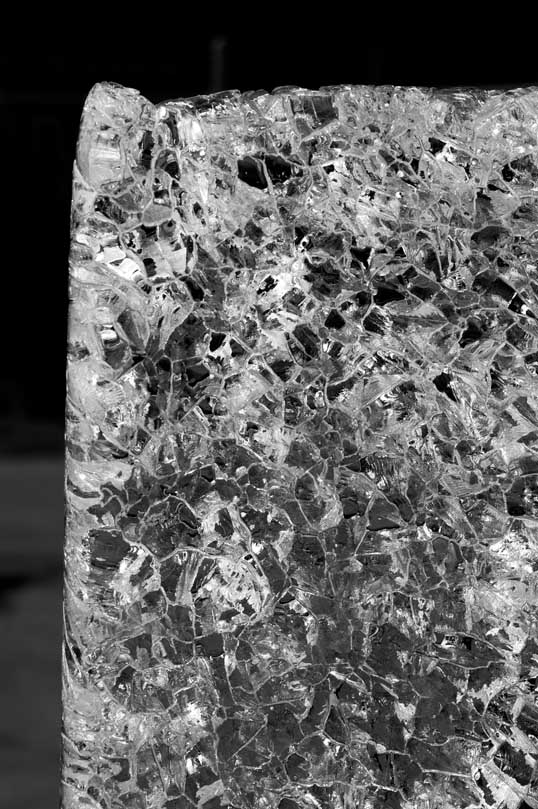
Closeup of the crazing in the ice sculpture at the Dallas Contemporary
The ice sculpture at the Dallas Contemporary
The last moments of the ice sculpture at the Dallas Contemporary
I have always been fascinated by ice as a sculptural medium. It is cheap, versatile, and, most importantly, temporary. It is fixed in time. What you see now is totally unique, it will never be repeated.
The coolest ice sculptures were Dane Pennington’s Transcendence – from the Arts District a couple years ago. Larger than life figures and monoliths slowly melted – releasing stones that were imprisoned within. I kept going downtown day after day to watch them melt.












 Bill Chance