Bring me my Arrows of desire

At the Cottonwood Art Festival, Richardson, Texas.

William Blake, from Milton a Poem (better known as the anthem Jerusalem)

And did those feet in ancient time.
Walk upon Englands mountains green:
And was the holy Lamb of God,
On Englands pleasant pastures seen!

And did the Countenance Divine,
Shine forth upon our clouded hills?
And was Jerusalem builded here,
Among these dark Satanic Mills?

Bring me my Bow of burning gold;
Bring me my Arrows of desire:
Bring me my Spear: O clouds unfold!
Bring me my Chariot of fire!

I will not cease from Mental Fight,
Nor shall my Sword sleep in my hand:
Till we have built Jerusalem,
In Englands green & pleasant Land

Tyger

At the Cottonwood Art Festival, Richardson, Texas.

Click for a larger version on Flickr

William Blake – The Tyger

Tyger, Tyger, burning bright
In the forests of the night,
What immortal hand or eye
Could frame thy fearful symmetry?

In what distant deeps or skies
Burnt the fire of thine eyes?
On what wings dare he aspire?
What the hand dare seize the fire?

And what shoulder, & what art,
Could twist the sinews of thy heart?
And when thy heart began to beat,
What dread hand? & what dread feet?

What the hammer? what the chain?
In what furnace was thy brain?
What the anvil? what dread grasp
Dare its deadly terrors clasp?

When the stars threw down their spears
And water’d heaven with their tears,
Did he smile his work to see?
Did he who made the Lamb make thee?

Tyger, Tyger, burning bright
In the forests of the night,
What immortal hand or eye
Dare frame thy fearful symmetry?

Bois D’Arc

On a little ride through my neighborhood, still working on my old Raleigh Technium, I saw that the Bois D’Arc trees were shedding their odd, green, brain-like convoluted, inedible, fruit. I’ve written of these before.

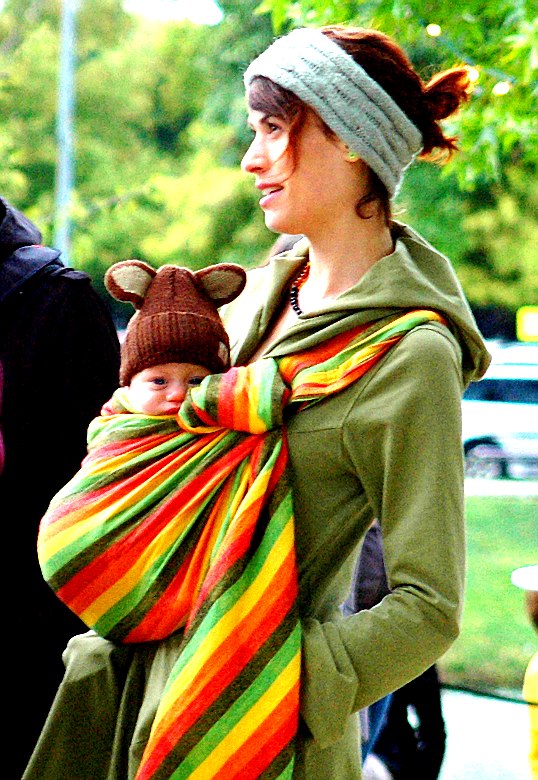
Sling

At the Cottonwood Art Festival, Richardson, Texas.

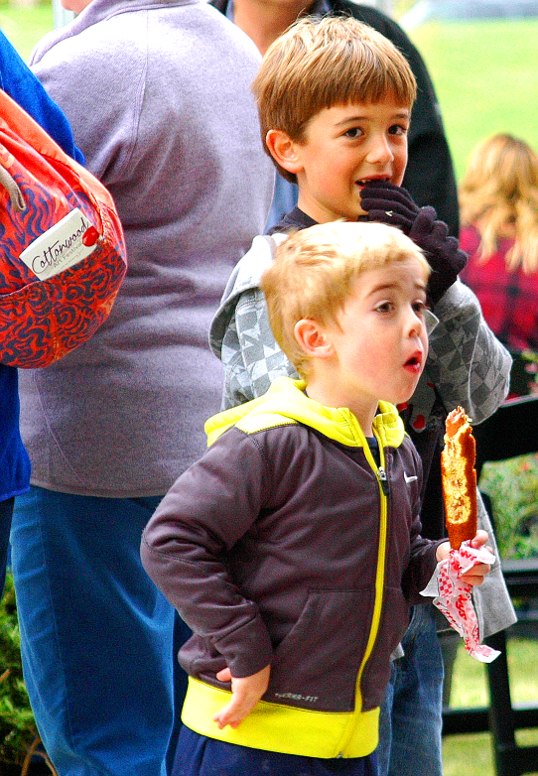
Corny Dog

There’s more than one way to eat a Corny Dog. At the Cottonwood Art Festival, Richardson, Texas.

This Rock and Roll thing, is it going to last?

A Hard Night’s Day – Beatles tribute band, Cottonwood Art Festival, Richardson, Texas

Men Between the Ponds

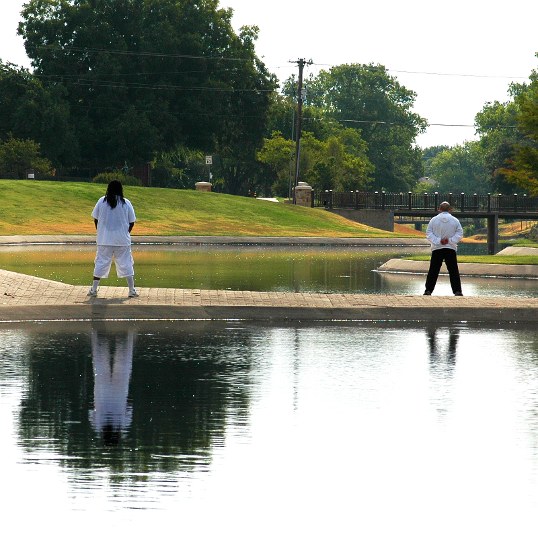
One of the comfortable, reliable, everyday things in my neighborhood is the man between the ponds in the park down at the end of my block. Most mornings (not all) there is a man standing on the concrete apron between the flood control ponds doing exercise – somewhat like Tai Chi Chuan, but a little more violent and martial-arts like. I see him when I drive down my alley to go to work. My son, Lee, has said he saw him years ago when he was running cross country before school.

I have paused on my commute and snapped a photo of him, written a quick blog entry, here and here. But I’ve never been able to get a good look because I’m always late for work and don’t have the time. The other day, however, I saw him for the first time on a weekend morning while I was leaving for a bicycle ride and had time to circle around into the parking lot and get a shot from the other side. By that time… another man had joined him.

I’d like to talk to him and find out exactly what he is doing – but I respect what he’s up to and don’t want to disturb his concentration.

Usually, I see the man standing still, but sometimes he’s moving quite a bit.

I drive across the little bridge beyond the man on the right every day on my commute to work.

Routh Cemetery

North of where I live is a patch of thick creek-bottom woods known as the Spring Creek Nature Area. I’ve been going there for years – to walk around or ride my bike on the complex of paved trails that loop through the forest. It’s a nice spot… a place to forget that you are in the middle of a giant city.

The looping trails through the Spring Creek Natural Area converge on a little footbridge over the creek. There is a nice bench there – a good place to rest and get away from the city for a few minutes.

I had read rumors that there were a couple of old cemeteries within this woodland stretch. A little bit of web searching and careful observation of the Googlemap aerial view of the area and I was pretty sure I had spotted the locations. I am not obsessed – but I find old cemeteries to be interesting. They are the only remaining mark that a lot of the early settlers left on the land here.

I had stopped off at one in the middle of a Plano neighborhood a month or so ago and now I thought I’d take a look at the one in Spring Creek.

So the other day, once my bike ride had been cut short by an unexpected flat, I left my car at Renner and 75 and walked down to where I figured the graveyards might be. It was a hot day and walking was not easy, even though I had brought a bottle of cold water. The cemeteries are not in the Nature Area exactly, but on private property, but judging by the trails and dirt roads penetrating the scrub and trees, I was not the first to venture back there.

After a short hike I came across a small family plot, with a rusting iron inner fence and a new black wrought iron palisade around that. This was the burial place for the scion of the Routh family, Jacob Routh, his wife, Lodemia, and two unmarried daughters. The plot is overgrown with vegetation and I didn’t feel like climbing the fence, so I never was able to see the daughter’s tombstone. The Routh name is still heard all over the Metroplex, especially now that Routh street pierces right through the heart of the uptown entertainment district.

It’s a very peaceful spot, perched right above a steep, deep, dropoff of native limestone down to the creek below. I can picture it over a hundred years ago, part of a ranch made of rolling hills rising up from the creek bed. It’s where a pioneer would choose to spend the rest of eternity. Somehow, I don’t think they would mind the fact that the plot is being overgrown, slowly returning to the way it used to be.

Around to the side of the tombstones of the four family members are two small markers. I could barely see these through the underbrush – couldn’t make out the dates. One had three names, Sharon, Rinnet, and Theda. The other simply said “Fluffie.” These are obviously pet graves… horses and a dog, probably. In those times, a family’s animals would have been very important, worthy of a carved stone in the main cemetery plot.

Jacob Routh’s tombstone in the family plot deep in the woods at the Spring Creek Nature Area in Richardson, Texas.

Pet grave marker.

I couldn’t get a good shot without climbing the fence… but it says “Fluffie.”

I left the small cemetery and followed an old road down through a little creek and up a hill, almost emerging onto a new road that winds through the glass and granite high-rise office buildings of the Richardson Telecom Corridor. Shielded from civilization by a thick grove of trees is a larger cemetery, containing about a hundred or so graves. It was fenced – I did not enter even though there were some gaping holes in the wire. Near the locked gate was a couple of crumbling benches and an official historical marker.

It reads:

Marker Number: 14532

Marker Text:

Brothers Jacob, George Washington, Joseph and Thomas Jefferson Routh, and their sister Elizabeth Routh Thomas, were cousins of the Vance Family which held the original land grant that encompassed this site. Jacob Routh (1818-1879), a Baptist minister, acquired the 440-acre J. V. Vance survey in 1851, and brought his mother and other relatives from Tennessee to Texas. The Routh family were instrumental in the establishment of the community surrounding their land. Routh family members helped to organize a school, church, and store in addition to the family cemetery.

Early Collin County settlers Nancy De Lozier Beverly (1806-1851)and seven year old William Klepper, along with an unknown child whose parents were camping nearby at the time of his death, were already buried on this site when Jacob Routh set aside one acre as a family burial ground. Jacob’s mother, Elizabeth Mashman Routh (1788-1852), died soon after her arrival in Texas and was the first family member to be interred here.

Jacob Routh, his wife Lodemia Ann Campbell, and two unmarried daughters, Rose and Clara Routh, are buried several hundred yards north of the cemetery in a private plot. Of the approximately two hundred graves here, fewer than one hundred are marked. The last burial to occur here was that of Serefta Ellen Campbell Miller, who was born in 1836 and dies in 1922. The Routh cemetery continues to serve as a record of the pioneers of north Texas. (1998)

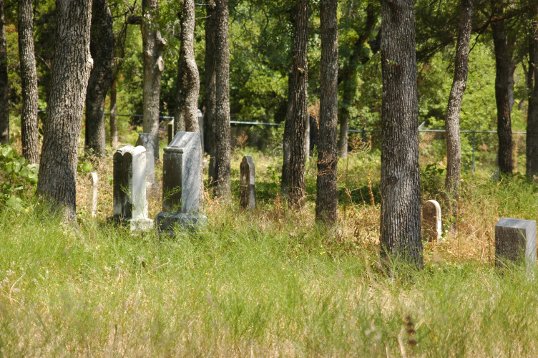
I walked around the fence and snapped a couple shots through the wire. Like the smaller plot this one was overgrown, with large mature trees grown up between the crumbling markers.

The sun was burning down and I had seen what I wanted and returned the way I came, taking time to explore a couple side trails that meandered through the woods down to the creek in a couple different spots. I hope that land doesn’t get developed any time soon, I’d like to see the the Spring Creek Nature Area expand… I’d like to see those cemeteries both protected and also, paradoxically, continue to return to the wild state they started from.

Bicycle Lanes

While Dallas rates, again, its well-deserved award as the worst city in the nation for bicycling, my suburb of Richardson was awarded the most bike friendly neighborhood. The best of the worst… so to speak.

One piece of cycling infrastructure that Richardson has embraced is the idea of separate, striped, bicycle lanes on their broad residential avenues. The square mile neighborhood I live in, Duck Creek, is bisected north and south, plus east and west, at the half mile marks by two of these avenues – Apollo, going east and west, and Yale, north and south.

In the last year or so, both have had a bike lane striped off going each way. These are marked off on the right hand side and are shared with bikes and parked cars. The square mile is also sliced on the diagonal with the Duck Creek Linear Park and its trail, plus the Owens Trail branching off to the north under the power lines, Glenville Trail heading west through the trails snaking around Huffines Park – my neighborhood is not lacking for bicycle infrastructure (love the Googlemap green lines for bicycle routes – though they don’t have the one’s on my streets).

The city is expanding this program, and another road near me, Grove, has had the same treatment for at least two miles of its transit through the city.

These improvements have been very popular. Not so much for the bicycle infrastructure they provide – but for their “calming” effect on traffic. These roads were wide enough to allow passing before – which only encouraged excessive speed, and a lot of folks were confused over which lane to drive in. Now the roads are narrowed to a reasonable width and seem to be the better for it.

Recently the city improved the bike lanes in my neighborhood by adding a narrow “buffer zone” that restricts traffic a tad more and gives a bit of confidence to the bike riders.

Bike lane on Yale, near my house.

I’ve been experimenting with these lanes a bit over the last few weeks and have come up with a few opinions and observations.

The lanes themselves are great. Sometimes, sharing the lane with parked cars can be a problem – wide vehicles like lawn-mowing company trailers can force you too far to the left, and there’s always the fear of someone opening a car door in front of you. The drivers do respect the lanes, though. The lanes would be tough for a high speed rider on a hot road bike – but a slow tourist or commuter has no problem in the middle of the blocks.

One problem is the intersections. Left hand turns are harrowing on a bicycle – there isn’t enough sidewalk or shoulder to do the stop, turn, and cross. The cars use the bike lanes for right turns. Look at this picture.

Bike lane merging with right turn lane at Beltline road.

This is a very busy crossing and the cars are going by fast in all directions. There is simply not enough space to navigate a bike through there. If you ride a bike very much in traffic you will learn that bicycles are often invisible to turning cars – I am more afraid of cars making turns than I am of speeding motorists.

Another observation is a more generic one. Planners tend to look at long stretches of road. If they can open up a long stretch, they view that as a victory.

When you are planning a route for your own personal use you tend to think about choke points. These are locations or short stretches of road that cannot be easily or safety crossed on a bicycle. Your route will be developed not to take advantage of long stretches of good road as much as it is chosen to avoid these choke points.

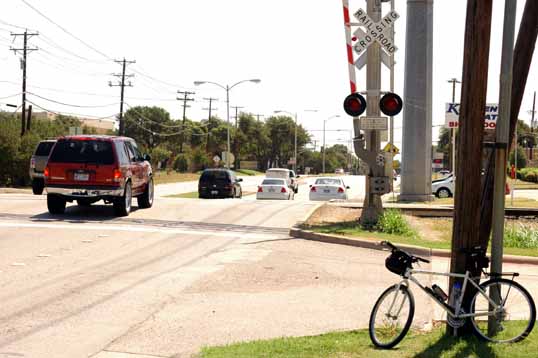
Some of the most notorious sets of these are the railroad crossings. Look at this one on Arapaho – a very busy major thoroughfare.

Rail crossing on Arapaho road.

There are three lanes of traffic both ways going through that little space – going fast, up to fifty miles per hour or more (don’t lecture me on speed limits… this is Texas). There is no sidewalk, no shoulder, no other way to cross. That hump has a set of rough wheel-swallowing steel rails sitting there on top of it. You hit that wrong on a bike and you are going down. There is no other crossing to the south for a mile. It’s two miles south to a safe crossing.

The Grove road bike lane is right behind me… as is the Arapaho DART station. If I want to ride my bike to the library; I have to go through there. If there is any traffic at all I have no alternative than to stop, get off my bike, and carry it over the tracks.

Which isn’t the worst thing in the world… but I wish someone would work on these choke points.