How to Live Safely in a Science Fictional Universe

 “Desire is suffering. A simple equation, and a nice catchphrase. But flipped around, it is more troubling: suffering is desire.”

—- Charles Yu, “How to Live Safely in a Science Fictional Universe”

I was looking for something fun and not too heavy to read so I paged through the books I’d bought (mostly during Amazon sales) for my Kindle and settled the cursor over “How to Live Safely in a Science Fictional Universe” by Charles Yu – clicking it into my “READING” folder.

It’s an odd, postmodern bit of strangeness. You know, right away, when you find out that the protagonist’s name is Charles Yu, the same as the author. You suspect that the protagonist claims to have written the book that you are reading… and you would be right… sort of.

Yu (the protagonist) works as a time machine repairman. For the last ten years he has lived in his own time machine, a TM-31 Recreational Time Travel Device. Though there isn’t any extra space in the thing, he does have two companions – TAMMY, his love interest – an attractive bit of programming, and Ed, his non-existent, ontologically valid dog.

He works in Minor Universe 31 (not a coincidence that it has the same model number as his machine) – which is a pretty grim stretch of time-space continuum. It is broken, never really finished, and cobbled together from New York and Los Angeles scrunched together, with half of Tokyo thrown in for leavening.

Protagonist Yu gets himself in a real jam. He returns to his time machine after it gets some needed maintenance and sees himself climbing out of it. He panics, shoots himself, then jumps into the time machine and escapes into the past.

He is now stuck in a time loop. His only hope is to write a book that will tell his future self how to escape from the trap. The book that he is writing is “How to Live Safely in a Science Fictional Universe,” and you are reading it.

There are, obviously, many twists and turns of space and time and many turns of phrase and twists of fate. Physics enters into it too. And hypertext.

The book has links in it – including a link to a YouTube video on the famous Libet experiment on free will.

So I don’t know if I really decided to read this book… or simply went along with the flow when I discovered that I had already moved it into my READING folder on my Kindle – then fooled myself into believing that I had chosen it – and now am lying to y’all about deciding…. or something like that.

So, all well and good. Food for thought. But, the big question is, do you give a damn?

And the answer is, surprisingly, yes. The beating heart of the book is the relationship between Charles Yu and his father. I can say with pretty strong confidence that the grip of emotion is present in both the author and his eponymous protagonist. The story is the search for his father, who has also become lost in time, and an examination of the father and son’s life together. This is the meat of the story. There are a few passages that will rip your heart out… and that is the reason to read the book.

The science fictional pyrotechnics are just added dessert.

 “I don’t miss him anymore. Most of the time, anyway. I want to. I wish I could but unfortunately, it’s true: time does heal. It will do so whether you like it or not, and there’s nothing anyone can do about it. If you’re not careful, time will take away everything that ever hurt you, everything you have lost, and replace it with knowledge. Time is a machine: it will convert your pain into experience… It will force you to move on and you will not have a choice in the matter.”

—- Charles Yu, “How to Live Safely in a Science Fictional Universe”

Oh, and this book sure feels unstageable and unfilmable… but it’s been adapted into a one-man play and Chris Columbus has optioned it for a film.

“There must be some kind of internal time distortion effect in here, because when I look at myself in the little mirror above my sink, what I see is my father’s face, my face turning into his. I am beginning to feel how the man looked, especially how he looked on those nights he came home so tired he couldn’t even make it through dinner without nodding off, sitting there with his bowl of soup cooling in front of him, a rich pork-and-winter-melon-saturated broth that, moment by moment, was losing – or giving up – its tiny quantum of heat into the vast average temperature of the universe.”

—- Charles Yu, “How to Live Safely in a Science Fictional Universe “

Harry Potter and the Too Many Pages

My kids have a history with the Harry Potter books. They were just the right age… Well, Nick was at first. He read the first three or so – I remember going to the bookstore in Mesquite at midnight and picking up the books as they were released, so he could start in the next morning. He would devour them.

Nick reading Harry Potter.

Nick reading Harry Potter. Is this the first one?

As the years went by, the books came out while we were out of town, in the middle of summer vacation. Once, we knew we would be in Santa Fe, New Mexico. So I reserved a copy at a bookstore there and Nick and I (he was old enough to stay up now – I don’t know which book it was) went down to pick it up. I remember the night – there was some serious nerdery going on in that bookstore – kids in costume, groups, organized events. I also remember one girl that had a friend in St. Louis. Since midnight there was an hour earlier, her friend was reading her the first chapter over her cell phone while she waited.

Nick sort of grew out of the books. He says he hasn’t read the last two. Lee took over… catching up and reading the rest as they came out. We learned the last book would come out while we were driving through West Texas so we reseved a copy in Amarillo. Back in the hotel, he went down to the lobby and stayed up all night (he has always been a night owl) – reading the thing. He said some strange people came into the hotel after three AM, but they left him alone. He finished the whole book about the time we left in the morning.

I had read the first book, gobbled it down quickly not long after it came out but never read any of the others. I saw… some of the films… maybe three of them. I sort of put them out of my mind as the years went by. I thought about reading them – but the massive size and the time it would require put me off.

But now that they are available as ebooks – I decided to read them on my Kindle. Somehow, the invisible digital bytes hiding inside the tiny tablet seemed less onerous than lugging around giant paper tomes and over four thousand pages of the US edition. So I charged through all seven, one after another. It took a few weeks – I have been busy, but with the Kindle I can carry it with me and grab spare minutes here and there. I liked to take it with me on my bicycle and stop to read when I wanted to take a bit of a rest.

So… what did I think about the beloved series?

First, the experience of reading this much in one gulp is overwhelming. I’ve said before that I have to be careful about what I’m reading because it has such a strong effect on my writing. I was pretty much unable to write any fiction while wallowing in the world of Harry Potter. I did squeeze out a couple mediocre tales of children or teens that didn’t fit in anywhere – lonely, confused, and abandoned… not my usual fare.

But it was an interesting experience – being immersed in J. K. Rowling’s world.

Unfortunately, reading like that does show the flaws in the books pretty starkly. Without a gap between the books the repetitive nature of the first six is obvious and tiring. It’s really the same story told six times. The last one breaks the chain… it is a fully realized grown-up novel.

Also, her overuse of creaky literary crutches – hackneyed plot devices – stuck out. The Harry Potter series is the home of the Hallowed MacGuffin. If you don’t know what a MacGuffin is… read this. Every book revolves around some object (or person), sometimes referred to in the title, that have all the characters dancing around like puppets on strings. But, in the end, that object (or person) really has nothing to do with the actual story at all. That makes it a MacGuffin. The later books have multiple MacGuffins.

There’s nothing wrong with a MacGuffin, of course. You could not have detective stories without them. Hitchcock loved them. The Maltese Falcon is the classic MacGuffin… and there’s no better story than that. But Harry Potter overused them – and when you read all the books and they keep hitting you one after another… a bit much.

She also likes to have all her characters stand around at the end of the books and speak directly about what was really going on – giving out plenty of information that was crudely, cruelly and sometimes arbitrarily withheld from the reader up until then.

And then there’s the Pensieve. Every writer struggles with backstory and point of view. In the Harry Potter books the point of view is held tightly to the hero (with the exception of a prolog or afterward here or there) and she needed a way to bring in information that wasn’t otherwise available to Harry, either by time, space, or the needs of the plot.

So, invent a Pensieve – basically a big bucket – and whenever you need to bring in information that Harry isn’t privy to, have the hero stick his head into the bucket – he falls in, and exactly what you need to have the story go forward (and nothing more) is delivered… by magic.

I shouldn’t complain – it works – but it’s a bit obvious, awkward, and lazy.

Still, though, after all the creaky prose and obvious plot devices it is one hell of a story. Especially when it’s read in one enormous gulp – like a professional eater and a mountain of hot dogs – the world of Harry Potter is irresistible and addictive. You can’t stop reading.

There is plenty there to strike a chord, plenty more to think about. It’s easy to see how it has sold so many copies and become such a touchstone for so many people of several different generations.

I’m just glad I’m done so I can get back to my own pitiful little world.

Hidden Places

Last Thursday I took a PTO day off of work, a mental health day. I decided to go to the Dallas Arboretum in the morning and hang out for a while. We have a membership there, so I don’t have to pay for parking or admission, which is nice. Especially nice because I can go at my leisure and simply relax and walk around, not feel any pressure to get my money’s worth. For that, I can always come back another time.

The Chihuly Exhibit is still up, and will be until November. It is a beautiful as always – and now, since I have a familiarity with it, I am able to see some details and subtle facets that I missed the first time or two through. More than the Chihuly stuff, gorgeous as it is, I am appreciating the beauty of the Arboretum itself – its design and vegetation.

This trip, as always, I took a lot of photographs, which I will continue to force upon my helpless readers whenever I feel like it – or I can’t think of anything else to whine on about. So far, from this trip, here, here, and here, for example… with many more to come.

But other than snapping photographs I wanted to find some spot to sit down with my Kindle and read for a bit, simply soak up the peaceful beauty.

When I first arrived at opening, there weren’t too many folks there, but the crowd quickly grew. Now, there weren’t as many folks as there are on the weekends, not by a long shot, but they tended to cluster along the main paths, surround the more spectacular Chihuly stuff, and blabber on about this and that – generally messing with my chill.

No problema, I expected this. It is a public spot – a tourist attraction – with a very popular special exhibit going on until November… I did not expect to have the whole place to myself. I had already decided to seek out a couple of hidden places, somewhere that I could sit, undisturbed, read a little, and generally chill out.

A couple of parameters had to be established:

  • Obviously, out of the main traffic areas.
  • A nice bench to sit on.
  • Shade (I am using the phrase “Chill Out” in the metaphoric sense – the heat is amazing and deadly)
  • A nice view

The first hidden spot is one I already knew about – I had spotted it the first time I came to the Arboretum. The first stage of A Woman’s Garden is a fiendishly designed series of formal gardens and water features that have a lot of Chihuly’s most spectacular glass works. It draws a big crown, oohing and ahhing and holding their iPhones up to send images back home to Aunt Emma who didn’t want to visit Dallas in the summer.

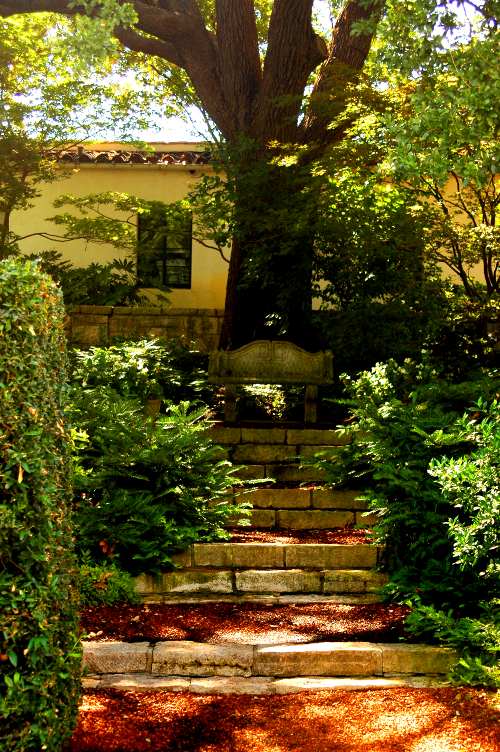
What they miss are some clever, smaller bits of garden that jut off to the side, little isolated areas that really make the place special. One of these, sandwiched between the first fountain by the entrance to A Woman’s Garden and the Degolyer Mansion is called The Sunset Garden. It is a tiny path that goes up a bit of hill to a stone bench beneath a huge tree. As the name implies, the bench faces west and would be a great place to watch the solar orb sink beneath White Rock Lake. There is a little sign that directs you to the side garden – a sign that everybody, entranced with the colorful glass beyond, seems to miss.

When you clamber up to the stone bench you look down through a gap to a fountain and then past into another small garden – The Pecan Parterre Garden, with a beautiful little sculpture – Harriet Frishmuth’s “Playdays” (more on that bronze piece in a few days, I promise). It is a truly idyllic spot.

The path up to the stone bench in the Sunset Garden from the main entrance to A Woman’s Garden.

A view of the Sunset Garden from the veranda of the DeGolyer mansion. You can see the sun-drenched entrance to A Woman’s Garden and its fountain, and the Pecan Parterre Garden, with the little statue, beyond. White Rock lake is through the trees in the background – this would be a wonderful spot to watch the sun set.

The only problem – as I discovered once I climbed up there and settled in – is that the stone bench is tilted out, ever so slightly, so it is not very comfortable. It’s like sitting in a church pew. I’m afraid that little detail makes the sunset garden a bit more useful to look at than to sit in for more than a few minutes.

Later on, though, I found another little hidden spot that didn’t have any disadvantages at all. I was strolling through the Jonsson Color Garden (the big open ovals where some large Chihuly glass rears up) and looking into the strip of woods that separates that area from the Texas Town (a children’s area with small historical displays) and noticed a wooden bench set deep within the trees. I walked around a bit and found the path back there.

It was perfect. It sits in deep shade from tall overhead trees and is screened from the main walking path by a clump of Crape Myrtles. Cool and quiet – most importantly, the wooden bench is very comfortable. A perfect spot to sit and read (I cranked through an entire novel) and contemplate the universe.

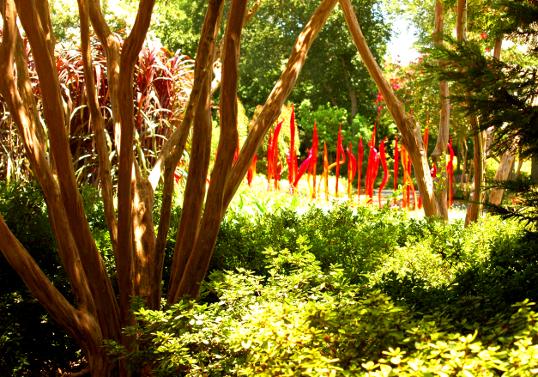
The view ahead and to the left from the little bench. These are some Chihuly red glass sculptures sitting along the edge of the Jonsson Color Garden.

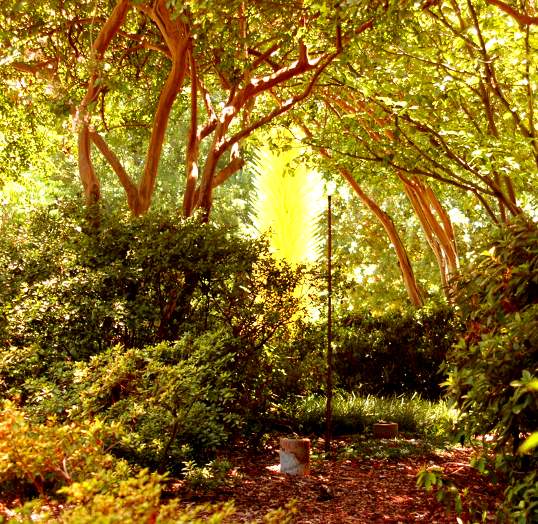
To the right from the bench is a bit of a view of Chihuly’s gigantic Yellow Icicle Tower.

Here’s the bench, with my Kindle, camera case, and woefully inadequate water bottle.

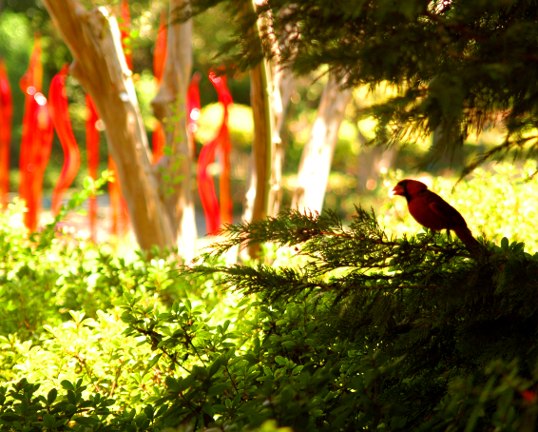
I had a little visitor while I was sitting there – somebody else trying to get out of the killer afternoon heat.

It was too comfortable – I stayed too long into the stifling heat of the afternoon. The rest of the day I was dizzy and confused… even more so than normal. Still, I think I’ll go back. It’s a nice place… and there has to be some more hidden spots that I haven’t found yet. Maybe one with some burbling water nearby.

Finally Finished

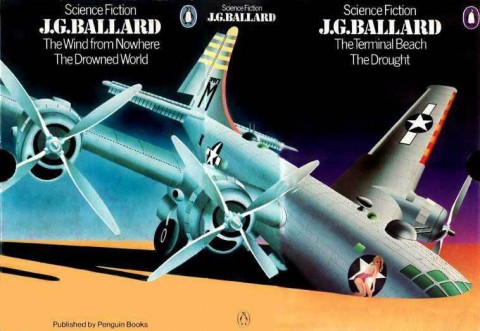
Well, one thing about writing this thing is that I can get dates. Let’s see here it is, September 17, 2011 is when I started reading the Complete Stories of J. G. Ballard. I finished it this week… so it took me about ten months to get through the whole thing.

By no means is that the only thing I’ve read in the last year. I’d read a few stories and then jump to something else… only to return when that was done. The last week or so, though, I made a concentrated push to get through to the end.

It is a massive tome. Ninety Eight short stories, novellas, and novelettes, ending up one short of one thousand two hundred pages. The paper version weighs about four pounds and would be a real pain to carry around. Inside my Kindle, though, the weight of all those bytes is barely noticeable.

I had read a lot of these stories before. In high school, in the 1970’s I discovered his short fiction and gobbled up what I could get my paws on. What was cool about reading this now is that the stories were arranged in chronological order – so I revisited what I remembered and then continued to cruise right on past, on into the future (which now is the relatively recent past). I would look at the dates on the later stories and think of myself sitting there in 1973, and realizing what I was reading wouldn’t be written for another decade.

Since this is his complete body of work, in order, you can’t help but notice the continuing themes. The lonely, wealthy woman living alone in a crumbling estate, exerting an inexorable influence on the protagonist and the people living around him. The abandoned decadent tourist destination. The desiccated sea with dry sand waves and coral canyons. Empty swimming pools. Nature, time, and technology intersecting and reacting in unexpected, beautiful, and horrific ways…. And many more.

Near the end there are three longer works: News from the Sun, Memories of the Space Age, and Myths of the Near Future. These three, read consecutively, are fascinating companions to each other. They are essentially the same story, told with tiny shifts in attitude and points of view. They deal with the theory that man’s ventures into outer space have set loose a change in the very nature of time itself and the entire human race, in a series of events centered on the now long-abandoned Florida NASA launch sites is becoming unstuck in time. It is never clear whether this is a disaster – a punishment for shaking off our bonds, or a further leap in evolution where the human race is able to exist within and without time itself. The strong impression is that it is both.

Fascinating. Especially powerful in that, within these vast movements of irresistible forces the central theme of the stories remains the human relationships of the protagonists and how they struggle to maintain their place, their loves, their very lives.

Ballard writes:

I just tend to write whatever comes mentally to hand, and what I find interesting at a particular time. These decisions as to what one’s going to write tend to be made somewhere at the back of one’s mind, so one can’t consciously say: ‘that’s what I’m going to write’. It doesn’t work out like that! (interview in ‘J. G. Ballard: The First Twenty Years’, 1976).

I’m barely aware of what is going on. Recurrent ideas assemble themselves, obsessions solidify themselves … (interview in ‘The Paris Review’, 1984).

I feel that the writer of fantasy has a marked tendency to select images and ideas which directly reflect the internal landscapes of his mind, and the reader of fantasy must interpret them on this level, distinguishing between the manifest content, which may seen obscure, meaningless or nightmarish, and the latent content, the private vocabulary of symbols drawn by the narrative from the writer’s mind (‘Time, Memory and Inner Space’, 1963).

Some of the stories, especially some of the later ones are more experimental pieces… a skilled author showing off what he can do – pushing the boundaries of fiction. Some of these work better than others.

Vermilion Sands

Vermilion Sands

Still, I think my favorite are the Vermilion Sands stores – especially The Cloud-Sculptors of Coral D. Something about that decadent vacation spot really gets to me.

Now, the tough question. What to read next?

  • 1 • Prima Belladonna • [Vermilion Sands] • (1956) • shortstory
  • 12 • Escapement • (1956) • shortstory
  • 23 • The Concentration City • (1957) • shortstory (aka Build-Up)
  • 39 • Venus Smiles • [Vermilion Sands] • (1957) • shortstory
  • 50 • Manhole 69 • (1957) • shortstory
  • 68 • Track 12 • (1958) • shortstory
  • 72 • The Waiting Grounds • (1959) • novelette
  • 96 • Now: Zero • (1959) • shortstory
  • 106 • The Sound-Sweep • (1959) • novelette
  • 137 • Zone of Terror • (1960) • shortstory
  • 150 • Chronopolis • (1960) • novelette
  • 169 • The Voices of Time • (1960) • novelette
  • 196 • The Last World of Mr. Goddard • (1960) • shortstory
  • 208 • Studio 5, The Stars • [Vermilion Sands] • (1961) • novelette
  • 235 • Deep End • (1961) • shortstory
  • 244 • The Overloaded Man • (1961) • shortstory
  • 255 • Mr F. is Mr F. • (1961) • shortstory
  • 267 • Billennium • (1961) • shortstory
  • 279 • The Gentle Assassin • (1961) • shortstory
  • 289 • The Insane Ones • (1962) • shortstory
  • 298 • The Garden of Time • (1962) • shortstory
  • 305 • The Thousand Dreams of Stellavista • [Vermilion Sands] • (1962) • shortstory
  • 321 • Thirteen to Centaurus • (1962) • novelette
  • 339 • Passport to Eternity • (1962) • shortstory
  • 355 • The Cage of Sand • (1962) • novelette
  • 373 • The Watch-Towers • (1962) • novelette
  • 395 • The Singing Statues • [Vermilion Sands] • (1962) • shortstory
  • 405 • The Man on the 99th Floor • (1962) • shortstory
  • 412 • The Subliminal Man • (1963) • shortstory
  • 426 • The Reptile Enclosure • (1963) • shortstory
  • 435 • A Question of Re-Entry • (1963) • novelette
  • 459 • The Time-Tombs • (1963) • novelette
  • 472 • Now Wakes the Sea • (1963) • shortstory
  • 480 • The Venus Hunters • (1963) • novelette
  • 504 • End-Game • (1963) • novelette
  • 521 • Minus One • (1963) • shortstory
  • 530 • The Sudden Afternoon • (1963) • shortstory
  • 541 • The Screen Game • [Vermilion Sands] • (1963) • novelette
  • 559 • Time of Passage • (1964) • shortstory
  • 569 • Prisoner of the Coral Deep • (1964) • shortstory
  • 574 • The Lost Leonardo • (1964) • shortstory
  • 589 • The Terminal Beach • (1964) • novelette
  • 605 • The Illuminated Man • (1964) • novelette
  • 628 • The Delta at Sunset • (1964) • shortstory
  • 641 • The Drowned Giant • (1964) • shortstory
  • 650 • The Gioconda of the Twilight Noon • (1964) • shortstory
  • 658 • The Volcano Dances • (1964) • shortstory
  • 663 • The Beach Murders • (1969) • shortstory
  • 669 • The Day of Forever • (1966) • shortstory
  • 683 • The Impossible Man • (1966) • shortstory
  • 697 • Storm-Bird, Storm-Dreamer • (1966) • shortstory
  • 711 • Tomorrow is a Million Years • (1966) • shortstory
  • 720 • The Assassination of John Fitzgerald Kennedy Considered as a Downhill Motor Race • (1966) • shortstory
  • 722 • Cry Hope, Cry Fury! • [Vermilion Sands] • (1967) • shortstory
  • 735 • The Recognition • (1967) • shortstory
  • 755 • The Cloud-Sculptors of Coral D • [Vermilion Sands] • (1967) • shortstory
  • 757 • Why I Want to Fuck Ronald Reagan • (1968) • shortstory
  • 760 • The Dead Astronaut • (1968) • shortstory
  • 769 • The Comsat Angels • (1968) • shortstory
  • 781 • The Killing Ground • (1969) • shortstory
  • 788 • A Place and a Time to Die • (1969) • shortstory
  • 795 • Say Goodbye to the Wind • [Vermilion Sands] • (1970) • shortstory
  • 806 • The Greatest Television Show on Earth • (1972) • shortstory
  • 811 • My Dream of Flying to Wake Island • (1974) • shortstory
  • 820 • The Air Disaster • (1975) • shortstory
  • 828 • Low-Flying Aircraft • (1975) • shortstory
  • 841 • The Life and Death of God • (1976) • shortstory
  • 849 • Notes Towards a Mental Breakdown (1976 version) • (1976) • shortstory
  • 856 • The 60 Minute Zoom • (1976) • shortstory
  • 864 • The Smile • (1976) • shortstory
  • 873 • The Ultimate City • (1976) • novella
  • 925 • The Dead Time • (1977) • novelette
  • 940 • The Index • (1977) • shortstory
  • 946 • The Intensive Care Unit • (1977) • shortstory
  • 953 • Theatre of War • (1977) • novelette
  • 968 • Having a Wonderful Time • (1978) • shortstory
  • 972 • One Afternoon at Utah Beach • (1978) • shortstory
  • 982 • Zodiac 2000 • (1978) • shortstory
  • 989 • Motel Architecture • (1978) • shortstory
  • 1000 • A Host of Furious Fancies • (1980) • shortstory
  • 1010 • News from the Sun • (1981) • novelette
  • 1037 • Memories of the Space Age • (1982) • novelette
  • 1061 • Myths of the Near Future • (1982) • novelette
  • 1085 • Report on an Unidentified Space Station • (1982) • shortstory
  • 1090 • The Object of the Attack • (1984) • shortstory
  • 1101 • Answers to a Questionnaire • (1985) • shortstory
  • 1105 • The Man Who Walked on the Moon • (1985) • shortstory
  • 1116 • The Secret History of World War 3 • (1988) • shortstory
  • 1124 • Love in a Colder Climate • (1989) • shortstory
  • 1130 • The Enormous Space • (1989) • shortstory
  • 1139 • The Largest Theme Park in the World • (1989) • shortstory
  • 1145 • War Fever • (1989) • novelette
  • 1161 • Dream Cargoes • (1990) • shortstory
  • 1173 • A Guide to Virtual Death • (1992) • shortfiction
  • 1175 • The Message from Mars • (1992) • shortstory
  • 1184 • Report from an Obscure Planet • (1992) • shortstory
  • 1189 • The Secret Autobiography of J.G.B. • (1981) • shortstory (aka The Secret Autobiography of J. G. B******)
  • 1192 • The Dying Fall • (1996) • shortstory

Volt

I had a little money left over on an Amazon.com gift card and began to choose some Kindle books. I picked up a couple of short story selections, Knockemstiff, by Donald Ray Pollock and Volt, by Alan Heathcock. Pretty much by a flip of the coin, I read Volt first.

Volt has eight semi-connected longish short stories. Right off the bat, the description of a farmer accidentally killing his son while tilling a field resonated with me. I’m a father and have spent a little time on a tractor seat bouncing in the heat and dust, watching a mile-distant fence line slowly, inexorably approach.  That awful scene was enough to justify the price of the book and the time to read it. I thought that first story could have ended after those two pages.

It didn’t though, as the father, destroyed by the accident and jolted by a near miss with a freight train – runs away. And runs and runs and runs – putting Forest Gump to shame. He ends up wiping his life away and building a new one, of sorts. It’s a journey worthy of Odysseus, and likewise, he finds that home is not what it used to be. Too much water under the bridge.

The stories are all small-town Gothic. They are set in the hopeless wide-spot-in-the-road of Krafton… an imaginary town. Trust me as one who knows – there are a lot of Kraftons out there. One hell of a lot. These are forgotten hamlets where everyone with any ambition or brains left town long ago – leaving the impression that the remaining conscripts – imprisoned by tradition, lack of imagination, and ennui – exist simply to work their way back down the evolutionary chain. There is even a Biblical Flood – though plenty of unworthy survive.

There is one hopeful character, Sheriff Helen Farraley, a plump middle-aged former grocery store manager pressed into service to combat evil no mortal should have to face. Her decisions seem insane, until you try to see her world through those eyes.

At the end of the finely crafted book, I felt I knew the doomed citizens of Krafton, and hoped somehow, someday they find the redemption that they deserve, even if they don’t see it or don’t chose it for themselves.

Now, on to Knockemstiff.

New York Times Review – Stories of Small-Town Strife

‘Volt’ writer Alan Heathcock’s internal duality fuels his gripping prose and creates his epic stories

‘Volt’: Stories for Mourning, After A Nameless Loss

BOOK REVIEW: Alan Heathcock

Bookslut – VOLT BY ALAN HEATHCOCK

Got Pupusa?

It was Thursday and time for the second of the Patio Sessions down at Sammons Park in front of the Winspear Opera House. Last week I took a lot of photographs (here, here, and here) and didn’t feel like doing that again. Viewing life through a viewfinder is not the best way to see things.

I did take my camera, just in case, but I loaded my Kindle, Moleskine, and selected a vacuum filler Parker “51” with a fine nib and Parker Quink black ink (my best note-taking combination – the “51” has an amazingly smooth fine nib, perfect for the Moleskine) and decided ahead of time I’d get something to eat from a food truck, commandeer a table, and relax – read and write a little.

I left work and caught the DART train downtown from the station near my office. The weather was cloudy and windy, but overall not too bad for Texas. I was happy when I saw they had a food truck that, not only had I never eaten at before – but it was also one I had wanted to check out. I was glad I at least brought my camera… have to get photos of food trucks.

It was Dos Paisano’s – a fairly new truck that promised Salvadorian fare. I’m a big fan because it is food that is similar to what I ate in High School in Nicaragua (I love banana-wrapped tamals)… plus pupusas.

Jacob Metcalf opened with a mellow acoustic set. The sound system is such that the music can be heard clearly from anywhere under the massive Winspear sunscreen so I went ahead and bought a pupusa plate and a bottle of water and settled down on a table, listening to the music and reading, just as I had planned. The food was very good. Now I need to track that truck down and try their plantains, yucca, and tamals.

The second musical act was The O’s – a neo-country duo singing upbeat folksy music using a banjo, a slide guitar, a foot pounded bass drum, and a bit of a goofy-corny sense of humor. I enjoyed them a lot though they had to deal with the pealing church bells, just like last week.

The crowd was quite a bit bigger than last week and the concert was sort of impaired by a large group of little kids that kept running around the reflecting pool, yelling and splashing. I know I shouldn’t complain – my kids were as big a pain as anyone’s – but I know how it works. To a parent there is nothing as attractive as their own children and nothing as amusing as their antics. You could see the proud mothers and fathers smiling broadly at the edges of the reflecting pool, out for an evening with their blankets, plastic wine glasses, and massive strollers. What is tough to do is to constantly remind yourself that not everybody thinks the way you do – as a matter of fact, nobody else thinks your kids are cute. You’re the only ones.

The Patio Sessions are not too long, at seven thirty everything was over. I gathered up my stuff and caught the train back home.

I have been working through this huge ebook of noir short stories, The Best American Noir of the Century. I kept reading on the train, coursing through a fascinating bit of fiction by Harlan Ellison called Mefisto in Onyx. Even with Ellison’s occasional overwrought chunk of prose here and there it’s a crackerjack story and sucked me in enough to have me look up and realize I had gone a stop too far. I had to get off the train and wait for another southbound to get me back to where my car was. I don’t like waiting around on a dark train station platform that I’m not familiar with… but there was some illumination from a streetlight and at least I was able to finish the harrowing story.

And it was very good.

The Dos Paisano's Salvadorian/Mexican fusion food truck. Look for it in your neighborhood.

Got Pupusa?

Ordering food from the Dos Paisano's Truck.

My pupusa order with a lot of red and (spicy) green sauce.

Also in the photo is my Kindle and its custom made case.

The top half of the Dos Paisano's Menu.

The bottom half of the menu. I'm going to have to go back.

I like that this song mentions Tietze Park – a Dallas sort of place. My bus drove by there on the way to work for years. I would look for its signature bent over tree  (I think it’s a “kneeling” bois d’ arc )every day. It was voted the best place to break up in the city. There’s even a song about it  by the band Elkhart- video performed at the Belmont, of course.

The amazing view of Downtown Dallas from the Belmont.

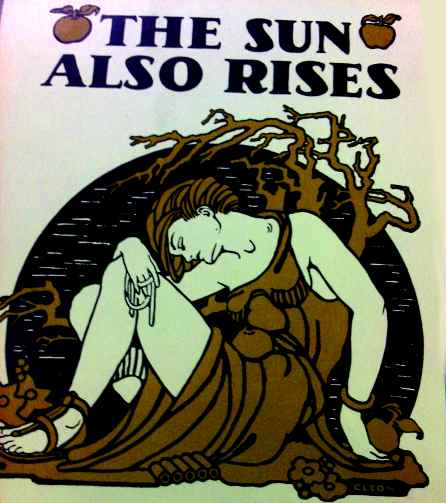
The Sun Also Rises

Sun

The Sun Also Rises

“In bull-fighting they speak of the terrain of the bull and the terrain of the bull-fighter. As long as a bull-fighter stays in his own terrain he is comparatively safe. Each time he enters into the terrain of the bull he is in great danger. Belmonte, in his best days, worked always in the terrain of the bull. This way he gave the sensation of coming tragedy.”

– Chapter 18, The Sun Also Rises, Ernest Hemingway

After another long day at work I drove to Love Field at ten to pick Nick up. He was returning from a few weeks in San Diego and out on a destroyer with the Navy.

While I was waiting at the baggage claim I finished reading Hemingway’s The Sun Also Rises.

As always, I am in awe of Hemingway’s tense terse prose and how he says so much with so little.

I have wanted to read this book ever since I read “The Drifters” by James Michener when I was in high school. There was a little bit of time that everybody was required to read “The Drifters.” The book made a big impression on me at the time, though I don’t remember any of it anymore. The only thing I remember is that the book made me want to go to Pamplona and run with the bulls.

Now I have to decide what to read next. Hundreds of books lie there, beckoning. So little time and so many stories.

Please forgive me. I’ve been thinking a lot about pride and seriousness. I want to work harder and do better on everything I do.

But right now I’m so tired. So I will bid a sweet adieu and trot off to dreamland. I’ll pick it up tomorrow.

Is Reading a Waste of Time?

Digging around in the archives of my old online journal... I found this entry from June 28, 2002. When I put it out in public – a lot of people had a strong opinion on this question – nobody thought that reading was a waste of time.  Despite this public consensus,  I still haven’t answered the question to my own satisfaction.

For example, despite the fact I’m a third of the way through a Hemingway novel, I haven’t had the time to pick up my Kindle in the last three days.

Nick reading Harry Potter.

Nick reading Harry Potter. Is this the first one?


There’s a kind of comfort in returning at the end of the day to the same people and watching them enter their lives more deeply.

—-Tobias Wolfe, on the novel

I came across this quote… about novels. After reading and thinking about it I realized how true it was.

For the last few months I’ve been reading collections of short stories or slim novellas, exclusively. Time has been very short. Plus, I’m working on a handful of stories myself – trying to get them ready to send off – and wanted to read the form and keep my mind and pen open to the myriad possibilities.

I felt the urge to bite into something more substantial, so I scanned my case of recently purchased, but unread, tomes and pulled out The Corrections, by Jonathan Franzen. I’m not interested in the media hoo-ha concerning this book and the author’s relationship with Oprah Winfry. I read some glowing reviews, though, so I thought it might be worth the read.

I’m maybe two-thirds through and the book is good. It started better than it is right now – Franzen seems to be repeating themes and situations, plus the center section feels a little padded – but it is well-written, with compelling characters. You can’t ask for much more.

What has taken me off guard is how much I’m enjoying reading the book. I catch myself looking forward to getting home, getting my stuff done, spending some time with Nick and Lee, getting in my daily writing, then settling down with the book (if I’m not too exhausted to stay awake). It feels like a deserved reward at the end of a long day.

It feels like a second life. I never thought about how the characters in a full-blown novel come, over the time it takes to get through the book, to occupy your imagination, your life of the mind. They become imaginary friends, shadow family members – unreal characters that, because they exist only within your own personal gray matter, share an odd intimacy with you.

The best thing is that, because they are only shadows of text and imagination, they are harmless. This second family can be as colorful as they want to be without causing problems in the real world. The more outrageous, dysfunctional, and insane, the better.

You can have flawed, unfaithful, even evil friends and relatives – with all the amusement that entails – but without them showing up at all hours to call in an old favor and demand you hide them from the police/mob/irate former lovers.

I used to buy books based on bulk. I’d dig through the used bookstores looking for massive tomes at low prices – sort of a cost per page value basis. I guess I was thinking about how much enjoyment – maximizing the time would I get from each book.

Over the years, I moved away from this philosophy of reading as my life became busier and busier and my time on earth becomes shorter and shorter.

I know a lot of successful people, type “A” personalities that are always rushing around getting things done, making lots of money, or fighting back the entropy that constantly attacks their living spaces. Most of them don’t read much. They view reading as a useless, frivolous, and wasteful activity.

Is reading a waste of time? It doesn’t accomplish anything. I consider watching television a waste of time (though I do watch too much, of course) – how is reading any different? How about going to films? Is that a waste? How is that different than TV?

If reading is a waste of time why do we work so hard to get our kids to do it? Fret so much when they would rather play with their friends – interact with real people rather than stick their solitary nose in a book?

Is reading a waste of time?

Are fish sticks considered seafood?

The Sound of his Horn – by Sarban

The lurid cover art from The Sound of his Horn by Saban

The lurid cover art from The Sound of his Horn by Saban

I finished Erik Larson’s Thunderstruck and wanted something light and easy to read – so I looked through my collection of pulp ebooks and came up with Sarban’s The Sound of his Horn. This was an odd bit of fiction that I had found recommended here and there across the interwebs.

It’s an interesting amalgam – told as a story-within-a-story… it has time-travel science-fiction aspects, alternate history, a possibly unreliable narrator (one of my favorite literary devices), themes akin to a reverse Island of Dr. Moreau, a bit of an unlikely love story, while at the heart it is a “Most Dangerous Game” tale on steroids.

What’s odd about the book is that it is told in a slightly archaic, literary style (I had to use the dictionary quite a bit as I read) but the story is full of lurid, shocking elements that would be at home in the most modern trashy paperback. In the story, the protagonist finds himself thrown a hundred years into a future where the Germans have won World War II. A Teutonic lord rules a massive forested estate where his decadent guests hunt half-naked women costumed as deer or birds. They are captured alive by the hunt and served as after-dinner entertainment trussed up and delivered under giant silver serving-domes.

See what I mean. And that is not the worst of it, by any means.

I really don’t know if I’ve read anything as strangely sophisticated and sleazy at the same time.

In summary – it’s a short novel and more than entertaining enough. It’s well worth reading – if that’s the sort of thing you want. It’ll stretch your mind more than a bit. You can get an ebook copy here or here.

The author, who chose the pen name of Sarban, was John William Wall, a British Diplomat for over thirty years and a published writer for about two. Other than The Sound of his Horn he has a couple collections of fantasy short stories (some ebooks here). He must have been an interesting man, a combination of a sharp mind and a sordid imagination.