What I learned this week, October 12, 2012

Then and Now:


In Dallas, October means the State Fair. And the State Fair means fried stuff.

Comprehensive 2012 Texas State Fair Fried Food Guide


Martyn Ashton takes the £10k carbon road bike used by Team Sky’s Bradley Wiggins & Mark Cavendish for a ride with a difference. With a plan to push the limits of road biking as far as his lycra legs would dare, Martyn looked to get his ultimate ride out of the awesome Pinarello Dogma 2. This bike won the 2012 Tour de France – surely it deserves a Road Bike Party!

Shot in various locations around the UK and featuring music from ‘Sound of Guns’. Road Bike Party captures some of the toughest stunts ever pulled on a carbon road bike.


How iPhones destroyed going to the movies — in more ways than one


13 Brains I’d Like To Eat


Cormac McCarthy Cuts to the Bone

Blood Meridian used to be a much different novel. McCarthy’s early drafts reveal how an American masterpiece was born.

At least this is what I pictured after I came across a recipe for homemade gunpowder in McCarthy’s notes. The laminated recipe, scrawled in small cursive letters on a bail bondsman’s notepad, is part of the Cormac McCarthy Papers—98 boxes of notes, letters, drafts, and correspondences on all of the reclusive author’s works—archived at Texas State University-San Marco’s Wittliff Collections. Bought for $2 million in 2008 as a joint venture between the university and Bill Wittliff (screenwriter of Lonesome Dove), the collection includes unpublished material such as a screenplay, Whales and Men, and drafts of an upcoming novel, The Passenger (not available for reading until after publication). But of primary interest to McCarthy’s most devoted fans are the multiple drafts of the Tennessean’s magnum opus, Blood Meridian or the Evening Redness in the West. The archives give us a unique look inside the working method of an artist who speaks little about his own work—and gives us clues as to how his reticence, when brought into Blood Meridian itself, transformed a good book into a cold-blooded masterpiece.


I’m not generally a big fan of bridal photograph shoots – but this one will do:

Bad-Ass Roller Derby Bridal Shoot

Source: frayededgeconcepts.files.wordpress.com / via: frayededgeconcepts.wordpress.com

From Frayed Edge Photography


40 Things To Say Before You Die


I live in a… well, in a completely different world than Camile Paglia. However, I’ve been reading some of her work online, am very interested in the book she is about to publish, and surprised how much we think alike, though our points of view are so very different.

Some meaty thought in some of these articles:

How Capitalism Can Save Art
Camille Paglia on why a new generation has chosen iPhones and other glittering gadgets as its canvas.

WHITHER THE ARTS? At Ricochet, Dave Carter links to Camille Paglia’s essay in the Wall Street Journal on the decline of the art world with a reminder of the wonders of the 700-year old Cologne Cathedral.

In the comments, Michael Malone of Forbes, ABC and PJM reminded readers of how the church managed to survive World War II:

I hate to burst anybody’s bubble about the ‘miraculous’ survival of Cologne Cathedral in WWII, but it was anything but that.  When my parents were touring the cathedral years ago and the tour guide began describing this miracle, my father, who actually had bombed Cologne, whispered to my mother, “We left it standing because it was perfect for targetting the rest of the city.”  On the same trip, sitting at a cafe enjoying his morning weiss beer and veal sausage, a local struck up a conversation with him, eventually asking, “Have you been to Cologne before, Herr Malone?”  My father casually replied, “No, but I’ve flown over it a couple times. . .”

And finally, a very interesting interview with some surprising points:

In “Glittering” return, Paglia lets loose

I don’t like the situation where the Democratic Party is the party of art and entertainment, the party of culture, while the Republicans have become the party of economics and traditional religion. What that does is weaken both sides. One of the themes in my book is the current impoverishment of the art world because of its knee-jerk hostility to religion, which is everywhere. That kind of sneering at religion that Christopher Hitchens specialized in, despite his total ignorance of religion and his unadmirable lifestyle, was no model for atheism. I think Hitchens was a burden to atheism in terms of his decadent circuit of constant parties and showy blather. He was a sybaritic socialite and roué – not a deep thinker — whose topical, meandering writing will not last. And I’m no fan of Richard Dawkins’ sniping, sniggering style of atheism, either.

A responsible atheist needs to be informed about religion in order to reject it. But the shallow, smirky atheism that’s au courant is simply strengthening the power of the Right. Secular humanism is spiritually hollow right now because art is so weak. If you don’t have art as a replacement for the Bible, then you’ve got nothing that is culturally sustaining. If all you have is “Mad Men” and the Jon Stewart “Daily Show,” then religion is going to win, because people need something as a framework to understand life. Every great religion contains enormous truths about the universe. That’s why my ’60s generation followed the Beat movement toward Zen Buddhism and then opened up that avenue to Hinduism – which is why the Beatles went to India with the Maharishi Mahesh Yogi. Then it all disappeared, when people became disillusioned with gurus. But spiritual quest was one of the great themes of the ’60s that has been lost and forgotten – that reverent embrace of all the world religions. This is why our art has become so narrow and empty. People in the humanities have sunk into this shallow, snobby, liberal style of stereotyping religious believers as ignorant and medieval, which is total nonsense. And meanwhile, the entire professional class in Manhattan and Los Angeles is doping themselves on meds and trying to survive in their manic, anxiety-filled world. And what are they producing that is of the slightest interest? Nothing. Nothing is being produced in movies or the fine arts today (except in architecture) that is not derivative of something else.


50 People You Wish You Knew In Real Life

Handi-Chest

In a desperate and assuredly ultimately futile effort to get something useful accomplished I have been cleaning, de-cluttering, and organizing my office room. To that effect, I bought something from an estate sale – it was marked a dollar, but I bought it on half-off Saturday… so I paid fifty cents.

It’s a bilious cube of cheap turquoise green plastic, with four clear lucite drawers. I have a vision of organizing small parts in these drawers and setting the unit within reach of my work table… when I need some tiny something or other, there it is – rather than spending a tired wasted evening looking in vain, digging through tangled piles of crap, and uncovering, too late, items that I had pursued weeks ago and now find useless while my grail quest goes forever ungratified.

A useless and hopeless vision, I know, but such is life.

One unexpected bonus, though – easily worth the four bits I paid. Inside the thing I discovered an original sales label touting the virtues of the purchase.

It’s a Handi-Chest – made in the U.S.A. By Campro Products, of Canton Ohio. There are four helpful illustrations indicating possible uses:

  • On the dresser for jewelry, notions
  • Mighty handy for sewing supplies and accessories
  • For the office a real “organizer”
  • In the workshop “a place for everything and everything in its place”

So maybe my delusions of adequacy aren’t unique – the thing was designed and constructed (from my best guess, about the time I was born) to meet the same fantasy that still flits around all these long decades later.

I love old postwar advertisements. It was a simpler time – a time of smiling men and women, a time without snark, a time made up of line drawings. It was Mad Men time – the advertising executives thought up this stuff right after their three martini lunches (that might help explain the surreality lurking below the surface) and sent it all off to the Midwest to be extruded, printed, boxed up, and set out on the shelves.

KEEP IT * FIND IT * IN A JIFFY

Those were the days.

Museum of the American Railroad

Years ago, when my kids weren’t much more than toddlers, I made a discovery down along the edge of Fair Park – The Museum of the American Railroad. Along one side of the Art Deco complex of buildings was a strip made up of a half-dozen sets of steel rails with an amazing collection of rolling stock. They had everything from an old station to restored dining cars to some of the largest steam engines ever made.

The kids loved the place. They would clamber around an on the huge masses of steel. Their favorite thing, of course, was to climb up into the cab and sit in the driver’s seat, looking out and around the giant boilers. You could see their imaginations working.

The only problem was that it was a terrible location. A weedy, hidden spot, neglected, unknown – the powers that ran Fair Park obviously didn’t want the trains there and had no appreciation for the unique and amazing history on steel wheels. I kept expecting to read that the place was melted down for scrap.

Nevertheless, over the years, there were rumors of renewal and movement. For a while I read about a spot in downtown’s West End where a developer would use the trains to anchor a new complex. But the ups and downs of the economy always killed the ambitions and plans and the railroad museum began to get more and more run down.

There is nothing worse than watching a potential jewel, especially one in a city that is so sorely lacking in any history whatsoever, slowly corrode and die. It was obvious that the city and the Fair Park management were waiting until the place was so far gone they could kill it once and for all without fear of reprisal.

Then, a couple years ago, I read that the City of Frisco was coming to the rescue. When I moved to North Texas, Frisco was a small town, far to the north of the Dallas Fort Worth Metroplex. Over the last few decades the urban sprawl has vomited itself out across the cotton fields and swallowed Frisco whole. Now it is a huge shiny new city and hungry for signature attractions. What could be better than a museum made from a collection of antique locomotives? They already have a nice local museum up and going. So they put together a piece of valuable property right in the new city center and started plans for a new railroad museum.

When I first read about this a couple years ago my first thought was, “I’ll believe it when I see it.” I had seen this act before. However, I underestimated Frisco’s ability to get something done, and now, a short few years later, the site is ready and the rolling stock ready to move out to the suburbs.

The other day, I rode down the Dallas Santa Fe Trail from White Rock to Deep Ellum, and took a left turn under the mixmaster and into Fair Park. I rode around and took some photos. One stop I had to make was to see what was left of the railroad museum. It was sealed up with only a watchdog to bark at me through the wire. There weren’t any signs of activity that day, but I’m sure they were working on getting these huge old hunks of steel ready to move.

I’ve been following the news, trying to figure out when the big steam engines are going to move. I’d love to see these things on their journey – the first time they’ve moved in decades. That is so cool.

Flats

I have been looking for new places to go for a bike ride – and willing to drive farther from home. With the seats folded down, my bike fits in the back of the Matrix and it gets nice gas mileage – so it’s all good.

Looking over Google Maps with the “Bicycling” option turned on, I spotted a green line going north from Highway 380, just east of Denton. It’s the 380 Greenway/Ray Roberts Greenbelt trail and runs ten miles north through the riperian forest of the Elm Fork of the Trinity River, ending up at the dam of Lake Ray Roberts.

So, after wasting the morning futsing and dutsing around the house, I loaded up my stuff and drove north through the big evil city until I reached the parking lot off of Highway 380. The Greenway trail is a branch of the Texas State Park system, so I had to pay to use it, sealing seven dollars into a little envelope and dropping it in a steel box. I checked all my gear out, saddled up and headed north into the woods.

The trail is flat as a pancake for the whole distance, which makes it easy and fast, though you never stop pedaling. The trail splits in two – with the equestrian trail on one side of the river and the hike/bike on the other. There were a few folks walking near the south end, but after a couple miles I only saw the occasional mountain bike. The southern section is locked in heavy woods – which is really nice, anything to shade the blazing Texas sun. As it goes north, the landscape opens out a little, with the occasional hayfield or open meadow breaking up the scenery.

It was a really nice ride through some bucolic scenery, but I made a tactical error. I didn’t read closely enough before I left and didn’t think about the trail surface. It is an improved hardpack with gravel surface. I left my thin, smooth, street tires on the bike. They are wide enough, so I didn’t have any problem riding – but the stones cut them to pieces.

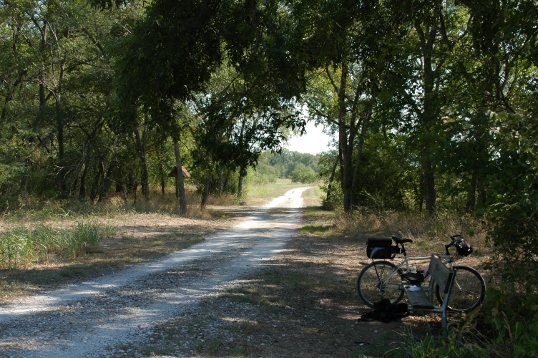
I was no more than a couple miles up the trail when I stopped to take a photo of the trail through the woods. When I started back up my bike tire was flat. I carried an extra tube and a patch kit, so I sat along the trail and swapped the tube out. I couldn’t find a thorn or anything, but did find a small hole and patched it, keeping that tube as a spare.

Six miles up the trail, it crosses a highway and I stopped there for a protein bar and some water, and my tire went flat again. Out with the tire levers, off with the tire, on with another patch. This time I did find a tiny glass sliver – took it out. Since this was my second flat, I thought about heading back south to my car, but I sat there for twenty minutes and it seemed to be holding, so I went north to ride the whole trail.

I stopped again at the base of the Ray Roberts dam to rest for a bit. A big, expensive SUV drove up and a couple climbed out. They walked up to me and the driver, in a thick New Jersey accent, asked me, “Do you live around here?”

“Umm, I live a long way from here, but maybe I can answer your questions.”

“Well, we’re looking at a house near here and I wanted to see about this park. It says you have to pay to park here.”

“Oh, if you lived close, you could buy an annual pass. It’s about fifty bucks, I think. You could use this trail and the Ray Roberts park has a nice beach and a lot of stuff to do.”

We talked a bit about the trail (he had looked at it on Google Maps) and where it went and how it connected to the park. The two of them walked around and looked at stuff. I wished them good luck on their house hunting and they drove off. I packed up and headed back down the trail.

A few miles down the trail I felt my back wheel hit a rock hard and immediately the tire went flat again.

This time I found three holes in the tube, patched them, and pumped it up. I counted my patches, three left, plus one spare patched tube, so I was pretty sure I could make it back to my car, but I was getting tired of working on those flats, and my arms were sore from pumping up those fat tires with the little portable pump.

I was able to hammer on down the trail without any more trouble though. As I neared the southern end more walkers began to appear – the day was getting long and the temperature was cooling off.

I went past a woman walking along wearing an outrageous frilly bright red dress, thick makeup, and high heeled shoes that were completely useless on the gravel trail. She looked sheepish, stumbling along, and next to her was a man carrying a tall, transparent, lucite chair. I certainly hope the two of them were walking to do a photo shoot in the woods – otherwise… well, I don’t know.

It was nice to see my car in the parking lot while I still had some air in my tires.

The trail runs through thick forest near the south end. While I was taking this photo – my tire was losing air.

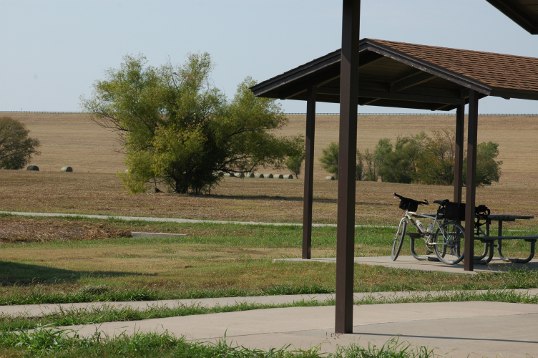
A nice rest spot near the north end of the trail.

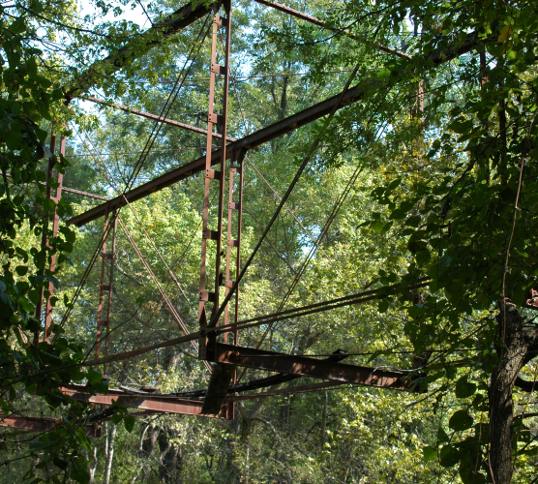
Ruins of an old bridge near where I took the photo above.

Under the old bridge – the Elm Fork of the Trinity is surprisingly clear and pleasant.

The northern terminus of the trail below the Lake Ray Roberts dam.

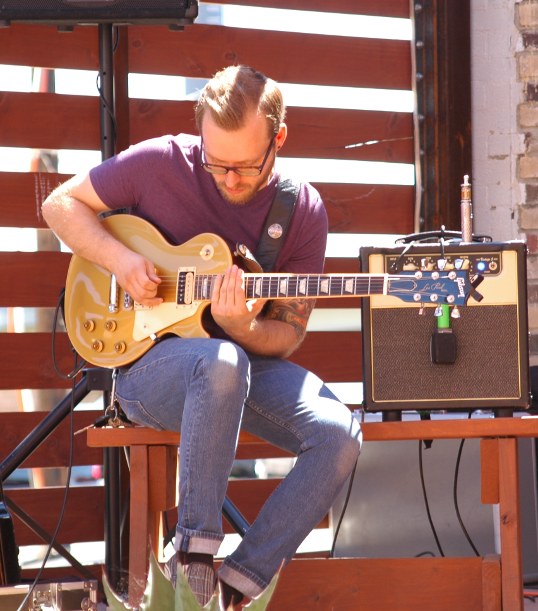
Sugarfoote and Company

There is nothing better than good, live, local music – especially in Texas. Here’s some photos of Sugarfoote & Company at the Saturday Brewery Tour at the Deep Ellum Brewing Company.

Eating Insects in the Rain

Back in the spring, I tracked down a Food Truck sponsored by Dos Equis. Billed as “The Most Interesting Taco in the World” – they had hired a well-known local truck, Rock and Roll Tacos, reskinned the outside, and sent it out to give away interesting tacos. They called it “Feast of the Brave.” I had shark and iguana tacos… and they were so good, it wasn’t even brave to eat them.

Dos Equis is doing the promotion again, this time with the Nammi Truck, which usually serves Banh Mi sandwiches. They’ve made up some sandwiches with Jellyfish, Quail, and Silkworms. The silkworms are billed as “Soy Silkworms” – but that means they were fed on soybeans… they are the real thing. I have always wanted to eat some insects, so I decided to track them down.

Today I had a long bicycle ride planned, but the weather didn’t cooperate. The streets were very wet and the rain spitting down. I’ve done some work and have replaced the spokes on my ancient Raleigh Technium 460 road bike so I took it out around the neighborhood. It worked great, though I was nervous with the narrow tires on the slick tarmac.

So, I had the day and had to make new plans. A quick look at the Internet and I discovered the Nammi/Dos Equis truck was down in the Arts District outside the grand opening of the new City Performance Hall. I grabbed my stuff and rode the DART train downtown.

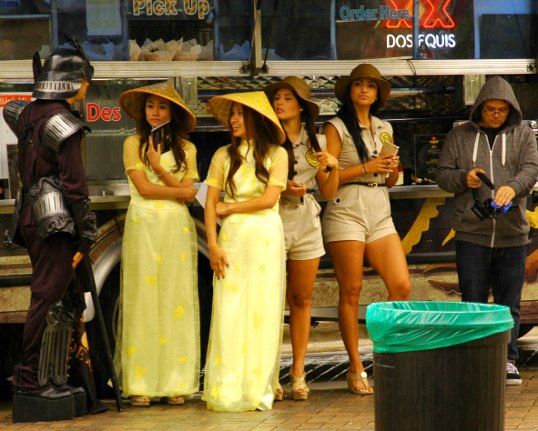
I didn’t think of an umbrella and by the time I walked up to the truck I was drenched and probably looked like an idiot. Four women and one guy in costumes were huddled outside the truck when I walked up and said, “Can I have a silkworm sandwich?”

“Oh, you want to go for it right off?” said one woman as she handed me a sandwich in a paper tray.

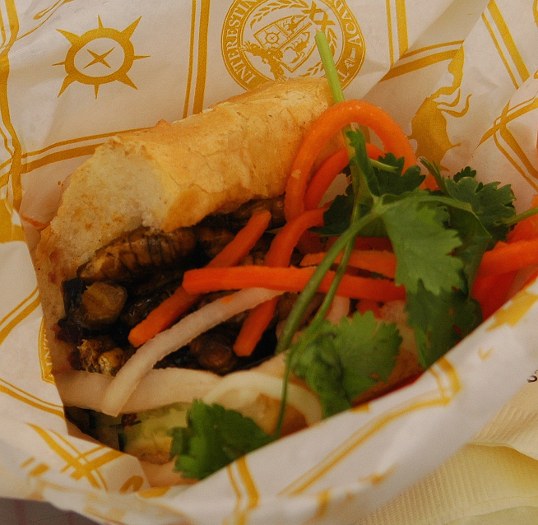
Until the moment that I looked down at the food I never really thought much about actually eating silkworms. They were brownish, obviously segmented bugs, and bigger than I had imagined. I guess it is the pupae stage of the silkworm that is edible… they were almost the size of the last joint on your little finger. There were plenty of them in a sandwich.

I walked over to a little table that had an umbrella (intended for shade… the rain water poured through it) and tucked in. The worms were, not surprisingly, crunchy. They had a bit of a nutty taste… though, really they tasted like… well, bugs.

While I was eating a couple walked up to me. We talked about the various other food trucks lined up. They did a good job of holding a normal conversation with a stranger that was shoveling insect pupae into his mouth. The guy had been to Vietnam and talked about the sandwiches and how they weren’t really sure about what was in them, but they were good.

Now, I was finishing my order. I love the Nammi Banh Mi – they are more expensive than the usual Vietnamese sandwich – but they are very generous with the meat (the pork, of course, is the best). A bunch always falls out into the little tray and you get the extra enjoyment of finishing off the spicy filling along with whatever vegetables have also fallen out.

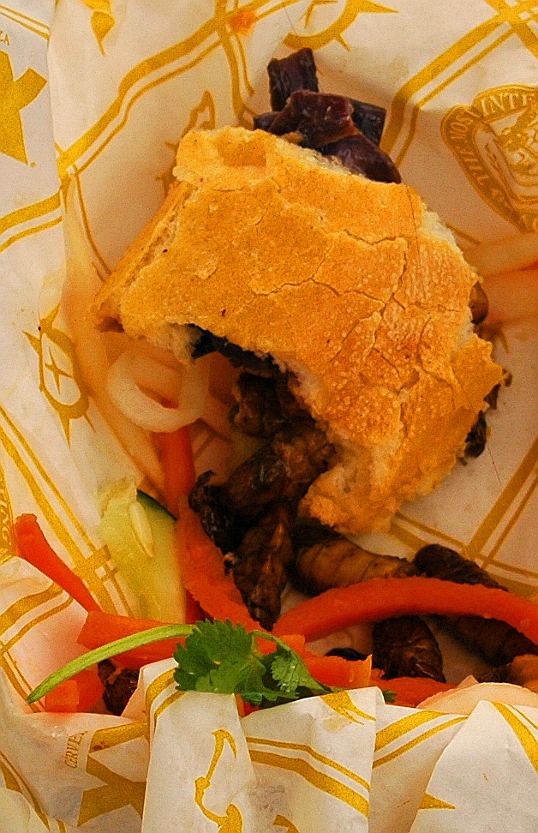
So now I looked down at the little tray and there, true to form, was a little pile of Silkworm Pupae along with some daikon, cilantro, and shredded carrot. Should I eat the worms?

I did. It was a little harder to eat the little buggers bare like that – without benefit of the sandwich bread concealing the fact that I was eating insects… but I figured if I’m up for it, I’m in. Like most from my generation, I have always felt a compulsion to finish my plate.

Insects consumed, I headed into the performance hall for the opening day festivities. But that’s a story for another day.

The Nammi folks trying to stay dry.

They were all in costume for the Dos Equis “Feast of the Brave” food giveaway.

Here’s my silkworm sandwich.

Proof I ate it – only a bite left.

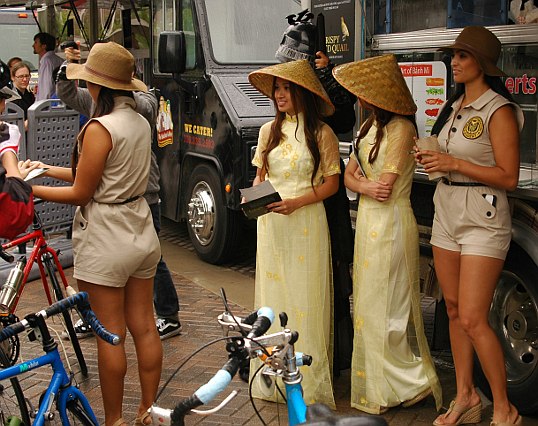
While I was eating, a rugged group on bicycles, braving the rain, came up for some food.

Spirit of the Centennial

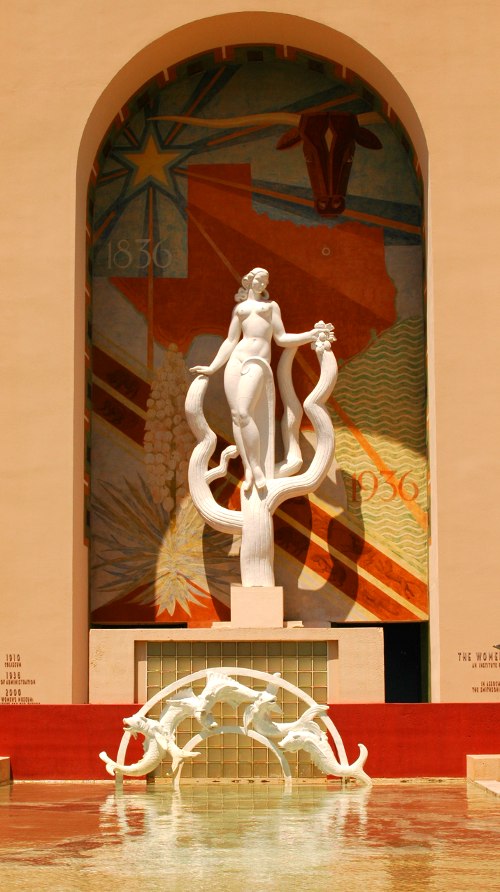
Fair Park is one of the underutilized gems in Dallas. Other than the few weeks of the Texas State Fair – the art deco wonderland goes neglected – shunned by most folks. I love to ride my bike down there and hang out – looking at the art. One of my favorite (among many) works is the sculpture Spirit of the Centennial, in front of the Woman’s Museum.

Spirit of the Centennial, Fair Park, Dallas

From Dallas City Hall:

Spirit of the Centennial Sculpture was designed by Raoul Josett and Jose Martin to sit in front of the Hall of Administration building (now the Women’s Museum). Carlo Ciampaglia designed the mural that serves as a backdrop to the sculpture, also titled Spirit of the Centennial. The woman featured in the sculpture has been a source of controversy with two different women claiming to have been the model. There is dispute over whether the model was Marry Ellen Bensterdt, a Duchess and 1930’s model, or the wife of K. Keiser, a big band leader during that era. Raoul Josett and Jose Martin also designed the Fish Fountain Sculpture, depicting flying fish swimming over a reflecting pond, which sits in front of the building. Stashka Star recreated renovated the Spirit of the Centennial mural and sculpture in 1998 and John Dennis recreated the Fish Fountain Sculpture in 2000.

Arbor Hills and Carrollton Blue and Orange

The overlook at Arbor Hills Nature Preserve in Plano, Texas.

Slowly, I am able to ride farther and farther on my bike. I’m still slow – I am riding an old, inefficient mountain bike (which does have the advantage of being able to go anywhere). I have my ancient road bike which I’m trying to get into rideable condition… but I am struggling with mystery flats. When it is fixed I should be able to up my speed and distance. Right now I am limited not so much by my fitness but by time and the amount of water I can carry. I drink an amazing amount of water in this heat.

What I like to do on weekends sometime is to load up my bike in the back of the Matrix, fill a cooler with bottles of iced water, and set out across the city. I use GoogleMaps on my phone, with the Bicycling option turned on – showing up the bike trails and dedicated lanes bright green. I look for long stretches or connected clusters and give a shot at riding somewhere I haven’t been before.

On Sunday, I headed northwest and the first place I came across was the Arbor Hills Nature Preserve. This is a large Plano park which I had seen a couple years ago when I made a wrong turn leaving the hospital where Candy was getting surgery. It had an odd parking lot, beige rock buildings, and a big ol’ mess of hilly woods. I looked it up online and had wanted to pay a visit ever since.

It was an interesting place to ride a bicycle. First – it does lack distance – only a couple miles of paved trails (I wasn’t in the mood for hitting the dirt). It isn’t a very good place for speed either – the trails are lousy with clots of people wandering around and others walking their dogs.

What is nice, though, is its hills. There are a lot of wooded nature trails in the Dallas area, but almost all of them are located in worthless river bottom floodplain and are as flat as a pancake. Arbor Hills has a good bit of ups and downs – not enough to make it too difficult or even unpleasant, but enough for a good workout.

The trails all wind around and rise up to a stone lookout, a nice destination, a pretty place looking out over the trees and scrub fields with only a hint of the millions of rooftops rising along the horizon – a reminder of the fact that you are not really in a wilderness, but merely a forgotten pocket of vegetation left over somehow when the world was paved over.

I looped around a couple of times, then packed my bike up and drove on. I wanted to go down to Carrollton and check out their trails. I had read about how they had been doing a lot of work on extending their hike/bike trail network. I did a circuit of their Orange and Blue trail routes, about ten miles total.

I applaud their work, and some of their trails are nice… running beside some swampy ponds and wild green creeks. They need to do more to access the network, though. It was fine for some exercise, but the pavement doesn’t really go anywhere – it would not work for commuting to work or shopping.

Sitting at a little shaded bench I gulped down my last bottle of cold water and knew it was time to head back to the car and go home. There is always tomorrow, and more stretches of pavement in a different direction.

Neighborhood Upgrade

One of my favorite bike trails in Dallas is the Santa Fe Trail, which runs from the south end of White Rock Lake (it connects with the trail around the lake) down an old railroad right of way, ending in Deep Ellum. I rode it the other day and turned the other way – going under Interstate 30 and riding around in Fair Park.

What I like about the trail is that it is a rare urban trail. The northern end starts in the woods around White Rock Creek but the trail soon emerges into a bustling lower-income city neighborhood. It makes for interesting riding.
I have noticed that a lot of the houses along the route, some little more than shotgun shacks, have been upgraded since the trail opened. There is a lot of fresh paint and large piles of trash along the streets waiting to be hauled away. I don’t know if it is because the residents feel that they are now more exposed and want to put a better foot forward, or, more likely, the trail raised property values a bit and the landlords are cleaning up to get higher rents.

At any rate, one property does have an unusual sculptural addition along the rear roofline. There is a four-person bicycle mounted along the edge of what used to be an awning – the roof long rotted away. A satellite dish sprouts out from next to the rear-most tire. It looks pretty odd, sitting there – sort of a shout-out to the cyclists on the trail – “hey, look at me… a quadruple… and you thought you were something!”

But it looks pretty cool, anyway.

I like the different patterns in the chainrings.