Holding Up the Sun

“By day the banished sun circles the earth like a grieving mother with a lamp.”
― Cormac McCarthy, The Road

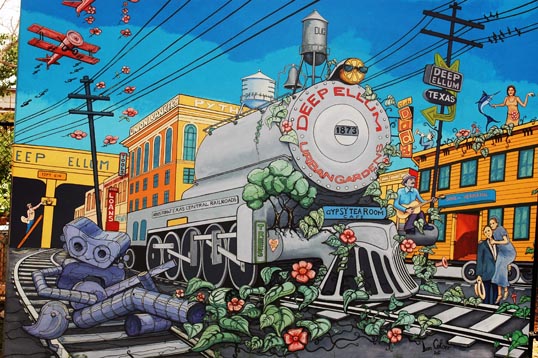
Mural by Richard Ross
Deep Ellum, Dallas, Texas

“See,” Sasha muttered, eyeing the sun. “It’s mine.”
― Jennifer Egan, A Visit from the Goon Squad

Richard Ross, Deep Ellum, Dallas, Texas

Richard Ross, Deep Ellum, Dallas, Texas

“Here I came to the very edge
where nothing at all needs saying,
everything is absorbed through weather and the sea,
and the moon swam back,
its rays all silvered,
and time and again the darkness would be broken
by the crash of a wave,
and every day on the balcony of the sea,
wings open, fire is born,
and everything is blue again like morning. ”
― Pablo Neruda

Guitar Player on a Column

Dan Colcer
Deep Ellum Art Park
Dallas, Texas

Dan Colcer Deep Ellum Art Park Dallas, Texas

Dan Colcer
Deep Ellum Art Park
Dallas, Texas

The same artist did this one:

Painting at the entrance to the Urban Gardens, Deep Ellum, Dallas, Texas

Painting at the entrance to the Urban Gardens, Deep Ellum, Dallas, Texas

from This Entry

Forty Thousand Years of Art in Fifty Eight Minutes

Plaza of the Americas
Dallas, Texas

glass_steel

During the week, after work, I am so tired. All I can think of is getting home and falling into bed. The whole world feels dim and tilted – sloping toward the land of nod.

This is not a good thing – I don’t want to sleep my life away. I try and figure out something to do after work every day. I’m not always successful – but that doesn’t mean I can’t keep trying.

So I saw that tonight was an Art History lecture at Kettle Art in Deep Ellum (this is the gallery where I bought my bargain painting a month ago). Painter and educator Justin Clumpner was giving a talk in BYOB Art History:

Justin Clumpner’s titillating presentation on this-thing-we-call-art kicks off the final weekend of “Love, Death, + The Desert”. Join us tomorrow night at 7 for the first installment of Justin’s behind-the-scenes glimpse into the strange and mysterious world of art through the ages.

That sounded like fun – so I decided to go.

I’ve always had a soft spot for Art History. I took a year of it in college, as a break from my chemistry classes (and in a vain attempt to meet women). It turned out to be a revelation.

My instructor was an interesting person. On the first day of class he said, “We are supposed to go from ancient art to the present, but we are going to stop at 1860, because there hasn’t been anything worthwhile done since.” He lived in a world of his own – a world filled exclusively with the art of yesteryear. He talked about the Roman Colosseum and how it had canvas shades that would extend out over the audience. He asked, “Those astro-dome things nowadays have that too, don’t they?” The man had no idea what a modern sports stadium was.

But he was able to teach. I was fascinated by how, with a little instruction and after looking at thousands of projected 35mm slides from a rotating carousel in a darkened room (these were the days before powerpoint – and possibly better for it) – I could look at a totally unknown painting and tell who had painted it and in what year, give or take a few.

My biggest problem is that I would have four hours of chemistry lab before the art history class. I had to make a difficult left brain-right brain switch in only a few minutes of walking across campus. I remember looking at a slide of a beautiful Byzantine Mosaic and all I could think of was, “What pigment did they use to get that blue?”

One day I left my lab, walked to art history, ate lunch, studied on campus for a few hours, then walked the two miles to my apartment. I started cooking dinner when my roommates came home. They stared at me and said, “Bill, what the hell is that on your face?” I realized I still had my big heavy laboratory goggles on. I was so used to them I forgot to take them off and still felt normal. I can’t believe nobody had said anything to me yet that day – I must have looked like an idiot.

Today, after work, I caught the Red DART line downtown and then transferred to the Green to get to Deep Ellum. The Transit Gods smiled on me and I didn’t have a wait – so I arrived early. The talk was billed as BYOB and I wish I had gone to pick up a growler of local beer – but I settled for a little metal flask loaded with a few draughts of precious Ron Flor de Cana.

The Altamira Bison

The Altamira Bison

The talk was really interesting. Of course, it could only be a quick overview, from cave paintings of forty thousand years ago to post-modernism in one hour is a tough and fast voyage – but Justin Clumpner is a high school art teacher and knows how to bring an audience along with him.

He said he wanted to make the BYOB Art History Talks a regular thing, maybe once a month. I hope so – it will be cool to hear him talk about some themes and topics in a more detailed, comprehensive way. If you want to give it a shot, like Kettle Art and watch their feed – I’ll see ya there.

Maybe I’ll be able to get a growler of beer to bring. Some fresh local beer and an art history lecture… that’s a good way to spend a work night. Better than collapsing at home.

The Weird and Wicked World of the Singing Cowboy

One of the surprisingly few times that I regret being poor is when I think about how I can’t afford to support artists or collect works of art as much as I would like… – especially local work.

Because of that, whenever an opportunity presents itself for me to pick up something affordable – well, it’s a good thing. For a long time, I have been a fan of Kettle Art in Deep Ellum and the artists they support. So I read about an annual event they put on For the Love of Kettle – I jumped all over it. It’s a fundraiser for the gallery. Participating artists donate a small work which are sold off for 50 dollars each – with the funds going to support the gallery. It is billed as a “competitive shopping event.”

I can come up with fifty bucks. I can pack a sack lunch for a couple of weeks.

On Facebook, over three hundred people has said they were going, but there were only going to be a hundred and fifty works of art. Looking through the selections on the website, I realized that there was going to be a feeding frenzy on this stuff when the doors opened, so I went down there an hour and a quarter early and stood in line. There were only a half dozen folks there when I arrived, but the line stretched out down the block, getting longer by the minute.

Most of the people in the front part of the line were participating artists – it was fun talking to them. Also, a lot of people said that this sale was popular not only for the price, but for the small size of the art. So many said they had art they couldn’t put out because they were out of wall space.

These were my kind of people.

Looking into the windows of the Kettle Gallery, waiting for the show to start.

Looking into the windows of the Kettle Gallery, waiting for the show to start.

Everybody peered through the windows at the art on the walls. The rules of the sale were distributed on little slips of paprer. You had to get the number (printed on the wall beside the painting) of the piece you wanted and then register with the volunteers. You wouldn’t necessarily know if someone had already bought the one you chose until you get to the desk. Later, your name would be called at the cashier station and you would pay. Then, you take your receipt to another desk to get your purchase. These careful rules were necessary to handle the surge of people desperate to buy something.

One woman said she fought somebody for a painting a couple years ago. Wouldn’t that be cool? I’d love to have a painting hanging in my hall that I could boast I punched someone for… maybe a splotch of dried blood on the back for proof.

We all talked about the art we could see from the sidewalk and the works that were in the back room. The cry went out, “One Minute!” and everyone tensed. I began to get nervous – this was going to be a lot of pressure to find and purchase the exact right painting under these competitive conditions. I had a three by five card in my had and a pen at the ready.

The door swung open and we rushed in. I went to a spot I had chosen from outside and started to look at the art up close. Knowing I didn’t have much time, I wrote numbers down on the card – paintings I liked in order… 26, 28, 30, 7, 136. Surely one of those five would be available. The line at the volunteer table was quickly growing so I jumped in. Within three more minutes the line reached the length of the gallery behind me.

A man was standing in line right in front of me. An out-of-breath woman came up and lifted up her phone. They had gone in with a plan. He had grabbed a spot in line while she ran up and down the walls taking shots of the paintings (with their associated numbers) with her phone. Now, the two of them were going over the artworks and deciding which one(s) they wanted to buy.

After a few minutes (I was the twentieth in line) it was my turn. Number 26, my first choice, was available. It was a work I had noticed on the website… and it had looked even better in person.

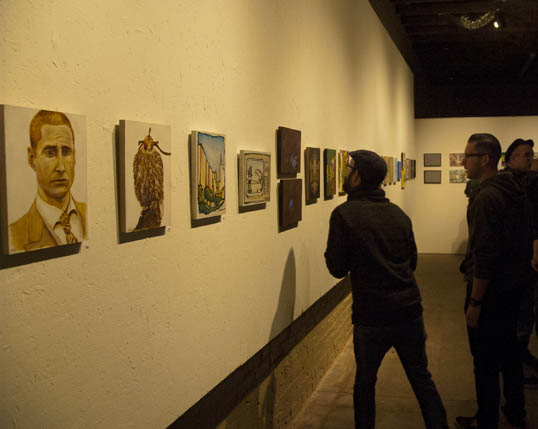
For the Love of Kettle Looking at the art

For the Love of Kettle
Looking at the art

For the Love of Kettle

For the Love of Kettle

For the Love of Kettle

For the Love of Kettle

Now, finally, I had time to leisurely push through the crowd and take a careful look at all of the hundred fifty works. They were all good. I thought that they could have sold them at random and I would have been happy – there were no more than two or three that I actually didn’t like. Still, I was pleased with what I chose.

The crowd was thick and happy. A lot of artists were there and some folks were taking pictures with the artists posing next to the artwork they had bought. That’s pretty cool.

A lot of people crowded into the gallery.

A lot of people crowded into the gallery.

They called my name and I went to pay. Since I was one of the first I had a discount and only paid forty two dollars. I milled around talking to people about what they had chosen, until the paintings were starting to disappear and I turned in my receipt and picked up my artwork.

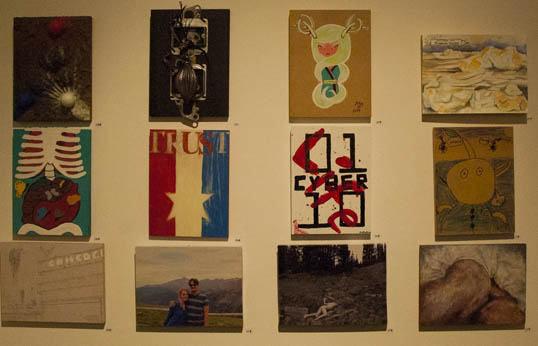
A row of paintings. I chose the one in the middle.

A row of paintings. I chose the one in the middle.

Clay Stinnett painting on the wall at Kettle Gallery.

Clay Stinnett painting on the wall at Kettle Gallery.

On my way to the door, someone looked at my artwork and said, “Oh, you’ve got the Clay Stinnett,” then he read the text off the front – “Tumbling Tumbleweeds.”

The Weird and Wicked World of the Singing Cowboy by Clay Stinnett

The Weird and Wicked World of the Singing Cowboy
by Clay Stinnett

The title, written on the back, is The Weird and Wicked World of the Singing Cowboy. I really like it.

Clay Stinnett Tumblr
Clay Stinnett’s Honky Tonk Mind
Clay Stinnett Is Painting A Collection of Big Tex On Fire Pictures
Art We Like: Clay Stinnett at Smoke and Mirrors

I’m definitely going back next year… and I’ll be there early and near the front of the line.

Pinstriping

“I have an idea that the only thing which makes it possible to regard this world we live in without disgust is the beauty which now and then men create out of the chaos. The pictures they paint, the music they compose, the books they write, and the lives they lead. Of all these the richest in beauty is the beautiful life. That is the perfect work of art.”
—- W. Somerset Maugham, The Painted Veil

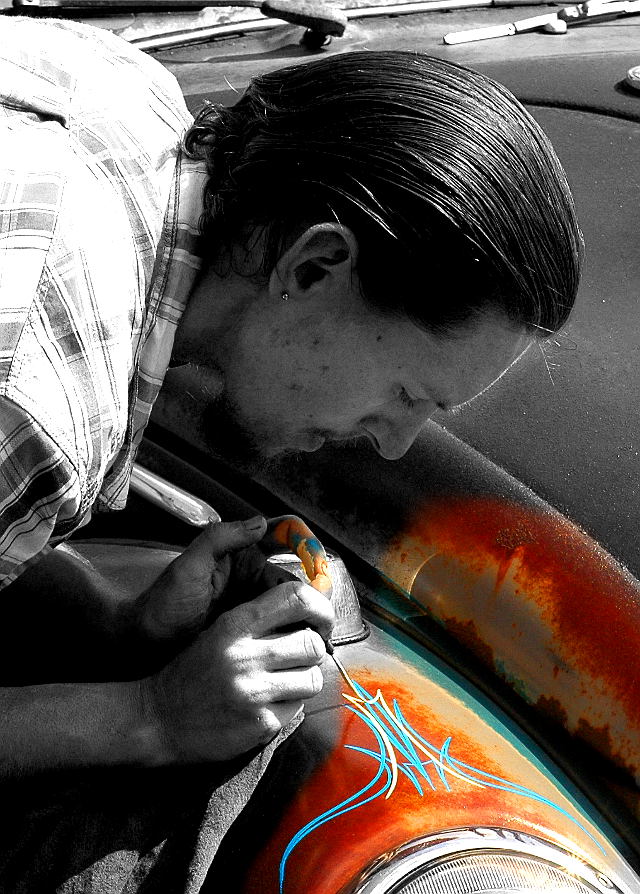
Pinstriper at work, Deep Ellum, Dallas, Texas (click to enlarge)

Pinstriper at work, Deep Ellum, Dallas, Texas
(click to enlarge)

To watch someone do something like this is like watching someone doing magic – real magic. I can’t imagine having the eye, the dexterity, most of all the ability to shut everything out of mind other than the brush, the fender, and the paint. Notice how he has the two colors of paint he is using in daubs on his index finger – he picks up what he needs and brushes it in place. It is completely freehand – no masking tape, no guide lines, not even a design done ahead of time.

Yet the result is perfect. It is smooth, faultless, and symmetrical – even though it is applied to a complex curve on a rusty Volkswagen Beetle fender. The sun was beating down – it was about 104 degrees. It was so hot, I could barely think straight.

“I hate to paint portraits! I hope never to paint another portrait in my life…. Portraiture may be all right for a man in his you th, but after forty I believe that manual dexterity deserts one, and, besides, the colour-sense is less acute. Youth can better stand the exactions of a personal kind that are inseparable from portraiture. I have had enough of it”
—- John Singer Sargent

Sushi and Georgia O’Keeffe

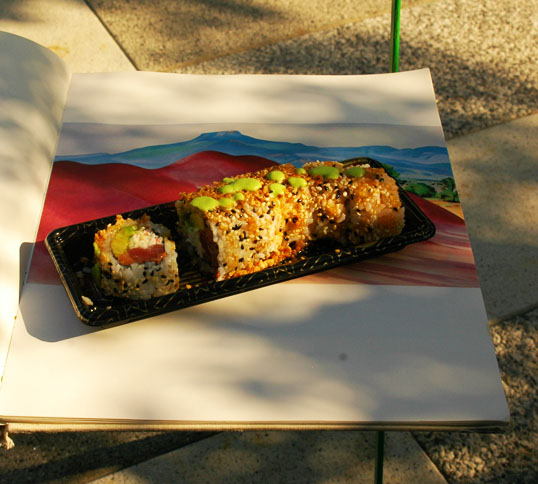
Crazy Fish Sushi and a book of Georgia O'Keeffe paintings (Click to Enlarge)

Crazy Fish Sushi and a book of Georgia O’Keeffe paintings
(Click to Enlarge)

It was way too hot. The mercury was rising well past the century mark and the Texas sun was beating down, roasting the world with its searing incandescence – still, I wanted to get out and do a bike ride – get some mobile urban photography done – for fun and fodder for blog entries. I packed up, rode to the station, took the DART train downtown and started wandering around.

The night before I had ridden some similar streets with a lot of other folks – the Critical Mass Dallas last-friday-of-the-month ride. I had a blast. We rode from Main Street Garden Park, through downtown, past the Hyatt Regency and across into Oak Cliff, down to Bishop Arts, and then on to a Cuban-Themed party on a rooftop along Jefferson Street (a few doors down from the Texas Theater).

A lot of cool folks, a good time. We rode back across the Jefferson Street Viaduct bike lane – which was spectacular at night. I’m going to have to repeat some of that ride with a camera and a bit of time.

At any rate – one nice thing about a night ride is the cool air.

By noon the next day – cool air was only found inside.

I locked up my bike in Deep Ellum and started walking around, but the heat was getting to me. I was feeling dizzy and my mind was fuzzing up like an old slice of bread. So I thought about bailing and heading home to flop around in the air conditioning, but I had brought two liters of iced water in the cooler that straps to the back of my commuter bike. I’ve learned that I can take the heat pretty well as long as I keep moving and drink as much cold water as possible.

I drank some water, rode a bit, drank some more, found some shade… and felt a lot better.

A week ago, I had been in Klyde Warren park, killing a few minutes, and had thumbed through a book of Georgia O’Keeffe paintings that was set out in the reading room in the park. One quote from the book was still rattling around in my head – but I couldn’t remember it exactly and without the exact words couldn’t find it on the Internet. I wanted to use the quotation for a bit of writing/photography. The mystery quote was bothering me like an unscratched itch so I decided to ride back there and take another look at the book.

While I was there I bought a sushi roll from the Crazy Fish Truck (plus more cold water and a diet coke ). Then I was able to get a little green table in some dappled shade and sit down with the paintings and my food and hang.

Oh, I did misremember the quote a little bit. I am happy to set the record straight – but I’m thinking that my misremembered version might be… if not better, more useful for my purposes.

Crazy Fish Sushi Roll, and a Georgia O'Keeffe

Crazy Fish Sushi Roll, and a Georgia O’Keeffe

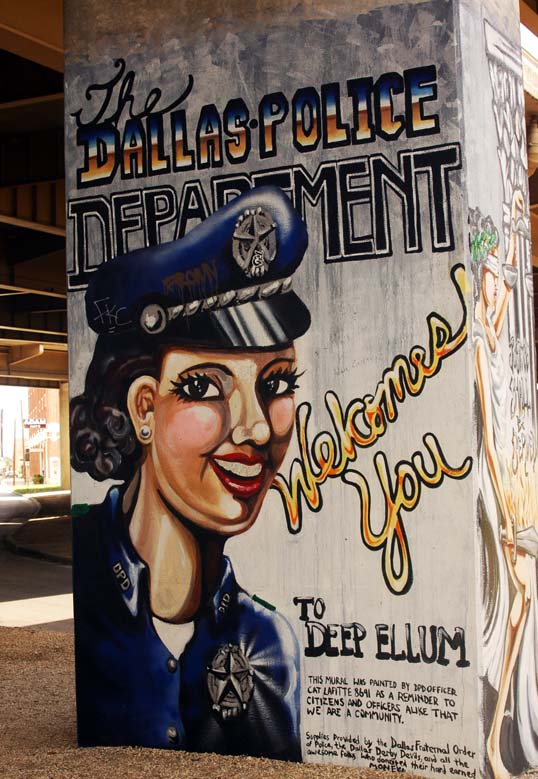
The Dallas Police Department Welcomes You to Deep Ellum

One pillar in the Dallas Art Park was painted by a Dallas Police Officer. It’s a good story.

“I know the law-abiding people don’t hate us, but just dealing with the criminal element, we get a lot of hate,” she said. “If I could plant one little seed in someone’s head that the police are the good guys, I would consider myself to be successful in this deal.”
—from the Dallas Morning News

From the Pillar:

This mural was painted by DPD officer Cat Lafitte 8642 as a reminder to citizens and officers alike that we are a community.
Supplies provided by the Dallas Fraternal Order of Police, the Dallas Derby Devils, and all the awesome folks who donated their hard earned money

Pillar in the Dallas Art Park painted by Cat Laffite

Pillar in the Dallas Art Park painted by Cat Laffite

The side of the pillar - Justice Shall Be Served

The side of the pillar – Justice Shall Be Served

The pillar contains some words of wisdom –

What I’ve Learned in 32 Years:

Thank a cop, a nurse, a teacher, a soldier, a firefighter – for working so hard for the benefit of everyone and never getting paid enough.

  • Hug your mama cuz I guarantee you were a turd when you were 2
  • Be yourself cuz those who matter don’t mind and those who mind don’t matter
  • If you’re unhappy with something, change it, if you can’t change it, accept it
  • Use your freakin turn signal, people!
  • Hate corrodes the vessel that carries it
  • If someone hurts you, do what you (legally) can to punish them then secretly thank them for making you a stronger person
  • Never eat yellow snow!
  • Read a book
  • Never fry bacon in the nude
  • Be nice to animals, old people and kids
  • If the shoe doesn’t fit, that aintcho shoe!
  • And most importantly….
What I've Learned in 32 Years

What I’ve Learned in 32 Years

Unfortunately, things did not work out well. The internet remembers everything.

A Dallas police officer who is under investigation after getting into a fight with a Plano hospital worker bragged about the incident on her Facebook page.
“I threw my boot at him, Jerry Springer style, and nailed him in the face,” Senior Cpl. Cat Lafitte wrote this week, several days after police were called to the hospital Feb. 9. “It broke his glasses and cut his face and bruised it up real good!”
—-from The Dallas Morning News

Cat Lafitte, Police Officer Fired for Brawling and Bragging About It, Refused Help, Cops Say

Welcome to the Deep Ellum Art Park

Dallas, Texas

Wink

Wink

Have a drink.

Have a drink.

It's Texas... you never know who's packin'

It’s Texas… you never know who’s packin’

welcome1

Tuesday Snippet – The Fatted Calf

Prodigal Son, Thomas Hart Benton, Dallas Museum of Art

Prodigal Son, Thomas Hart Benton, Dallas Museum of Art

The Fatted Calf
(First Scene of a Short Story)

It had been a decade since Sam had rented a car. He always had his assistant arrange for a limousine. Those days were gone – long gone.

At the rental counter the first three credit cards were rejected but the fourth went through and after a short, polite argument he was allowed a subcompact car. Red-faced he took the vehicle out onto the old highway – the one he remembered from his childhood – now gone over to cracked asphalt and weeds creeping over the edges. He blared the radio and tore down the rough road with the windows down – looking across the bright green bristles of spring wheat at the lines of huge trucks on the newer Interstate – parallel – a mile distant.

He remembered his mother driving him to the airport twenty years earlier – his small bag packed. His mother teared and resigned – her wet eyes locked on the road ahead. His father was plowing the east forty. Sam could see the cloud of brown dust raised by the steel blades slicing and turning the dry soil. He watched the distant tractor stop – the dust cloud blowing past and leaving the huge machine alone and tiny in the distance. Sam had to imagine his father watching the pickup flying by on the road clear past the end of the field carrying his son away.

The hamlet was closer to the city than Sam had remembered and he drove down the main street before heading out to the family farm. Everything was so familiar – nothing had changed in the two decades – except it all seemed smaller somehow. Smaller and quieter – the streets deserted and more than a few windows boarded up or taped over with paper.

It was like driving through a miniature model of his childhood memories – perfect in detail, yet missing something essential – a soulless reproduction.
This strange living mutation of what he remembered frightened him. He accelerated, squealing his tires in the dust that leaked in thin waves onto the streets, and turned off the paved highway at the edge of town. He drove down the familiar washboarding sanded country lane – the hedgerows on each mile section taller than he remembered or often taken out altogether, leaving a gap like a missing tooth.

As he approached the farm he felt his heart beating like a fluttering bird – his breath coming with some difficulty.

At first he didn’t recognize the place. The weeds had grown high across the yard – once kept cropped short by a small herd of sheep – now gone riot. The familiar barn to the left of the drive was gone. Sam looked closer and saw the expanse of scorched earth where the wood and stored hay must have burned. The encroaching weeds were greener and taller here – fertilized by the ash.

The house – always a clean white wash – was speckled with a gray peeling – revealing the weathered old wood underneath. The windows, which Sam remembered as bright rectangles showing his mother’s colorful handmade curtains were now bare shadow pits adorned only with crystal scythes – shards of shattered windowglass.

Although it was obvious that the place was uninhabitable, for some reason Sam took his suitcase – no larger than the one he had left with two decades ago – out of the trunk after he climbed out of the tiny car.

For a long time, he stood in the remaining bit of sandy road, trying not to touch the invading weeds, with his hand on his jaw, trying to comprehend. Off to the side, behind a few strands of rusted barbed wire, was the skeleton of a cow, now bleached by the sun to a bright white. He wondered if this was the calf he had left behind –the one he had been getting up before dawn to feed. It wasn’t of course – those onerous chores were twenty years in the past – that calf was hamburger long, long ago.

The skeleton seemed to pull Sam out of his reverie and, looking past the house, he saw a structure still intact. It was the old windmill. Green vines climbed the four metal struts that supported the structure, but the zinc-coated blades were still creaking, spinning in the breeze.

Sam pushed his way through the weeds and found the path that ran from the kitchen to the windmill. The well below was too shallow – the water too contaminated and salty for humans to drink, but the cows and sheep seemed to like it fine. A series of troughs, now twisted and junked, ran from the pump attached to the mill to a half dozen watering stations that the farm animals could use.

It had another use, though. The farm was too far out for city utilities, and potable water was precious. Halfway up the tower was a tank that could be filled by the windmill, and underneath that a compartment, about the size and shape of a phone booth, was constructed of galvanized steel. A big old-fashioned shower head hung below the tank like a drooping sunflower.
Sam had hated going out to the windmill and taking his shower before school – especially in the winter. It was humiliating even when it wasn’t brutally uncomfortable.

Staring at the mechanism now, Sam was oddly drawn to it. He reached out and yanked a few stray vines out of the way and then pulled the familiar lever. Sam jumped back when the pump arm let out a huge metallic groan, but it started to move again and he heard rumbling and the telltale splash of water starting to fill the tank. As if on cue, the breeze picked up and the blades began turning faster.

Sam looked around at the vast expanse of nothing, nobody. It was silent except for the clicks and hissing of insects moving through the weeds. The sun was directly overhead and the day had turned hot – Sam felt the streams of sweat trickling across his face.

As the tank filled, Sam pulled off his suit and hung his clothes on the old hooks that ran up the windmill strut. As he waited for the tank to top off he stood naked, leaning back in the sun. As a child, he was always shy and would dash from the house with a towel held firmly, but now he didn’t care. There was nobody within miles anyway.

He reached out and pulled on the rusty handle that opened the valve to the shower head. At first there was only a hiss, then some lumps of old mud-dauber wasp nest tumbled out, followed by little more than a thin rusty trickle. It did not take long for the pipes to clean themselves and the stream gained in strength and clarity. Soon the water was pure and strong, and Sam stepped into the shower, ducking his head into the cold liquid, sparkling in the sunlight.

Flying Over the City

Graffiti, Deep Ellum, Dallas, Texas

“The Guide says there is an art to flying”, said Ford, “or rather a knack. The knack lies in learning how to throw yourself at the ground and miss.”
― Douglas Adams, Life, the Universe and Everything

flying2

“When we started the show, ‘Dallas’ was known as the city where JFK was assassinated. By the end it was known as JR’s home town.”
—-Larry Hagman

flying1

“But there is so much more to do for the city we love… a Dallas with roads as strong as our businesses, parks as beautiful as our children, a downtown as tall as our imagination.”
—-Laura Miller