New Orleans, French Quarter, Halloween

New Orleans, French Quarter, Halloween
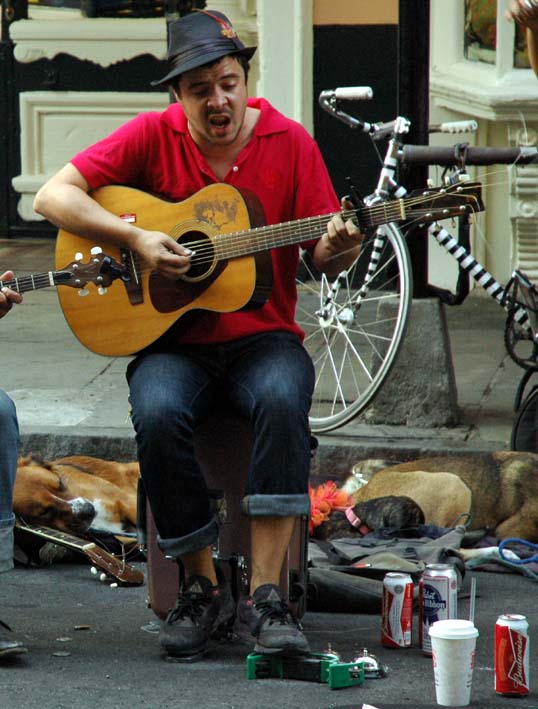
New Orleans, French Quarter
.

.
.

Garden District, New Orleans
I love the Bishop Arts District – one of the things that is making Dallas a different, better place. It’s easy to forget how delicate something like this is and how much it needs everyone’s support.

Bishop Arts in 1985 -photo by Jim Lake Cos.
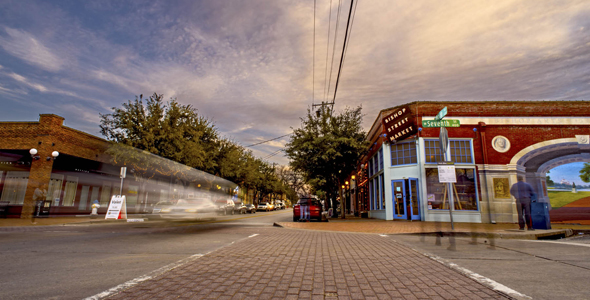
Bishop Arts Now
Asking the important Questions-
Where are the Bicycles in Post-Apocalyptic Fiction?
Tulane, New Orleans, and the Super Bowl. I give a damn about two of these three…
I need a small, thin wallet to carry while I ride my bike. Something for a little cash (like I have any) ID and a card – something that won’t take up much space in my seat bag. I could buy an expensive sports wallet but I won’t. I have at least two rolls of raw wallet material.
How Dallas is Throwing Away $4 Billion
The more I think about this, the better I like it. It is a great idea. …And it will never happen. When all you have is a hammer – everything looks like a nail.
My son Lee recommended the book Moonwalking with Einstein. I already knew a lot of the memory techniques he talks about (my problem with memory is the huge hole in my brain labeled “don’t give a shit”) – but there are some very interesting concepts in the book.
Some money Quotes:
“I’m working on expanding subjective time so that it feels like I live longer,” Ed had mumbled to me on the sidewalk outside the Con Ed headquarters, a cigarette dangling from his mouth. “The idea is to avoid that feeling you have when you get to the end of the year and feel like, where the hell did that go?” “And how are you going to do that?” I asked. “By remembering more. By providing my life with more chronological landmarks. By making myself more aware of time’s passage.” I told him that his plan reminded me of Dunbar, the pilot in Joseph Heller’s Catch-22 who reasons that since time flies when you’re having fun, the surest way to slow life’s passage is to make it as boring as possible. Ed shrugged. “Quite the opposite. The more we pack our lives with memories, the slower time seems to fly.”
Monotony collapses time; novelty unfolds it. You can exercise daily and eat healthily and live a long life, while experiencing a short one. If you spend your life sitting in a cubicle and passing papers, one day is bound to blend unmemorably into the next—and disappear. That’s why it’s important to change routines regularly, and take vacations to exotic locales, and have as many new experiences as possible that can serve to anchor our memories. Creating new memories stretches out psychological time, and lengthens our perception of our lives.
Indeed, most of who we are and how we think—the core material of our personalities—is bound up in implicit memories that are off-limits to the conscious brain.
Life After Blue: The Middle Class Will Beat The Seven Trolls
Tulane Campus, Homecoming, New Orleans

A desire to make a choice of some kind… I am concerned with magic, awe and wonder, with ontological insecurity.
—-Michael Sandle

The Drummer, Michael Sandle
The Drummer, Michael Sandle, The Sydney and Walda Besthoff Sculpture Garden, New Orleans Museum of Art
I am very aware of the way that Britain has a habit of interfering overseas. Years ago I did a Mickey Mouse machine-gun sculpture as a comment on the Americans in Vietnam. I was interested to discover from my historical research how we’d meddled with the place after the Japanese surrender. It wasn’t the Americans who started it and it wasn’t the French. It was us.
Coming to the Royal Academy: death, brutality and Adam and Eve of No 10
Controversial artwork showing Blairs naked unveiled as the centrepiece of summer exhibition
—-Michael Sandle
Belgrano Medal – a Medal of Dishonour
When I’m lucky enough to visit New Orleans I try to avoid the more obvious tourist traps. I see nothing special about the bitter Joe and greasy dough at Cafe Du Monde, rarely set foot on Bourbon Street, and try to walk out of the Quarter (or at least skirt the edges) whenever possible. Still, there is cool stuff even in the heart of touristland.
One special little spot is Pirate’s Alley. It’s a narrow passage that runs alongside the St. Louis Cathedral, connecting Jackson Square with Royal Street. History drips onto the cobblestones like Spanish Moss from an iron balcony.
Usually I like to aimlessly drift through and see what there is to see. There is usually something interesting. Once, I stumbled across a fashion shoot in the alley.

Fashion Shoot in Pirate’s Alley (click to enlarge)
On our last trip – I walked down Decatur from Canal, headed for Pirate’s Alley. This time I was going somewhere in particular – an unusual state for me in the Big Easy. I had realized that I had never visited Faulkner House Books – a tiny bookstore located in the alley.
What makes this store so famous is that it occupies an apartment on the lower floor where William Faulkner once lived. There, in that very space, he hammered out his first novel Soldier’s Pay, begining the transition from unknown poet to Nobel prize winning novelist.
So I crossed Jackson Square – ignoring the thick crowd of artists, musicians, tourists, and fortunetellers – strolled down the alley past the Absinthe House and pushed the doors open to the bookstore.
It’s a small place – not hard to imagine it as a tiny apartment for a young, struggling writer. It’s packed with bookcases, every inch of wall covered, plus a collection of free-standing cases.
“Can I help you?” a woman asked.
“Umm, I’m just looking.”
“Well, the rare and first editions are around the corner, and ask me if you need anything.”
I glanced and saw a well-dressed elderly gentleman delicately thumbing through the case. The woman walked over to him and began to talk about the history of each volume he was examining. I heard him talking about which editions he already had in his collection and what holes he was trying to fill.
Those books were obviously not in my price range so I moved back toward the entrance and began to peruse the ordinary mass market offerings – after all, I had to buy something. I considered picking up a Faulkner novel but decided instead on Same Place, Same Things, a book of short stories by Tim Gautreaux. A South Louisiana writer, I had read another collection of his, Welding With Children, and really liked it.
We had talked about Tim Gautreaux while walking around on our New Orleans Writing Marathon the day before. I had discovered that he had written a story, Waiting for the Evening News, (contained in the book I chose) based on a train derailment in Livingston, Louisiana in 1982. I wanted to read that story because I had worked that train derailment when I was a consultant to the Emergency Response Division of the EPA.
Paperback in hand, I waited while the other man paid for his purchases – two beautiful, large books. His bill came to just under a thousand dollars. After he left, I handed my little trade sale paperback to the woman.
“Sorry, my purchase isn’t quite as big as his,” I said.
She ignored this. “This is very good work, have you read him before?”
I said I had and told her a quick version of the story of the derailment. She smiled and rang me up.

The entrance to Faulkner House Books


Right after I took a photo of the plaque, this guy did the same thing.

He and his wife never went in the store – he just moved along, not even taking his eye out of the viewfinder.
An old video of the train derailment at Livingston. I worked there for a couple weeks – providing technical assistance and taking samples to help determine when the residents could return home. I’m in the video, though unrecognizable, at about the nine minute mark.
“The reason why I know the Blue Dog is important today, really, is because it relates to so many kids. If you relate something to the children, then you know you’re on something that’s sincere, that’s truth, that’s truth that’ll never die.”
—- George Rodrigue

Source Figure, by Robert Graham, and We Stand Together, by George Rodrigue
The Sydney and Walda Besthoff Sculpture Garden, New Orleans Museum of Art
Robert Graham’s bronze, Source Figure, (Graham was well-known as Angelica Huston’s husband until his death)
– in front of We Stand Together… one of George Rodrigue’s Blue Dogs.
The Universal view melts things into a blur.
—-Emile Cioran

You must have a colorful fork.
New Orleans, French Quarter
I enjoy sitting at a little sidewalk table, sipping something – maybe my notebook is out – watching the world going by. If you move too much, you miss everything. Stay still, and it will come to you… sort of like hunting from a blind. It may not seem so exciting, but it’s how to bag the big game.
Having a camera does ruin things a bit. I don’t like looking at the world through a viewfinder. I don’t like closing my mind so I can think of angles, exposures, ISO. But if I don’t make that sacrifice I can’t share it all with you, can I… so enjoy what you can… viddy well, my little droogies, viddy well.
Of course, another option is to set the camera on the table and simply reach out, now and then, and tap the shutter.
My youngest son, Lee, on Halloween, then, Mesquite, Texas
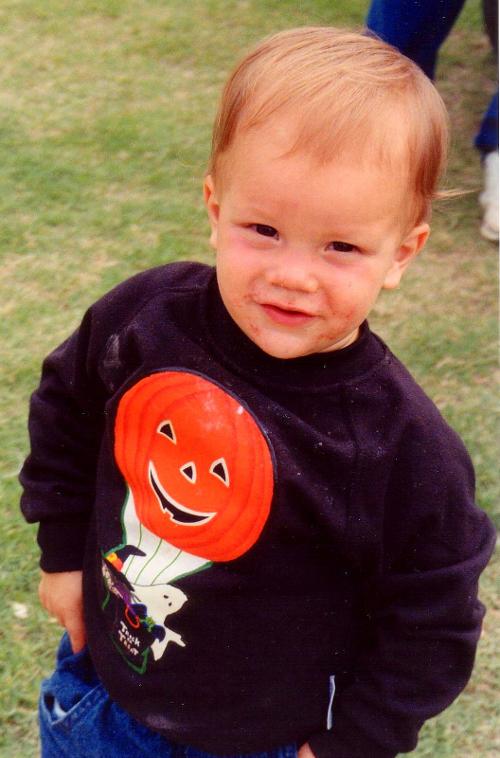
Now, Halloween, French Quarter, New Orleans, Louisiana


 Bill Chance